The funniest play of the year?
Donmar Warehouse
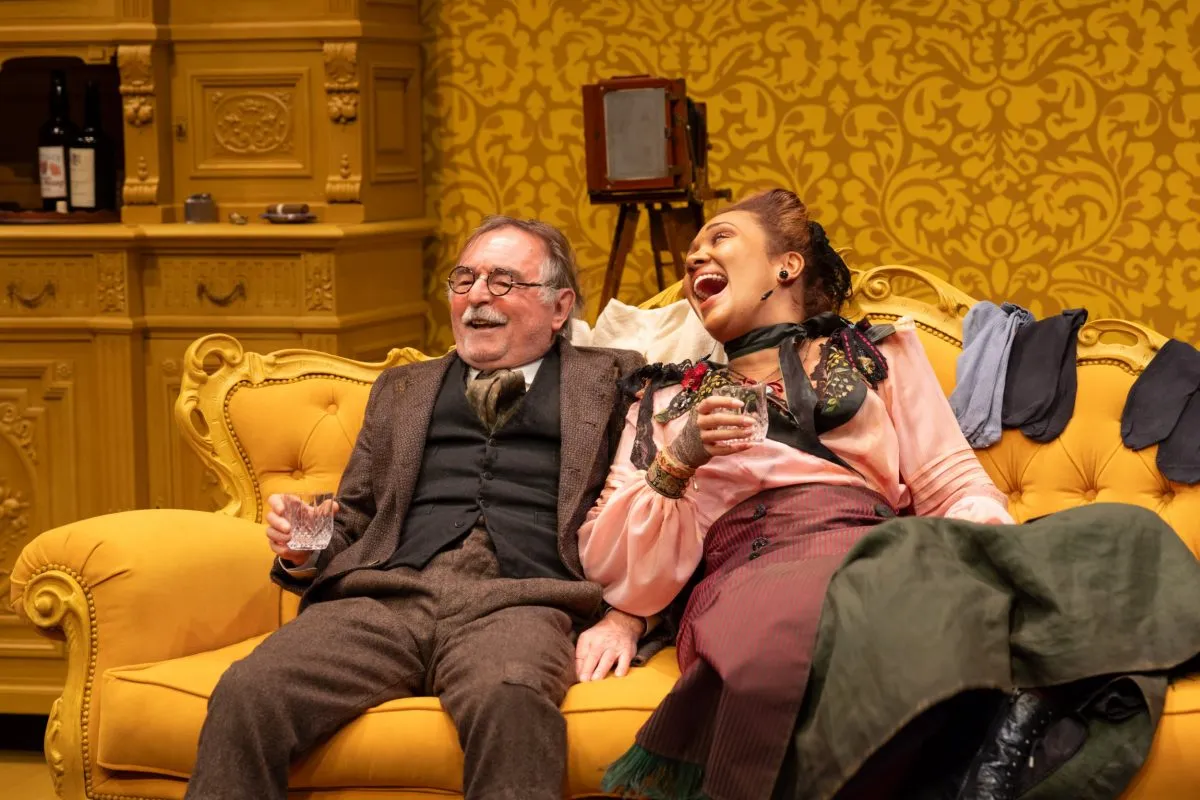
Set in 1908, J B Priestley’s 1938 comedy concerns three Yorkshire couples who find they were never legally married. The critics loved the comic fallout that ensues, praising the direction, the design and the cast.
Links to full reviews are included but a number are behind paywalls and therefore may not be accessible]
5 stars ⭑⭑⭑⭑⭑
Gary Naylor for BroadwayWorld declared: ‘There can be few merrier shows in town this bleak midwinter than The Donmar Warehouse’s super-slick, laugh-a-minute, new production of When We Are Married.’
4 stars ⭑⭑⭑⭑
The i’s Fiona Mountford admitted: ‘I haven’t laughed so much at a play in a long time. What a glorious way to wrap up the theatrical year.’ She loved the play, the production and the cast: ‘Best of all is Sophie Thompson as the timid Annie Parker, a weary wife who gradually finds her voice and speaks her mind to her overbearing stuffed shirt of a spouse, Albert (Marc Wootton). “I know me own mind,” says he, imperiously. “Sometimes I wish you’d keep a bit of it to yourself,” she replies.’
WhatsOnStage‘s Sarah Crompton was full of Christmas cheer: ‘This revival of JB Priestley’s comedy of marital disharmony is a hoot, a joyful reminder of the power of supreme comic acting, and the way that humour can reveal truths with a light touch.’ She commented: ‘Priestley’s point, gently but fiercely made, is that the problem with his three complacent, pompous husbands, dignitaries of the council and the chapel, and their respective wives, is not that they are in themselves laughable, but that their hypocrisy and pretension is. Just as in An Inspector Calls, he smuggles social satire into an apparently straightforward drama.’ and she praised the design: ‘Peter Mckintosh’s mustard yellow set, with its flocked walls and giant aspidistra, is both real and unreal; Anna Fleischle’s beautifully detailed costumes catch the period but also say quite a lot about the men and women wearing them.’
Theo Bosanquet for LondonTheatre reported: ‘Donmar artistic director Tim Sheader’s production keeps things pretty simple, wisely not trying to reclaim the play for modern times but rather aim for some solid festive funnies. And it finds them in abundance thanks to a stellar comedy cast who get just the right balance between farcical OTT-ness and droll understatement.’ He concluded: ‘Ultimately it’s a love letter both to Yorkshire and to the tradition of farce, making it a smart piece of programming for this time of year. Just like a good Christmas cocktail, it’s fizzy, fruity, and eminently moreish.’
Time Out‘s Andrjez Lukowksi pointed out: ‘the basic idea of insufferable rich people lording it over the rest of us and how thrilling it would be to see them get taken down a peg or two remains timeless.’ He continued: ‘it remains funny, fat free and at least mildly insurrectionary. Plus Sheader’s witty, accessible production has a cast to die for: Thompson alone is a woman quite capable of bringing a house down, and her fluting voiced, slightly ethereal Annie is a hoot. But everyone is good fun, from Hodgkinson’s towering, increasingly flustered straight man Joseph to the great Rob Cook’s glorious supporting role as an increasingly smashed local press photographer.’
Dave Fargnoli for The Stage wrote: ‘Sheader sets a cracking pace from the first moments, introducing the characters in an energetic whirl and letting events spiral towards absurdity from there. The focus stays firmly on the zippy banter and comic misunderstandings, and while the inherent drama of characters’ marital turmoil is only ever lightly explored, Priestley’s sharply observational writing gently probes tensions between social classes and the weakening grip of patriarchal power.’
The Standard‘s Nick Curtis found: ‘The pleasure here is in the performances, specifically the relish these excellent actors give to Priestley’s robust, precise, Bradfordian dialogue.’ He stated: ‘It’s a compliment to say that Sheader’s direction is pretty much imperceptible. He seems to just let his fine cast run, without imposing any fussy “vision” on them’.
Calling it ‘an absolute blast’, Clare Allfree wrote in The Telegraph: ‘The real joy, … lies in the performances which to a man (and woman) are pure bliss: Marc Wootton’s Albert Parker, so puffed up with a baleful sense of his own importance you fear he might pop; Cook, who turns the low-hanging fruit role of a booze-sodden photographer into a masterful miniature portrait of hapless humanity. And there’s an excellent turn from Janice Connolly as the gleeful help Mrs Northrop, who sees right through her employers’ pretensions.’
The Times‘ Clive Davis was more begrudging in his praise than his fellow critics: ‘things are tied up a tad too neatly and briskly at the end. But with Siobhan Finneran’s Mrs Helliwell and Sophie Thompson’s Mrs Parker adding subtle touches along the way, it’s an evening of genial entertainment.’ Nevertheless he noted: ‘Tim Sheader’s streamlined revival…putters along very nicely. He gets note-perfect performances from the husbands, Marc Wootton and John Hodgkinson oozing complacency as Councillor Albert Parker and Alderman Joseph Helliwell. Jim Howick is even more amusing as the terminally timid Herbert Soppitt’.
Critics’ average rating 4.1⭑
When We Are Married can be seen at the Donmar Warehouse until 7 February 2026. Buy tickets directly from the theatre
Read Paul Seven Lewis’s 3 star review of When We Are Married here. Watch his ‘Angry Yorkshireman’ review on YouTube here.
If you’ve seen When we Are Married at the Donmar, please leave a review and/or rating below
As the critics say, a superbly directed and brilliantly acted piece, faithful to the play and the period, with no tiresome ‘re-imagining’ to make it ‘relevant’. It is a very funny play with sufficient social commentary to give it extra depth. Its observations on the relations between men and women haven’t dated a minute. A really enjoyable night at the theatre and all credit to the Donmar team for having the confidence to let the playwright speak for himself, rather than be subjected to some tedious directorial interpretation.