Dull Yorkshire comedy rescued by cast
Donmar Warehouse
⭑⭑⭑

Bah ‘eck, I’m puzzled as to why director Tim Sheader chose to revive J B Priestley‘s When We Are Married. In its day, it was a very popular comedy, but that day has passed. Three couples celebrating their silver weddings find they were never legally married. There’s much potential for comedy but little of it is developed. Most of the fun seems to derive from puncturing the pomposity of these people, and having a laugh at their Yorkshire dialect. Fortunately, the cast are exceptional and they can generate laughter from the smallest facial flicker or vocal inflection, despite the mediocre script.
John Hodgkinson plays Joseph Helliwell, a domineering, self-righteous community leader, with relish. As his wife Maria, Siobhan Finneran is a delight: a snob who appears to be permanently sniffing something unpleasant under her nose. Mark Wootton is perfectly cast as a bombastic loudmouth, his beard almost as outsized as his voice. Sophie Thompson, as his submissive wife Annie, steals the acting honours with her exquisitely contemptuous looks and increasing confidence.
The final couple, Clara and Herbert Soppitt, are played by Samantha Spiro and Jim Howick. Herbert is a textbook—by which I mean clichéd—henpecked husband, but the dynamic is handled with real finesse: his repeated attempts to speak, only to be briskly cut off, are timed to perfection. Herbert’s tender moment with Annie is a rare hint that more could made of this marital crisis.
Instead, although all the couples are forced to reassess their relationships and view their partners afresh, the socialist J. B. Priestley concentrates on satirising the two pompous businessmen, while advancing a broader message about the need to value and respect women.
Director Tim Sheader has streamlined the play by cutting and consolidating roles: the maid and housekeeper, for instance, are merged into a single, gloriously disruptive character, played with gleeful, mischievous cackling by veteran performer Janice Connolly. Likewise, a newspaper reporter and photographer are combined, allowing Ron Cook to deliver some superb physical comedy as his increasingly inebriated character stumbles out of control—an act that may evoke fond memories, for those of a certain age, of the great Freddie Frinton.
The remaining supporting roles are all convincingly cast. Tori Allen-Martin brings far more nuance than expected to Lottie, who arrives to claim her newly single lover. Reuben Joseph and Rowan Robinson acquit themselves well in the thankless parts of the rather bland young couple, whose marriage-for-love is held up as a moral counterpoint. Leo Wringer is engaging as the priest tasked with untangling the marital chaos, beginning with calm authority before becoming progressively—and amusingly—exasperated. The reduced cast lends the production focus and momentum, sharpening the pace throughout.
That said, the script itself feels dated, and I’m not convinced it would survive without such a skilled ensemble to carry it over the finishing line. Comic sensibilities have shifted: contemporary audiences tend to favour sharper wit over broad humour and an exploration of transgression over a reliance on funny accents.
Imaginative production
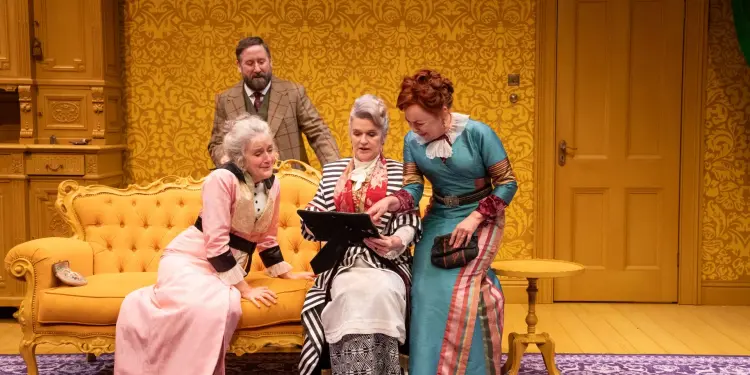
Even so, Sheader’s production is peppered with thoughtful and imaginative touches. I particularly enjoyed the way each half opens with a period song and closes with a contemporary one. The Biggest Aspidistra in the World, written around the time of the play, speaks to pride and status—and is echoed visually by the enormous aspidistra dominating Peter McKintosh’s largely naturalistic set. The first half ends with Beyoncé’s feminist anthem All the Single Ladies, signalling the freedoms now beckoning the women.
The second half opens with the music-hall number A Little of What You Fancy (Does You Good), written at the time the play is set and rich in a sexual innuendo sadly absent from Priestley’s text, hinting at possibilities that ultimately remain both unrealised and largely unaddressed. We depart the theatre to the strains of Bruno Mars’ celebratory Marry You, neatly puncturing the pomposity of the powerful. These musical bookends add a layer of commentary that the script alone mostly lacks.
I also have a fundamental problem with staging a play like this on a thrust stage. Too often, you experience a sense of theatrical FOMO. Sitting in one of the side blocks, I had my view completely obscured by an actor, for what must have been five minutes of Ron Cook’s comic business—quite possibly some of the funniest moments. I’ll never know. I might well have enjoyed the production more from a central seat.
While audience-surrounded staging can heighten intimacy—as demonstrated recently by The Lady from the Sea at the Bridge Theatre—in this instance I can’t help feeling the play would benefit from a traditional proscenium setup, with a single, shared viewpoint. It would certainly make life easier for the actors, who currently have to accommodate multiple sightlines.
Perhaps the production will transfer to a more conventional West End theatre. Judging by the largely enthusiastic reviews, it may well do so. Tim Sheader has an impressive track record from his time at the Open Air Theatre of successfully reviving classics and sending them on to the West End, much to the benefit of the balance sheet. He may repeat that success with this Donmar production. That said, I hope revivals of dated plays remain the exception. There is a place for revisiting a genuine classic but I don’t believe the Donmar is it. I hope Mr Sheader concentrates on the new work and inventive revivals of more recent plays that have characterised his time in charge there, such as Natasha, Pierre & the Great Comet of 1812, The Fear of 13, The Maids, and, one of my favourite plays of 2025, Intimate Apparel.
When We Are Married can be seen at the Donmar Warehouse until 7 February 2026.
Click here to watch this review on the YouTube channel Theatre Reviews With Paul Seven
Click here to read a roundup of other critics’ reviews of When We Are Married