Play within a play tickles both brain and funny bone
Hampstead theatre
⭑⭑⭑⭑
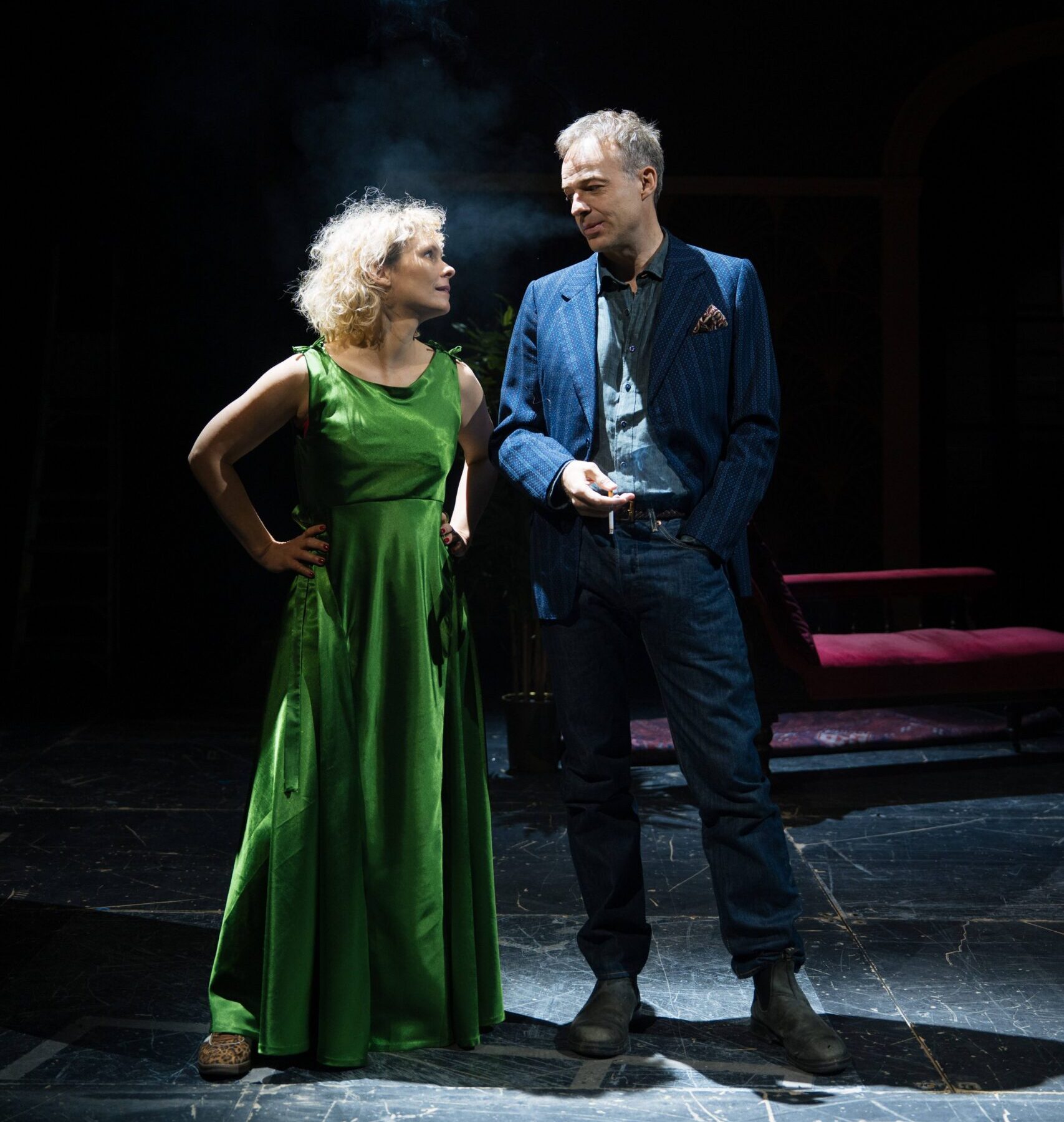
We start with an audition. It takes place under full house lights, so, before we think about hiding in the darkness and immersing ourselves in the play, we’re reminded we’re in a theatre, and the people on stage are all actors. Don’t worry, the lights soon go down. We find out the play is going to involve kissing. What we don’t realise at this point is the blurring of boundaries between actors pretending to kiss and actors pretending to be pretending to kiss. In the first act we watch rehearsals and part of the performance of a revival of an dreadful 1930s musical comedy. Since the stilted dialogue can only be performed in a pompous way, you could say it’s a meal of corn and ham.
The spoof of a Cary Grant/Katharine Hepburn style screwball comedy is amusing and the mishaps of the rehearsals are genuinely funny. There’s a director played by Rolf Saxon who refuses to direct (‘Follow your instincts’ he says), props waiting to be tripped over, songs that burst out from nowhere. Having said that, it’s not in the class of the great behind-the-scenes farce Noises Off. In fact, I was getting a little bored with the theatrical in-jokes. Then it got a lot more interesting.
Stage Kiss is a clever comedy that delves into the nature of art. It turns out the two leads met years earlier and had a torrid affair, which is now reigniting, even as their characters in the play revive their earlier love. It is fascinating that what happens on stage becomes reality off stage, while conversely the actors’ real life affects their performance. The two leads are referred to as She and He, and the director as, well, The Director. Does this make them anonymous lumps of clay that authors and audiences can mould into whatever sculpture we like? Maybe. Certainly, both change as the evening progresses, as does the setting. At first Myanna Buring as She is a ditzy blonde, then she’s a dominating actor. then she’s a broken woman. Patrick Kennedy as He is passionate, then arrogant, then childish.
The author Sarah Ruhl is definitely toying with the confusion between art and life. We are after all watching actors in a play pretending to be pretending to be kissing. At one point I was thinking He went off with She’s daughter in real life until I remembered that happened in the first play within the play.
In the second act, the two actors are living together and get involved in another not terribly good play this time set in the gritty 1970s but with dialogue to match that seems implausible to today’s ears. Once again the cast are convincing at being unconvincing. A more aggressive relationship in the play reflects the lovers’ new real life issues. It’s all very meta theatre.
The kiss is key, because, while the two plays-within-a-play are awful, the kisses between He and She within them appear to be what we might call in the context real. This is made clear when the under-talented understudy, a delightfully goofy performance by James Phoon, tries to kiss She and looks like a python about to devour its victim. She then demonstrates how to kiss, using another cast member played by Jill Winternitz who subtly indicates how genuinely moved she is by the experience. But we can’t forget what is presented as authentic is still well rehearsed acting. To get all the levels to work so well is a considerable achievement by the actors and director Blanche McIntyre.
Just to throw us off balance further, the husband in the first play and the real husband in act two are played by the same actor, a calm, tolerant character on both sides of the curtain, performed to perfection by Oliver Dimsdale. The role The Husband plays in the twist is a reminder from the author that art is manipulation. It can fulfil our fantasies or reflect our more prosaic life.
The set begins as a bare rehearsal room but gradually fills up until designer Robert Innes Hopkins presents us with a believable stage set for a 1930s play, and then a naturalistic apartment with a messy bed, that subsequently becomes another stage set.
This reinforces what Sarah Ruhl seems to be saying: that art and life merge in our own brains. “All the world’s a stage.” We create a story of our lives inside our heads and we bring real emotions to our experience of art. The problem I had with this funny and thoughtful piece of art is that the fate of the three principals didn’t arouse enough emotions in me. Even so, it is a pleasure to have one’s brain tickled as well as one’s funny bone.
Stage Kiss can be seen at Hampstead Theatre until 13 June 2026. Buy tickets directly from the theatre
Paul was given a review ticket by the theatre
Watch this review on the YouTube channel Theatre Reviews With Paul Seven