It’s not Coward’s words, it’s the women that makes this a hit
Menier Chocolate Factory
⭑⭑⭑⭑⭑
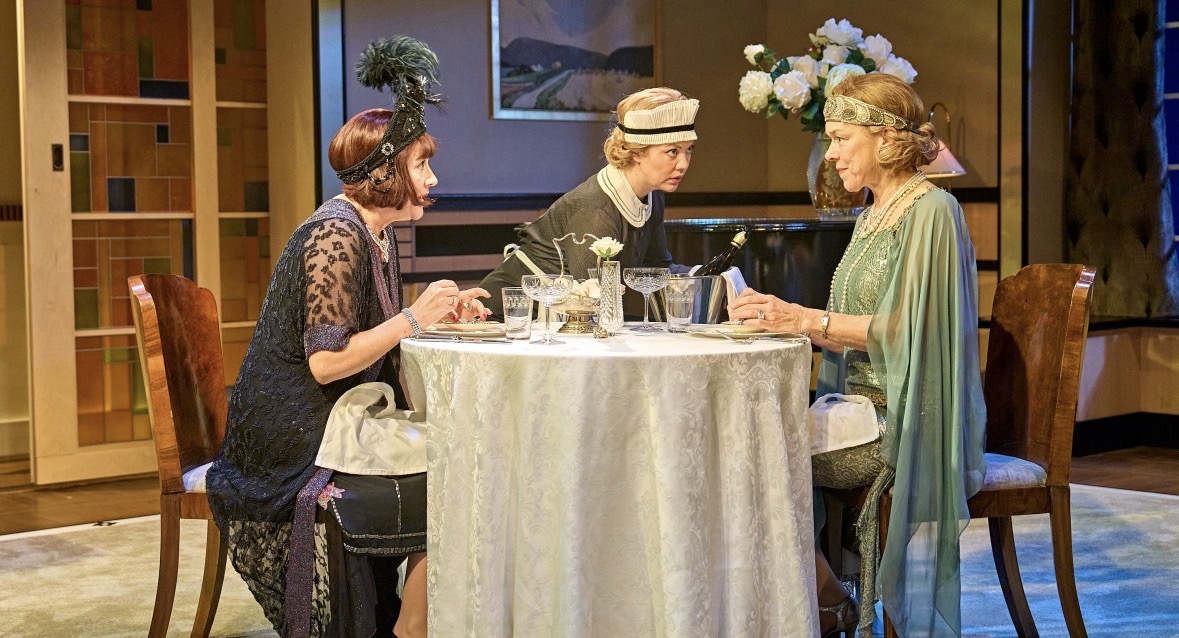
Alexandra Gilbreath, Sarah Twomey & Janie Dee in Fallen Angels. Photo: Manuel Harlan
I’ve been to three shows this year in which women in unsatisfactory marriages assess the alternatives. All were written in the years between the two world wars, all are funny, but the one that made me laugh the most was Fallen Angels by Noel Coward, and, surprisingly, it wasn’t because of The Master’s legendary wit.
J B Priestley’s When We Are Married at The Donmar depicts three couples who discover they are not legally married. The husbands learn a lesson about how they should treat their wives. And that, unfortunately, is about it. An opportunity wasted. Somerset Maugham’s The Constant Wife, given a stylish makeover by Laura Wade and now touring, finds a wife turning the tables on her adulterous husband to considerable comic effect.
All the authors have a way with words. What makes Fallen Angels at the Menier Chocolate Factory the funniest play I’ve seen in a long time is not Coward’s witty aphorisms. They’re there all right, but it’s no Private Lives or Present Laughter. What elevates it to comedy heights is the production itself, directed by Christopher Luscombe with lightness and pace, and the dazzling physical comedy of its three female stars.
First, a brief outline of the plot. Julia and Jane’s husbands, played by Richard Teverson and Christopher Hollis, go off on a golfing weekend, conveniently coinciding with the anticipated return of Maurice, a Frenchman with whom both women had pre-marital relationships. A clue as to what might follow comes when Julia informs her husband Fred that while they may love one another, after ten years of marriage, they are no longer ‘in love’. The play places women’s unfulfilled sexual desire firmly in the spotlight. No wonder it caused a scandal back in 1925, although that wasn’t the only reason, as we’ll see.
Noel Coward’s dialogue is amusing, especially during the women’s giggling memories of their past romances and breathless anticipation of their former lover’s arrival. He gave the hint of how they’re feeling with lines as close to being censored as he could get, as when Jane says, ‘Oh I adore a little sausage with my egg’. Yet, Janie Dee as Julia and Alexandra Gilbreath as Jane, barely need the nudge. You can feel the heat radiating from them.
However, what had the audience rolling in the aisles is the physical humour. In Act One, we meet the new maid, Saunders, played by Sarah Twomey. The notion of a servant more clever than his or her employer is not novel. It’s been around since Ancient Greece and P G Wodehouse’s great creations Jeeves and Wooster would have been familiar to Mr Coward.
In Fallen Angels, she swiftly demonstrates that she can play the piano better than Julia, knows more about golf than Fred, and speaks French better than any of them. Her standout moment comes when she prepares the room for dinner while performing ballet, every gesture from placing flowers to laying a table cloth is choreographed perfectly to the music. Credit here to movement director Nicola Keen– and Noel Coward is nowhere in sight.
A masterpiece of physical comedy
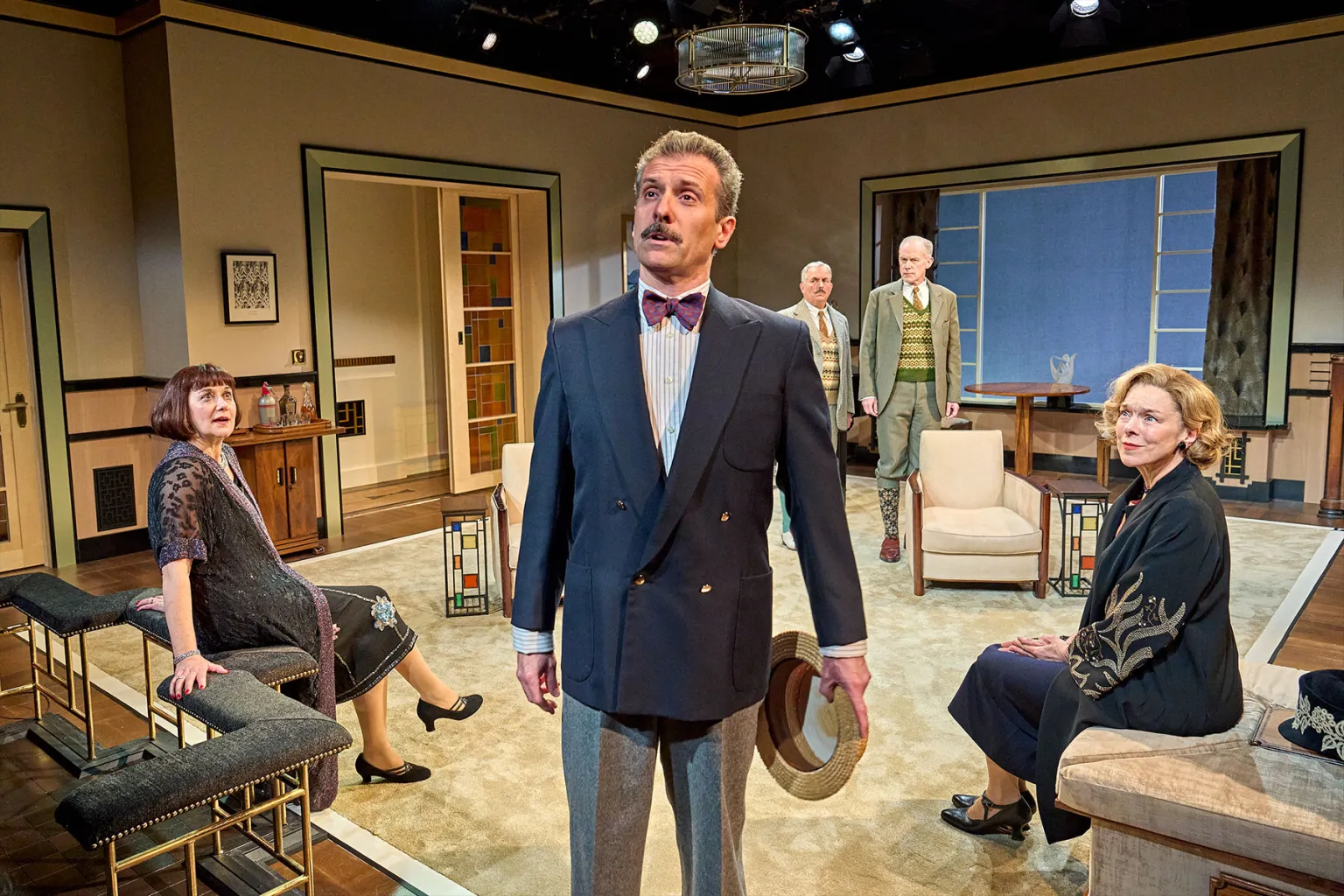
The cast of Fallen Angels at The Menier. Photo: Manuel Harlan
Sarah Twomey would steal the show, except that in Act Two, Julia and Jane, waiting for the arrival of Maurice, consume an entire meal (I lost track of how many courses) and get increasingly inebriated in the process. Women getting drunk was the other reason the play was a cause célèbre. In the hands of Janie Dee and Alexandra Gilbreath, the physical comedy builds with the courses of the meal. They begin pleasantly tipsy on cocktails reminiscing with giddy nostalgia about their time with Maurice. By the end of the act they are blind drunk on champagne, falling over, bickering and nearly coming to blows over their former lover.
Slow reactions, shocked looks, ungainly postures abound. The success lies in the minutiae – for example, there’s a moment when Jane kicks her shoes off in an extravagant gesture, then gingerly places her aching feet on the floor; or when Julia goes to lean on the piano and misses. It’s a masterpiece of comic observation that had the audience in stitches. There are also – thank you, Mr Coward- outlandish insults: ‘I’d like to rush up and down Bond street with one of your tiny heads on a pole’ snarls Jane.
Simon Higlett‘s art deco set beautifully recreates a London flat from the inter war years, and reinforces that this was an era in which elegance ruled, making the women’s behaviour all the more comical (and shocking back then).
After the interval, Act Three is something of an anti-climax. Hangovers seem to afflict characters and audience alike. But the arrival of Maurice, played with suave sophistication by Graham Vick, and the return of the two husbands (slowly realising with shocked looks that their wives might prefer their old flame to them) give us much to enjoy and a satisfyingly neat conclusion.
Fallen Angels can be seen at The Menier Chocolate Factory until 21 February 2026.
To provide the best experiences, we use technologies like cookies to store and/or access device information. Consenting to these technologies will allow us to process data such as browsing behaviour or unique IDs on this site. Not consenting or withdrawing consent, may adversely affect certain features and functions.
Functional
Always active
The technical storage or access is strictly necessary for the legitimate purpose of enabling the use of a specific service explicitly requested by the subscriber or user, or for the sole purpose of carrying out the transmission of a communication over an electronic communications network.
Preferences
The technical storage or access is necessary for the legitimate purpose of storing preferences that are not requested by the subscriber or user.
Statistics
The technical storage or access that is used exclusively for statistical purposes.The technical storage or access that is used exclusively for anonymous statistical purposes. Without a subpoena, voluntary compliance on the part of your Internet Service Provider, or additional records from a third party, information stored or retrieved for this purpose alone cannot usually be used to identify you.
Marketing
The technical storage or access is required to create user profiles to send advertising, or to track the user on a website or across several websites for similar marketing purposes.