Does this classic play work in the age of #MeToo?
Lyttelton at the National Theatre
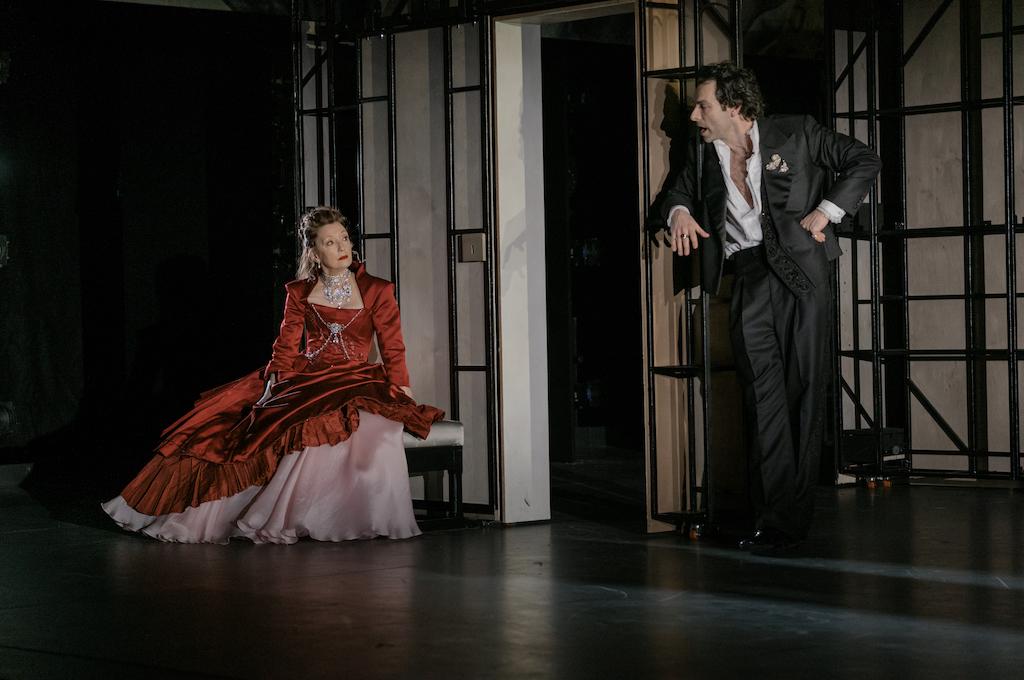
Christopher Hampton wrote his play Les Liaisons Dangereuses, based on a scandalous 1782 novel, back in 1985 when it came across has a rebuke to Thatcherism. He adapted it into a film in 1988 which starred Glenn Close and John Malkovich. Quite a few critics didn’t feel comfortable with the play and the production, despite both author Christopher Hampton and director Marianne Elliott trying to make it acceptable to a modern audience more sensitive to men’s behaviour towards women, than when it was written.
The reviews were full of praise for Lesley Manville as Marquise de Merteuil and, to a slightly lesser extent, Aidan Turner (surprising to find at least three misspellings of his name among the reviews) as the Vicomte de Valmont, who play a nasty game in which the female victims are seduced and humiliated.
[Links to full reviews are included but a number are behind paywalls and therefore may not be accessible]
4 stars ⭑⭑⭑⭑
LondonTheatre‘s Marianka Swain liked the actors, describing Lesley Manville as ‘magnificent’ and Aidan Turner as ‘a comic force … (he) also has a good line in wolfish lust, though stops short of convincing as a truly sociopathic predator, and is deeply affecting in the story’s latter stages as Valmont succumbs to heartbreak and despair’. She also liked the play: ‘Hampton’s tweaked script gives the women slightly more agency, while maintaining the queasiness of the exploitation and continuing cycle of abuse. Valmont and Merteuil operating as a coercive double act brings to mind vile contemporary examples like Jeffrey Epstein and Ghislaine Maxwell. Beneath the play’s Wildean bon mots, champagne and glamour, there lurks a dark heart and all-consuming destructive devastation.’
The Standard’s Nick Curtis was disappointed in both the play and the production: ‘In this precise, stately, sometimes ponderous revival by Marianne Elliott, the script is more self-consciously aphoristic than I remember. Many of the lines sound like they’re designed to be quoted rather than just spoken.‘ Fortunately he loved the acting: ‘As the Marquise de Merteuil, a widow who breaks hearts and ruins reputations for her own wicked pleasure in 1780s French society, the implacable, raptor-ish Manville absolutely owns this show. She has strong support from an amusedly saturnine Aidan Turner’.
Aliya Al-Hassan at BroadwayWorld commented on the stars: ‘Manville is magnificent and really gets her teeth into the woman who is both cruel and highly manipulative, but also keenly senses her own fading youth and allure…Aidan Turner…treads a fine line between a flirtatious lothario and a darkly sinister rake as Valmont. Keeping his own Irish accent seems to add to his charm and persuasiveness, which is slightly problematic, as it lessens the character’s biting cruelty. However, the chemistry between him and Manville crackles with authenticity; both palpable and powerful, treading that ever-fine line between love and hate.’
Unlike some reviewers, WhatsOnStage‘s Sarah Crompton felt ‘Marianne Elliott’s production subtly reconfigures Christopher Hampton’s Les Liaisons Dangereuses for the MeToo generation. In a world where love is a battle of single combat, a hand-to-hand struggle for survival, women are constantly melding themselves to the shapes and behaviour demanded by the men, who still hold all the cards’. She continued: ‘There’s no doubt that its themes have become more troubling as time has gone on. But Manville and Turner are simply superb, their performances deep and thoughtful. They make the characters fallibly human, and Elliott makes the evening sing.’
The Independent’s Alice Saville declared: ‘the greatest strength of Hampton’s reworking is also the biggest triumph of this production: the icy brilliance of Merteuil, powered by Manville’s wonderful performance. It’s terrifying to watch her scrutinise her corseted, black-lace clad body in the mirror, assessing her sexual effect like an engineer checking over an instrument of war. And it’s impossible not to root for her, especially when her campaign of destruction claims her as its final victim.’
3 stars ⭑⭑⭑
The Guardian‘s Arifa Akbar compared Aidan Turner with John Malkovich who played the part in the movie: ‘Turner as Valmont is an Irish-accented serial seducer, louche and playful rather than truly dangerous: an affable rake who does not summon Malkovich’s snake-like menace. His seduction scenes do gather in power, though’. She noted that when he is forced by the Marquise to give up someone he loves, ‘he finally drops his playfulness and becomes truly tragic.’
The Times’ Clive Davis was critical: ‘What’s often missing, though, is the sense of abject cruelty that ought to lie at the heart of this story of cold-blooded seduction.’ In particular, he felt Aidan Turner was too comical: ‘By the very end, the marquise and Valmont both face retribution for their sins. Her anguish is palpable. Do we care as much about Valmont? No. The dandy has outstayed his welcome.’
The Stage‘s Sam Marlowe liked the stars: ‘Manville is formidable. Turner’s Valmont is hardly less lethal, relentlessly performative, ruthlessly switching from romantic lovesick swain to boyish to bully as tactics demand. But it simply doesn’t feel as if there’s enough at stake here.’ She explained: ‘This revival by Marianne Elliott…lacks bite and atmosphere, the intricate symmetrical plotting of its torments, temptations and scandals less shocking than mechanical.’ She concluded: ‘Elliott’s production never really makes a convincing case for the play’s importance in the here and now. As a drama, it emerges as elegant and divertingly nasty; it needs to matter more.’
Claire Allfree in The Telegraph asked: ‘How to stage Christopher Hampton’s glittering adaptation of Les Liaisons Dangereuses about the nihilistic sex wars of the French fin de siecle aristocracy in the post Me Too era?’ She wasn’t satsified that Marianne Elliott had the answer: ‘Elliot’s insistence on turning the play into a spectacle of irredeemable decay doesn’t always reap dividends. Those allergic to the use of interpretative ballet (several scenes are choreographed, as though every character is trapped in a dance they can’t stop) won’t find their prejudices allayed. Hampton’s play demands a lightness of touch, not the whiff of heavy melodrama. I admired this production but I can’t say I enjoyed it.’
While praising the cast, Time Out‘s Andrzej Lukowski had serious reservations about the play: ‘Hampton’s play has endured in large part because it’s titillating – a rare quality in theatre – and some of it now feels wildly out of step with the times. I think if you were to adapt De Laclos today, you’d interrogate the treatment of women rather more probingly. What can I say: it’s a really good production with two sensational leads, of a play that has long stopped being a sexy novelty and now kind of sits as a guilty pleasure. I don’t want to preach, I just question whether Les Liaisons really has enough going for it to justify this sort of lavish revival at our flagship theatre.’
at The Arts Desk got to the heart of the problem with reviving this work: ‘The amorality at play is positively delicious, not least when the culprits feast on each other. But how does that appeal work, as entertainment, at a time when real-life morality is under more constant, and more rigid scrutiny? Will Christopher Hampton’s celebrated stage adaptation become darker, more powerful, or simply leave a bad taste? … it’s led to a bit of a muddle, a determined dressing up of the play that has simply diluted its drama – a liaison lite, if you will.’
2 stars ★★
The Sunday Times’ Dominic Maxwell rated the chemistry between the two stars: ‘Well, I won’t quite say they look as if they only just met at a break-the-ice brunch for the company earlier that day. Yet the mutual heat is strictly gas mark 3.‘ He ended his review: ‘ it should all be so much funnier, sexier, nastier and zippier than this.’
Critics’ average rating 3.5⭑
Value rating 38 (Value rating combines critics’ average rating with typical ticket price)
Les Liaisons Dangereuses can be seen at the National Theatre until 6 June 2026. Buy tickets directly from the theatre
If you’ve seen Les Liaisons Dangereuses at the National Theatre, please leave a review and/or rating below
*Malkovich — spelling errors are contagious
Thanks. I’ve corrected the typo in my comment on the Guardian review (I did get the spelling right in my intro). I had a feeling I shouldn’t bring attention to other people’s mistakes. Pride comes before a fall.
I thoroughly enjoyed a play that I am very familiar with. I thought the cast were excellent particularly Manville, Turner and Barbaro. The set and costumes were exquisite as well as the score and I even think the dances worked. Well worth a see.
Thoroughly enjoyed this yesterday; as everyone has said Lesley Manville was superb. Aidan Turner was the best I have seen him since Poldark! Miss Barbaro was also superb; no hint of her being American. Always revel in the National productions.
Very profound acting, but a plot with ideas and intentions which are definately not Carry on or Brian Rix farce chase round the bedroom but are assault and forced attentions. I did understand what the director was trying to do but I didnt find the evening enjoyable.