Sadie Sink and Noah Jupe bring passion to Robert Icke’s Sliding Doors Shakespeare
Harold Pinter Theatre
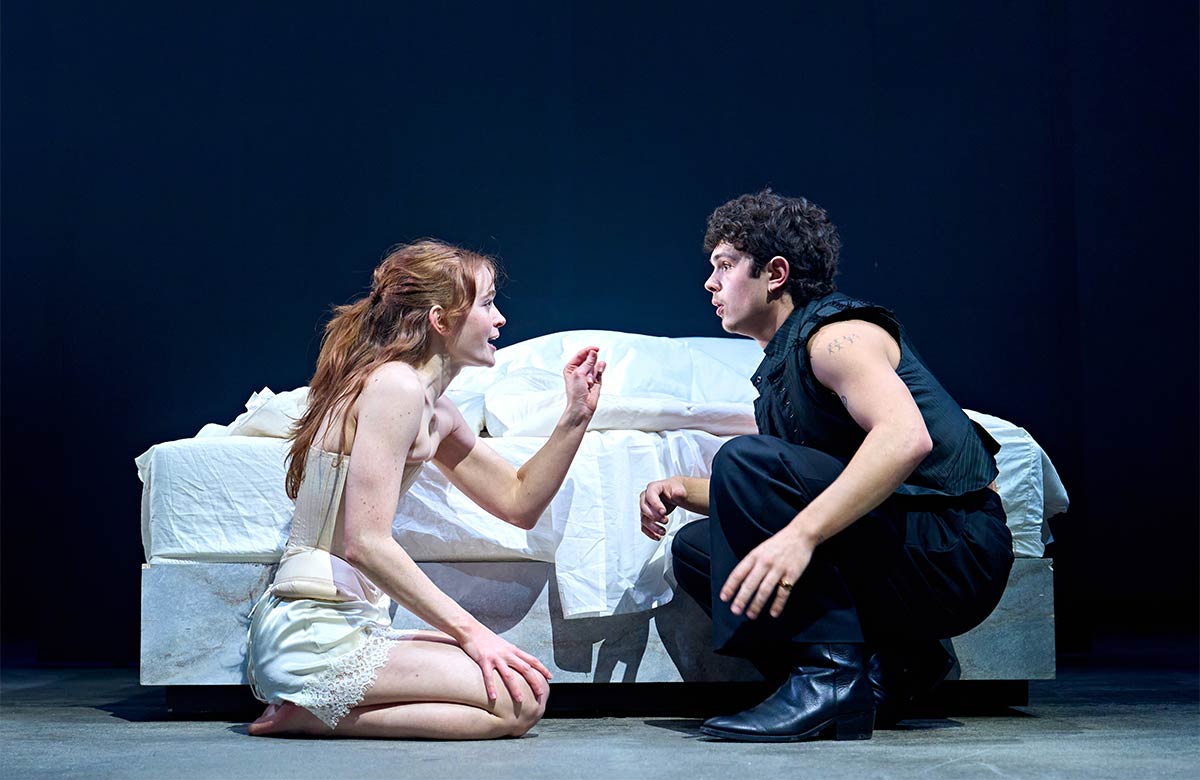
Romeo & Juliet is a play in which the lovers race to their tragic end . Radical director Robert Icke has fixed on time and timing being crucial to story and tells it in what a number of critics referred to as a Sliding Doors style, showing what might have happened to the lovers alongside what did. Mostly the critics liked this, although some thought it didn’t always work and some found it over-the-top. The reviews all praised Sadie Sink (famous for Stranger Things) and Noah Jupe (last seen in Hamnet).
5 stars ⭑⭑⭑⭑⭑
Brooke Ivy Johnson for The Metro noted: ‘to watch the audience — many of whom might more readily identify as fans of Stranger Things than of Shakespeare — sit rapt, laughing, weeping, blushing, and generally utterly absorbed, is to understand exactly what this show achieves. This Romeo and Juliet captures something essential about the play’s emotional core: that its tragedy lies not only in its ending, but in the beautiful, reckless, funny intensity of youth that drives it there.’ She explained: ‘what is most striking about his Romeo and Juliet is its emotional accessibility. This is a production that understands that the tragedy only works if you believe, wholeheartedly, in the reckless sincerity of young love’.
4 stars ⭑⭑⭑⭑
‘It’s a richly rewarding evening’ declared Claire Allfree in the Telegraph. She said the production ‘has a near metaphysical preoccupation with the vagaries of time that lends this most callow of stories a rare gravitas.’
The Standard‘s Nick Curtis weighed straight in with his assessment of the stars and the production: ‘Sadie Sink…is a magnificent Juliet in Robert Icke’s powerful revival of Shakespeare’s tragedy, physically delicate but with a steely passion. She is matched by Noah Jupe, the young British screen talent making an assured stage debut as an impetuous, boyish Romeo. Rarely has the brutal speed of the play’s events, and its juxtaposition of sudden violence and bombshell love, seemed as clear as it does in Icke’s staging.’
WhatsOnStage‘s Sarah Crompton explained: ‘Noticing that the play is built on coincidence and is full of “what if”s that could have turned tragedy into comedy, Icke creates a sequence of sliding door moments, marked by blinding flashes of light, that actually show an alternate version of the play.’ She commented: ‘Sink is at her best when she’s at her stillest and most earnest, gazing into her lover’s eyes with feverish excitement and determination; Jupe has moments when his boyish exuberance is tempered by a growing wonder. But the chemistry between them seems to dissipate as the mood grows darker.’ She also picked out other members of the cast: ‘Clare Perkins is magnificent as the Nurse, bustling and full of self-importance, but also of wisdom and warmth.’
The Stage‘s Sam Marlowe described how ‘With Sadie Sink and Noah Jupe as the impassioned teenage couple gleaming with youthful potential and poignantly vulnerable, it’s moving to imagine how their story might have ended under different circumstances. Icke’s concept agonisingly points up how precarious their fate is – how cruelly close they come to contentment, together or apart. A sharp new spin on the familiar tale, it’s a reminder of what a lottery life and love are for us all.’
Cindy Marcolina at BroadwayWorld noted: ‘This is an investigation of fate, and definitely not your traditional Romeo and Juliet. Though he punctuates the mise en scène with huge digital clocks that tick relentlessly towards the lovers’ demise, Icke feverishly tries to rewrite the narrative. Just as the story starts diverging from its natural path, blinding flashes à la Men in Black “Neuralyzer” rewind the scenes, bringing it back to its fatal route. It’s clever and original, making this an utterly thrilling vision.’ Of the lovers, she said: ‘Sink and Jupe are simply tremendous. The Broadway veteran conquers her first Shakespeare with sophistication, introducing a Juliet who’s far from being a wilting flower. She’s in charge, bubbly, and headstrong; she knows what she wants and she knows how to get it.’
At LondonTheatre, Olivia Rook described Sadie Sink: ‘(She) is luminous as Juliet, capturing the headiness of first love, as well as its ability to make you impulsive and awkward. Sink finds the humour in the balcony scene, navigating the new relationship with fluttering, hesitant speech and interrupting Romeo as he makes grand proclamations. She also knows how to plumb the depths of despair, appearing half mad as the Friar’s potion slips down her throat.’
The Independent‘s Alice Saville concluded: ‘This is a richly emotional, brilliantly intelligent take on a classic – one that’ll plunge a knife into your heart so skilfully that you hardly notice the pain.’
Referring to what he called the Sliding Doors moments, Time Out‘s Andrzej Lukowski noted: ‘you can easily imagine a world where things worked out better for them, and in acknowledging this Icke elevates the plot’s sillier moments. However,…he overplays his hand in a final scene that teeters on the mawkish. It would have made for a more elegant production if he’d left it be, but auteurs are gonna auteur.’ He jokingly ended: ‘But much as I am a fan, I can’t help but think there’s a parallel universe out there where he didn’t try the Sliding Doors thing (or reined it in a bit) and that that led to an all-timer Romeo & Juliet. In our branch of the multiverse, we’ll have to settle for one that’s merely very good.’
CityAM‘s Adam Bloodworth said Icke ‘delivers a technically cool, youthfully exuberant production that comes with a shocking twist.’ He went on: ‘It’s solid stuff, but everything pales by comparison to the finale, which dares to rethink everything you know. Who on earth would rethink the finale of Romeo and Juliet? Robert Icke, a man who has a good enough grasp of subtlety to know when to come out all guns blazing. It’s a risk, and blimey, every hair on both of my arms stood up.’
The Financial Times’ Sarah Hemming said:’ It’s a production charged with adolescent passion and buzzing with fresh insights. Icke overplays his hand on occasion, but he brings a raging, compassionate eye to this awful tale of wasted life.’
Matt Wolf at The Arts Desk said, as if anticipating the review in The Times: ‘Some may reisist the apparent tricksiness of devices that include repetitions or reprises of scenes, as often as not accompanied by searing flashes of light separating out what might have happened (if, say, Friar Laurence’s letter had not gone AWOL) as opposed to what in fact does. But … Icke makes clear that time waits for no one. Small wonder that Juliet famously exhorts nightfall to “gallop apace” so that she can be with Romeo once again: this is a play whose title characters are undone by a velocity of feeling they can’t control’.
3 stars ⭑⭑⭑
The Times’ Clive Davis warned: ‘assured though she is, Sink can’t quite redeem a production which is overrun with distracting tics, from that ever-bleeping clock to painful explosions of light that burn their way into your retina. Slab-like sliding doors on Hildegard Bechtler’s austere set trundle back and forth, hinting at paths and decisions left untaken.’ He got through it but: ‘By the end, you find yourself hoping that Sink will try her hand at more Shakespeare, only with a different director.’
The Guardian‘s Arifa Akbar declared`: ‘What makes the production effective, ultimately, in spite of the overbearing directorial stamp, are the two central performances. Sink makes for an intense teenager, quirkily neurotic, who brings comedy to the balcony scene. She is so strong a presence that Juliet at times seems the play’s central protagonist. Jupe’s Romeo is dramatically mopey in his unrequited love for Rosaline at the start, and earnest in his passion for Juliet. They have a sweet, pure chemistry that encapsulates the urgent and uncompromising nature of first love, so absolute in its adolescent ardour that it is worth dying for. Both speak the verse without straining for effect, too.’
Critics’ average rating 3.9⭑
Value Rating 40 (Value Rating is a combination of the Average star rating and the typical ticket price)
Romeo & Juliet can be seen at the Harold Pinter Theatre until 20 June 2026. Buy tickets directly from the theatre
If you’ve seen this production of Romeo & Juliet, please leave a review and/or rating below