Vivid play about reaching adulthood
Royal Court theatre
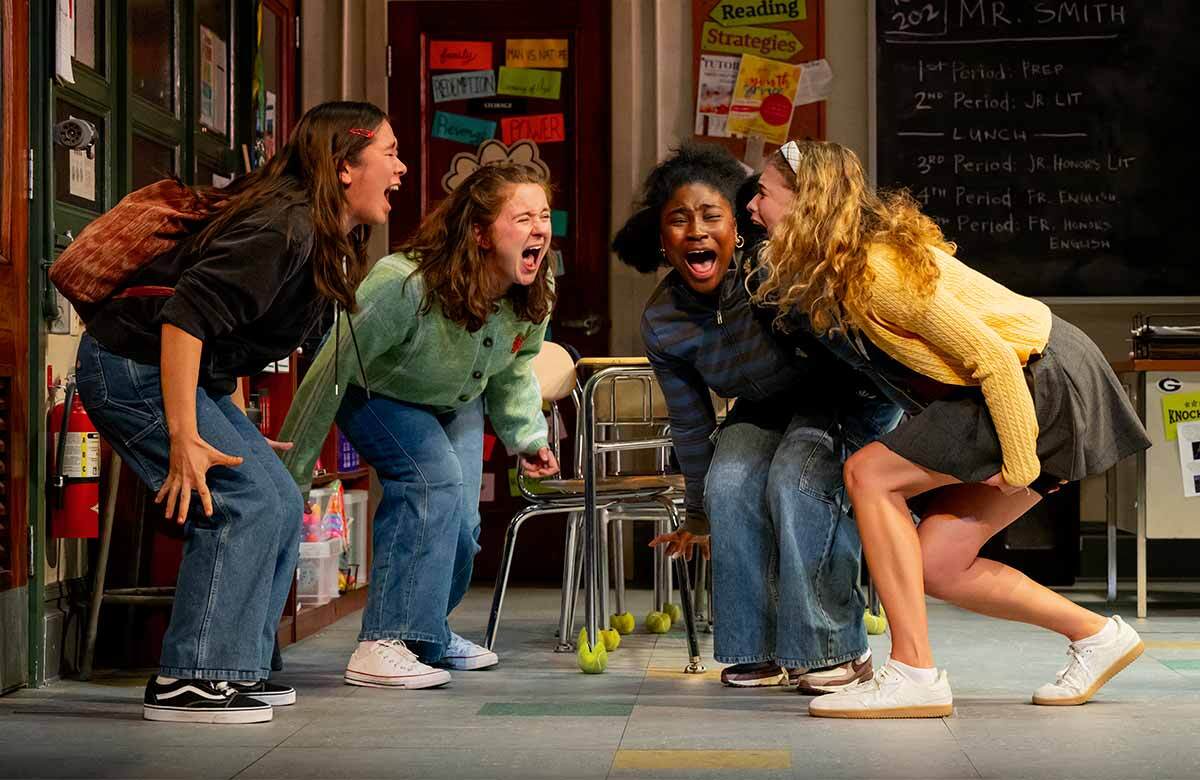
Kimberly Belflower’s 2022 play John Proctor is the Villain was a sensation on Broadway and looks like being one over here. The same production directed by Danya Taymor, but with a British cast, has arrived at the Royal Court theatre to an exceptional three 5 star reviews and four 4 stars. This gives it the second highest average rating for Limited Run Shows, at the time of writing. The critics liked the portrait of teenage schoolgirls in a strict religious community discovering adulthood at the same time as the #MeToo movement broke. Some loved it (‘joyous, blazingly intelligent’ FT) while others liked it but found it too obvious. They all praised the young women in the cast.
[Links to full reviews are included but a number are behind paywalls and therefore may not be accessible]
5 stars ⭑⭑⭑⭑⭑
Sarah Hemming wrote a detailed, insightful review in The Financial Times (such a shame her reviews are hidden behind a very expensive paywall). She declared: ‘what a joyous, blazingly intelligent play this is: at once a restless interrogation of the role of art in defining and expressing who we are; a compassionate, funny portrayal of what it means to be a teenage girl; and a furious appraisal of the way power games repeat across generations. It’s staged with irrepressible energy by Danya Taymor and her terrific young cast.’
‘What really makes the play is its vivid and touching depiction of young women trying to navigate their way to adulthood against this roiling backdrop. They’re played with great affection and aching authenticity here.’
Marianka Swain at LondonTheatre declared: ‘if there is any justice, it will soon bring its whip-smart, potent, gloriously funny and remarkably affecting drama to the West End.’ She remarked: ‘Belflower beautifully captures the way that adolescent girls (and especially those in a small, insular, religious community) are simultaneously knowing and innocent, playing out fantasies of adulthood but still, heartbreakingly, just children.’ She ended: ‘It all culminates in the most extraordinary, heart-pounding, viscerally cathartic climax I’ve ever experienced, brilliantly utilising Lorde’s song “Green Light” along with an interpretive dance that moves from kooky to joyful to a full-on rebellion. This play likewise makes me want to scream, laugh, cry, and dance. It’s not just a drama: it’s a revolution.’
Cindy Marcolina at BroadwayWorld couldn’t fault it: ‘Belflower’s work is perfectly plugged into the rippling effects that cause societal disruption. The script is as emotionally intelligent as it is fun and casual, but it also reveals a proclivity for fostering debate. She questions the nature of authority, debating the need for it and addressing the abuse of power. Her characters are smart, provocative, proactive, and unapologetically proud of who they are. Most of anything, they feel real.’ She concluded with a call to action: ‘The production is relatable, accessible, poignant, and bursting with ideas. Beg, borrow, steal, but get yourself into this utterly galvanising room!’
4 stars ⭑⭑⭑⭑
An underlying anger pulses through Alice Saville’s review in The Independent: ‘if you want to really understand the millions of small, hidden dramas that erupted in the wake of #MeToo, plays like this one are the way to do it. And its frenzied, Lorde-fuelled dancefloor climax is the perfect outlet for anyone who feels a bit crazy thinking about everything we’ve forgotten, as the world’s brief mass feminist awakening is replaced by deadening silence.’
Claire Allfree at the Telegraph praised ‘a gifted young British cast’, noting ‘Miya James is both unshowy and mesmeric as Raelynn; Saltburn’s Sadie Soverall is horribly compelling as the wild and glowering Shelby.’ She admitted: ‘There are quibbles. Modern readings of The Crucible already cast doubt on Proctor’s behaviour; he’s no longer quite the fully paid-up canonical hero Belflower needs him to be. The play feels a little thin, too. It relies on an emotional charge rather than a thorny argument… But it nails absolutely the timeless fury of female adolescence.’
The Standard’s Nick Curtis described it as ‘a terrific piece of provocative entertainment.’ He wrote: ‘Though the play is mechanical in the way it works through #MeToo issues, with some scenes straining credibility, Belflower is acute on the way women and girls are manipulated and gaslit. And on victim-blaming and the excuses people make for predators.’
Time Out‘s Andrzej Lukowski explained: ‘what Belflower does do brilliantly is nail the intersection between the relatively brief apex of the #MeToo movement and a generation of smart, naive school girls who would have been the right age to absorb its rhetoric at the precise moment they’re discovering what it was a reaction to’. He reported: ‘Danya Taymor’s production…is an absolute blast, the many serious issues raised all of a piece with its breathless ebullience and Belflower’s endlessly witty text. As much as anything else, it’s a wholehearted celebration of teen girl dorkiness and a rebuttal to the idea their lives should be viewed through a sexual lens, even in sympathy.’
3 stars ⭑⭑⭑
The Stage‘s Sam Marlowe said the play was ‘at pains to spell out its themes and subtext, sometimes to a declamatory, over-explicit fault. But, in a tenderly handled production by Danya Taymor, it has a huge, pulsing heart and captures something of the thrilling, almost unbearable intensity of adolescent girlhood, building to a wildly emotional conclusion of mingled defiance, joy, rage and hope.’ She concluded: ‘Belflower’s play is, in many ways, one familiar story wrapped in another; but it’s done with wit and leaves us, with its final, glorious act of rebellion, on a high of irrepressible optimism.’
The Times’ Clive Davis questioned whether the play is the ‘modern classic’ some claim; ‘There’s certainly plenty to savour in Danya Taymor’s high-energy production, recast for London audiences, which burrows deep inside the overheated psyches of teenagers. At its sharpest, the dialogue generates waves of laughter too.’ Unlike some other reviewers, he found the ending a letdown: ‘Belflower can’t quite resist forcing home her message in the closing scenes. Ambiguity goes out of the window’.
The Guardian’s Arifa Akbar called it ‘a moving play… (that) catches the mood of 2018 for a bewildered generation of girls growing into womanhood in the shadow of Weinstein.’ She liked the way: ‘Belflower’s dialogue captures the way girls talk to each other with humour and pathos, as well as how they internalise the world’s micro-aggressions towards women.’ But she had reservations, one of which was: ‘the relationships here are flattened by their cuteness, rather than sharp-edged and gritty, as this cusp of girlhood and adulthood so often tends to be.’
Critics’ average rating 4.0⭑
John Proctor Is The Villain can be seen at the Royal Court Theatre until 25 April 2026. Buy tickets directly from the theatre. Transferring to Wyndham’s Theatre from 2 February until 24 April 2027.
Read Paul’s review of John Proctor is the Villain here
If you’ve seen John Proctor Is The Villain at the Royal Court Theatre, please leave a review and/or rating below