Mel Brook’s musical is almost as offensive as ever (Thank goodness)
Garrick Theatre
⭑⭑⭑⭑⭑
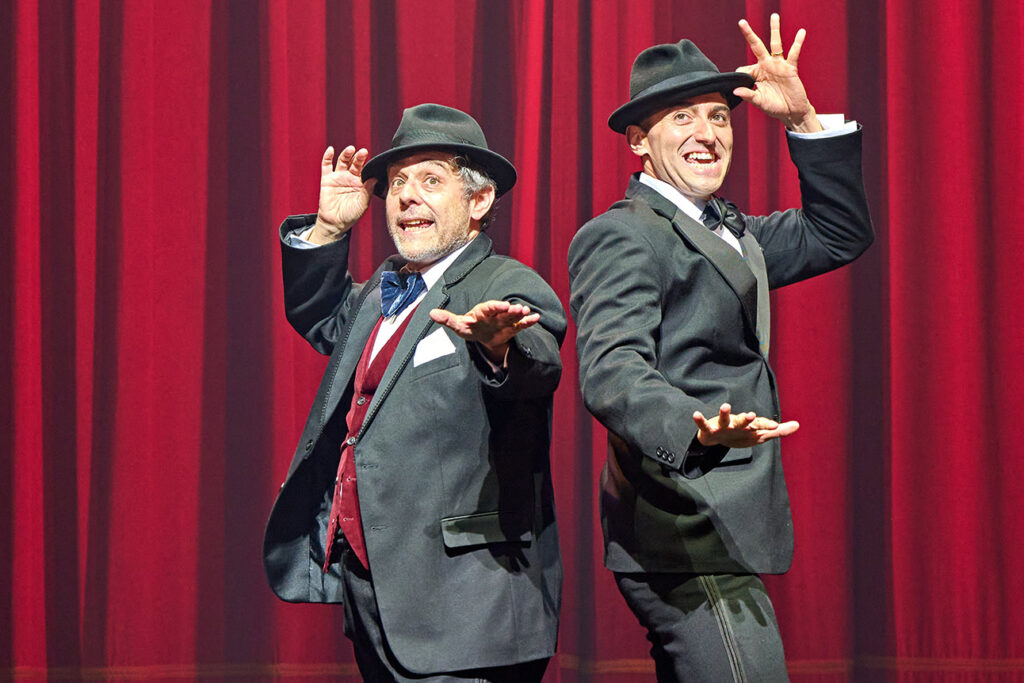
The Producers was and still is one of the great musical comedies, so why was I slightly disappointed in the current West End production? Not so let down by it that I didn’t find it laugh-out-loud funny nor so dissatsified that I wouldn’t recommend it, but left with the feeling that it is unwise to mess with perfection.
This production is the first one in London that Mel Brooks has allowed that doesn’t have to stick to Susan Stroman‘s original Broadway direction. It was probably necessary to have that agreement simply to be able to present it in the tiny space of The Menier Chocolate Factory, where it was created pre-transfer.
The spectacle may be reduced but there is still enough going on to dazzle the audience and fill the Garrick stage. As well being effective in puncturing the vainglory of fascism, The Producers is (like Spamalot!) an affectionate send-up of Broadway musicals. No matter how much fun there is along the way, the success of the show is founded on it being a great musical itself. Director Patrick Marber shows he is aware of this: the clever songs, the slapstick and the dancing are done to perfection.
You wallow in the glory of the big build of Springtime for Hitler number with its goosestepping troopers in Busby Berkeley style formation, King of Broadway, where Max (played by Andy Nyman) lamenting his failure becomes a pastiche of Fiddler On The Roof, the hilarious zimmer frame number danced by the old ladies who give Max cheques in exchange for sex, and I Wanna Be A Producer sung by Leo played by Marc Antolin, who brilliantly develops his character from a nervous accountant to confident impresario. Mr Marber, directing his first musical, has been well served by choreographer Lorin Latarro and set designer Scott Pask.
However a slight reduction in scale isn’t the only change. There is a noticeable shift from the 2001 production that may, or may not, be designed to accommodate changing sensitivities. That may seem an odd thing to say about a show that is renowned for shocking audiences with its offensiveness, ever since the film was released in 1967. It was written to shock liberal audiences with its swastikas, campness, and more.
That’s all still there. If anything, it’s even more camp, and the Nazis even more shocking. The scene where the producers recruit director (and transvestite) Roger de Bris now contains a living statue with an enormous penis (which Roger slaps), and a Jesus in a nappy that could have stepped straight out of Jerry Springer The Musical. Trevor Ashley as Roger and Raj Ghatak as Carmen Ghia are on a Liberace level of campness that still somehow remains rooted in real characters.
The idea of camp as synonymous with being gay dates from a time when it was necessary to negate and subvert homophobia. On the other hand, while there is no longer a stereotype gay person, unapologetically camp celebrities like Alan Carr and Julian Clary remain popular gay icons. In the case of The Producers, you’ll remember that when the two producers Max and Leo plan to create a musical flop, they decide to put on a show celebrating Hitler, written by a Nazi pigeon fancier played by Harry Morrison, who is all the more funny for being serious. Their mistake is to make everything as camp as possible (Keep It Gay), which, in mocking Hitler and the Nazis, transforms their musical Springtime For Hitler into a hit.
Not offensive enough?
So the campness is essential, but something has changed. To understand what, you only have to look at Umma’s scene. This is where a woman auditions before Max and Leo. Inevitably she is Swedish, partly because in the world of Mel Brooks stereotypes, Sweden is synonymous with sexual liberation, and also because in that same world, accents are always funny. She sings When You’ve Got It Flaunt It. Only, in this production, she doesn’t. Flaunt it, I mean. In the original production, she showed a great deal of cleavage, fulfilling Max’s request for ‘big tits’, which she thrusts under their noses, and her legs couldn’t have got further apart when she danced around the stage.
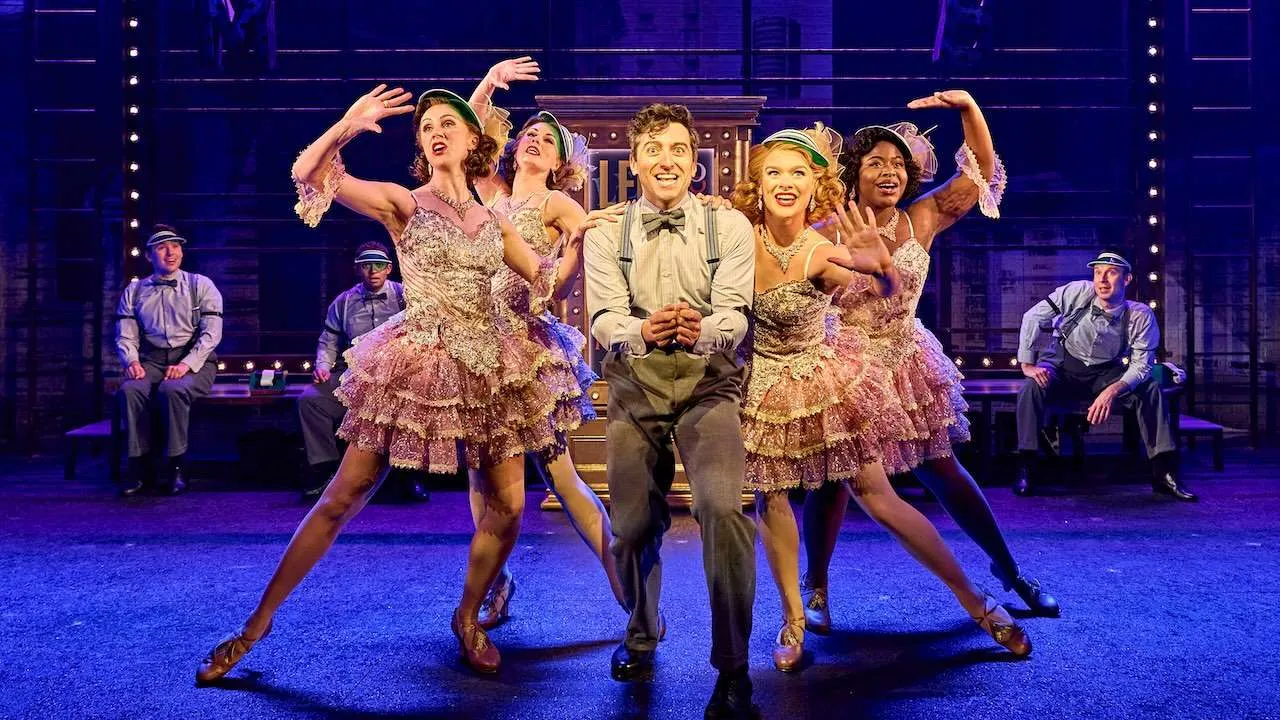
In this version of Umma, as portrayed by Joanna Woodward, she has a wonderful voice and is undoubtedly beautiful, but she dresses and dances demurely. It is hard to believe her audition would generate the famous punchline from Max: ‘We may be sitting but I can assure you we are giving you a standing ovation.’
So, despite the book (script) remaining untouched, the really noticeable change in the treatment of it is in the sexism. Patrick Marber was quoted in an interview as saying: ‘Things have changed a lot… and it is quite old fashioned in some of its attitudes. We’ve tried to do what we can with that.’ It seems that the attitudes to women have been the focus of his concern.
All the women who once showed legs and cleavage, here keep their flesh quite well covered by looser and less revealing garments than seen 25 years ago. I can see the sexism can be problematic for today’s audience, but then again The Producers is a period piece, so why not embrace it, as being of its time?
Mel Brooks is equal opportunities in his offensiveness. Just as he can laugh at Nazis and camp theatricality, he also sees the funny side of sex. His musical does not endorse sexism: his character Max was always seedy, as played by the great Zero Mostel in the film and Nathan Lane on Broadway. Here, perhaps acknowledging a (rightly) less tolerant time, he is presented as downright sleazy. Andy Nyman, unshaven with greasy hair plastered to his scalp and yellowing teeth, still gives Max a soft centre, but there is no way you could approve this man’s attitude to women. The women’s dancing was always a parody of the sexist fantasies of male directors, so there is no reason why we shouldn’t laugh if they were to ‘flaunt it’ in this iteration. It’s ironic that a production of a musical which doesn’t care who it offends should on this score, apparently, be so timid about causing offence.
Nevertheless, it’s great to see The Producers back on a London stage, and this production is a triumph that both pays homage to the original and sets the stage alight once more.
The Producers can be seen at the Garrick Theatre until 19 September 2026. Buy tickets directly from the theatre
Click here to watch this review on YouTube
Click here to read the roundup of critics’ reviews of both the run at The Garrick and at The Menier
I so agree with your comments on today’s acceptable standard of being outrageous. It seems the main criteria is that Theatre must not ‘offend’. Fings ain’t wot they used t’be, and we are ruled by the new puritans, with special limits set for the expression of sexuality. We even have to have trigger warnings to prepare us for being offended by what was acceptable in the past. I always hope for Theatre to reflect life and educate us about all aspects of it, not protect us but reveal what is, what used to be, and hopefully what might be in the future. It can do all this while it entertains us, but not by forcing us to wear blinkers. (And yes, even The Producers blinkered still deserves its five star rating.)
The only really interesting art is the kind that challenges us. The rest just gives us a cuddle and tells us how wonderful we are.