Heavyweight acting in lightweight play
Donmar Warehouse
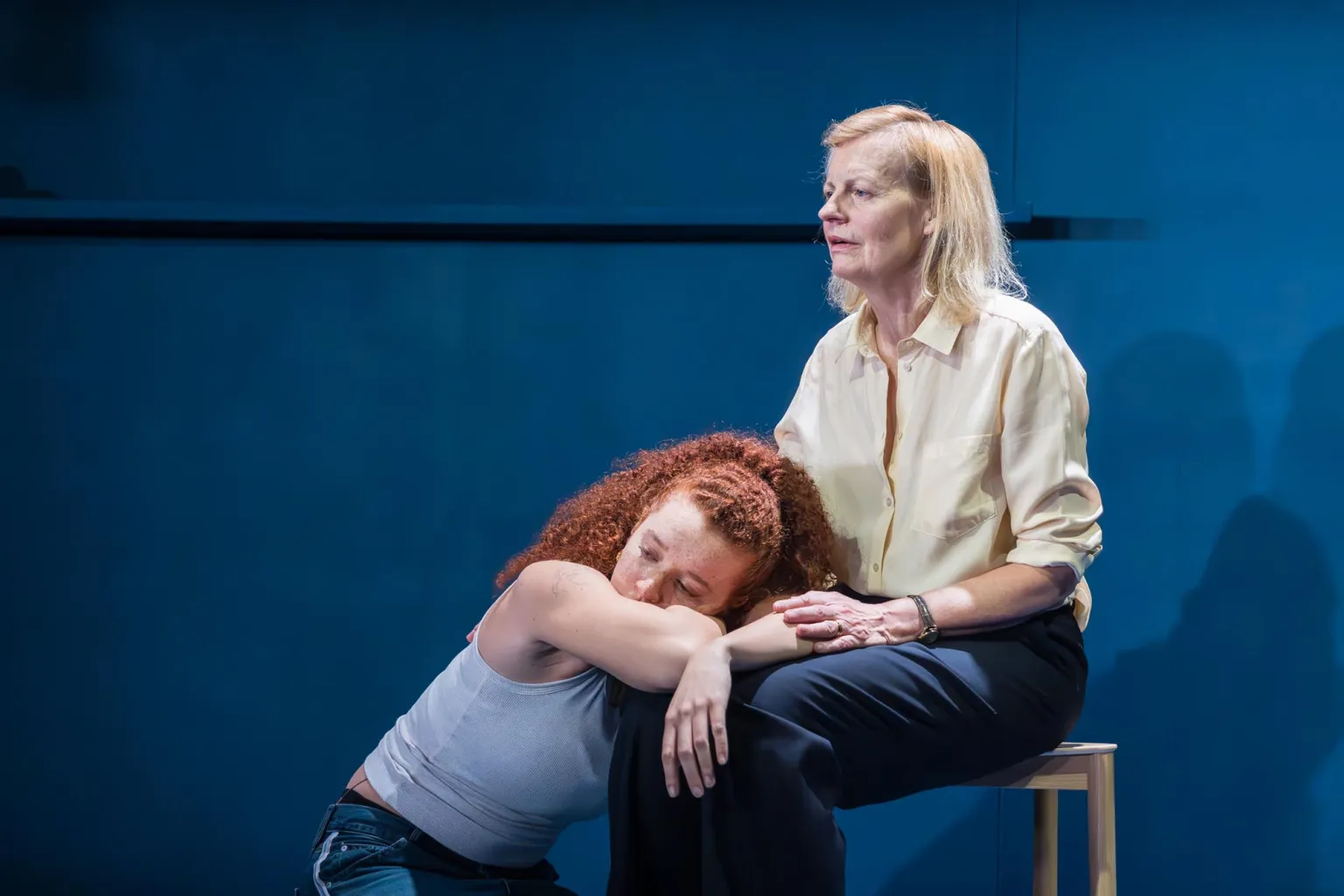
The critics loved the two actors in this new two-hander by written by Anna Ziegler and directed by Diyan Zora. Erin Kellyman (‘burningly charismatic’ – Time Out) is Delilah, coping with her mother’s death, and Anastasia Hille (‘a twisted coil’ – WhatsOnStage) plays Jennifer, her stepmother, whom Covid lockdown forces together. Their clashes and emotional connections were disparaged by many critics as lacking in depth. ‘if this is a wisp of a drama, these two actors give its gauzy translucency substance’ summed up The Stage.
[Links to full reviews are included but a number are behind paywalls and therefore may not be accessible]
4 stars ★★★★
WhatsOnStage‘s Sarah Crompton called it: ‘a surprising and quietly powerful study of grief and families.’ She said: ‘It’s a rare thing, a piece of storytelling that constantly surprises and never settles for the obvious.’ She praised both actors: ‘Kellyman’s Delilah is convincing in both her bolshiness and in her sense of being unmoored, grappling with feelings that she cannot quite control (…) Hille is like a twisted coil, all buttoned up in a brown cardigan and high-necked shirt, desperately trying not to be a doormat, to do the right thing, but battling her own demons.’ She added: ‘Diyan Zora directs with a delicacy and gentleness that lets the performances and the text develop at precisely the right pace’.
The Times’ Clive Davis said it was: ‘a hypnotic, sometimes very funny portrait of figures from different generations who discover that the loss of their mothers creates a bond of sorts between them. If that sounds like the outline of a conventionally uplifting piece of against-all-odds storytelling, Ziegler and the director Diyan Zora build the narrative out of shards and fragments, as if piecing together a broken mirror. Each sentence draws us in closer.’ He explained: ‘We are inside the minds of characters who speak a different language and have very different thoughts. We never want to stop eavesdropping.’
The Telegraph‘s Dominic Cavendish was enthusiastic: ‘Erin Kellyman and Anastasia Hille give beautifully judged performances in an effective, affecting evening’. He felt: ‘the piece, directed by Diyan Zora, is at its strongest in its conversational ebb and flow. Ice is broken then resealed, the age-gap straddled then left exposed anew. Hille’s Jennifer is diffident, resolute, quietly wise. We enjoy the discomfort inflicted on her, yet empathise as she buckles.’ He also gave praise to Kellyman, who ‘makes a striking stage debut, adopting a taunting, sullen impassivity that masks her character’s bubbling distress.’
Time Out‘s Andrzej Lukowksi was impressed by ‘an absolutely storming stage debut for Erin Kellyman (…) The young actor is burningly charismatic…but it’s the combination of insouciant swagger and cataclysmic fragility that draws us to her.’ He found the play itself ‘a bit too sleek, a bit too streamlined’ but liked the ‘simple revolve set from Basia Binkowska revealing clever hidden depths, abetted by some magical lighting from Natasha Chivers.’
3 stars ★★★
This is how The Stage‘s Sam Marlowe opened, and effectively summed up, her review: ‘It often feels as if this new two-hander … is teetering on the brink of profundity. But somehow, it never quite topples in. It’s a quiet, sensitive piece about grief, love, memory and motherhood, in which a woman and the daughter of her new husband struggle to overcome the ghosts of their past and to forge some sort of understanding. Both are haunted, and Ziegler rather overworks both the spooky metaphor and the self-consciously poetic language into which they sometimes lapse. But Diyan Zora’s production is beautifully acted by Anastasia Hille and Erin Kellyman, and if the pace is more meandering than hypnotic, there are moments that pierce.’
The Guardian‘s Arifa Akbar described the interaction: ‘Artfully directed by Diyan Zora, the play is both a telling (the women narrate in third person) and an enactment of their developing relationship within a circle on stage, which revolves as the two psychologically orbit each other. We see them meet, clash and misunderstand each other while confessing their inner worlds to us, just outside this dramatic circle.’ She ended: ‘The play’s power, ultimately, lies in its liminal spaces: between dream, psychosis and reality, between fiction and its creation, and between the tragedy of death and the capacity for healing found within it.’
Holly O’Mahony for LondonTheatre thought: ‘Both characters are wonderfully flawed creations, and it’s simultaneously moving and wryly funny watching them muddle their way through. Ziegler’s zippy dialogue is shot through with dark wit, and the awkwardly spiky exchanges between her chalk and cheese characters are always entertaining ‘. However: ‘it’s an unremarkable story and the turn-taking monologues start to feel tediously self-indulgent towards the end of the play’s 90-minute run-time.’
The Standard‘s Nick Curtis concluded: ‘As director, Zora invests the fraught verbal engagements between the two women with tension, but the constant resort to soliloquy – one or other character unpacking the last argument or preparing us for the next one – becomes tiresome and saps this 90-minute play of energy. The epistolatory epilogue is trite. I never like to describe a show as a curate’s egg – parts of it are off, parts of it are excellent – but here the phrase is inescapable.’
Cindy Marcolina at BroadwayWorld summed up: ‘The production is sleek and the acting is exquisite, but the narrative is commonplace and the considerations are elementary.’
Maryam Philpott for Plays International was more critical: ‘Ziegler’s play about grief and motherhood tries to do too many things at the same time, drawing in lightly explored mental health challenges, a predatory university environment, the pandemic, and generational miscommunication. With some of these themes acting as a catalyst for the action and others as both motivation and consequences, Ziegler loses sight of a much cleaner two-hander.’
Critics’ Average Rating 3.4⭑
Evening All Afternoon can be seen at the Donmar Warehouse until 11 April 2026. Buy tickets directly from donmarwarehouse.com
Moved at pace (no interval). Great interaction between the 2 protagonists trying to occupy the same space. Few nice twists. Negative, another grief play