Theatre reviews roundup: Gerry & Sewell

Northern play heads South

Aldwych Theatre
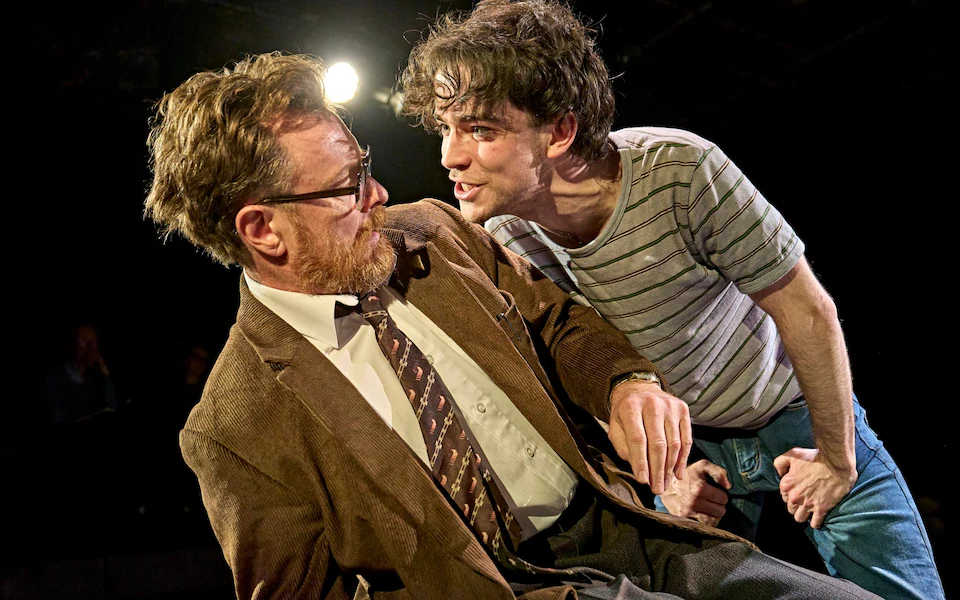
Jack Robertson and Dean Logan in Gerry & Sewell. Photo: Von Fox Promotions

A fringe success from the North East has opened in the West End. Among the handful of reviews, three gave it two stars but its rating was balanced by a 5 and a 4 star review. The latter liked the humour and the portrayal of working class life in Gateshead; the low scorers found it unable to make its mind up whether it was a comedy or a tragedy. Jamie Eastwood’s play stars Dean Logan and Jack Robertson in the title roles.

[Links to full reviews are included but a number are behind paywalls and therefore may not be accessible]

5 stars ★★★★★

Amber-Rae Stobbins, a native of Newcastle, popped up at BroadwayWorld to hand out full marks: ‘Jamie Eastlake’s brilliantly witty and raw play is just as upfront and vulnerable as the real-life people it is about’. She gave all the cast high praise including Logan: ‘Every word he says catches the audience and holds them, all while never missing a beat.’ And ‘Robertson’s comedic timing is unmatched, all while never dropping the beat. Moments of fourth-wall-breaking humour really connect his performance with the audience in a way that can only be put simply as ‘masterful’. And Clayburn: ‘Her ability to effortlessly contrast her characters through voice and physicality made her performance a joy to watch. Clayburn humanises characters that society often doesn’t – a marvel to see.’ And the ‘incredible singing voice of Halfpenny: ‘She represented those of us who left Newcastle to move to London for the sake of our art beautifully, and I couldn’t ask for more from her for that.’

4 stars ★★★★

The Independent’s Alice Saville had reservations: ‘It’s hard to get the genre’s balance of harrowing realism and crude joys right on stage. And as funny as this show’s offbeat animal puppets and showboating song-and-dance moments are, they sit weirdly alongside the story’s nihilistic trajectory.’ Nevertheless, ‘what Jamie Eastlake’s production really does nail is the humour. It’s hilarious from start to finish, providing you don’t gag at toilet jokes. And it’s also constantly, wittily self-aware of all the tensions of telling a story of poverty and deprivation in front of a middle-class audience’.

3 stars ★★★

The Stage’s Sam Marlowe said: ‘It’s frustratingly scattershot, and just about hangs together thanks to the sheer energy of its execution. But you can’t help wishing Eastlake would tighten the focus on Logan’s wiry, buoyant yet sensitive Gerry and Robertson’s food-obsessed, wise-cracking, clumsy and kindly Sewell.’

2 stars ★★

The Times’ Clive Davis was disparaging: ‘In an intimate community centre, it might just have worked; under the proscenium arch, it has all the allure of watching a bad Sunday League game on a quagmire of a pitch.’

’it’s less of a play than a hectic series of sketches that’s hard to take seriously as a comedy or a tragedy’ said LondonTheatre’s Julia Rank.

The Guardian’s Arifa Akbar noted: ‘the script as a whole is messy and incohesive, its various parts pulling away from each other (…) The season ticket storyline is beached by the end and some basic plotlines remain fuzzy.’ She conceded: ‘Still, there are sparks of brilliance and much potential – as well as a ton of heart and soul.’

Critics’ average rating 3.0★

Gerry & Sewell can be seen at the Aldwych Theatre, London, until 24 January 2026. Tickets from nederlander.co.uk

If you’ve seen Gerry & Sewell at the Aldwych, please leave a review and/or rating below

Theatre reviews roundup: A Ghost in your Ear

Sounds frightening

Hampstead Theatre Downstairs
Jonathan Livingstone & George Blagden in A Ghost in Your Ear. Photo: Marc Brenner

Yet another horror story has the critics jumping out of their seats. Unlike the  Paranormal Activity or 2:22 A Ghost Story, which relied on visual stage magic, A Ghost in your Ear relies on sound effects over headphones. An actor played by George Blagden records a horror story alongside a studio engineer played by Jonathan Livingstone. We see him reading the story but, more to the point, we hear the increasingly terrifying recording. Four stars all round for writer/director Jamie Armitage in collaboration with sound design geniuses Ben and Max Ringham.

[Links to full reviews are included but a number are behind paywalls and therefore may not be accessible]

4 stars ★★★★

‘If you’ve come to be scared, you’re in the right place. This is a good, old-fashioned ghost-train of a story’ declared The Guardian’s Arifa Akbar. Miriam Sallon for WhatsOnStage agreed: ‘on a bleak, cold January night, what better than a good haunting tale to get your blood pumping again?’

The Times’ Dominic Maxwell was truly spooked: ‘I spent much of these 90 minutes getting the willies in just the way Armitage wanted me to. Does it add up in the cold light of day? Not sure that matters: Anisha Fields’s shadowy set design and Ben and Max Ringham’s sound design help to ensure the light of day isn’t let anywhere near.’

Tim Bano for the Financial Times  explained: ‘It’s a piece that uses mood as much as jump scares to unseat us. The big, loud frights are few, and each is terrifying. As a ghost story, it twists and unsettles and gets under the skin. As a technical achievement, it’s pretty remarkable. It knows we might think the binaural thing is a bit of a gimmick, and even George is sceptical. Until those voices start to whisper in our ears.’

Katie Kirkpatrick at BroadwayWorld said: ‘It’s hugely impactful, and a stellar fit for the horror genre: it creates the illusion that the action is taking place all around instead of on an isolated stage, and weaves its way into the fabric of the piece. You feel breaths on the back of your neck, voices in the distance, creaking floors – it’s very effective and very scary.’

Rachel Halliburton on The Arts Desk praised the cast: ‘Plaudits to both Blagden and Livingstone for an enjoyably compelling management of the journey from the rational to the irrational. Whether or not you believe in ghosts, this should prove at the very least a decent work out for your adrenal gland’

The Standard‘s Nick Curtis assured us: ‘this is a meticulous and artfully conceived blend of storytelling, technology and actorly skill’. Oh, and frightening as well: ‘And the scares? Again, it would be a shame to spoil them, but they are extremely potent and even those that can be anticipated induce horripilation (a lovely word one rarely gets to use, it describes hair stirring on a scalp tightening with dread).’

Holly O’Mahony for The Stage gave some details: ‘It’s when the studio starts mimicking the setting of the story that this horror really takes hold, and the experience of watching it in the Hampstead’s intimate downstairs space begins to feel cleverly claustrophobic and inescapable (although as a voice tells us at the start, you can always remove your headphones if it gets too much). Anisha Fields’ set, which traps George in a soundproofed booth between two glass windows, contains all sorts of hidden facets primed to chill. And Ben Jacobs’ lighting cloaks portions of the stage in thick blackness, making you dread what might be in a corner.’

Time Out‘s Andrzej Lukowksi was impressed, saying it: ‘maybe feels a little too much like an extended episode of Inside No 9 for its own good. But horror theatre is a small, weird and often terrible genre and this is a proper scary little gem’.

Critics’ average rating 4.0⭑

A Ghost in your Ear can be seen at Hampstead Theatre until 14 February 2026. Buy tickets directly from hampsteadtheatre.com

If you’ve seen A Ghost in Your Ear, please leave your review and/or rating below

Theatre reviews roundup: High Noon

Stage Western emphasises politics rather than drama

Harold Pinter Theatre
Denise Gough & Billy Crudup in High Noon. Photo: Johan Persson

It is always asking for trouble from the critics when you adapt a well-loved film for the stage.  And so it proved with High Noon. Some critics, including one giving a 2 star review, found the stage show came off a poor second to the Oscar winning original. Others liked it in its own terms, enjoying Billy Crudup‘s more modern male, Denise Gough‘s stronger woman, and the shift in political message toward a more contemporary examining of why people would allow a bad person to come to power. The basic plot is the same: Will Kane is getting married and giving up his job as the town’s US marshal. News comes that a notorious killer is returning from prison on the noon train to wreak revenge on Kane, the man who put him away. None of the townspeople will help him. His Quaker wife Amy won’t stand by him either. Carl Foreman‘s original screenplay has been adapted by first time playwright but established screenplay writer Eric Roth. The critics liked the two leads’ performances, although some seemed to feel Denise Gough was too good for the part.  At least she got to sing some added Bruce Springsteen songs to considerable acclaim. There was disagreement among the reviewers about the level of tension supplied in Thea Sharrock‘s production.

[Links to full reviews are included but a number are behind paywalls and therefore may not be accessible]

5 stars ★★★★★

Gary Naylor for BroadwayWorld confessed he doesn’t like Westerns and has never seen the original movie, but this stage version made him realise ‘Not all Westerns are the same.’ He credited the script but added ‘Casting is key’:  ‘Billy Crudup… catches our hero’s flawed dignity and dangerous dilemma perfectly, a quiet man unexpectedly pitched into a life or death situation as the clock, handily visible above the stage, rolls towards midday.’ He explained the fifth star: ‘I was moved. I was there in the room with Kane as he failed to find the trust of his erstwhile supporters, with Amy as she wrestled with her conscience and ultimately left admiring a man who could do what I can’t (yet) in these difficult days for the world – The Right Thing.’

4 stars ★★★★

The Guardian’s Arifa Akbar was lukewarm about it as a piece of theatre, but ‘As a debate play…it gathers a locomotive energy as it travels towards the showdown’. She noted: ‘Eric Roth’s script uses many lines from Foreman’s screenplay but fleshes out the debates on the ethical stance of a community in the face of wrongdoing and misguided American myths around immigration.’ Regarding the two stars: Billy Crudup ‘manages to hold up the part on stage as an upstanding, earnest and increasingly desperate man. Gough makes her part grittier and more modern than that of her film counterpart, Grace Kelly. The pair are convincing as a couple although their narrow characterisation hems in the full scale of their abilities.’ She concluded: ‘For all its early stiffness, it builds in momentum and there are moving moments. Ultimately, the political message speaks loudest, harnessing the McCarthyist fear of then and the Trumpian terror of today.’

3 stars ★★★

For WhatsOnStage’s Sarah Crompton,  it was ‘careful and elegantly enjoyable, but lacks that emotional punch’. She explained: ‘the central debates of the film, the agonised wrestling with what is truly right, are slightly muted here as the play tracks Kane’s quest for support from various groups of townspeople… He keeps saying he must do what he must do, but the moral thrust of the film is somehow missing’

The Times’ Clive Davis liked the way Billy Crudup ‘delivers a more ambivalent version of an unassuming man who is trying to do his duty… His voice is often jittery, his gestures stiff-limbed.’ However: ‘Roth doesn’t quite persuade you that this is a story that needs to be remade. If you haven’t seen the movie, you may well find the play’s storyline a tad one-dimensional. Anyone, on the other hand, who is familiar with the original will struggle to shake off memories of a showdown in New Mexico.’ He praised the look of the show: ‘Tim Hatley’s set design, with its sliding wooden-slat walls, evokes a fragile, dusty township. But while a clock hanging above the stage ticks away as we wait for the villainous Frank Miller to arrive on the noon train, the climactic shoot-out looks perfunctory.’

Alice Saville of The Independent said: ‘Billy Crudup lends a quiet integrity to the role of … Kane, who finds his town turns its back on him, while an impassioned Denise Gough throws his values into question as his pacifist new wife.’ She ended: ‘it doesn’t deliver either the adrenaline or the emotional punch that gives Western movies their enduring power.’

Julia Rank of LondonTheatre thought the same: ‘Crudup brings gravitas and quiet dignity to the role, as well as a touch of delicacy (he could have been ruthless in his approach, but he wasn’t), though he lacks a big stirring speech to bring everything together.‘ As for his co-star, ‘Gough conveys her quiet strength in a relatively underwritten part… and she has the chance to showcase her singing ability with songs by Bruce Springsteen and others.’

For Time Out’s Andrjez Lukowski, the film adaptation ’doesn’t quite cut it on the stage. Magnetic as Crudup is, and solid as the gunplay bits are, none of it can negate the fact that the story ends weirdly abruptly – it needs a much longer final act. Gough is great, but she’s playing an amped up version of a relatively small character and the part doesn’t really justify an actor of her towering abilities…there’s a feeling that some of the songs etc are just there to find Gough something to do.’

2 stars ⭑⭑

The Telegraph’s Dominic Cavendish was disappointed: ‘Billy Crudup and Denise Gough can’t match Gary Cooper and Grace Kelly on screen, and Thea Sharrock’s stylish and yet grit-free production stokes only fitful tension.’ He analysed the many ways the stage adaptation is inferior to the classic film, including the ending: ‘the big gun-slinging denouement, albeit rushed in the film, here lacks the requisite adrenal quality – less high noon, more morning elevenses.’

Critics’ average rating  3.3⭑

Value Rating 34  (Value rating is the Critics’ average rating divided by the typical ticket price)

High Noon can be seen at the Harold Pinter Theatre until 6 March 2026. Buy tickets directly from highnoontheplay.com

If you’ve seen High Noon at The Harold Pinter Theatre, please share your review/comment and rating below

Theatre review: When We Are Married

Dull Yorkshire comedy rescued by cast

Donmar Warehouse

⭑⭑⭑

John Hodgkionson, Marc Wootton & Jim Howick in When We Are Married. Photo: Johan Persson

Bah ‘eck, I’m puzzled as to why director Tim Sheader chose to revive J B Priestley‘s When We Are Married. In its day, it was a very popular comedy, but that day has passed. Three couples celebrating their silver weddings find they were never legally married. There’s much potential for comedy but little of it is developed. Most of the fun seems to derive from puncturing the pomposity of these people, and having a laugh at their Yorkshire dialect. Fortunately, the cast are exceptional and they can generate laughter from the smallest facial flicker or vocal inflection, despite the mediocre script.

John Hodgkinson plays Joseph Helliwell, a domineering, self-righteous community leader, with relish. As his wife Maria, Siobhan Finneran is a delight: a snob who appears to be permanently sniffing something unpleasant under her nose. Mark Wootton is perfectly cast as a bombastic loudmouth, his beard almost as outsized as his voice. Sophie Thompson, as his submissive wife Annie, steals the acting honours with her exquisitely contemptuous looks and increasing confidence.

The final couple, Clara and Herbert Soppitt, are played by Samantha Spiro and Jim Howick. Herbert is a textbook—by which I mean clichéd—henpecked husband, but the dynamic is handled with real finesse: his repeated attempts to speak, only to be briskly cut off, are timed to perfection. Herbert’s tender moment with Annie is a rare hint that more could made of this marital crisis.

Instead, although all the couples are forced to reassess their relationships and view their partners afresh, the socialist J. B. Priestley concentrates on satirising the two pompous businessmen, while advancing a broader message about the need to value and respect women.

Director Tim Sheader has streamlined the play by cutting and consolidating roles: the maid and housekeeper, for instance, are merged into a single, gloriously disruptive character, played with gleeful, mischievous cackling by veteran performer Janice Connolly. Likewise, a newspaper reporter and photographer are combined, allowing Ron Cook to deliver some superb physical comedy as his increasingly inebriated character stumbles out of control—an act that may evoke fond memories, for those of a certain age, of the great Freddie Frinton.

The remaining supporting roles are all convincingly cast. Tori Allen-Martin brings far more nuance than expected to Lottie, who arrives to claim her newly single lover. Reuben Joseph and Rowan Robinson acquit themselves well in the thankless parts of the rather bland young couple, whose marriage-for-love is held up as a moral counterpoint. Leo Wringer is engaging as the priest tasked with untangling the marital chaos, beginning with calm authority before becoming progressively—and amusingly—exasperated. The reduced cast lends the production focus and momentum, sharpening the pace throughout.

That said, the script itself feels dated, and I’m not convinced it would survive without such a skilled ensemble to carry it over the finishing line. Comic sensibilities have shifted: contemporary audiences tend to favour sharper wit over broad humour and an exploration of transgression over a reliance on funny accents.

Imaginative production

Jim Howick, Sophie Thompson, Siobhan Finneran & Samantha Spiro in When We Are Married. Photo: Johan Persson

Even so, Sheader’s production is peppered with thoughtful and imaginative touches. I particularly enjoyed the way each half opens with a period song and closes with a contemporary one. The Biggest Aspidistra in the World, written around the time of the play, speaks to pride and status—and is echoed visually by the enormous aspidistra dominating Peter McKintosh’s largely naturalistic set. The first half  ends with Beyoncé’s feminist anthem All the Single Ladies, signalling the freedoms now beckoning the women.

The second half opens with the music-hall number A Little of What You Fancy (Does You Good), written at the time the play is set and rich in a sexual innuendo sadly absent from Priestley’s text, hinting at possibilities that ultimately remain both unrealised and largely unaddressed. We depart the theatre to the strains of Bruno Mars’ celebratory Marry You, neatly puncturing the pomposity of the powerful. These musical bookends add a layer of commentary that the script alone mostly lacks.

I also have a fundamental problem with staging a play like this on a thrust stage. Too often, you experience a sense of theatrical FOMO. Sitting in one of the side blocks, I had my view completely obscured by an actor, for what must have been five minutes of Ron Cook’s comic business—quite possibly some of the funniest moments. I’ll never know.  I might well have enjoyed the production more from a central seat.

While audience-surrounded staging can heighten intimacy—as demonstrated recently by The Lady from the Sea at the Bridge Theatre—in this instance I can’t help feeling the play would benefit from a traditional proscenium setup, with a single, shared viewpoint. It would certainly make life easier for the actors, who currently have to accommodate multiple sightlines.

Perhaps the production will transfer to a more conventional West End theatre. Judging by the largely enthusiastic reviews, it may well do so. Tim Sheader has an impressive track record from his time at the Open Air Theatre of successfully reviving classics and sending them on to the West End, much to the benefit of the balance sheet. He may repeat that success with this Donmar production. That said, I hope revivals of dated plays remain the exception. There is a place for revisiting a genuine classic but I don’t believe the Donmar is it. I hope Mr Sheader concentrates on the new work and inventive revivals of more recent plays that have characterised his time in charge there, such as Natasha, Pierre & the Great Comet of 1812, The Fear of 13, The Maids, and, one of my favourite plays of 2025, Intimate Apparel.

When We Are Married can be seen at the Donmar Warehouse until 7 February 2026.

Click here to watch this review on the YouTube channel Theatre Reviews With Paul Seven

Click here to read a roundup of other critics’ reviews of When We Are Married

Theatre reviews roundup: Woman In Mind with Sheridan Smith

Critics go crazy for Sheridan Smith 

Romesh Ranganathan and Sheridan Smith in Woman In Mind. Photo: Marc Brenner

The 40th anniversary revival of Alan Aykbourn‘s play about a repressed housewife who, following a blow to the head, enters a fantasy world, was welcomed by critics, not necessarily because of the play, which some found dated, but because of the quality of Sheridan Smith‘s performance. Michael Longhurst‘s direction was appreciated. Romesh Ranganathan‘s West End debut was widely liked.

[Links to full reviews are included but a number are behind paywalls and therefore may not be accessible]

4 stars ★★★★

Clare Allfree confessed in the Telegraph: ‘I’ve always thought this play to be one of Ayckbourn’s very best – it mixes his particular blend of suburban comic pathos with a febrile dash of horror. Longhurst’s revival is correspondingly both a Middle England sitcom and a psychedelic fever dream.’ She was impressed that: ‘Smith … gives us a thoroughly specific character study of a flawed and complicated woman, forced to bury her vivacious sexuality in the depths of a soulless marriage, but who is no straight-forward victim either.’ She noted: ‘Soutra Gilmour’s magic lantern set seems itself to quiver with nervous energy, disconcertingly flipping between hallucination and normality, and with everything drenched in hyper-bright light.’

As you’ll see below, some critics found the 40 year old play dated but for Olivia Rook at LondonTheatre, the ‘story of an ordinary woman in turmoil has just as much resonance now as it did then.’ She liked the way ’emotions are always bubbling beneath the surface’ in Sheridan Smith’s performance. She praised all the cast: Romesh Ranganathan ‘brings an amiable, bumbling, nervous energy, frequently breaking into awkward laughter. Tim McMullan is a hoot as Susan’s dismissive and dull husband Gerald… and is matched by Louise Brealey as his stiff yet neurotic sister Muriel’.

‘It’s so cheering to see the West End can still take risks’ said The Times’ Clive Davis.

3 stars ★★★

The Guardian‘s Arifa Akbar reported: ‘the play stands the test of time for its originality and boldness: this is a critique of the emptiness of married life and the desperation that a woman feels inside it that takes us from the domestic drudge to high-wire supernaturalism. When it works, it is unnerving. The imaginary family is creepy for its wooden perfection and performative warmth. You feel the chill building as they turn into nightmarish tormentors.’

On the other hand, WhatsOnStage‘s Sarah Crompton found it dated: ‘The problem with the play 40 years on is that, although its truths are universal, its characters are very much of its time.’ She appreciated Sheridan Smith’s performance: ‘She is infinitely moving, her little gestures and movements of discontent convincing, her face a constant reflection of her shifting moods of disappointment, anger and sadness, utterly convincing as both her worlds spin out of control. It’s a lovely, naturalistic performance, but it exposes the artificiality of the play.’

The Standard‘s Nick Curtis also found it ‘somewhat dated material’. He thought: ‘concept overwhelms character: everyone, including Susan, is thinly drawn.’ Fortunately, ‘it works thanks to Smith. She has a uniquely vivid physical presence, and her emotions are shimmeringly close to the surface.’

Sam Marlowe in The Stage gave the same message: ‘If there’s a good reason to see this dated, blunt-edged and ultimately exasperating 1985 work by the doggedly prolific Alan Ayckbourn, it will surprise practically no one that it is Sheridan Smith (…) the play is a study in acute mental crisis that is constantly undermined by its structural games, the drama choked off by formal conceit. It doesn’t help that the portrayal of psychological agony seems, to 21st-century eyes, crude and unconvincing; or that, aside from the tormented Susan, the characters are flat and cartoonish’.

Time Out‘s Andrzej Lukowski described Sheridan Smith as: ‘a wonderful and empathetic actor who effortlessly covers Susan’s considerable emotional terrain and the requirement to play hero, villain and victim all at once.’ However, ‘Watching Smith switch between families and moods is impressive and even thrilling, but the longer it went on the less I understood what point Ayckbourn was trying to make beyond a technical exercise.’

The Independent‘s Alice Saville had a similar view: ‘it feels that Ayckbourn is ultimately more interested in the creative possibilities of madness than in probing too deeply into its underlying causes.’

Critics’ average rating 3.3⭑

Value rating 33 (Value rating is the Critics’ average rating divided by the typical ticket price)

Woman in Mind can be seen at the Duke of York’s until 28 February 2026. Buy tickets directly at thedukeofyorks.com ; it will then tour to Sunderland Empire 4-7 March and Theatre Royal, Glasgow, 10-14 March. womaninmindplay.com

If you’ve seen Woman in Mind starring Sheridan Smith, please share your review/comment and rating below

Theatre reviews roundup: Pinocchio

Heartwarming- and that’s no lie

Shakespeare’s Globe
Pinocchio at Shakespeare’s Globe. Photo: Johan Persson

Written by Charlie Josephine (book and lyrics) and Jim Fortune (music and lyrics), The Globe’s Christmas show melted the hearts of the critics. The creation of the little wooden child impressed, as did the story of what makes us human.

5 stars ⭑⭑⭑⭑⭑

Aliya Al-Hussain of WhatsOnStage found: ‘Josephine’s funny and touching script edits Collodi’s tale down to a comprehensive yet snappy show, just short enough to keep the kids engaged, but with plenty for everyone to enjoy.’ She concluded: ‘Pinocchio is an uplifting, witty and beautifully realised production. A perfect family show for any time of year… and that is no lie.’

Christiana Rose for BroadwayWorld loved it: ‘Directed with clarity and imagination by Sean Holmes Pinocchio feels both familiar and refreshingly new, touching visually spectacular and musically rich. Above all it is a celebration of love, resilience and the many forms family can take. This is a special production crafted with immense care and creativity, offering a truly magical festive experience for audiences young and old.’

4 stars ⭑⭑⭑⭑

Claire Allfree of the Telegraph declared: ‘this full-scale musical adaptation of Carlo Collodi’s unsettling 19th-century parable about an insubordinate boy puppet is an absolute treat and, amid the annual slosh of panto and exhausted West End festive musicals, one of the best family shows around.’

The Independent’s Alice Saville agreed: ‘The playwright Charlie Josephine has adapted Carlo Collodi’s strange, sanctimonious 1883 novel into a quaintly rustic musical that feels a million miles away from both Disney’s version and from anything else you’ll see on stage right now. It uses this story of a wooden puppet to explore what it means to be human, and to be loved – and ends up pulling the heartstrings of everyone in the audience.’

Dave Fargnoli at The Stage enjoyed it: ‘Director Sean Holmes sets a brisk pace, keeping the energy high and the tone light while introducing some unsettling themes and, at times, a plausible sense of danger – the irrepressible Pinocchio is stalked, swindled and set on fire – but always bounces back. Designed by Peter O’Rourke, the puppet protagonist is a charming, spindly-limbed creation, articulated Bunraku-style by a busy cluster of puppeteers.’

Lucinda Everett at The Guardian explained the secret of its success: ‘the puppet’s journey to boyhood isn’t just about learning what makes us good, but what makes us human. His scrapes along the way are born not out of wickedness but curiosity and impulsive energy – perfectly captured by the three puppeteers animating Peter O’Rourke’s simple wooden design (including Lee Braithwaite, who gives Pinocchio a voice wild and wonder-filled), and by Josephine’s book’.

Martin Robinson at The Standard had reservations about the plot (‘patchy’) and the songs (‘rarely stir the soul’) but: ‘in the end, this show is for the children, and the gaggle accompanying the Standard absolutely loved the puppet, loved screaming at the Coachman and laughed throughout. Did they learn anything? No. Which made it even better, as far as they were concerned. A solid four stars from the little people.’

3 stars ⭑⭑⭑

Theo Bosanquet of London Theatre said: ‘It helps that Globe associate director Sean Holmes’s production has an irresistible homespun charm, augmented by Grace Smart’s clever and colourful toy theatre-esque design. It’s just so wonderfully real, unlike the poor titular character himself, who nevertheless proves the standout, skilfully handled by three puppeteers’.

Critics’ average rating 4.1⭑

Pinocchio can be seen at Shakespeare’s Globe until 4 January 2026. Buy tickets directly from the theatre.

If you’ve seen Pinocchio at The Globe, please leave your review and/or rating below

Theatre reviews roundup: Christmas Carol Goes Wrong

Comic chaos for Christmas

Apollo Shaftesbury Avenue
Christmas Carol Goes Wrong. Photo: Mark Senior

Mischief Theatre, responsible for the multitude of Goes Wrong comedies, present one of their finest shows, according to the reviews.

[Links to full reviews are included but a number are behind paywalls and therefore may not be accessible]

5 stars ⭑⭑⭑⭑⭑

At BroadwayWorld, Kat Mokrynski said it was ‘yet another triumph for Mischief Theatre that is perfect for the holiday season.’ She noted: ‘There are many times when audiences will recognise when a gag is going to happen (for example, when a box of Maltesers is placed into the set model), but it doesn’t stop the bit from being funny – in fact, it tends to add to the hilarity, with the build-up to the reveal only adding to the laughs.’

4 stars ⭑⭑⭑⭑

Chris Wiegand of The Guardian is a Mischief Theatre fan: ‘in the first half of this Dickensian foul-up, much of the pleasure comes from watching the company spring-load a very familiar crop of gags ready to explode after the break.’ And when that second half comes: ‘As the am-dram players’ lines go out of sync or their dialogue doesn’t match what we see, Matt DiCarlo’s production hums with comedic harmony.’

Alun Hood at WhatsOnStage noted: ‘Christmas Carol Goes Wrong really is uproariously, side-splittingly funny, all the more so because the performances, even at their most manic, keep one eye on some sort of truth.’

The Standard‘s Nick Curtis reported: ‘this revival of their farce about a malfunctioning amateur version of Charles Dickens’s Christmas fable had me laughing out loud. The brash, obvious, knockabout humour is laced with moments of lightning-flash wit and invention.’

The anonymous reviewer for London Theatre Reviews found: ‘A Christmas Carol Goes Wrong is exactly what it promises and exactly what you want on a cold winter’s night: sharp, silly, and relentlessly funny. By the final bow, the audience is exhausted with laughter’.

Anya Ryan for Time Out declared: ‘What’s funnier than watching things go wrong? Honestly: not much (…) while the slapstick and mayhem that ensues is hardly new ground for the company, the endless stream of slip-ups is what we’re here for.’

Holly O’Mahony of The Stage admitted: ‘the company’s resident writer-actors Henry Lewis, Henry Shields and Jonathan Sayer are on top form with this spoof of Charles Dickens’ festive favourite, originally developed for the BBC in 2017. The sincere sentimentality of the yuletide story lends itself well to a Mischief treatment, and in director Matt DiCarlo’s production, any would-be heartfelt moment is flipped spectacularly. If you’re a Mischief sceptic (guilty!), it’s a worthy reminder that everyone is worthy of a second chance.’

The Times‘ Clive Davis joined the chorus of approval: ‘It’s no easy job to keep a production teetering on the edge of disaster. These actors know how to fail with a flourish.’

Critics’ average rating 4.1⭑

Value rating 49 (Value rating is the Average Rating divided by the most common weekend ticket price)

Christmas Carol Goes Wrong can be seen at the Apollo Theatre in Shaftesbury Avenue until 26 January 2026 (Buy tickets directly from christmascarolgoeswrong.com) and then touring

If you’ve seen Christmas Carol Goes Wrong, please leave your reveiw and/or rating below

Theatre reviews roundup: Twelfth Night

Samuel West is an outstanding Malvolio

Barbican Theatre
Samuel West in Twelfth Night. Photo: Manuel Harlan

Last Christmas the Royal Shakespeare company presented Twelfth Night in Stratford. A year later, it has arrived in London at The Barbican Theatre. Critics had mixed feelings about director Prasanna Puwanarajah‘s dark interpretation of the play but they generally agreed that Samuel West‘s Malvolio was a highlight of the show.

[Links to full reviews are included but a number are behind paywalls and therefore may not be accessible]

5 stars

Helen Hawkins sitting at TheArtsDesk summed up her rave review: ‘This is a heartening evening out, where the atmosphere is almost pantomime-like and the complicity between players and audience becomes total. There are so many treasurable moments to take home with you – the crazed drunken “12 Days of Christmas” that Olivia’s household perform, Grady-Hall’s turn as a ventriloquist’s dummy, his reading of the letter that Malvolio, mad with rage, has sent his mistress, which he dutifully delivers as a stream of burbling anger. Extraordinary. Don’t miss.’

4 stars

The Independent’s Alice Saville was intoxicated by it : ‘Director Prasanna Puwanarajah’s take on this tragicomedy seeps across the stage with a measured boldness that’s completely intoxicating. He’s found a persuasive, original re-reading for almost every character in this story, highlighting all the weirder, queerer bits of Shakespeare’s text rather than rubbing them away.’

Debbie Gilpin at BroadwayWorld  was enamoured with Samuel West’s acting: ’In a production full of brilliance, his is truly the standout performance. It’s multi-layered, exploring Malvolio’s irritating fastidiousness, his penchant for celebrity gossip, and also his more human side; there is a pin-drop silence as he declares his intent to seek revenge.’ Of the evening as a whole, she said: ‘Although it does take a little while to warm up, once it finds the balance between comedy and drama there is a lot of fun to be had with this production.’

3 stars

Julia Rank at LondonTheatre felt: ‘More lightness might help bring the show to life. As it stands, it’s a version that accentuates the many strands of weirdness and ennui found in the play, which are often glossed over in more conventionally cheerful productions.’

Alex Wood for WhatsOnStage decided ‘without the inclusive embrace of a thrust stage, the production feels occasionally distanced and muted: evasive, witty and wry, without ever truly surrendering to its audience.’ He praised the actors: ‘There are some cracking performances along the way. A Cockney-accented Samuel West channels the best of a well-to-do Gary Oldman as the pugnacious Malvolio (with a mightily impressive arrival during the yellow stockings scene), while a marvellous Freema Agyeman hits all the comedy beats as Olivia once the show’s proceedings brighten in act two. There’s also a juicy and enigmatic suggestion that Viola’s time posing as male courtier Cesario may have been more liberating than is often assumed. The electrifying Daniel Monks is also unafraid to present Orsino with an entitled air of pomp’.

The Times’ Clive Davis found it a long three hours: ‘I found myself longing for him (the director) to edit all these bright ideas down into something zippier and more coherent.’

Critics’ average rating 3.7⭑

Value rating 43 (Value rating is the Average Rating divided by the most common weekend ticket price)

Twelfth Night can be seen at The Barbican Theatre until 17 January 2026. Buy tickets directly from the theatre.

If you’ve seen Twelfth Night at The Barbican Theatre, please leave a review and/or rating below

Theatre reviews roundup: Oh Mary!

Hilariously wild or wildly unfunny

Trafalgar Theatre
Oh Mary! at the Trafalgar Theatre. Photo: Manuel Harlan

A huge success on Broadway, this totally fictional portrait of Mary Todd Lincoln and her President husband Abraham had some critics in  stitches and others scratching their heads. The show is written by Cole Escola and directed by Sam Pinkleton, who was responsible for the Broadway production. Non-binary actor Mason  Alexander Park stars with Giles Terera.

[Links to full reviews are included but a number are behind paywalls and therefore may not be accessible]

4 stars ⭑⭑⭑⭑

The Independent’s Alice Saville loved it: ‘This imaginary version of Mary is a captivating creation – melodramatic, childish, and monstrously self-absorbed…non-binary actor Mason Alexander Park plays the part with the dark energy of a crinolined poltergeist, their black ringlets bobbing as they smash up Lincoln’s presidential office in search of forbidden gin.’ She explained: ‘Escola’s play basically sits in a genre of its own, one that mixes the farcical humour of am-dram classics like Charley’s Aunt with the disturbing queer energy of early John Waters films.’

The Telegraph‘s Dominic Cavendish was a fan: ‘this knowingly bogus portrait of the First Lady as a dipsomaniac and frustrated cabaret star is a riot, laced with a truth about the necessity of self-expression, in which American actor Mason Alexander Park gives the funniest performance in town (…) in a bullet-fast 80 minutes, it delivers a transgressive charge, and finishes the West End year on a screamingly silly high.’

LondonTheatre‘s Marianka Swain praised the ‘tour-de-force turn from Mason Alexander Park, who tears into the material like a ravenous tiger. Park hits every note with absolute comic precision: Mary’s infantile narcissism, crippling boredom, devilish humour, and, when presented with a hunky new acting teacher in tight breeches, all-consuming lust.’

‘It’s an absolute hoot’ said The Standard‘s Nick Curtis. ‘This show can’t see a top without going over it. Park’s performance is the polar opposite of subtle but it is exactingly precise and finely detailed. Their attempts to get down from a desk in Mary’s Husband’s office … is a masterpiece of physical comedy. Their timing and delivery is impeccable.’

Holly O’Mahony for The Stage was another fan of the lead: ‘Park’s Mary is riveting, and just as watchable during fiery exchanges with her husband (a no-nonsense Giles Terera), as in giddy lessons with her acting teacher (Dino Fetscher) and when bullying her chaperone (Kate O’Donnell).’

3 stars ⭑⭑⭑

Time Out’s Andrjez Lukowski was confused: ‘I didn’t hate this lurid cabaret about Abraham Lincoln’s wife. But after the slew of American critics describing the life-changing injuries they’d suffered from laughing so hard at Sam Pinkleton’s production, the whole thing just felt a bit… ’70s? A little bit Airplane!, a little bit Benny Hill, maybe even a touch of Mr Bean… Really it’s broad, dated humour salvaged by a tremendous cast headed by Jamie Lloyd veteran Mason Alexander Park as Mary and the redoubtable Giles Terera as ‘Mary’s husband’ (ie Abe).’

Aliya Al-Hussan for BroadwayWorld couldn’t get on board: ‘There are some funny moments and the energy never flags, but the overall feeling is that you are watching an 80-minute-long comedy sketch.’

2 stars ⭑⭑

The Guardian’s Arifa Akbar didn’t get it: ‘Escola’s show left US audiences in stitches with its camp chaos but contains the kind of low-hanging fruit that Kenny Everett’s team might have rejected.’ She pulled it apart: ‘I felt cheated of story, character, wit or wonder’. Unlike the Telegraph critic who felt it was about’the necessity of self-expression’, she was left puzzled: ‘Satire and black comedy as genres are built to accommodate social observation and acid critique, but there is none of that here.’

The Times’ Clive Davis was at his most acid: ‘What’s the most positive thing I can say about this much-trumpeted ultra-camp import from New York, hailed as one of the hottest tickets of the year? Well, thank heavens it’s only 80 minutes long.’ He couldn’t understand some of the audience’s ‘maniacal cackling’ at what ‘is really a Saturday Night Live sketch stretched to improbable lengths.’ It left him in a thoughtful mood: ‘We are living in a strange world. A clown is in the White House, and this show is riding high on Broadway. Can things get any madder?’

Critics’average rating: 3.3⭑

Value rating 37 (Value rating is the Average Rating divided by the most common weekend ticket price)

Oh, Mary! can be seen at the Trafalgar Theatre until 18 July 2026. Buy tickets directly.

If you’ve seen Oh Mary! at the Traflagar Theatre, please leave a review and/or rating below

Theatre reviews roundup: Top Hat

Great song and dance show loses its sparkle during boring plot

Top Hat at The Barbican. Photo: Johan Persson

The 2013 stage adaptation of the Astaire-Rogers musical with songs by Irving Berlin was revived last year at Chichester to good reviews  The London reviewers were not quite so impressed. They enjoyed songs like Cheek to Cheek, Let’s Face the Music and Dance, Top Hat, White Tie and Tails and Puttin’ on the Ritz, and the sparkling choreography by Kathleen Marshall but criticised the drawn-out, corny story. The two leads- Phillip Attmore and Amara Okereke– were complimented.

[Links to full reviews are included but a number are behind paywalls and therefore may not be accessible]

4 stars

Marianka Seain, reviewing for the Telegraph, declared: ‘once you accept the madcap plotting, along with jokes so cheesy that they belong in a Christmas cracker, you can indulge in the fizzing, glamorous escapism. It’s all really just an excuse to stage exuberant ensemble numbers, as Marshall does with aplomb, and give the principals lovely spotlight moments.’

Clementine Scott for BroadwayWorld found it a ‘joy’. She enjoyed the two leads: ‘Attmore’s lithe tap dance work is a character unto itself, but his vocals are also charming and almost conversational at times. Okereke… manages to lend Dale a compelling blend of playfulness and sexual confidence’

3 stars

Anya Ryan at LondonTheatre was disappointed: ‘the luxurious, big-chorus tap numbers… twinkle and soar and are everything you could possibly hope them to be. However, much of the other action that plays out on the Southbank’s circular stage is curiously muted. It feels as if the actors are stuck performing behind a gauze screen, their emotional reasoning never quite reaching us, and the romance between star performer Jerry Travers and fashion model Dale Tremont seems to lack genuine chemistry.’

The Standard’s Nick Curtis had a similar experience: ‘Though stylishly mounted with lavish tap and ballroom routines to Irving Berlin’s peerless songs, this adaptation … is a curiously flat affair. As long as director and choreographer Kathleen Marshall’s cast are singing and dancing it’s fine… But the slight and overextended romance that fills the gaps in between is sluggish where it should sparkle, the pace slow’.

Siobhan Murphy for The Stage noted: ‘The main drawback…is that stuffing the piece with so many extra songs stretches the whole thing to two and a half hours – so, despite Marshall’s best efforts, the dynamic energy that would send you out into the night desperate to shuffle-ball-change isn’t really there.’

The anonymous reviewer at London Theatre Reviews reported: ‘If you are looking for a show with spectacular dancing and nostalgic songs, this production delivers; the musical numbers are truly great. But you will need some patience for the story, which is not nearly as exciting as the footwork’.

2 stars

Chris Selman at Gay Times was damning: ‘the singing is perfectly solid, the orchestrations are nice, the costumes look the part, the choreography impresses on occasion. But Top Hat falls flat largely because the narrative is just so flimsy.’

Critics’ average rating 3.2⭑

Value rating 26 (Value rating is the Average Rating divided by the most common weekend ticket price)

Click here for Paul Seven Lewis’ review of Top Hat at Chichester

You can see Top Hat at the Queen Elizabeth Hall in London’s Southbank Centre until 17 January 2026 (Buy tickets directly from the Southbank Centre), then touring to Sheffield, Dublin, Glasgow, Eastbourne, Southend, Birmingham, Aberdeen, Norwich, Salford and Southampton.

If you’ve seen Top Hat at the Queen Elizabeth Hall or on tour, please add your review and/or rating below
×