Theatre reviews roundup: The Unlikely Pilgrimage of Harold Fry

Sentimental Musical touches hearts

Theatre Royal Haymarket
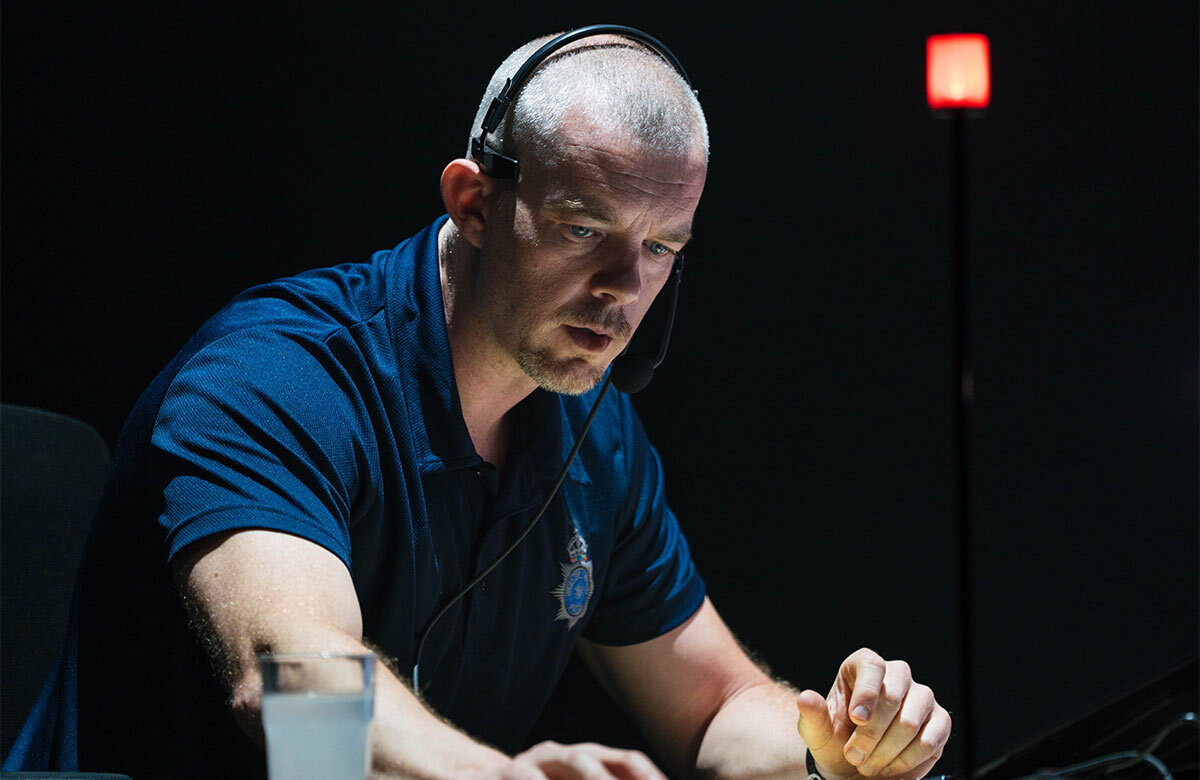
The Unlikely Pigrimage of Harold Fry. Photo: Tristram Kenyon

Rachel Joyce‘s play started as a radio play, became a successful novel, was made into a film, was adapted into a musical in Chichester directed by Katy Rudd, and is now looking like a West End hit. It’s the story of a retired man who embarks on a 600 mile walk to visit an old colleague, now dying. In the course of the journey he meets many people and comes to terms with his own demons. Some critics found it ‘sentimental’ (The Stage) but others thought it was ‘heart warming’ (Telegraph). ‘Completely captivating’ (LondonTheatre) Mark Addy was felt to be a good choice for the curmudgeonly Harold despite not being much of a singer. Any vocal deficit on his part seems to have been more than made up for by the ‘sensational’ (The Stage) Jenna Russell as his wife. The music by Passenger was ‘genuinely catchy’ (Independent) or simply ‘amiable’ (The Times).

[Links to full reviews are included but a number are behind paywalls and therefore may not be accessible]

4 stars ⭑⭑⭑⭑

Alex Wood of WhatsOnStage rejected the notion that it used emotional manipulation:: ‘It is a show bubbling with grief, hope, love, and music. Joyce’s writing has always possessed a particular groundedness; even at its most moving, it never feels overly saccharine.’  He gave much of the credit to the leading man: ‘Addy captures all of Harold’s journeys – physical, geographical, emotional, psychological, and philosophical – with an immense sense of skill and tempered restraint. He is a man of few words for much of the play, but it is in the cheery silence that Addy does his best work…It is a performance of quiet devastation.’ He summed up: ‘By the time the final number starts, you aren’t just crying because the show told you to; you’re crying because you’ve seen so many facets of a couple, burdened by decades of mourning, finally able to let it go.’

The Telegraph’s Dominic Cavendish had a similar thought: ‘You can easily argue that it is hardly subtle and wants us to weep and smile on cue; but, to my mind, its sadness rings true, while its crowd-pleasing positivity is hedged with knowing make-believe.’ He appreciated: ‘its gentle reckoning with grief, loss and loneliness’. It is, he said, ‘a heart-warming musical…that deserves to become an unlikely West End hit’.

The Independent’s Alice Saville said it was ‘a rare thing: a new British musical with an engrossing, new(ish) story that’s powered by genuinely catchy songs, written by Passenger’. She noted: ‘when pathos and calm is needed, we get it by the spadeload. Jenna Russell lends so much repressed depth to the part of Harold’s wife Maureen’. She pointed out: ‘There’s something sharply, painfully sad about the second act’s excavation of grief and loss, which lends a much-needed acidity to the musical comfort food that’s gone before.’

Olivia Rook at LondonTheatre reported that her heart melted: ‘thanks to Katy Rudd’s immaculate direction, and superb, balletic choreography by Tom Jackson Greaves, Harold Fry’s journey from Devon to Berwick-upon-Tweed to see his old, dying friend Queenie is a heartfelt, gripping voyage.’ She loved Mark Addy: ‘His performance is the acting equivalent of putting on a favourite, comfortable old jumper —his Harold is a little rough round the edges, but he is good, real, stoic, and completely captivating’.

BroadwayWorld’s Aliya Al-Hassan credited the star: ‘Mark Addy (who had never performed in a musical prior to this) gives a great performance, first as the epitome of an unremarkable man, decent and polite who wears a shirt and tie to have breakfast, then slowly comes back to life as his journey progresses. His vocals are not the strongest in the cast, but there is heart and deep emotion in his performance.’ She declared: ‘With a message of kindness, compassion and hope, it’s theatre that we all need right now.’

3 stars ⭑⭑⭑

Paul Vale for The Stage noted: ‘it’s is a distinctly British tale of relationships, loss and healing. Directed with lyrical flair by Katy Rudd, Joyce’s rather sentimental story blossoms as a musical, with Passenger’s diverse score enhancing those underlying themes.’ She pointed out: ‘It’s a curious and occasionally frustrating choice for the lead character to sing barely a note, but this is countered by the sensational Russell, who interprets Passenger’s songs with emotional integrity and a sublime narrative skill.’

The Times’ Clive Davis damned with faint praise: ‘The truth, though, is that while the folk-inflected songs by Mike Rosenberg (known as Passenger) are amiable enough…Joyce’s script is oddly underpowered…Katy Rudd’s production at the Haymarket in the West End trudges on and on, tugging at our heartstrings along the way.’

Time Out‘s Andrzej Lukowski seemed to reject the musical, but then: ‘It is kind of MOR, and the various revelations along the way do skew towards the predictable. Still, I think male inarticulacy – both inward and out – is a fascinating odd thing to put at the heart of a work of musical theatre. And though a secondary theme, it does a very nice job in dissecting the nature of faith via Harold’s peculiar gaggle of followers, each of whom essentially see themselves reflected in their hero, a man that they don’t understand one bit. It’s a bit cosy, but not entirely so – there’s a wildness and darkness bubbling beneath the surface that means The Unlikely Pilgrimage packs a surprising punch.’

The Standard’s Nick Curtis was unmoved: ‘for all its obvious charms and consummate professionalism it remains curiously uninvolving and slight. Call it a meh-sical.’

Critics’ Average Rating 3.6⭑

Value Rating 37 (Value rating is the Critics’ average rating divided by the typical ticket price)

The Unlikely Pilgrimage of Harold Fry can be seen at the Theatre Royal Haymarket until 18 April 2026. Buy tickets directly from https://haroldfrymusical.com/

If you’ve seen The Unlikely Pilgrimage of Harold Fry, please leave your review and/or rating below
Theatre reviews roundup: Shadowlands

Hugh charms the critics

Aldwych Theatre
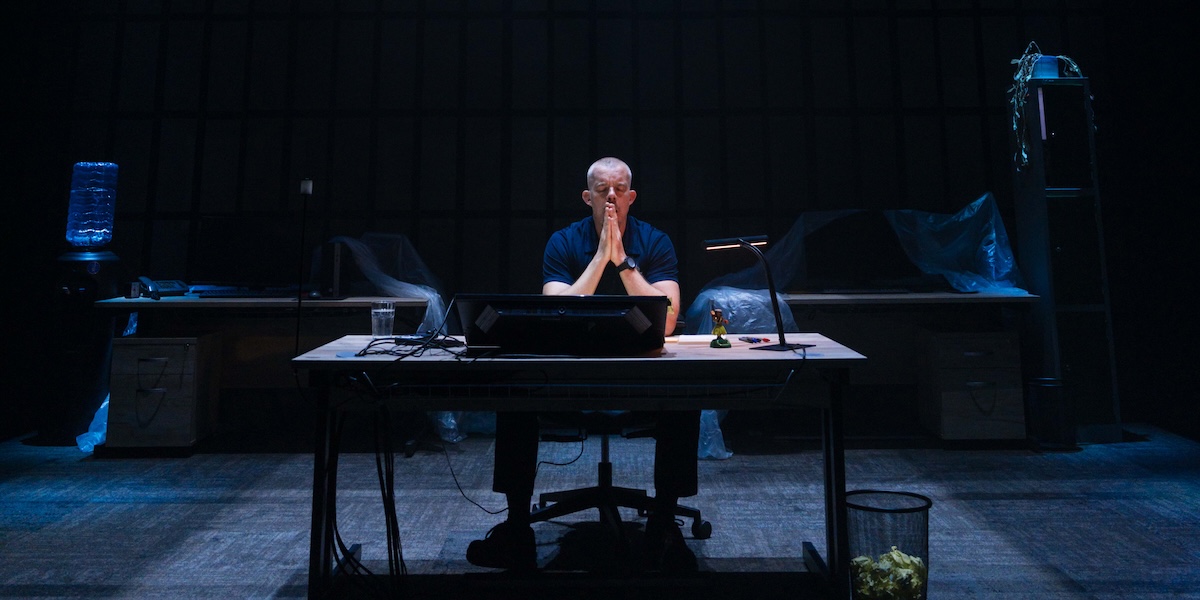
Maggie Siff and Hugh Bonneville in Shadowlands. Photo: Johan Persson

They may or may not have liked the play but the critics were charmed by Hugh Bonneville’s ‘shrewdly understated’ (Times) performance in the role of the emotionally repressed C S Lewis. In William Nicholson’s biographical play, Lewis’s Christian beliefs are challenged when he falls in love with a divorced American woman, then has to cope with her terminal illness. Some critics felt the play was superficial and ‘rose-tinted’ (Stage), but others were profoundly moved by the ‘potent’ (Telegraph) portrayal of grief. Maggie Siff was praised for her robust performance as Joy. The critics were generally impressed by Peter McKintosh’s set design in which a wall of bookshelves symbolises the stifling world of academia but also opens into a Narnia-like paradise. This production, directed by Rachel Kavanagh, was first seen at Chichester in 2019.

4 stars ★★★★

The Telegraph’s Dominic Cavendish wrote a moving review: ‘it could all veer into a superficial, episodic résumé. Yet Rachel Kavanaugh’s stylish production lends the story the vital, unifying aura of a restless, soulful quest.’ He found ‘All (the) genteel restraint means that when Bonneville’s placid, unassuming demeanour breaks into a howl of distress, or his gauche stiffness yields to a kneeling marriage proposal at Joy’s hospital bed, the effect is one of emotional detonation.’ He was touched by Bonneville, who, he said, ‘gives a commendably un-egotistical performance that provides a potent conduit for our own experiences of deep personal loss.’

The Times’ Clive Davis also praised the star: ‘Bonneville certainly deserved the acclaim he received at the end of the evening: this was a shrewdly understated performance that hinted at the turmoil stirring inside a public figure struggling to reconcile his own beliefs with the catastrophe that has set his private life.’ The set design made its contribution: ‘Every now and then, the walls of books slide away to reveal a wintry, Narnia-ish domain. Howard Harrison’s shifting lighting always seems to remind us that the line separating the here and now from eternity is a thin one.’

The i’s Fiona Mountford decided it was a test of true love: ‘On this Valentine’s weekend, I have concocted a failsafe test for a potential love interest: does this person snuffle quiet tears at the end of Shadowlands? Are they profoundly moved by the line ‘The pain now is part of the happiness then. That’s the deal’? If the answers are ‘no’, run a mile, as this person lacks any evidence of a beating heart.’

3 stars ★★★

Holly O’Mahony for The Stage criticised it for being ‘rose-tinted’: ‘while it’s witty, there’s something insincere about Nicholson’s script – polite and polished for palatability, it’s the version of events that you might tell ageing relatives (…) it all lacks punch; but it’s a heart-warming watch.’

Anya Ryan at LondonTheatre complained: ‘(Lewis’s) moral and spiritual dilemma is largely glossed over.’ But she did like the star: ‘Bonneville begins with a stiff-upper-lip Englishness…But, with Joy’s encouragement, he opens up piece by piece; his final wail is utterly devastating.’ She also praised the set design: ‘Nodding to Narnia, Peter McKintosh’s staging reveals a hidden, magical world from behind a bookcase. It suggests that beyond the shadows of life, there is something beautiful waiting.’

WhatsOnStage’s Sarah Crompton liked the show as far as it went, which was not far enough: ‘Nicolson’s play…is expertly directed by Rachel Kavanaugh, who firmly emphasises the humour and incongruity of this passion between a celibate English don and a straight-talking American poet…But she cannot disguise the way it skates along the surface of multiple moral dilemmas.’ Fortunately, ‘Bonneville is an actor who can tease feeling and nuance out of the most straightforward script. He’s wonderful as Lewis, awkward and endearing, but also catching the man’s self-righteousness stuffiness… The moments towards the close, when he is suddenly overwhelmed by feeling are deeply affecting.’

In a literally holier-than-thou comment, The Independent’s Alice Saville said: ‘There are audiences who’ll lap it all up as an emotive alternative to a church sermon, but they deserve better. Real life is much more complicated than the fridge magnet quote-worthy moralising that fills this play’s later scenes, and an author with the imaginative power to turn God into a friendly lion would have understood that.’

Aliya Al-Hussan of BroadwayWorld described the play as ‘Plodding in parts, but ultimately devastating’ but joined the Hugh Bonneville hugfest: ‘Bonneville is amiable, believable and gently formal as Lewis. His presence feels like a comfortable pair of shoes; familiar and unchallenging, but as the character submits to the waves of grief after Joy dies, Bonneville is touchingly bereft.’ She also praised Maggie Siff, saying she ‘never slips into the caricature of a loud and overly positive American and her sharp-tongued ripostes to the mysogynist views of Lewis’s academic circle are perfectly delivered.’

TimeOut’s Andrzej Lukowski thought it was one for Hugh’s stans (super fans): ‘None of it serves to quicken the pulse, really: it’s high class MOR, a chaste romantic fantasy that plays great with the Bonneville stans but is lacking a layer of depth. Still, even if I couldn’t exactly believe in the couple, I could still root for them.’

2 stars ★★

The Guardian’s Arifa Akbar put the boot in: ‘It has charm and pulls you into its sadness but seems as creaky as the half-filled, wood-panelled library in its backdrop…plods from one scene to the next, sleepy in pace and action but breezy in its emotions’. As for the star: ‘Bonneville is a lovely presence, as always’ but ‘he lacks the hard, anguished depths that show Lewis’s stunting shyness and repression.’ She felt ‘Siff is excellent as Joy, bringing sharp edges and ardour but the chemistry between them is just too fond and gentle.’

Critics’ average rating 3.2★

Value Rating 34 (Value Rating is a combination of the show rating and the typical ticket price)

Shadowlands can be seen at the Aldwych Theatre until 9 May 2026. Buy tickets directly from shadowlandsplay.com

If you’ve seen this production of Shadowlands, please leave your review and/or rating below 
Theatre reviews roundup: Man And Boy

Ben Daniels towers in expressionist take on Rattigan 

Dorfman Theatre, National Theatre
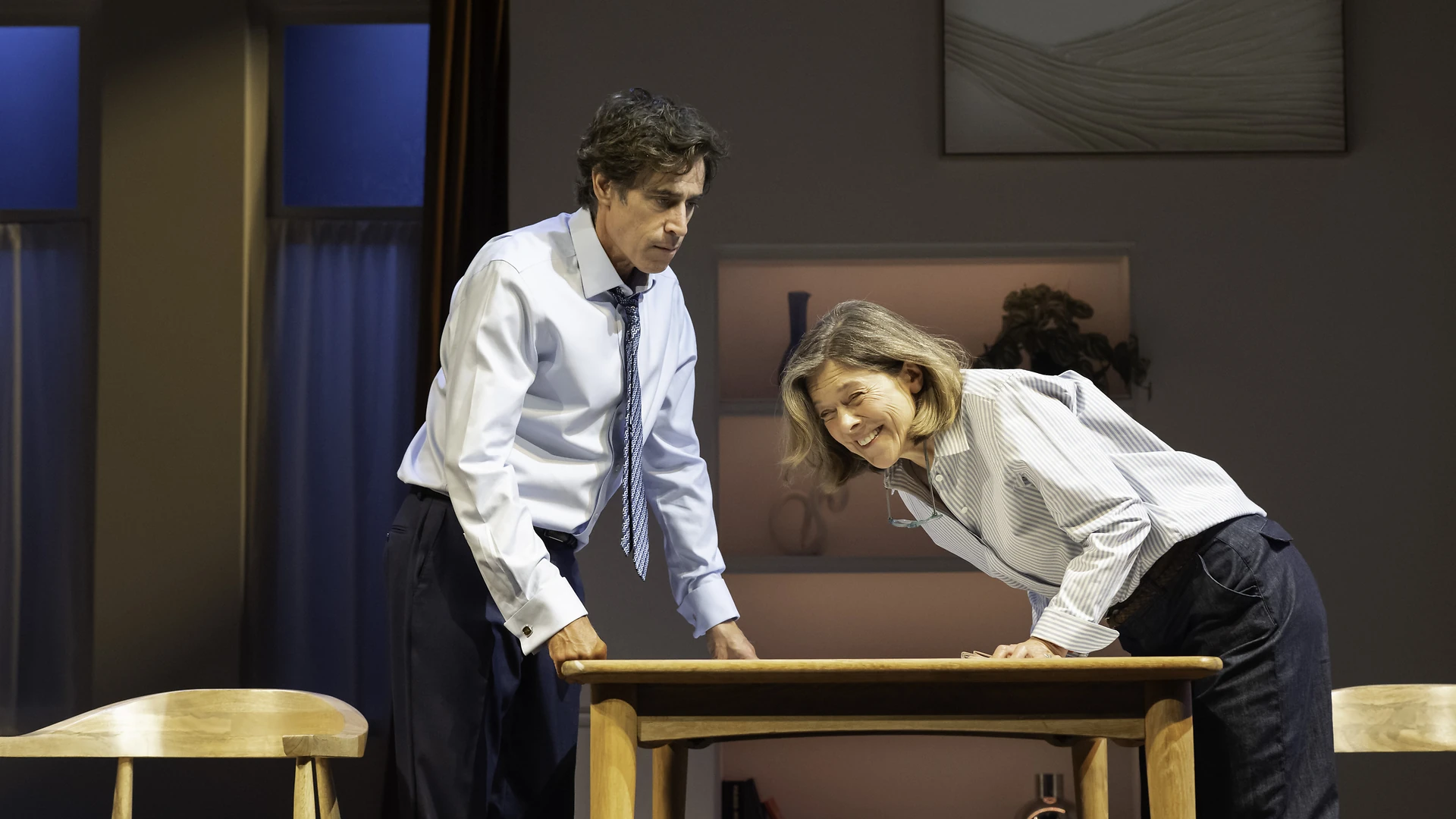
Ben Daniels and Laurie Kynaston in Man And Boy. Photo: Manuel Harlan

Man And Boy was a late play from Terence Rattigan, long after his golden reputation had been washed away by the new wave of ‘kitchen sink’ dramatists. It is largely neglected, and some critics thought it deserved to be (‘Rattigan’s plot isn’t far removed from dime fiction’ said The Times). Others loved the way director Anthony Lau ‘throws off the shackles of realism’ (Time Out) to make it seem contemporary. All agreed that Ben Daniels‘ performance as the 1930s amoral millionaire Antonescu, who tries to pimp out his adult son (Laurie Kynaston) to save his business, was award worthy.

[Links to full reviews are included but a number are behind paywalls and therefore may not be accessible]

5 stars ⭑⭑⭑⭑⭑

Time Out‘s Andrzej Lukowski enthused: ‘Anthony Lau’s production is the first Rattigan I’ve seen that throws off the shackles of naturalism.’ The design, he said, ‘sets Rattigan free from chintzy tradition, and when combined with Angus MacRae’s wild, jazzy score gives the whole thing a sense of danger, unpredictability and transcendence of a specific time and place. It also liberates star Ben Daniels from period constraints, freeing him up to deliver what is easily the best stage performance of the year to date.’ His portrayal was ‘seethingly dangerous, his shark-like charm punctuated by flashes of bottomless rage and an unsettling, insectoid physicality as he prowls and scuttles over the tables.’ He summed it up as: ‘a wild production that tears up everything we thought we knew about how to stage good old Terence Rattigan.’

4 stars ⭑⭑⭑⭑

WhatsOnStage‘s Sarah Crompton observed: ‘Watching it in the light of the Epstein scandal, it feels pressingly pertinent in its depiction of a valueless world where everything has a price – even love. With the peerless Ben Daniels outstanding as Antonescu, it has a savagery and sharpness that make it utterly compelling.’ Shew continued in her praise of Daniels, calling him ‘magnificent’: ‘We first see him waiting to enter, black raincoat buttoned up to his neck, his face impassive, his profile eagle-like…he’s like a force-field of energy, with a serpentine, seductive charm that can’t quite disguise either his anxiety about his ruin or his essential toughness. He’s a master of the universe, bestriding the stage like a colossus.’

Anya Ryan of LondonTheatre found: ‘Ben Daniels is triumphant as Antonescu – a performance that should surely earn him an award nomination or two. Commanding the stage, lizard-like and menacing, he orders those around him to follow his instructions with the easy authority of a man long accustomed to obedience.’ She concluded: ‘Man and Boy may still not show Rattigan at his most humanly rich. But this production – in all its ruthless, game-playing glory – surely shows the play in its finest light.’

Clementine Scott at BroadwayWorld agreed: ‘this is an astutely written drama the National were right to revisit.’

3 stars ⭑⭑⭑

The Independent‘s Alice Saville pointed out: ‘No one in this play has the intellectual heft or bravery to remotely challenge Antonescu, and that makes it ultimately unsatisfying to watch.’. Her response to the show was subdued: ‘Rattigan’s play unfurls soberly and without remorse for either characters or audience (…) Lau’s production tries to inject a bit of energy by getting the actors to clamber incongruously over tables, or by crushing them under a lighting grid that descends worryingly close to the stage, or by having them sway in dim light like they’re in a slo-mo fight scene. These witty touches are refreshing – but they feel like a bit of a mismatch with Rattigan’s serious portrait of moral corruption, which offers more to respect than to enjoy.’

The Telegraph‘s Dominic Cavendish was reserved in his praise: ‘While the two lead performances in Anthony Lau’s revival at the National compel, its glaring deficit is that it strains too hard to jazz things up experimentally.’

Sam Marlowe of The Stage wrote a review of two halves. It started well:  ‘Reconfigured in this production by Anthony Lau, which gives it a dash of expressionism, the play leaps along in exuberantly grotesque fashion, far removed from conventional Rattigan stagings. It’s still an uneven piece, but it feels both pertinent and darkly entertaining here – thanks in no small degree to an enthralling central performance from Ben Daniels’. It didn’t end so positively: ‘Things go awry, unfortunately, in the second half, when the action calls for more humanity and emotional sincerity, which seems at odds with Lau’s heightened, almost grimly farcical staging.’

Over at The ArtsDesk, Demetrios Matheou agreed: ‘If the first half sees Antonescu at his diabolical best, while setting up a bleak confrontation between father and son, the second fails to deliver on that tension, settling for a rather conventional comeuppance with few surprises and little satisfaction in how the central relationship plays itself out. There could have been real tragedy here. Nonetheless, Daniels continues to hold the attention, adeptly shifting his physicality from strength to frailty.’

2 stars ⭑⭑

The Guardian’s Arifa Akbar wasn’t impressed: ‘Director Anthony Lau has put a thoroughly new spin on this old yarn but one which sadly drains the emotion and tragedy.’ Her demolition was thorough: ‘The first half is pulled down by the weight of its laboured reinvention. The drama is so arch that it seems operatic – the bigger the performances, the more you feel removed from Rattigan’s subtexts.’ It clearly left her cold: ‘It engages more when some of the theatrics are dropped, a little too late…so much distance has been created that his downfall becomes emotionally remote, his self-loathing rejection of filial love understood rather than felt.’

The Times‘ Clive Davis was scathing: ‘Sadly, Anthony Lau’s febrile expressionist production is so overheated that it’s impossible to ignore the implausibilities in the storyline. Financiers are a strange breed, as we’re reminded every time a batch of Epstein files drops, but Rattigan’s plot isn’t far removed from dime fiction’. He continued: ‘that fine actor Ben Daniels is required to play the villain as a shrill, camp figure — think Rudolf Nureyev channelling Professor Moriarty. And if Georgia Lowe’s Dorfman set looks stunning at first glance … you find yourself wondering why the principal characters are jumping on to tables whenever they want to deliver a speech.’

Critics’ Average Rating 3.3⭑

Mand And Boy can be seen at the National’s Dorfman Theatre until 14 March 2026. Buy tickets directly from the theatre.

If you’ve seen this production, please leave your review and/or rating below

Theatre review: Fallen Angels

It’s not Coward’s words, it’s the women that makes this a hit

Menier Chocolate Factory

⭑⭑⭑⭑⭑

Alexandra Gilbreath, Sarah Twomey & Janie Dee in Fallen Angels. Photo: Manuel Harlan

I’ve been to three shows this year in which women in unsatisfactory marriages assess the alternatives. All were written in the years between the two world wars, all are funny, but the one that made me laugh the most was Fallen Angels by Noel Coward, and, surprisingly, it wasn’t because of The Master’s legendary wit.

J B Priestley’s When We Are Married at The Donmar depicts three couples who discover they are not legally married. The husbands learn a lesson about how they should treat their wives. And that, unfortunately, is about it. An opportunity wasted. Somerset Maugham’s The Constant Wife, given a stylish makeover by Laura Wade and now touring, finds a wife turning the tables on her adulterous husband to considerable comic effect.
All the authors have a way with words. What makes Fallen Angels at the Menier Chocolate Factory the funniest play I’ve seen in a long time is not Coward’s witty aphorisms. They’re there all right, but it’s no Private Lives or Present Laughter. What elevates it to comedy heights is the production itself, directed by Christopher Luscombe with lightness and pace, and the dazzling physical comedy of its three female stars.
First, a brief outline of the plot. Julia and Jane’s husbands, played by Richard Teverson and Christopher Hollis, go off on a golfing weekend, conveniently coinciding with the anticipated return of Maurice, a Frenchman with whom both women had pre-marital relationships. A clue as to what might follow comes when Julia informs her husband Fred that while they may love one another, after ten years of marriage, they are no longer ‘in love’. The play places women’s unfulfilled sexual desire firmly in the spotlight. No wonder it caused a scandal back in 1925, although that wasn’t the only reason, as we’ll see.
Noel Coward’s dialogue is amusing, especially during the women’s giggling memories of their past romances and breathless anticipation of their former lover’s arrival. He gave the hint of how they’re feeling with lines as close to being censored as he could get, as when Jane says, ‘Oh I adore a little sausage with my egg’. Yet, Janie Dee as Julia and Alexandra Gilbreath as Jane, barely need the nudge. You can feel the heat radiating from them.
However, what had the audience rolling in the aisles is the physical humour. In Act One, we meet the new maid, Saunders, played by Sarah Twomey. The notion of a servant more clever than his or her employer is not novel. It’s been around since Ancient Greece and P G Wodehouse’s great creations Jeeves and Wooster would have been familiar to Mr Coward.
In Fallen Angels, she swiftly demonstrates that she can play the piano better than Julia, knows more about golf than Fred, and speaks French better than any of them. Her standout moment comes when she prepares the room for dinner while performing ballet, every gesture from placing flowers to laying a table cloth is choreographed perfectly to the music. Credit here to movement director Nicola Keen– and Noel Coward is nowhere in sight.

A masterpiece of physical comedy

The cast of Fallen Angels at The Menier. Photo: Manuel Harlan

Sarah Twomey would steal the show, except that in Act Two, Julia and Jane, waiting for the arrival of Maurice, consume an entire meal (I lost track of how many courses) and get increasingly inebriated in the process. Women getting drunk was the other reason the play was a cause célèbre. In the hands of Janie Dee and Alexandra Gilbreath, the physical comedy builds with the courses of the meal. They begin pleasantly tipsy on cocktails reminiscing with giddy nostalgia about their time with Maurice. By the end of the act they are blind drunk on champagne, falling over, bickering and nearly coming to blows over their former lover.

Slow reactions, shocked looks, ungainly postures abound. The success lies in the minutiae – for example, there’s a moment when Jane kicks her shoes off in an extravagant gesture, then gingerly places her aching feet on the floor;  or when Julia goes to lean on the piano and misses. It’s a masterpiece of comic observation that had the audience in stitches. There are also – thank you, Mr Coward- outlandish insults: ‘I’d like to rush up and down Bond street with one of your tiny heads on a pole’ snarls Jane.
Simon Higlett‘s art deco set beautifully recreates a London flat from the inter war years, and reinforces that this was an era in which elegance ruled, making the women’s behaviour all the more comical (and shocking back then).
After the interval, Act Three is something of an anti-climax. Hangovers seem to afflict characters and audience alike. But the arrival of Maurice, played with suave sophistication by Graham Vick, and the return of the two husbands (slowly realising with shocked looks that their wives might prefer their old flame to them) give us much to enjoy and a satisfyingly neat conclusion.

Fallen Angels can be seen at The Menier Chocolate Factory until 21 February 2026.

Theatre reviews roundup: Tom Stoppard’s Arcadia

A fitting tribute to the late Tom Stoppard

The Old Vic
Arcadia at The Old Vic. Photo: Manuel Harlan

Arcadia is widely considered to be Tom Stoppard‘s greatest play. Set in the 1800s and the 1990s, the play covers science, landscape design, writing and human attraction. It fizzes with ideas but is imbued with a strong sense of humanity.  Alex Eales‘ revolving set, in the round, the way the two periods pan out in parallel. The critics were largely overwhelmed by the play and Carrie Cracknell‘s production, but some found Stoppard too clever by half. The cast were highly praised, with Isis Hainsworth in particular attracting attention.

[Links to full reviews are included but a number are behind paywalls and therefore may not be accessible]

5 stars ⭑⭑⭑⭑⭑

The Standard‘s Nick Curtis described the play and the production: ‘This prodigious, teemingly intelligent, breezily witty 1993 play by Tom Stoppard packs in more challenging matter than most writers would attempt in a lifetime but has the seeming effortlessness of pure entertainment. It embraces thermodynamics, poetry, landscape design, sex and much more besides, in parallel timelines set in the 1990s and the early 1800s in one room of a Derbyshire country house. Carrie Cracknell’s superbly cast and elegantly realised in-the-round revival is a fitting tribute to the genius of Stoppard’.

Matt Wolf at The Arts Desk gave the detailed analysis of a devotee: ‘Having been in attendance at Arcadia‘s world premiere at the National some 33 years ago come April, I had always thought I’d never see a staging to match Trevor Nunn’s original…Yet here the play is again, with at least three performers who eclipse all memory of their forbears. And even those who don’t are superb in their own rights, the ensemble working in harmony to foreground feeling amidst the playfulness, fun and scientific and mathematical fodder that inform the text throughout’.

BroadwayWorld‘s Aliya Al-Hassan asked rhetorically: ‘Does it matter if you don’t understand the complex scientific and mathematical theories? Not at all. Carrie Cracknell’s magnificent revival has huge amounts of humour and heart, which is not always a given with Stoppard’s work.’

4 stars ⭑⭑⭑⭑

The Telegraph’s Dominic Cavendish called it a ‘triumphant return’ for an ‘intellectually thrilling and romantically stirring masterpiece’ that is ‘a spellbinding portrait oif transient, mysterious existence itself.’ He seemed to cope with the blitz of ideas more than some critcs: ‘It all grips like a thriller. The intimacy of Cracknell’s production – presented in-the-round, beneath two elliptical lighting rigs that suggest planets in orbit – creates a sense of magnified scrutiny; you can easily follow the trains of thought and marvel at the clockwork finesse of it all.’

Theo Bosanquet for LondonTheatre noted: ‘In Carrie Cracknell’s stripped-back, in-the-round production, Stoppard’s densely intellectual dialogue is given centre stage, while his dual-era narrative is enriched through subtle and sensitive overlapping.’

WhatsOnStage‘s Sarah Crompton pointed out: ‘It is also incredibly funny, and its richness lies in the way that its thoughts never compromise its humanity. Instead, they underline them as Stoppard shows chaos and unpredictability at work in human relations too. Sex and people “fancying people they shouldn’t” is another disruptor of the maths of the universe.’ She summed it up as: ‘a multi-faceted gem that glimmers in every light, thought-provoking and profoundly moving. It’s a glory.’

Dave Fargnoli of The Stage praised the cast: ‘Among the large ensemble, Isis Hainsworth stands out as teenage maths prodigy Thomasina with a believable balance of flashing insight, naivety and adolescent emotional spikes, swinging from frothy enthusiasm to tearful desolation in a heartbeat. Seamus Dillane is a fine foil as her tutor Septimus, deploying roguish charm and acerbic wordplay to create an appealingly rakish persona.’ He ended: ‘although the production may lose momentum at times, the script’s interplay of erudition, insouciant wit and relatable human drama is never less than intriguing and engaging.’

The Independent‘s Alice Saville reported on the look: ‘what Cracknell’s staging excels at is weaving together past and present. Designer Alex Eales has turned the Old Vic into an intricate miniature galaxy, with a revolving set whose rings let the cast orbit each other like planetary bodies. There’s a beautiful naturalness to the way that their paths seem set for collision but never quite meet – leaving historical mysteries forever unsolved.’

3 stars ⭑⭑⭑

The Guardian’s Arifa Akbar had ‘the sense of a playwright tossing about complex ideas with such excitement, dexterity and depth that it doesn’t matter whether you understand them. Or up to a point, at least. Everyone here is so clever, from the winningly precocious Thomasina to Stoppard himself that it can make your head hurt’.

The Times’ Clive Davis was less convinced than some about the play’s greatness: ‘There were more than a few moments during this evening when the lengthy disquisitions on the nature of the universe left me feeling as slow and ponderous as the tortoise that serves as one of the mischievous props (…) As in so many of Stoppard’s plays … the characters seem less like rounded individuals than repositories for his ideas.’ He acknowledged: ‘Arcadia does sparkle, especially in the opening scenes…Tutor Septimus Hodge (played with élan by Seamus Dillane) spars with his pupil, Thomasina Coverly, Isis Hainsworth’s portrayal of the young girl is a delight, conveying both innocence and knowingness as she tries to win Septimus’s approval.’

2 stars ⭑⭑

The i’s Fiona Mountford was the harshest critic: ‘Stripped of all décor, the play appears ever more daunting and ever less dramatic and in the underpowered first half of Carrie Cracknell’s production the atmosphere falls dangerously flat. Too often it becomes a seemingly never-ending lecture and we the poor students trapped inside the lecture hall.’

Critics’ average rating 3.9⭑

Value Rating 52 (Value rating is the Average Critic Rating divided by the typical ticket price)

Arcadia can be seen at The Old Vic until 21 March 2026. Buy tickets directly from the theatre.

If you’ve seen Arcadia at The Old Vic Theatre , please share your review/comment and rating below

Theatre reviews roundup: American Psycho

A Fond Farewell to a Killer Show

almeida Theatre
Arty Froushan and cast in American Psycho. Photo: Marc Brenner

Roberto Aguirre-Sacasa’s musical adaptation of American Psycho, Bret Easton Ellis’s satire of 1980s Wall Street consumerism, was a huge success in Rupert Goold‘s first season as Artistic Director of the Almeida (then it starred Matt Smith). Now, 13 years later, it forms part of his final season there. Here’s Alex Wood’s summary of the plot at WhatsOnStage: ‘That story…is of a disillusioned banker, Patrick Bateman, filling the emotional void in his life with consumerist jargon, macho-posturing and, eventually, a homicidal rampage through New York.’ The critics loved the production- the music, the set, the lighting, the choreography- and praised the cast especially Arty Froushan in the lead role. Some felt it wasn’t as effective as it could have been.

[Links to full reviews are included but a number are behind paywalls and therefore may not be accessible]

4 stars ⭑⭑⭑⭑

The Guardian‘s Arifa Akbar listed the reasons why she liked it so much: ‘First there is satire, deliciously dark, and then horror…unsettlingly effective when the violence comes (…) Duncan Sheik’s score contains one great electro-synth number after another, with a razor sharp book by Roberto Aguirre-Sacasa (…) Es Devlin’s fleet set design turns nightclubs into bedrooms into hideous mounds of twitching bodies. Jon Clark’s Stringfellows style lighting and Finn Ross’s projections give off a luminous, hallucinatory quality, insinuating Bateman’s unreliable reality.’

‘it’s big, bold, and deliciously sinister’ declared BroadwayWorld‘s Cindy Marcolina. She noted: ‘Arty Froushan is exquisite as Bateman. A psychotic glint in his eye and steely arrogance make him the quintessential finance bro. He makes his inability to get a table at the exclusive Dorsia restaurant the driving force of his homicidal streak, filling his nights with violent sex and murderous escapades. The musical spells out Bateman’s contradictions, and Froushan revels in them.’

Alex Wood for WhatsOnStage stated: ‘It’s not a perfect show, and its true impact is perhaps left that bit too late in the final scenes. That said, it’s still a hypnotic, bloody good time – one that perhaps says more about the macabre dimensions of modern masculinity than anything else on a UK stage right now.’

The Standard‘s Nick Curtis noted the look of the show: ‘If I say that Rupert Goold’s revival of his hit electropop murder musical is full of surface gloss and chilly razzmatazz, I mean it as a compliment. Bret Easton Ellis’s original 1991 novel was a slashing satire on late-80s consumerist capitalism, as lived by psychotic Wall Street banker Patrick Bateman. This shiny, energetic, body-conscious production lands when greed is once again good and looksmaxxing misogynists are literally all the rage in the manosphere.’ He explained more about the men’s bodies: ‘the hench torsos and sculpted six packs the younger male actors reveal …This fits the vanity (and the semi-suppressed homo-eroticism) of Bateman’s milieu. But it seems that stage actors, like movie stars, now have to have the body of a Calvin Klein model as well as talent.’

The Independent‘s Alice Saville had some doubts but ‘if this show’s message is uncertain, its impact is undeniable. It doesn’t look or sound like any other musical you’ll see in London, and there’s something entrancing about this icy injection of nihilism into a remorselessly peppy genre.’

Time Out‘s Andrzej Lukowski liked it but had reservations: ‘for all the demonic razzle dazzle that Goold and his top-notch creative team bring to bear – disturbingly twitchy choreography, infernal monochrome elegance, a lot of indoor sunglass wearing – American Psycho is a deadpan show with a downbeat story that sometimes feels in conflict with the maximalist nature of musical theatre. And in humanising Bateman and stressing his anxieties, his collapse into full-blown paranoia at the end feels less momentous than in book and film.’

3 stars ⭑⭑⭑

Claire Allfree in the Telegraph was dissatisfied with the adaptation: ‘Perhaps the greatest stumbling block is the fact that the original novel is a masterpiece in narrative ambiguity. Since this adaptation signals from the beginning that Bateman is a fantasist, any sense of ghastly jeopardy is lost. Froushan…expertly conveys the sense of both moral void and existential despair but he is never remotely terrifying.’

Holly O’Mahony at LondonTheatre cautioned: ‘It’s not that the story itself hasn’t aged well, or faded in relevance, but under Goold’s watch, Patrick Bateman (an appropriately beguiling Arty Froushan) never seems as void of feelings as he says he is. We witness him spiralling his way through an existential crisis, wearing his fragility on his sleeve. And making him a shade or two more ‘relatable’ diminishes the satire of Ellis’s story’.

The Stage’s Sam Marlowe was underwhelmed, saying it was ‘a highly enjoyable satirical romp – but one that, despite some vivid gory splatters, is essentially bloodless. It’s smart and horribly pertinent. But it probably won’t give you nightmares.’

The Times’ Clive Davis didn’t get it: ‘It’s slick, it’s shiny, it’s empty (…) There are solid performances all round, but is the show itself really worth reviving?’ Like Bateman, he put the axe in: ‘As for the music, Sheik…has assembled an efficient if colourless selection of technopop anthems.’ 

Critics’ average rating 3.6

American Psycho can be seen at the Almeida Theatre until 21 March 2026.

If you’ve seen this production, please leave your review and/or rating below
Theatre reviews roundup: Ballad Lines

A Musical with heart

Southwark Playhouse Elephant
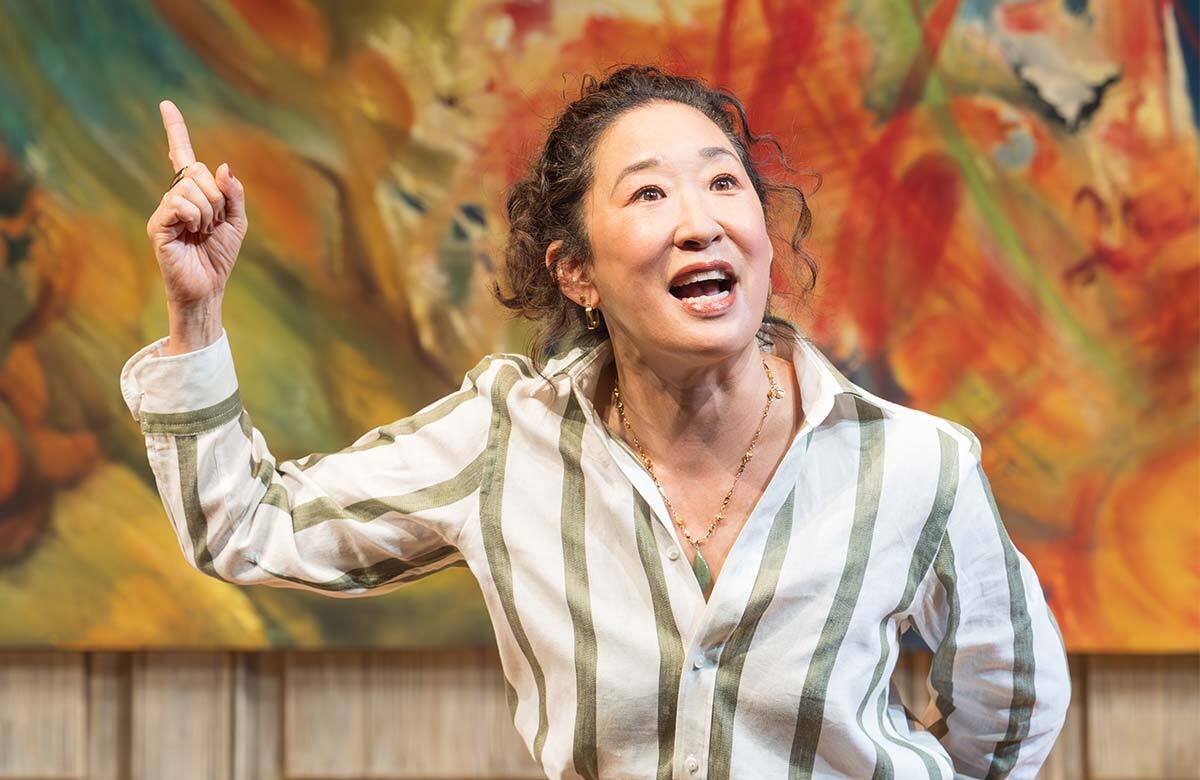
Ballad Lines at Southwark Playhouse. Credit: Pamela Raith

Ten years in the making, Ballad Lines has arrived in London. Finn Anderson and Tania Azevedo’s musical follows connections between women and songs over the centuries. Some critics felt there was more work needed on it, but they loved the music and found the story heartwarming.

[Links to full reviews are included but a number are behind paywalls and therefore may not be accessible]

4 stars ⭑⭑⭑⭑

Cindy Marcolina for BroadwayWorld said: ‘Ballad Lines must be one of the most exciting new musicals to hit the stage in some time. We follow Sarah, an American queer woman, as she dives headfirst into her family’s roots. Through the centuries, the same melodies come back to link the women who came before her (…) it might be a bit corny here and there, but it’s a solid celebration of women’s endurance as well as the role of music and its influence on our lives. The score and the plot are equally engrossing; the direction and performances are inspired.’

‘Brimming with ambition and warmth, it has the makings of the next brilliant thing’ reported Aliya Al-Hussan for WhatsOnStage. She admitted: ‘Touching on family, identity and motherhood, there’s a lot to pack in and some characters inevitably feel less rounded than others, but Azevedo directs with great fluidity.’ She concluded: ‘Heartwarming, poignant and deeply human, it has the potential to go far.’

Emma John in The Guardian explained; ‘It was the Ulster immigrants, passing down their boisterous tunes and melancholy ballads, who gifted the US some of its first iterations of country music.’ Anderson’s score powerfully evokes the source material it is exploring, and the ensemble’s singing positively electrifies the traditional song (…) Composer Finn Anderson and director Tania Azevedo have used that journey to tell a musical story across generations.’

Gary Naylor at The Arts Desk praised the show but ‘You shouldn’t be standing back, but few aspects of life are as inaccessible to a man as pregnancy and childbirth (…) For all the heart and soul and technical achievement on stage, that yawning empathy gap was never bridged – at least not for me. I appreciated the show because it’s a really fine musical, but I didn’t really feel it. Many will. ‘

3 stars ⭑⭑⭑

The Stage’s Sam Marlowe noted: ‘There are some soaringly impassioned performances in this new musical, but it’s the songs that are the star. Woven around traditional Appalachian folk tunes and accompanied by a live band dominated by lyrical fiddle, they are lilting, haunting and oozing with gorgeous harmonies.’ However, ‘McNamee sometimes seems a little stranded, a bystander floating at the verge of more interesting tales, and the piece sometimes bobs too long among the eddies and whorls of the multi-stream storytelling.’

Matt Wolf for LondonTheatre called it ‘a show suffused with passion and heart that comes tethered to a surging score from the fast-rising Scottish singer-songwriter Finn Anderson’. He declared: ‘There’s no faulting an eight-person cast…and McNamee should go far with her stirring occupancy of the show’s star part.’ Unfortunately, ‘Too often, the writing lapses into clunky portentousness’ and it’s also in ‘desperate need of trimming and shaping’, he said.

Anna Maloney in CityAM described the story: ‘Ballad Lines dives into the lives of Cait, Jean and Sarah, three women from the same blood line but very different times…connected by heritage, womanhood but, more importantly, the power of song, with the score blending Scottish, Irish and Appalachian folk ballads.’ She suggested it was not quite complete: ‘this could be the kind of show that really benefits from scale. With a few set pieces and the potential for big, gorgeous ensemble numbers, Ballad Lines could be a hit in waiting.’

Critics’ average rating 3.6⭑

Ballad Lines can be seen at Southwark Playhouse Borough until 21 March 2026. Buy tickets directly from the theatre

If you’ve seen Ballad Lines at Southwark Playhouse, please leave your review and/or rating below
Theatre Review: The Producers – Now and Then

Mel Brook’s musical is almost as offensive as ever (Thank goodness)

Garrick Theatre

⭑⭑⭑⭑⭑

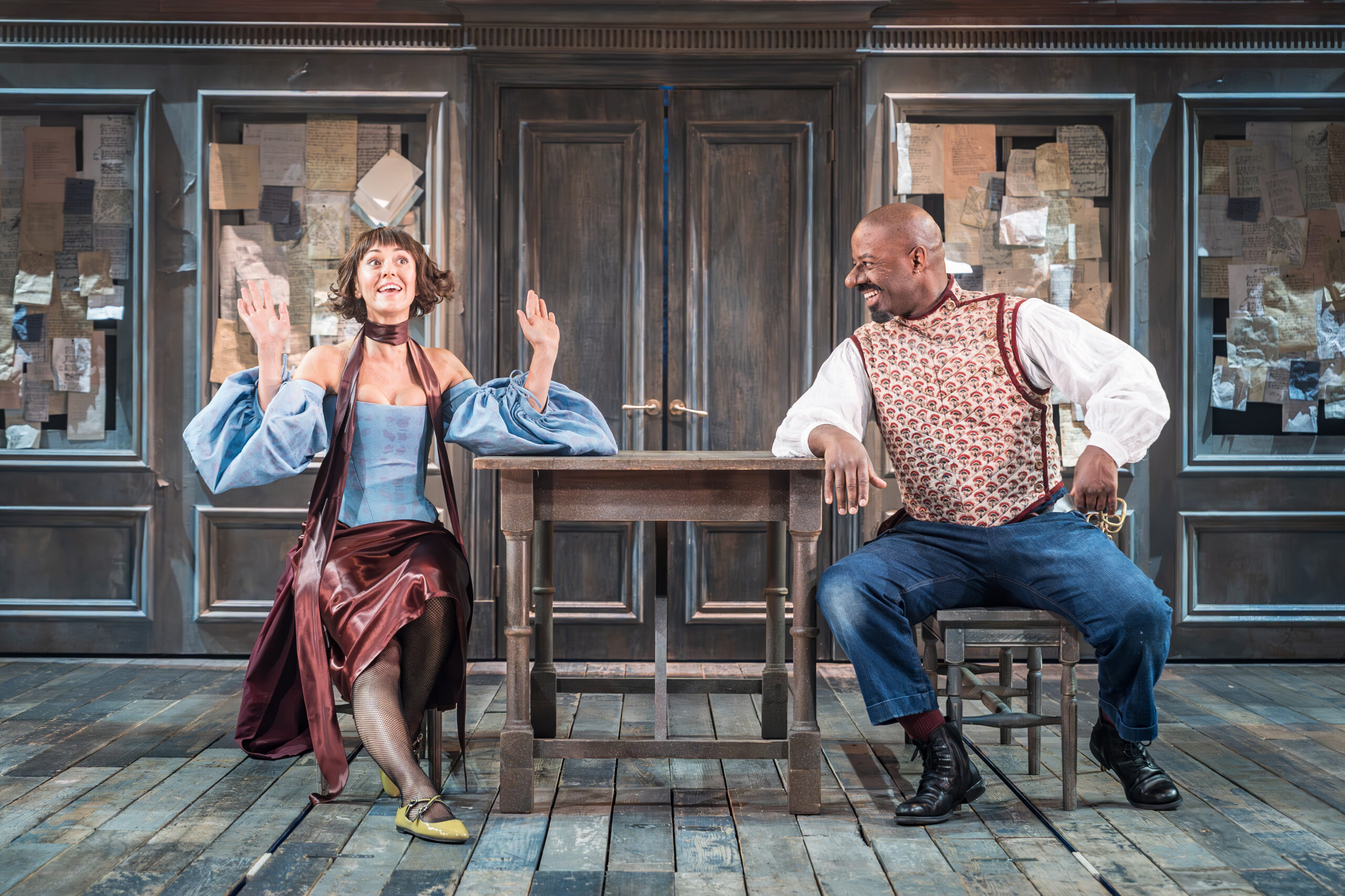
Andy Nyman & Marc Antolin in The ~producers. Photo: Manuel Harlan

The Producers was and still is one of the great musical comedies, so why was I slightly disappointed in the current West End production? Not so let down by it that I didn’t find it laugh-out-loud funny nor so dissatsified that I wouldn’t recommend it, but left with the feeling that it is unwise to mess with perfection.

This production is the first one in London that Mel Brooks has allowed that doesn’t have to stick to Susan Stroman‘s original Broadway direction. It was probably necessary to have that agreement simply to be able to present it in the tiny space of The Menier Chocolate Factory, where it was created pre-transfer.

The spectacle may be reduced but there is still enough going on to dazzle the audience and fill the Garrick stage. As well being effective in puncturing the  vainglory of fascism, The Producers is (like Spamalot!) an affectionate send-up of Broadway musicals. No matter how much fun there is along the way, the success of the show is founded on it being a great musical itself. Director Patrick Marber shows he is aware of this: the clever songs, the slapstick and the dancing are done to perfection.

You wallow in the glory of the big build of Springtime for Hitler number with its goosestepping troopers in Busby Berkeley style formation, King of Broadway, where Max (played by Andy Nyman) lamenting his failure becomes a pastiche of Fiddler On The Roof, the hilarious zimmer frame number danced by the old ladies who give Max cheques in exchange for sex, and I Wanna Be A Producer sung by Leo played by Marc Antolin, who brilliantly develops his character from a nervous accountant to confident impresario. Mr Marber, directing his first musical, has been well served by choreographer Lorin Latarro and set designer Scott Pask.

However a slight reduction in scale isn’t the only change. There is a noticeable shift from the 2001 production that may, or may not, be designed to accommodate changing sensitivities. That may seem an odd thing to say about a show that is renowned for shocking audiences with its offensiveness, ever since the film was released in 1967. It was written to shock liberal audiences with its swastikas, campness, and more.

That’s all still there. If anything, it’s even more camp, and the Nazis even more shocking. The scene where the producers recruit director (and transvestite) Roger de Bris  now contains a living statue with an enormous penis (which Roger slaps), and a Jesus in a nappy that could have stepped straight out of Jerry Springer The Musical. Trevor Ashley as Roger and Raj Ghatak as Carmen Ghia are on a Liberace level of campness that still somehow remains rooted in real characters.

The idea of camp as synonymous with being gay dates from a time when it was necessary to negate and subvert homophobia. On the other hand, while there is no longer a stereotype gay person, unapologetically camp celebrities like Alan Carr and Julian Clary remain popular gay icons. In the case of The Producers, you’ll remember that when the two producers Max and Leo plan to create a musical flop, they decide to put on a show celebrating Hitler, written by a Nazi pigeon fancier played by Harry Morrison, who is all the more funny for being serious. Their mistake is to make everything as camp as possible (Keep It Gay), which, in mocking Hitler and the Nazis, transforms their musical Springtime For Hitler into a hit.

Not offensive enough?

So the campness is essential, but something has changed. To understand what, you only have to look at Umma’s scene.  This is where a woman auditions before Max and Leo. Inevitably she is Swedish, partly because in the world of Mel Brooks stereotypes, Sweden is synonymous with sexual liberation, and also because in that same world, accents are always funny. She sings When You’ve Got It Flaunt It. Only, in this production, she doesn’t. Flaunt it, I mean. In the original production, she showed a great deal of cleavage, fulfilling Max’s request for ‘big tits’, which she thrusts under their noses, and her legs couldn’t have got further apart when she danced around the stage.

Marc Antonlin & cast in The Producers. Photo: Manuel Harlan

In this version of Umma, as portrayed by Joanna Woodward, she has a wonderful voice and is undoubtedly beautiful, but she dresses and dances demurely. It is hard to believe her audition would generate the famous punchline from Max: ‘We may be sitting but I can assure you we are giving you a standing ovation.’

So, despite the book (script) remaining untouched, the really noticeable change in the treatment of it is in the sexism. Patrick Marber was quoted in an interview as saying: ‘Things have changed a lot… and it is quite old fashioned in some of its attitudes. We’ve tried to do what we can with that.’ It seems that the attitudes to women have been the focus of his concern.

All the women who once showed legs and cleavage, here keep their flesh quite well covered by looser and less revealing garments than seen 25 years ago. I can see the sexism can be problematic for today’s audience, but then again The Producers is a period piece, so why not embrace it, as being of its time?

Mel Brooks is equal opportunities in his offensiveness. Just as he can laugh at Nazis and camp theatricality, he also sees the funny side of sex. His musical does not endorse sexism: his character Max was always seedy, as played by the great Zero Mostel in the film and Nathan Lane on Broadway. Here, perhaps acknowledging a (rightly) less tolerant time, he is presented as downright sleazy. Andy Nyman, unshaven with greasy hair plastered to his scalp and yellowing teeth, still gives Max a soft centre, but there is no way you could approve this man’s attitude to women. The women’s dancing was always a parody of the sexist fantasies of male directors, so there is no reason why we shouldn’t laugh if they were to ‘flaunt it’ in this iteration. It’s ironic that a production of a musical which doesn’t care who it offends should on this score, apparently, be so timid about causing offence.

Nevertheless, it’s great to see The Producers back on a London stage, and this production is a triumph that both pays homage to the original and sets the stage alight once more.

The Producers can be seen at the Garrick Theatre until 19 September 2026.  Buy tickets directly from the theatre

Click here to watch this review on YouTube

Click here to read the roundup of critics’ reviews of both the run at The Garrick and at The Menier

Theatre reviews roundup: Beautiful Little Fool

The worst show of the year so far

Southwark Playhouse Borough

The worst reviews of the year so far greeted Beautiful Little Fools. The musical tells the story of Scott and Zelda Fitzgerald though the eyes of their daughter, but none of the critics thought it did justice to the legendary literary couple. The score by Hannah Corneau, who also plays Zelda, was agreed to be unmemorable. The actors could sing apparently but found nothing in the songs or the book by Mona Mansour to get their acting teeth into.

[Links to full reviews are included but a number are behind paywalls and therefore may not be accessible]

3 stars ⭑⭑⭑

Alun Hood for WhatsOnStage tried his best to be positive: ‘It’s a frustratingly inconsistent evening but, for all that, it’s heartening to see a new musical genuinely trying to break into unusual and challenging territory. In its present form, it’s equal parts beautiful and foolish, but with a little work, it could become something special.’

2 stars ⭑⭑

The Standard’s Nick Curtis didn’t hold back: ‘This banal meander through the lives of Zelda and F Scott Fitzgerald is… unsubtle and trivialising. Michael Greif’s awkward production features a cast of five and a band of four, and just about every cocktail-clinking, writer’s-blocking cliché you could wave a volume of short stories at.’

The Stage’s Sam Marlowe came up with a striking simile: ‘the show feels a bit like a gaudy chocolate box – alluring, but full of empty wrappers.’

There have been no reviews so far from the Times, Telegraph, Independent nor the i. The Guardian was one of the few heavyweight news media to send a reviewer, although the producers may wish they hadn’t when they read Emma John’s damning critique: ‘no melodies linger from the many ballads, and there is no sense of the spark or wit of these two wordsmiths colliding beyond a single waspish argument on the Riviera. The show steadfastly ignores Zelda’s mental health issues for the sake of its sudden, damn-the-patriarchy climax.’

BroadwayWorld’s Aliya Al-Hussain had some choice words for the show: ‘fails to get beyond something shallow and unsatisfying’, the songs: ‘clunky lyrics sound like they could have been written by ChatGPT’ and the performers: ‘As F Scott, David Hunter is not quite tortured enough as the alcoholic and tormented writer. His vocals are strong, but he struggles to make much of the one-dimensional character he is given.’

Gary Naylor forThe Arts Desk joined the chorus of disapproval, describing it as ‘a misfire, not taking us into the Fitzgerald’s marriage nor into their work, the detail required to locate poor Zelda’s health issues within their time and place left unexplored. Great musical theatre songs can rescue an ill-focused book, but there just aren’t enough to raise a show that has a marvellous story to tell, but not the tools to tell it.’

Time Out didn’t supply a star rating for Tim Bano’s review but it didn’t seem likely to warrant more than two with a comment like this: ‘like a Wikipedia page with songs’. He ended: ‘These are legendary lives diminished by being squashed into a musical, pulled out of time by the score. Beautiful Little Fool takes all the glamour, the outrageousness, the cleverness, the vitality, the fights, the drinking, the intensity of the lives that F Scott and Zelda lived and reduces them to schmaltz.’

Critics’ Average Rating 2.2⭑

Beautiful Little Fool can be seen at Southwark Playhouse Borough until 28 February 2026.

If you’ve seen Beautiful Little Fool, please leave your review and/or rating below
Theatre reviews roundup: Guess How Much I Love You?

Harrowing play about a couple facing a dilemma

Jerwood Theatre Downstairs, Royal Court
Rosie Sheehy and Robert Aramayo in Guess How Much I Love You? Photo: Johan Persson

The Royal Court’s 70th anniversary season got off to a tremendous start with a new play by Luke Norris, directed by Jeremy Herrin. The story of how a couple nearly fall apart when faced with a terrible decision during her pregnancy was harrowing, the critics all agreed and gave 4 and 5 stars. Only one dissenter gave 2 stars, calling it ‘grief porn’. Rosie Sheehy was highly praised for her no holds barred performance as the woman.

[Links to full reviews are included but a number are behind paywalls and therefore may not be accessible]

5 stars ★★★★★

The Guardian’s Arifa Akbar said it was ‘a harrowing portrait of pregnancy and grief, plumbing the depths of sorrow within a marriage. But it is not only that. It is funny and profound, intense without ever becoming overwrought.’ She continued: ‘Plot twists bring shock and dread, but alongside this there is both whimsy and deep rumination on mortality’. She concluded: ‘This is a tear-jerker with 100% heart, 0% sentimentality. What a start to the Royal Court’s 70th anniversary season. What an emotional tour de force.’

4 stars ★★★★

The Independent’s Alice Saville explained: ‘It starts with a couple at their 20-week antenatal scan, their hope visibly curdling as they realise the road ahead isn’t the sweetly straightforward one they’d imagined. Then, it follows them to the proverbial hell and back, in an emotionally exhausting journey through suffering and redemption.’ She reassured us: ‘For all its overpowering bleakness, there’s something ultimately hopeful about Norris’s play, and the way that he details every hideous contour of this pair’s suffering – then shows us that this, too, is survivable.’

In a typically perceptive review, Sam Marlowe’s reported in The Stage: ‘Norris’ chamber drama, wrapped around a couple in their 30s, Him (Robert Aramayo) and Her (Rosie Sheehy), is a sort of gloriously profane hymn to hope and human resilience, and to love; mingled with the obliterating pain is passion and poetry, tenderness and laughter, faith and deep despair. It’s mercilessly concentrated and intimate, almost as if the characters are being gradually stripped of their skin. And yet the writing also exudes a profound compassion.’

‘This harrowingly powerful play by Luke Norris about grief, loss and love features exceptional performances from Rosie Sheehy and Robert Aramayo’  began The Standard’s Nick Curtis, and continued: ‘What follows is hard to watch but impossible to tear your eyes from. It’s as bleak as Beckett but also brutally funny and agonizingly empathetic.’ He declared: ‘Norris, an accomplished actor as well as a writer with a growing reputation, knows how to compose dialogue that addresses the unsayable but also embraces the unsaid.’

Anya Ryan at LondonTheatre described how the couple cope: ‘Together, they circle their options, fracture, and test the limits of their love. From the one central, damning dilemma, Norris’ script opens out into an examination of human feeling at its most raw: passion, guilt, impossible inner battles, and grief without reprieve.’ She was particularly impressed by Rosie Sheehy: ‘Continuing her reign as one of the country’s finest stage actors, Sheehy is nothing short of extraordinary. Flitting from sharp sarcasm to raw, animalistic despair, she behaves like a body reacting before her mind has time to catch up.’

WhatsOnStage’s Sarah Crompton commented: ‘For all the agony, Guess How Much I Love You? is a play illuminated by love. It takes an extreme version of the fears facing every couple who have ever tried for a baby and examines it with compassion and sensitivity. It doesn’t have any huge relevance beyond itself, but it does shine a light on ordinary people faced with extraordinary circumstances and lets them live on stage.’

The Times’ Dominic Maxwell praised the two leads: ‘   Aramayo is terrific as the more passive partner trying to be supportive, straining to stay included.’ He concluded: ‘Yes, I chafed slightly at some overwriting, but the last half hour moved and gripped me entirely. It is not easy. It is not exactly enjoyable. And yet this smartly observed, cannily constructed, beautifully performed play will stay with me.’

Time Out’s Andrzej Lukowski agreed it ‘does ring painfully emotionally true.’ He pointed out: ‘The sense of paring things back is matched by Jeremy Herrin’s production, which is naturalistic and uncluttered. But there’s a little more to it than that. The relative lack of other cast members (Lena Kaur plays a midwife in one scene) and the fact Grace Smart’s sets don’t tend to fill the stage, but rather sit in inky pools of darkness, gives it an unsettling, claustrophobic feel.’

Debbie Gilpin for BroadwayWorld found it ‘a thought-provoking play that is full of humanity, with a great many moments of lightness which balance out the dark topics at its core; it’s a reminder that although grief can and will persist, so does hope.’

Aleks Sierz at The Arts Desk declared: ‘Sheehy and Aramayo take us on a journey that is both agonising yet also affirmative of the power of love’s survival in a climate of adversity. It’s a very hard watch, but also, by the end, oddly uplifting. A good balance, right? At the same time it’s a demonstration not only of the power of theatre to dig into common, if also taboo-charged, experiences, but likewise a testament to the relevance of the Royal Court’s project of staging the best, and most beautiful, intense new writing it can find. Happy 70th!’

2 stars ★★

Claire Allfree at the Telegraph was the one dissenting voice: ‘while Norris is clearly motivated by the need to tell a ghastly story that could affect any prospective parent, his subject feels like a creative cop-out. Landing smack alongside the debate over grief porn generated by Hamnet and H is for Hawk, his play insists we respond from the gut to his couple’s predicament, or not at all. And if we don’t, he has nothing to offer us. There is an occasional nod to religious sensibilities but it’s low stakes stuff. Another writer might have given us a chewy back and forth debate on the ethics of the couple’s dilemma. Norris essentially dramatises only how it makes them feel.’

Critics’ Average Rating 3.9⭑

Guess How Much I Love You? can be seen at Jerwood Theatre Downstairs, Royal Court, until 21 February 2026

If you’ve seen Guess How Much I Love You? please leave a review and/or rating below

×