Great song and dance show loses its sparkle during boring plot
Top Hat at The Barbican. Photo: Johan Persson
The 2013 stage adaptation of the Astaire-Rogers musical with songs by Irving Berlin was revived last year at Chichester to good reviews The London reviewers were not quite so impressed. They enjoyed songs like Cheek to Cheek, Let’s Face the Music and Dance, Top Hat, White Tie and Tails and Puttin’ on the Ritz, and the sparkling choreography by Kathleen Marshall but criticised the drawn-out, corny story. The two leads- Phillip Attmore and Amara Okereke– were complimented.
[Links to full reviews are included but a number are behind paywalls and therefore may not be accessible]
4 stars ⭑⭑⭑⭑
Marianka Seain, reviewing for the Telegraph, declared: ‘once you accept the madcap plotting, along with jokes so cheesy that they belong in a Christmas cracker, you can indulge in the fizzing, glamorous escapism. It’s all really just an excuse to stage exuberant ensemble numbers, as Marshall does with aplomb, and give the principals lovely spotlight moments.’
Clementine Scott for BroadwayWorld found it a ‘joy’. She enjoyed the two leads: ‘Attmore’s lithe tap dance work is a character unto itself, but his vocals are also charming and almost conversational at times. Okereke… manages to lend Dale a compelling blend of playfulness and sexual confidence’
3 stars ⭑⭑⭑
Anya Ryan at LondonTheatre was disappointed: ‘the luxurious, big-chorus tap numbers… twinkle and soar and are everything you could possibly hope them to be. However, much of the other action that plays out on the Southbank’s circular stage is curiously muted. It feels as if the actors are stuck performing behind a gauze screen, their emotional reasoning never quite reaching us, and the romance between star performer Jerry Travers and fashion model Dale Tremont seems to lack genuine chemistry.’
The Standard’s Nick Curtis had a similar experience: ‘Though stylishly mounted with lavish tap and ballroom routines to Irving Berlin’s peerless songs, this adaptation … is a curiously flat affair. As long as director and choreographer Kathleen Marshall’s cast are singing and dancing it’s fine… But the slight and overextended romance that fills the gaps in between is sluggish where it should sparkle, the pace slow’.
Siobhan Murphy for The Stage noted: ‘The main drawback…is that stuffing the piece with so many extra songs stretches the whole thing to two and a half hours – so, despite Marshall’s best efforts, the dynamic energy that would send you out into the night desperate to shuffle-ball-change isn’t really there.’
The anonymous reviewer at London Theatre Reviews reported: ‘If you are looking for a show with spectacular dancing and nostalgic songs, this production delivers; the musical numbers are truly great. But you will need some patience for the story, which is not nearly as exciting as the footwork’.
2 stars ⭑⭑
Chris Selman at Gay Times was damning: ‘the singing is perfectly solid, the orchestrations are nice, the costumes look the part, the choreography impresses on occasion. But Top Hat falls flat largely because the narrative is just so flimsy.’
Critics’ average rating 3.2⭑
Value rating 26 (Value rating is the Average Rating divided by the most common weekend ticket price)
You can see Top Hat at the Queen Elizabeth Hall in London’s Southbank Centre until 17 January 2026 (Buy tickets directly from the Southbank Centre), then touring to Sheffield, Dublin, Glasgow, Eastbourne, Southend, Birmingham, Aberdeen, Norwich, Salford and Southampton.
If you’ve seen Top Hat at the Queen Elizabeth Hall or on tour, please add your review and/or rating below
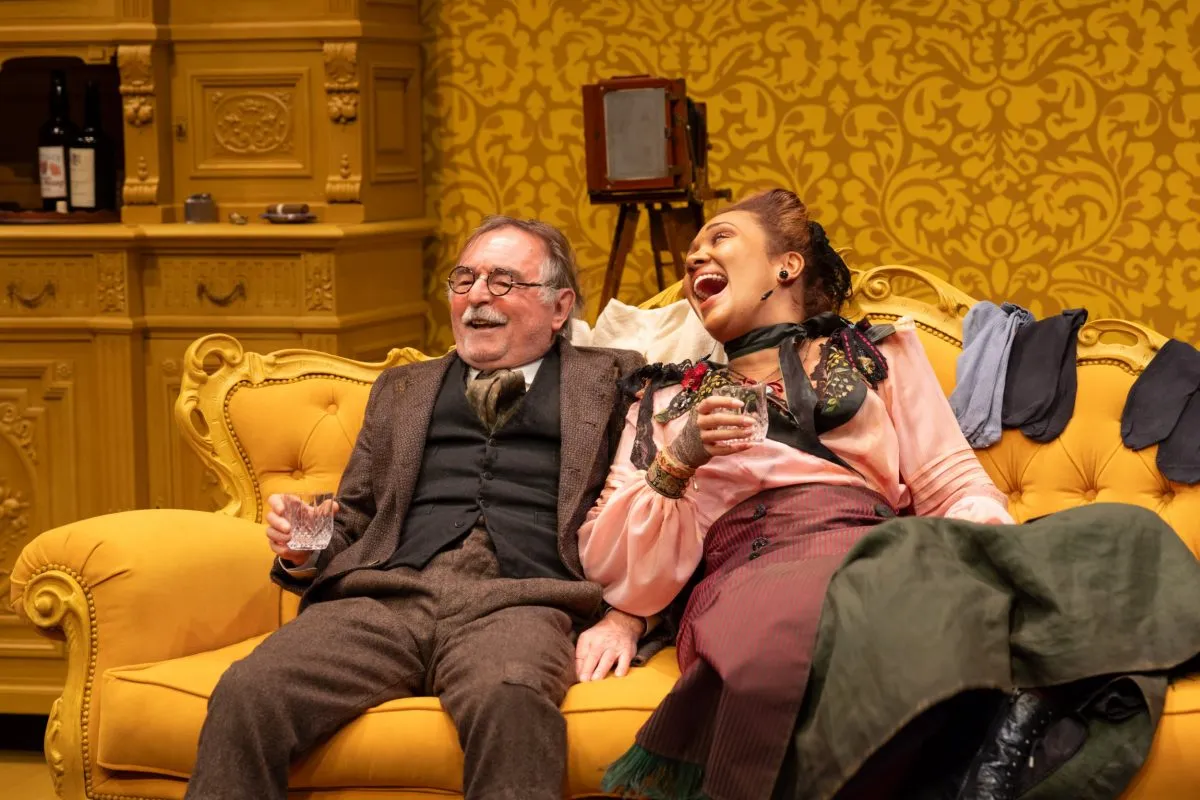
Ron Cook and Tori Allen Martin in When We Are Married at the Donmar. Photo: Johan Persson
Set in 1908, J B Priestley’s 1938 comedy concerns three Yorkshire couples who find they were never legally married. The critics loved the comic fallout that ensues, praising the direction, the design and the cast.
Links to full reviews are included but a number are behind paywalls and therefore may not be accessible]
5 stars ⭑⭑⭑⭑⭑
Gary Naylor for BroadwayWorld declared: ‘There can be few merrier shows in town this bleak midwinter than The Donmar Warehouse’s super-slick, laugh-a-minute, new production of When We Are Married.’
4 stars ⭑⭑⭑⭑
The i’s Fiona Mountford admitted: ‘I haven’t laughed so much at a play in a long time. What a glorious way to wrap up the theatrical year.’ She loved the play, the production and the cast: ‘Best of all is Sophie Thompson as the timid Annie Parker, a weary wife who gradually finds her voice and speaks her mind to her overbearing stuffed shirt of a spouse, Albert (Marc Wootton). “I know me own mind,” says he, imperiously. “Sometimes I wish you’d keep a bit of it to yourself,” she replies.’
WhatsOnStage‘s Sarah Crompton was full of Christmas cheer: ‘This revival of JB Priestley’s comedy of marital disharmony is a hoot, a joyful reminder of the power of supreme comic acting, and the way that humour can reveal truths with a light touch.’ She commented: ‘Priestley’s point, gently but fiercely made, is that the problem with his three complacent, pompous husbands, dignitaries of the council and the chapel, and their respective wives, is not that they are in themselves laughable, but that their hypocrisy and pretension is. Just as in An Inspector Calls, he smuggles social satire into an apparently straightforward drama.’ and she praised the design: ‘Peter Mckintosh’s mustard yellow set, with its flocked walls and giant aspidistra, is both real and unreal; Anna Fleischle’s beautifully detailed costumes catch the period but also say quite a lot about the men and women wearing them.’
Theo Bosanquet for LondonTheatre reported: ‘Donmar artistic director Tim Sheader’s production keeps things pretty simple, wisely not trying to reclaim the play for modern times but rather aim for some solid festive funnies. And it finds them in abundance thanks to a stellar comedy cast who get just the right balance between farcical OTT-ness and droll understatement.’ He concluded: ‘Ultimately it’s a love letter both to Yorkshire and to the tradition of farce, making it a smart piece of programming for this time of year. Just like a good Christmas cocktail, it’s fizzy, fruity, and eminently moreish.’
Time Out‘s Andrjez Lukowksi pointed out: ‘the basic idea of insufferable rich people lording it over the rest of us and how thrilling it would be to see them get taken down a peg or two remains timeless.’ He continued: ‘it remains funny, fat free and at least mildly insurrectionary. Plus Sheader’s witty, accessible production has a cast to die for: Thompson alone is a woman quite capable of bringing a house down, and her fluting voiced, slightly ethereal Annie is a hoot. But everyone is good fun, from Hodgkinson’s towering, increasingly flustered straight man Joseph to the great Rob Cook’s glorious supporting role as an increasingly smashed local press photographer.’
Dave Fargnoli for The Stage wrote: ‘Sheader sets a cracking pace from the first moments, introducing the characters in an energetic whirl and letting events spiral towards absurdity from there. The focus stays firmly on the zippy banter and comic misunderstandings, and while the inherent drama of characters’ marital turmoil is only ever lightly explored, Priestley’s sharply observational writing gently probes tensions between social classes and the weakening grip of patriarchal power.’
The Standard‘s Nick Curtis found: ‘The pleasure here is in the performances, specifically the relish these excellent actors give to Priestley’s robust, precise, Bradfordian dialogue.’ He stated: ‘It’s a compliment to say that Sheader’s direction is pretty much imperceptible. He seems to just let his fine cast run, without imposing any fussy “vision” on them’.
Calling it ‘an absolute blast’, Clare Allfree wrote in The Telegraph: ‘The real joy, … lies in the performances which to a man (and woman) are pure bliss: Marc Wootton’s Albert Parker, so puffed up with a baleful sense of his own importance you fear he might pop; Cook, who turns the low-hanging fruit role of a booze-sodden photographer into a masterful miniature portrait of hapless humanity. And there’s an excellent turn from Janice Connolly as the gleeful help Mrs Northrop, who sees right through her employers’ pretensions.’
The Times‘ Clive Davis was more begrudging in his praise than his fellow critics: ‘things are tied up a tad too neatly and briskly at the end. But with Siobhan Finneran’s Mrs Helliwell and Sophie Thompson’s Mrs Parker adding subtle touches along the way, it’s an evening of genial entertainment.’ Nevertheless he noted: ‘Tim Sheader’s streamlined revival…putters along very nicely. He gets note-perfect performances from the husbands, Marc Wootton and John Hodgkinson oozing complacency as Councillor Albert Parker and Alderman Joseph Helliwell. Jim Howick is even more amusing as the terminally timid Herbert Soppitt’.
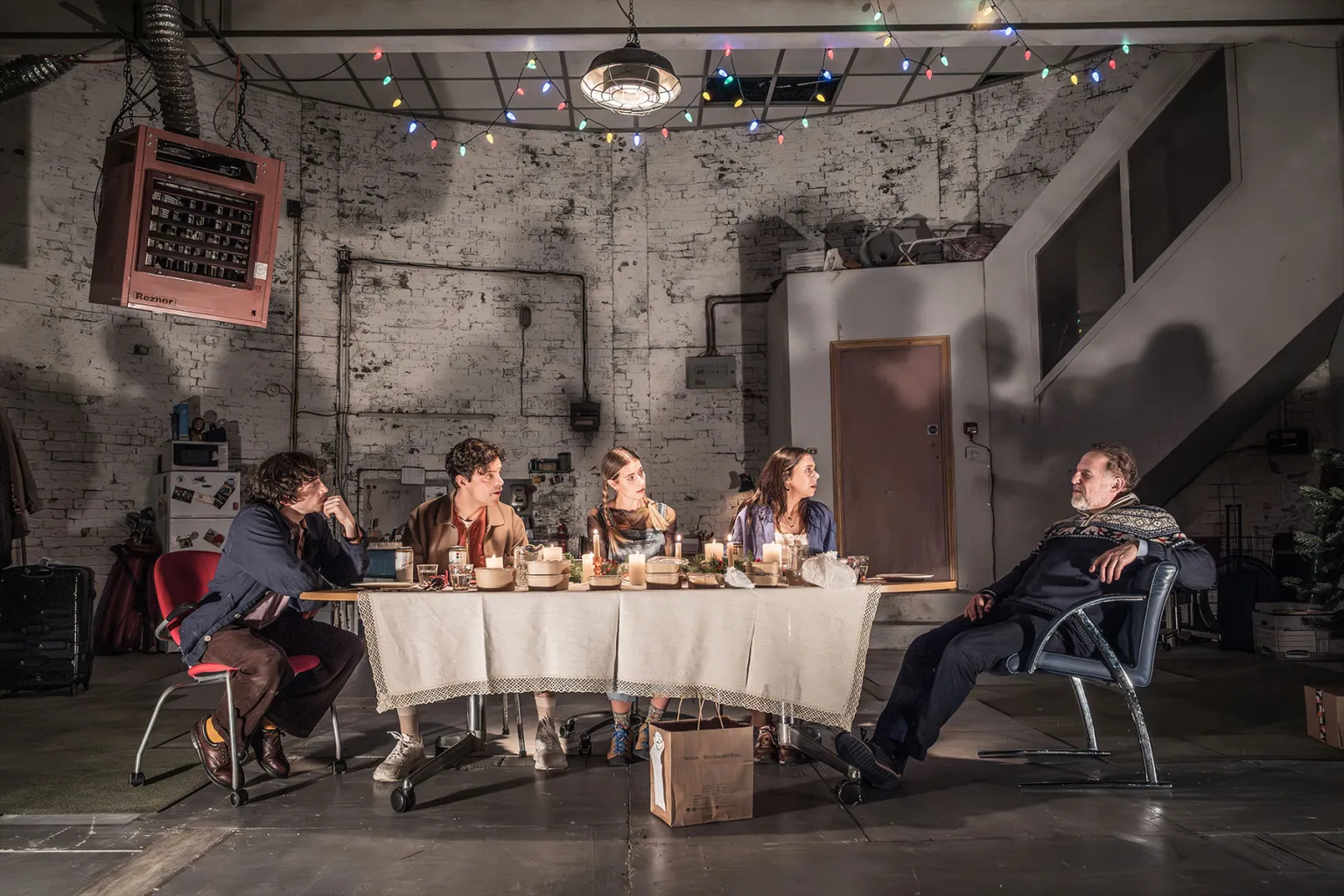
In his latest play, Sam Grabiner brings together a Jewish family on Christmas Day to argue about a threatening outside world.
[Links to full reviews are included but a number are behind paywalls and therefore may not be accessible]
4 stars ⭑⭑⭑⭑
The Guardian’s Arifa Akbar declared: ‘It is not a perfect play but an immensely courageous one. So is its programming by outgoing artistic director Rupert Goold. I have not seen a drama that deals with British Jewish identity with this much complexity. There are some manufactured rows between characters as a result, but they hold you, and emanate danger merely in their airing.’
The Times’ Clive Davis got all of a quiver: ‘Sam Grabiner’s account of a Jewish family gathering for a fractious Christmas meal is a fever dream of a play with a vicious, absurdist streak. There’s nudity, gore and vomiting, and the arguments about identity and Gaza stab at the heart. It’s uneven and downright confusing at times, but you are compelled to keep watching.’
Holly O’Mahony at The Stage enjoyed her evening: ‘It’s meticulously naturalistic, with the meal unfolding – and actually eaten – in real time. Grabiner has real skill for writing rounded characters with depth, and committed performances all round ensure Macdonald’s production never loses momentum, even in seemingly inconsequential moments.‘
Time Out‘s Andrzej Lukowski described it as ‘a dark, dark comedy about a jaw-droppingly dysfunctional British Jewish family. It is an anarchic meditation on the British Jewish psyche, that is really very fearless about ‘going there’ with certain political issues. It is about the British tradition of having a massive ding dong on Christmas Day. And it’s a comedy about living in London.’
3 stars ⭑⭑⭑
The Telegraph’s Dominic Cavendish found that the play ‘captures the wrangling, dread-filled mood of 2025. There’s a sense throughout that you never quite know what is going to be said, or happen, next.’ He continued: ‘as the ancillary characters try to chip in, too, and the script lunges for head-turning talking points (“I sort of miss the pogroms.”), it’s as though the author himself is stumbling about, groping for a firm hold on his subject. It’s hard to fault the cast, or James Macdonald’s direction, but it feels as though this promising piece is a few drafts short of its full potential.’
WhatsOnStage’s Sarah Crompton summed up: ‘The play is often funny, catching exactly the family tensions – the hyper competitive quizzing, the dislike of a new girlfriend – that rip apart many family Christmases. Grabiner’s writing is chewy and tough-minded. It tries to do a lot, raising so many difficult, complex questions that are impossible to resolve, and doesn’t always feel fully realised. But its portrait of inherited trauma is convincingly explored and James Macdonald’s direction, responsive to each change of mood, ready to allow silence as well as explosions, makes it intense and compelling.’
Matt Wolf for LondonTheatre called it a ‘fascinating, beautifully acted play’. His main reservation was: ‘I’m not sure Grabiner has yet landed the knockout ending his consistently intriguing script requires’.
The Independent’s Alice Saville made a similar point: ‘It’s got all the ingredients of a theatrical staple: the family drama where old secrets emerge over the dinner table. But Grabiner’s approach is more opaque: he lets massive revelations drop without really acknowledging them, fills his story with strange red herrings, and finishes with an odd, symbolic, ritualistic scene that you’d probably need a panel of debating religious authorities to really get to the bottom of.’
The Standard‘s Nick Curtis reported: ‘Challenging and frustrating though the play is, I was hooked throughout. It’s bold of Grabiner to tackle the ramifications of rising antisemitism and the war in Gaza, albeit in a raw and elliptical form. Bold too of the Almeida to schedule it during the season of family shows and panto. Christmas Day is often viciously funny, thanks in large part to the delivery of the always-excellent Lindsay and of Cooke’.
Gary Naylor at The Arts Desk was challenged by the show: ‘Director, James Macdonald, is juggling so many themes and churning personalities that I’m unconvinced that the required clarity of storytelling is distilled from the script’s whirlpool of ideas. That said, Grabiner does expect his audience to meet him at least halfway, as the best playwrights must, in that task. The writing brought me to the minds of this family, but not its hearts, still less its souls. I’m not sure I had the necessary perspective to see that far.’
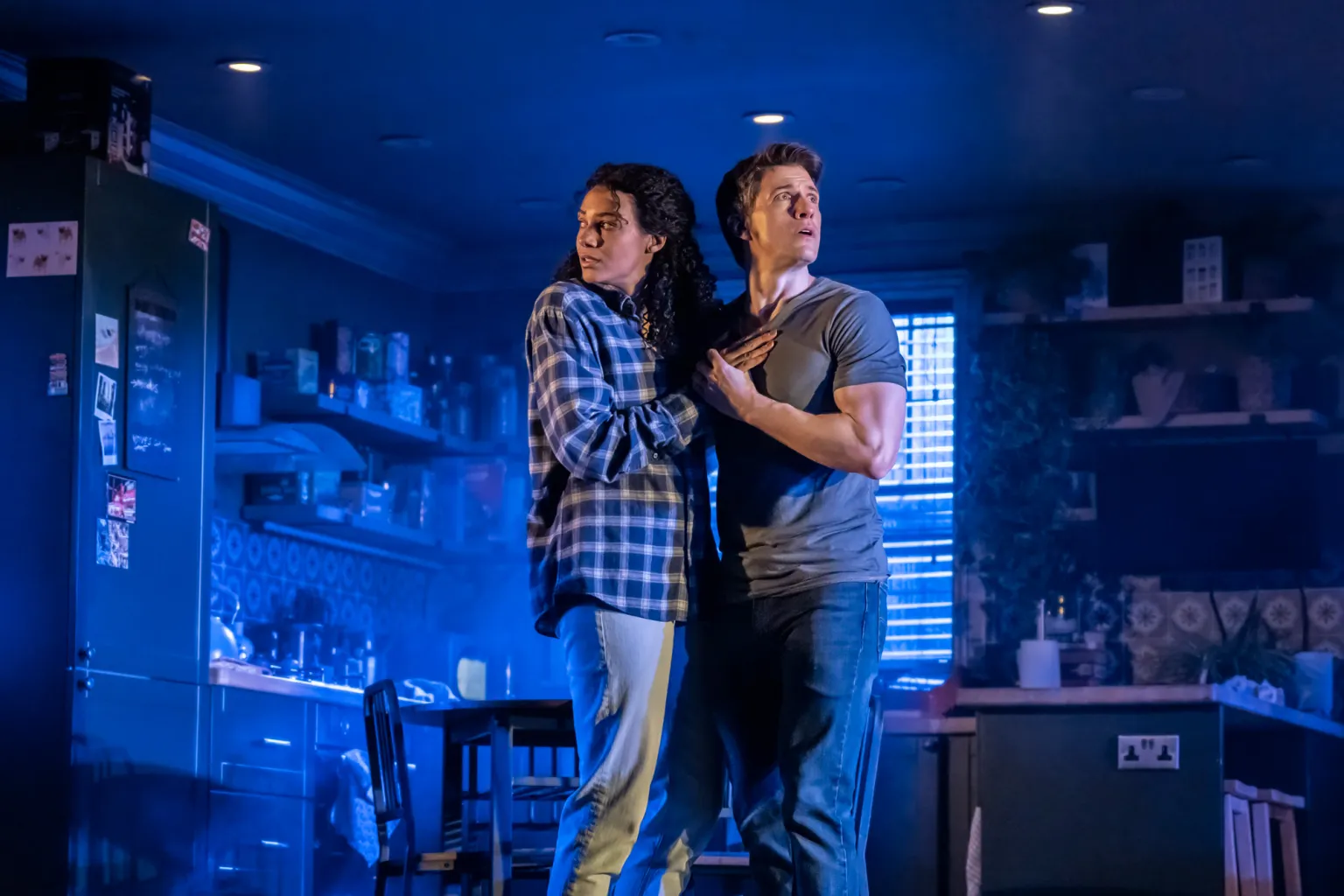
Melissa James & Patrick Heisinger in Paranormal Activity. Photo: Johan Persson
An American couple, played by Patrick Heusinger and Melissa James, move to London in an original story inspired by the Paranormal Activity film franchise. With a couple of exceptions, the critics found the play, directed by Punchdrunk’s Felix Barrett, written by Levi Holloway, and designed by Fly Davis, a scary experience.
Links to full reviews are included but a number are behind paywalls and therefore may not be accessible]
5 stars ⭑⭑⭑⭑⭑
The anonymous critic at London Theatre Reviews reported that they ‘left nearly two hours later, shaken, having experienced one of the most visceral, adrenaline-fueled pieces of theatre of the year (…) It’s scary, it’s clever, and it is undoubtedly the wildest ride in London right now.’
4 stars ⭑⭑⭑⭑
Kate Wyver for The Guardian began: ‘By treating horror as an art form rather than a cheap set of jump scares, this thrilling new show…proves how jaw-clenchingly, arm-clutchingly frightening horror on stage can be (…) But what is remarkable, thanks to Chris Fisher’s eye-popping illusions, is how that terror is accompanied by a giddy, awe-filled delight at the devilry we just witnessed – and how the hell they made it work.’
Tim Wicker in The Stage described how ‘Anna Watson’s lighting turns the domestic detail of Fly Davis’s split-level set into a place of moving shadows. Blackouts accompanied by the deafening pitch of Gareth Fry’s sound design all serve to keep us perpetually on edge’. He announced: ‘When the supernatural is finally unleashed on us, it’s spectacularly handled by illusionist Chris Fisher. The set pieces have you jumping in your seat, but they’re never cheap scares. They are impressively accomplished and always tightly woven into the story, from a scary bait-and-switch to subtler but no less nerve-shredding moments of dread. It’s a truly terrifying experience.’
Time Out‘s Andrzej Lukowski pointed out: ‘It’s not the only consideration, but judgement does essentially boil down to one main question: is it scary? To which the answer here is a frazzled ‘oh my, yes’.’ He was pleased that ‘on the whole it avoids manipulative jump scares in favour of unnerving moments of rug pulling, where what you assumed was happening in a scene is revealed to be horrifyingly off the mark. And the creepy atmosphere stuff is second to none’. He concluded: ‘Paranormal Activity is about as good as stage horror gets.’
The Standard‘s Nick Curtis found: ‘Barrett uses the full armoury of stage frights, from crash blackouts and sudden blaring rock music, to jump scares wrought through sound and lighting effects, to put the willies up us. He also has a superlative talent for misdirection. Though the techniques are familiar, it doesn’t make them any less electrifying.’ The cast were good too: ‘James gives a strong performance as the withdrawn and troubled Lou, and Heusinger is equally good as the mansplaining Jamie, whose cocksure self-confidence is slowly eroded.’
Rachel Halliburton for The Times liked it: ‘Where the scariest moments of the film lie in recorded footage, here Barrett leans fully into the live experience, and it pays off. Fly Davis’s meticulously observed two-storey set stands before us like an open doll’s house, letting us see each room — though as any good director knows, it’s what remains hidden that is most powerful.’
Rachel Agyekum for WhatsOnStage praised the actors: ‘The cast of four, led by Patrick Heusinger and Melissa James, deliver strong performances…Together, they express complex characters and their chemistry as a couple is believable.’
The Telegraph sent their film critic Tim Robey. He wasn’t disappointed by the switch from celluoid to stage: ‘The play tells a new story set in London, but reworks the original premise of a young American couple unsettled at home by things going bump in the night.’ Calling it ‘a spook-a-thon mounted with devious technical finesse,’ he said: ‘Surrounded by gasps, nervous giggles, and people jerking back in their seats, you won’t know what’s coming next.’
3 stars ⭑⭑⭑
Matt Wolf writing for LondonTheatre managed to stay calm: ‘The horror play franchise has had an uptick of late, from the return of Ghost Stories at the Peacock Theatre to the multiple roll-outs of 2:22 A Ghost Story. So it’s not entirely this production’s fault if some of the tricks up its sleeve seem mighty familiar by now. Isn’t it de rigueur for this sort of material to somewhere or other fold wonky electrics, sudden musical swells and rattling radiators or the like into the mix?’
2 stars ⭑⭑
Franco Milazzo at BroadwayWorld was left unmoved. : ‘Two stars feels about right here: one for the occasional inspired rug-pull, and one for reminding us that sometimes the scariest thing in theatre is wasted potential.’
Critics’ average rating 3.8⭑
Value rating 43 (Value Rating is a combination of the critics’ rating and the typical ticket price)
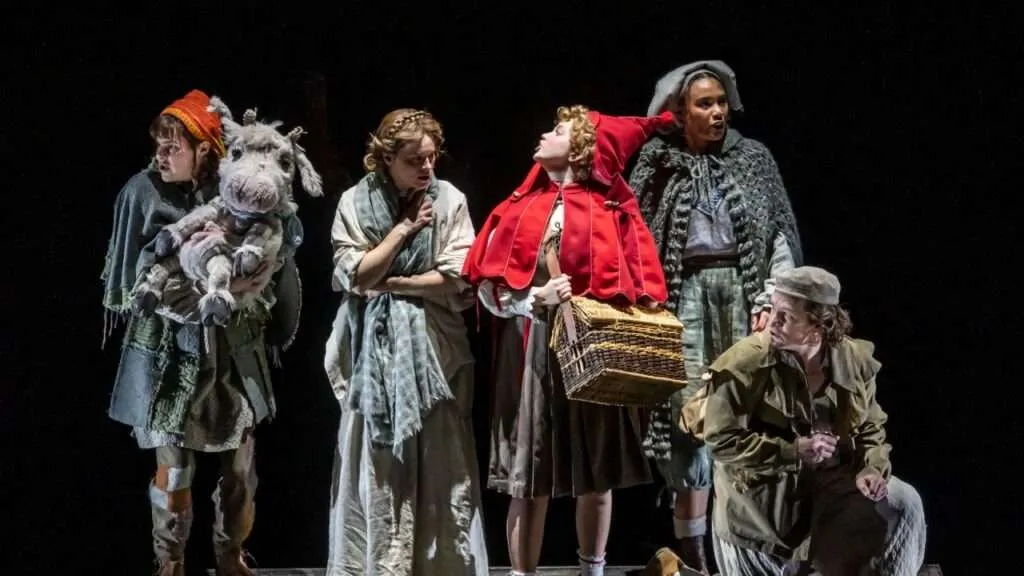
Into The Woods at The Bridge Theatre. Photo: Johan Persson
Following up his impressive open air Fiddler on The Roof, Jordan Fein directs Into The Woods for the Bridge Theatre. Stephen Sondheim and James Lapine‘s musical brings together familiar fairy tale characters encountering new deeper stories. For the critics, the 1986 musical seemed fresh and gripping, benefiting from Tom Scutt‘s lush set, and a perfect cast. So good were the reviews, it gained a transfer to the West End where it garnered even more brilliant notices.
[Links to full reviews are included but a number are behind paywalls and therefore may not be accessible]
Reviews from the transfer to the Noël Coward Theatre
5 stars ⭑⭑⭑⭑⭑
‘Picking up some new cast members along the way, Jordan Fein’s magical production of Sondheim and James Lapine’s fairytale meta-mash-up is even better than ever’, declared Tom Wicker at The Stage. He continued: ‘The joy of the show’s book and the lyrics is how skilfully they weave staples such as Cinderella, Little Red Riding Hood, Rapunzel and Jack and the Beanstalk into a shared universe, in which the titular woods are both the literal destination for the converging quests and storylines of these characters, and a moving metaphor for adulthood and parenthood.’
LondonTheatre‘s Julia Rank declared: ‘The entire team’s respect for the material is palpable, combined with irresistible joy and playfulness. As the evenings draw in, it provides a return to childhood with an adult twist and makes you feel everything. This return to the woods is not to be missed.’
Alex Wood for WhatsOnStage noted: ‘The heightened intimacy of the West End auditorium allows fine details in Scutt’s design to shine through, such as the way Cinderella’s gowns subtly “grow” and expand with each successive midnight as her wish snowballs. This visual detailedness is matched by technical design work from lighting designer Aideen Malone, sound designer Adam Fisher, and video designer Roland Horvath. Fisher’s sound design makes full use of the new space, pushing a subwoofer vibration through the stalls that goes well beyond what was achievable at the Bridge. Paired with Horvath’s video projections, the arrival of the giant becomes a moment of genuine awe, rattling the theatre to its core. A production that has lost none of its magic.’
Cheryl Markosky for BroadwayWorld reported: ‘Scutt’s glorious, wooded set on a traditional proscenium-arched stage resembles a child’s innocent toy theatre. As well as being thrilling, it also reminds us we will leave the theatre after the show and return to the real world. Along with the awe of this stunning revival, we’ll also take with us Sondheim’s thoughtful existential themes of loss, grief, the strength of storytelling and the importance of passing the right values onto our children.’
Time Out said: ‘what really sets this production apart is how it moves. Tom Scutt’s design fills the stage with trees, and the cast pop in and out of them so smoothly that it feels like you’re truly following them through a forest. One minute you’re watching the Baker by a trunk, the next Cinderella bursts out from behind another, dishevelled from running. The musical links between scenes, where the title refrain comes back round and characters appear one by one to deliver a single line, never missing a beat. You’re barely waiting for the story to move on, because you’re too busy watching who’ll pop out from behind the next tree. It’s a wordy, fiddly, nearly three-hour musical about fairytales, and somehow it flies by.’
4 stars ⭑⭑⭑⭑
Dominic Maxwell of The Times mentioned: ‘Everyone impresses, but Kate Fleetwood (…) is stunningly good as the Witch. Grotesque but sardonic, she becomes ever more human as the night goes on.’
Reviews from the run at the Bridge Theatre
5 stars ⭑⭑⭑⭑⭑
The Times’ Clive Davis declared: ‘Jordan Fein … works wonders with a Stephen Sondheim show which has, in the past, risked sinking under the weight of its outsized ambitions.’ He found it ‘endowed with stunning set and costume designs by Tom Scutt and extraordinarily atmospheric lighting by Aideen Malone, is sharp, propulsive and often very funny.’
‘It’s a great production of a terrific show’ proclaimed Sarah Crompton at WhatsOnStage. Why is it terrific?: ‘There are familiar characters: Cinderella, Red Riding Hood, a Witch. But there’s also a Baker and his Wife, who long for a child, and the genius of the show is the way that the arrival of these unfamiliar figures with their real human feelings into the landscape of myth transforms the narrative, making it dangerously real and unpredictable.’
Time Out‘s Andrzej Lukowski described how ‘every second is filled with Sondheim’s presence: his lush, motif-saturated score of baroque nursery rhymes feels as vividly alive as the forest itself; his lyrics are sometimes hilariously bathetic, sometimes formally audacious, sometimes devastatingly poignant, often all three in a single song.’ He assured us: ‘Fein smashes it, largely thanks to exceptional casting.’ He rounded off: ‘It’s just great, really, a sublime production of a sublime musical with a sublime cast. Fein doesn‘t try to reinvent the wheel, so much as he acknowledges the importance of the wheel’s function and then goes ahead and makes the best looking, best crafted wheel you’ve ever seen. Pure magic.’
‘this is a much darker, sexier and more thrilling journey into the woods than I’ve ever experienced before’ revealed London Theatre‘s Marianka Swain. She analysed why it is so effective: ‘The sneakily profound existential themes come through potently: individual needs versus a collective society, how we make hard choices and process grief and guilt, the immense power of storytelling, and the values we pass down to our children. But this is also a transporting wonder – everything you could wish for and more.’
Aliya Al-Hassan for Broadway World called it: ‘A celebration of these twisted fairytales, this is a razor-sharp production full of heart, thoughtful design and wonderful performances. Pure theatrical magic.’
4 stars ⭑⭑⭑⭑
The Guardian’s Arifa Akbar said: ‘its book is so clever and it is driven by the most gorgeous (if tricky) music? Jordan Fein’s production shimmers and shines with all the humour and pathos of these errant fairytale characters who misadventure into the woods, winding their rearranged stories around each other.’ She continued: ‘The actors are on blazing musical form too, hitting every difficult or dissonant note, and each performer finds a moment to excel.’ Her conclusion? ‘This production has none of the broadness or festive spirit of a Christmas show or panto, but the wonder and magic of both.’
The Telegraph’s Dominic Cavendish explained: ‘Fein initially positions his lead cast around a work-table, with Michael Gould markedly understated as the show’s Narrator. Then designer Tom Scutt reveals a woodland scene with tree-trunks so tangible and foliage so lush, you want in on the adventure, too.’
Louis Chilton for The Independent thought: ‘it’s no bad thing that director Jordan Fein has opted for a fairly down-the-line approach. There are no real surprises here, no radical reinvention in characterisation or staging. But it’s a production that really plays to the musical’s strengths: the big moments feel enormous.’ He pointed out: ‘It helps that so much of the production, particularly the set design, costume design (by Tom Scutt) and lighting (by Aideen Malone), is stellar: on a purely aesthetic level, this production is a thing of lush and arresting beauty.’
The Standard‘s Nick Curtis noted: ‘Fein assembles a terrific cast of new and established singing talents who give soaring voice to the witty lyrics and a score that hopscotches elegantly through recurring themes and motifs.’
3 stars ⭑⭑⭑
The Stage‘s Sam Marlowe was one of the least keen of the reviewers: ‘Fein’s production looks and sounds sumptuous, yet it’s a little like an expensive chocolate box, with nothing within that offers any fresh or surprising flavour.’ Another objection was, ‘the mechanics of the plotting feel slightly laborious’ but she admitted: ‘Still, it’s plush and polished, and moment by moment, there’s plenty to enjoy. And visually, it’s spellbinding.’
Combined Critics’ average rating 4.6⭑
Value rating 46 (Value Rating is a combination of the critics’ rating and the typical ticket price)
Into The Woods was at the Bridge Theatre until 30 May 2026 . It can be seen the Noël Coward Theatre until 9 January 2027..
If you have seen Into The Woods, please leave a review and/or rating below
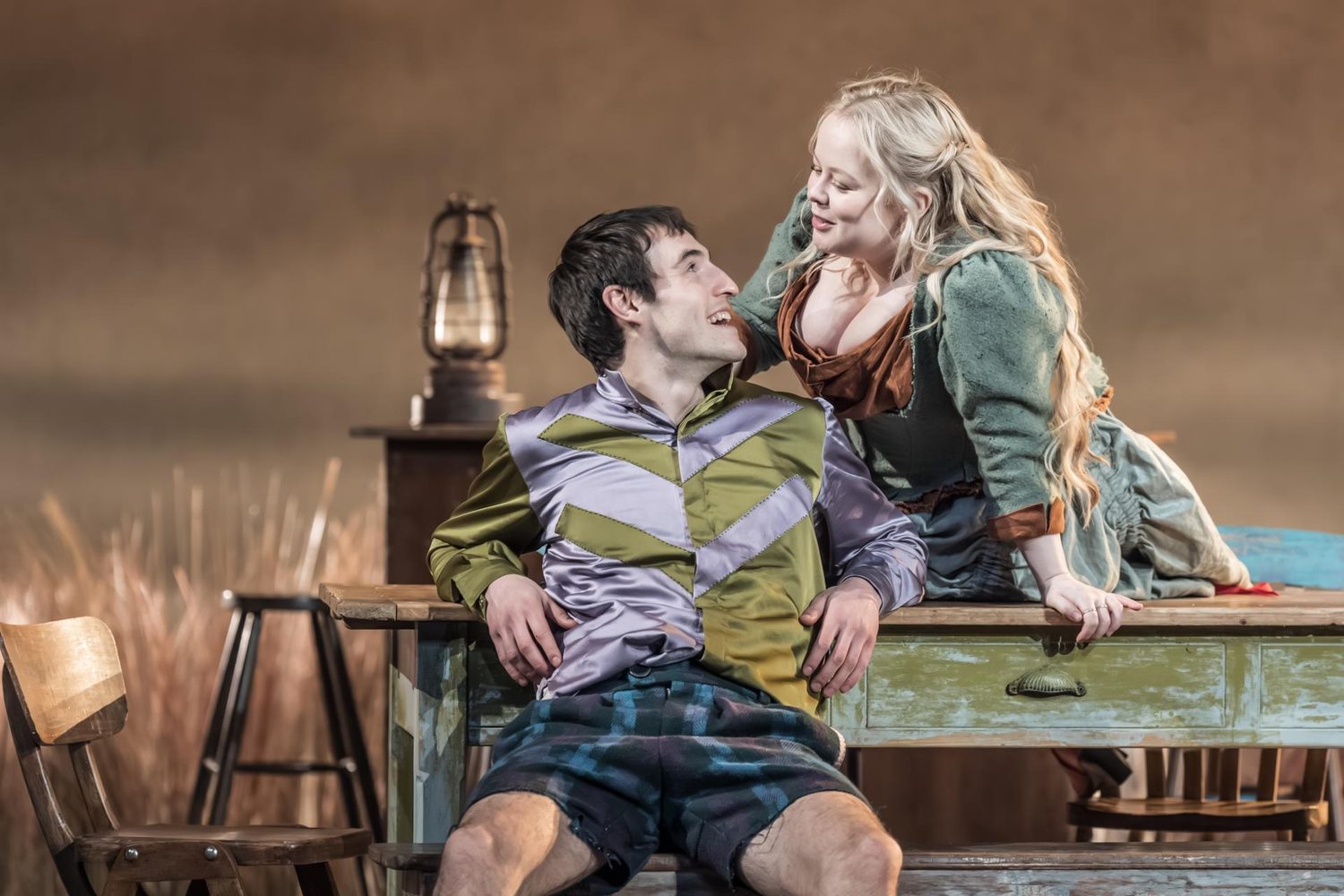
Éanna Hardwicke and Nicola Coughlan in The Playboy of the Western World. Photo: Marc Brenner
It may be a classic of Irish theatre but London critics gave J M Synge‘s The Playboy of the Western World a cool reception. The story of a self proclaimed murderer who becomes a local celebrity seemed slow and old fashioned to many of them. There was also widespread criticism of Caitríona McLaughlin‘s production as being uneven. Worst of all, the decision to be faithful to the traditional Irish accents made it difficult to understand. On the other hand, Derry Girls alumni Nicola Coughlan and Siobhán McSweeney were praised for their performances as lovestruck women, and Katie Davenport‘s design impressed.
4 stars ⭑⭑⭑⭑
Holly O’Mahony, writing for LondonTheatre, found the play ‘transfixing: ‘There’s great direction from McLaughlin here, as a parade of beautiful young lasses appear with gifts, practically quivering with lust’ (…) ‘If you don’t know whether to laugh or cry by the end, you’ll still leave satisfied, with plenty to chew over’
3 stars ⭑⭑⭑
Dave Fargnoli for The Stage found it ‘an appealingly edgy, unsettling treatment.’ He noted: ‘McLaughlin pitches the piece somewhere between slow-building farce and folk horror’. He also thought: ‘it looks great; bleak and vivid and just slightly disconcerting’. But ‘the performances themselves are uneven, with some of the cast members needing time to lock into the particular, lilting rhythm of Synge’s writing’.
The Times’ Clive Davis warned: ‘this production … is too reverential to do full justice to the dark humour in the text. It’s also delivered in strong traditional accents that will leave outsiders straining to make sense of the dialogue.’
The Guardian’s Arifa Akbar said: ‘Synge could even have been the Tarantino of his time, glamorising Christy’s violence. But it seems old-fashioned in this faithfully period production‘
The Standard’s Nick Curtis found: ‘the portrayal of poverty and repressed lasciviousness that caused riots when the play originally opened at Dublin’s Abbey Theatre now feel quaint and stereotypical.’ While praising the acting, he decided: the ‘production celebrates the play’s lyrical language but falls prey to its meandering, repetitive structure.’
For Anya Ryan in Time Out (assumed 3 stars) there were ‘beautiful, affecting images of County Mayo folklore alongside some standout acting performances’, however: ‘the production comes across as a hodgepodge of competing ideas.’ She attributed some of the blame to ‘the rambling, stretched-out plot’.
Clare Allfree for the Telegraph complained: ‘thanks to the use of archaic Irish accents and syntax, Synge’s succulent poetry is frequently unintelligible – almost to the point of inaccessible – to those not acquainted with the dialect.’ She said Nicola Coughlan gave ‘a performance of stealth power’.
The Independent’s Alice Saville found it: ‘densely written and deeply strange, meaning it’s not a straightforward watch – but its leads have got enough vigour and wit to carry us through.’ She picked out: ‘McSweeney (as Widow Quin) is wonderfully funny as this calculating local weirdo’. As for the production: ‘the tone feels disconcertingly uneven. Some bleak scenes are played straightforwardly for laughs, while potentially comedic moments (the final punchline included) are invested with a surprising heaviness.’
Cindy Marcolina at BroadwayWorld wrote: ‘McLaughlin approaches the text with pure naturalism. She leans into the humour, but counteracts it with creepy disturbance. At the hand of Éanna Hardwicke, Christy is an impish figure, a devilish narcissist who chuckles and stalks and teases like a displaced fae from a fairy tale.’ She loved Nicola Coughlan’s ‘thrilling performance. Vain and opinionated, she tries hard to resist the stranger’s allure with upfront wariness – but even her fiery feistiness bends.’
Alun Hood for WhatsOnStage opined: ‘This is a sumptuous production, rich in detail, craft and spectacle. It’s impressive but dramatically inert, ultimately not really proving why Synge’s tale of romantic disappointment and the ludicrousness of putting people on a pedestal, is worthy of a major revival at the present time.’
2 stars ⭑⭑
Alekx Sierz on The Arts Desk put the boot in: ‘Michael Flaherty’s bar should be like the cramped room of Conor McPherson’s The Weir (obviously influenced by Synge). Instead, here it is a huge space like a mega urban Wetherspoon’s. A massive barn. Hardly a place of poverty. To fill the acres of empty space, director Caitríona McLaughlin … adds a fair amount of over-designed folkloric business, with keening funeral processions, masked mummers and goddess worshippers galore.’
Critics’ average rating: 3.0⭑
Value rating 35 (Value Rating is a combination of the critics’ rating and the typical ticket price)
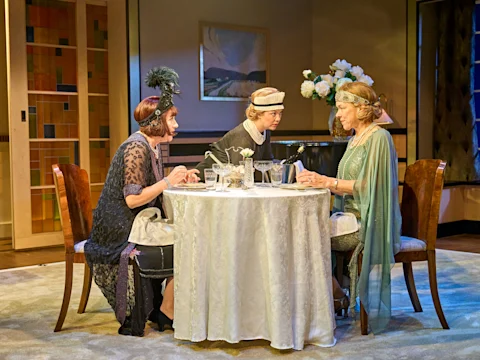
A neglected Noel Coward comedy turns up at The Menier Chocolate Factory to appreciative reviews. Janie Dee and Alexandra Gilbreath provide plenty of laughs as two middle-aged married women whose sexual desires are stirred by the arrival of an ex-lover. There is even more fun when a maid played by Sarah Twomey appears in the second act.
[Links to full reviews are included but a number are behind paywalls and therefore may not be accessible]
4 stars
The Telegraph’s Dominic Cavendish welcomed it: ‘In Christopher Luscombe’s retro, stylish and delightful Menier revival, Janie Dee and Alexandra Gilbreath give us drunk-acting of the highest order.‘ He admitted: ‘the play’s charms are ephemeral, but as the forgivably badly behaved duo – a touch of Ab Fabavant la lettre – discover, resistance is futile.’
The Times‘ Clive Davis told us: ‘It’s light, it’s fluffy, it’s ridiculous, but when actresses of the calibre of Janie Dee and Alexandra Gilbreath are having so much fun in the lead roles, you’re happy to see them making merry.’
Laura Jones for BroadwayWorld declared: ‘It’s a night of humour, subtle longing and quietly sharp social observation. For those who appreciate well-crafted comedy with a vintage edge, Fallen Angels is a thoroughly enjoyable reminder of why Coward remains a master of the drawing-room farce.’
3 stars
The Guardian‘s Arifa Akbar wrote: ‘It is not as rich as Blithe Spirit or Private Lives, and a little one note, but it is impeccably performed, with shades of 1920s screwball comedy and excellent turns from Dee, who plays Julia as blithely imperious, and Gilbreath, who becomes more cackling and crude as she tips back the bubbles.’
For Tim Bano in The Standard: ‘Christopher Luscombe’s handsome take has plenty of good moments, and two strong central performances from Janie Dee and Alexandra Gilbreath, but it struggles to completely lift itself beyond being gently entertaining.’
Matt Wolf for LondonTheatre found: ‘Unfolding on an airy Art Deco set from Simon Higlett, and costumed to kill by Fotini Dimou, this iteration of the play is good fun’.
WhatsOnStage’s Sarah Crompton complained: ‘the obsession of the two friends…with their lost French love Maurice seems vaguely tiresome; their cleverness undermined by their passion.’ She continued: ‘Christopher Luscombe’s sparkling production does everything it can to paper over the cracks and disguise the occasional longueurs and it is blessed with two uproarious comic performances from Janie Dee and Alexandra Gilbreath as the frustrated and excitable pair.’
Dave Fargnoli for The Stage was lukewarm in his reaction: ‘Director Christopher Luscombe sets a plodding pace at the outset, underlying the tedium of the characters’ lives of leisure in contrast to the frantic chaos of the later scenes. The tone swerves from stultifying stiffness to outrageous absurdity as the wives scheme, bicker, and get absolutely trashed on champagne, leading to some fine moments of physical comedy which, while amusing, unavoidably pull against the extreme poise of Coward’s acerbic dialogue.’ But he did note: ‘Sarah Twomey gives a scene-stealing turn as precocious servant Saunders’.
‘it’s a genteel museum piece’ said Time Out’s Andrzej Lukowski.
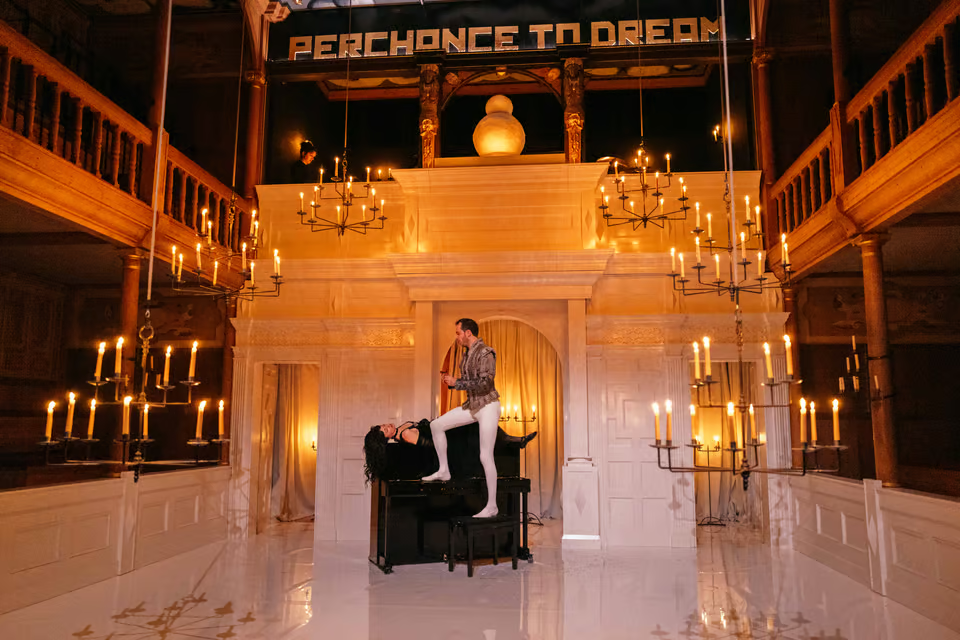
A Midsummer Night’s Dream at Shakespeare’s Globe. Photo: Helen Murray
If you were thinking of treating the kids to the Globe’s first ever production of Shakespeare’s popular comedy about fairies, you may have to think again . Their website warns: ‘It contains loud noises, strong language, scenes of sexual content, drug use and gunshots.’ Headlong theatre’s Holly Race Roughan (with co-director Naeem Hayat) has found every dark element in A Midsummer Night’s Dream, and then proceeds to darken it. The result pleased some critics and outraged others. Nearly all were shocked by the new violent ending. Danny Kirrane received praise for his coke-snorting, downtrodden Bottom.
[Links to full reviews are included but a number are behind paywalls and therefore may not be accessible]
4 stars ⭑⭑⭑⭑
Kate Wyver for The Guardian explained: ‘comedy and horror sit cheek by jowl, as director Holly Race Roughan conjures a nightmarish take on Shakespeare’s classic dream.’
Using the word ‘creepy’ more than once, Tim Bano at The Standard explained: ‘what is usually a summery froth of fairies and lovers (turns) into a crisp and frosty fairytale, a kind of sexed-up Narnia, twisting a Grimm story out of one of Shakespeare’s most popular plays.’ He ended: ‘(the) climax may not be for everyone, but the ride to reach it is wonderful, as Roughan rids the play of any trace of hazy summer, and turns it instead into a deeply unsettling winter’s tale.’
Holly O’Mahony for The Stage warned: ‘Nothing is quite as it seems. At court, the soon-to-be-weds Theseus and Hippolyta are at each other’s throats with knives and guns, while in the forest – which, on Max Johns’ set of crisp linen and polished white floor, offers no trace of woodland – there’s nothing playful about the sinister fairies, who hurl charms that land with the crack of a whip.’ She pointed out: ‘The text sometimes battles against Roughan and Hayat’s high-concept reframing, which takes considerable creative licence (…) But what becomes a mesmerisingly unusual reading ultimately wins out.’
Rachel Halliburton at The Arts Desk also endorsed the interpretation: ‘this is a sharply beguiling production, full of wit and vigour. Some might condemn it for trying too hard to shock, but there’s nothing we see on stage that isn’t in a text that I, personally, find more fascinatingly disturbing each time I read it. The Tarantino-style ending certainly makes jaws drop, yet there are plenty of real-life tyrants who would not hesitate to deal with outspoken individuals as callously as Marcus’s king does. Go, and bank on a wild time – it’s credible, clever, and you’ll never look at a banana in the same way again.’
Alun Hood for WhatsOnStage found: ‘There are few laughs but plenty of chills, cruelty and intimations of some of the worst of human behaviour, from coercion to paedophilia. If you let go of the idea of traditional enchantment, it’s a compelling piece of theatre.’
3 stars ⭑⭑⭑
Time Out’s Andrzej Lukowski was confused, all the way to the changed end: ‘to me it felt like a cruel, capricious whim that snatched defeat from the jaws of victory, ending an enjoyably spikey Dream on a note of pure WTF.’
Julia Rank for LondonTheatre seemed taken aback by the ‘brutality’. She concluded: ‘Not everything in this production gels but it does lead to a genuinely shocking denouement. It isn’t easy to make amends and request the hand of friendship under such circumstances.’
2 stars ⭑⭑
Kirsten Grant wrote in The Telegraph: ‘Headlong Theatre’s grim new production for the candlelit Sam Wanamaker Playhouse takes one of the few Shakespearean comedies that remains genuinely funny, and strips it of much of its romance, enchantment and humour.’ Her parting shot: ‘What a nightmare this Dream is.’
Ben Dowell for The Times called it: ‘a spare, pitch black ballet-themed spectacle full of spite and horror – with a needlessly shocking final scene that has to be seen to be believed.’ Not that he’s encouraging you to see it: ‘a summer dream becomes a wintry nightmare you’ll be glad to wake up from.’
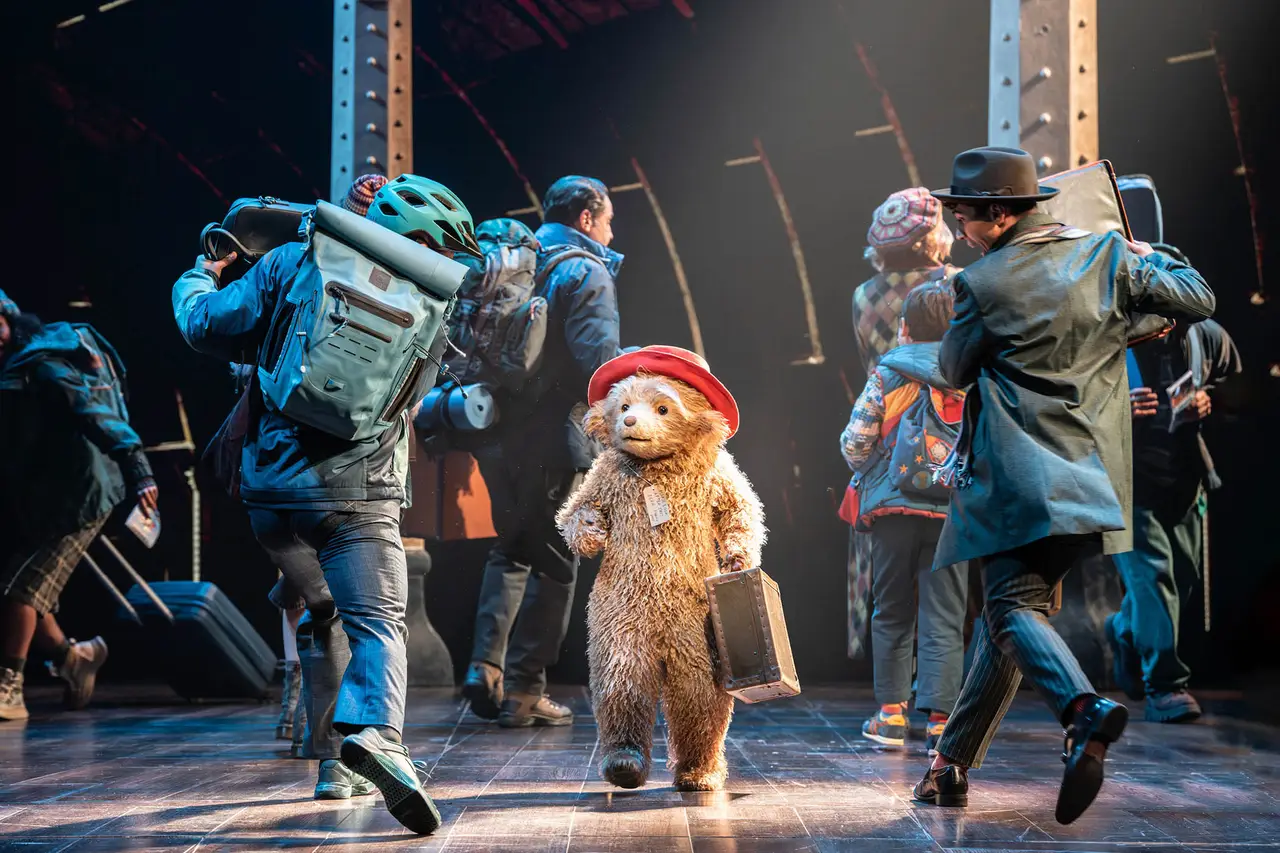
Paddington The Musical at The Savoy Theatre. Photo: Johan Persson
The critics’ hearts were captured by the little bear from Peru. Even those who found faults in the production still awarded four stars. For the majority who gave five star reviews, it was not only the clever creation of the little chap but every aspect of the production pleased. This one could run and run.
[Links to full reviews are included but a number are behind paywalls and therefore may not be accessible]
5 stars ★★★★★
LondonTheatre’s Marianka Swain declared: ‘Paddington is pure theatre magic.’ To prove it, she pointed out many theatrical flourishes including: ‘There’s … thoughtful exploration of what family, home and belonging can mean, and how our capital thrives because it’s a cultural melting pot. That’s irresistibly expressed in “The Rhythm of London”, begun by Brenda Edwards’s Caribbean neighbour Tanya, and opened out to involve high-kicking Buckingham Palace guardsmen and bankers waving sparkly Union Jack brollies. Tom Pye’s wondrous design, a real love letter to London, also features an actual black cab and red telephone box, pastel-coloured Windsor Gardens, and full-size giraffes in the Natural History Museum.’
The Guardian‘s Arifa Akbar decided: ‘This is the new Mary Poppins: a well-known story imaginatively staged, immaculately performed and utterly winning. Tom Fletcher’s songs are marvellous, Jessica Swale’s book earnest, Ellen Kane’s choreography vigorous.’
Olivia Garrett at Radio Times enthused: ‘Honestly, this show is exactly what it promised and more. Cutting right into your soul with its message of kindness, love and acceptance, it’s a musical we need now more than ever.’
‘This is a show with a heart as big and generous as Paddington himself’ raved Sarah Crompton at WhatsOnStage. She described Paddington on stage as ‘utterly real, his little grey eyebrows rising in surprise, his jaw dropping open when he is shocked, his nose wrinkling in search of marmalade.’
The Independent‘s Alice Saville explained: ‘The most immediately delightful thing about this show is that they’ve got Paddington absolutely spot on. Who wouldn’t give a home to this bear? (..) Inside this super-realistic (and no doubt quite warm) suit is 4ft tall actor Arti Shah, who gives him authentically bear-like movements while singer James Hameed lends his incongruously powerful vocals to punchy songs by Tom Fletcher (of McFly fame).’
Tim Bano for The Standard described some of the experience: ‘In just the first twenty minutes we get smoke, fire, explosions, collapsing furniture, rain, and whipped cream. It’s a multimillion pound piece of theatre that feels warm and fun and intimate, with no opportunity missed for a bit of extra silliness or a burst of theatricality.’
The i’s Fiona Mountford noted: ‘It is not only the bear design that is marvellous. Scenic designer Tom Pye makes stunning use of the high ceiling and proscenium arch of the theatre by flooding them with a changing mosaic of images that evoke Paddington’s homeland and the superhero cartoons that Mrs Brown designs. Every detail of this show is exquisite – and I confidently predict that this will be one proudly British export that will go on to conquer the world.’
The Mail’s Patrick Marmion reminded us: ‘let’s not forget, there’s also a musical attached to the costume, with comic, anthemic and shamelessly sappy songs by Tom Fletcher (of yesteryear’s boy band, McFly).’
4 stars ★★★★
The Telegraph‘s Dominic Cavendish almost got carried away: ‘Paddington Bear has been brought to life in a funny, feel-good, family-friendly musical that looks set to run and run (…) see the little visitor from Darkest Peru sing, dance (after a modest fashion) and bumble for Britain! Children will love him and adults will warm to his restorative sweetness’ until he stepped back and remembered he’s a theatre critic: ‘it’s a touch threadbare, and a little over-stuffed with songs, but fittingly, it’s still a very welcome addition to the British musical family.’
Similarly Time Out‘s Andrzej Lukowski liked it but wasn’t completely won over: ‘a fine creative team led by director Luke Sheppard has created a very enjoyable show indeed’ but ‘It’s a luxury musical that feels overstuffed at times.’
The Stage‘s Sam Marlowe stopped trying to be objective: ‘although there is plenty about this show that needs tweaking, rewriting and frankly doing away with altogether, there’s an overwhelming amount in Luke Sheppard’s production that is fundamentally just right. Save yourself some time and succumb – because resistance, trust me, is futile.’ She does list its many shortcomings, only to conclude: ‘whatever the faults of the show, it’s sweeter than a marmalade sandwich, and if the cuddly creation at its heart doesn’t make it a hit, I’ll eat his hat.’
Adam Bloodworth at CityAM wasn’t convinced by the hype: ‘What sticks is that the much-hyped animatronic bear’s mouth is fairly clunky, without the depth of movement to simulate real speech. When live lines are amplified from the side of the stage by designer-performer James Hameed, the mouth opens and closes more like a Sesame Street puppet than anything resembling ‘real’ speech.’ He pointed out: ‘Paddington the Musical at its core is actually a fairly analogue musical experience, a fairly conventional piece of musical theatre that is sustainably quality without relying on particularly viral moments, gimmicks or tricks. Instead Luke Sheppard’s overall show is a wholesome homage. Just nice songs and a decent ensemble held together by some brilliant writing. What more could you want?’
Critics’ average rating 4.7★
Value rating 49 (Value Rating is a combination of the critics’ rating and the typical ticket price)
Paddington The Musical can be seen at the Savoy Theatre until at least February 2027. Buy tickets directly from https://paddingtonthemusical.com
Rory Keenan in The Spy Who Came In From The Cold. Photo: Johan Persson
The Chichester production of The Spy Who Came In From The Cold, adapted by David Eldridge from John Le Carré’s novel and directed by Jeremy Herrin, transfers to London prior to a UK tour. Critics welcomed it despite many thinking it didn’t convey the depth of the original. Rory Keenan was praised in the lead role.
4 stars ⭑⭑⭑⭑
Andrzej Lukowski of Time Out enjoyed it for waht it was: ‘This is a slick and yes, maybe slightly MOR adaptation of Le Carre’s taut, brutal espionage yarn. But it’s a very good one, and Eldridge deftly crafts an intensely interior world, with us seeing the action unfold as much from within jaded spy protagonist Alec Leamas’s head as without.’
WhatsOnStage’s Sarah Crompton noted: ‘one of the many strengths of David Eldridge’s fluent adaptation for the stage … is that it emphasises the way in which this period piece is also a piercing play for today. It’s a serious and sobering examination of the shoddy accommodations of real politick, and their effect on the human heart.’
The Standard’s Nick Curtis called it ‘a propulsive, streamlined and reassuringly old-fashioned staging’. The Independent‘s Alice Saville called it ‘a lean, pacy adaptation’. She remarked: ‘Rory Keenan brings a rougher, more careworn energy to this story’s conflict-scarred star spy, Alec Leamas.’
Chris Dorrell for CityAM got over excited: ‘The production had everything you’d want from a spy thriller: great coats, a lonesome trumpet soundtrack, and enough drink-dropping twists to leave the person in front of you soaking (sorry).’
3 stars ⭑⭑⭑
Theo Bosanquet at LondonTheatre found: ‘a lot of the action is overly static, stilted by the understandably exposition-heavy dialogue, which lends it a radio play feel at times.’ However: ‘There is much to enjoy, particularly for Le Carré aficionados, and it’s a noble effort to show that his densely detailed novels are stageable. But those unfamiliar with the source material may feel somewhat left out in the cold.’
Clementine Scott for BroadwayWorld concluded: ‘This has still been a tale exhilaratingly told, and if it fails it fails for being too inventive in developing Smiley’s character, rather than not inventive enough. Leamas’s interiority is an issue for adaptations of this novel that needs puzzling out, but the solution is not just to have another character drily explaining his motivations.’
Claire Allfree for the Telegraph was disappointed: ‘Le Carré’s novel is a shocking slice of spiritual nihilism in which everyone is ultimately damned. At times, Eldridge’s play feels suspiciously more like a romantic melodrama.’
The Times’ Clive Davis was concerned that: ‘While Rory Keenan is thoroughly convincing as the cynical, dishevelled intelligence officer Alec Leamas, Jeremy Herrin’s … production… risks falling between two stools. Le Carré fans will, I suspect, find themselves hankering after the book’s intricately layered study of secret service ethics; newcomers, on the other hand, may well be left confused by the breathless twists in the narrative.’
For Aleks Sierz at The Arts Desk, particularly in the first act: ‘things happen very fast, and atmosphere is sacrificed to speed of storytelling – which dilutes the noir in this noirish thriller.’
Critics’ average rating 3.6⭑
The Spy Who Came In From The Cold can be seen at sohoplace until 21 February 2026.Buy tickets directly at sohoplace theatre
If you’ve seenThe Spy Who Came In From The Cold at sohoplace, Chichester Festival Theatre or on tour, please share your review/comment and rating below
Manage Consent
To provide the best experiences, we use technologies like cookies to store and/or access device information. Consenting to these technologies will allow us to process data such as browsing behaviour or unique IDs on this site. Not consenting or withdrawing consent, may adversely affect certain features and functions.
Functional
Always active
The technical storage or access is strictly necessary for the legitimate purpose of enabling the use of a specific service explicitly requested by the subscriber or user, or for the sole purpose of carrying out the transmission of a communication over an electronic communications network.
Preferences
The technical storage or access is necessary for the legitimate purpose of storing preferences that are not requested by the subscriber or user.
Statistics
The technical storage or access that is used exclusively for statistical purposes.The technical storage or access that is used exclusively for anonymous statistical purposes. Without a subpoena, voluntary compliance on the part of your Internet Service Provider, or additional records from a third party, information stored or retrieved for this purpose alone cannot usually be used to identify you.
Marketing
The technical storage or access is required to create user profiles to send advertising, or to track the user on a website or across several websites for similar marketing purposes.