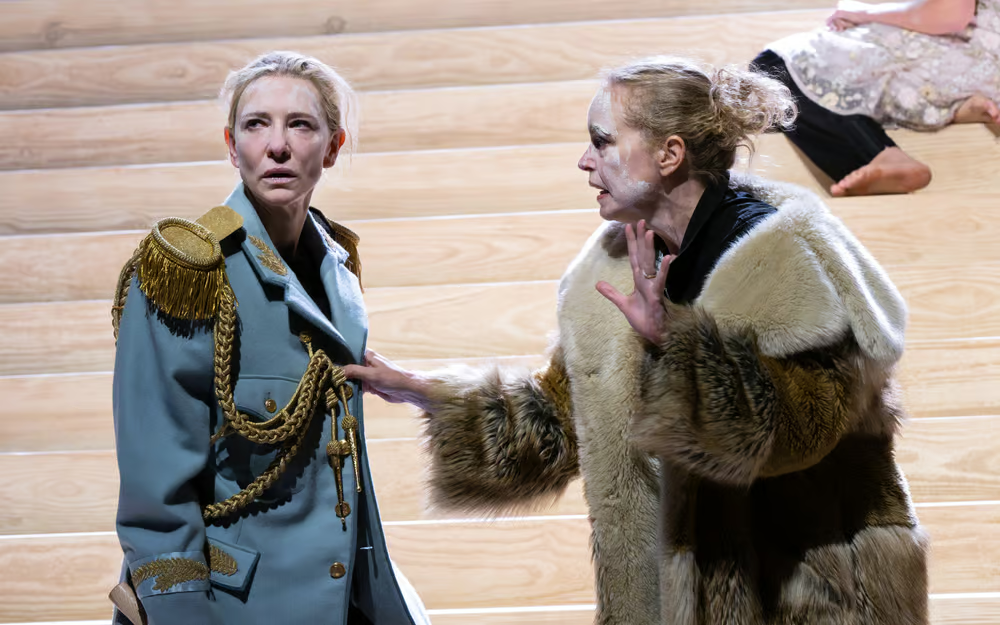
Christine Baranski & Richard E Grant get mixed reception
Wyndham’s Theatre

First produced in 1924, Noël Coward‘s Hay Fever has delighted audiences for a hundred years with its description of a ghastly fading film star Judith Bliss, her bad-tempered husband and their obnoxious son and daughter, who invite unexpected guests to a squirm-inducing get-together. The critics all felt the play and the production were old fashioned fun. Whether ‘a meringue of nothingness’ (WhatsOnStage) is worth the money was only considered by The Telegraph’s Dominic Cavendish: ‘Burns’s production won’t enter the annals. Nor does it justify a top price of £250.’ The star attractions got a mixed reception. Hollywood actor Christine Baranski was generally found to be amusing if not hilarious (‘She commands the stage’ FT; A few commented unfavourably on her acquired English accent (‘mumbles’ Independent). For many, Richard E Grant seemed the bigger attraction. His insouciant poshness was both a blessing and a curse for the critics: ‘perfect’ CityAM; ‘only okay … no fireworks‘ Time Out. The supporting cast, which included Lucy Karczewski, Nancy Carroll and Charles Edwards, received the highest praise. Emily Burns‘ direction of the farce elements and Frankie Bradshaw’s grand set design were appreciated.
4 stars ⭑⭑⭑⭑
What’sOnStage’s Sarah Crompton began by reminding us: ‘Noël Coward’s Hay Fever is a meringue of nothingness. Or rather, as his biographer Oliver Soden points out, it is “not so much artificial, as a commentary on artifice.”’ She pointed out at the end of her review: ‘Meringues aren’t exactly filling, but they are fun to eat.’ Baranski, she said, ‘retains instinctive comic timing and an ability to convey, with a raised eyebrow or a disappointed frown, her sense of life passing her by.’
CityAM’s Adam Bloodworth was a fan: ‘Burns’ conventional but sparkling production proves Coward is still an absolute king of farce.’ He liked the two stars: ‘Richard E Grant is obviously perfect for the feverishly privileged, short tempered David, who, like so many poshos, is magnetic to watch self-destruct (…) Baranski grips equally, flipping in milliseconds between sensual and ballistic’.
3 stars ⭑⭑⭑
The Telegraph’s Dominic Cavendish reported : ‘Grant is in his element as the scatty patriarch, combining Tiggerish zest with flashes of truculence. He’s not on stage much, though; Judith is the play’s real motor, yet Baranski’s performance stutters (…) he character should be entertainingly ghastly, yet where we need to see lavish layers of ingrained theatricality – with professed sincerity blurring, alarmingly, into affectation – we get one too many beady stares, and moments of televisual restraint.’ He was pointed in his conclusion: ‘It’s all enjoyable enough, and there are laughs to be had, but Burns’s production won’t enter the annals. Nor does it justify a top price of £250.’
Dominic Maxwell of The Times liked the supporting cast: ‘Coward’s prodigious dialogue calls for robust precision. Carroll leads a cavalry of light-comic supporting turns who know what’s needed. Charles Edwards is sublimely stiff in his tailored suits as the diplomat Richard. Lucy Karczewski is a quiet joy as a 1920s shy girl you could mistake for a socially anxious Gen Zer.’ He decided: ‘Emily Burns’s production gets more reliably spritzy as it goes along. The second act in particular has some relishable set pieces. Frankie Bradshaw’s grand set design mirrors the blues, beiges and gold trim of this theatre. It’s all still pretty pointless — but always handsomely, often amusingly pointless.‘
Tim Bano for The Financial Times thought: ‘Mostly … it chugs along in a pleasant and satisfying way, better than your local amateur effort but no great revelatory production to tug Coward into the 21st century. Grant is entertaining enough to watch, with nutty professor hair quivering on his head, and a childish giddiness at the games his family plays.’ He acknowledged: ‘Mostly, though, it’s Baranski’s show. She commands the stage like Judith does her household. From low imperious hoots, her voice flies up several octaves every few words. It’s cleverly done, this performance by a good actor playing a bad actor who thinks she’s good.’ He concluded: ‘This production is happy enough to be a diverting night at the theatre, but seems afraid of peering behind the performance. Despite a good cast and elegant set, it remains as shallow as its characters.’
‘It’s glossy comfort theatre.’ declared Time Out’s Andrzej Lukowski. He thought the cast almost saved it: ‘Christine Baranski brings a pleasingly doleful turn to reluctantly retired actress matriarch Judith Bliss’. However: ‘the play … just doesn’t have enough fizz left in it after a century to feel entirely justified without some sort of superstar performance to lead it. And the problem lies with big star Grant … (his) performance is only okay: he offers workmanlike support but no fireworks.’
Regarding Baranski, Emma John for The Guardian thought ‘a technically sound RP oddly constrains her. Judith’s combination of pretend languor and genuine vagueness mean that jokes go begging and some lines land too earnestly’. She pointed out: ‘Director Emily Burns’s CV majors in farce and she stages some lovely bits of business, including a scene when a servant silently lays a breakfast table to a swellingly romantic soundtrack and a Gone With the Wind-crimson backdrop.’
BroadwayWorld‘s Aliya Al-Hassan agreed about Christine Baranski’s accent: ‘(her) muddled accent of an odd mixture of RP and Atlantic twang impacts some of her delivery. But when she gets into her stride she leans into the acute and comedic melodrama of the role with gusto, sweeping from low imperious tones to much higher octaves. Richard E. Grant’s David has little to do in the first half, but emerges like a beacon in the second as the utterly self-absorbed writer. He is perfectly suited to the role of very well-spoken toff, which he does with ease, exploding into the vehement arguments with beautifully fluid delivery.’ She concluded: ‘Burns is not attempting to rewrite history here and there is nothing radical or new to be seen. The Bliss family are so bored with their lives and themselves that they have to create drama to pass the time, but we never get to peep below the surface of these motivations. A comfortable and comforting night at the theatre – just don’t expect fireworks.’
When it came to the leads, The Independent’s Alice Saville was damning: ‘Christine Baranski mumbles her way through the central role of flamboyant actress Judith Bliss, while Richard E Grant fades unexpectedly into the scenery as her grumpy husband David. Instead, the biggest joy of the evening are this couple’s bewildered house guests, whose politeness imprisons them in an oh-so-genteel form of hell.’
Critics’ average rating 3.2⭑
Value rating 32 (Average rating combined with typical ticket price)
Hay Fever can be seen at Wyndhams Theatre until 12 December 2026. Buy directly from the theatre
If you’ve seen this production of Hay Fever, please leave your review and rating below