Not even Sandra Oh can save this toothless satire
Lyttelton Theatre at the National Theatre
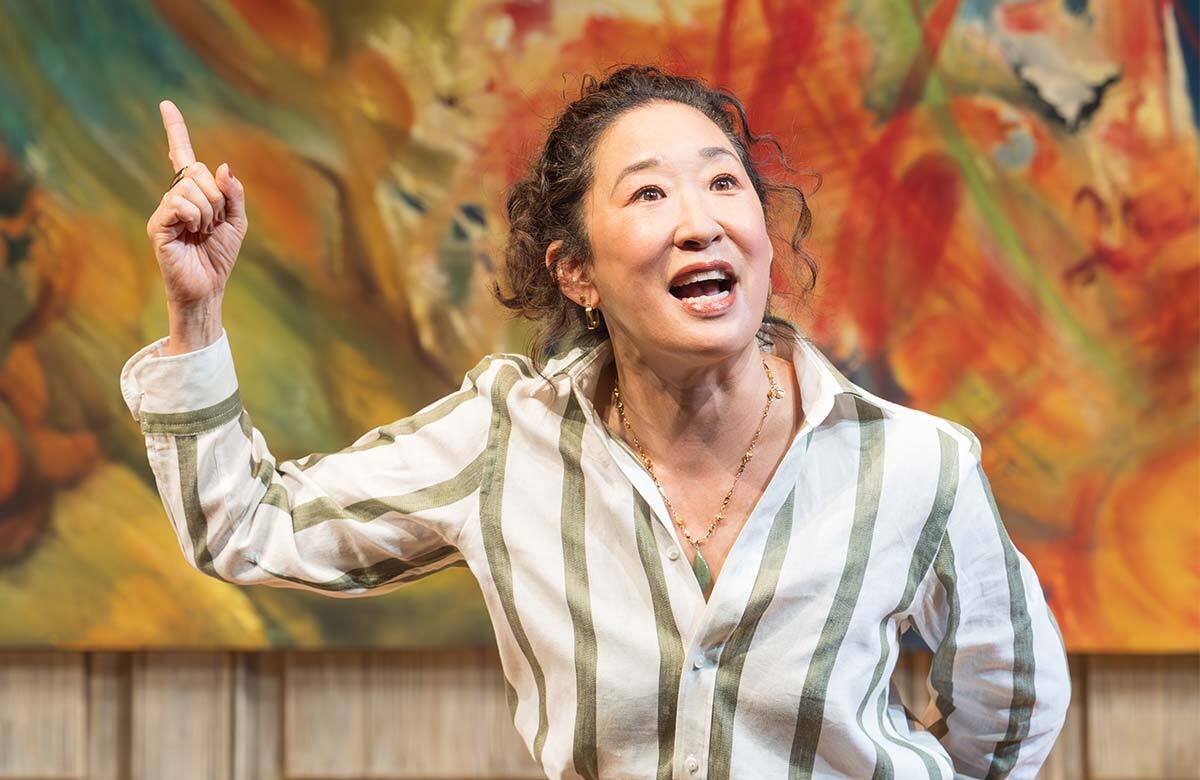
Martin Crimp‘s latest adaptation of The Misanthrope moves Molière’s satirical classic to the present day and makes its protagonist a female novelist. It fires at too many targets without really scoring any hits, said most of the reviewers. Quite a few liked Sandra Oh as the gender-flipped people-hater.
[Links to full reviews are included but a number are behind paywalls and therefore may not be accessible]
4 stars ⭑⭑⭑⭑
The Sunday Times’ Dominic Maxwell found: ‘You almost don’t notice how good Oh is because she makes you simply believe in the forever disgruntled, forever rhyming Alice.’ He was more appreciative of the adaptation than others: ‘It’s a story about trust, or the lack of it, and the shiny surfaces that some of us — most of us? — choose in preference to gnarly reality. Even before its surprisingly spectacular finale, it’s stranger, more raggedy and harder to fathom than the slick satire as which it first presents. And it makes its own gloriously off-kilter kind of sense.’
3 stars ⭑⭑⭑
WhatsOnStage‘s Sarah Crompton seemed to sum up everybody else’s reaction: ‘This is a Misanthrope full of interesting ideas and fine effects, but not quite enough bite or fury.’
Dave Fargnoli for The Stage said much the same: ‘Although the dialogue is snappy, the satire feels unfocused. Crimp mocks those who pay lip service to ideals of inclusivity, takes aim at the vanity of public figures and laments the myriad harms caused by the internet, but never lands a really shattering blow.’ On the other hand, he praised the director: ‘Indira Rubasingham’s judicious direction makes the piece feel lively and natural, despite all the intricate verbal artifice, with sparky sparring matches breaking out and conversations frequently descending into overlapping arguments.’ And the star: ‘Sandra Oh makes a brilliantly bitter Alice. By turns analytical, angry, cold and cruel, she tears strips off anyone who tries to sideline her, resolutely refusing to be ignored.’
Holly O’Mahony for LondonTheatre decided that Sandra Oh ‘brings great conviction and amusing bolshiness to the role. Like a kettle that’s just about to whistle, she practically vibrates under the effort of bottling up her disdain for other people. More often, of course, she insists on speaking her mind, even when her views are unpopular.’ But she too was disappointed with the adaptation: ‘if there are plenty of current, provocative references here, they’re flimsily addressed and leave little to chew over once the story peters out.’
The Guardian‘s Arifa Akbar agreed: ‘With sprawling ideas and OTT satire, it is stuffed full of the debates of our time around female empowerment, patriarchy, digital rage, misinformation and the hollow language of “acceptance” with plenty of pops at theatre and bad writing. Not all of these issues seem to belong to a single play; they are bitten off but barely chewed.’ She continued: ‘The satirical elements are hard to anchor. Who is being satirised and why?’ And yet: ‘In the best dramatic moments it contains some riveting acting from Oh, who brings heart, fire, vulnerability and comic timing.’
The Standard‘s Nick Curtis sounded exasperated: ‘Too many scenes feature two people arguing, and many of them end abruptly. Crimp’s play and Rubasingham’s production are half in love with the rarefied world they are satirising. There are too many knowing asides for the cognoscenti, too many debates about the importance of writing.’
Time Out‘s Andrzej Lukowski was kind enough to open his review by saying: ‘Sandra Oh makes a very decent UK stage debut as Alice’. He then took the adaptation apart but ended by noting: ‘Anyway, after 90 minutes of feeling slightly less than the sum of its parts, Indhu Rubasingham’s production and Crimp’s text finally go gloriously mad for the final furlong, switching to Molière-style rhyming verse and leaving any sense of naturalism behind as Robert Jones’ hitherto realist set suddenly becomes… very strange. It’s a weird final sequence, but without unduly spoiling exactly what happens, it worked for me because it felt like Crimp was finally actually making a point.’
Annabel Nugent at The Independent found: ‘Crimp, … like a kid in a candy store, can’t decide and so takes one of everything. The result is a broad satire filled with platitudes and generalised debates about female empowerment, the patriarchy and trolls on the internet. Crimp aims his satire like a fine spritz rather than the firehose jet of Molière’s original.’ She said of the star: ‘Oh is decent enough at the protesting and proclaiming and denouncing and ranting that her role requires, but the actor is best in the play’s quieter moments, her fangs retracted and her soft underbelly exposed’.
The Telegraph‘s Dominic Cavendish was underwhelmed by the star: ‘It too often feels like there’s an Oh-shaped hole in the production. The supporting performances are accomplished, with especially enjoyable work from Paul Chahidi as Alice’s gay playwright pal, and Rina Fatania as her insufferable reputation manager. But they crowd out the star attraction. The star strives to show us what she can do – eyes sealed in pent-up frustration, sorrow lurking in her insouciance. But she’s never really scary, and never makes us care, fully. Not her fault: she’s subject to killing even-handedness.’
The Financial Times’ Sarah Hemming was frustrated: ‘there are so many rolling plots and lines of attack that the narrative becomes overloaded and confusing, and Alice’s central predicament — conform or rebel — gets rather lost, together with the questions it poses to us all. Even so, Oh is riveting — waspishly funny, whilst suggesting her character’s despair and loneliness — and she’s supported by a very fine cast.’
2 stars ⭑⭑
Like his Times colleague Dominic Maxwell, Clive Davis was the only one of our chosen critics to break the 3-star consensus, except he went for one less. For him, not even Sandra Oh could save it: ‘I’m not sure anyone else could have salvaged a fatally cluttered romp that resembles an extended episode of Absolutely Fabulous with most of the wit surgically removed.’ He explained:’Part of the problem with this production, directed at a frenetic tempo by the National’s new boss Indhu Rubasingham … is that Oh’s delivery lacks nuance. We get disdainful snarls, but not much more.’ ‘By the time the piece stumbles towards its meta conclusion at a baroque-themed costume party, we’ve long ceased to care about the outcome. The wardrobe department comes up trumps, though.’
Critics’ average rating 3.0⭑
Value for money 33 (typical price vs average rating)
The Misanthrope can be seen at the Lyttelton Theatre until 1 August 2026. Buy tickets directly from the theatre Molière’s
If you’ve seen The Misanthrope at the National theatre, please leave your review and/or rating below