Actors excel in evening of two halves
Lyttelton Theatre, National Theatre
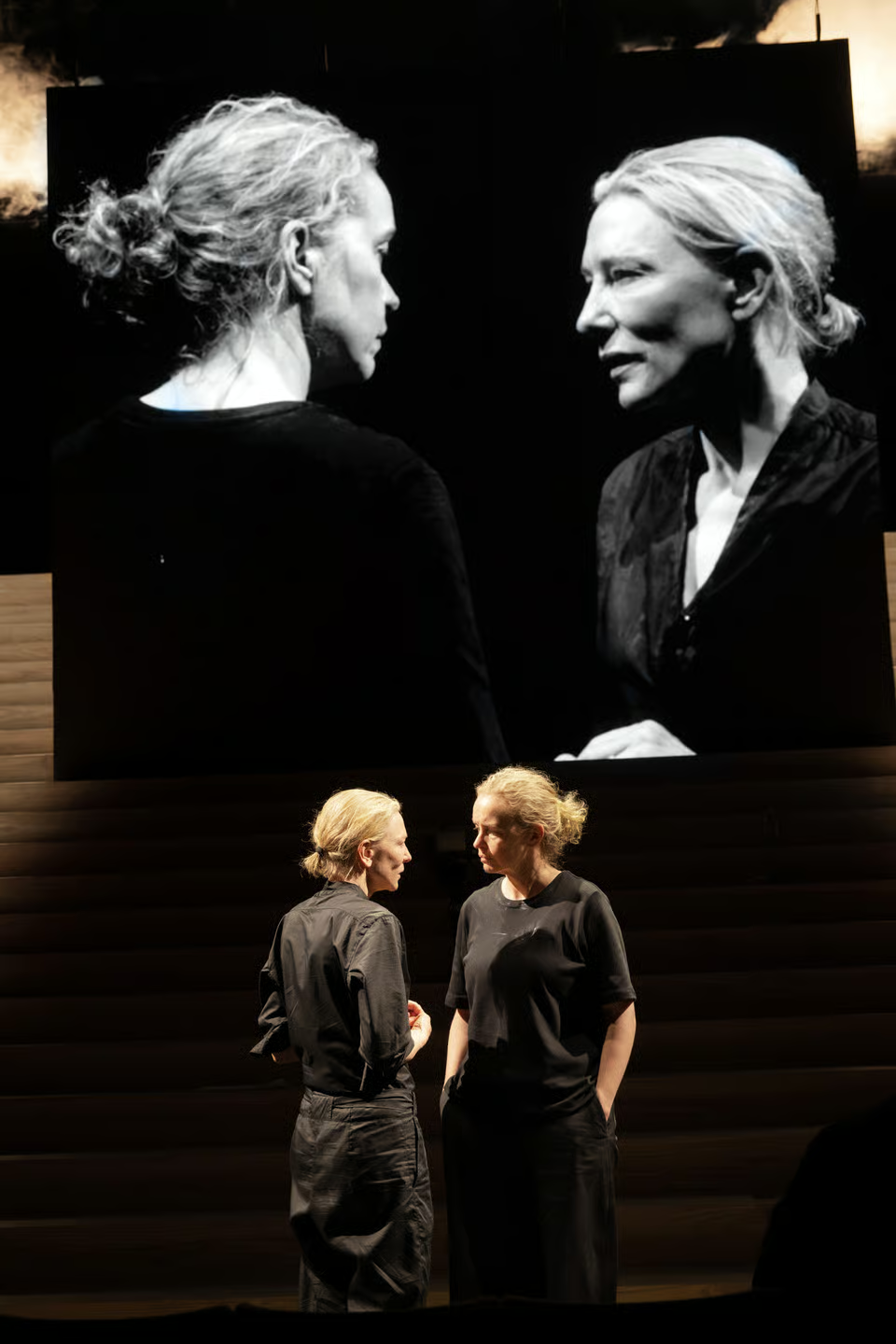
Praise rained down on Cate Blanchett (‘a sinewy sensuality’ Standard) and Nina Hoss (‘riveting’ WhatsOnStage). Sadly the critics’ enthusaism did not extend to Benedict Andrews who wrote and directed the play. There is no interval but it is an evening of two parts. The critics found the opening 50 minute adaptation of Sophocles’ Electra ’emotionally astute and nuanced’ (LondoinTheatre) but thought the subsequent longer section based on Bergman’s film Persona ‘strangely sterile’ (Guardian). The latter is about an actress who is struck silent during a performance of Electra. Personally, I was pleased to see the critics finally calling time on the use of live film on stage. Who plays which parts is decided each night on the toss of a coin. On the press night, Cate Blanchett played Clytemnestra and Nina Hoss was Electra.
5 stars ⭑⭑⭑⭑⭑
Clementine Scott for BroadwayWorld was an outlier: ‘Benedict Andrews … poses the question of why, of all the plays, Elisabet’s breakdown should happen during Sophocles’ Electra.’ She provided a detailed analysis which included this insight: ‘The boundaries of reality blur further [in Electra] as they start role-playing episodes from their family’s history … as though stepping outside of themselves will help these characters process their grief. The result is not clarity, though, but confused identities and incestuous overtones. All this means is that when we get to Persona, we are troubled by the notion of characters losing their sense of self.’ She ended: ‘Both Andrews’s Electra and his Persona could more than stand on their own as imaginative takes on seminal texts that reward those with knowledge of the source material. But the production’s real strength is in the elegant parallels it draws, to form a new whole that enriches and enhances the work of both Sophocles and Bergman.’
Other critics were less impressed.
4 stars ⭑⭑⭑⭑
Time Out‘s Andrzej Lukowski concentrated on the stars: ‘even if Benedict Andrews’ production doesn’t entirely ‘work’, the sense that it is just bloody amazing having two incredible actors doing an enormous amount of acting – and that we’re actually only seeing half of it – carries the night.’ He pointed out: ‘while there are links between the pieces, you could drive yourself mad looking for continuity: I think it’s easier to view Electra/Persona as a double bill.’ He concluded: ‘watching them journey to the deepest recesses of the characters’ blurred souls is all you should want from the stage, really.’
3 stars ⭑⭑⭑
The Standard‘s Nick Curtis called it: ‘a mashup that refuses to mesh’, explaining ‘it’s hard to see what connects the two stories’. He praised the actors, saying Blanchett had ‘a vulpine, glittering grin and a sinewy sensuality’ while Hoss was ‘a gutsy, compelling presence, powerfully communicating the maelstrom of emotion ‘. However: ‘where Electra is primal, Persona is wilfully elusive.’ In the Persona section, he declared: ‘The use of a probing, chasing lens onstage and backstage has become an overused technique’.
The Guardian‘s Arifa Akbar helpfully explained the connection: ‘The Electra bit of the title refers to the Sophoclean tragedy of a daughter trapped in a cycle of vengeance, the Persona part to Ingmar Bergman’s 1966 film about an actor who suddenly stops speaking while performing Electra on stage.’ Hoss who gave ‘a searing performance’ as Elektra and Blanchett was ‘commanding’ as Clytemnestra. Like Nick Curtis above, she found: ‘Andrews’ overhaul of the ancient much more successful than his strangely sterile play on Bergman’s classic.’ She too was tired of the use of cameras: ‘It’s now an old trick, beloved of the likes of Ivo van Hove and Jamie Lloyd, which looks hackneyed here.’
Holly O’Mahony for The Stage described the first section ‘an appetiser in the form of a mini production of Electra – one that dials down the tragedy and heightens the comedy, holding its audience at arm’s length to remind us it’s all pretend.’ As for the more dominant Persona: ‘for all its stylishness and persuasive performances, this production is clinically intellectual – theatre for the head, not the heart.’
The Financial Times‘ Sarah Hemming commented: ‘Cate Blanchett (Clytemnestra) and Nina Hoss (Electra) stand, nose-to-nose, squaring off in their characters’ determination not to yield. “You have no idea what it’s like to be me,” spits Hoss’s Electra, with contempt. It’s riveting: a moment charged with all the electricity and charisma these two great actors bring to the stage. It’s also deeply ironic and drives at the heart of this strange, intense exploration of identity. They actually both know exactly what it is like to be the other — in performance terms at least.’ She commented on the role swapping: ‘That’s no gimmick, but another twist in an evening that plunges into questions about power, grief, roleplay and how much we can ever know about ourselves or one another. It proves by turns gripping and weirdly becalmed, with the long, chillier second half critically losing momentum.’
The Times’ Clive Davis concluded: ‘Blanchett and Hoss’s immaculate screen technique comes to the fore: these are actors who can make the most of the smallest gesture. Brendan Aanes’s sound design is claustrophobic in both sections. As theatre, though, it lacks spontaneity. Perhaps we’ve simply seen too many cameras on stage lately: it’s time for human beings to be centre stage again.’
WhatsOnStage‘s Sarah Crompton described the acting: ‘As Electra, Hoss’s purposeful walk, her downturned mouth, and rising fury perfectly suggests a woman in the grip of mania, exuding “the holy stench of grief.” Her ability as Elisabet to reflect thought and feeling while staying utterly still is riveting; her strength and vulnerabilities are both delicately charted. As Clytemnestra, Blanchett is imperious and frightening, as Alma, needy, ingratiating and slightly terrifying’.
While conceding: ‘Hoss and Blanchett are entirely watchable’, Claire Allfree for the Telegraph decided: ‘There’s little here to match Persona’s uncanny claustrophobia and ambiguous visual power. Andrews beautifully rethinks Sophocles but proves unequal to Bergman.’
Anya Ryan of LondonTheatre said: ‘Electra is emotionally astute and nuanced. Persona feels detached, with the use of screen recording now an overused, stale technique in theatre.’ She continued: ‘for the most part, it remains a production that is frustratingly over-directed. It lacks a sense of instinctive freedom. We are constantly being told to see parallels between the two halves, the characters and their actions. But it’s rare we actually feel their weight.’
The Independent’s Alice Saville noted: ‘Watching this hybrid play is often a laborious exercise, like trying to connect pieces from two different jigsaw puzzles that don’t quite fit. There’s also a kind of cerebral chilliness to this production – a kind of distancing that doesn’t really speak to its emotive themes of motherhood, and the failure to live up to the impossible demands of parental love.’
Critics’ average rating 3.3⭑
Value Rating 47 (Rating combined with typical price)
Electra/Persona can be seen at the Lyttelton Theatre until 10 October 2026. Buy tickets from the theatre nationaltheatre.org.uk
If you’ve seen Electra/Persona, please leave a review and/or rating below