Theatre reviews roundup: The Playboy of the Western World

Irish classic hasn’t aged well

Lyttelton Theatre at the National Theatre
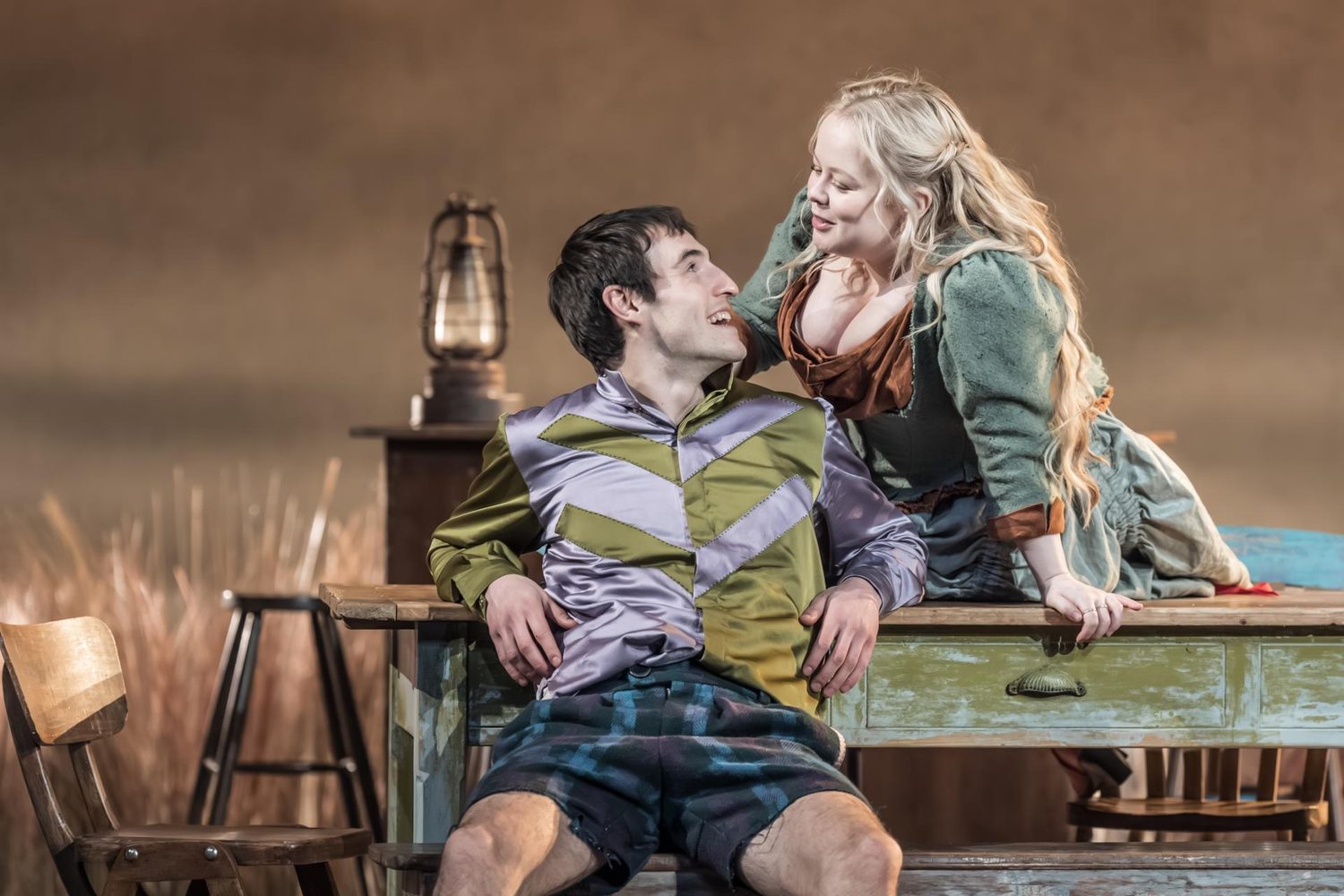
Éanna Hardwicke and Nicola Coughlan in The Playboy of the Western World. Photo: Marc Brenner

It may be a classic of Irish theatre but London critics gave J M Synge‘s The Playboy of the Western World a cool reception. The story of a self proclaimed murderer who becomes a local celebrity seemed slow and old fashioned to many of them. There was also widespread criticism of Caitríona McLaughlin‘s production as being uneven. Worst of all, the decision to be faithful to the traditional Irish accents made it difficult to understand. On the other hand, Derry Girls alumni Nicola Coughlan and Siobhán McSweeney were praised for their performances as lovestruck women, and Katie Davenport‘s design impressed.

4 stars ⭑⭑⭑⭑

Holly O’Mahony, writing for LondonTheatre, found the play ‘transfixing: ‘There’s great direction from McLaughlin here, as a parade of beautiful young lasses appear with gifts, practically quivering with lust’ (…)  ‘If you don’t know whether to laugh or cry by the end, you’ll still leave satisfied, with plenty to chew over’

3 stars ⭑⭑⭑

Dave Fargnoli for The Stage found it ‘an appealingly edgy, unsettling treatment.’ He noted: ‘McLaughlin pitches the piece somewhere between slow-building farce and folk horror’. He also thought: ‘it looks great; bleak and vivid and just slightly disconcerting’. But ‘the performances themselves are uneven, with some of the cast members needing time to lock into the particular, lilting rhythm of Synge’s writing’.

The Times’ Clive Davis warned: ‘this production … is too reverential to do full justice to the dark humour in the text. It’s also delivered in strong traditional accents that will leave outsiders straining to make sense of the dialogue.’

The Guardian’s Arifa Akbar said: ‘Synge could even have been the Tarantino of his time, glamorising Christy’s violence. But it seems old-fashioned in this faithfully period production‘

The Standard’s Nick Curtis found: ‘the portrayal of poverty and repressed lasciviousness that caused riots when the play originally opened at Dublin’s Abbey Theatre now feel quaint and stereotypical.’ While praising the acting, he decided: the ‘production celebrates the play’s lyrical language but falls prey to its meandering, repetitive structure.’

For Anya Ryan in Time Out (assumed 3 stars) there were ‘beautiful, affecting images of County Mayo folklore alongside some standout acting performances’, however: ‘the production comes across as a hodgepodge of competing ideas.’ She attributed some of the blame to ‘the rambling, stretched-out plot’.

Clare Allfree for the Telegraph complained: ‘thanks to the use of archaic Irish accents and syntax, Synge’s succulent poetry is frequently unintelligible – almost to the point of inaccessible – to those not acquainted with the dialect.’ She said Nicola Coughlan gave ‘a performance of stealth power’.

The Independent’s Alice Saville found it: ‘densely written and deeply strange, meaning it’s not a straightforward watch – but its leads have got enough vigour and wit to carry us through.’ She picked out: ‘McSweeney (as Widow Quin) is wonderfully funny as this calculating local weirdo’. As for the production: ‘the tone feels disconcertingly uneven. Some bleak scenes are played straightforwardly for laughs, while potentially comedic moments (the final punchline included) are invested with a surprising heaviness.’

Cindy Marcolina at BroadwayWorld wrote: ‘McLaughlin approaches the text with pure naturalism. She leans into the humour, but counteracts it with creepy disturbance. At the hand of Éanna Hardwicke, Christy is an impish figure, a devilish narcissist who chuckles and stalks and teases like a displaced fae from a fairy tale.’ She loved Nicola Coughlan’s ‘thrilling performance. Vain and opinionated, she tries hard to resist the stranger’s allure with upfront wariness – but even her fiery feistiness bends.’

Alun Hood for WhatsOnStage opined: ‘This is a sumptuous production, rich in detail, craft and spectacle. It’s impressive but dramatically inert, ultimately not really proving why Synge’s tale of romantic disappointment and the ludicrousness of putting people on a pedestal, is worthy of a major revival at the present time.’

2 stars ⭑⭑

Alekx Sierz on The Arts Desk put the boot in: ‘Michael Flaherty’s bar should be like the cramped room of Conor McPherson’s The Weir (obviously influenced by Synge). Instead, here it is a huge space like a mega urban Wetherspoon’s. A massive barn. Hardly a place of poverty. To fill the acres of empty space, director Caitríona McLaughlin … adds a fair amount of over-designed folkloric business, with keening funeral processions, masked mummers and goddess worshippers galore.’

Critics’ average rating: 3.0⭑

Value rating 35 (Value Rating is a combination of the critics’ rating and the typical ticket price)

The Playboy of the Western World can be seen at the National Theatre until 28 February 2026. Buy tickets directly from the theatre.

If you have seen The Playboy of the Western World at the National Theatre, please leave a review and/or rating below
Theatre reviews roundup: Fallen Angels

Fluffy but fun

Menier Chocolate Factory
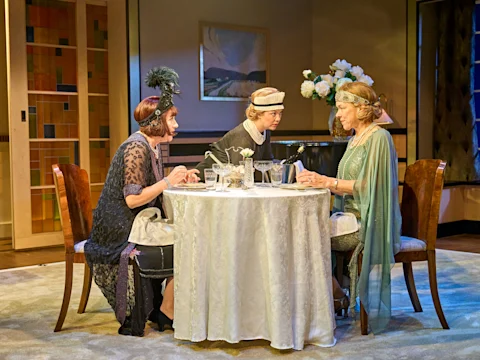
Fallen Angels. Photo: Manuel Harlan

A neglected Noel Coward comedy turns up at The Menier Chocolate Factory to appreciative reviews. Janie Dee and Alexandra Gilbreath provide plenty of laughs as two middle-aged married women whose sexual desires are stirred by the arrival of an ex-lover. There is even more fun when a maid played by Sarah Twomey appears in the second act.

[Links to full reviews are included but a number are behind paywalls and therefore may not be accessible]

4 stars

The Telegraph’s Dominic Cavendish welcomed it: ‘In Christopher Luscombe’s retro, stylish and delightful Menier revival, Janie Dee and Alexandra Gilbreath give us drunk-acting of the highest order.‘ He admitted: ‘the play’s charms are ephemeral, but as the forgivably badly behaved duo – a touch of Ab Fab avant la lettre – discover, resistance is futile.’

The Times‘ Clive Davis told us: ‘It’s light, it’s fluffy, it’s ridiculous, but when actresses of the calibre of Janie Dee and Alexandra Gilbreath are having so much fun in the lead roles, you’re happy to see them making merry.’

Laura Jones for BroadwayWorld declared: ‘It’s a night of humour, subtle longing and quietly sharp social observation. For those who appreciate well-crafted comedy with a vintage edge, Fallen Angels is a thoroughly enjoyable reminder of why Coward remains a master of the drawing-room farce.’

3 stars

The Guardian‘s Arifa Akbar wrote: ‘It is not as rich as Blithe Spirit or Private Lives, and a little one note, but it is impeccably performed, with shades of 1920s screwball comedy and excellent turns from Dee, who plays Julia as blithely imperious, and Gilbreath, who becomes more cackling and crude as she tips back the bubbles.’

For Tim Bano in The Standard: ‘Christopher Luscombe’s handsome take has plenty of good moments, and two strong central performances from Janie Dee and Alexandra Gilbreath, but it struggles to completely lift itself beyond being gently entertaining.’

Matt Wolf for LondonTheatre found: ‘Unfolding on an airy Art Deco set from Simon Higlett, and costumed to kill by Fotini Dimou, this iteration of the play is good fun’.

WhatsOnStage’s Sarah Crompton complained: ‘the obsession of the two friends…with their lost French love Maurice seems vaguely tiresome; their cleverness undermined by their passion.’ She continued: ‘Christopher Luscombe’s sparkling production does everything it can to paper over the cracks and disguise the occasional longueurs and it is blessed with two uproarious comic performances from Janie Dee and Alexandra Gilbreath as the frustrated and excitable pair.’

Dave Fargnoli for The Stage was lukewarm in his reaction: ‘Director Christopher Luscombe sets a plodding pace at the outset, underlying the tedium of the characters’ lives of leisure in contrast to the frantic chaos of the later scenes. The tone swerves from stultifying stiffness to outrageous absurdity as the wives scheme, bicker, and get absolutely trashed on champagne, leading to some fine moments of physical comedy which, while amusing, unavoidably pull against the extreme poise of Coward’s acerbic dialogue.’ But he did note:  ‘Sarah Twomey gives a scene-stealing turn as precocious servant Saunders’.

‘it’s a genteel museum piece’ said Time Out’s Andrzej Lukowski.

Critics’ average rating 3.3⭑

Fallen Angels is performing at The Menier Chocolate Factory until 21 February 2026. Buy tickets directly from the theatre

Read Paul Seven Lewis’ 5 star review of Fallen Angels 

If you’ve seen Fallen Angels at The Menier, please leave your review and/or rating below

Theatre reviews roundup: A Midsummer Night’s Dream

Dream turned into a Nightmare

Shakespeare’s Globe
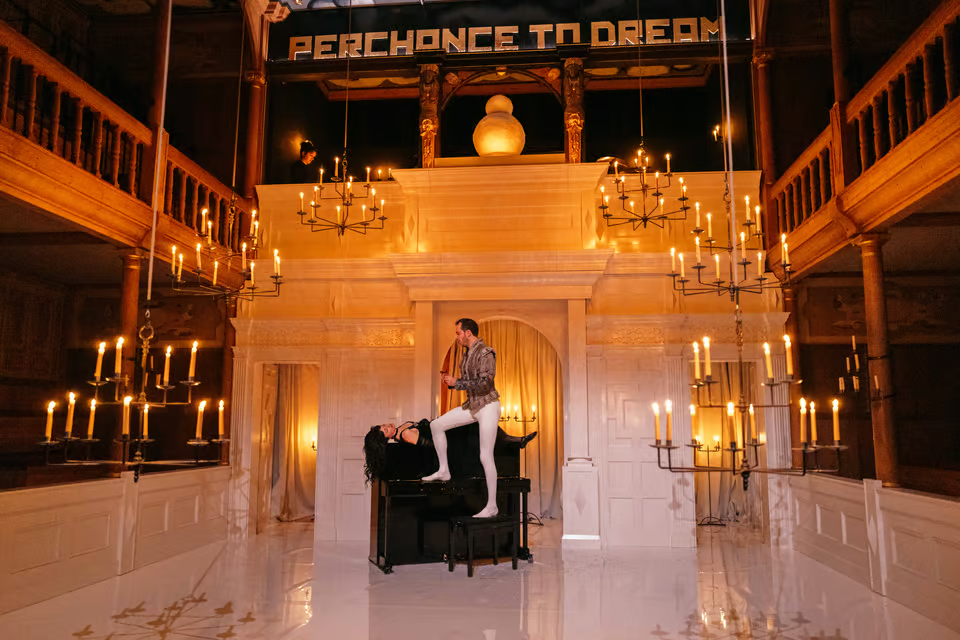
A Midsummer Night’s Dream at Shakespeare’s Globe. Photo: Helen Murray

If you were thinking of treating the kids to the Globe’s first ever production of Shakespeare’s popular comedy about fairies, you may have to think again . Their website warns: ‘It contains loud noises, strong language, scenes of sexual content, drug use and gunshots.’  Headlong theatre’s Holly Race Roughan (with co-director Naeem Hayat) has found every dark element in A Midsummer Night’s Dream, and then proceeds to darken it. The result pleased some critics and outraged others. Nearly all were shocked by the new violent ending. Danny Kirrane received praise for his coke-snorting, downtrodden Bottom.

[Links to full reviews are included but a number are behind paywalls and therefore may not be accessible]

4 stars ⭑⭑⭑⭑

Kate Wyver for The Guardian explained: ‘comedy and horror sit cheek by jowl, as director Holly Race Roughan conjures a nightmarish take on Shakespeare’s classic dream.’

Using the word ‘creepy’ more than once, Tim Bano at The Standard explained: ‘what is usually a summery froth of fairies and lovers (turns) into a crisp and frosty fairytale, a kind of sexed-up Narnia, twisting a Grimm story out of one of Shakespeare’s most popular plays.’ He ended: ‘(the) climax may not be for everyone, but the ride to reach it is wonderful, as Roughan rids the play of any trace of hazy summer, and turns it instead into a deeply unsettling winter’s tale.’

Holly O’Mahony for The Stage warned: ‘Nothing is quite as it seems. At court, the soon-to-be-weds Theseus and Hippolyta are at each other’s throats with knives and guns, while in the forest – which, on Max Johns’ set of crisp linen and polished white floor, offers no trace of woodland – there’s nothing playful about the sinister fairies, who hurl charms that land with the crack of a whip.’ She pointed out: ‘The text sometimes battles against Roughan and Hayat’s high-concept reframing, which takes considerable creative licence (…) But what becomes a mesmerisingly unusual reading ultimately wins out.’

Rachel Halliburton at The Arts Desk also endorsed the interpretation: ‘this is a sharply beguiling production, full of wit and vigour. Some might condemn it for trying too hard to shock, but there’s nothing we see on stage that isn’t in a text that I, personally, find more fascinatingly disturbing each time I read it. The Tarantino-style ending certainly makes jaws drop, yet there are plenty of real-life tyrants who would not hesitate to deal with outspoken individuals as callously as Marcus’s king does. Go, and bank on a wild time – it’s credible, clever, and you’ll never look at a banana in the same way again.’

Alun Hood for WhatsOnStage found: ‘There are few laughs but plenty of chills, cruelty and intimations of some of the worst of human behaviour, from coercion to paedophilia. If you let go of the idea of traditional enchantment, it’s a compelling piece of theatre.’

3 stars ⭑⭑⭑

Time Out’s Andrzej Lukowski was confused, all the way to the changed end: ‘to me it felt like a cruel, capricious whim that snatched defeat from the jaws of victory, ending an enjoyably spikey Dream on a note of pure WTF.’

Julia Rank for LondonTheatre seemed taken aback by the ‘brutality’. She concluded: ‘Not everything in this production gels but it does lead to a genuinely shocking denouement. It isn’t easy to make amends and request the hand of friendship under such circumstances.’

2 stars  ⭑⭑

Kirsten Grant wrote in The Telegraph: ‘Headlong Theatre’s grim new production for the candlelit Sam Wanamaker Playhouse takes one of the few Shakespearean comedies that remains genuinely funny, and strips it of much of its romance, enchantment and humour.’ Her parting shot: ‘What a nightmare this Dream is.’

Ben Dowell for The Times called it: ‘a spare, pitch black ballet-themed spectacle full of spite and horror – with a needlessly shocking final scene that has to be seen to be believed.’ Not that he’s encouraging you to see it: ‘a summer dream becomes a wintry nightmare you’ll be glad to wake up from.’

Critics’ average rating: 3.3⭑

A Midsummer Night’s Dream can be seen at Shakespeare’s Globe until 31 January 2026. It will then tour to Shakespeare North (4–7 February), Leeds Playhouse (14–28 February), Bristol Old Vic (4–21 March), and Oxford Playhouse (24–28 March). For tickets go directly to shakepsearesglobe.com. For tour details, visit headlong.co.uk

If you’ve seen the Globe/Headlong production of A Midsummer Night’s Dream, please leave your review/rating below

Theatre reviews roundup: Paddington The Musical

This little bear will run and run

Savoy Theatre
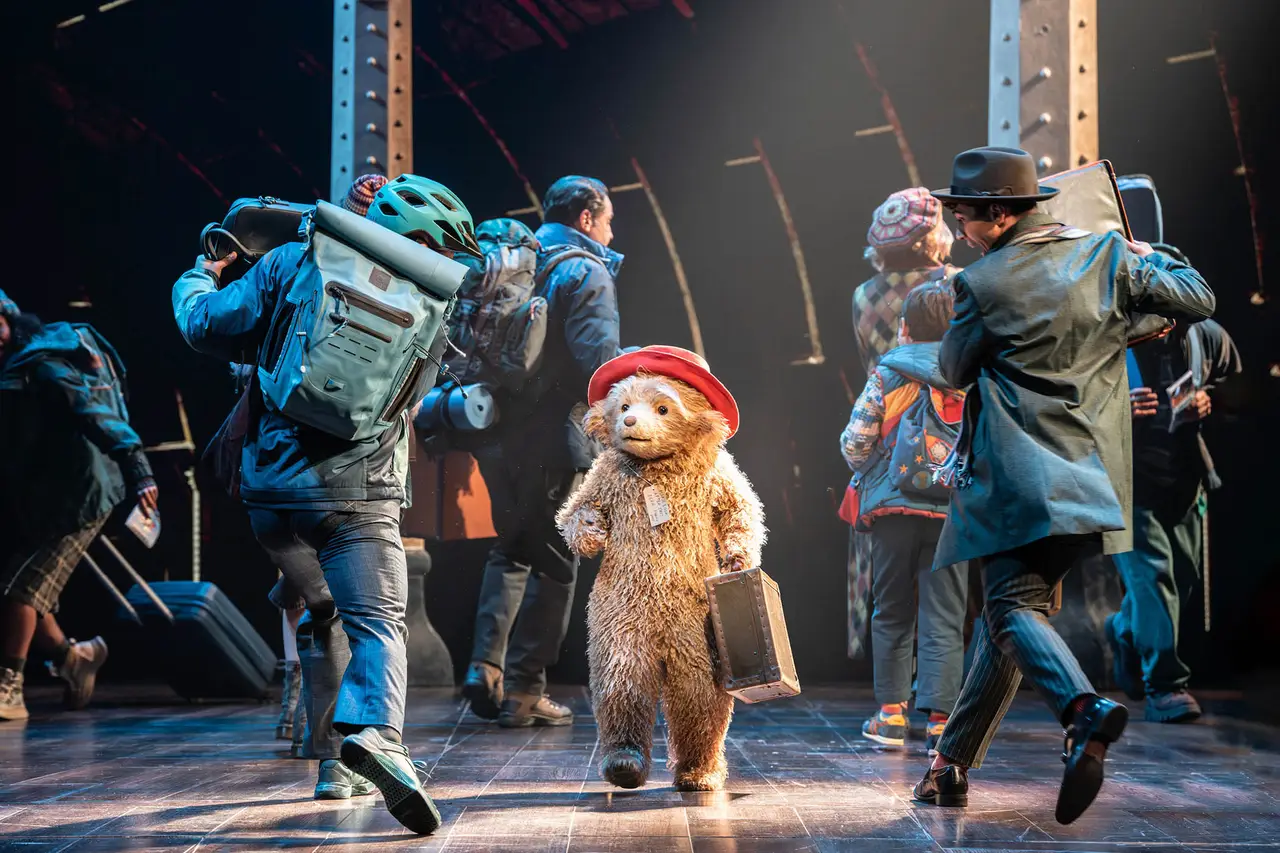
Paddington The Musical at The Savoy Theatre. Photo: Johan Persson

The critics’ hearts were captured by the little bear from Peru. Even those who found faults in the production still awarded four stars. For the majority who gave five star reviews,  it was not only the clever creation of the little chap but every aspect of the production pleased. This one could run and run.

[Links to full reviews are included but a number are behind paywalls and therefore may not be accessible]

5 stars ★★★★★

LondonTheatre’s Marianka Swain declared: ‘Paddington is pure theatre magic.’ To prove it, she pointed out many theatrical flourishes including: ‘There’s … thoughtful exploration of what family, home and belonging can mean, and how our capital thrives because it’s a cultural melting pot. That’s irresistibly expressed in “The Rhythm of London”, begun by Brenda Edwards’s Caribbean neighbour Tanya, and opened out to involve high-kicking Buckingham Palace guardsmen and bankers waving sparkly Union Jack brollies. Tom Pye’s wondrous design, a real love letter to London, also features an actual black cab and red telephone box, pastel-coloured Windsor Gardens, and full-size giraffes in the Natural History Museum.’

The Guardian‘s Arifa Akbar decided: ‘This is the new Mary Poppins: a well-known story imaginatively staged, immaculately performed and utterly winning.  Tom Fletcher’s songs are marvellous, Jessica Swale’s book earnest, Ellen Kane’s choreography vigorous.’

Olivia Garrett at Radio Times enthused: ‘Honestly, this show is exactly what it promised and more. Cutting right into your soul with its message of kindness, love and acceptance, it’s a musical we need now more than ever.’

‘This is a show with a heart as big and generous as Paddington himself’ raved Sarah Crompton at WhatsOnStage. She described Paddington on stage as ‘utterly real, his little grey eyebrows rising in surprise, his jaw dropping open when he is shocked, his nose wrinkling in search of marmalade.’

The Independent‘s Alice Saville explained: ‘The most immediately delightful thing about this show is that they’ve got Paddington absolutely spot on. Who wouldn’t give a home to this bear? (..) Inside this super-realistic (and no doubt quite warm) suit is 4ft tall actor Arti Shah, who gives him authentically bear-like movements while singer James Hameed lends his incongruously powerful vocals to punchy songs by Tom Fletcher (of McFly fame).’

Tim Bano for The Standard described some of the experience: ‘In just the first twenty minutes we get smoke, fire, explosions, collapsing furniture, rain, and whipped cream. It’s a multimillion pound piece of theatre that feels warm and fun and intimate, with no opportunity missed for a bit of extra silliness or a burst of theatricality.’

The i’s Fiona Mountford noted: ‘It is not only the bear design that is marvellous. Scenic designer Tom Pye makes stunning use of the high ceiling and proscenium arch of the theatre by flooding them with a changing mosaic of images that evoke Paddington’s homeland and the superhero cartoons that Mrs Brown designs. Every detail of this show is exquisite – and I confidently predict that this will be one proudly British export that will go on to conquer the world.’

The Mail’s Patrick Marmion reminded us: ‘let’s not forget, there’s also a musical attached to the costume, with comic, anthemic and shamelessly sappy songs by Tom Fletcher (of yesteryear’s boy band, McFly).’

4 stars ★★★★

The Telegraph‘s Dominic Cavendish almost got carried away: ‘Paddington Bear has been brought to life in a funny, feel-good, family-friendly musical that looks set to run and run (…) see the little visitor from Darkest Peru sing, dance (after a modest fashion) and bumble for Britain! Children will love him and adults will warm to his restorative sweetness’ until he stepped back and remembered he’s a theatre critic: ‘it’s a touch threadbare, and a little over-stuffed with songs, but fittingly, it’s still a very welcome addition to the British musical family.’

Similarly Time Out‘s Andrzej Lukowski liked it but wasn’t completely won over: ‘a fine creative team led by director Luke Sheppard has created a very enjoyable show indeed’ but ‘It’s a luxury musical that feels overstuffed at times.’

The Stage‘s Sam Marlowe stopped trying to be objective: ‘although there is plenty about this show that needs tweaking, rewriting and frankly doing away with altogether, there’s an overwhelming amount in Luke Sheppard’s production that is fundamentally just right. Save yourself some time and succumb – because resistance, trust me, is futile.’ She does list its many shortcomings, only to conclude: ‘whatever the faults of the show, it’s sweeter than a marmalade sandwich, and if the cuddly creation at its heart doesn’t make it a hit, I’ll eat his hat.’

Adam Bloodworth at CityAM wasn’t convinced by the hype: ‘What sticks is that the much-hyped animatronic bear’s mouth is fairly clunky, without the depth of movement to simulate real speech. When live lines are amplified from the side of the stage by designer-performer James Hameed, the mouth opens and closes more like a Sesame Street puppet than anything resembling ‘real’ speech.’ He pointed out: ‘Paddington the Musical at its core is actually a fairly analogue musical experience, a fairly conventional piece of musical theatre that is sustainably quality without relying on particularly viral moments, gimmicks or tricks. Instead Luke Sheppard’s overall show is a wholesome homage. Just nice songs and a decent ensemble held together by some brilliant writing. What more could you want?’

Critics’ average rating 4.7★

Value rating 49 (Value Rating is a combination of the critics’ rating and the typical ticket price)

Paddington The Musical can be seen at the Savoy Theatre until at least February 2027. Buy tickets directly from https://paddingtonthemusical.com

Click here to read Paul Seven’s review 

If you have seen Paddington The Musical, please leave a review and/or rating below
Theatre reviews roundup: The Spy Who Came In From The Cold

Warm reception for Cold War play

@sohoplace
Rory Keenan in The Spy Who Came In From The Cold. Photo: Johan Persson

The Chichester production of The Spy Who Came In From The Cold, adapted by David Eldridge from John Le Carré’s novel and directed by Jeremy Herrin, transfers to London prior to a UK tour. Critics welcomed it despite many thinking it didn’t convey the depth of the original. Rory Keenan was praised in the lead role.

4 stars ⭑⭑⭑⭑

Andrzej Lukowski of Time Out enjoyed it for waht it was: ‘This is a slick and yes, maybe slightly MOR adaptation of Le Carre’s taut, brutal espionage yarn. But it’s a very good one, and Eldridge deftly crafts an intensely interior world, with us seeing the action unfold as much from within jaded spy protagonist Alec Leamas’s head as without.’

WhatsOnStage’s Sarah Crompton noted: ‘one of the many strengths of David Eldridge’s fluent adaptation for the stage … is that it emphasises the way in which this period piece is also a piercing play for today. It’s a serious and sobering examination of the shoddy accommodations of real politick, and their effect on the human heart.’

The Standard’s Nick Curtis called it ‘a propulsive, streamlined and reassuringly old-fashioned staging’. The Independent‘s Alice Saville called it ‘a lean, pacy adaptation’. She remarked: ‘Rory Keenan brings a rougher, more careworn energy to this story’s conflict-scarred star spy, Alec Leamas.’

Chris Dorrell for CityAM got over excited: ‘The production had everything you’d want from a spy thriller: great coats, a lonesome trumpet soundtrack, and enough drink-dropping twists to leave the person in front of you soaking (sorry).’

3 stars ⭑⭑⭑

Theo Bosanquet at LondonTheatre found: ‘a lot of the action is overly static, stilted by the understandably exposition-heavy dialogue, which lends it a radio play feel at times.’ However: ‘There is much to enjoy, particularly for Le Carré aficionados, and it’s a noble effort to show that his densely detailed novels are stageable. But those unfamiliar with the source material may feel somewhat left out in the cold.’

Clementine Scott for BroadwayWorld concluded: ‘This has still been a tale exhilaratingly told, and if it fails it fails for being too inventive in developing Smiley’s character, rather than not inventive enough. Leamas’s interiority is an issue for adaptations of this novel that needs puzzling out, but the solution is not just to have another character drily explaining his motivations.’

Claire Allfree for the Telegraph was disappointed: ‘Le Carré’s novel is a shocking slice of spiritual nihilism in which everyone is ultimately damned. At times, Eldridge’s play feels suspiciously more like a romantic melodrama.’

The Times’ Clive Davis was concerned that: ‘While Rory Keenan is thoroughly convincing as the cynical, dishevelled intelligence officer Alec Leamas, Jeremy Herrin’s … production… risks falling between two stools. Le Carré fans will, I suspect, find themselves hankering after the book’s intricately layered study of secret service ethics; newcomers, on the other hand, may well be left confused by the breathless twists in the narrative.’

For Aleks Sierz at The Arts Desk, particularly in the first act: ‘things happen very fast, and atmosphere is sacrificed to speed of storytelling – which dilutes the noir in this noirish thriller.’

Critics’ average rating 3.6⭑

The Spy Who Came In From The Cold can be seen at sohoplace until 21 February 2026.Buy tickets directly at sohoplace theatre

If you’ve seen The Spy Who Came In From The Cold at sohoplace, Chichester Festival Theatre or on tour, please share your review/comment and rating below

Theatre reviews roundup: Ballet Shoes

Best Christmas Show is back

Olivier Theatre at the National Theatre
Ballet Shoes at the National Theatre. Photo: Alastair Muir

Back for a second year, the National Theatre’s adaptation of the Noel Streatfeild’s classic Ballet Shoes continues to garner high praise.

[Links to full reviews are included but a number are behind paywalls and therefore may not be accessible]

5 stars ★★★★★

Aliya Al- Hassan for LondonTheatre explained: ‘the tale has endured so long due to its universal themes of resilience, female self-determination, ambition and chosen family.’ She enthused: ‘With limitless charm, wry humour and a sincere heart, this revival of Ballet Shoes is a must-see for all the family.’

Dominic Maxwell of The Times also raved: ‘Katy Rudd’s handsomely playful production of Kendall Feaver’s adaptation works even better second time round (…) it feels even slicker, even more soulful, even more at ease with its copious theatrical conceits. This retelling of Noel Streatfeild’s 1936 novel about three adopted girls in interwar London is a total treat.’

Christiana Rose for BroadwayWorld summed up her thoughts: ‘Ballet Shoes is rich, heartfelt and exquisitely crafted with a uniquely talented cast and a vision which underlines the themes of ambition, family and individuality. It honours the spirit of the original novel while elevating to present a visually stunning, musically vibrant and deeply human celebration of growing up and finding one’s place in the world. It is a triumph for The National Theatre’.

4 stars ★★★★

The Stage’s Sam Marlowe declared: ‘while it’s heady with the whiff of greasepaint, it also has grit.’ The Standard’s Nick Curtis said: ‘This is a splendid piece of inventive theatre that’s also great family entertainment.’

Reviews from 2024

5 stars ★★★★★

At the i Fiona Mountford announced, ‘here is a real Christmas cracker from the National Theatre’, saying it ‘has been exuberantly adapted by Kendall Feaver in a manner so skilful it will please the novel’s generations of fans while simultaneously enchanting a whole new audience.’

For The Telegraph‘s Dominic Cavendish: ‘the girls’ voyage of discovery is … thrilling and catches a collective joy achieved through pluck and grit.’ I

Sarah Crompton at WhatsOnStage noted: ‘Above all the staging, fluidly choreographed by Ellen Kane (with Jonathan Goddard), creates its own magic, making a story that is full of love for the self-realising powers of theatre and dance into a transformative experience in itself.’

Alice Saville in The Independent said it ’is as delicately balanced as a dancer en pointe as it leaps between its period setting and the present, finding ways to diversify and complexify this story in ways that never feel lazy or jarring. It’s a Christmas treat for every possible kind of family.’

4 stars ★★★★

The Guardian‘s Arifa Akbar decided: ‘this is an exquisite Christmas cracker of a show, albeit an elegant one that never quite let its hair down, but still it is filled with spectacular theatricality and fabulous performances all round

Louise Levine for the Financial Times noted: ‘Kendall Feaver’s dramatisation galvanises Streatfeild’s chronicle into a lively feminist tale of self-discovery and mutual support. Katy Rudd’s decisive direction keeps exposition to a minimum and handles the passage of time with wit and economy as our three heroines slog through daily class or toil away in the chorus.’

Susannah Clapp at The Observer joined in the praise: ‘adapter Kendall Feaver and director Katy Rudd have not simply sent the original text pirouetting over the stage but subtly rewired it for today.’

3 stars ★★★

Only Time Out’s Andrzej Lukowski struck a slightly sour note: ‘It’s slick, classy and meticulously directed by Katy Rudd. But ultimately it lacks dramatic punch.’

Critics’ average rating 4.5★

Value rating 50 (Value rating is the Average Critic Rating divided by the typical ticket price)

Ballet Shoes can be seen at the National Theatre until  21 February 2026. Buy tickets directly from the theatre 

If you’ve seen Ballet Shoes at the National Theatre , please share your review/comment and rating below

Theatre review: All My Sons with Bryan Cranston

Bryan Cranston, Paapa Essiedu & Marianne Jean-Baptiste are the perfect cast

Wyndham’s Theatre


⭑⭑⭑⭑

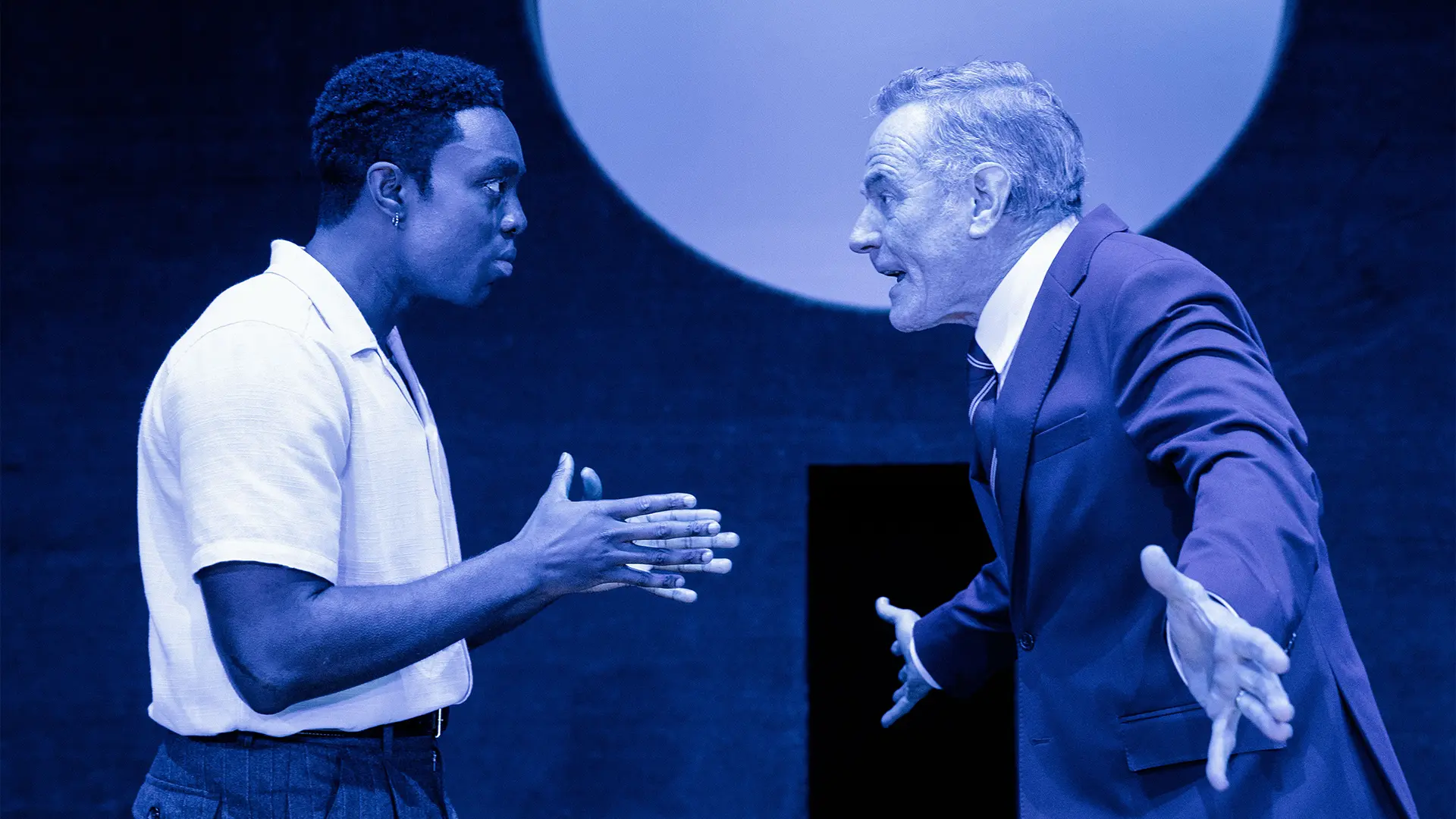
Paapa Essiedu & Bryan Cranston in All My Sons. Photo: Jan Versweyveld

When asked to name my favourite theatre production, I invariably cite Ivo van Hove and Jan Versweyveld’s stark staging of A View from the Bridge. Their return to Miller, this time with All My Sons—and with Bryan Cranston, Paapa Essiedu and Marianne Jean-Baptiste leading the cast—was therefore an enticing prospect. The result is a formidable, if not flawless, revival.

All My Sons remains a meticulously engineered dramas: the early hints, the incremental revelations, and the inexorable tightening of tension culminate in a climax of crushing inevitability. Its moral architecture—examining the corrosion that follows when a man, and indeed a society, elevates profit above humanity—remains chillingly contemporary. Miller’s characters, drawn with psychological acuity and emotional precision, still compel.

Van Hove and Versweyveld strip the stage of naturalistic detail, replacing Miller’s suburban garden and household façade with a bare stage. Lighting rigs stand in for hedges; the house becomes a blank wall with an aperture and a large circular window that variously evokes a sun, a moon, and, perhaps, an unblinking moral eye. It is a yellow circle when the play begins at dawn, before it unfolds over a single day. This follows an added prologue— we see the violent storm that fells the tree representing the missing eldest son. The fallen trunk remains onstage, the lone scenic element, a constant reminder of where the play is heading.

Versweyveld’s set is ingenious in its austerity, it anchors the play in the heart of mid Western industrial America but it is also universal in time as well as space. His lighting design holds the hand of the play throughout, carrying the emotional arc from the gentlest morning glow to a brutal, unforgiving glare.

Cranston’s Joe Keller is immediately persuasive: genial, grounded, radiating decency. Too good to be true? That’s the pleasure of acting of this calibre: for a time, we truly can’t tell as he walks the tightrope between public charm and private guilt. Paapa Essiedu as his son Chris charts a substantial arc, moving from principled idealism to profound disillusionment. He suggests, with remarkable nuance, the fragility of Chris’s outlook—an annoying idealism propped up by the wealth of the family business and his distance from its harsher realities; his life shaped by his experience of war. Paapa Essiedu matches Bryan Cranston in the depth of emotion he conveys.

Gradually we learn that the family lives beneath a shadow. During the recently ended Second World War, Joe’s factory produced a batch of faulty aircraft parts, leading to the deaths of several pilots. Joe was accused of knowingly shipping them, but ultimately his employee Steve was convicted and imprisoned.

His older son, Larry, was declared missing in action four years ago—but not because his plane contained one of the faulty parts (that would be too neat). His mother, Kate, refuses to accept his death. To do so would shatter the brittle righteous world she clings to. Marianne Jean-Baptiste is superb as Mother, revealing both the warmth that holds the family together and the ferocious denial that threatens to tear it apart. Her breakdown is executed with such controlled intensity that it becomes genuinely difficult to watch.

A catalyst arrives in the form of Ann, Larry’s former fiancée, now intending to marry Chris—and, crucially, she’s Steve’s daughter. Wearing a red dress that contrasts with everyone’s else’s duller browns and blues, she’s a spark tossed into a powder keg. The character can easily feel like a functional supporting role, but in Hayley Squires’ hands she is resolute, textured, and quietly courageous, weathered by hard experience yet capable of deep compassion.

This depth of casting extends throughout: the neighbours and relatives, each seem like real human beings with their own moral dilemmas. Take George, Ann’s brother, who storms through the auditorium in a frenzy of grief and fury to accuse Joe of framing Steve. Tom Glynn-Carney gives him the haunted volatility of someone consumed by pain yet desperate to believe he might be mistaken.

Bold in conception, thrilling in execution, and unquestionably relevant

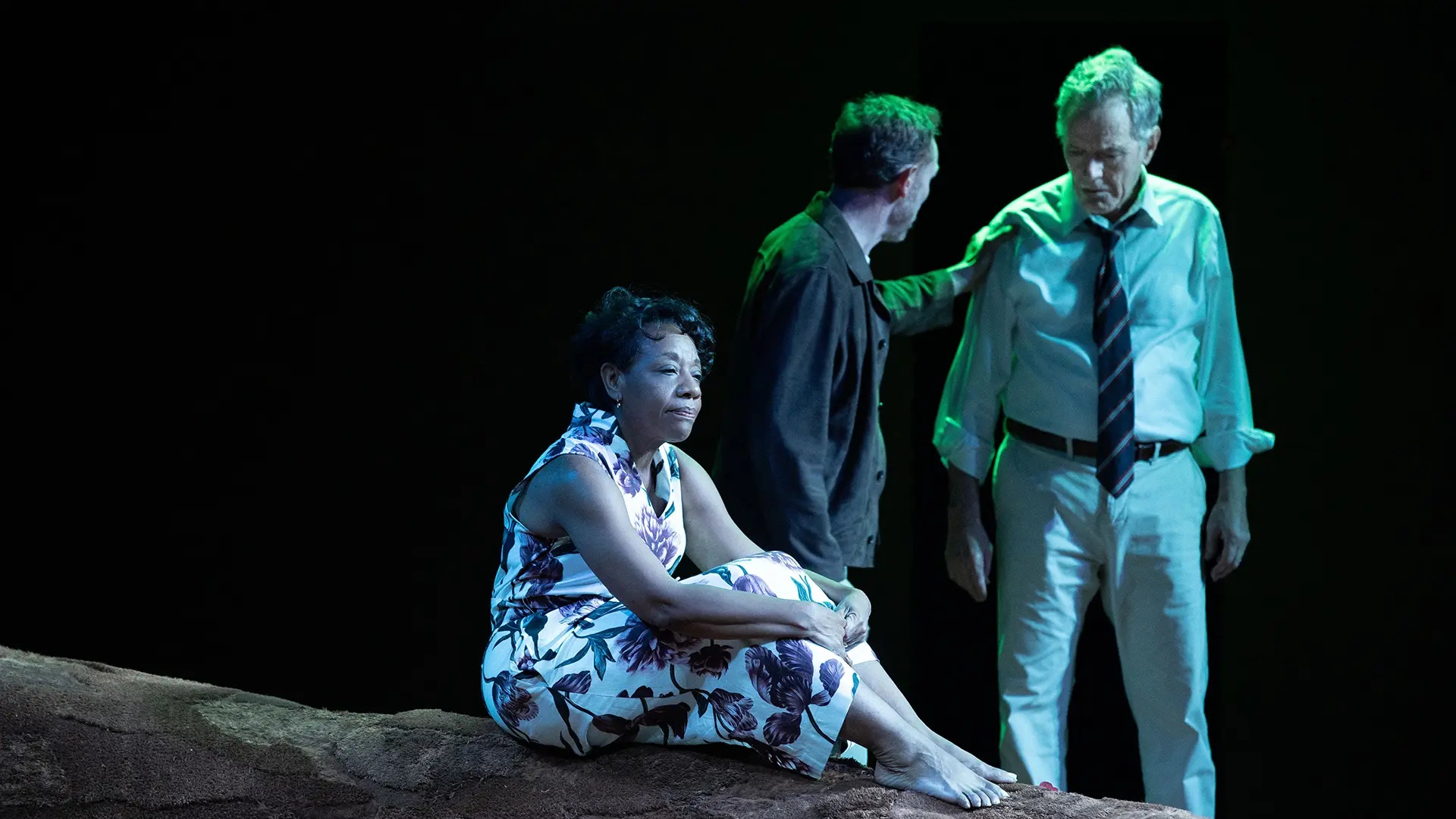
Marianne Jean-Baptiste & Bryan Cranston in All My Sons. Photo: Jan Versweyveld

As Joe offers his catalogue of justifications—military pressure, contractual anxiety, the reassurance that “everyone else was doing it”. These excuses echo across the decades: Boeing overlooking fatal design flaws; suppliers profiting from shoddy PPE during the COVID pandemic; water companies concealing pollution; social-media giants resisting regulation despite the harm to children, vulnerable people and democratic processes; politicians using public office to enrich themselves and their allies. The play has never felt more painfully relevant.

We are left in no doubt that there is no justification for placing profit above human life—even for the most seductive of all reasons: Joe’s claim that he did it for his family. And it is that very family we watch torn apart. “I know you’re no worse than most men,” Chris says, “but I thought you were better. I never saw you as a man. I saw you as my father.”

As the play progresses, Joe’s facade begins to crack, his easygoing selling of his image becomes more desperate, until he is finally confronted with the horror of what he has done. I swear, you can see the life draining from Bryan Cranston, as his face and body sag.

Miller never dilutes his central argument—that business must be governed by conscience and social responsibility—but the greatness of the play is in thw ay it shows us the humanity of the characters and acknowledges the agonising complexity of moral choice. All My Sons may begin in the realm of Ibsenite naturalism, but it concludes as a Greek tragedy of cause and consequence.

Van Hove and Versweyveld deliver a stark, intellectually rigorous interpretation that honours Miller’s ethical inquiry. That said, the production is not without missteps. The fallen tree which is only meant to be four years old is oversized, overly dominant  and overstates its symbolism. For someone who adores minimalism, I surprised myself by wishing for a modest table and chairs downstage and a smaller tree upstage. Then there was the incidental music- the persistent, plaintive plinking of piano and string. Though tastefully executed, it ultimately competes with, rather than elevates, the drama. Given the exceptional performances and the potency of Miller’s dialogue, such embellishment feels unnecessary.

These reservations notwithstanding, this is an incisive, superbly performed revival—bold in conception, often thrilling in execution, and unquestionably relevant. Not quite a five-star triumph, but a richly deserved and emphatic four.

All My Sons can be seen at the Wyndham’s Theatre until 7 March 2026. Buy tickets directly at allmysonsplay.com

Click here to watch this review on the YouTube channel Theatre Reviews With Paul Seven

Paul paid for his ticket.

Click here to read a roundup of other critics’ reviews of All My Sons at Wyndham’s Theatre


Theatre reviews roundup: End

Poignant end to trilogy

Dorfman Theatre in the National Theatre
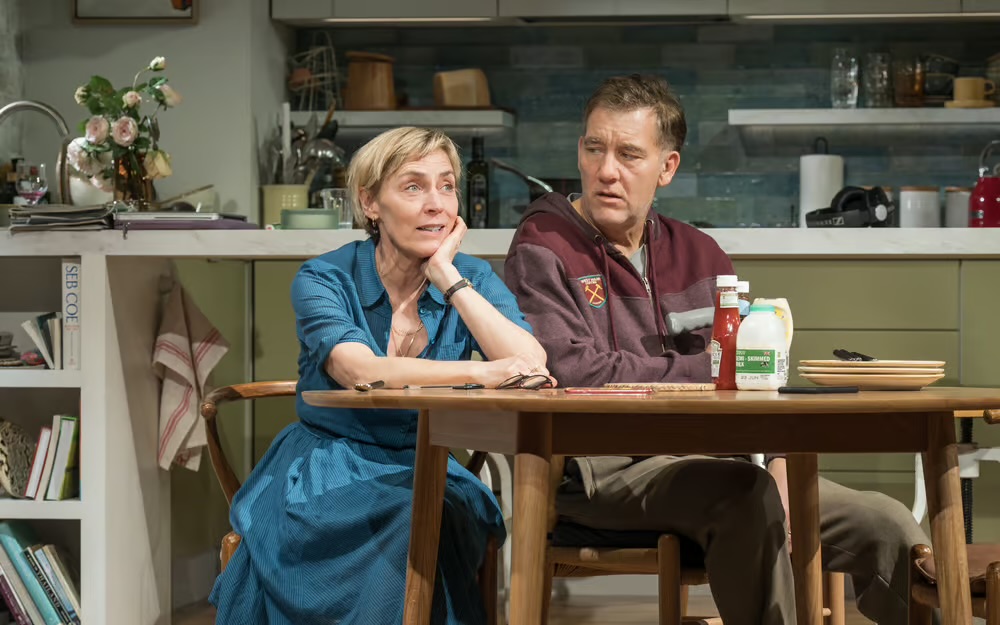
Saskia Reeves and Clive Owen in End. Photo: Marc Brenner

The final part of David Eldridge’s trilogy concerning couples at various stages in their relationships provides great acting from Clive Owen and Saskia Reeves in a story concerning a dying partner, said the critics.

[Links to full reviews are included but a number are behind paywalls and therefore may not be accessible]

4 stars ⭑⭑⭑⭑

LondonTheatre’s Marianka Swain found:  ‘Both actors are tremendous. Owen viscerally conveys the exhausted frustration of this energetic man being confined to a failing body (…) An extraordinary Reeves cycles through the desperate stages of grief (denial, anger, bargaining) while also hinting at Julie’s reserves of strength.’ She concluded: ‘Eldridge could do with leaving more space for such exchanges – there are a few too many florid speeches and over-worked metaphors – but this is tender, compassionate drama.’

Calling it ‘a beautiful conclusion’, Fiona Mountford in the Telegraph said: ‘Rachel O’Riordan’s sensitive production is not afraid to take its time and sit in its silences, allowing ruminative rhythms to play out. Yet it is by no means all downbeat, as Alfie and Julie playfully recall a rich shared history of past pleasures.’

WhatsOnStage’s Sarah Crompton found: ‘Owen and Reeves give performances of such honesty that the characters cease to be imagined and become real, every flicker of their shifting emotion beautifully recognised’. She decided: ‘It’s an astonishingly realised portrayal of the way human beings can grope towards an expression of the real things they are feeling’.

The Standard’s Nick Curtis said: ‘O’Riordan’s production depends on the chemistry of Reeves and Owen. The flashes of pique, exasperation and anger between Julie and Alf are underpinned by a mature and demonstrative affection. End features one of the more tender and delicate love scenes I’ve seen on stage’.

3 stars ⭑⭑⭑

Time Out’s Andrzej Lukowski was unconvinced: ‘Alfie and Julie’s dialogue and actions often feel wildly implausible in the context of a 90-minute realtime conversation, overly crammed with exposition and incident. Some veering in tone makes sense, but it gets a bit silly here. It’s a naturalistic drama, but (without wishing to spoiler) it becomes increasingly hard to believe a conversation like this would ever happen.’

Dave Fargnoli for The Stage found: ‘O’Riordan handles the sensitive, slow-paced piece with great finesse, assuredly judging when to let a pause stretch into a loaded silence and when to slip in an uplifting moment of humour. The unhurried staging never becomes static, but while the script is truthful and keenly observed, the piece feels more like documentary than drama: overly observational; lacking forward momentum.’

The Guardian‘s Arifa Akbar stated: ‘This is grown up, bittersweet fare that brings with it a full-bodied reflection on the end that awaits us all: death.’

The Independent‘s Alice Saville explained: ‘The first two parts captured decidedly normal Essex couples falling in love, then (almost) falling apart, played out in real time. Its conclusion breaks new territory by showing a couple who’ve broken with their past, by moving away from their beloved home county, and by contemplating the still scarier reality of moving off this planet altogether. But it still feels like it’s building to something bigger that never comes – a pay-off, postponed in favour of yet another cup of tea.’

Dominic Maxwell in The Times thought it was: ‘too rich with reminiscence, but it offers lots of telling details and little knots for its characters to untangle or move beyond.’ He observed: ‘This kind of nicely observed writing needs fabulous playing to stop from feeling like nicely observed writing. Rachel O’Riordan’s assured production gives us just that.’

Critics’ Average Rating 3.4★

End can be seen at the National Theatre until 7 March 2026.Buy tickets directly at allmysonsplay.com

If you’ve seen End at the National Theatre , please share your review/comment and rating below


Theatre reviews roundup: All My Sons

Bryan Cranston stars in drama of the year

Wyndham’s Theatre
Paapa Essiedu & Bryan Cranston in All My Sons at Wyndham’s Theatre. Photo: Jan Versweyveld

Director Ivo van Hove and his designer Jan Versweyveld first made their names in the UK with their stripped down production of Arthur Miller’s A View From The Bridge at the Young Vic in 2014. They’re back with a West End production of the same playwright’s All My Sons, returning to the same less-is-more treatment. The critics loved it. It’s one of the all time great plays, which helps, but they loved the cast- Bryan Cranston, Marianne Jean-Baptiste, Paapa Essiedu and more, and the way the director and designer did enough (but not too much) to bring out the play’s human dilemma of whether to sacrifice morals for self interest.

[Links to full reviews are included but a number are behind paywalls and therefore may not be accessible]

5 stars ★★★★★

The Guardian’s Arifa Akbar wrote a rave review. She praised van Hove for ‘letting the cast (and what a cast this is) just inhabit their parts but somehow become them as if by magic. They articulate the devastating truths in this play about the corruptions of the American dream and the toxic inheritance handed down from fathers to sons’. She observed: ‘There is a Sophoclean examination of the family, what it means for a son to inherit a father’s crimes, and the production lays out the psychology of blame, guilt and complicity in an incredibly full-bodied and clarifying way.’ She noted it ‘is a rare thing to see a group of actors quite this brilliant gel so completely (…) Every scene is strong, no actor stealing the show, each raising the power of the ensemble as a whole.

‘Calling it ‘an astonishing, deeply moving piece of theatre’, The Standard’s Nick Curtis said: ‘Bryan Cranston and Marianne Jean-Baptiste deliver near pitch perfect performances‘.

Time Out’s Andrzej Lukowski declared: ‘Bryan Cranston and Paapa Essiedu …offer two of the best stage performances of 2025.’  The key to the production was: ‘what van Hove has done is discretely uncouple Miller’s play from the naturalism that often stifles it (…) (his) production really savours the writing.

Cindy Marcolina of BroadwayWorld declared: ‘Each element of the mise-en-scène works perfectly in tune with the other, delivering a simply arresting theatrical event. Van Hove adds even more misanthropy to Miller’s already bleak point of view, exacerbating the significance of Joe’s choices. He cowardly picked money over people’s safety, capitalism over life, ego over justice: it’s as contemporary as it gets. But the intent doesn’t overshadow the humanity in it. He keeps the piece strongly fixed in its genre. It can be a tragic realist drama’.

Annabel Nugent in The Independent noted: ‘Van Hove manages something ingenious here, creating a version of suburban American that’s abstract and epic – while still humming with the sense of a local community that bustles into the backyard for tense little exchanges or leisurely card games. When this story’s tragedy reaches its full force, that thrum of gossip becomes a nightmarish mosquito whine. Joe hasn’t just displeased his community; he’s angered the old gods, and his downfall is absolute.’

The i’s Fiona Mountford stated: ‘playing now at just over two hours without interval, All My Sons assumes the grim yet towering momentum, inexorability and universality of a Greek tragedy (…) I have quite simply never seen a better production of this play.’

4 stars ★★★★

WhatsOnStage’s Sarah Crompton described van Hove’s ‘remarkable ability to crank up tension, to pull the relationships in the Keller family to taut breaking point and to orchestrate the results.’ She praised the design: ‘Jan Versweyveld’s set and lighting design are stark, brown, scuffed. This is not the usual suburban house but an expressionistic wasteland’. She loved the cast: ‘Marianne Jean-Baptiste gives ‘an utterly devastating performance of quiet despair and willed intent’ and ‘Essiedu is simply superb, leaning into Colin’s essential goodness, his trust in a world that is about to be destroyed.’

The Times’ Clive Davis said it was ‘a clear-sighted yet full-blooded reading of one of the most perfectly plotted dramas (with echoes of Ibsen and the ancient Greeks) you will ever see.’ He praised the stars: ‘Cranston gives a masterclass in fusing an easy exterior with a roiling interior’. But, ‘Good as everyone is here, it’s Paapa Essiedu … you walk out talking about. His ascent from affable shrugs to righteous rants is plausible, compelling, freshly minted.’ He concluded: ‘this is a seriously good play, seriously well acted, seriously well staged.’

The Stage’s Sam Marlowe found von Hove’s staging ‘shot through with a profound disgust for the jettisoning of morals and common humanity in the pursuit of the mighty dollar. As it builds towards a frenzy of anguish over more than two interval-free hours, you can’t help but sense a boiling anger at the current US administration.’ She had a reservation:  ‘Von Hove directs with his habitual expressionistic flourishes, some of which are a touch heavy-handed’. She ended:  ‘As we watch them all rip themselves and each other apart on a stage littered with red autumn leaves that irresistibly recall memorial poppy fields, this brutal dismantling of the American dream feels more pertinent than ever.’

For The Mail’s Patrick Marmion, it was a ‘harrowing journey into guilt-racked despair’.

Dominic Cavendish in the Telegraph thought: ‘the virtue of this production is… its spare focus’. He had one niggle: ‘With performances this strong, and a tragic climax so potent, the cinematic incidental music that plays beneath the dialogue feels like an unnecessary emotional nudge. Van Hove’s “less is more” approach works well; even less would work even better.’

Critics’ Average Rating 4.5★

Value rating 45 (Value rating is the Average Critic Rating divided by the typical ticket price)

All My Sons can be seen at Wyndham’s Theatre until 7 March 2026.Buy tickets directly at allmysonsplay.com

Click here to read Paul Seven’s review of All My Sons

If you’ve seen All My Sons at the Wyndham’s Theatre , please share your review/comment and rating below

Theatre reviews roundup: Porn Play

Ambika Mod excels as porn addict in uneven play

Royal Court Theatre
Ambika Mod and Lizzy Connolly in Porn Play. Photo: Helen Murray

Ambika Mod rose above a play about addiction to pornography that received mixed reviews. Some critics thought Sophia Chetin-Leuner’s play, directed by Josie Rourke, was a bold look at female sexuality while others thought it heavy handed and unfocused.

[Links to full reviews are included but a number are behind paywalls and therefore may not be accessible]

4 stars ★★★★

Chris Wiegand in The Guardian called it an ‘ambitious balance of tragedy, horror and comedy’. He commented: ‘In a riveting performance, Ambika Mod manages to make Ani’s isolation and emptiness as moving as it is unsettling.’

Annabel Nugent in The Independent described the play as ‘a welcome and bold addition to the growing discourse surrounding sex and the internet.’ As for Ambika Mod’s performance: ‘she brings a naturalism and genuine fearlessness’.

The play is ‘brutally sad rather than sexy’ said The Standard’s Nick Curtis. He continued: ‘It features a harrowing central performance, more emotionally than physically exposing, from Ambika Mod’.

Olivia Rook for LondonTheatre reported : ‘Chetin-Leuner’s tight, 100-minute play asks lots of probing questions about the complicated and thorny strands of female desire, but only gently touches on the likely root of Ani’s struggle. In Porn Play’s final moments, shame and grief mingle together in a harrowing display that shows not only the skill of its lead performer, but the craft of its ambitious young writer.’

Three stars ★★★

Writing for the Telegraph, Fiona Mountford found it ‘an uncompromising, uncomfortable – get ready to watch myriad masturbation scenes – and too often unsubtle watch.’ The star disappointed her: ‘Mod makes Ani unrelentingly bleak and blank in Josie Rourke’s 100-minute production. The unfortunate upshot of this is that we, like everyone in Ani’s life, feel very distant from her.’

Time Out’s Andrzej Lukowski pointed out: ‘Rourke’s production is staged on a remarkable Yimei Zhao set: it transforms the Royal Court’s Upstairs theatre into a sort of gigantic flesh-coloured sofa with what I’m going to go ahead and say is a big hole that’s meant to be evocative of a vaginal opening as its focal point.’ He is critical of the play: ‘It’s a bold play with a fantastically committed performance from Mod. My basic problem is that violent porn addiction in women is such a rare and delicate subject to be tackling that Chetin-Leuner’s splashy conceptual flourishes feel like a personal hobby horse she’s unsubtly worked in.’

The Stage’s Sam Marlowe praise was tempered: ‘It feels like a frenzy of intriguing ideas, none of which is properly pursued – but for all its nebulous muddle, in Josie Rourke’s striking production, it compels. The dialogue zings, and there’s a playful erudition in the writing, even if it seems a draft or two away from the intricate, layered work it might become.’

The Times’ Clive Davis gave faint praise: ‘Josie Rourke’s production is actually as soft-centred as the material underfoot’ and ‘delivers a portrait of a woman who remains more symbol than substance. Ani is a gifted researcher whose expertise on Milton’s Paradise Lost is the cue for some unremarkable reflections on sin and morality. In case we miss the parallels with Eve’s temptations in the Garden of Eden, Ani and her boyfriend, Liam, are shown about to consume an apple in their opening scene.’

Franco Milazzo’s review in BroadwayWorld was so excoriating, I’m surprised he gave the play as many as three stars. ‘This is not an easy watch by any means but neither is it a particularly informative one.’ His many objections include ‘the parallels between Ani’s fall from grace and Eve’s in Paradise Lost. The allusions could hardly be less subtle (…) If the hints were any heavier, the Royal Court should think about reinforcing the foundations.’ The review was also full of research that served to undermine Chetin-Leuner’s story: ‘one study suggests (…) another study points to…’ 

Critics’ average rating 3.4★

Porn Play can be seen at The Royal Court theatre until 12 December 2025. Buy tickets direct from the theatre 

Click here to read Paul Seven’s review

If you’ve seen Porn Play, please add your rating and/or review below 


×