Terence Rattigan’s play is overpowered by Ben Daniels’ thrilling performance
⭑⭑⭑⭑
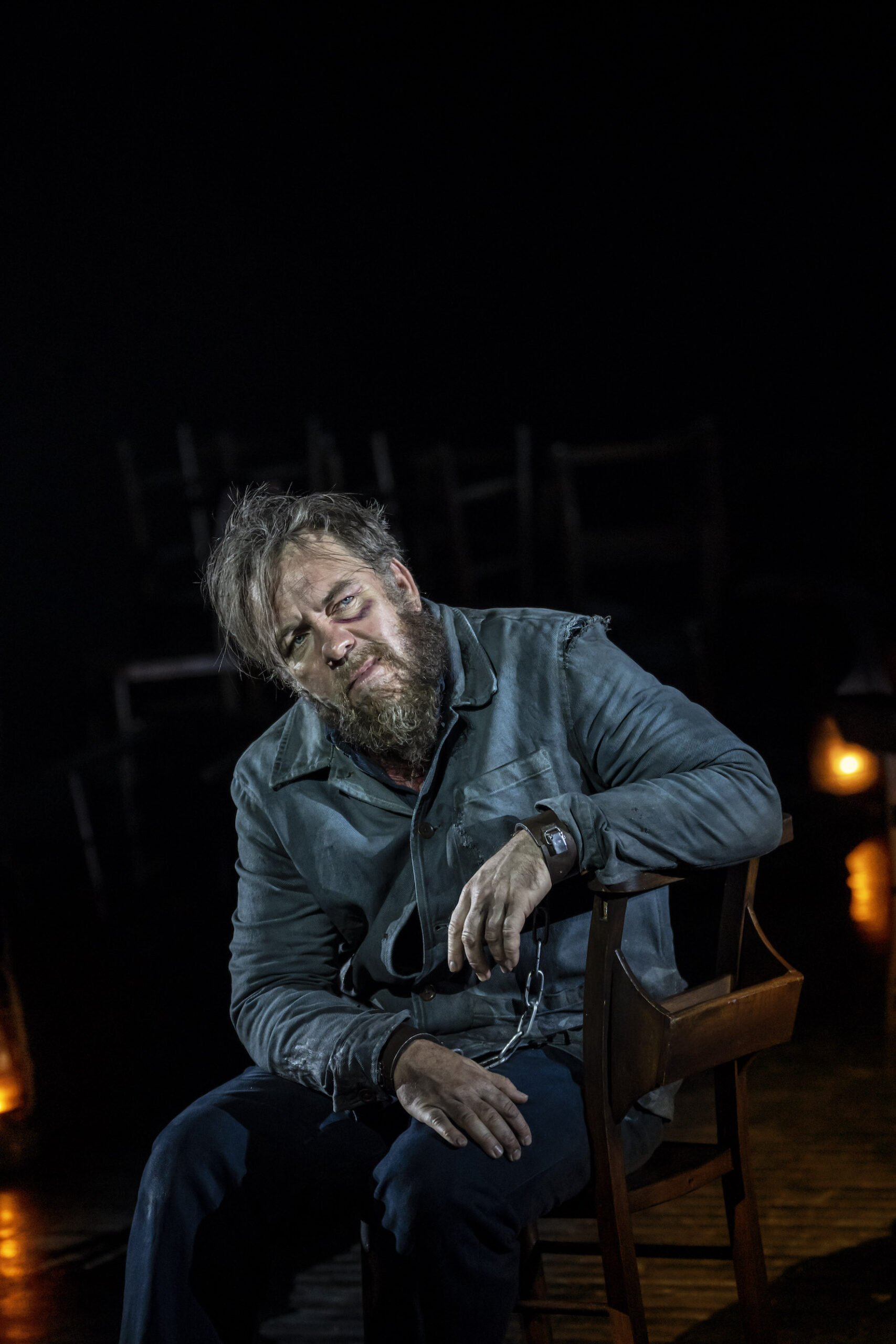
Ben Daniels in Man And Boy. Photo: Manuel Harlan
Terence Rattigan is now recognised as one of our great playwrights, spoken of as a successor to Ibsen and Chekov. But this wasn’t always so. After his pre-eminence in the 1940s and 50s, he was swept aside by the new wave of so-called kitchen sink and absurdist drama from the likes of Osborne and Pinter. So when Man And Boy arrived in 1962, it was pretty much dismissed by audiences and critics. It took until 2005 before there was a revival in London, which, although well received, still didn’t bring it into the repertoire of regularly performed Rattigan plays such as The Winslow Boy, The Browning Version, The Deep Blue Sea, and Separate Tables.
Is it then a problem play? Well, the National Theatre is giving us a chance to find out, albeit clothed in a thoroughly modern makeover. The trouble is, Anthony Lau‘s stripped down treatment featuring Ben Daniels leaping on and off tables, tends to overpower the play itself. Then again, it’s such a thrill, maybe that doesn’t matter.
Man And Boy, set in the early 1930s, when financial markets were unstable, centres an amoral, sociopathic millionaire and his relationship with his son. Gregor Antonescu is said to the richest, cleverest financier in the world. Ben Daniels, suited and booted, knocks the role into the acting stratosphere, brilliantly conveying a fast talking charm while occasionally revealing his savage contempt for all around him. He smiles, he bares his teeth, he moves like a raptor.
Ben Daniels in Man And Boy. Photo: Manuel Harlan
‘Liquidity and confidence’ keep him afloat, and it’s a phrase he often repeats. As the play begins, liquidity has deserted him in this world where loans are moved around and called in at dizzying speed, and with that has gone his backers’ confidence in him. Matters are made worse when criminal charges are brought against him. ‘In finance, man makes his own miracles,’ says Gregor, and sets about proving his point. A radio provides an urgent commentary. It’s a searing, damning portrait of the world of the super rich, that resonates today.
Trying to avoid the media while he attempts to make a deal that will save him, he holes up in his estranged son Basil’s pokey apartment in a poor part of New York. It turns out the venue is not random. He has set up a meeting with a major banker Mark Herries, played with a combination of smarm and steel by Malcolm Sinclair. Herries is a closet gay man, whom Gregor hopes to manipulate by passing off his son as a rent boy that he can link up with.
Basil is played with a moving mixture of sadness and surliness by Laurie Kynaston. He is a sensitive musician with a social conscience, hence ‘weak’ in Gregor’s eyes. At first, Basil is hostile to his father- ‘you are nothing’ he says- yet still shows filial loyalty when his father is under threat. So, the second half of the play looks more closely at this damaged relationship, with a broken Gregor who has previously said ‘love is a commodity I can’t afford’ wondering whether he has underestimated the importance of love, and Basil doing everything he can to gain that missing paternal affection.
So, what about the tables? On the stage of Georgia Lowe‘s traverse-style set are three long tables that are moved into different configurations for no reason that was apparent to me, unless it was an elaborate pun to do with turning the tables on his enemies. In addition, there are a few simple chairs, a piano, a telephone, a radio, and I think that was it.
On one wall at the back of the theatre is projected the cast list and above the stage entrance the neon words ‘Knock Knock’, although it’s always a doorbell that rings. Why? It could be an attempt at Brechtian alienation, intended to make us step back from emotional involvement, and think about the moral issues. I doubt Rattigan would have approved.
Do the tables help or hinder?
So do the tables help or hinder our understanding of the play? Looked at positively, they create some dramatic moments when Ben Daniels jumps onto them and looks down on all around him. At these times, he is the colossus the world believes him to be, and when he crouches on his haunches and leans over his son, he is like an alpha male silverback gorilla. But, also, they are only cheap kitchen tables, an apt metaphor for the flimsy foundations of Gregor’s power. Credit here to Choreographer and Movement Director Aline David.
Ben Daniels & Laurie Kynaston in Man And Boy. Photo: Manuel Harlan
Then again, when other characters clamber onto a table, the effect feels mannered and a bit distracting. Are they isolating themselves from those close to them, as they are already doing emotionally? Maybe. Or are they just doing it because the tables are there? Any way you interpret it, I will always think of this as the ‘table production’.
I guess we’re used to seeing plays by Rattigan’s contemporaries, writers like Arthur Miller and Tennessee Williams, being given minimalist settings, not to mention those by the father of naturalism, Ibsen. But a naturalistic background has come to seem integral to Rattigan’s work. Very few of us have had the opportunity to see Man And Boy in a conventional production, so it’s hard to judge what is gained or lost in this stripped-bare version.
While the first half dominance of Ben Daniels was thrilling, and his breakdown in the second half shocking, yet his sheer theatrical force, and (yes) the tables, stopped me from getting fully engaged with the evolution of the father-son relationship. This may be intentional, since the play’s centre of gravity is undeniably Gregor.
The other characters we encounter are very much secondary, albeit well played. Phoebe Campbell brings verve to Basil’s girlfriend Carol. Gregor knows all about her, because he has spies, and information is power in his world (that’s how he knows about Mark Harries’ secret life). Leo Wan is David Beeston, an accountant at first confident and aggressive when he tries to prove Gregor’s corruption, but who breaks down in the face of humiliation and frustration. Isabella Laughland gives a delightful performance as Gregor’s semi-detached wife, enjoying the high life but annoyed at the lack of attention from her husband. Nick Fletcher plays Sven, Gregor’s cynical consigliere. It is significant that when Gregor hits rock bottom and craves some human touch, his Wife and his closest friend both make their excuses.
By the way, although I said the set is two-sided, there are gallery and circle seats on the other two sides. I would advise you that those areas offer severely restricted views.
Man And Boy make lack the finesse of Rattigan’s best plays, but Anthony Lau’s bold staging and Ben Daniels mighty performance make the revivial well worthwhile.
Man And Boy can be seen at the National Theatre until 14 March 2026.Buy tickets directly from nationaltheatre.org.uk
Erin Doherty in The Crucible at National Theatre London 2022
Back in 1953, when Arthur Miller wrote The Crucible, a play about the late 17th century witch trials in Salem Massachusetts, he no doubt had in mind a modern day witch hunt in which a US senator persecuted perceived communists, especially in Hollywood. But it could be about any time when authorities demonise others to consolidate their power.
It’s a compelling study in how the process of a witch hunt develops a momentum of its own and triggers vengeance, fear and even mass hysteria. Lyndsey Turner’s intense production is powerfully acted by Erin Doherty, Brendan Cowell and the rest of the cast.
In a small town run by the church, some misbehaving girls try to get off the hook by claiming to be possessed by the Devil. This gets out of hand as they take the opportunity to get their own back on some respectable and respected citizens by accusing them of being disciples of the devil who lead them on. A trial ensues. Adults confess to outlandish encounters with demons, more accusations fly, more adults confess in a form of mass hysteria, and the children too start to believe their own tales.
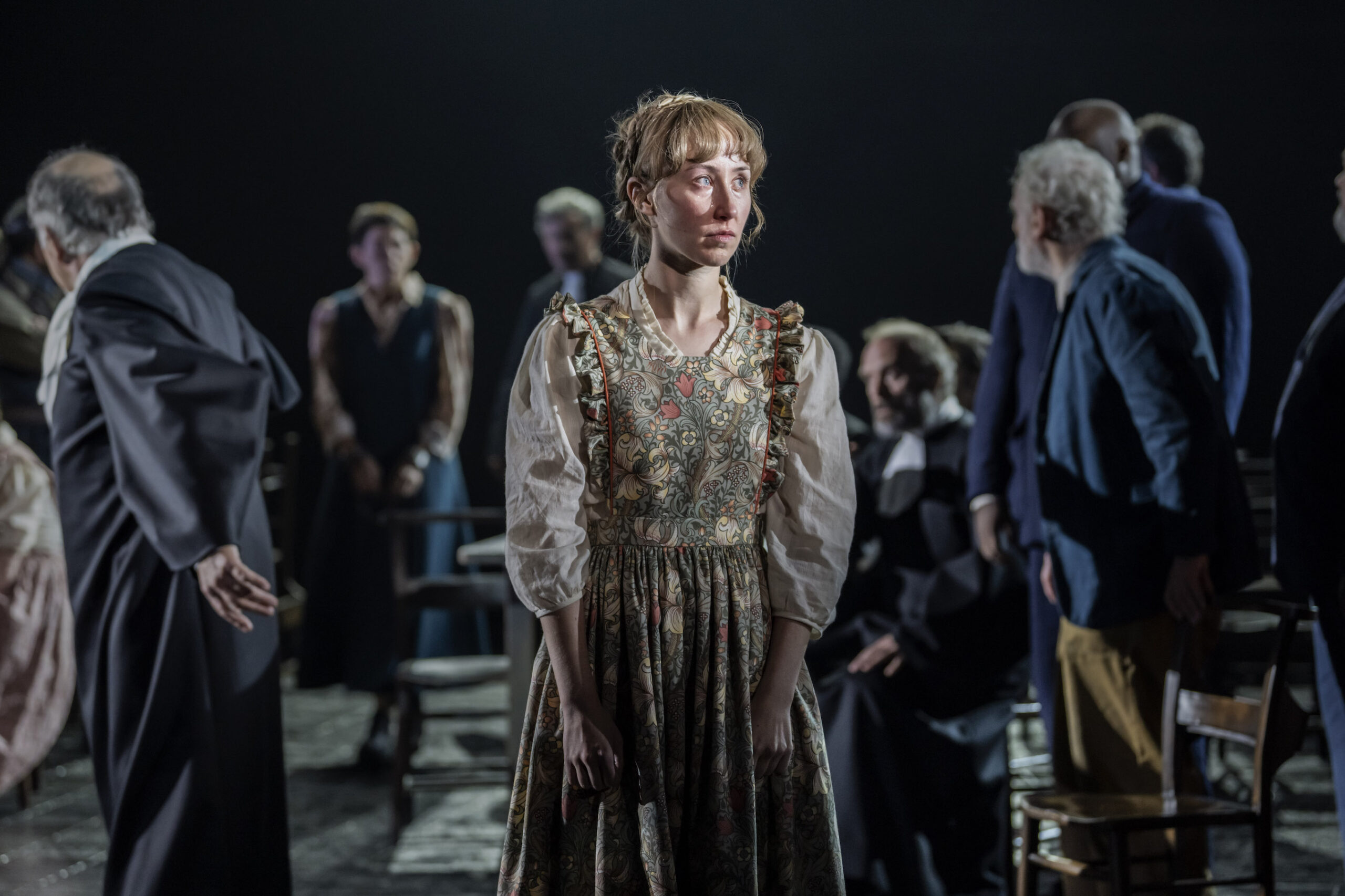
The girls are led by Abigail. It’s a bravura performance by Erin Doherty. You might know her best as an excellent Princess Anne in The Crown but she shows her full range as an actor here. Her character is clearly a rebel but also scheming. So, we see her wheedling, pleading, and, in a terrifying scene, inspiring the other girls into wild-eyed, uncontrolled shaking, as if possessed.
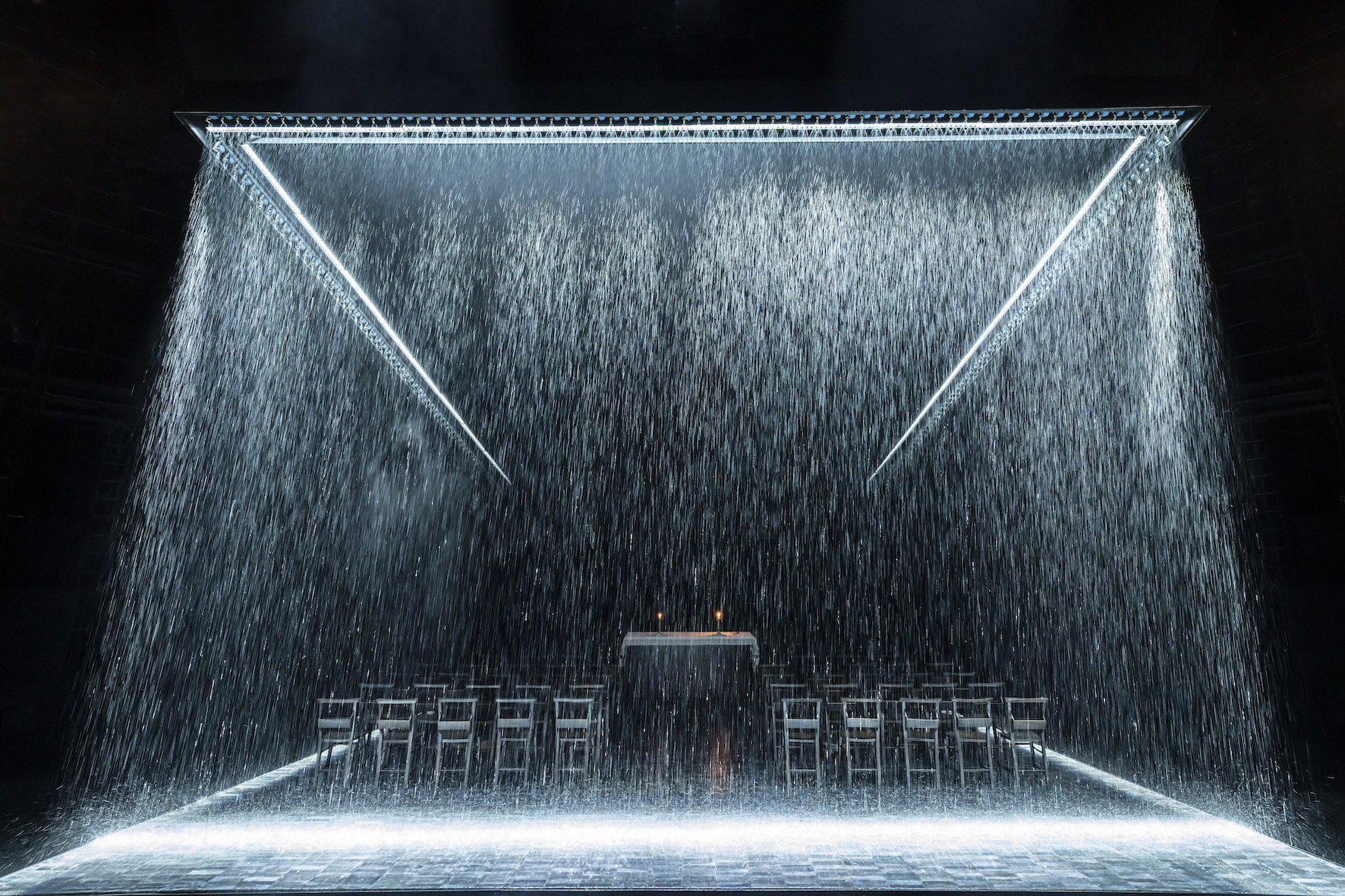
Authoritarian power is just one of the subjects explored in Arthur Miller’s complex play, but it’s the one from which all elsefrom which all else arises. As we enter the Olivier auditorium, we are confronted by pouring rain. Every scene begins with pouring rain. Torrents of water team onto the front of the stage. It seems this community is already suffering the punishment of a pitiless Old Testament God. We’re told the community is a theocracy. No separation in those days between church and state: the Church is in charge and there can be no challenge to its authority.
Photo: Johan Persson
The church leader Reverend Parris is confronted by children secretly rebelling against the church’s rules by secretly dancing, among other things. Some of the citizens believe this behaviour has been caused by the Devil in the form of witchcraft. The priest is skeptical but he knows support for him in the community is shaky, so he calls in a preacher with higher authority and a knowledge of witchcraft: the Reverend Hale. A major trial follows, headed by Deputy Governor Danforth, played with a steely eye and a stern jaw by Matthew Marsh. He has his own reasons for wanting to stamp his authority on the community.
At this point, it’s a case of ‘to a hammer everything is a nail’. It seems obvious that the children are dissembling but, as the excellent National Theatre programme points out, the authorities see what they believe rather than believing what they see. As the witch hunt goes to extremes in the heat of the ‘crucible’, both Parris and Hale, given passionate and nuanced performances by Nick Fletcher and Fisayo Akinade respectively, begin to see how one-sided the trial is. They realise good people are being dragged down and note that ‘every defence is seen as an attack on the court’.
Brendan Cowell in The Crucible. Photo: Johan Persson
One man who speaks out against the trial is John Proctor whose wife is accused of witchcraft. It’s a thundering piece of acting from Brendan Cowell as a good but flawed man. In a heart-breaking sequence, he nobly tries to reason with the Court and is brought down by his own honesty and the challenge he poses to the Church’s teachings.
What else is going on? Oppression of women by the church. They are expected to be silent and obedient. As the girls are indoctrinated by tales of hellfire and damnation, they are primed for believing they have been taken over by unseen forces. And they have a readymade means of excusing themselves.
Fear, revenge and greed all play a part. People turn on each other to save themselves. The girls are only too quick to denounce the many adults they resent. Ruthless people take the opportunity to gain land from those found guilty of witchcraft. There’s a lot to think about and be shocked by in this intelligent, frightening play.
It’s easy to discern many parallels more modern than the McCarthyite witch hunt. We can see what goes in all totalitarian countries where a weak authority cannot be questioned: the actions of the morality police in Iran for example, or would-be authoritarians closer to home for whom an alternative point of view or a minor misdemeanour can ignite outrage on social media leading to death threats and cancellation.
Director Lyndsey Turner has created an fervid production, only marred by a tendency at times towards melodrama. One nice touch is that nearly all the characters point fingers as they argue, a metaphor made physical. The masterful set by Es Devlin is appropriately black-and-white except when we visit the Proctors’ warmer-coloured home. An opaque ceiling hangs over hhe entire stage. Through it filters a diffused flouredcrnt white light suggesting no one can hide from a pitiless regime.
Crucial to the production are Tim Lutkin’s lighting and the sound by Caroline Shaw, Tingying Dong and Paul Arditti. The cast are usually lit from the side creating a lchiaroscuro effect, again suggesting no middle ground. A stretched low note drones in the background, ratcheting up the tension.
The impressive cast also includes Sophia Brown, Karl Johnson, Eileen Walsh and Tilly Tremayne.
The Crucible was performed at the National Theatre 21 September – 5 November 2022, and will transfer with cast changes to the Gielgud theatre from 2 June to 7 September 2023
To provide the best experiences, we use technologies like cookies to store and/or access device information. Consenting to these technologies will allow us to process data such as browsing behaviour or unique IDs on this site. Not consenting or withdrawing consent, may adversely affect certain features and functions.
Functional
Always active
The technical storage or access is strictly necessary for the legitimate purpose of enabling the use of a specific service explicitly requested by the subscriber or user, or for the sole purpose of carrying out the transmission of a communication over an electronic communications network.
Preferences
The technical storage or access is necessary for the legitimate purpose of storing preferences that are not requested by the subscriber or user.
Statistics
The technical storage or access that is used exclusively for statistical purposes.The technical storage or access that is used exclusively for anonymous statistical purposes. Without a subpoena, voluntary compliance on the part of your Internet Service Provider, or additional records from a third party, information stored or retrieved for this purpose alone cannot usually be used to identify you.
Marketing
The technical storage or access is required to create user profiles to send advertising, or to track the user on a website or across several websites for similar marketing purposes.