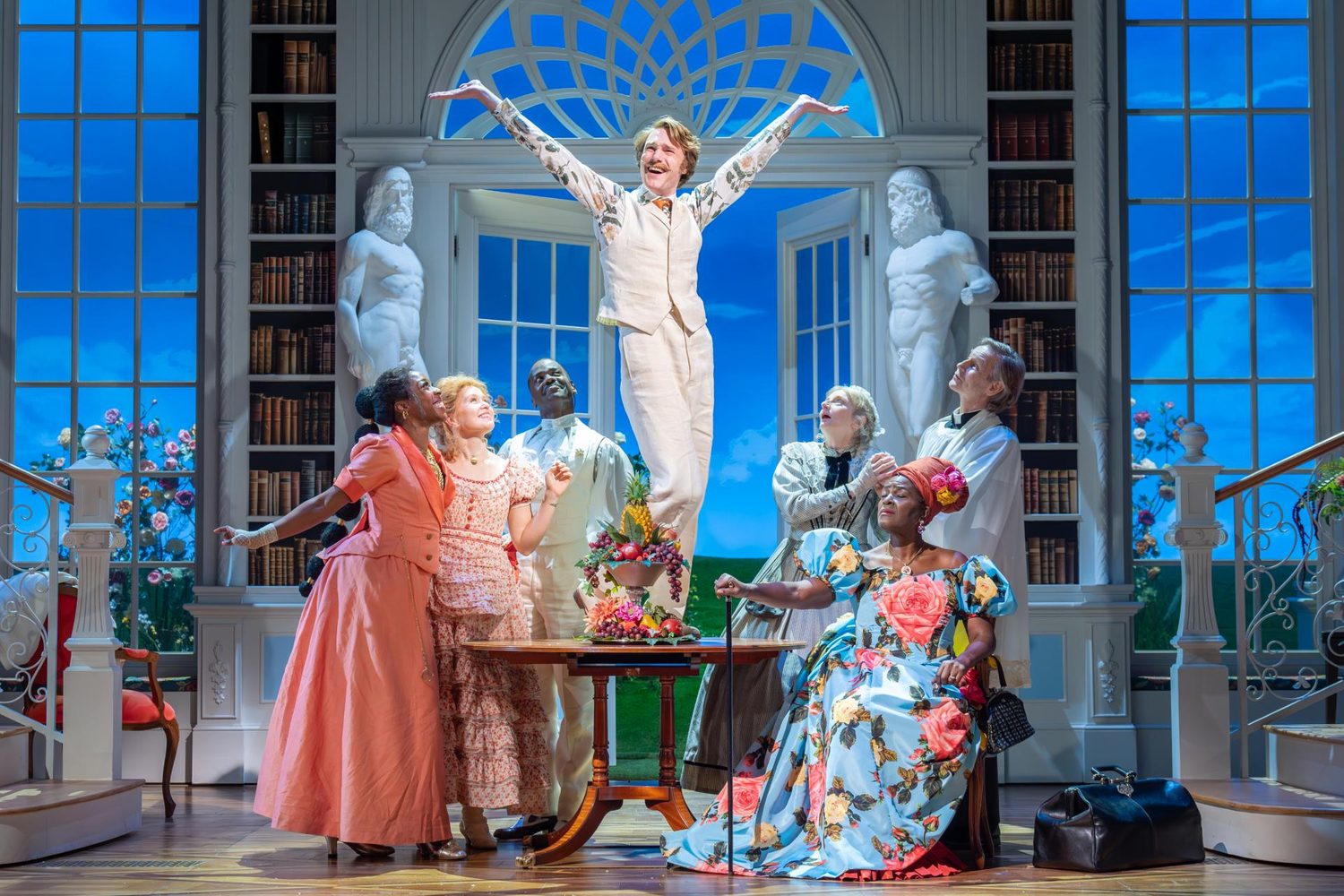
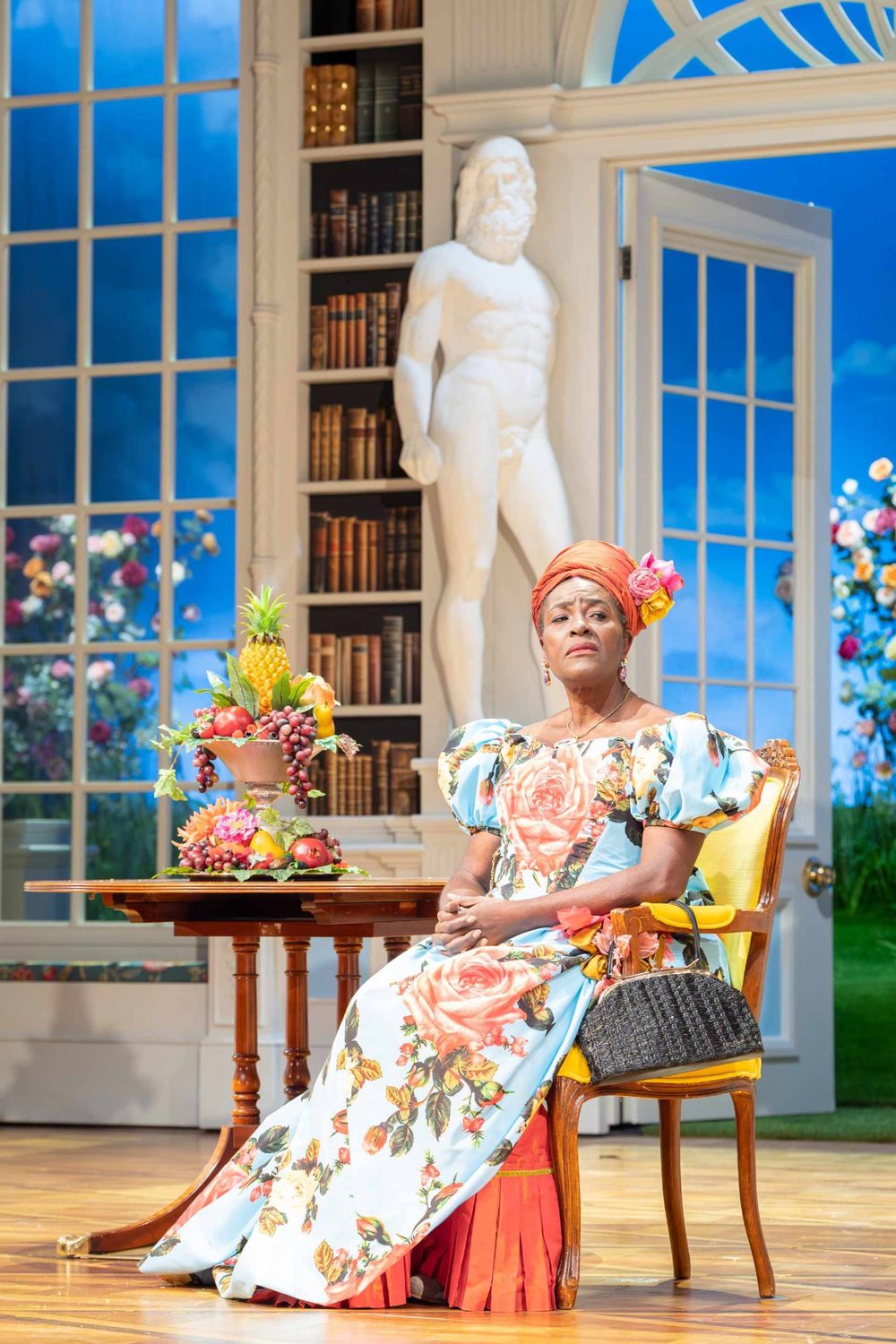
Stephen Fry in The Importance of Being Earnest. Photo: Marc Brenner
I gave a lukewarm review to this production of The Importance of Being Earnest when it premiered at the National Theatre. Part of the reason was, I love this play and, even though I still enjoyed the witty dialogue and the ingenious story of identity and hidden truth, I felt the queer interpretation was laid on a bit thick. I accepted that the two main characters’ double lives could be taken as a metaphor for gay men’s secrecy in past times, but, to my mind, Max Webster‘s decision to foreground the subtext undermined the power of Wilde’s actual text. I now think my prejudice blinded me to the quality of what was in front if me
So I wanted to give it a second chance, and go in more prepared for this approach. And I wanted to compare Olly Alexander‘s Algernon and Stephen Fry’s Lady Bracknell with Ncuti Gatwa and Sharon D Clarke.
It’s not only the twostars, there’s a complete new cast. Each actor captured the distinctive cadence of Oscar Wilde’s prose, delivering lines with clarity. Putting my gratitude for that aside, I fully expected Alexander and Fry to lack the power of Gatwa‘s dazzle and Clarke’s swagger. And in a way I was right, neither has the charisma of the National’s original casting. However, their more restrained interpretations of Algie and Lady Bracknell create a more balanced production.
They make the parts their own, as judges on talent shows are apt to say. Olly Alexander delivers an exemplary performance, imbuing Algie with endearing boyish charm, while Stephen Fry relied on a quiet, clipped delivery (and to be fair his height) to exert his authority. This is not the pantomime dame I feared but rather a totally believable version of the snobbish, domineering representative of the aristocracy. Where the previous larger-then-life characterisations almost suffocated Wilde’s delicate plot construction, toning them down seems to allow it to breathe a little more.
The rest of the West End cast are as good if not better than their National Theatre counterparts. Outstanding are the two young women, Gwendolen and Cecily, played by Kitty Hawthorne and Jessica Whitehurst respectively, and the object of Jack and Algie’s affections. I still found their overt expressions of sexual frustration somewhat incongruous with the period context, but I went with it, and actually the tongue waggling and the attention they pay to their fiery loins is pretty funny. Come to think of it, their obsession with their husband being called Ernest is just as silly.
Another highlight is Hayley Carmichael playing the manservants Lane and Merriman. It’s hard not to laugh at Merriman’s every entrance, when this diminutive figure dressed in oversized wig and tailcoat moves with mechanical stiffness and an air of complete bewilderment.
Shobna Gulati and Hugh Dennis extract plenty of humour from the relationship between Miss Prism and Canon Chasuble. Their suppressed passions form a delightful counterpoint to the younger lovers’ unbridled emotions. Nathan Stewart-Jarrett is a fine, likeable Jack Worthing.
Olly Alexander and Hayley Carmichael in The Importance of Being Earnest. Photo: Marc Brenner
Far from going further in laying on thick this gay interpretation, the transferred production seems to have reined it in ever so slightly. I admit I was expecting, and therefore was less concerned about the opening where Algie is in a cocktail dress at a cross dressing party, or the men and women being sexually excited by their own as much as the opposite sex, or by the references to modern pop songs.
It may have avoided becoming the pantomime I feared but the production is still deliciously over the top. Rae Smith’s colourful costumes and lavish sets, complete with masses of blooming bushes and two naked male statues, create an exuberant atmosphere. And the curtain call does provide a panto-style walkdown, with the cast dressed in giant petals.
I would still prefer a version of The Importance of Being Earnest that allows the lines to speak for themselves, but I am very happy to concede that Wilde’s timeless comedy is big enough to take a joke, and this is a particularly good joke.
The Importance of Being Earnest. Photo: Marc Brenner
Did you know Oscar Wilde was gay? I’ll be surprised if you didn’t, but after seeing Max Webster’s production at the Lyttelton, you’ll be in no doubt. His subtle references to the Victorian gay community are circled with a pencil, underlined with a marker pen, and coloured in with a fluorescent highlighter in this panto style production.
The generous view would be that Mr Webster has turned the familiar classic into a Pride Party. To me it was like saying the Mona Lisa is smiling, so let’s make that clear by painting a big toothy grin over her mouth. Fortunately, Doctor Who’s Ncuti Gatwa and Sharon D Clarke save the day.
We start with a scene in which Ncuti Gatwa appears in a slinky dress in the middle of what appears to be a gay party. Then the curtain goes up on Oscar Wilde’s actual play, but with added text, added gestures and added modern touches.
Whenever Max Webster’s production sticks to the text, it works really well. The central character Algernon is a kind of proxy for Wilde himself: decadent, amoral and bubbling over with cynical epigrams. Even people who have never seen the play before will probably know some of them, such as ‘In matters of grave importance, style, not sincerity is the vital thing.’
Ncuti Gatwa is a very good Algie: cool, laid back, with a mischievous smile, which he often employs in the direction of the audience. He delivers those epigrammatic lines as they are meant to be- clear and confident, defying argument. That he wears colourful tight-fitting clothes and poses like a cat is all we need to suggest a fluid sexuality. But we get a lot more.
His friend Earnest is played by Hugh Skinner projecting the same kind of puppyish naivety he brought to the character Will in W1A. Both the young men have secrets that will inevitably be exposed.
Earnest, whose real name is Jack, is in love with Algy’s cousin Gwendoline. The main obstacle to their marriage is her mother Lady Bracknell who cross examines him for suitability and discovers that he was abandoned as a baby in a railway station in a handbag, leading to the most famous two word line in theatre history.
Sharon D Clarke in The Importance of Being Earnest. Photo: Marc Brenner
With all due respect to other members of the cast, Sharon D Clarke is the saviour of the evening. Her Lady Bracknell is every bit as imperious and formidable as she should be, which of course is what makes her pronouncements about the rules of society so funny. You know the sort of thing: ‘Fortunately in England, at any rate, education produces no effect whatsoever.’ Making the character Caribbean in origin is inspired. Her slight lilt gives extra weight to every word. She is as good as any Lady Bracknell I’ve seen, including the legendary Judi Dench.
Before long, Algy too is in love with a woman, namely Jack’s ward Cecily. The girls have in common that they can only love a man named Earnest. I won’t say any more about how the plot rolls out and resolves, in case you’re unfamiliar with it.
Part of the joy of Wilde’s dialogue is that you are left in no doubt that the young women are physically attracted to the men, and more predatory, without actually saying it. Yet, Ronkẹ Adékọluẹ́jọ́ and Eliza Scanlen as Gwendoline and Cecily respectively are required by the production to make clear their sexual arousal with shuddering bodies and flicking tongues. Gwendoline rolls her eyes and gives the audience lascivious looks, while Cecily talks like Miranda Richardson playing the randy Queen in Blackadder.
Far from trusting the audience to pick up the subtext, bits of business are added throughout. And I’m hard pressed to find one addition that doesn’t actually take away from the play’s effectiveness. Here are some examples. To a list of overdue bills from The Savoy is added Dalston Superstore (a contemporary gay bar). When Algie and Jack come through a door, they are singing James Blunt’s You’re Beautiful. Faced with having to ask Lady Bracknell for help, Jack mutters ‘crap’. The celibate Canon Chasuble and Miss Prism, played with gentle affection by Richard Cant and Amanda Lawrence, won’t admit they are attracted to one another. Their skirting around the subject is what makes their relationship amusing, not Canon Chasuble hiding an erection under his hat, which belongs in a 1970s farce. When volumes of books which each cover a letter of the alphabet are picked out, the first three are G A and Y. Subtle it ain’t.
I’m fully at ease with modernising classics. It can breathe new life in them, it can add to our understanding of them. And I also think it’s great that we should honour Oscar Wilde as a gay man who courageously exposed Victorian hypocrisy and was persecuted for it. I like challenging work but, frankly, this production does Wilde and the audience – even non theatregoing Whovians- a disservice by seeming to treat the play as if it’s too subtle for its audience to appreciate.
This production is running over Christmas which may explain the decision to turn it into an adult pantomime. In fact, it’s great fun if you ignore the assault on the play. There’s even a panto style walk down in which all the cast wear glittering sexy costumes and enter to beat music, encouraging clapping along rather than applause.
By the way, all the dazzling costumes and the sets, designed by Rae Smith, are fabulous. They are recognisably Victorian within a false proscenium arch, so the design pays homage to the style of a late Victorian stage play while using bright light and colour to open it up, in a way that the direction aspires to but doesn’t.
Oscar Wilde triumphs despite the production, thanks to Ncuti Gatwa, Hugh Skinner and Sharon D Clarke doing justice to his witty, perceptive script.
Paul paid for his ticket. He saw the last preview before the official opening night. This review was slightly revised on 2 December 2024 for the purpose of clarification.
The Importance of Being Earnest is at the National Theatre until 25 January 2025. Tickets from nationaltheatre.org.uk
To provide the best experiences, we use technologies like cookies to store and/or access device information. Consenting to these technologies will allow us to process data such as browsing behaviour or unique IDs on this site. Not consenting or withdrawing consent, may adversely affect certain features and functions.
Functional
Always active
The technical storage or access is strictly necessary for the legitimate purpose of enabling the use of a specific service explicitly requested by the subscriber or user, or for the sole purpose of carrying out the transmission of a communication over an electronic communications network.
Preferences
The technical storage or access is necessary for the legitimate purpose of storing preferences that are not requested by the subscriber or user.
Statistics
The technical storage or access that is used exclusively for statistical purposes.The technical storage or access that is used exclusively for anonymous statistical purposes. Without a subpoena, voluntary compliance on the part of your Internet Service Provider, or additional records from a third party, information stored or retrieved for this purpose alone cannot usually be used to identify you.
Marketing
The technical storage or access is required to create user profiles to send advertising, or to track the user on a website or across several websites for similar marketing purposes.