Mixed reviews for Ike’s eavesdropping thriller
Adelphi Theatre
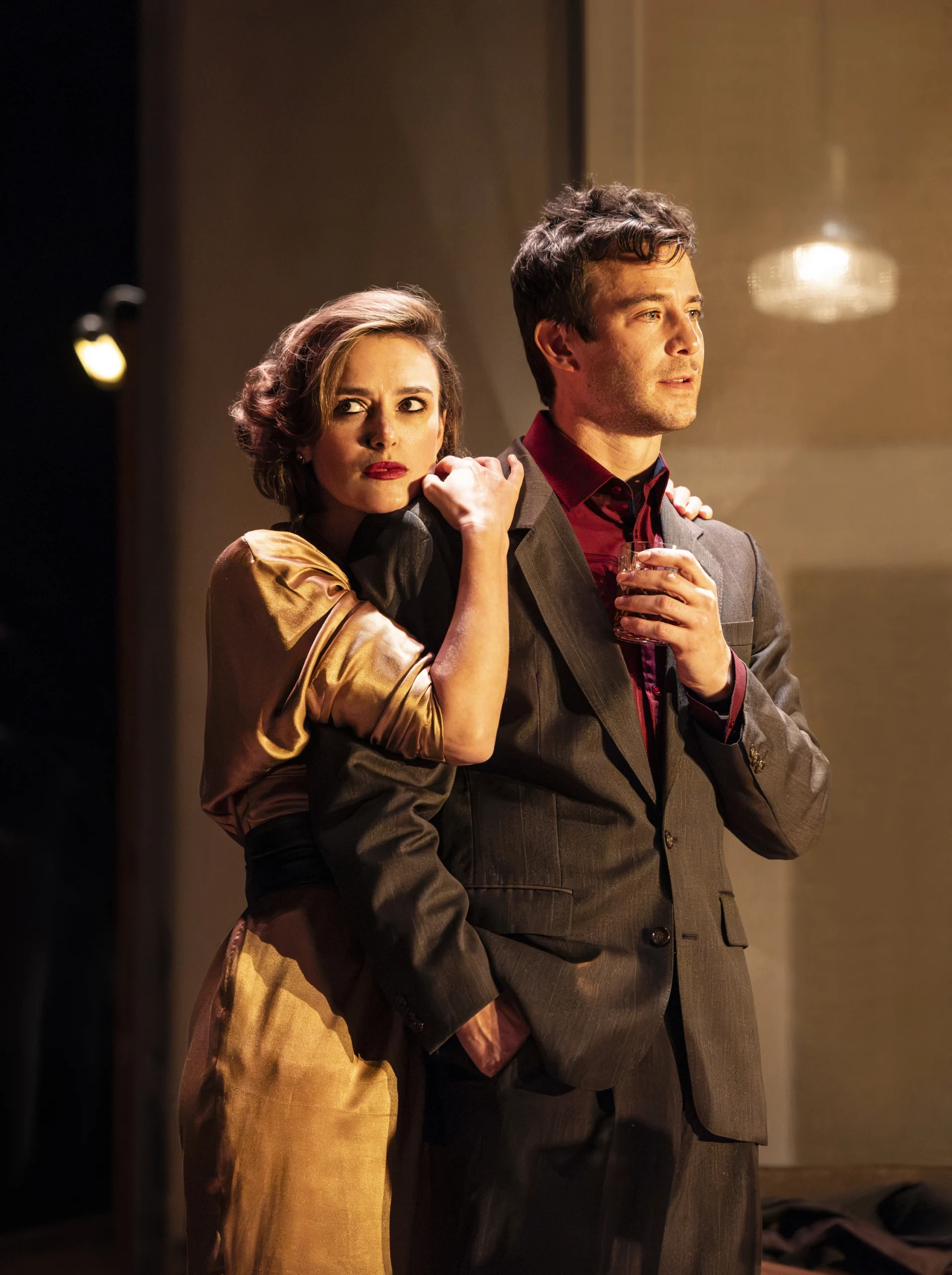
Theatrical wunderkind Robert Icke has turned his attention away from the classics to adapt a film. The critics were happy that he had created a gripping play that reflected on the power of art, although some felt it didn’t match the subtlety of Florian Henckel von Donnersmarck’s 2006 film. The play and film are set in East Germany during the communist days when the Stasi spied on everybody, looking for dissent. In this case, Gerd Wiesler played by Stephen Dillane is listening in on a couple from the arts world, gradually becomes involved in their lives and tries to save them. Luke Thompson is Georg Dreyman, a playwright who initially compromises his work in order to stay out of trouble before becoming rebellious. As so often, a big West End play requires a big screen name, in this case, Keira Knightley, who plays Christa-Maria Sieland, a fragile star actor who tries to survive by sleeping with the enemy. All the actors were complimented and there was much praise for Hildegard Bechtler‘s set.
Its ‘Value’ rating is currently the lowest of any limited run show listed. At the time of writing, mid-price tickets on which my rating is based started are £195. The top price is £275. If this makes you you think only rich people can afford to go to the theatre, you may be surprised to find there is only a handful of seats available.
[Links to full reviews are included but a number are behind paywalls and therefore may not be accessible]
5 stars ⭑⭑⭑⭑⭑
The Standard‘s Nick Curtis was bowled over by Icke’s ‘magnificent adaptation’. He thought Keira Knightley ‘is fittingly cast as Christa-Marie Sieland, the bright, brittle star of the East Berlin theatre scene – all professional sheen and charm until a devastating scene that Knightley performs with wrenching conviction. This is not a celebrity vehicle, though, but an ensemble piece. Indeed, you could almost call it a gesamtkunstwerk – a “total artwork” – so vital are design, sound and music to Icke’s vision.’ He ended: ‘It’s great to have Knightley back on the London stage after 15 years, alongside Dillane and Thompson in a fine, big cast. Icke, best known for his radical Shakespeares and startlingly reworked classics, here brilliantly re-examines the recent past at a time when we’re arguably more surveilled, monitored, and eavesdropped-upon than ever.’
WhatsOnStage‘s Sarah Crompton declared in a passionate review: ‘Icke has transmuted a film about heroic resistance to authority and the moments that people crack or rebel into a play about the power of art and the need for the kind of understanding it provokes, subtly but insistently altering the focus. His vision is an immense achievement not least because it is nigh-on perfect in execution (…) The whole production is a triumph because it embodies its own theme. Art matters, empathy counts. A society that forgets compassion for the lives of others is not worth having. And it shows that by being a deeply moving and utterly spellbinding evening of theatre.’
Aliya Al-Hassan of BroadwayWorld called the adaptation ‘utterly compelling’. She ended: ‘This is a gripping and totally absorbing night out, with star casting that pays off in spades.’
Jane Edwardes for Plays International was impressed by the way ‘Icke has put together an outstanding production team who support his work all the way. Hildegard Bechtler’s design is noteworthy for the austerity of the black flats that slide back and forth, and for a revolving stage which adds to the sense that the state can probe into every aspect of one’s life (…) Giles Thomas’s sound design brilliantly shifts from the classical music in Dreyman’s apartment to the crackle of the sound waves, to the insistent sound of Max Richter’s music.’
4 stars ⭑⭑⭑⭑
The Financial Times’ Sarah Hemming praised ‘Robert Icke’s brilliantly slippery and exquisitely acted adaptation (…) On stage, the interplay between truth and artifice, trust and deception, so central to live drama, becomes critical not just to the story but to its delivery, bringing the issues thrillingly and troublingly alive.’ She described how the actors portray characters are trying to survive in an authoritarian regime: ‘The actors trace precisely and eloquently the cost this exacts. Thompson’s glossy confidence and boy-next-door bounce gradually drain away as he realises that he’s a pawn; Knightley’s defiantly tilted chin and poised charm give way to brittle, strung-out despair. Dillane, meanwhile, is sensationally good as a man eaten away by the sordid reality of grubbing about in people’s intimate lives.’
Marianka Swain for LondonTheatre called it a ‘sleek and riveting adaptation’. She reported: ‘Keira Knightley … is inspired casting for the glamorous star possessed of an otherworldly beauty. She’s excellent, too, as the insecure offstage Sieland’.
The Telegraph‘s Dominic Cavendish was delighted by the return of Keira Knightley to the stage: ‘you can’t take your eyes off her – even if the evening belongs to Stephen Dillane as Wiesler, the conflicted Stasi captain in the attic.’ He said: ‘the achievement of the production, played without interval and often using a stage revolve to create a sense of remorseless scrutiny, is that it has its own strange, nightmarish logic.’ He continued: ‘Sparingly employing camerawork for the interrogation scenes, the director makes the case for the story as a live, communal experience: there’s an astounding coup de théâtre when the set is pulled apart, exposing the Adelphi’s full stage, the scene-shifters, and the artifice of it all. That’s not just a Truman Show-style indictment of Communist oppression, but a form of mass implication, too: we’re all voyeurs here.’
The Independent‘s Alice Saville said Icke succeeded in ‘turning grimy state machinery into heartstopping visual poetry (…) Icke’s staging here creates a series of beautifully-designed prisons; spaces that trap, stifle and ultimately destroy the people who live in them. Sliding screens move at breakneck speed to shrink the audience’s view of the stage into a tiny, cinematic close-up. Designer Hildegard Bechtler creates a midcentury apartment whose covetable modernist comforts can vanish in an instant, replaced by desolate institutional punishment.‘
3 stars ⭑⭑⭑
Dave Fargnoli of The Stage felt: ’Icke’s production never quite equals the film’s oppressive atmosphere, puncturing the tension too often with out-of-place comic relief and a frustrating tendency to gloss over the emotional impact of certain key events. Still, the story remains absolutely gripping, and Icke’s staging is typically slick and tautly paced.‘
The Guardian‘s Arifa Akbar declared: ‘Icke chooses a difficult story to adapt and direct here’ and concluded the adaptation ‘does not manage the immensely difficult task it sets itself.’ She had particular words to say about the actors: ‘Luke Thompson … seems too puppyish in the role. Knightley (…) gives a committed performance, but the character feels overheated and underwritten’ and Dillane’s ‘inner change is portrayed too subtly and not subtly enough.’
Time Out‘s Andrzej Lukowski also dissected the actors: ‘Dillane is terrific in the role: a desiccated, hollowed out old apparatik who passionlessly destroys lives but is astounded to discover the flickering embers of a conscience deep inside. Thompson is very good as Georg, a man whose initial bland niceness and aversion to risk isn’t actually a front (the Ed Sheeran of East Germany). But his slide into rebellion is really well-handled, with Thompson keeping him winningly innocent throughout. Big name Knightley lacks the stage experience of her co-stars (…) She’s fine, but a really great stage actor could probably have elevated not only the part, but by extension probably the entire play. As it is, it’s not prime Icke, but he’s at least done a fine job in turning a 20-year-old foreign language film into gripping West End entertainment.’
Mary Conway for The Morning Star found: ‘That Robert Icke is the director adds excitement to what would otherwise be a pale copy of the film. And Icke’s visual imagination leaves us with lasting images: not least Bechtler’s glorious revolving set which brings us every detailed corner of Dreyman’s flat, all fully exposed except for the bedroom and bathroom — both sites of significant private happenings in the drama — which appear in misty focus as if Wiesler himself can’t bear to look.’ She assured her readers: ‘While the play does highlight the ever-present potential threat of writers and artists to the dominant political philosophy, it more precisely embodies the corruption of power and the abiding humanity of ordinary people. And it’s not an anti-socialist play. At one point Dreyman asserts that the socialist experiment of the Eastern bloc is overwhelmingly a quest for good. And that is the takeaway, not a Western celebration of glasnost as we might expect.’
The Times‘ Clive Davis offered faint praise: ‘in the end you are often left admiring the bravura flourishes rather than being drawn into the story itself’ (…) ‘Knightley is perfectly fine’ (…) ‘Thompson is likeable enough’ (…) ‘Hildegard Bechtler’s revolving set … the constant movement does tend to overshadow the actors at times’ (…) ‘Icke’s extended soundtrack delivers mixed results as well.’ (…) ‘Icke also indulges in a few too many theatre in-jokes … in the context of a drama set in a totalitarian state they had a frivolous air to them.’
Critics’ average rating 3.9⭑
Value rating 20 (combining average rating with typical ticket price)
The Lives of Others is at The Adelphi Theatre until 9 January 2027. Buy directly from the theatre
If you’ve seen The Lives Of Others at the Adelphi Theatre, please leave your review and rating below