Theatre reviews roundup: Porn Play

Ambika Mod excels as porn addict in uneven play

Royal Court Theatre
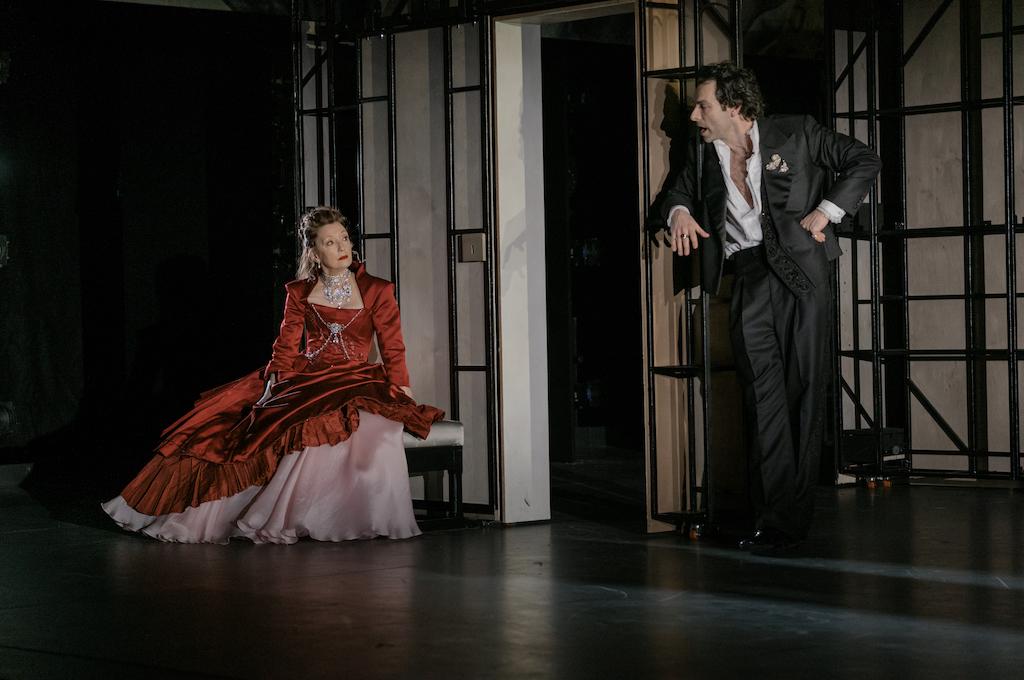
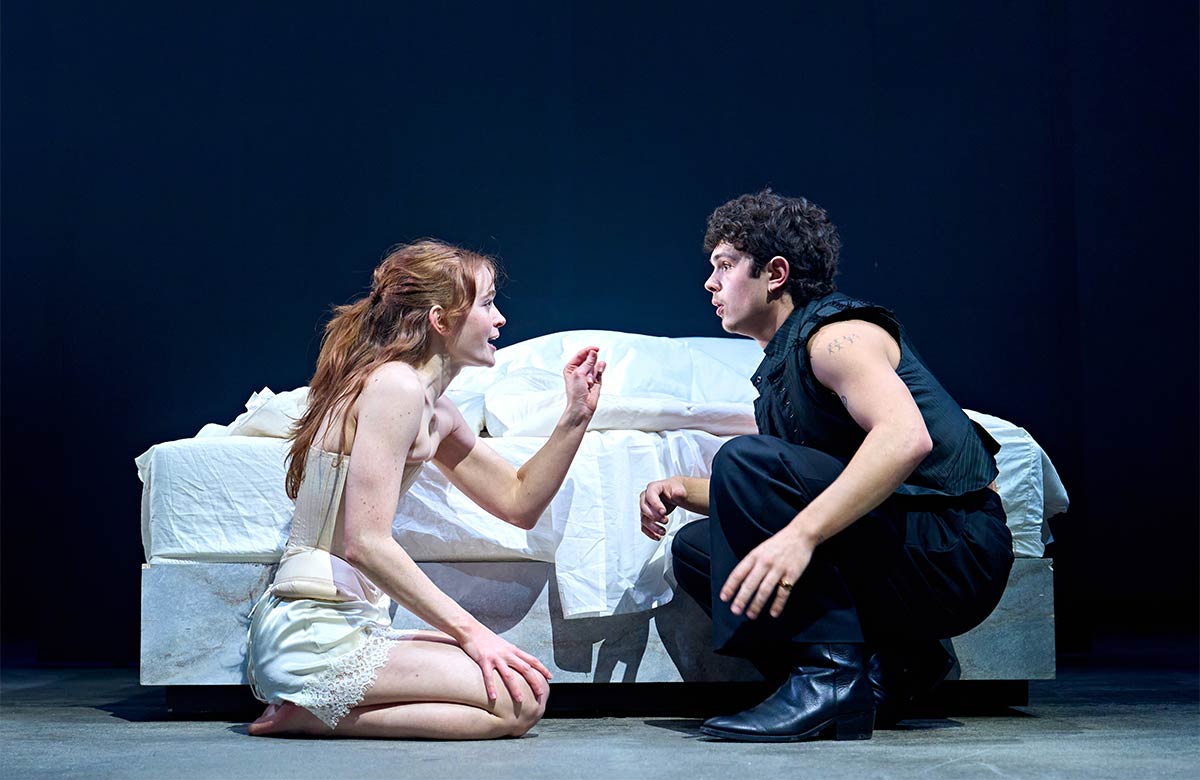
Ambika Mod and Lizzy Connolly in Porn Play. Photo: Helen Murray

Ambika Mod rose above a play about addiction to pornography that received mixed reviews. Some critics thought Sophia Chetin-Leuner’s play, directed by Josie Rourke, was a bold look at female sexuality while others thought it heavy handed and unfocused.

[Links to full reviews are included but a number are behind paywalls and therefore may not be accessible]

4 stars ★★★★

Chris Wiegand in The Guardian called it an ‘ambitious balance of tragedy, horror and comedy’. He commented: ‘In a riveting performance, Ambika Mod manages to make Ani’s isolation and emptiness as moving as it is unsettling.’

Annabel Nugent in The Independent described the play as ‘a welcome and bold addition to the growing discourse surrounding sex and the internet.’ As for Ambika Mod’s performance: ‘she brings a naturalism and genuine fearlessness’.

The play is ‘brutally sad rather than sexy’ said The Standard’s Nick Curtis. He continued: ‘It features a harrowing central performance, more emotionally than physically exposing, from Ambika Mod’.

Olivia Rook for LondonTheatre reported : ‘Chetin-Leuner’s tight, 100-minute play asks lots of probing questions about the complicated and thorny strands of female desire, but only gently touches on the likely root of Ani’s struggle. In Porn Play’s final moments, shame and grief mingle together in a harrowing display that shows not only the skill of its lead performer, but the craft of its ambitious young writer.’

Three stars ★★★

Writing for the Telegraph, Fiona Mountford found it ‘an uncompromising, uncomfortable – get ready to watch myriad masturbation scenes – and too often unsubtle watch.’ The star disappointed her: ‘Mod makes Ani unrelentingly bleak and blank in Josie Rourke’s 100-minute production. The unfortunate upshot of this is that we, like everyone in Ani’s life, feel very distant from her.’

Time Out’s Andrzej Lukowski pointed out: ‘Rourke’s production is staged on a remarkable Yimei Zhao set: it transforms the Royal Court’s Upstairs theatre into a sort of gigantic flesh-coloured sofa with what I’m going to go ahead and say is a big hole that’s meant to be evocative of a vaginal opening as its focal point.’ He is critical of the play: ‘It’s a bold play with a fantastically committed performance from Mod. My basic problem is that violent porn addiction in women is such a rare and delicate subject to be tackling that Chetin-Leuner’s splashy conceptual flourishes feel like a personal hobby horse she’s unsubtly worked in.’

The Stage’s Sam Marlowe praise was tempered: ‘It feels like a frenzy of intriguing ideas, none of which is properly pursued – but for all its nebulous muddle, in Josie Rourke’s striking production, it compels. The dialogue zings, and there’s a playful erudition in the writing, even if it seems a draft or two away from the intricate, layered work it might become.’

The Times’ Clive Davis gave faint praise: ‘Josie Rourke’s production is actually as soft-centred as the material underfoot’ and ‘delivers a portrait of a woman who remains more symbol than substance. Ani is a gifted researcher whose expertise on Milton’s Paradise Lost is the cue for some unremarkable reflections on sin and morality. In case we miss the parallels with Eve’s temptations in the Garden of Eden, Ani and her boyfriend, Liam, are shown about to consume an apple in their opening scene.’

Franco Milazzo’s review in BroadwayWorld was so excoriating, I’m surprised he gave the play as many as three stars. ‘This is not an easy watch by any means but neither is it a particularly informative one.’ His many objections include ‘the parallels between Ani’s fall from grace and Eve’s in Paradise Lost. The allusions could hardly be less subtle (…) If the hints were any heavier, the Royal Court should think about reinforcing the foundations.’ The review was also full of research that served to undermine Chetin-Leuner’s story: ‘one study suggests (…) another study points to…’ 

Critics’ average rating 3.4★

Porn Play can be seen at The Royal Court theatre until 12 December 2025. Buy tickets direct from the theatre 

Click here to read Paul Seven’s review

If you’ve seen Porn Play, please add your rating and/or review below 


Theatre reviews roundup: The Hunger Games: The Stage Show

Film adaptation favours spectacle above emotion

The Troubadour Canary Wharf Theatre
Mia Carragher in The Hunger Games. Photo by Johan Persson

The Hunger Games is a stage version of the first film in the series of the same name. It has a stellar creative team, with Conor McPherson (The Weir, Girl From The North Country) doing the adaptation, Matthew Dunster directing and Miriam Buether designing. Many reviewers felt the nuances of the story were lost in the large scale spectacle, although some didn’t care about that. The critics didn’t actually agree on how spectacular the show was. Some were dazzled, others found it fell short of their expectations. Mia Carragher as the lead impressed with her action hero prowess.

[Links to full reviews are included but a number are behind paywalls and therefore may not be accessible]

4 stars

Holly O’Mahony in The Stage was a fan of the spectacle: ‘there’s plenty here to impress fans of the franchise, and the space is used in its entirety. Set pieces rise up from beneath the arena-like stage, and props are lowered from above. Ian Dickinson’s sound design sends the flutter of birds’ wings around the auditorium, bringing us closer to the action; Kev McCurdy’s fight direction orchestrates gasp-worthy duels; and Chris Fisher’s illusions send arrows flying into the bullseye of their targets.’

3 stars

Cindy Marcolina at BroadwayWorld declared: ‘The actors are tireless athletes, the theatre is an imposing arena, and the stagecraft is often remarkable. Unfortunately, it’s also a soulless incarnation (…) If you expect to be wowed to the edge of your seat, the technical aspects will do that. If you look for emotional depth and the same thematic inquiry as the source material, you might be disappointed.’

For Alex Wood at WhatsOnStage, it was ‘a show that often feels caught between two impulses: thoughtful character study and full-throttle spectacle, and never really satisfyingly landing either.’ He concluded: ‘It has just enough theatrical invention to justify its existence beyond the films, while Carragher’s debut is a genuine highlight.’

Time Out‘s Andrzej Lukowski took a different view of the choice of lead: ‘It’s hardly hack work. And it very nearly clicks – just a stronger lead away from triumph.’ He explained that ‘Mia Carragher is certainly up to the considerable physical demands of playing Katniss (…) But she’s somewhat light on the ol’ charisma and she talks in a breathy Marilyn Monroe-style accent that is odd bordering on distracting.’ He didn’t think it worked to have her as ‘both protagonist and narrator. It’s true that there’s a lot to explain. But in such an action-heavy format, having the lead character constantly offering background on what’s going on really undermines the sense of her living in a dangerous moment.’

The Mail‘s Patrick Marmion decided it wasn’t as good as the film: ‘Martial arts, modern dance, and hand-to-hand combat are what drive the pageant, heightened by strobe lighting and nasty white noise. Sadly for the producers, the practicalities of live performance can’t touch the roller-coaster ride of the film.’

Over at The Independent Alice Saville disagreed: ‘There are wince-inducing fight scenes, eyebrow-singeing bursts of fire, and dazzling bits of stage trickery. Its tensest moments plunge the audience right into this dangerous world’. Her beef is with McPherson’s adaptation: ‘he makes too much of Katniss and her sister’s pretty dresses, and not enough of their raging sense of injustice.’

The Guardian‘s Arifa Akbar found: ‘you don’t feel the dread in Conor McPherson’s adaptation, which seems clipped by the pace of events, all spectacle above emotion.’ She noted: ‘John Malkovich, appearing on screen as President Snow, goes his own way a little more, not as lugubriously contemptuous as Donald Sutherland in the film, more blank-eyed and Spock-like. But he remains as flat as his 2D image, more a cameo than a character.’

2 stars

Claire Allfree for the Telegraph called it a ‘depressingly bad adaptation’. She continued: ‘Dunster’s production feels thuddingly perfunctory. Save for a blink-and-you’ll-miss-it moment of suspended action in the rafters, startlingly little use is made of the hangar-like proportions of the Troubadour auditorium (which was purpose-built for this show).’ Her parting shot was: ‘we are left with a mediocre half-way house, neither theatrically coherent nor, alas, a patch on the far superior films.’

The i’s Fiona Mountford ‘found this unexcitingly staged spectacle an underwhelming trudge.’ She was disappointed by the lack of spectacle: ‘With this sort of setting, an audience understandably expects bells-and-whistles excitement; as it is, the friend who came with me commented that, “It looks like they’re running around a school gym”.’

For Marianka Swain at LondonTheatre, it was ‘a damp squib’. She said: ‘Matthew Dunster’s production never really finds a unique and coherent theatrical language for The Hunger Games. It’s a hodge-podge of ideas, including limited video, songs, aerial stunts, and unconvincing stylised dance.’

‘This dystopia could surely do with a little more pizzazz,’ began The Times’ Clive Davis. ‘The in-the-round arena, designed by Miriam Buether, looks impressive when you take your seat, but once the action starts you soon discover that Dunster and his team struggle to fill it with enough spectacle to justify the steep prices.’ He found:  ‘Mia Carragher … is an energetic central presence as Katniss Everdeen (…) But the fact that she’s required to narrate much of the story while sprinting here and there is a distinct flaw in a script by the playwright Conor McPherson, which plods through the tale as told in the first film’.

Critics’ Average Rating 2.7⭑

Value rating 34 (Value rating is the Average Critic Rating divided by the typical ticket price.)

The Hunger Games continues at The Troubadour Canary Wharf Theatre until October 2026. Buy tickets direct from the theatre

Theatre reviews roundup: David Harewood & Toby Jones in Othello

Stars shine in a solid production

Theatre Royal Haymarket
Toby Jones, Caitlin FitzGeraqld & David Harewood in Othello. Photo: Brinkhoff/Moegenburg

David Harewood is back on stage as Othello 30 years after he became the National Theatre’s first Black Othello. The critics liked his dignified general and most enjoyed Toby Jones‘ devious Iago tricking him into killing his wife. Caitlin FitzGerald is an unusually mature Desdemona and all the better for it, thought the critics. Despite the modern setting, critics found Tom Morris’ production safe and traditional, which may have disappointed them but probably comes as a relief to those theatregoers wary of experimental productions.

[Links to full reviews are included but a number are behind paywalls and therefore may not be accessible]

4 stars ⭑⭑

Fiona Mountford at the i was enthusiastic: ‘There are no fussy tricks or overbearing directorial conceits at work here; instead, the key notes of Tom Morris’s production are clarity and confidence. Purists will be relieved and delighted, whereas everyone else will be glad to be reminded in a highly compelling fashion of what an intimate, domestic tragedy Othello is.’ She has something positive to say about all ghe main actors and ends: ‘For once, the now inevitable standing ovation come the curtain call is entirely earned.’

The Mail’s Patrick Marmion loved David Harewood’s acting : ‘Coasting about in a crisp cream uniform with crimson epaulettes, he is sweet, subtle and tender, but – fatally – also gullible and easily led.’ He concluded: ‘Great as the acting often is on Ti Green’s gracefully metamorphic set, the play endures as a queasy, morally dubious melodrama.’

The Telegraph‘s Dominic Cavendish liked all three stars. He declared David Harewood ‘A great, under-sung Shakespearean, he summons a martial authority and dignity that’s registered in much of the verse.’ He thought Toby Jones ‘exudes a rumpled, bloke-next-door affability, punctured by gleeful nastiness’. And ‘Caitlin Fitzgerald’s terrific, finally terrified Desdemona, combining innocence with independent-mindedness, stands her ground too.’ He cautioned: ‘The acting makes the evening, then, and Morris need only trust it more. We don’t require intrusive lighting rigs in the final scenes, or imposing projected images, or eccentric costuming. When the core cast is as strong as this, less is more; the sparer the better.’

3 stars

Even if she had reservations about the production, The Guardian‘s Arifa Akbar stated upfront: ‘Harewood’s Othello holds your attention with his physical presence and imperial quality, the sniffs, smirks and tics in the lead up to his murderously wounded rage.’ In fact she liked all the main actors: Toby Jones ‘fights his battle for domination with a shining relish that borders on the comically conniving’ and ‘Caitlin FitzGerald, as Desdemona, is a smooth blend of strength and fearfulness’. However: ‘This is every bit a “West End Othello” that is ravishing to look at, immaculately choreographed and darkly humorous. It is pacy and does not probe deeply or seek to connect the play’s manipulations with our era of Trumpian truths and lies’.

Having praised David Harewood’s ‘gravitas and initially, the lucky-me geniality of someone lately fortunate in love’ and Toby Jones’ ‘layered, loathsome, inveigling Iago ‘, The Standard‘s Nick Curtis asks: ‘Why then does the whole thing feel so humdrum and inert?’ His answer: ‘There’s a lack of dynamism and propulsion to the direction. There’s also an uncertainty of tone: the endless assertions of Iago’s honesty come across as absurd rather than ironic (…) There’s a lot of laborious signposting (…) there’s a sense of slapdash carelessness’.

For The Independent‘s Alice Saville, David Harewood’s Othello has ‘a self-contained, confident energy’ although she found a ‘certain chemistry’ between him and Caitlin FitzGerald’s Desdemona missing. As for Iago: ‘Jones is completely convincing without channelling the inner darkness you’d expect from this destructive force. Instead, an excellent Vinette Robinson becomes the emotional heart of the play as Desdemona’s maid Emilia.’ She liked the way ‘Tom Morris’s production grows into its horror, building into a deeply nasty tale of murder and manipulation’ but thought ‘This staging could do with more moments of lyricism and menace, to capture the insidious nature of the evil that patterns through it. Instead, it feels like an entertaining but ultimately unpersuasive take on Shakespeare’s story of an arch manipulator. ‘

Holly O’Mahony at LondonTheatre commented: ‘The women are also pleasingly rounded, and in the month where Vogue has declared it officially embarrassing to have a boyfriend, hearing Caitlin FitzGerald’s earthy, serene Desdemona and Vinette Robinson’s fiery truthsayer Emilia bemoan the male-female dynamic with views akin to what we now call heterofatalism feels thrillingly before its time.’ Complimenting David Harewood and Jones, she said: ‘this Shakespearean tragedy is in good hands, and if it’s not a revelatory production, it’s certainly a slick one, with each interaction fine-tuned and deftly choreographed – especially the violence.’ She was impressed by the set: ‘It plays out on Ti Green’s opulent set of golden geometrics, where open doorways could also be mirrors, challenging these characters to see themselves and others in the frame clearly.’

Time Out‘s Andrzej Lukowski foundt Tom Morris’ direction ‘a lighter-than-usual take on the play. Not out-and-out hilarious, but with a glossiness that speaks of a desire to go easy on a West End audience.’ He described David Harewood’s Othello as ‘a precise, confident, seemingly unflappable man who shows little sign of jealousy or doubt for a long time. But his extreme rationalism proves his downfall: once Toby Jones’s Iago presents ‘proof’ of Othello’s wife Desdemona (Caitlin FitzGerald) being unfaithful’. Furthermore, ‘Jones is a thoroughly entertaining Iago, who tackles Shakespeare’s elegant verse with a coarse vigour that helps explain why the other characters like him so much: he comes across as plainspoken, down to earth, and funny (…) Also good is FitzGerald as Desdemona. The character is usually young and often drippy, but here she’s a self-confident middle-aged woman’.

Aliya Al-Hassan at BroadwayWorld thought the production ‘looks impressive, is well acted, thoughtful and glossy, but lacking in sufficient darkness.’

2 stars

WhatsOnStage‘s Sarah Crompton found it ‘a curiously old-fashioned and superficial version of a play that cries out for a powerful vision. A disappointment.’ She also baulked at the stars’ performances: ‘Its principal problem is that all its stars seem to be starring in a different version of Shakespeare’s play. Harewood is a tragic hero, a dignified warrior undone by his own vulnerability; Toby Jones, as his nemesis Iago, seems to be playing a stock Medieval villain, all surface evil. And Caitlin Fitzgerald as Othello’s wife Desdemona is American. Every side of this doomed triangle feels as if it is pulling in a different direction.’ She noted:’The advance publicity has suggested that Morris’s intention was to play Othello both as a love story and as a thriller, yet in the end, it is not suspenseful or engaging enough to be either.’

Critics’ average rating: 3.1⭑

Value rating 32 [Value Rating is a combination of Critics’ average rating and typical ticket price]

Othello can be seen at the Theatre Royal Haymarket until 17 January 2026. Buy tickets direct from the theatre.


Theatre reviews roundup: Wendy and Peter Pan

Christmas comes early

Barbican Theatre

In JM Barrie’s original play was called Peter Pan, the subsequent novel was Peter and Wendy, so the decision to call the latest iteration of the story Wendy and Peter Pan is not without significance, as the critics noted. This Royal Shakespeare Company production is written by Ella Hickson and was first staged in 2014. Despite it being a traditional seasonal treat, this outing at The Barbican closes before Christmas.

[Links to full reviews are included but a number are behind paywalls and therefore may not be accessible]

Four stars ★★★★

The Standard’s Nick Curtis informed is: ‘It features a nimble Daniel Krikler as a feral, sybaritic Peter Pan, Hannah Saxby as a physically gung-ho, jolly-super Wendy Darling, and Toby Stephens as a winningly louche Captain Hook. The design, the effects and the vibe are all spot-on.’ He also told us: ‘Colin Richmond’s sets, including a full pirate frigate, are a detailed delight and the choreography, combat and aerial scenes are beautifully done. On balance, magic.’

Julia Rank at LondonTheatre said: ‘this is a gorgeous spectacle and real “total theatre” experience sprinkled with plenty of fairy dust to delight every member of the family.’

Lucinda Everett for WhatsOnStage enjoyed the way ‘Hickson’s script is stuffed with laughs, and Jonathan Munby’s exuberant direction ramps up the fun. Young audience members will love the physical comedy, toilet humour, and Joe Hewetson’s perfectly useless pirate.’

Calling it ‘a splendid treat’, The Telegraph’s Dominic Cavendish explained that the adaptation ‘puts a feminist emphasis on Wendy’s struggle for independence amid the lost boys of Neverland, while also reflecting the brevity and fragility of life itself.’

Welcoming a feminist version of the story, at BroadwayWorld went on: ‘Hickson’s script is light and witty, with deeper tinges of loss, love and liberation that all children ­– young and old ­– can relate to. And of course, there’s all the added fun of pirates, fairies and a ticking crocodile’. She found it ‘flies along at an exhilarating pace,’

Three stars ★★★

Holly O’Mahony in The Stage noted: ‘there’s plenty of charm to this revival, which is sure to delight young audiences, in particular, with its fiery explosions and liberal sprinklings of glittering fairy dust.’

Time Out’s Andrzej Lukowski gave us some highlights: ‘even if the play can’t help but compulsively spell out its points, there’s still fun to be had along the way. The fight scenes are great and the actors inhabiting the Lost Boys enjoyably spoof childishly mangled versions of masculinity. Daniel Krikler impresses as Peter, a tangle of loose-limbed bluster. Meanwhile, as Captain Hook (and Mr Darling), Toby Stephens eats most of the scenery before the crocodile gets round to eating him.’

The Independent’s Alice Saville described it as ‘a fascinating, feminist riff on a classic – albeit one that’s more suited to misty-eyed adults than actual kids.’

Is it drama or panto? Helen Hawkins at The Arts Desk got mixed messages: ‘the whole needs to be turned down from 11 and the comic scenes tightened up. The mixed tone isn’t helped by Shuhei Kamimura’s rather standard-issue music, which signals a kind of dramatic portentousness that isn’t on the stage. This is not a production graced with sentiment, though a dash of it would be welcome.’

The Sunday Times’ Dominic Maxwell felt it didn’t live up to its promise: ‘the show can feel like a jumble of good ideas, partly because, on a set that never entirely leaves the playroom, Neverland remains a notional place rather than somewhere fully specific and vivid. Hannah Saxby’s Wendy is lively and likeable but not quite as outright fascinating as the script wants her to be. Shuhei Kamimura’s recorded soundtrack is more filmic than theatrical.’

Two stars ★★

The Guardian’s Arifa Akbar found it all a bit much: ‘It should all arrest the senses but seems like a cheap sugar-rush of spectacle that does not hit the spot. Actors rush around, often shouting or screeching their lines so that they really do seem like adults playing at being children too energetically.’

Critics’ average rating 3.4★

Value Rating 42 [Value Rating is a combination of Critics’ average rating and typical ticket price]

Wendy and Peter Pan can be seen at the Barbican Theatre until 22 November 2025. Buy tickets direct from the theatre

If you’ve seen Wendy and Peter Pan, please leave a comment, review and/or rating below

Theatre reviews roundup: The Line of Beauty

Prize winning novel is filleted

Almeida Theatre
The Line of Beauty at The Almeida Theatre. Photo: Johan Persson

Alan Hollinghurst‘s novel won the Booker Prize and now Jack Holden has adapted it for the stage. Let’s turn to The Stage for a plot summary: ‘it charts an agile odyssey from 1983 to 1987 through sex and love, financial and political chicanery, class division and the AIDS crisis.’ The critics liked Michael Grandage‘s restrained direction and Holden’s fidelity to the story, but on the whole they were not engaged by the production.

[Links to full reviews are included but a number are behind paywalls and therefore may not be accessible]

Four stars ★★★★

Alex Wood at WhatsOnStage said: ‘Rather than reimagining Hollinghurst’s novel, Holden translates it for the stage with precision, capturing its wit, sensuality and quiet melancholy. The result feels less like a radical reinterpretation and more like a refined condensation: a world of dinner parties, desire, denial and drug-sniffing brought vividly to life within Grandage’s clear, uncluttered production, with design by Christopher Oram.’

For such a positive rating, The Telegraph‘s Dominic Cavendish is surprisingly restrained: ‘(Jack Holden’s) adaptation is straightforwardly episodic, its instinct faithful but restrained. Without the interiority the novel brings and the wider context he could add, he’s scratching the surface, both of the characters and the era.’ He concluded: ‘Assisted by nostalgia-stirring pop sounds, here’s another bittersweet evocation of a momentous decade that cast a long shadow. It’s just a shame there’s not a bit more dramatic meat to chew on.’

Alice Saville of The Independent commented: ‘Grandage’s deliciously witty production is so good at delineating the subtle class tensions of this world: the gaffes, the blunders, the ways in which outsiders are tolerated – provided they know their place.’ She cautioned: ‘Holden’s take here is subtly moralistic, giving Nick a clear choice between humble true love and the false blandishments of wealth. What it’s missing, perhaps, is time and space to explore his agony as he’s crushed by the wagon he hitched himself to. But it’s still a wild, witty ride, powered by slow-burning anger at a political elite that’s updated its shoulderpads – but not its values.’

The Standard‘s Nick Curtis declared: ‘this is a hugely entertaining skim across the shiny surface of 80s Britain, and a return to form for Grandage (…) (Jasper) Talbot, (Charles) Edwards, (Claudia) Harrison and (Francesca) Amedwudah-Rivers stand out from a fine ensemble.’

Three stars ★★★

The Guardian‘s Arifa Akbar called it ‘a warning for our age of rising intolerance, and an adaptation well worth seeing’. She picked out certain aspects: ‘Michael Grandage brings fantastic directorial polish and pace and the cast are excellent, from Alistair Nwachukwu as Nick’s wryly funny, working-class boyfriend Leo, to Arty Froushan as the uber-rich Wani, who is engaged to a woman but in a secret relationship with Nick.’ She had reservations: ‘what a lot of story, and feelings, to fit in’ which meant ‘we do not really enter into these relationships fully.’

The Stage‘s Sam Marlowe wasn’t fully on board: ‘The smooth-running intricacy of the piece and its dislikeable denizens mean we experience it at arm’s length. But it’s unarguably adroit and accomplished.’

Andrzej Lukowksi’s review in TimeOut seems more enthusiastic than some of the four star ones: ‘it does a tremendous job of cutting Hollinghurst’s period odyssey into a gripping, flab-free two-and-a-half hours of theatre. It is, above all, a great piece of storytelling.’ He expects it to transfer to the West End where ‘it would stand as a smart, sympathetic take on a somewhat daring choice of novel for commercial theatre. At the edgier Almeida it feels exquisite, but MOR.’

Two stars ★★

The Times’ Clive Davis was unimpressed: ‘It’s not just the music that goes thud, thud, thud (…) Jack Holden’s adaptation, stripped of the languorous, Henry James-ish embellishments, turns into a lumbering string of scenes from a high-society soap’ and ‘the production is alternately gauche and garish’ and  ‘it’s undercut by some oddly uneven performances’ and ‘The dialogue … is closer to the drawing room clichés of a rainy Sunday afternoon at Downton Abbey.’

Critics’ average rating 3.4★

The Line of Beauty can be seen at the Almeida Theatre until 29 November 2025. Buy tickets direct from the theatre

If you’ve seen The Line of Beauty, please leave a comment, review and/or rating below

Theatre reviews roundup: The Maids

Visceral version of murderous maids divides the critics

Donmar Warehouse
The Maids at The Donmar. Photo: Marc Brenner

Kip Williams, the writer/director who had a huge success last year with his adaptation of The Picture of Dorian Gray, has turned his attention to Jean Genet’s 1947 classic The Maids. Williams’ familiar use of screens is again prominent in this visceral version of the story of two maids who plot to murder their mistress. The screens project the social media conscious women’s digital images as they act out their fantasies and plot against their employer. The frantic pace elicited a full range of reactions in the reviews from 1 to 5 stars. Whether you find the production ‘conveys the corrupt value systems and ludicrous hierarchies of much of 21st-century culture’ or ‘has nothing new or interesting to say’ may depend on your taste.

[Links to full reviews are included but a number are behind paywalls and therefore may not be accessible]

Five stars ⭑⭑⭑⭑⭑

The Stage’s Sam Marlowe, one of the least generous critics when it comes to handing out stars, loved it: ‘Williams’ experiential production conveys the corrupt value systems and ludicrous hierarchies of much of 21st-century culture with visceral force: it crushes nuance beneath Bottega Veneta heels and assaults our eyes with fake spectacle. It’s draining, it’s overwhelming, it’s kind of gross – and it’s brilliant.’

Four stars ⭑⭑⭑⭑

The Guardian’s Arifa Akbar complimented Kip Williams’ take on Genet’s original work, saying he ‘gives a modern meaning to the play through the technology itself: influencer image-making and online celebrity culture are critiqued. The analogy is obvious, once it is introduced, and ingenious (….) The slippages into fantasy, for all three women, are into a curated online space of augmented reality and performance.’ She praised the cast: ‘There are storming performances, especially from Saban and Wilson, and a hurtling dread as the projections become wilder, the set seeming to disassemble as their inner worlds crack apart.’

Calling it a ‘wild ride’, The Standard’s Nick Curtis Williams said ‘Williams draws powerful and intricately precise performances from a magnetic Lydia Wilson and relative newcomers Phia Saban and Yerin Ha.’

Cheryl Markosky for BroadwayWorld described it as ‘a hugely strong play with a moving denouement where no one escapes from a spiral of love and hate in a fantasy social media world.’ She also described the ‘terrific set design by Rosanna Vize’: ‘luxurious white wall-to-wall carpeted bedroom stuffed with ostentatious flowers and tall wardrobe doors with mirrors and shiny surfaces’.

Three stars ⭑⭑⭑

Time Out’s Andrzej Lukowski found: ‘For a good half an hour there’s something totally hypnotic about the blur of wild visuals and undigested, darkly comic loathing that pours out of the women’s mouths. It’s exhilarating, hilarious, horrifying stuff. But the trouble is it doesn’t really have anywhere to go.’ He noted: ‘A tonal gearshift in the middle would have really done so much for it. But I still think you should see it. The cast is great, especially Wilson. And did I mention it looks incredible?’

Alex Wood for WhatsOnStage found: ‘The production is, without doubt, a feast of bells and whistles – technically immaculate, visually audacious, and conceptually dense – but that polish sometimes comes at the expense of intimacy (…) Bells and whistles are all well and good – but sometimes they just add to the noise.’

Olivia Rook at LondonTheatre said: ‘Williams leans heavily on hilariously grotesque Snapchat filters and live streaming through Zakk Hein’s video design, cleverly implicating the superficial world of social media in the unravelling of maids Solange and Claire. They crave visibility, but are repeatedly denied any form of independent identity’. Like other critics, she observed that Kip Williams’ version of Genet’s play ‘is still grasping to find something more than its surface-level spectacle.’

The Times’ Clive Davis declared: ‘The set is the winner in this manic update’ but asked: ‘does all this frippery — the vibrant visuals leave you feeling as if you’ve been locked in a cupboard with Paris Hilton and Katie Price — make the play, which has been baffling audiences since 1947, any more comprehensible?’ Apparently not.

2 stars ⭑⭑

The Independent’s Alice Saville complained: ‘it feels like spending one hour and forty minutes eavesdropping on private conversations that are so trivial you wish you hadn’t bothered. Like a smartphone filter, it creates a pretty picture – but seeing the uglier realities underneath would have been more interesting.’

Claire Allfree for the Telegraph didn’t like what she heard: ‘The dialogue is a relentless hyperactive stream of toxic, quasi-ironic OMG-style hyperbole.’ Nor what she saw: ‘Williams’s faintly misogynistic production may playfully gesture towards a nightmarish, narcissistic online future in which women are eaten alive by their own trout pouts, but it fundamentally resembles a mirror of itself – a two-dimensional onslaught of eye-rolling vacuity.’ Her final message was: ‘Genet’s play is hard to like at the best of times. In Williams’s version, it’s borderline unwatchable.’

1 star ⭑

The Express’ Stefan Kyriazis had a terrible evening: ‘For 100 interminable minutes that felt far, far longer, three actors on stage screamed at each other, at full speed, non-stop, barely taking a breath. It’s exhausting.’ He continued: ‘It has nothing new or interesting to say and treats the important social and mental health issues it raises with as little respect as it treats us’. His final message: ‘Avoid at all costs.’

Critics’ average rating 3.1⭑

The Maids can be seen at The Donmar Warehouse until 29 November 2025. Buy tickets direct from the theatre.

Read Paul Seven Lewis’ 5 star review here

If you’ve seen this production of The Maids, please leave your comment, review and/or rating below

Theatre reviews roundup: The Unbelievers

Nicola Walker at her best in a below par play

Jerwood Theatre Downstairs at Royal Court
Nicola Walker in The Unbelievers. Photo: Brinkoff-Moegenburg

Perhaps most famous for Constellations, Nick Payne returns to the Royal Court for his latest play. The Unbelievers concerns the aftermath of the disappearance of a 15 year old boy, and is told in a series of flashbacks that some critics found confusing. In fact, not many reviews had a good word for this exploration of the devastating effect on the mother. Although Royal Court has pulled together a starry creative team, with Marianne Elliot directing and Bunny Christie designing the set, for most critics the show was saved by an exceptional performance from Nicola Walker.

[Links to full reviews are included but a number are behind paywalls and therefore may not be accessible]

Four stars ⭑⭑⭑⭑

The Sunday Times’ Dominic Maxwell acknowledged some might find it ‘monotonous’ but declared: ‘I’m slightly obsessed now with this new play about trauma, grief, family and obsession. And I can’t imagine anyone making it more vivid than Nicola Walker does here. It’s a joy to spend time in her unrelaxed company.’

Time Out‘s Andrjez Lukowksi was bowled over by Nicola Walker, claiming this as her best stage performance yet: ‘its star gives a turn that is absolutely, magnificently, unfettered Nicola Walker. Her unique gift for proper nuanced acting filtered via an unshakeable deadpan grumpiness is harnessed to perfection as she plays a grieving mother whose sorrow and grief at the unexplained disappearance of her son has curdled into something darker and more disturbing.’ He had this insight into the play: ‘the out-of-order scenes feel like a sort of random anthology of grief for a while. But for my money they do eventually coalesce into something wonderful. (….) What happens (at the end) totally wrongfoots you, but it’s beautifully written and the point at which I realised this was really a play about human faith and the fundamentally unknowable nature of the world.’

Fiona Mountford in The i found much to like. She said Nicola Walker gave a ‘performance of blistering potency’. She described how ‘this family’s excruciating limbo-like state of non-grief is anything but a straight line; every social interaction down the years has an inescapably hollow sense of people small-talking over the immeasurable chasm of loss.’ She even liked the comedy which others were uncomfortable with: ‘Payne allows shards of dark humour to leaven the gloom’. And the set? ‘One half is the family living room, bleached of all colour and individuality in this new landscape of loss, while the other is a waiting area in which the actors sit slumped, a tableau vivant of isolation and despair, when they do not feature in a scene.’

Three Stars ⭑⭑⭑

‘It’s an intermittently engrossing, well-acted and slickly staged look at loss, grief and how closure is impossible without answers,’ wrote Alun Hood at WhatsOnStage, ‘However, in presenting the inexplicable and unfathomable, Payne’s writing and Marianne Elliott’s production tend to be as elliptical and inconclusive as the subject matter (….) it’s never less than watchable and when it’s good, it’s very, very good, although seldom does it seem to have the complete measure of its complex, emotionally-charged subject matter.’

The Stage‘s Sam Marlowe compared The Unbelievers with Nick Payne’s earlier Constellations: ‘this is a far more sprawling work, lacking the elegance and concision of its predecessor. The writing also, despite an astute and sensitive production from Marianne Elliott, has an air of contrivance.’ She liked the acting for being ‘raw and committed’, including ‘Walker, clenched, aridly funny, furious and utterly desolate, is fiercely compelling.’

Like others, Nick Curtis of The Standard was grateful for the performance of the lead actor, saying: ‘An astonishing performance of rage and grief from Nicola Walker is at the core of Nick Payne’s play’. As for the script, he declared: ‘This is a sincere, empathetic and surprisingly funny work … but it’s also relentless and lacking in tonal variety.’ He ended: ‘Payne’s determination to leave Oscar’s disappearance unresolved, observing the way it works and worms its way through the family over time, is a bold one. But it also gives this play a relentlessness that manufactured moments of comedy or awkwardness don’t fully defray.’

Holly O’Mahony for LondonTheatre focussed on the star: ‘Though the play is uneven as a whole (…) Nicola Walker delivers an astonishing, raw portrayal of a mother navigating a terrible sea of complex emotions (….) this is very much Walker’s show, and her performance alone is worth the ticket price.’ She described the set: ‘Bunny Christie’s set visualises the endless empty hours of waiting with a police reception room in view behind the main strip of stage – a sparse, abstract portrayal of the family home.’

The Telegraph‘s Dominic Cavendish thought: ‘Payne’s tricksy chronology, shuttling across the years, means that vital dramatic depth goes missing in action.’ He noted: ‘even allowing for too many incidental details and moments of humour, there’s too indistinct a sense of the boy himself, his personality, his mates. Real-life cases of this ilk can break your heart. Despite the bravura lead performance, I was left unmoved.’

Two stars ⭑⭑

The Guardian‘s Arifa Akbar was unimpressed: ‘There are strong stand-alone moments but something feels off, with a flatness of tone and an injection of ridiculous comedy that chips away at the family tragedy, shrivelling its effect.’ She praised Nicola Walker and Paul Higgins but ‘as a whole, the emotional range of performances seems limited, maybe hemmed in by the jumping structure.’

Although he found Nicola Walker ‘thoroughly persuasive’, The Times’ Clive Davis decided that ‘by playing with the chronology…Payne makes it hard to share in the anguish of Miriam’s family…we’re left in a sort of limbo.’ He continued:  ‘the production, icily directed by Marianne Elliott, often strikes a jarringly comic note’

Critics’ average rating 3.1

The Unbelievers can be seen at the Royal Court Theatre until 29 November 2026. Buy tickets direct from the theatre

If you’ve seen The Unbelievers, please leave a comment, review and/or rating below

Theatre reviews roundup: Troilus and Cressida

Problem play is still a problem

Shakespeare’s Globe
Lucy McCormick in Troilus And Cressida at The Globe

A rare production of Shakespeare’s romantic story set within a satirical look at the Trojan War. Many of the critics’ reminded us this is a ‘problem play’, incoherent in tone, and neither comedy nor tragedy. Some thought Owen Horsley’s comic interpretation skewing toxic masculinity was inspired, others found it inappropriate. The reviews were a good example of the way critics can help our understanding of a play. Many displayed their knowledge of this obscure play and provided analyses of why it is a ‘problem’ and the extent to which this interpretation did or did not succeed in solving it.

[Links to full reviews are included but a number are behind paywalls and therefore may not be accessible]

4 stars ★★★★

The Standard’s Nick Curtis declared: ‘Owen Horsley’s bracingly ribald, mordant staging is a study of toxic masculinity in which war is treated as a game, or a reality show, that suddenly stops being funny.’ He pointed out: ‘Horsley’s greatest stroke is to gender-swap (some of the roles). Samantha Spiro – a mistress of grotesque comedy – exudes bawdy relish as “auntie” Pandarus, tottering on her heels and twittering filth. Meanwhile, the dazzling Lucy McCormick folds the role of prologue into that of her goth-girl Thersites…who generates an easy, sardonic rapport with the audience.’
The evening is, he said, ‘a vivid, kaleidoscopic exploration of human foibles’.

Rachel Halliburton for The Times came down in favour of the interpretation: ‘for my money this bawdy, ballsy interpretation…arrestingly captures the play’s spirit.’ She explained: ‘Horsley captures the cynical disillusion in a script that punctures heroic myth to convey a nihilistic wasteland of war.’ Against this backdrop, the two lovers pursue their romance: ‘Kasper Hilton-Hille presents a nuanced, sensitive Troilus, alert to his world’s pain and absurdity. There’s real warmth in his connection with Charlotte O’Leary’s cheerful no-nonsense Cressida, a sense that amid the turbulence here is something worth living for.’

Debbie Gilpin at BroadwayWorld liked the comedic treatment but didn’t think it was a total success. She was swayed by the actors: ‘An almost omnipresent Lucy McCormick is the key to the tone and entertainment value of the production. As Thersites, she is part of the Greek camp but also acts as a de facto Chorus’.

Time Out’s Andrzej Lukowski warned: ‘May the gods help you if this is your first Shakespeare play, or you’re unfamiliar with the basic plot outline of the Iliad. But…Horsley’s production is rewarding, an engaging mix of jet-black cynicism and unfettered silliness.’

3 stars ★★★

Matt Wolf for LondonTheatre also wondered: ‘Quite what audiences new to the play will take away from this production by Owen Horsley, here making his Globe debut, is anyone’s guess. You have to admire both the vigour and rigour of an exceptionally committed cast…Horsley’s judicious cuts to the text keep proceedings from resembling a fusty history lesson, but this play’s singular dark, depraved centre never quite lands.’

The Guardian’s Arifa Akbar pointed out it was a difficult play to mount but seemed happy with the director’s response to it: ‘this is satire – if not war-farce – in which the “heroes” of classical antiquity are roundly ridiculous.’ She concluded: ‘It is a heroic attempt at comedy all round.’

Helen O’Mahony for The Stage found the production ‘straddles light and dark, leaning into the play’s lack of clear emotional direction or resolution, to varying effect.’ While finding elements enjoyable, she wasn’t happy overall: ‘it’s a production that never wants you to get too invested in the story’s pretence, and this can be jarring.’

Julia Rank at WhatsOnStage damned with faint praise: ‘it’s probably about as accessible as this deliberately un-crowdpleasing play ever will be.’

2 stars ★★

Fiona Mountford, writing for the Telegraph, made clear she loves the play and didn’t take kindly to the interpretation: ‘the magnificence of the work is lost in an ill-advised attempt to jolly things along by introducing moments of comedy.’

Critics’ average rating 3.3★

You can see Troilus And Cressida at Shakespeare’s Globe, London until 26 October 2025. Buy tickets directly from the theatre 

If you’ve seen Troilus And Cressida at The Globe , please leave your rating and review below 

Theatre reviews roundup: Susan Sarandon in Mary Page Marlowe

Star performances in a fragmented play

Old Vic Theatre
Susan Sarandon in Mary Page Marlowe. Photo: Manuel Harlan

In Tracy Letts’ play, eleven scenes go back and forth through a woman’s life.  The theme of the play, as explained by Sarah Crompton at WhatsOnStage, is: ‘What is the significance of an ordinary life? Are there turning points where we could engineer change or does existence just unfold with an inevitability that we barely notice?’ Questions that were not really answered, said the critics. Even if the play itself left them unsatisfied, reviewers liked Matthew Warchus‘ in-the-round production, and loved the cast, including the screen luminaries Susan Sarandon and Andrea Riseborough.

[Links to full reviews are included but a number are behind paywalls and therefore may not be accessible]

4 stars ⭑⭑⭑⭑

Aliya Al-Hassan at LondonTheatre liked what she saw: ‘Matthew Warchus has reconfigured the space to make an intimate in-the-round experience for the audience. We may see Mary from every angle, but never know the complete person; it is a clever conceit. Warchus handles the fractured timeline well, creating fluidity and really allowing the quieter scenes to breathe. It is the excellent acting that vividly brings every Mary to life, as Letts asks (but never answers) the eternal question of what is fated to happen in a life and what we can control.’

WhatsOnStage‘s Sarah Crompton found: ‘The effect is like watching fragments of a shattered vase, glued back together. The pieces don’t quite fit and the cracks start to show, but the truthfulness of the writing – and of the performances – is the way that they suggest that behaviour is not always tangential. Bad choices are made, and generational trauma is handed down. But also, things happen. Dreams die.’

The Stage’s Sam Marlowe was impressed: ‘Matthew Warchus’ production, performed by an impeccable cast led by Hollywood royalty Susan Sarandon and Andrea Riseborough, could hardly be more finely calibrated.’ She fixed on what she thought might be ‘the nub of Letts’ play: the impossibility of truly knowing another human being, the many selves we all inhabit and present to the world. It’s an elusive piece of writing that changes shape as you stare at it, wriggles away if you try to pin it down. The impact is muted, but the overall effect is disquieting. The execution is faultless.’

The i’s Fiona Mountford noted: ‘Playwright Tracy Letts offers us tantalising “fragments of a life” and leaves it to us to piece them together and fill in the gaps.’ She commented on the set: ‘The Old Vic auditorium has been strikingly reconfigured into an in-the-round setting, which adds to the thrilling sense that we are being allowed to eavesdrop on something fiercely personal, the inner workings of another person’s world.’ She praised ‘Matthew Warchus’s sensitive direction (that) points up the question that Letts floats throughout: how much agency do we really have in our own lives? Is it more or less than we think?’

‘The play is not as profound as it thinks it is’ opined Nick Curtis in The Standard ‘…But it is a subtle and elegantly constructed piece of work.’ Like many of the other critics, it was the acting opportunities that interested him most: ‘The fireworks go to a shifty, slippery Rosy McEwen and a wracked and haunted Andrea Riseborough who play the title character from her later 20s to the age of 50, as a wife, mother, adulteress, divorcee and alcoholic.’ And ‘Sarandon reappears at the end as a 59-year-old Mary Page, careworn but upbeat and absolutely radiant. Pretty amazing.’

3 stars ⭑⭑⭑

The Guardian‘s Arifa Akbar acknowledged: ‘It is beautifully directed by Matthew Warchus, who elicits magnificent performances from the ensemble. Sarandon performs with ease, assurance and total ownership of her character; Riseborough, in scraped back ponytail, is astonishing as a woman whose life has hurtled off-course. Rosy McEwen, as an unfaithful wife who feels like an actor in her own life, is a scintillating, dangerous force on stage.’ However, ‘The play raises (…) questions and then lets them fall away, unanswered.’

Time Out’s Andrjez Lukowski was delighted to see Andrea Riseborough back on stage: ‘chewing the scenery, yes, but with nuance and feeling and a devastating arsenal of facial expressions: she elevates the blank stare into art, and her delicate face acting is probably the best justification for the in-the-round set up.’

The Times’ Dominic Maxwell said Susan Sarandon is ‘so casually excellent in her three shortish scenes that you want the Old Vic to impound her passport and keep her here for an entire season.’ He loved the individual scenes but: ‘You sit waiting in vain for them to add up to something greater than the sum of their parts…Letts wants to let us join the dots for ourselves, but the end result can feel more like a writing exercise than a fully satisfying play.’

For BroadwayWorld, Laura Jones concluded it was: ‘a thoughtful and often moving exploration of a life lived. The performances from each Mary and the excellent supporting cast give the piece its heartbeat, even when the episodic structure keeps the audience slightly at bay. It is a production worth seeing for its remarkable acting and for the way it asks us to piece together, from fragments, the mysteries of an ordinary, complicated life.’

Alice Saville of The Independent noted: ‘To be a woman is to play a part, we’re told. And if all these bodies somehow fail to fit together into a single living, breathing portrait of an actual person, each still brings some brilliance of its own to this fractured story.’

Referring to The Years, Clare Allfree for the Telegraph observed: ‘it’s hard to shake the nagging feeling that we have seen this theatrical conceptualising of a woman struggling to fit inside the various pieces of her life before.’ Nevertheless, she was captured by Susan Sarandon: ‘her deceptively artless performance at once sexy, tricky, playful, effortlessly lived in.’ Even so, ‘she is, whisper it, outclassed here by Andrea Riseborough (who..) delivers a masterclass in pathetic, bravado-charged despair.’

Critics’ average rating 3.4⭑

Value rating 26 (Value rating is the Average Critic Rating divided by the typical ticket price.)

Mary Page Marlowe can be seen at The Old Vic theatre until 1 November 2025. Click here to buy tickets direct from the theatre.

If you’ve seen Mary Page Marlowe at The Old Vic Theatre, please leave your rating and review below

Theatre reviews roundup: Hamlet

Not to be

Lyttelton, National Theatre
Hiran Abeysekera in Hamlet. Photo: Sam Taylor

After Bacchae provided a faltering start to Indhu Rubasingham’s launch season, she might have hoped her deputy Artistic Director Robert Hastie would get it back on track by directing a memorable modern dress Hamlet. Sadly, it was not to be. The Olivier Award-winning Hiran Abeysekera was thought by most reviewers to be fast and funny at the expense of the play’s depth. One bright point was the praise heaped on Francesca Mills’ Ophelia.

[Links to full reviews are included but a number are behind paywalls and therefore may not be accessible]

5 stars ⭑⭑

For Debbie Gilpin at BroadwayWorld, ‘This is exactly the kind of Hamlet you would hope to see at The National Theatre. Challenging, entertaining, and compelling, it takes one of the most well-known plays in the English language and shows us something new.’ The main reason she was an outlier in her five star review is that she had a different opinion to other critics on Hiran Abeysekera’s hyperactive approach to the part: ‘We recognise now that grief can manifest itself in many different ways, so our titular prince doesn’t have to mope around and be visibly melancholic throughout the play; he can outwardly appear to be coping, whilst his interior monologue says all sorts of things. As an audience we are given an insight into this via his soliloquies, which almost spill out of him at times – Hiran Abeysekera’s Hamlet’s mind is working at 100mph as it tries to process everything that’s going on around him. There’s a ring of truth to this, as your mouth can often struggle to keep up with your brain in times of stress.’ She falls in line with the others in her opinion of Francesca Mills’ Ophelia: ‘her breakdown is all-consuming and visceral, the raw emotion from Mills enough to shatter even the iciest of hearts.’

3 stars

‘It’s very funny but does it mean anything?’ wrote Andrjez Lukowksi at TimeOut, ‘I’m not sure it does. Abeysekera’s character basically seems to be ‘crazy guy’, which is entertaining scene to scene but it’s hard to remain sympathetic or invested in his fate as he ruins an ever increasing number of lives without a twinge of self-doubt.’

The Standard‘s Nick Curtis had this insight: ‘Hiran Abeysekera brings a manic, impulsive, boyish energy to Shakespeare’s Hamlet in Robert Hastie’s uneven production. It’s the first I’ve seen that implies the 30-year-old prince has ADHD or some similar disorder. This arguably makes sense of the character’s mood swings, his introspection and inertia, and his complete inability to read a room or recognise others’ emotional needs.’ As for the production as a whole:’Hastie’s interpretation is full of novel ideas and subtly revelatory touches but feels ponderous and staid overall.’

Anya Ryan for LondonTheatre picked out many qualities, such as: ‘Abeysekera is marvellous as the Danish prince – impish, breathless and full of new ideas. Visually, too, everything is done well.’ But she was confused: ‘It’s an active, pacy production that doesn’t pause for breath. And all of it makes for a perfectly pleasant night out at the theatre. But with so many ideas thrown at it with no explanation, it remains unclear what Hastie is actually trying to say.’

WhatsOnStage’s Sarah Crompton disagreed: ‘Hastie has provided a handsome, clear-sighted production.’ However, ‘It’s original to see a Hamlet who isn’t a melancholic poet, but the disadvantage of the approach is that it strips the play of its thoughtful centre.’ She thought: ‘Francesca Mills’s Ophelia…brings this intelligent, thoughtful production to its most vivid life.’

The Guardian’s Arifa Akbar agreed about Ophelia: ‘Mills …steals the show with her astonishing portrayal of Ophelia’. She summed up the production as ‘a well-put together, beautifully choreographed production but one with a frustrating emotional vacuum at its centre.’

Dominic Cavendish in the Telegraph was disappointed with Hiran Abeysekera: ‘In broad terms, he contends capably with the heaving cargo of lines yet goes overboard with his frenzied attacks on the soliloquies, rushing trains of thought so you’re left short-changed of lyrical beauty and psychological insight. For all his charisma, the evening winds up fast-paced but fatally unmoving.’ ‘The noble idea implicit in the production that “anyone” can play Hamlet translates into something too conversationally workaday.’ Like others, he reserved his highest praise for a relatively minor part : ‘The true star of the night is Francesca Mills, who is an irresistible and irrepressible Ophelia, every line, and look, hits home. The actor, who has a form of dwarfism, commands the stage’.

The i’s Fiona Mountford started with praise: ‘Where Hastie scores most highly is in the sense of hurtling momentum that his slick and sinuous production creates’. She had mixed feelings about the star: ‘Abeysekera gives his tortured modern prince a manic energy and a smile of deep existential emptiness…but the performance is let down by the fact that he takes the soliloquies at an almighty lick, racing through “To be or not to be” with little sense of truth or profundity. This lack of gravitas creeps insidiously outwards to colour everything else’.

The Independent‘s Alice Saville took a different slant: ‘it does feel fitting that this Hamlet’s catharsis should come through laughter, not through mass murder. It creates a posh, slick, morally bankrupt vision of a court that takes nothing seriously, until they’re forced to. And in a theatre climate where showy, weighty revivals of Shakespeare with big stars and massive concepts are the norm, it’s a reminder that a lighter touch can be powerful, too.’

2 stars

Dave Fargnoli of The Stage stuck the sword in. Here are some of the elements of the production he skewered: ‘After a taut, promisingly eerie opening sequence, the production loses momentum, lurching to a boisterous modern wedding scene full of recognisably awkward family interactions, then on to a half-hearted stab at the palace intrigue’; ‘Hiran Abeysekera is a manic, wild-eyed Hamlet, more stand-up comedian than prince. He races through his lines in a breathless blur, rarely pausing to consider the intention behind his words, but straining to turn everything into a joke as a defence mechanism, quipping and mugging to the audience’; ‘its lack of focus means it never grips as it should’.

The Times‘ Clive Davis was another strong critic: ‘Hiran Abeysekera spends so much time smirking and joshing with the audience that it’s hard to care what happens to him in that final duel.’ He still had fresh in his mind Giles Terera’s triumphant Hamlet in Chichester: ‘Abeysekera — who, to be fair, does look every bit the wayward student — possesses a thinner voice and rattles along at such a frantic tempo that the effect is like listening to a podcast where someone has been toying with the speed settings.’ He summed up: ‘we’re left with a fitful evening that lurches from one lush tableau to another.’

Critics’ Average Rating 3.0⭑

Value rating 43

Hamlet can be seen at the National Theatre until 22 November 2025. Buy tickets direct from the theatre.

If you’ve seen Hamlet at the National Theatre, please add your rating and review below

×