Theatre Reviews Roundup: Bird Grove

Elizabeth Dulau soars as young George Eliot

Hampstead Theatre
Owen Teale & Elizabeth Delaunay in Bird Grove. Photo: Johan Persson

Before she was George Eliot, Mary Ann Evan’s was a rebellious young woman. Alexi Kaye Campbell’s new play explores the period when she lived at home in conflict with her father and society in general. The critics were unanimous in their praise for the ‘lovely, strong, central performance’ (Guardian) from Elizabeth Dulau (from TV’s Andor) and ‘Wryly funny’(Stage) Owen Teale. They had mixed feelings about the play which was ‘entirely modern’ (LondonTheatre) with a ‘delicate emotional power’ (Guardian) or ‘slightly overlong’ (Arts Desk) and ‘ponderous’ (Standard). Anna Ledwich is the director.

[Links to full reviews are included but a number are behind paywalls and therefore may not be accessible]

4 stars ★★★★

Matt Wolf at LondonTheatre informed us: ‘The narrative ceases before Evans has actually adopted her legendary nom de plume. But playgoers by that point will surely be in thrall to the psychic journey that has led her to this decision’. He claimed: ‘the play feels entirely modern in its insistence on the kind of self-reckoning that people talk about these days when they reference “being seen”. The material wouldn’t land as well as it does, however, without the energy and drive of Dulau’.

3 stars ★★★

The Stage’s Sam Marlowe liked it: ‘Ledwich’s production is lively and vibrantly performed, on a turquoise set by Sarah Beaton that gracefully suggests airy rooms and high ceilings, and makes discreet use of a revolve. Dulau is a forthright, confident, zingily intelligent Mary Ann, and the tenderness between her and Teale’s wryly funny, pragmatic, self-made man Robert feels touchingly authentic.’

The Financial Times’ Sarah Hemming praised the two stars : ‘Elizabeth Dulau handles the central role terrifically. It’s hard to play intelligence, but Dulau achieves it, quietly suggesting a brilliant mind buzzing beneath her mild expression. She’s drily funny, too, as she endures the bombastic overtures of a would-be suitor too stupid to notice his own limitations (enjoyably played by Jonnie Broadbent). In reply, Owen Teale, as Robert, conveys a well of feeling behind a facade of gruff reserve.’

The Guardian’s Arifa Akbar pointed out: ‘The production is a kind of half-way house between a play of ideas and a father-daughter drama.’ She said: ‘the play has a delicate emotional power that takes hold slowly and has a lovely, strong, central performance from Dulau.’

Time Out’s Andrzej Lukowski concluded: ‘It’s not a radical or earthshaking show, but fans of stately period dramas with a feminist twinkle won’t go away disappointed. Teale is great and Dulau shows she can hold a stage as well as a screen. Its real strength, though, is its sweet and rare depiction of the beauty of a loving bond between a father and a daughter.’

Alexi Kaye on The Arts Desk concluded: ‘This is a rather serious, heartfelt and thoughtful, if slightly overlong, account of family tensions and a young Victorian woman’s coming of age.’

Clementine Scott at BroadwayWorld liked the two leads but didn’t mince her words about the play: ‘Too often, oafish suitors, awkward dinners and hackneyed cries of “I want to read!” overwhelm the tender portrait of a complex domestic life that we see glimpses of throughout. Most depressingly of all, we have to be told constantly of Mary Ann’s intellectual capacity, because the play she’s in is too overwritten to give her the chance to show some of that intellect herself.’

Miriam Sallon for WhatsOnStage couldn’t see the point: ‘If this is truly Eliot’s origin story, perhaps we’re best left without it. Let her literature speak for itself.’ She made a plea: ‘I would request a much tighter plot to distract from the lack of Eliot’s words, and perhaps a refocus on what really makes an interesting story, besides simply saying, that fairly ordinary girl is going to be extraordinary some time after this story ends.’

2 stars ★★

’Elizabeth Dulau is the saving grace in this ponderous play’ declared the Standard’s Nick Curtis. He expanded: ‘The play is all text and no subtext, the characters constantly explaining themselves through anecdotes or reference to the conventions of the era.’ Furthermore, Campbell ‘creates unconscionably bad parts for the supporting cast here.’

Critics’ Average Rating 3.0★

Bird Grove can be seen at Hampstead Theatre until 21 March 2026.  Buy tickets directly from the theatre.

If you’ve seen Bird Grove, please leave your review and/or rating below
Theatre reviews roundup: Evening All Afternoon

Heavyweight acting in lightweight play

Donmar Warehouse
Erin Kellyman and Anastasia Hille in Evening All Afternoon. Photo: Marc Brenner

The critics loved the two actors in this new two-hander by written by Anna Ziegler and directed by Diyan Zora. Erin Kellyman (‘burningly charismatic’ – Time Out) is Delilah, coping with her mother’s death, and Anastasia Hille (‘a twisted coil’ – WhatsOnStage) plays Jennifer, her stepmother, whom Covid lockdown forces together. Their clashes and emotional connections were disparaged by many critics as lacking in depth. ‘if this is a wisp of a drama, these two actors give its gauzy translucency substance’ summed up The Stage.

[Links to full reviews are included but a number are behind paywalls and therefore may not be accessible]

4 stars ★★★★

WhatsOnStage‘s Sarah Crompton called it: ‘a surprising and quietly powerful study of grief and families.’ She said: ‘It’s a rare thing, a piece of storytelling that constantly surprises and never settles for the obvious.’ She praised both actors: ‘Kellyman’s Delilah is convincing in both her bolshiness and in her sense of being unmoored, grappling with feelings that she cannot quite control (…) Hille is like a twisted coil, all buttoned up in a brown cardigan and high-necked shirt, desperately trying not to be a doormat, to do the right thing, but battling her own demons.’ She added: ‘Diyan Zora directs with a delicacy and gentleness that lets the performances and the text develop at precisely the right pace’.

The Times’ Clive Davis said it was: ‘a hypnotic, sometimes very funny portrait of figures from different generations who discover that the loss of their mothers creates a bond of sorts between them. If that sounds like the outline of a conventionally uplifting piece of against-all-odds storytelling, Ziegler and the director Diyan Zora build the narrative out of shards and fragments, as if piecing together a broken mirror. Each sentence draws us in closer.’ He explained: ‘We are inside the minds of characters who speak a different language and have very different thoughts. We never want to stop eavesdropping.’ 

The Telegraph‘s Dominic Cavendish was enthusiastic: ‘Erin Kellyman and Anastasia Hille give beautifully judged performances in an effective, affecting evening’. He felt: ‘the piece, directed by Diyan Zora, is at its strongest in its conversational ebb and flow. Ice is broken then resealed, the age-gap straddled then left exposed anew. Hille’s Jennifer is diffident, resolute, quietly wise. We enjoy the discomfort inflicted on her, yet empathise as she buckles.’ He also gave praise to Kellyman, who ‘makes a striking stage debut, adopting a taunting, sullen impassivity that masks her character’s bubbling distress.’

Time Out‘s Andrzej Lukowksi was impressed by ‘an absolutely storming stage debut for Erin Kellyman (…) The young actor is burningly charismatic…but it’s the combination of insouciant swagger and cataclysmic fragility that draws us to her.’ He found the play itself ‘a bit too sleek, a bit too streamlined’ but liked the ‘simple revolve set from Basia Binkowska revealing clever hidden depths, abetted by some magical lighting from Natasha Chivers.’

3 stars ★★★

This is how The Stage‘s Sam Marlowe opened, and effectively summed up, her review: ‘It often feels as if this new two-hander … is teetering on the brink of profundity. But somehow, it never quite topples in. It’s a quiet, sensitive piece about grief, love, memory and motherhood, in which a woman and the daughter of her new husband struggle to overcome the ghosts of their past and to forge some sort of understanding. Both are haunted, and Ziegler rather overworks both the spooky metaphor and the self-consciously poetic language into which they sometimes lapse. But Diyan Zora’s production is beautifully acted by Anastasia Hille and Erin Kellyman, and if the pace is more meandering than hypnotic, there are moments that pierce.’

The Guardian‘s Arifa Akbar described the interaction: ‘Artfully directed by Diyan Zora, the play is both a telling (the women narrate in third person) and an enactment of their developing relationship within a circle on stage, which revolves as the two psychologically orbit each other. We see them meet, clash and misunderstand each other while confessing their inner worlds to us, just outside this dramatic circle.’ She ended: ‘The play’s power, ultimately, lies in its liminal spaces: between dream, psychosis and reality, between fiction and its creation, and between the tragedy of death and the capacity for healing found within it.’

Holly O’Mahony for LondonTheatre thought: ‘Both characters are wonderfully flawed creations, and it’s simultaneously moving and wryly funny watching them muddle their way through. Ziegler’s zippy dialogue is shot through with dark wit, and the awkwardly spiky exchanges between her chalk and cheese characters are always entertaining ‘. However: ‘it’s an unremarkable story and the turn-taking monologues start to feel tediously self-indulgent towards the end of the play’s 90-minute run-time.’

The Standard‘s Nick Curtis concluded: ‘As director, Zora invests the fraught verbal engagements between the two women with tension, but the constant resort to soliloquy – one or other character unpacking the last argument or preparing us for the next one – becomes tiresome and saps this 90-minute play of energy. The epistolatory epilogue is trite. I never like to describe a show as a curate’s egg – parts of it are off, parts of it are excellent – but here the phrase is inescapable.’

Cindy Marcolina at BroadwayWorld summed up: ‘The production is sleek and the acting is exquisite, but the narrative is commonplace and the considerations are elementary.’

Maryam Philpott for Plays International was more critical: ‘Ziegler’s play about grief and motherhood tries to do too many things at the same time, drawing in lightly explored mental health challenges, a predatory university environment, the pandemic, and generational miscommunication. With some of these themes acting as a catalyst for the action and others as both motivation and consequences, Ziegler loses sight of a much cleaner two-hander.’

Critics’ Average Rating 3.4⭑

Evening All Afternoon can be seen at the Donmar Warehouse until 11 April 2026. Buy tickets directly from donmarwarehouse.com

Theatre reviews roundup: Dracula with Cynthia Erivo

Fabulously sophisticated or theatrical gimmickry?

Noel Coward Theatre
Cynthia Erivo in Dracula. Photo: Daniel Boud.

The much anticipated collaboration of superstar actor Cynthia Erivo and avant garde theatre director Kip Williams received mixed reviews. Some critics thought it was a ‘magic’ (Telegraph), ‘manifestation of desire within us all’ (Standard), while others found ‘there is neither chill nor heat here’ (Guardian) and ‘not enough substance’ (BroadwayWorld). For some, the acting on stage and screen was ‘ingeniously interlaced’ (Times) and ‘fabulously sophisticated’ (Financial Times), but others described this as ‘theatrical gimmickry’ (WhatsOnStage) and ‘Overly elaborate’ (Independent). The star, who played all 23 parts on stage and on screen, was ‘burningly intense’ (Time Out) and a ‘one–woman tour de force’ (Mail).

[Links to full reviews are included but a number are behind paywalls and therefore may not be accessible]

4 stars ⭑⭑⭑⭑

The Standard‘s Nick Curtis summed up the quality Cynthia Evrio brought to the production : ‘Shaven-headed, preternaturally physically ripped and androgynous, her expressive hands lengthened into talons by nail extensions, the Wicked star juggles costumes and accents, interacting with onscreen versions of herself in a hectic 120-minute canter through the Gothic tale. Her performance triumphantly walks a knife edge between virtuosity and absurdity.’ He explained that ‘Williams accentuates the Victorian novel’s barely-repressed queer subtext and general air of heavy-breathing lasciviousness’ and that he ‘foregrounds the idea that Dracula is not an external monster but a manifestation of desire within us all.’

The Financial Times’ Sarah Hemming called it a ‘fabulously sophisticated cine-theatre adaptation’. She was bowled over by the star: ‘It’s an outstanding performance: Erivo, a tiny, mercurial figure, ricochets between 23 characters…a switch of wig, a shift in stance, a lacy skirt or a pair of spectacles, and suddenly she’s someone else’. She was also impressed by the production: ‘It’s clever, technically. But it’s also an ingenious contemporary response to the themes of death, desire, transgression and identity running through the novel, and to prejudiced attitudes to outsiders.’ Unfortunately: ‘As the plot rumbles on, the text itself becomes a drag and the show begins to feel overlong.’

The Telegraph‘s Dominic Cavendish was almost over-the-top in his enthusiasm: ‘It’s feats of stamina like this that keep British theatre un-dead.’ He gave more detail: ‘Over almost two hours, Erivo – sporting elongated nails and with a formidable muscular athleticism – shape-shifts and gender-flips, with costumes and wigs changed swiftly by stagehands. But also she can talk to, and is superimposed beside, a raft of other pre-recorded characters on screen – as the nominal villain steals with rapacity from Transylvania to Yorkshire. Magic.’

Clive Davis of The Times felt a rush of blood: ‘Now that’s what I call event theatre. Watching Cynthia Erivo in this solo rendition of Bram Stoker’s novel is akin to seeing an ice skater going for gold in the Winter Olympics. Can she pull off one triple Lutz after another without taking a tumble? (…) Erivo fumbled a few lines but otherwise gave a commanding display in a Kip Williams production that is part theatre, part cinema.’ He reacted more positively to the cinema content than many of the reviewers below: ‘recorded videos … are ingeniously interlaced with the live action.’

Brooke Ivey Johnson for The Metro stated: ‘The constant doubling — a live body here, a filmed apparition there — reinforces that sense of fragmentation, as though we are witnessing a mind at war with itself. And with Erivo – openly queer and fluid in her masculinity and femininity – inhabiting every role, the novel’s homoerotic undertones surface with a clarity that feels both modern and radical.’

3 stars ⭑⭑⭑

‘is her West End return a show to die for? Not quite’ intoned Olivia Rook at LondonTheatre. Part of her reaction  related to the cine elements: ‘The camerawork is as slick as we have come to expect from Williams’ but ‘Close-up shots of fangs and Erivo’s trademark talons scraping a cut neck aren’t enough to get the blood pumping, however well they’ve been framed. The balance seems to be off between the live work on stage, and the screens that dwarf Erivo.’ She also worried that ‘in a production that demands so much of its performer, you can’t shake the feeling it’s about to run away from her.’

Time Out‘s Andrzej Lukowski felt that ‘Erivo is tiny and the screen is massive, and the pre-recorded stuff is so dominant – as many as four gigantic versions of her on screen versions of her – that it overshadows the technically impressive work happening on stage.’ As the evening progressed: ‘Not only does it become quite a lot like watching a weird pre-recorded film of Dracula, but there’s just too much plot compressed into too little space.’ But he did like the star: ‘Erivo is a burningly intense performer who nonetheless has some fun casting sarcastic looks or exaggerated doe eyes at the camera. Some of her characters verge on stereotypes, but her stylish, implicitly African Count is fascinating. And it’s worth saying that while Erivo has a diminutive stature, her otherworldly looks look great blown up on a giant screen – she’s a movie star!’

WhatsOnStage‘s Sarah Crompton’s blood boiled rather curdled: ‘How wonderful it would have been to see her play Dracula. Or his nemesis, Van Helsing. Or even his prey, Mina. How brilliant it might have been to watch her return to the stage after her world-conquering performance as Elphaba in Wicked in a real play. Instead, she is forced to attempt to lend some bite to Kip Williams’ meandering – and excessively long – adaptation of Bram Stoker’s epistolary novel, which sacrifices her undoubted talent on the altar of superficially exciting theatrical gimmickry.’

Aliya Al-Hassan of BroadwayWorld said it had ‘a lot of style, but not enough substance’. She expanded: ”The production is a technical feat, but is so caught up in its own cleverness that it forgets one of the most intrinsic appeals of theatre; to connect an actor to an audience through their live presence on stage. Not on a screen.’ She did admire the star: ‘Erivo shows remarkable focus and commitment to the material, switching between characters with ease. Even with some curious creative choices, such as Van Helsing’s Gandalf-like wig and Dracula speaking with a Nigerian accent, she seems to carry it off.’

For The Mail‘s Patrick Marmion, Cynthia Erivo was ‘quite simply wicked all the way through this one–woman tour de force. Wicked meaning good. Wicked meaning exciting. And wicked meaning eerily creepy.’ He said: ‘this is a mind–bogglingly complex show, which goes beyond the kitchen sink in its attempts to create an audio–visual hallucination. Yet what’s missing is old–fashioned suspense. We all know, roughly speaking, what’s coming.’

2 stars ⭑⭑

The Guardian‘s Arifa Akbar found it toothless: ‘the story is narrated by Erivo, with only snippets in dialogue, which gives the sense of an audiobook accompanied by screen illustrations. It comprises mostly diary entries from journals and preserves the epistolary form of the book. Why, when it serves no dramatic purpose other than to remind us of the story’s original form?’ Of Erivo, she commented: ‘despite the speed, the atmosphere stays sedate, with none of the fever required, and no peril whatsoever. And characters seem so simplistic that they verge on the comical. Most ludicrous of all is vampire-slayer, Van Helsing, who looks like a gothic version of Gandalf with long white locks and weird goatee. Erivo’s feat of narration also seems to distract her from the actual acting, too neutral in her physical and facial expressions.’ Like Dracula’s victims, she was left cold: ‘The production seeks to focus on the battle between fear and desire in the story but there is neither chill nor heat here.’

The i’s Fiona Mountford found it increasingly ‘bewildering’. She reported: ‘Williams’ adaptation is not an easy one; there are multiple changes of narrator and place to navigate and Erivo speaks at an unwaveringly fast pace for the 110-minute duration of the interval-free production. Goodness knows what this does to her, but for us spectators it is exhausting. I craved a change of tempo, quieter sections to counterbalance the flurry.’ She suggested: ‘If someone were to write a song about (Erivo’s) experience here, “Defying Technology” might be an apposite title.’

The Independent‘s Alice Saville put a stake through its heart, calling it ‘an overly elaborate production that’s not satisfying either as a play or as a film’.

The Stage’s Sam Marlowe asked a rhetorical question: ‘What could possibly go wrong? Sadly, the answer is: almost everything. There are flickers of what makes all the elements here great: flashes of wit and insight, of an enthralling interaction between the art forms and aesthetics of theatre and cinema. But there’s little here of the layered interplay between real and illusory, between established classic and impishly irreverent, technophile modernity, or of that most 21st-century of preoccupations – the fracturing, remodelling and performing of identity – which were the hallmarks of those other Williams productions. Even Marg Horwell’s designs – previously so overwhelmingly, ravishingly rich – are more muted here. And Erivo seems ill at ease with the material.’ She summed up: ‘I wouldn’t go so far as to say it sucks, but it certainly doesn’t bite’.

Critics’ Average Rating 3.2⭑

Value Rating 14 (Value Rating is the Average Critics’ Rating divided by the most common ticket price, in this case £225)

You can see Dracula at the Noel Coward theatre until 30 May 2026. Buy tickets directly from draculawestend.com

If you’ve seen Dracula with Cynthia Erivo, please leave your review and/or rating below


Theatre reviews roundup: Sorry, Prime Minister

Hacker & Sir Humphrey have lost the plot

Apollo Theatre
Clive Francis and Griff Rhys Jones in I’m Sorry, Prime Minister. Photo: Johan Persson

Bringing back the much loved Prime Minister Jim Hacker and his nemesis Sir Humphrey as doddery 80 year olds was always a gamble, and for most of the critics it didn’t quite pay off. Some were kinder than others but only the Telegraph loved it and awarded 4 stars. Otherwise, the blanket of 3 star reviews plus 2 stars from WhatsOnStage and The Independent, praised Clive Francis as Sir Humphrey (‘sharp timing’ Standard) and to a lesser extent Griff Rhys Jones as Hacker. Nostalgia seemed to soften some of the critics’ attacks but there was almost universal criticism of the lack of plot and the cliché jokes about wokery from writer Jonathan Lynn. Having said that, the market for the show is likely to be an older demographic that few of the reviewers fall into.

[Links to full reviews are included but a number are behind paywalls and therefore may not be accessible]

4 stars ★★★★

The Telegraph‘s Dominic Cavendish was a fan: ‘While not in the same league as the original, it is an enjoyable, nostalgic coda – oddly topical and surprisingly poignant, too.’ It is, he said: “a light-hearted, clunky yet meaty play of ideas about how the country once “worked” and to whose benefit.’ He described the two stars: ‘there is something winning about Rhys Jones’s portrayal, which sees him hobbling madly about, boggling for Britain in exasperation, and constantly chortling in a cajoling attempt to laugh off serious situations and dismiss criticism. For his part, Francis is impeccably beady as the wily, erudite Sir Humphrey, as prone as ever to tactical prolixity.’

3 stars ★★★

Dave Fargnoli of The Stage was complimentary-ish: ‘The script is typically witty and wordy, built around a series of extended conversations that touch on a range of hot-button topics, from inheritance tax to diversity-hiring policies, from cancel culture to the complex legacies of imperialism. Lynn and co-director Michael Gyngell ensure that these debates never become too heated. The play’s pacing is languid and the energy dips during long, static conversations, but Lynn and Gyngell balance out the cerebral dialogue with plenty of sight gags and lightly farcical moments.’ He concluded: ‘this is an affectionate portrait and a fond farewell to the familiar characters in their last years.’

Brian Logan for The Guardian noted: ‘At its worst, it’s less a play than a vehicle for Lynn and his characters to discourse, not very insightfully, on trigger warnings and safe spaces. Stephanie Levi-John does spiritedly in the thankless role of Sophie, forever correcting her elders’ improprieties. Rhys Jones and Clive Francis as Sir Humphrey are a treat, too, the former blithering and pompous, the latter a delicious mixture of vulnerability and shrewdness.’

The Mail‘s Patrick Marmion was unimpressed: ‘We are left in a low-stakes fug, buried under an electric blanket of humorous nostalgia. Rhys Jones deploys the intellectual acuity of the grunting farmer in Shaun The Sheep. ‘I’m not dead, I’m in the House of Lords!’ remains his best joke. But the funniest moments belong to Francis’.

The Standard‘s Nick Curtis was also critical of Jones: ‘Here we have a baggy, old-fashioned stage finale to a 46-year-old political sitcom that amuses despite the misplaced star casting of Griff Rhys Jones in the role of ex-Prime Minister Jim Hacker. Always untroubled by subtlety, the comedian’s constant mugging and whinnying, guffawing, meandering delivery of every single line here stand in stark contrast to the sharp timing and comic physical precision of Clive Francis as Hacker’s sparring partner, former cabinet secretary Sir Humphrey Appleby.’

On the other hand, Gary Naylor at BroadwayWorld claimed: ‘the biggest factor in filling the warm bath of nostalgia for which most of the house are paying, lies in the casting. Griff Rhys Jones has the name recognition for the playbill and can do exasperated bumbling with a winning charm, but he veers too close to Boris Johnson at times.’

Tom Wicker for Time Out liked the new Sir Humphrey: ‘Francis delivers his lines with the same acidly snobby, guillotine-sharp dryness as Nigel Hawthorne did as Humphrey in the TV series but strikingly mixed with flashes of anger and frailty.’ However: ‘What works less well is Lynn’s attempts to confront Hacker and Humphrey with today’s landscape of de-colonisation, no-platforming and campus protests…the play feels less assured in these moments, touching on contemporary issues in a stiffly regimented way.’

For The Times’ Clive Davis,  it was: ‘a gentle comedy that only occasionally rekindles the ultra-sharp satire of his classic sitcom collaboration with Anthony Jay’. Although he found ‘the plotting…haphazard’, he conceded: ‘ If the storyline doesn’t really go anywhere, the audience still gave a cheer whenever Sir Humphrey launched into one of his wheezy, multi-syllable bouts of obfuscation. Memories of a perfect TV show came flooding back.’

Matt Wolf at LondonTheatre declared: ‘The give-and-take between the two gents is really it for plot in an evening concerned more with striking attitudes and delivering position papers.’

Helen Hawkins at The Arts Desk said  kindly: ‘Fans of the TV series will not be disappointed. The repartee has all the snappiness of old, even if the responses are rather predictable…Overall, it’s an affable evening that many boomers who are no longer working full-time will warm to.’

The i’s Fiona Mountford gave a backhanded compliment: ‘more elegiac and emotive than we might have been expecting.’

2 stars ★★

The Independent’s Alice Saville said: ‘It’s undeniably poignant. But ultimately, its directionless satire of woke politics doesn’t just lose the plot – it forgets it was meant to be looking for one.’ She found: ‘Its ending is both cosy and utterly implausible: like an electric coal fire, it emits a hollow kind of warmth.’

Theo Bosanquet at WhatsOnStage found it: ‘more of a disappointing coda than a fond farewell.’ He explained: ‘It’s a shame (Lynn) seems so preoccupied with airing grievances about the wokerati, when he should be letting his much-loved characters do what they do best: making us laugh.’

Critics’ Average Rating 2.9⭑

Value Rating 31 (Value rating is the Average Critic Rating divided by the typical ticket price)

I’m Sorry, Prime Minister can be seen at the Apollo Theatre until 9 May 2026 and will tour from 19 May. Buy tickets directly from imsorryprimeminister.com

If you’ve seen I’m Sorry, Prime Minister, please share your review/rating below


Theatre reviews roundup: The Unlikely Pilgrimage of Harold Fry

Sentimental Musical touches hearts

Theatre Royal Haymarket
The Unlikely Pigrimage of Harold Fry. Photo: Tristram Kenyon

Rachel Joyce‘s play started as a radio play, became a successful novel, was made into a film, was adapted into a musical in Chichester directed by Katy Rudd, and is now looking like a West End hit. It’s the story of a retired man who embarks on a 600 mile walk to visit an old colleague, now dying. In the course of the journey he meets many people and comes to terms with his own demons. Some critics found it ‘sentimental’ (The Stage) but others thought it was ‘heart warming’ (Telegraph). ‘Completely captivating’ (LondonTheatre) Mark Addy was felt to be a good choice for the curmudgeonly Harold despite not being much of a singer. Any vocal deficit on his part seems to have been more than made up for by the ‘sensational’ (The Stage) Jenna Russell as his wife. The music by Passenger was ‘genuinely catchy’ (Independent) or simply ‘amiable’ (The Times).

[Links to full reviews are included but a number are behind paywalls and therefore may not be accessible]

4 stars ⭑⭑⭑⭑

Alex Wood of WhatsOnStage rejected the notion that it used emotional manipulation:: ‘It is a show bubbling with grief, hope, love, and music. Joyce’s writing has always possessed a particular groundedness; even at its most moving, it never feels overly saccharine.’  He gave much of the credit to the leading man: ‘Addy captures all of Harold’s journeys – physical, geographical, emotional, psychological, and philosophical – with an immense sense of skill and tempered restraint. He is a man of few words for much of the play, but it is in the cheery silence that Addy does his best work…It is a performance of quiet devastation.’ He summed up: ‘By the time the final number starts, you aren’t just crying because the show told you to; you’re crying because you’ve seen so many facets of a couple, burdened by decades of mourning, finally able to let it go.’

The Telegraph’s Dominic Cavendish had a similar thought: ‘You can easily argue that it is hardly subtle and wants us to weep and smile on cue; but, to my mind, its sadness rings true, while its crowd-pleasing positivity is hedged with knowing make-believe.’ He appreciated: ‘its gentle reckoning with grief, loss and loneliness’. It is, he said, ‘a heart-warming musical…that deserves to become an unlikely West End hit’.

The Independent’s Alice Saville said it was ‘a rare thing: a new British musical with an engrossing, new(ish) story that’s powered by genuinely catchy songs, written by Passenger’. She noted: ‘when pathos and calm is needed, we get it by the spadeload. Jenna Russell lends so much repressed depth to the part of Harold’s wife Maureen’. She pointed out: ‘There’s something sharply, painfully sad about the second act’s excavation of grief and loss, which lends a much-needed acidity to the musical comfort food that’s gone before.’

Olivia Rook at LondonTheatre reported that her heart melted: ‘thanks to Katy Rudd’s immaculate direction, and superb, balletic choreography by Tom Jackson Greaves, Harold Fry’s journey from Devon to Berwick-upon-Tweed to see his old, dying friend Queenie is a heartfelt, gripping voyage.’ She loved Mark Addy: ‘His performance is the acting equivalent of putting on a favourite, comfortable old jumper —his Harold is a little rough round the edges, but he is good, real, stoic, and completely captivating’.

BroadwayWorld’s Aliya Al-Hassan credited the star: ‘Mark Addy (who had never performed in a musical prior to this) gives a great performance, first as the epitome of an unremarkable man, decent and polite who wears a shirt and tie to have breakfast, then slowly comes back to life as his journey progresses. His vocals are not the strongest in the cast, but there is heart and deep emotion in his performance.’ She declared: ‘With a message of kindness, compassion and hope, it’s theatre that we all need right now.’

3 stars ⭑⭑⭑

Paul Vale for The Stage noted: ‘it’s is a distinctly British tale of relationships, loss and healing. Directed with lyrical flair by Katy Rudd, Joyce’s rather sentimental story blossoms as a musical, with Passenger’s diverse score enhancing those underlying themes.’ She pointed out: ‘It’s a curious and occasionally frustrating choice for the lead character to sing barely a note, but this is countered by the sensational Russell, who interprets Passenger’s songs with emotional integrity and a sublime narrative skill.’

The Times’ Clive Davis damned with faint praise: ‘The truth, though, is that while the folk-inflected songs by Mike Rosenberg (known as Passenger) are amiable enough…Joyce’s script is oddly underpowered…Katy Rudd’s production at the Haymarket in the West End trudges on and on, tugging at our heartstrings along the way.’

Time Out‘s Andrzej Lukowski seemed to reject the musical, but then: ‘It is kind of MOR, and the various revelations along the way do skew towards the predictable. Still, I think male inarticulacy – both inward and out – is a fascinating odd thing to put at the heart of a work of musical theatre. And though a secondary theme, it does a very nice job in dissecting the nature of faith via Harold’s peculiar gaggle of followers, each of whom essentially see themselves reflected in their hero, a man that they don’t understand one bit. It’s a bit cosy, but not entirely so – there’s a wildness and darkness bubbling beneath the surface that means The Unlikely Pilgrimage packs a surprising punch.’

The Standard’s Nick Curtis was unmoved: ‘for all its obvious charms and consummate professionalism it remains curiously uninvolving and slight. Call it a meh-sical.’

Critics’ Average Rating 3.6⭑

Value Rating 37 (Value rating is the Critics’ average rating divided by the typical ticket price)

The Unlikely Pilgrimage of Harold Fry can be seen at the Theatre Royal Haymarket until 18 April 2026. Buy tickets directly from https://haroldfrymusical.com/

If you’ve seen The Unlikely Pilgrimage of Harold Fry, please leave your review and/or rating below
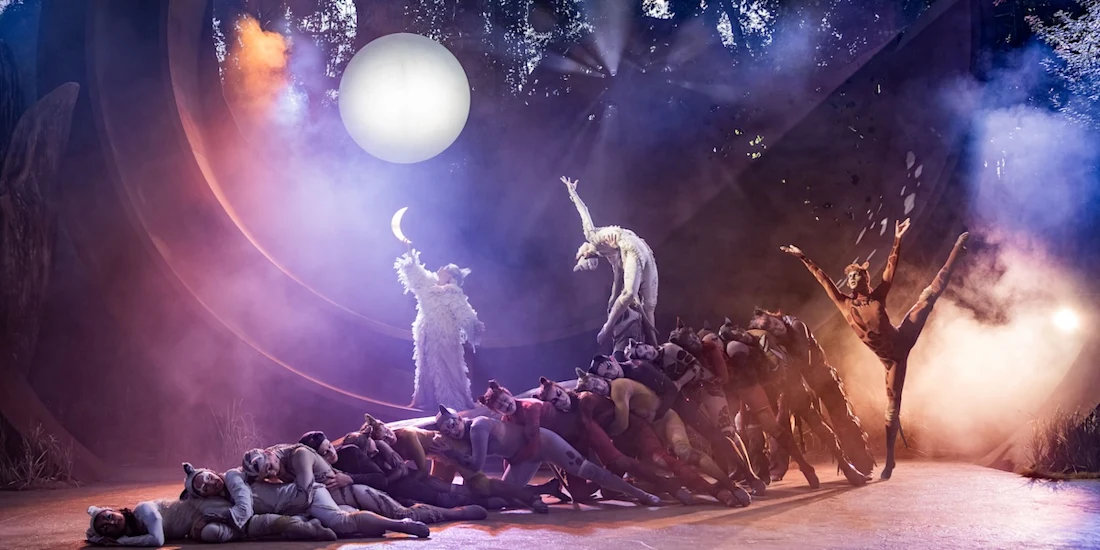
Theatre reviews roundup: Shadowlands

Hugh charms the critics

Aldwych Theatre
Maggie Siff and Hugh Bonneville in Shadowlands. Photo: Johan Persson

They may or may not have liked the play but the critics were charmed by Hugh Bonneville’s ‘shrewdly understated’ (Times) performance in the role of the emotionally repressed C S Lewis. In William Nicholson’s biographical play, Lewis’s Christian beliefs are challenged when he falls in love with a divorced American woman, then has to cope with her terminal illness. Some critics felt the play was superficial and ‘rose-tinted’ (Stage), but others were profoundly moved by the ‘potent’ (Telegraph) portrayal of grief. Maggie Siff was praised for her robust performance as Joy. The critics were generally impressed by Peter McKintosh’s set design in which a wall of bookshelves symbolises the stifling world of academia but also opens into a Narnia-like paradise. This production, directed by Rachel Kavanagh, was first seen at Chichester in 2019.

4 stars ★★★★

The Telegraph’s Dominic Cavendish wrote a moving review: ‘it could all veer into a superficial, episodic résumé. Yet Rachel Kavanaugh’s stylish production lends the story the vital, unifying aura of a restless, soulful quest.’ He found ‘All (the) genteel restraint means that when Bonneville’s placid, unassuming demeanour breaks into a howl of distress, or his gauche stiffness yields to a kneeling marriage proposal at Joy’s hospital bed, the effect is one of emotional detonation.’ He was touched by Bonneville, who, he said, ‘gives a commendably un-egotistical performance that provides a potent conduit for our own experiences of deep personal loss.’

The Times’ Clive Davis also praised the star: ‘Bonneville certainly deserved the acclaim he received at the end of the evening: this was a shrewdly understated performance that hinted at the turmoil stirring inside a public figure struggling to reconcile his own beliefs with the catastrophe that has set his private life.’ The set design made its contribution: ‘Every now and then, the walls of books slide away to reveal a wintry, Narnia-ish domain. Howard Harrison’s shifting lighting always seems to remind us that the line separating the here and now from eternity is a thin one.’

The i’s Fiona Mountford decided it was a test of true love: ‘On this Valentine’s weekend, I have concocted a failsafe test for a potential love interest: does this person snuffle quiet tears at the end of Shadowlands? Are they profoundly moved by the line ‘The pain now is part of the happiness then. That’s the deal’? If the answers are ‘no’, run a mile, as this person lacks any evidence of a beating heart.’

3 stars ★★★

Holly O’Mahony for The Stage criticised it for being ‘rose-tinted’: ‘while it’s witty, there’s something insincere about Nicholson’s script – polite and polished for palatability, it’s the version of events that you might tell ageing relatives (…) it all lacks punch; but it’s a heart-warming watch.’

Anya Ryan at LondonTheatre complained: ‘(Lewis’s) moral and spiritual dilemma is largely glossed over.’ But she did like the star: ‘Bonneville begins with a stiff-upper-lip Englishness…But, with Joy’s encouragement, he opens up piece by piece; his final wail is utterly devastating.’ She also praised the set design: ‘Nodding to Narnia, Peter McKintosh’s staging reveals a hidden, magical world from behind a bookcase. It suggests that beyond the shadows of life, there is something beautiful waiting.’

WhatsOnStage’s Sarah Crompton liked the show as far as it went, which was not far enough: ‘Nicolson’s play…is expertly directed by Rachel Kavanaugh, who firmly emphasises the humour and incongruity of this passion between a celibate English don and a straight-talking American poet…But she cannot disguise the way it skates along the surface of multiple moral dilemmas.’ Fortunately, ‘Bonneville is an actor who can tease feeling and nuance out of the most straightforward script. He’s wonderful as Lewis, awkward and endearing, but also catching the man’s self-righteousness stuffiness… The moments towards the close, when he is suddenly overwhelmed by feeling are deeply affecting.’

In a literally holier-than-thou comment, The Independent’s Alice Saville said: ‘There are audiences who’ll lap it all up as an emotive alternative to a church sermon, but they deserve better. Real life is much more complicated than the fridge magnet quote-worthy moralising that fills this play’s later scenes, and an author with the imaginative power to turn God into a friendly lion would have understood that.’

Aliya Al-Hussan of BroadwayWorld described the play as ‘Plodding in parts, but ultimately devastating’ but joined the Hugh Bonneville hugfest: ‘Bonneville is amiable, believable and gently formal as Lewis. His presence feels like a comfortable pair of shoes; familiar and unchallenging, but as the character submits to the waves of grief after Joy dies, Bonneville is touchingly bereft.’ She also praised Maggie Siff, saying she ‘never slips into the caricature of a loud and overly positive American and her sharp-tongued ripostes to the mysogynist views of Lewis’s academic circle are perfectly delivered.’

TimeOut’s Andrzej Lukowski thought it was one for Hugh’s stans (super fans): ‘None of it serves to quicken the pulse, really: it’s high class MOR, a chaste romantic fantasy that plays great with the Bonneville stans but is lacking a layer of depth. Still, even if I couldn’t exactly believe in the couple, I could still root for them.’

2 stars ★★

The Guardian’s Arifa Akbar put the boot in: ‘It has charm and pulls you into its sadness but seems as creaky as the half-filled, wood-panelled library in its backdrop…plods from one scene to the next, sleepy in pace and action but breezy in its emotions’. As for the star: ‘Bonneville is a lovely presence, as always’ but ‘he lacks the hard, anguished depths that show Lewis’s stunting shyness and repression.’ She felt ‘Siff is excellent as Joy, bringing sharp edges and ardour but the chemistry between them is just too fond and gentle.’

Critics’ average rating 3.2★

Value Rating 34 (Value Rating is a combination of the show rating and the typical ticket price)

Shadowlands can be seen at the Aldwych Theatre until 9 May 2026. Buy tickets directly from shadowlandsplay.com

If you’ve seen this production of Shadowlands, please leave your review and/or rating below 
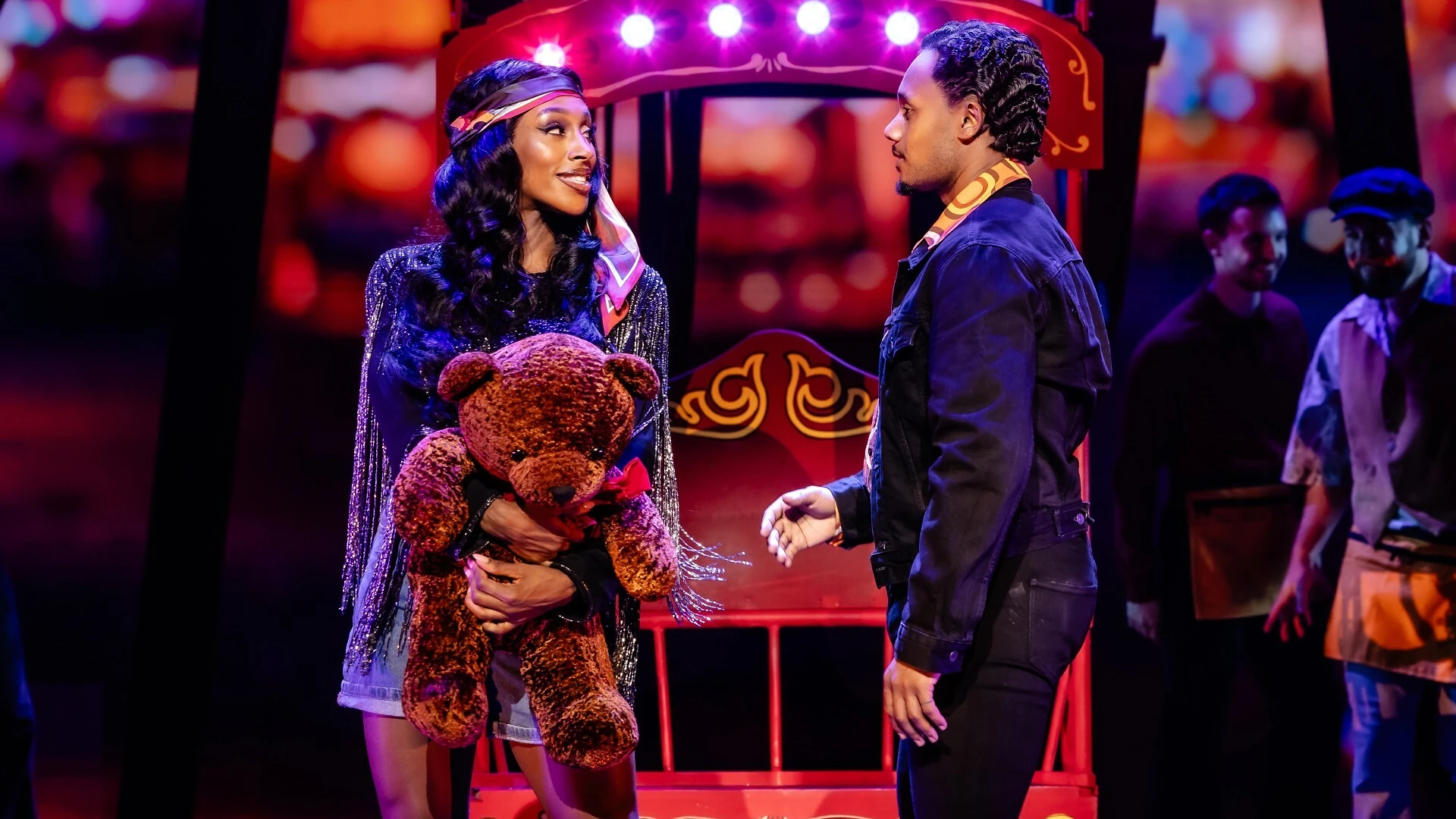
Theatre reviews roundup: Man And Boy

Ben Daniels towers in expressionist take on Rattigan 

Dorfman Theatre, National Theatre
Ben Daniels and Laurie Kynaston in Man And Boy. Photo: Manuel Harlan

Man And Boy was a late play from Terence Rattigan, long after his golden reputation had been washed away by the new wave of ‘kitchen sink’ dramatists. It is largely neglected, and some critics thought it deserved to be (‘Rattigan’s plot isn’t far removed from dime fiction’ said The Times). Others loved the way director Anthony Lau ‘throws off the shackles of realism’ (Time Out) to make it seem contemporary. All agreed that Ben Daniels‘ performance as the 1930s amoral millionaire Antonescu, who tries to pimp out his adult son (Laurie Kynaston) to save his business, was award worthy.

[Links to full reviews are included but a number are behind paywalls and therefore may not be accessible]

5 stars ⭑⭑⭑⭑⭑

Time Out‘s Andrzej Lukowski enthused: ‘Anthony Lau’s production is the first Rattigan I’ve seen that throws off the shackles of naturalism.’ The design, he said, ‘sets Rattigan free from chintzy tradition, and when combined with Angus MacRae’s wild, jazzy score gives the whole thing a sense of danger, unpredictability and transcendence of a specific time and place. It also liberates star Ben Daniels from period constraints, freeing him up to deliver what is easily the best stage performance of the year to date.’ His portrayal was ‘seethingly dangerous, his shark-like charm punctuated by flashes of bottomless rage and an unsettling, insectoid physicality as he prowls and scuttles over the tables.’ He summed it up as: ‘a wild production that tears up everything we thought we knew about how to stage good old Terence Rattigan.’

4 stars ⭑⭑⭑⭑

WhatsOnStage‘s Sarah Crompton observed: ‘Watching it in the light of the Epstein scandal, it feels pressingly pertinent in its depiction of a valueless world where everything has a price – even love. With the peerless Ben Daniels outstanding as Antonescu, it has a savagery and sharpness that make it utterly compelling.’ Shew continued in her praise of Daniels, calling him ‘magnificent’: ‘We first see him waiting to enter, black raincoat buttoned up to his neck, his face impassive, his profile eagle-like…he’s like a force-field of energy, with a serpentine, seductive charm that can’t quite disguise either his anxiety about his ruin or his essential toughness. He’s a master of the universe, bestriding the stage like a colossus.’

Anya Ryan of LondonTheatre found: ‘Ben Daniels is triumphant as Antonescu – a performance that should surely earn him an award nomination or two. Commanding the stage, lizard-like and menacing, he orders those around him to follow his instructions with the easy authority of a man long accustomed to obedience.’ She concluded: ‘Man and Boy may still not show Rattigan at his most humanly rich. But this production – in all its ruthless, game-playing glory – surely shows the play in its finest light.’

Clementine Scott at BroadwayWorld agreed: ‘this is an astutely written drama the National were right to revisit.’

3 stars ⭑⭑⭑

The Independent‘s Alice Saville pointed out: ‘No one in this play has the intellectual heft or bravery to remotely challenge Antonescu, and that makes it ultimately unsatisfying to watch.’. Her response to the show was subdued: ‘Rattigan’s play unfurls soberly and without remorse for either characters or audience (…) Lau’s production tries to inject a bit of energy by getting the actors to clamber incongruously over tables, or by crushing them under a lighting grid that descends worryingly close to the stage, or by having them sway in dim light like they’re in a slo-mo fight scene. These witty touches are refreshing – but they feel like a bit of a mismatch with Rattigan’s serious portrait of moral corruption, which offers more to respect than to enjoy.’

The Telegraph‘s Dominic Cavendish was reserved in his praise: ‘While the two lead performances in Anthony Lau’s revival at the National compel, its glaring deficit is that it strains too hard to jazz things up experimentally.’

Sam Marlowe of The Stage wrote a review of two halves. It started well:  ‘Reconfigured in this production by Anthony Lau, which gives it a dash of expressionism, the play leaps along in exuberantly grotesque fashion, far removed from conventional Rattigan stagings. It’s still an uneven piece, but it feels both pertinent and darkly entertaining here – thanks in no small degree to an enthralling central performance from Ben Daniels’. It didn’t end so positively: ‘Things go awry, unfortunately, in the second half, when the action calls for more humanity and emotional sincerity, which seems at odds with Lau’s heightened, almost grimly farcical staging.’

Over at The ArtsDesk, Demetrios Matheou agreed: ‘If the first half sees Antonescu at his diabolical best, while setting up a bleak confrontation between father and son, the second fails to deliver on that tension, settling for a rather conventional comeuppance with few surprises and little satisfaction in how the central relationship plays itself out. There could have been real tragedy here. Nonetheless, Daniels continues to hold the attention, adeptly shifting his physicality from strength to frailty.’

2 stars ⭑⭑

The Guardian’s Arifa Akbar wasn’t impressed: ‘Director Anthony Lau has put a thoroughly new spin on this old yarn but one which sadly drains the emotion and tragedy.’ Her demolition was thorough: ‘The first half is pulled down by the weight of its laboured reinvention. The drama is so arch that it seems operatic – the bigger the performances, the more you feel removed from Rattigan’s subtexts.’ It clearly left her cold: ‘It engages more when some of the theatrics are dropped, a little too late…so much distance has been created that his downfall becomes emotionally remote, his self-loathing rejection of filial love understood rather than felt.’

The Times‘ Clive Davis was scathing: ‘Sadly, Anthony Lau’s febrile expressionist production is so overheated that it’s impossible to ignore the implausibilities in the storyline. Financiers are a strange breed, as we’re reminded every time a batch of Epstein files drops, but Rattigan’s plot isn’t far removed from dime fiction’. He continued: ‘that fine actor Ben Daniels is required to play the villain as a shrill, camp figure — think Rudolf Nureyev channelling Professor Moriarty. And if Georgia Lowe’s Dorfman set looks stunning at first glance … you find yourself wondering why the principal characters are jumping on to tables whenever they want to deliver a speech.’

Critics’ Average Rating 3.3⭑

Mand And Boy can be seen at the National’s Dorfman Theatre until 14 March 2026. Buy tickets directly from the theatre.

If you’ve seen this production, please leave your review and/or rating below
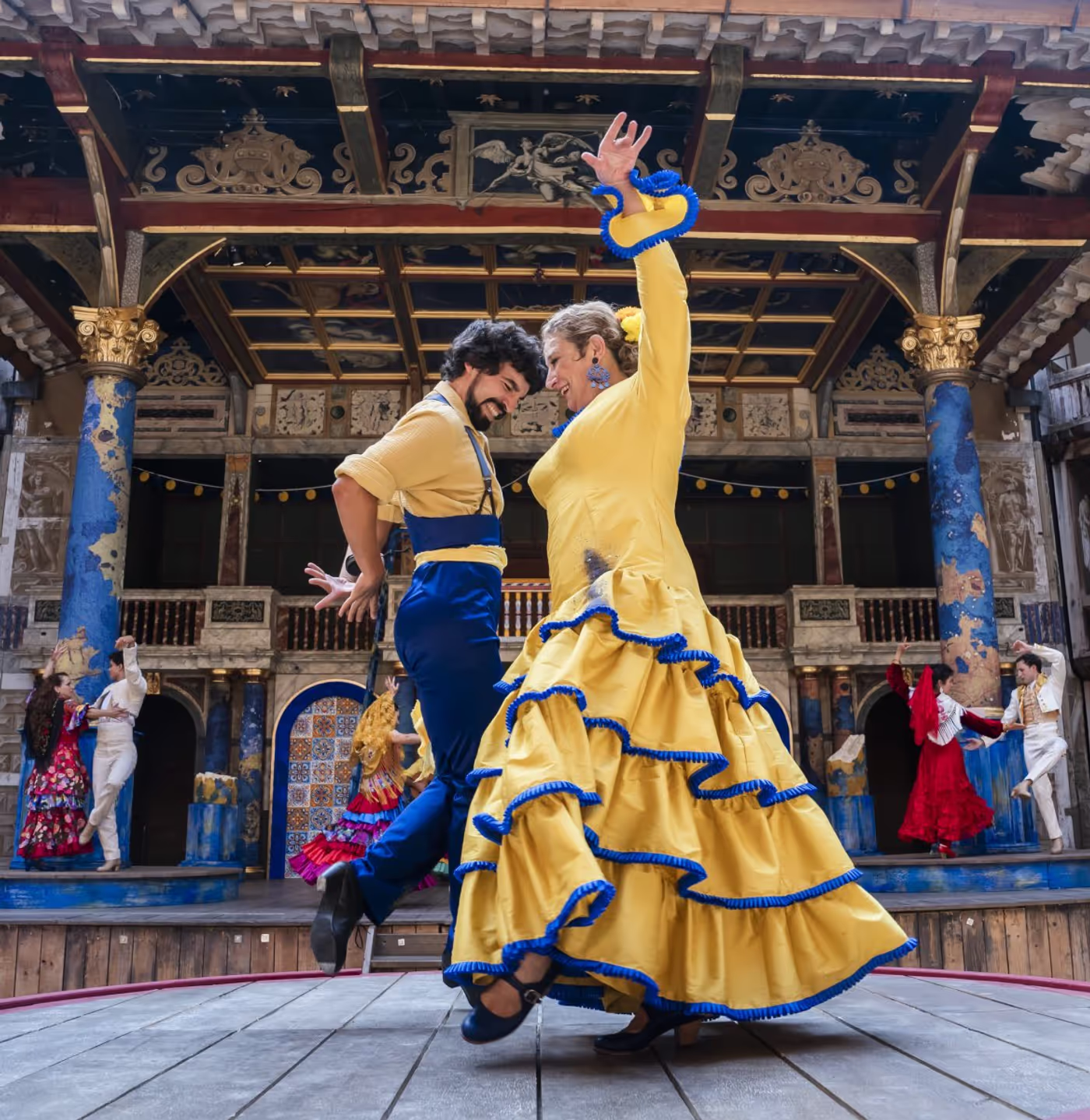
Theatre reviews roundup: Tom Stoppard’s Arcadia

A fitting tribute to the late Tom Stoppard

The Old Vic
Arcadia at The Old Vic. Photo: Manuel Harlan

Arcadia is widely considered to be Tom Stoppard‘s greatest play. Set in the 1800s and the 1990s, the play covers science, landscape design, writing and human attraction. It fizzes with ideas but is imbued with a strong sense of humanity.  Alex Eales‘ revolving set, in the round, the way the two periods pan out in parallel. The critics were largely overwhelmed by the play and Carrie Cracknell‘s production, but some found Stoppard too clever by half. The cast were highly praised, with Isis Hainsworth in particular attracting attention.

[Links to full reviews are included but a number are behind paywalls and therefore may not be accessible]

5 stars ⭑⭑⭑⭑⭑

The Standard‘s Nick Curtis described the play and the production: ‘This prodigious, teemingly intelligent, breezily witty 1993 play by Tom Stoppard packs in more challenging matter than most writers would attempt in a lifetime but has the seeming effortlessness of pure entertainment. It embraces thermodynamics, poetry, landscape design, sex and much more besides, in parallel timelines set in the 1990s and the early 1800s in one room of a Derbyshire country house. Carrie Cracknell’s superbly cast and elegantly realised in-the-round revival is a fitting tribute to the genius of Stoppard’.

Matt Wolf at The Arts Desk gave the detailed analysis of a devotee: ‘Having been in attendance at Arcadia‘s world premiere at the National some 33 years ago come April, I had always thought I’d never see a staging to match Trevor Nunn’s original…Yet here the play is again, with at least three performers who eclipse all memory of their forbears. And even those who don’t are superb in their own rights, the ensemble working in harmony to foreground feeling amidst the playfulness, fun and scientific and mathematical fodder that inform the text throughout’.

BroadwayWorld‘s Aliya Al-Hassan asked rhetorically: ‘Does it matter if you don’t understand the complex scientific and mathematical theories? Not at all. Carrie Cracknell’s magnificent revival has huge amounts of humour and heart, which is not always a given with Stoppard’s work.’

4 stars ⭑⭑⭑⭑

The Telegraph’s Dominic Cavendish called it a ‘triumphant return’ for an ‘intellectually thrilling and romantically stirring masterpiece’ that is ‘a spellbinding portrait oif transient, mysterious existence itself.’ He seemed to cope with the blitz of ideas more than some critcs: ‘It all grips like a thriller. The intimacy of Cracknell’s production – presented in-the-round, beneath two elliptical lighting rigs that suggest planets in orbit – creates a sense of magnified scrutiny; you can easily follow the trains of thought and marvel at the clockwork finesse of it all.’

Theo Bosanquet for LondonTheatre noted: ‘In Carrie Cracknell’s stripped-back, in-the-round production, Stoppard’s densely intellectual dialogue is given centre stage, while his dual-era narrative is enriched through subtle and sensitive overlapping.’

WhatsOnStage‘s Sarah Crompton pointed out: ‘It is also incredibly funny, and its richness lies in the way that its thoughts never compromise its humanity. Instead, they underline them as Stoppard shows chaos and unpredictability at work in human relations too. Sex and people “fancying people they shouldn’t” is another disruptor of the maths of the universe.’ She summed it up as: ‘a multi-faceted gem that glimmers in every light, thought-provoking and profoundly moving. It’s a glory.’

Dave Fargnoli of The Stage praised the cast: ‘Among the large ensemble, Isis Hainsworth stands out as teenage maths prodigy Thomasina with a believable balance of flashing insight, naivety and adolescent emotional spikes, swinging from frothy enthusiasm to tearful desolation in a heartbeat. Seamus Dillane is a fine foil as her tutor Septimus, deploying roguish charm and acerbic wordplay to create an appealingly rakish persona.’ He ended: ‘although the production may lose momentum at times, the script’s interplay of erudition, insouciant wit and relatable human drama is never less than intriguing and engaging.’

The Independent‘s Alice Saville reported on the look: ‘what Cracknell’s staging excels at is weaving together past and present. Designer Alex Eales has turned the Old Vic into an intricate miniature galaxy, with a revolving set whose rings let the cast orbit each other like planetary bodies. There’s a beautiful naturalness to the way that their paths seem set for collision but never quite meet – leaving historical mysteries forever unsolved.’

3 stars ⭑⭑⭑

The Guardian’s Arifa Akbar had ‘the sense of a playwright tossing about complex ideas with such excitement, dexterity and depth that it doesn’t matter whether you understand them. Or up to a point, at least. Everyone here is so clever, from the winningly precocious Thomasina to Stoppard himself that it can make your head hurt’.

The Times’ Clive Davis was less convinced than some about the play’s greatness: ‘There were more than a few moments during this evening when the lengthy disquisitions on the nature of the universe left me feeling as slow and ponderous as the tortoise that serves as one of the mischievous props (…) As in so many of Stoppard’s plays … the characters seem less like rounded individuals than repositories for his ideas.’ He acknowledged: ‘Arcadia does sparkle, especially in the opening scenes…Tutor Septimus Hodge (played with élan by Seamus Dillane) spars with his pupil, Thomasina Coverly, Isis Hainsworth’s portrayal of the young girl is a delight, conveying both innocence and knowingness as she tries to win Septimus’s approval.’

2 stars ⭑⭑

The i’s Fiona Mountford was the harshest critic: ‘Stripped of all décor, the play appears ever more daunting and ever less dramatic and in the underpowered first half of Carrie Cracknell’s production the atmosphere falls dangerously flat. Too often it becomes a seemingly never-ending lecture and we the poor students trapped inside the lecture hall.’

Critics’ average rating 3.9⭑

Value Rating 52 (Value rating is the Average Critic Rating divided by the typical ticket price)

Arcadia can be seen at The Old Vic until 21 March 2026. Buy tickets directly from the theatre.

If you’ve seen Arcadia at The Old Vic Theatre , please share your review/comment and rating below

Theatre reviews roundup: American Psycho

A Fond Farewell to a Killer Show

almeida Theatre
Arty Froushan and cast in American Psycho. Photo: Marc Brenner

Roberto Aguirre-Sacasa’s musical adaptation of American Psycho, Bret Easton Ellis’s satire of 1980s Wall Street consumerism, was a huge success in Rupert Goold‘s first season as Artistic Director of the Almeida (then it starred Matt Smith). Now, 13 years later, it forms part of his final season there. Here’s Alex Wood’s summary of the plot at WhatsOnStage: ‘That story…is of a disillusioned banker, Patrick Bateman, filling the emotional void in his life with consumerist jargon, macho-posturing and, eventually, a homicidal rampage through New York.’ The critics loved the production- the music, the set, the lighting, the choreography- and praised the cast especially Arty Froushan in the lead role. Some felt it wasn’t as effective as it could have been.

[Links to full reviews are included but a number are behind paywalls and therefore may not be accessible]

4 stars ⭑⭑⭑⭑

The Guardian‘s Arifa Akbar listed the reasons why she liked it so much: ‘First there is satire, deliciously dark, and then horror…unsettlingly effective when the violence comes (…) Duncan Sheik’s score contains one great electro-synth number after another, with a razor sharp book by Roberto Aguirre-Sacasa (…) Es Devlin’s fleet set design turns nightclubs into bedrooms into hideous mounds of twitching bodies. Jon Clark’s Stringfellows style lighting and Finn Ross’s projections give off a luminous, hallucinatory quality, insinuating Bateman’s unreliable reality.’

‘it’s big, bold, and deliciously sinister’ declared BroadwayWorld‘s Cindy Marcolina. She noted: ‘Arty Froushan is exquisite as Bateman. A psychotic glint in his eye and steely arrogance make him the quintessential finance bro. He makes his inability to get a table at the exclusive Dorsia restaurant the driving force of his homicidal streak, filling his nights with violent sex and murderous escapades. The musical spells out Bateman’s contradictions, and Froushan revels in them.’

Alex Wood for WhatsOnStage stated: ‘It’s not a perfect show, and its true impact is perhaps left that bit too late in the final scenes. That said, it’s still a hypnotic, bloody good time – one that perhaps says more about the macabre dimensions of modern masculinity than anything else on a UK stage right now.’

The Standard‘s Nick Curtis noted the look of the show: ‘If I say that Rupert Goold’s revival of his hit electropop murder musical is full of surface gloss and chilly razzmatazz, I mean it as a compliment. Bret Easton Ellis’s original 1991 novel was a slashing satire on late-80s consumerist capitalism, as lived by psychotic Wall Street banker Patrick Bateman. This shiny, energetic, body-conscious production lands when greed is once again good and looksmaxxing misogynists are literally all the rage in the manosphere.’ He explained more about the men’s bodies: ‘the hench torsos and sculpted six packs the younger male actors reveal …This fits the vanity (and the semi-suppressed homo-eroticism) of Bateman’s milieu. But it seems that stage actors, like movie stars, now have to have the body of a Calvin Klein model as well as talent.’

The Independent‘s Alice Saville had some doubts but ‘if this show’s message is uncertain, its impact is undeniable. It doesn’t look or sound like any other musical you’ll see in London, and there’s something entrancing about this icy injection of nihilism into a remorselessly peppy genre.’

Time Out‘s Andrzej Lukowski liked it but had reservations: ‘for all the demonic razzle dazzle that Goold and his top-notch creative team bring to bear – disturbingly twitchy choreography, infernal monochrome elegance, a lot of indoor sunglass wearing – American Psycho is a deadpan show with a downbeat story that sometimes feels in conflict with the maximalist nature of musical theatre. And in humanising Bateman and stressing his anxieties, his collapse into full-blown paranoia at the end feels less momentous than in book and film.’

3 stars ⭑⭑⭑

Claire Allfree in the Telegraph was dissatisfied with the adaptation: ‘Perhaps the greatest stumbling block is the fact that the original novel is a masterpiece in narrative ambiguity. Since this adaptation signals from the beginning that Bateman is a fantasist, any sense of ghastly jeopardy is lost. Froushan…expertly conveys the sense of both moral void and existential despair but he is never remotely terrifying.’

Holly O’Mahony at LondonTheatre cautioned: ‘It’s not that the story itself hasn’t aged well, or faded in relevance, but under Goold’s watch, Patrick Bateman (an appropriately beguiling Arty Froushan) never seems as void of feelings as he says he is. We witness him spiralling his way through an existential crisis, wearing his fragility on his sleeve. And making him a shade or two more ‘relatable’ diminishes the satire of Ellis’s story’.

The Stage’s Sam Marlowe was underwhelmed, saying it was ‘a highly enjoyable satirical romp – but one that, despite some vivid gory splatters, is essentially bloodless. It’s smart and horribly pertinent. But it probably won’t give you nightmares.’

The Times’ Clive Davis didn’t get it: ‘It’s slick, it’s shiny, it’s empty (…) There are solid performances all round, but is the show itself really worth reviving?’ Like Bateman, he put the axe in: ‘As for the music, Sheik…has assembled an efficient if colourless selection of technopop anthems.’ 

Critics’ average rating 3.6

American Psycho can be seen at the Almeida Theatre until 21 March 2026.

If you’ve seen this production, please leave your review and/or rating below
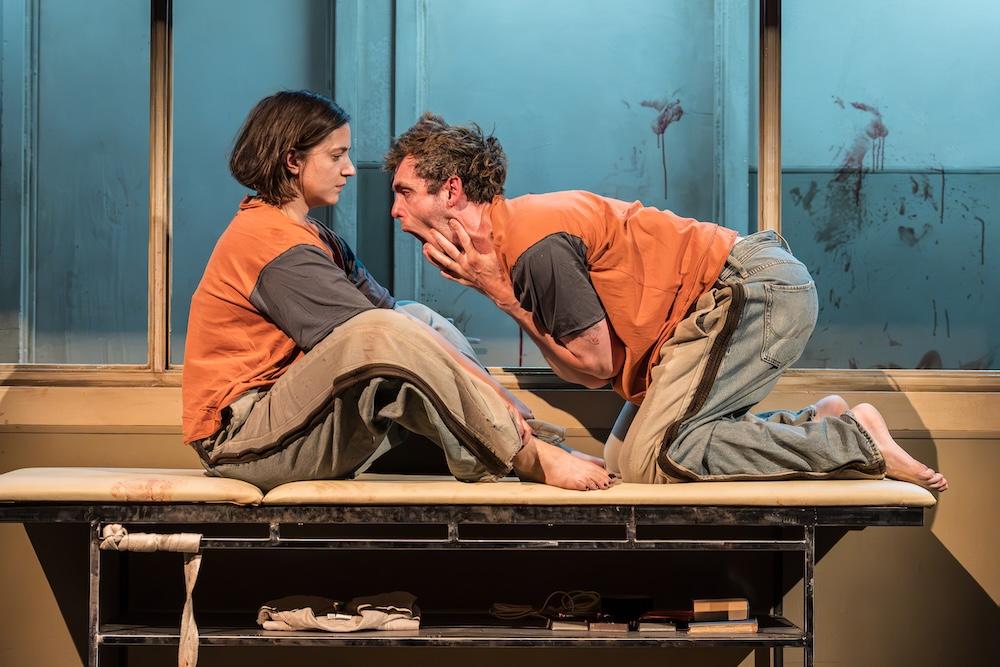
Theatre reviews roundup: Ballad Lines

A Musical with heart

Southwark Playhouse Elephant
Ballad Lines at Southwark Playhouse. Credit: Pamela Raith

Ten years in the making, Ballad Lines has arrived in London. Finn Anderson and Tania Azevedo’s musical follows connections between women and songs over the centuries. Some critics felt there was more work needed on it, but they loved the music and found the story heartwarming.

[Links to full reviews are included but a number are behind paywalls and therefore may not be accessible]

4 stars ⭑⭑⭑⭑

Cindy Marcolina for BroadwayWorld said: ‘Ballad Lines must be one of the most exciting new musicals to hit the stage in some time. We follow Sarah, an American queer woman, as she dives headfirst into her family’s roots. Through the centuries, the same melodies come back to link the women who came before her (…) it might be a bit corny here and there, but it’s a solid celebration of women’s endurance as well as the role of music and its influence on our lives. The score and the plot are equally engrossing; the direction and performances are inspired.’

‘Brimming with ambition and warmth, it has the makings of the next brilliant thing’ reported Aliya Al-Hussan for WhatsOnStage. She admitted: ‘Touching on family, identity and motherhood, there’s a lot to pack in and some characters inevitably feel less rounded than others, but Azevedo directs with great fluidity.’ She concluded: ‘Heartwarming, poignant and deeply human, it has the potential to go far.’

Emma John in The Guardian explained; ‘It was the Ulster immigrants, passing down their boisterous tunes and melancholy ballads, who gifted the US some of its first iterations of country music.’ Anderson’s score powerfully evokes the source material it is exploring, and the ensemble’s singing positively electrifies the traditional song (…) Composer Finn Anderson and director Tania Azevedo have used that journey to tell a musical story across generations.’

Gary Naylor at The Arts Desk praised the show but ‘You shouldn’t be standing back, but few aspects of life are as inaccessible to a man as pregnancy and childbirth (…) For all the heart and soul and technical achievement on stage, that yawning empathy gap was never bridged – at least not for me. I appreciated the show because it’s a really fine musical, but I didn’t really feel it. Many will. ‘

3 stars ⭑⭑⭑

The Stage’s Sam Marlowe noted: ‘There are some soaringly impassioned performances in this new musical, but it’s the songs that are the star. Woven around traditional Appalachian folk tunes and accompanied by a live band dominated by lyrical fiddle, they are lilting, haunting and oozing with gorgeous harmonies.’ However, ‘McNamee sometimes seems a little stranded, a bystander floating at the verge of more interesting tales, and the piece sometimes bobs too long among the eddies and whorls of the multi-stream storytelling.’

Matt Wolf for LondonTheatre called it ‘a show suffused with passion and heart that comes tethered to a surging score from the fast-rising Scottish singer-songwriter Finn Anderson’. He declared: ‘There’s no faulting an eight-person cast…and McNamee should go far with her stirring occupancy of the show’s star part.’ Unfortunately, ‘Too often, the writing lapses into clunky portentousness’ and it’s also in ‘desperate need of trimming and shaping’, he said.

Anna Maloney in CityAM described the story: ‘Ballad Lines dives into the lives of Cait, Jean and Sarah, three women from the same blood line but very different times…connected by heritage, womanhood but, more importantly, the power of song, with the score blending Scottish, Irish and Appalachian folk ballads.’ She suggested it was not quite complete: ‘this could be the kind of show that really benefits from scale. With a few set pieces and the potential for big, gorgeous ensemble numbers, Ballad Lines could be a hit in waiting.’

Critics’ average rating 3.6⭑

Ballad Lines can be seen at Southwark Playhouse Borough until 21 March 2026. Buy tickets directly from the theatre

If you’ve seen Ballad Lines at Southwark Playhouse, please leave your review and/or rating below
×