Anne-Marie Duff is chilling in 20th century classic
★★★★
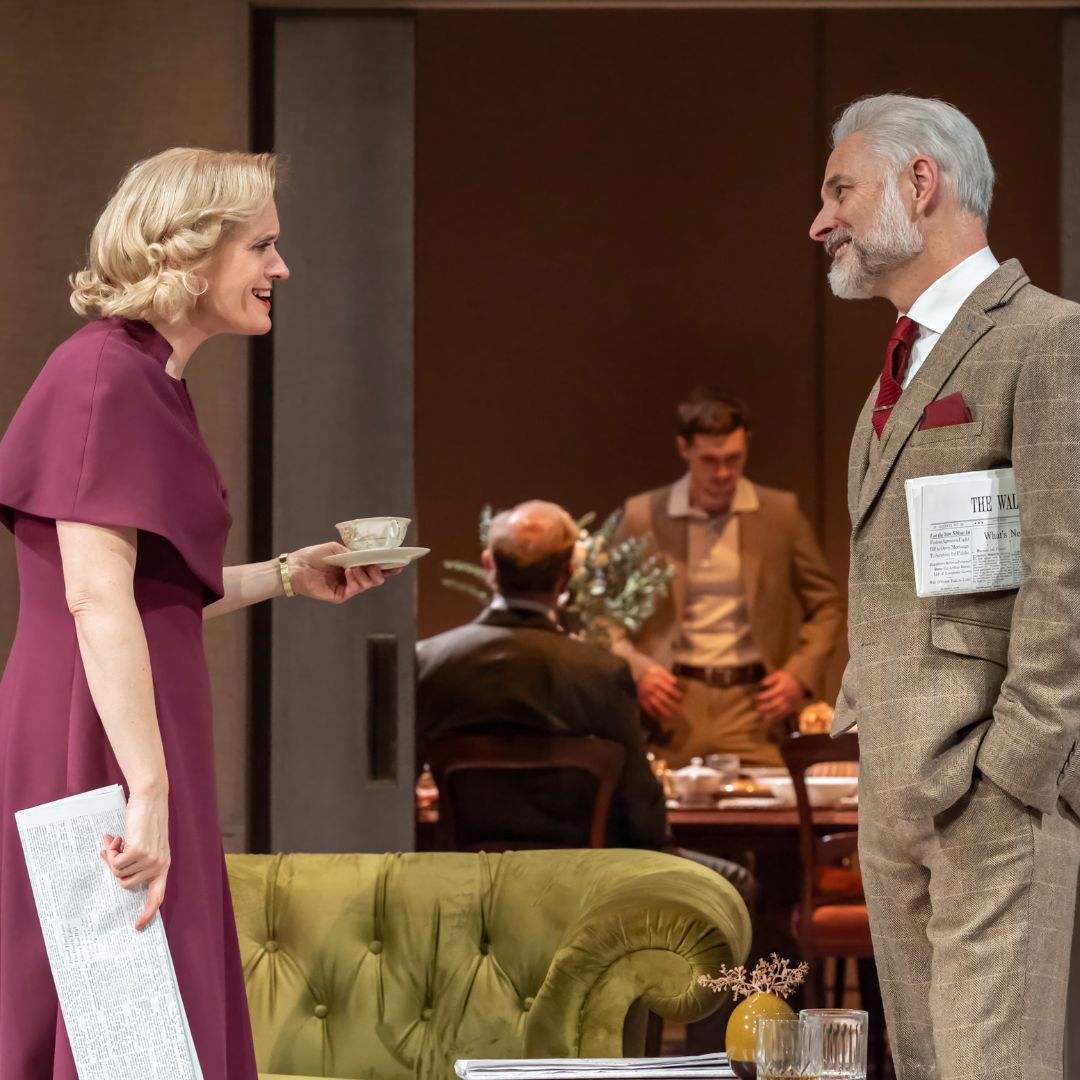
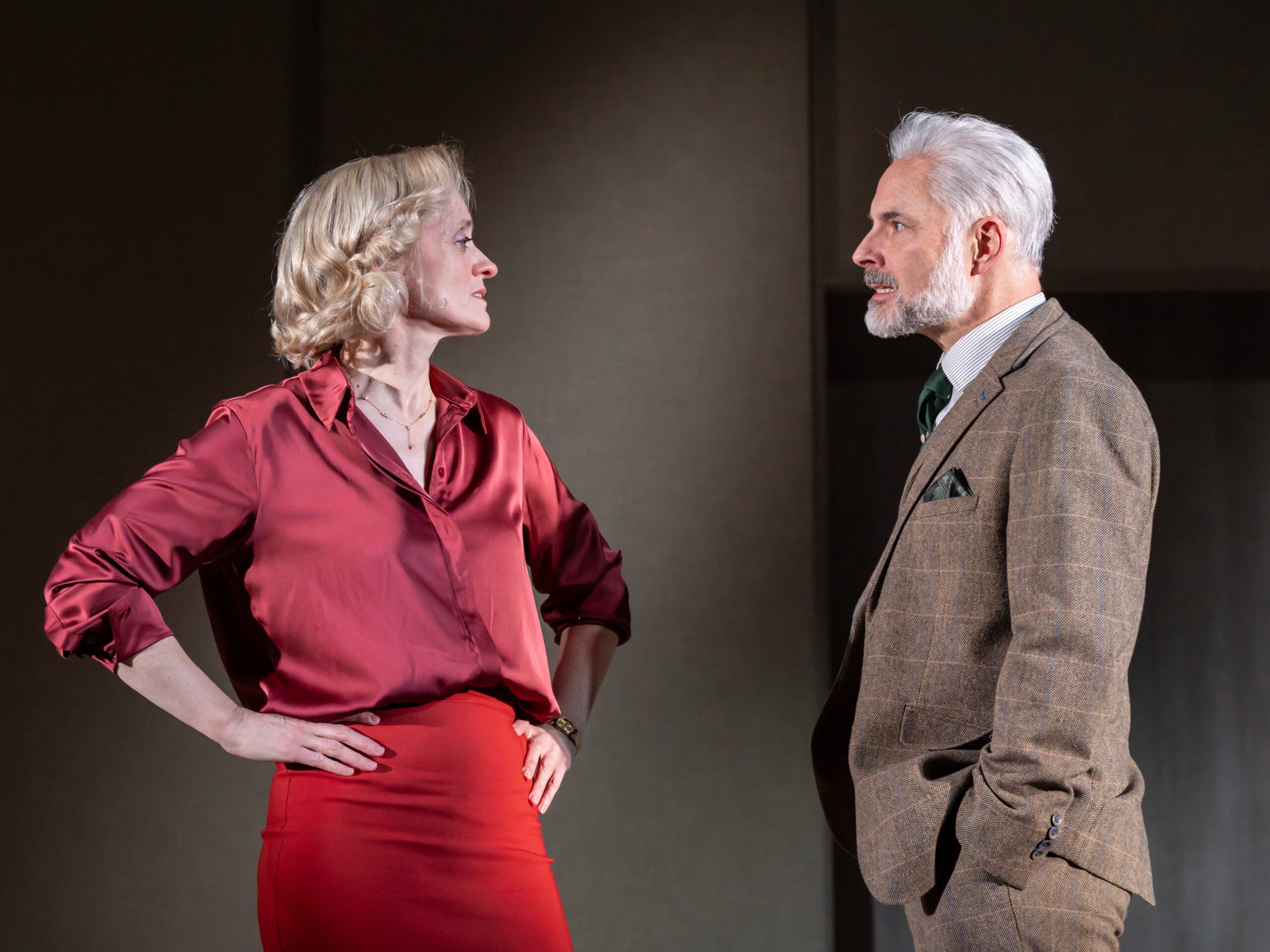
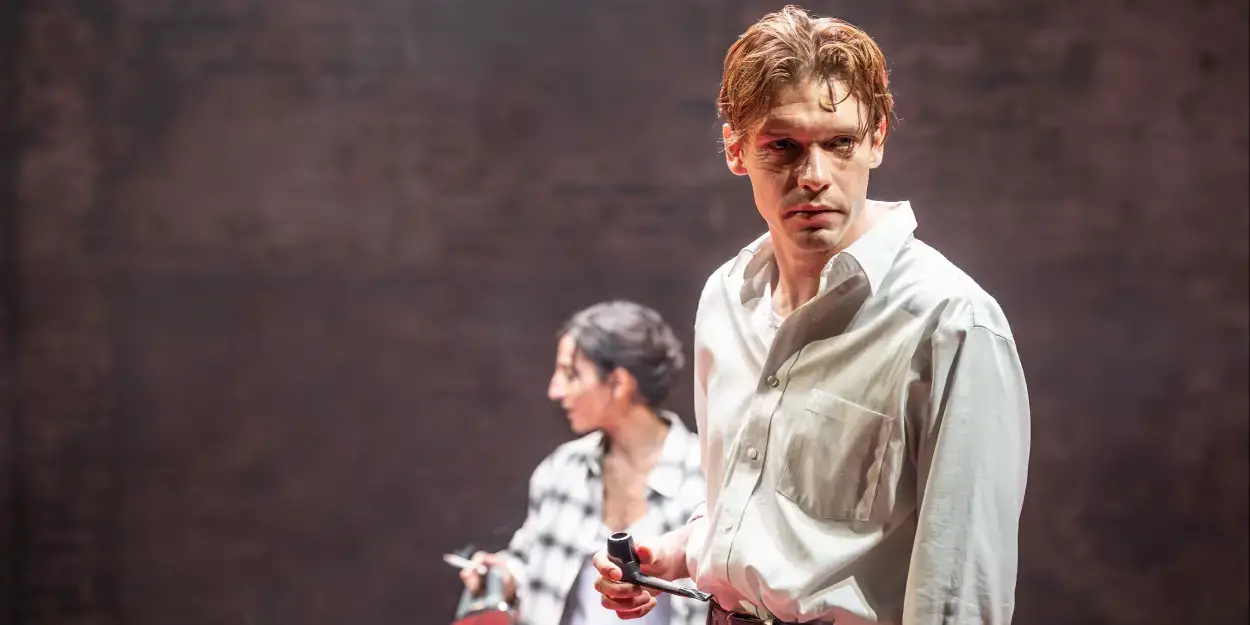
Anne-Marie Duff & Mark Bonnar in The Little Foxes. Photo: Johan Persson
Like me, you probably see more acting on TV than in the theatre. That means I’m always interested to see whether a favourite actor can make that transition from screen to stage. The Little Foxes at the Young Vic was packed with faces from British television. Mark Bonnar who you will have seen in Shetland and Guilt; Steffan Rhodri best known as Dave Coaches from Gavin & Stacey; Anna Madeley who is Mrs Hall in All Creatures Great And Small; and one certifiable star in Anne-Marie Duff most recently seen in Bad Sisters.
I have seen all these actors on stage before, but it is still a thrill to be reminded that, like so many other screen actors, they are often only giving us a glimpse of their skills when they’re in front of a camera. The real test of their acting ability comes when they are trapped in the time and space of a theatre show, communicating directly with a live audience. This cast passed the test with distinction.
Lillian Hellman’s The Little Foxes was premiered in 1939 but this attack on capitalism focuses on a family of landowners from the American South around 1900. So, the first question you might ask is, why did Lillian Hellman, who was a communist by the way, set her play around 40 years in the past? I’m guessing it’s because 1939 was not the best time for an anti-capitalist message. America had just experienced successful state intervention in their free market system in the form of Roosevelt’s New Deal, so a mixed economy may have seemed more attractive than a communist one. More than that, communists, capitalists, rich and poor were in the process of uniting in a fight against fascism, or at least that was the perception. So it might have been easier to show unadulterated capitalism, raw in tooth and claw as it were, from a couple of generations earlier.
The first half introduces us to the Hubbard family. There are two brothers- Ben played by Mark Bonnar, cunning as a fox and arrogant as a peacock, initially strutting about the stage, nonchalantly shrugging off challenges. Ben boasts of the way his family, who were traders, took advantage of the Civil War to buy up property while the Southern grandees were being defeated, fighting for their principles. He is even proud of their exploitation of what he calls ‘coloured people’.
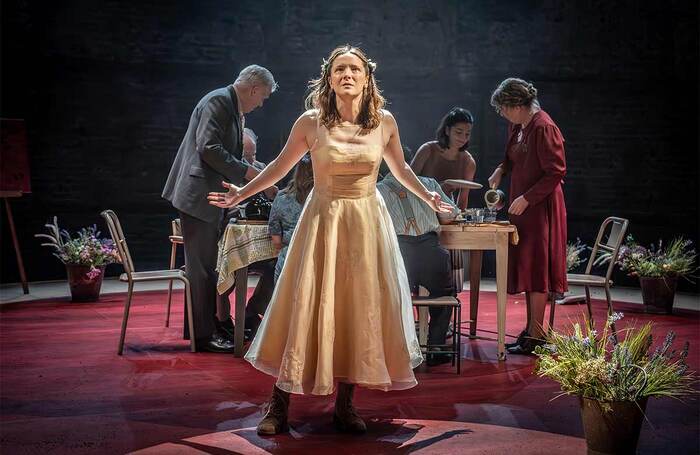
The other brother Oscar, a weak bully, is played by Steffan Rhodri with a rat-like blend of slyness and nerves. The lead character is their sister Regina played by Anne-Marie Duff. Her bravura performance dominates the evening, entrancing us with her hyperactive character, who is by turn charming, quivering with frustration or displaying a diamond hard will power that is genuinely chilling. Her sparkling eyes and wide smile are a mask that covers her amorality.
The brothers inherited their father’s money. When they have an investment opportunity that will make them a huge fortune, Regina is shocked and angry to find she has been left out of the spoils. She plots to get both her share and revenge, by using her ailing husband’s money to make up the additional investment her brothers need.
After a slow first half that establishes the characters and their situation, the play takes off like a SpaceX rocket, as these greedy siblings ruthlessly trick and use one another. Regina becomes more ruthless than any of them in her ambition.
It’s a savage expose of people whose greed trounces love, loyalty and all other moral values. But, is it relevant today? I guess the answer to that partly depends on your politics, but the fact is, capitalism remains the dominant system, despite regulation and the welfare state. Add to which, we appear to be entering an era of less regulation, in America at least, and we have seen the privatisation of public services in the UK. So I suppose it is a good time to be reminded that however high the quality of service or product we receive from companies, their number one priority is profit, not people.
Powerful performance from Anna Madeley
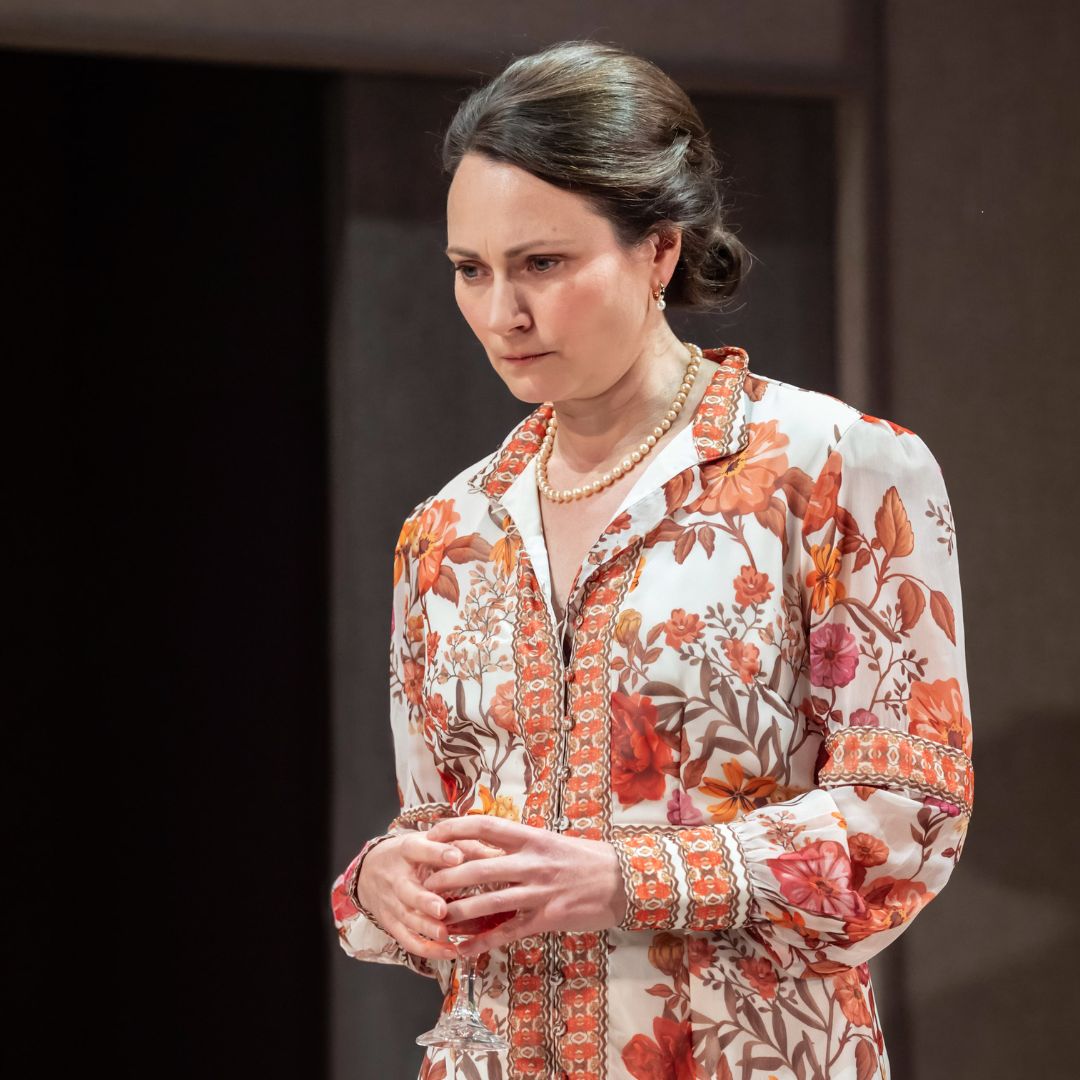
Anna Madeley in The Little Foxes. Photo: Johan Persson
The play presents some alternatives. Oscar’s wife Birdie is from an aristocratic family. She represents the ‘old values’ based on patronage, duty and responsibility. She is an alcoholic, bullied by her husband, and ghosted into a lack of confidence. She may be brittle- she laughs nervously, she looks down, there’s fear in her eyes- but still expresses her beliefs. It’s a powerful performance from Anna Madeley, showing Birdie beaten down but still proud. The quality and depth of her acting won’t surprise you if you’ve seen her as Mrs Hall, giving much-needed weight to the cosiness of All Creatures Great and Small.
Regina’s husband and daughter show that behaving morally is an option. They are played by John Light and Eleanor Worthington-Cox, the latter subtly showing how her character grows in strength as events force her to choose between standing up for her beliefs or standing by watching. In fact, the play’s strongest message is that most of us stand by watching bad things happening and do nothing about it. In stark contrast, Oscar’s son, played by Stanley Morgan, is morally bankrupt, like his father.
The black servants show two different sides of the class that has been most exploited and abused by this family. Freddie MacBruce as Cal goes about his job without question, but Andrea Davy’s Addie is firm in her opinions and tenderly loyal to those who treat her well.
Quite a few reviewers criticised the design, suggesting that its mid 20th century look was not appropriate, and even confusing, when used in a play set in 1900. On the contrary, I think Lizzie Clachan’s design is a stroke of genius. First and foremost, it doesn’t distract. A turn of the century design could have made the story seem of a bygone age, irrelevant to today. On the other hand, modern day clothes would have been too anachronistic for a play that’s set over a hundred years ago and mentions horses and carriages.
Instead, Ms Clachan cleverly plumps for the neutrality of clothes of the time it was written. The dominant beige reinforces this. The absence of the trappings of the life of the well-off suggests these are people who want wealth for its own sake. They aren’t even that interested in enjoying the luxuries that come with it.
It’s a damning picture of capitalism but I think it’s unfair to suggest, as some critics did, that it fails because the main character doesn’t evoke enough sympathy. I found that I had plenty of sympathy with her over the way she was treated and therefore cheered her on as she exacted revenge. But that sympathy only heightened the shock of seeing just how far she would go and what sacrifices she would make. Yes, she does become a monster but it seems possibly sexist to me to suggest that this portrait of a greedy capitalist woman can only can only be of interest if we have sympathy for her. I don’t think you have to sympathise with the murdering Macbeth to get involved in his character and story, or with the greedy Lehman Brothers to find them fascinating. I didn’t like Regina as a human being but it was gripping to see how far she would go and whether she would finally realise there is more to life than money.
Director Lyndsey Turner delivers a powerful interpretation and the excellent cast squeeze every ounce of drama out of it. Before the interval I was wondering whether it was ever going to take off but when it did it was riveting. And if you love watching great acting, this is one not to miss.
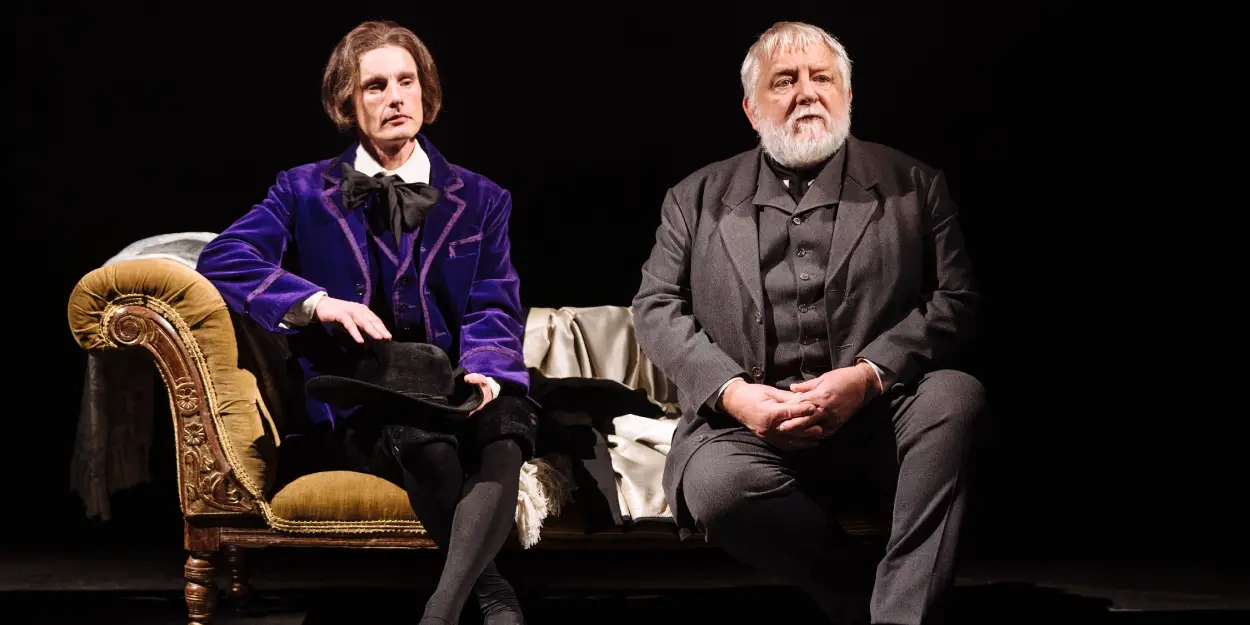
Dickie Beau and Simon Russell Beale in The Invention of Love. Photo: Helen Murray
In Tom Stoppard’s revived 1997 play, the poet and classicist A E Housman finds himself dead in Hades, meets his younger self and explores his memories. Simon Russell Beale as the older Houseman garnered great praise, but some of the critics found the play too clever by half.
Matt Wolf popping up at LondonTheatre (5★) noted, ‘Abstruse as Stoppard’s hyper-erudite text can sometimes be, it is suffused at every turn with feeling. You watch in continual awe – and perhaps occasional confusion – as classical references get lobbed across the footlights, only to clock the deepening ache of this near-definitive portrait of unrequited love.’
Tim Bano in The Independent (4★) said, ‘Blanche McIntyre’s subtle, uncluttered production…delivers a pretty good case for the play being …a bona fide masterpiece.’
The Telegraph’s Dominic Cavendish (4) was also impressed: ‘There’s more to chew on in two or so hours than at the amplest festive feast.’ He said Simon Russell Beale ‘makes every line resonate with fresh thought and feeling’.
David Jays in The Guardian (3★) said, ‘The quicksilver Russell Beale is a vocal glory, leaping in a breath from flute to poignant bassoon, from wit to sorrow.’
Alexander Cohen at BroadwayWorld (3★) also liked SRB but was unsure about the play: ‘this is Stoppard at his most frustrating: lapping tides of stuffy self-referentiality, self-congratulatory smirks, and pats on the back for every reference you can count pull you under the waves.’
Chris Omaweng for LondonTheatre1 (3★) wrote, ‘A demanding and yet not completely inaccessible show, it is at least consistent in its intense analysis of ancient works as well as the world inhabited by Housman and his contemporaries.’
Dominic Maxwell of The Times (3★) said ‘it offers plenty of pleasures, not least a characteristically lucid and tender central turn from Simon Russell Beale. It’s wise, witty, dense, dazzling, opaque. And sometimes it’s a slog.’ To put it another way, ‘this is a play with great monents, not a great play ‘
The i-paper‘s Fiona Mountford (2★) found it ‘unbearable’. About Stoppard, she said, ‘too often his lofty intellect cowers audience members into submission’. But not Ms Mountford with her ‘Oxbridge classics degree’. She explained, ‘we have three hours of often indistinguishable men exchanging achingly arch lines about the minutiae of classical grammar and quoting screeds and screeds of Latin at each other.’ To put it more plainly: ‘it feels less like drama and more like intellectual masturbation’. Est quodest! as Fiona might say.
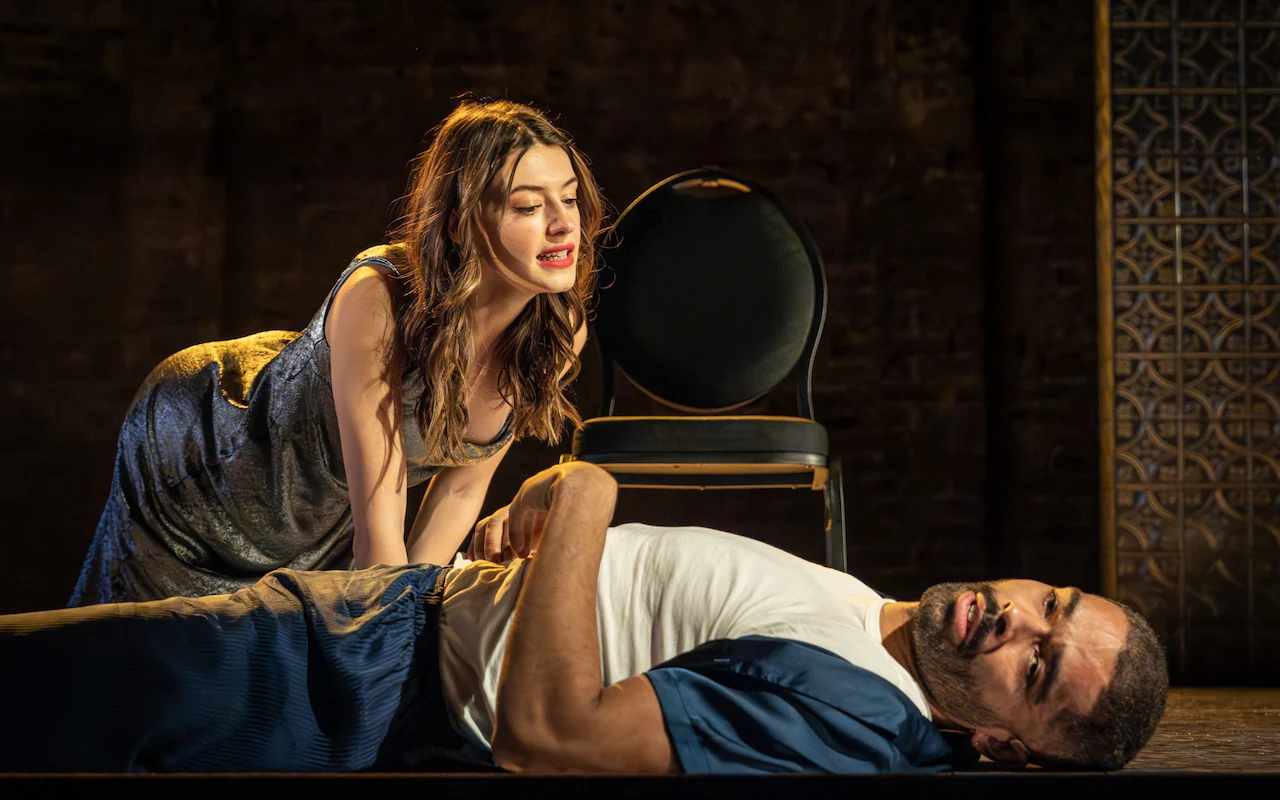
Daisy Edgar-Jones and Kingsley Ben-Adir in Cat On A Hot Tin Roof
Hopes must have been high at the Almeida when they announced Cat On A Hot Tin Roof. Director Rebecca Frecknall has had spectacular success with her previous productions of Tennessee Williams. Daisy Edgar-Jones, Kingsley Ben-Adir and Lennie James play, respectively, a sexually frustrated wife, an alcoholic, possibly gay husband, and a bullying, dying family patriarch. As the Time Out review said, ‘the horror here is the hell of other people. Everyone is trapped with everyone else’.
Unfortunately for The Almeida, a number of critics felt trapped by this long production, although most gave favourable reviews. Kingsley Ben-Adir and Lennie James received high praise but the reviewers didn’t agree about Daisy Edgar-Jones with comments ranging from ‘so good’ to ‘irritating’.
[Links to the full reviews are given but some websites may be blocked unless you have a subscription]
In fact, it was Time Out’s Andrjez Lukowski (5★) who loved it most of all. Daisy Edgar-Jones, he proclaimed, ‘is so, so good, inhabiting Maggie with a burning, vivacious swagger, alternatively self-mocking, self-pitying, compassionate and vicious’. Kingsley Ben-Adir displays, he said, ‘terrific acting, but sacrificing showing off to the greater good of the play.’.
The Standard’s Nick Curtis (4★) too praised the cast in this ‘striking and vivid interpretation’. He said Daisy Edgar-Jones ‘gives an intense and physically exact performance as a woman born poor and aware of the currency of her body and its fecundity. There’s intention in every tilt of her shoulders or arch or her bare instep.’ He talked of ‘Kingsley Ben-Adir, bringing nuance to stumbles and slurs’ and ‘Lennie James, terrifying…he’s magnetic.’
‘Performances are strong all round,’ agreed Holly O’Mahony for LondonTheatre (4★). The Financial Times’ Sarah Hemming (4★) spoke of ‘Rebecca Frecknall’s bruising, claustrophobic production, in which bad faith seems to hang in the air like mist, pooling in the corners of Chloe Lamford’s coldly opulent set.’ ‘What a savage, poisonous, ugly work this semi-autobiographical piece proves anew in Frecknall’s unflinching, if overlong revival,’ observed Clare Allfree in the Telegraph (4★).
Siobhan Murphy for The Stage (3★) declared: ‘if baroque, red-in-tooth-and-claw intensity is what you seek from a Williams play, you won’t feel short-changed.’ Arifa Akbar in The Guardian (3★) decided, ‘Ultimately this is a production that you admire rather than one that moves you.’ Sarah Crompton at WhatsOnStage (3★) had a similar reaction: ‘illuminating, but strangely passive’.
The Independent’s Alice Saville (2★) didn’t like it: ‘Frecknall’s play runs long and slow at 180 minutes – and it feels unbalanced, too, with Maggie’s thin scenes outweighed by her husband’s bloated ones.’
Adam Bloodworth for CityAM (2★) found ‘this version of Cat on a Hot Tin Roof only skims the surface, rarely getting into the darkness at the heart of Williams’ play about trauma, ageing and identity.’ For him, ‘Daisy Edgar-Jones is irritating, never defusing from a perpetual state of angry-shouty indoor voice.’ The Times’ Clive Davis (2★) was another left cold by the Hot Roof: ‘this weirdly off-kilter production, alternately ponderous and manically overheated, could almost be a parody of Williams’s gothic manner.’
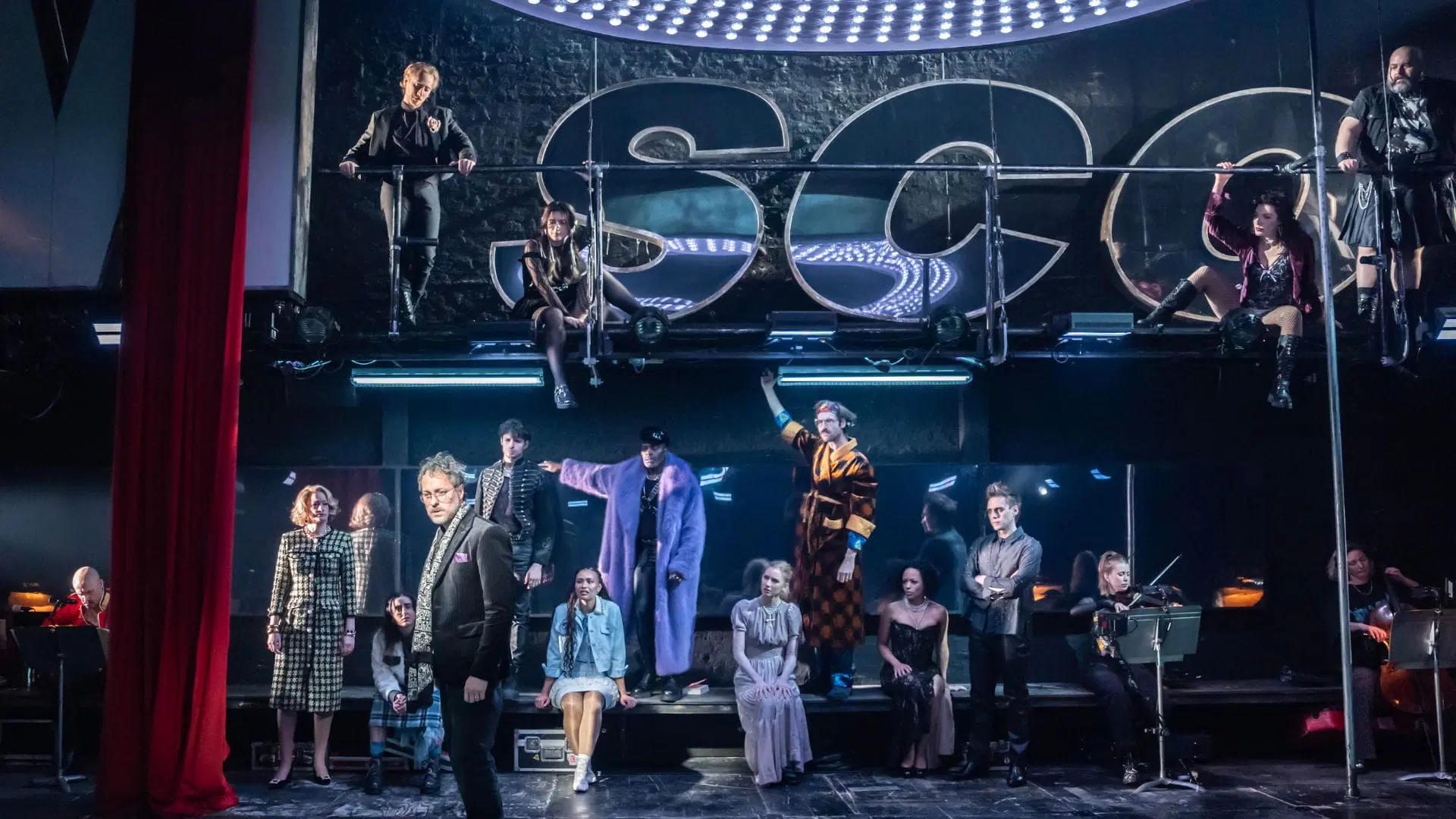
Dave Malloy’s award-winning sung-through musical version of a short but eventful section of Tolstoy’s War and Peace has taken ten years to travel from Broadway, but the critics thought it was worth the wait. With some exceptions, they loved the music, the production (directed by Tim Sheader) and the performances. So, another hit for Mr Sheader in his first season as Artistic Director of The Donmar.
[Links to the full reviews are given but some websites may be blocked unless you have a subscription]
Sarah Crompton at WhatsOnStage (5★) was captivated: ‘both epic and intimate, vast and tiny. It is magnificent, infinite riches in a little room.’ She concluded, ‘It’s a riveting journey, true to Tolstoy’s themes yet compressing his mighty thoughts into one of the best new musicals for years, both hugely entertaining and deeply intelligent.’
The Observer’s Susannah Clapp (5★) said it was ‘aswirl with colour and movement, alive with decisive characterisation and rending story’.
Marianka Swain at LondonTheatre (5★) described it thus: ‘Dave Malloy’s gonzo, knowing, blisteringly funny and wildly creative chamber opera only takes one small section of the novel, and although it is undoubtedly, excitingly ambitious, this big-hearted show invites the audience into his dazzling world.’ She continued: ‘the most luminous element by far is the fantastic cast and onstage band laying into Malloy’s magpie score, which brilliantly fuses Slavic folk with EDM, rock-pop, jazz, and yearning ballads.’
Claire Allfree for the Telegraph (5★) said, ‘Malloy’s score is a gypsy carnival of sound…The singing throughout is outstanding and allows for expressive individual moments’.
Debbie Gilpin at BroadwayWorld (5★) found ‘The heady mix of ballads and uptempo numbers, not to mention drama and comedy, in the relatively intimate environment of the Donmar makes for a unique musical theatre experience.’
Arifa Akbar in The Guardian (4★) called it a ‘dynamic new production, which has stratospheric levels of energy’ but tempered her praise by saying, ‘the show is held back by its own polished larkiness though it is hugely and amusingly original all the same.’ She concluded, ‘this is a terrific creation and at its best it soars.’
‘Sparkling and strange, Dave Malloy’s EDM-fuelled rock opera is a thing to marvel at’ declared The Independent’s Alice Saville (4★). She went on, ‘Malloy’s … musical is a masterclass in prosody, with its often-thin lyrics given emotional heft and depth by orchestration choices, which elicit their meaning.’
Laurie Yule writing for The Stage (4★) picked out ‘Most notable, though, are the jaw-dropping performances from an energetic and passionate ensemble.’ Andrzej Lukowski of Time Out (4★) called it ‘one of the great musicals of our day’.
There were dissenters. The Standard’s Nick Curtis (3★) described it as a ‘massively audacious, massively pretentious musical’. Clive Davis of The Times (3★) was unmoved: ‘if its sheer theatricality is never less than dazzling, the relentlessly quirky tone…kept me at a distance from the characters. I laughed, I grinned, but I never really felt inclined to shed a tear.’
Anne-Marie Duff and Mark Bonner in The Little Foxes
Lillian Hellman’s classic play from 1939 is rarely performed nowadays because, if some of the critics are to be believed, that’s because its hectoring style, unsympathetic hero, and even its subject matter are considered dated. Some critics even wondered why it was being revived. Others were bowled over by the power of the play.
The story concerns a family that has made a fortune from cotton. The men of the family have all the money and are looking to make more. Their sister Regina, like all women at that time (1900), has no inheritance but is determined to have her share. Her machinations tear apart the greedy family.
The acting was praised, particularly that of Anne-Marie Duff, but director Lyndsey Turner’s updating the period from the late 19th century to the 1940s, and Lizzie Clachan’s beige set caused some heads to be scratched.
My own view is that it was a gripping drama and the production’s 1940s design made perfect sense by being in the past but not seeming to be from a bygone age. My 4-star review is here
[Links to the full reviews are given but some websites may be blocked unless you have a subscription]
The Standard’s Nick Curtis (4★) was bowled over: ‘A fine ensemble is anchored by a standout performance from Duff. She mines pathos and empathy from the character of Regina Giddens’. He declared, ‘I basically loved it’ and joked that he ‘also admired the audacity of the timing. Family tensions, rampant capitalism, excessive drinking, someone falling over. Yes, this is definitely a Christmas show.’
Sarah Crompton at WhatsOnStage (4★) said, ‘Little Foxes may be old-fashioned, but it still packs a desolate and depressing punch.’ She pointed out, ‘it has at its heart an absolute stunner of a role for an actor – Regina Hubbard, disempowered wife of the weak and sick Horace, who is manipulating her way to a share of the spoils of her brothers’ business machinations. It’s a role …that Anne-Marie Duff seizes here with charismatic power.’
Dave Fargnoli in The Stage (4★) found ‘Hellman’s writing has a masterly restraint. Her characters hide threats and double meanings behind a veneer of crisp manners and affected politeness, which they break only in the greatest extremity, consummately constructed masks slipping to reveal the violence and viciousness boiling beneath. Director Lyndsey Turner controls the tone of the piece skilfully, gradually and inexorably building tension with an unhurried but never slack pace’. Included in much that he liked was ‘The stylish set, designed by Lizzie Clachan’.
JonThan Marshall for LondonTheatre1 (4★) concluded, ‘As bleak as it all might sound, there is a satisfyingly soapy melodrama to the play we can’t help but buy into. Due to its occasionally archaic writing, it’s clear that a high-calibre cast is needed for the piece to stand up in 2024. This incarnation of The Little Foxes pleasingly does just that.’
Alice Saville in The Independent (3★) said, ‘Duff is a fascinatingly nasty creation here, exuding a brittle glamour in her blood-red gown’. ‘Turner’s staging makes the calculated decision not to romanticise this family, showing them as the grasping parasites they are.’ ‘Turner heightens the story’s early moments of violence, which dims its power to shock later on.’
Time Out’s Andrzej Lukowski (3★) found ‘In Lyndsey Turner’s elegant revival, Anne-Marie Duff …is icy-cold and laser focused’. ‘It’s a grim story, lacking in catharsis. But it’s impressively done.’ However, he had a complaint: ‘The strangest thing about Turner’s revival is the aggressively beige ’60s boardroom aesthetic to Lizzie Clachlan’s set and costumes. The play is very, very definitely set in the Deep South of 1900 and it feels somewhat jarring to, on the one hand, remove this from the production visually, but on the other hand replace it with something relatively non-specific.’
The i’s Fiona Mountford (3★) had many reservations: ‘For all the excellence of the performances, Lyndsey Turner’s production stubbornly refuses to coalesce into a compelling whole…It doesn’t help that the action unfolds on Lizzie Clachan’s long and unlovely set of unadorned beige walls, which provides no anchoring sense of time, place or family history. The greater problem, however, lies with the script’s structuring: too many key events happen offstage and are reported to us second hand, stranding us at one crucial remove from full involvement.’
Natalie Evans for The ArtsDispatch (3★) said, ‘This is, for all intents and purposes, a fantastic production of impeccable quality.’ However, ‘I simply cannot bring forth an answer to the question of ‘Why this? Why now?’ Hellman wrote this piece 85 years ago when it would no doubt have been groundbreaking. However, in 2024, nothing overly new is said, or even implied here.’
Patrick Marmion in the Mail (3★) said, ‘Despite top-of-the-range acting and portentous sound effects, urging us to feel the tension, Hellman’s writing is simply too schematic to make us care about the outcome.’ Holly O’Mahony at LondonTheatre (3) called it ‘a tricky, hard-nosed play that seems to hold its audience at a distance.’ The Telegraph’s Dominic Cavendish (3) called the production ‘fuzzy, unfocused’.
The Times’ Clive Davis (2★) was ground down: ‘A steely-eyed Anne-Marie Duff drips venom as Regina. Steffan Rhodri is persuasive as the charmless Oscar…Anna Madeley’s character, a sort of proto-Blanche DuBois is, in fact, the most interesting of all of them…In the end, however, she, like the rest of the cast, is ground down by the gears of the clockwork plot.’
Helen Hawkins writing for The ArtsDesk (2★) was also highly critical: ‘Turner’s production doesn’t really present us with a play focusing on American racism or the iniquities of the South. These issues are in the text but not at this staging’s core. Ditto feminism. What we are left with is a patchwork: a plot about family finances and double-crosses yoked to a melodrama – emphasised by the ominous rumbling sounds that accompany the climax. As a tragedy of failed dreams, though, it doesn’t engage.’
Critics’ average rating 3.2★
The Little Foxes can be seen at The Young Vic until 8 February 2025 Buy tickets direct from the theatre youngvic.org
If you’ve seen The Little Foxes at the Young Vic, please leave a review and/or rating below
Critics divided over The Glorious French Revolution
New Diorama Theatre
The Glorious French Revolution. Photo: Alex Brenner
The Glorious French Revolution (or why sometimes it takes a guillotine to get anything done), to give it its full title, is the latest production from experimental theatre company YESYESNONO. Directed and written by company founder Sam Ward, it uses five actors to tell the story of what happened in Paris in 1789 and just after. The critics were thin on the ground but neatly divided between three that thought it was entertaining and exciting, and three that thought heads should roll.
[Links to full reviews are included but a number are behind paywalls and therefore may not be accessible]
Dave Fargnoli in The Stage (4★) called it ‘part-potted history, part-grotesque pantomime, and – in its most effective moments – a stingingly relevant social critique.’ This ‘is an enthralling rollercoaster of a work,’ enthused Franco Milazzo of BroadwayWorld (4★). Monica Fox for The Reviews Hub (4 ) said it was ‘a bold, imaginative, and entertaining piece of theatre.’
The Guardian’s Arifa Akbar (2★) commented, ‘it could be a five-star show, but in its current state it is an intelligent mess.’
The Times’ Clive Davis (1★) dismissed it as ‘An excruciatingly simple-minded romp through the events leading up to the Terror…I’m tempted to describe it as Horrible Histories for Brechtians, but at least those children’s books deliver decent jokes.’
Time Out‘s Andrzej Lukowski gave no rating but concluded, ‘ultimately there is no real insight here, and no attempt to explain why this show exists or what the Revolution meant to its makers. Stylish hipster theatre, about the coolest of the big Western revolutions, but it’s about as profound as a Che Guevara t-shirt.’
Critics’ Average Rating 2.8★
The Glorious French Revolution (or why sometimes it takes a guillotine to get anything done) can be seen at the New Diorama Theatre until 14 December 2024. Buy tickets direct here.
If you’ve seen The Glorious French Revolution (or why sometimes it takes a guillotine to get anything done) at the New Diorama Theatre, please add your review below
Some critics thought this black comedy about Hull trawlermen dealing with the loss of a ship in the 1970s was one of Richard Bean’s best. Others liked it but were not keen on the contrast between the comedy of the first act and the more serious, spooky second half. Anna Reid’s detailed sets were highly praised.
[Links to full reviews are included but a number are behind paywalls and therefore may not be accessible]
The Telegraph ‘s Claire Allfree (4★) declared, ‘this is a richly, even bravely old-fashioned play, one of Bean’s very best, which puts its faith in exquisite characterisation and extends a profound humanity to its subject, and as such, a rare treat.’ In Time Out (4★) Andrzej Lukowski) called it ‘an elegiac ‘serious comedy’. For The Standard (4★) Nick Curtis described it as ‘Gritty, spooky and enthralling’.
The Times’ Dominic Maxwell (3) who sees a lot of comedy said it had ‘more fizzingly funny lines than you’ve heard all year’. Julia Rank for WhatsOnStage (3★) was not so convinced: ‘This isn’t one of Bean’s finest efforts but it is watchable – it’s mostly a shame that the potential of act one isn’t followed through.’
Over at The Arts Desk (3★) Aleks Sierz was hoping for better: ‘the slackness of the plotting makes this more of a love letter to old Hull than an exciting well-plotted drama.’ The Stage‘s Dave Fargnoli (3★) found it ‘elegiac snd overstretched’.
It sank for Arifa Akbar in The Guardian (2★) who thought it was ‘baggy and aimless’.
Critics’ Average Rating 3.3★
Reykjavík is at the Hampstead Theatre, London, until 23 November 2024. Buy tickets directly
If you’ve seen Reykjavík at the Hampstead Theatre, please add your review and rating below
Based on the true story of an innocent man who spent 22 years on death row, The Fear of 13 stars Oscar-winning Hollywood star Adrien Brody. The actor was highly praised by reviewers, and there were laudits too for Miriam Buether’s set which turned the Donmar auditorium into the round and immersed some of the audience in the action. Some critics found the play itself by Lindsey Ferrentino a little flat.
[Links to full reviews are included but a number are behind paywalls and therefore may not be accessible]
Clive Davis in The Times (5★) said, ‘Brody delivers an intense, soul-baring performance in his London stage debut.’ Fiona Mountford in the i (5★) concurred, ‘This is an actor at the top of his game and it is a privilege to watch him up close in this space as we reflect upon the ultimate fairness, or otherwise, of justice.’
Matt Wolf in London Theatre (5★) found, ‘Brody is the real deal – a simmering, soulful theatre animal’. He ended, ‘I surely wasn’t the only one who watched the curtain call misty-eyed at the restoration of justice and in awe of Brody’s impassioned commitment to this story of snatching victory from the jaws of psychic defeat.’
Claire Allfree in the Telegraph (5★) noted, ‘(Brody) combines a bewildered, swaggering, teenage vulnerability with a growing gnawing despair … His consummate performance has the audience on side every step of the way.’
Helen Hawkins at The Arts Desk (5★) said of Brody, ‘His face, with its characterful eyebrows, was built for pathos, his rangey physique to embody suffering; but here his features can also radiate a sunny kind of joy as Yarris discovers love, and that freedom means the freedom to love’.
Alex Wood at What’s On Stage (5★) was impressed that ‘under the creative eye of director Justin Martin and designer Miriam Buether, the auditorium is transformed into the round – generating an oppressive, claustrophobic sense of confined space that is disarmingly flexible when required.’
The Observer‘s Susannah Clapp (4★) also praised the production: ‘Miriam Buether’s design – a bare space for jail and a cosy house trapped behind a glass screen – punches home the distance between inmates and the outside world: like two hands on a prison visit unable to touch.’
Sarah Hemming in the Financial Times (4★) praised Brody, ‘He’s charismatic, funny and a born storyteller, but Brody also finds a more ambivalent, reckless streak that suggests the damage within. It’s a spellbinding performance’.
Andrzej Lukowski in Time Out (4★) commented, ‘It is, above all, a cracking piece of storytelling, that exists because Yarris is a fascinating man who has lived a remarkable life, and because Brody has the tortured oddball charisma to bring that to the stage.’
Arifa Akbar in The Guardian (3★) thought Adrien Brody ‘is a beguiling presence here but is not given enough space to flex his actorly muscles. Action takes the place of atmosphere.’ Nick Curtis in the Standard (3★) called him ‘Tousled, impossibly lean and charmingly wolfish, Brody surfs each twist and turn of a script that is mostly preoccupied with the stories we tell ourselves as individuals or as a society.’
Alice Saville in The Independent (3★) described how ‘the profound bleakness underlying this story is constantly kept at bay with jokes, soul singing, and the bustling of guards and prisoners coming and going on its busy stage. It’s engrossing and poignant, even if it’s afraid to let the dark in.’ Sam Marlowe in The Stage (3★) was muted: ‘Brody is mesmerising’ she said but ‘it’s a straightforward retelling without much subtext or theatrical texture.’
Critics’ Average Rating 4.2★
The Fear of 13 can be seen at The Donmar Warehouse Theatre until 30 November 2024. Buy tickets directly here
If you’ve seen The Fear of 13 at the Donmar, please add your review and rating below
The Cabinet Minister at The Menier Theatre. Photo: Tristram Kenton
Who would have thought that a forgotten play by a seldom-performed Victorian playwright would be one of the funniest theatre shows of the year?
Arthur Pinero was one of the most popular playwrights of his day- he was even given a knighthood. He made his name with farces and then with more serious plays on social matters like The Second Mrs Tanquery– one of the few that people may have heard of. While he may not offer quite the sharp wit or tight plots of his contemporary Oscar Wilde, Pinero too mocked the Victorian upper class.
I think it’s fair to say his plays haven’t aged as well as Wilde’s, but with a little attention from adaptor Nancy Carroll, The Cabinet Minister scrubs up very well. She’s simplified the story, cut the anachronisms, and added lashings of innuendoes.
What is the plot? Unbeknownst to him, a government minister’s wife and son have run up enormous debts. The latter is a gambler, the former has bought far too many expensive dresses on credit. If the debts aren’t paid, the minister already under pressure to resign, will be disgraced and forced to retire to that fate worse than death (to his wife, anyway) the countryside.
The dressmaker and her moneylender brother intend to use the debts as leverage to gain entry into high society, and, in the brother’s case, to use insider knowledge to make a stock market killing. The wife’s solution is to marry off her children to rich spouses. They have different ideas- they would like to marry for love.
A rollicking farce
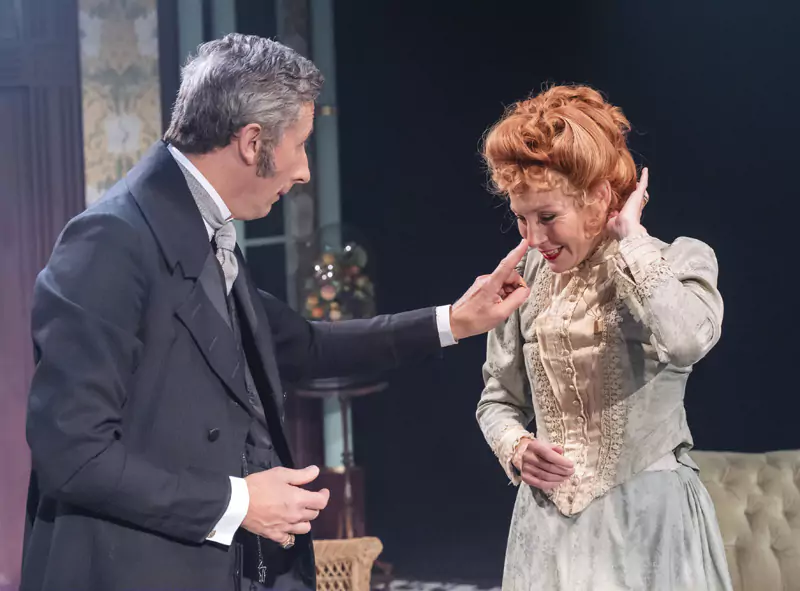
Nicholas Rowe & Nancy Carroll in The Cabinet Minister. Photo: Tristram Kenton
So, it has all the ingredients of a comedy of manners and a rollicking farce. Nancy Carroll, director Paul Foster, designer Janet Bird and a well chosen cast have cooked them up into the comedy of the year. Nicholas Rowe plays the government minister Sir Julian Twombley. Tall and patrician, and so cynical about politics he gets his butler to write his speeches, he provides the still centre for the shenanigans.
Nancy Carroll not only adapted the play, she stars as his wife Lady Katherine Twombley. She knows how lucky she is to be part of high society, and doesn’t want that luck to run out. In Ms Carroll’s hands, she carries herself haughtily, throws out barbed one-liners, and panics wholeheartedly, as when she tries to strangle her nemesis Bernard Lacklustre. He’s the main creditor and, played by Laurence Ubong Williams, is a Del Boy character failing at every turn to blend into upper class society.
His sister Fanny Lacklustre is a tradesperson in the morning and a lady in the afternoon, such are the complexities of the class system. Lady Katherine may feel contempt for her, and shows it, but she cannot resist the pressure to bring her into her world. Phoebe Fildes gives a great turn as the thick-skinned schemer, ignoring sleights, ever smiling and pressing on with her plans.
Then there are the children. I particularly liked Rosalind Ford as a naive, confused Imogen Twombley. She is in love with Valentine, a hairy, smelly explorer who won’t settle for domesticity, and played by George Blagden with panache. Unfortunately, her parents have promised her to a rich Scottish laird, Sir Colin McPhail. And here we come to the highest comedy of the evening. Sir Colin is taciturn and shy. Played by Matthew Woodyatt, he’s a lumbering giant ties himself in knots trying to proclaim his feelings, while his mother Lady MacPhail speaks for him and at times the whole of Scotland. Played by Dillie Keane, best known as part of Fascinating Aida, she is an over-the-top Scot forever banging on about the glens and hills of her beloved country.
Attempting to matchmake is Dora, the Dowager Countess of Drumdurris. She constantly appears and disappears through the two doors in classic farce fashion. Sara Crowe was indisposed when I saw the show. While her last minute replacement read the lines well from a script, we lost some of the speed that I am sure was intended by movement director Joanna Goodwin.
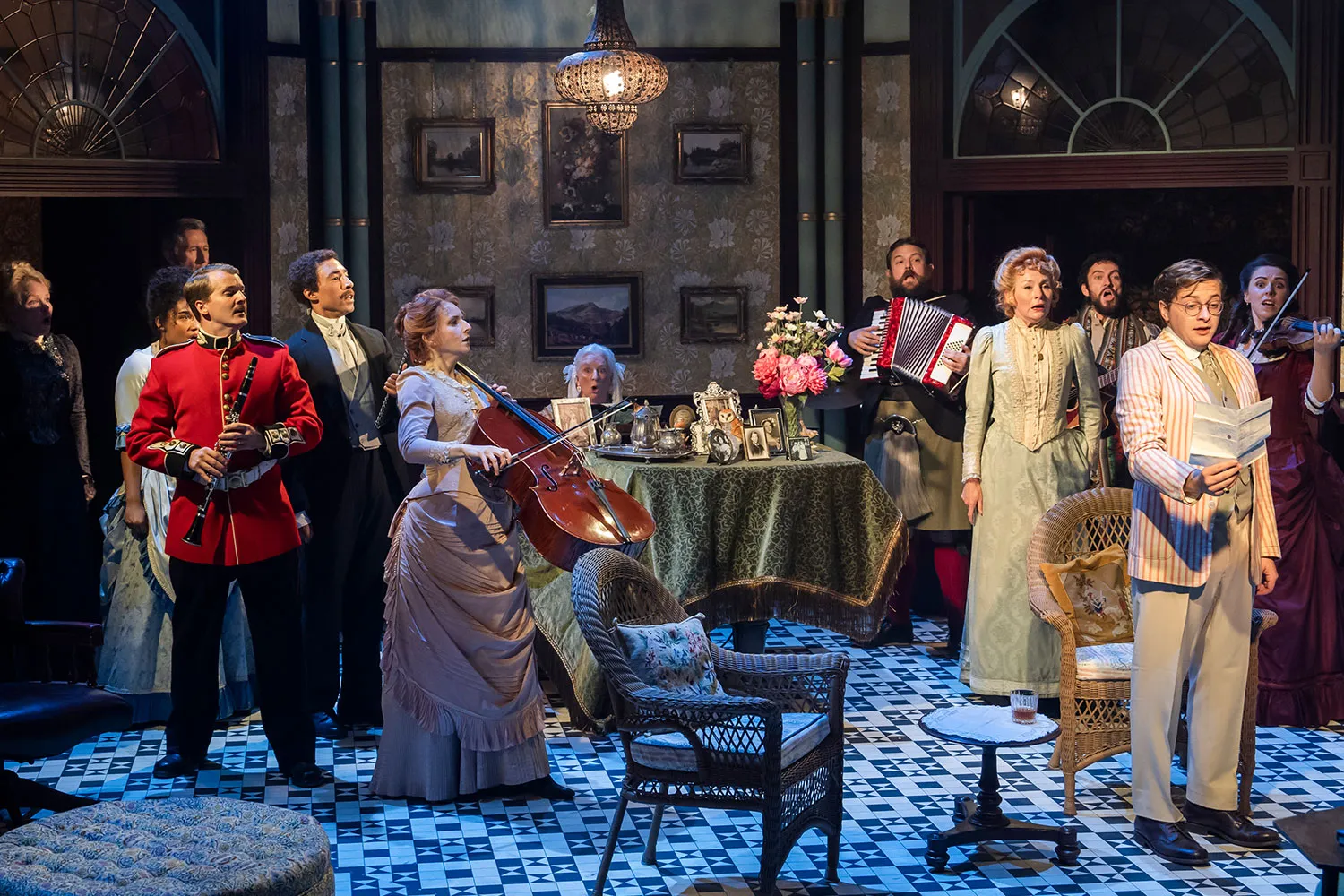
Members of the cast play musical instruments. This device is used regularly by The Watermill Theatre and by Pride and Prejudice* (*sort of). It is highly effective in establishing mood and sometimes character and can also help keep us the audience at bay in a play where we are deliberately distanced from being emotionally involved with the characters.
I mentioned Nancy Carroll has packed her adaptation with innuendoes. If you’d like an example, I’ll give you one. At one musical moment, Fanny offers to fiddle with flute playing Sir Julian.
The sets and costumes by Janet Bird are terrific. The Menier stage area is quite small but versatile. On this occasion, the audience is on two sides, creating an intimate drawing room feel. The costumes are sumptuous, looking fin de siecle and subtly reflecting the characters. The Twombleys’ home is decorated minmally but with a chintzy late Victorian style including a chaise longue and of course a piano.
The portrait of high society and its fragility, as well as the seriousness of debt, would have been much more recognisable to a Victorian audience, but we are still a class-ridden society and the characters’ many pretensions hit home. And without it ever needing to be stated explicitly, the references to corrupt politics and donations in exchange for influence show times haven’t changed as much as we might hope. I’m sure the rumours that Lord Ali gave Sir Keir tickets for the opening night are entirely without foundation.
In their Angry And Young season, The Almeida has revisited two plays from the 1950s that helped revolutionise the English stage. Both concern working class people and are set in kitchens (hence the nickname ‘kitchen sink drama’?). Atri Banerjee directs John Osborne’s Look Back In Anger and Diyan Zora directs Arnold Wesker’s Roots. Each critic had a favourite, while often not liking the other: where some saw a striking portrait of anger and misogyny in Jimmy Porter in Look Back in Anger, others were merely disturbed; some admired Roots‘ defiant Beattie, others thought the play lacked passion. All admired the stars Billy Howle and Morfydd Clark. I’ve separated comments about the two plays but the star ratings sometimes covered both, and sometimes star ratings were omitted.
Look Back In Anger
Billy Howle in Look Back In Anger. Photo: Marc Brenner
The Guardian‘s Arifa Akbar (2★) was on the attack: ‘watching it now is a curiously cold anthropological experience’. ‘John Osborne’s pugilistic sweet-stall seller…looks like a charmless, self-pitying tyrant here who weaponises his working-class chip against his wife.’
Patrick Marmion in the Mail (2★) joined in, ‘There’s a strong seam of misogyny in all Osborne’s writing — and Howle does little more than lend this sullen, self-pitying exponent a babyish whimper. The play has little to teach us, and does less to amuse.’
The Times’ Clive Davis (3★) felt ‘watching the endlessly self-pitying Jimmy complain about his wife, Alison, is like watching a thoroughly one-sided boxing match’. Sam Marlowe in The Stage said, ‘The unrelenting verbiage of Jimmy Porter, as he assaults Ellora Torchia as his upper-class wife Alison with a battery of taunts and insults, is heavy going and quickly begins to seem like overkill.’
Fiona Mountford in the i (3★) called it, ‘this interminable bore of an often misogynistic rant’. Susannah Clapp in The Observer (3) took a similar stand: ‘Billy Howle dazzles as Porter: as raw and ranging as Poor Tom on King Lear’s heath. But for all their force, his speeches are puny: Osborne glorying in his misogynistic power.’
Andrjez Lukowksi of Time Out (3★) commented, ‘antihero Jimmy Porter’s abusive treatment of his upper middle class wife Alison is deeply problematic. It was doubtless meant to be so at the time as well, but it was written in an age with a different attitude towards domestic violence, and I think the passage of years has made Jimmy an increasingly repulsive, harder to emphasise with character. ‘ He didn’t like with the way the production moved away from the original’s naturalism: ‘At the end of the day a Pinteresque take on Osborne neither conveys the shattering impact of Look Back in Anger’s original incarnation nor, crucially, can it out-Pinter Pinter.’
Aleks Sierz at The Arts Desk (4★) took a more positive view: ‘What’s exciting theatrically is Osborne’s truthfulness in depicting masculinist attitudes which are as prevalent today as they were some 70 years ago. Yes Jimmy rants; yes, he’s unbearable (we have all surely met his type); yes, his opinions are disagreeable. But, boy, does he light up the stage.’
Tim Bano in The Standard (4★) called it ‘a crackling piece of drama’. For him, ‘Banerjee pulls the tension tighter and tighter, a nasty, thrilling tension, in which Porter expresses his vile, misogynistic, insulting views, shoving them at his wife and friend Cliff because there’s nowhere else for them to go.’
The Telegraph‘s Dzifa Benson (4★) said, ‘Howle portrays (Jimmy) as a coercive abuser, with a nervy, febrile energy that always feels dangerously on edge and ready to explode at any minute.’
Matt Wolf for LondonTheatre (4★) said, ‘you shiver at Jimmy’s weaponising of verbal finesse – language from his mouth cuts arguably more deeply than a knife – even as you sense a lost and haunted manchild adrift in a world that, as Jimmy knows full well, doesn’t give a damn.’
Sarah Hemming in The Financial Times (4★) declared, ‘It’s a blazing production of a tough, ugly, angry, desperate, sad play.’ Sarah Crompton at Whats on Stage (4★) observed, ‘(Howle’s) Jimmy really is lost and by emphasising that, Banerjee subtly counteracts Osborne’s unbearable desire to see this ruthless man-child as a hero.’
For Alexander Cohen at Broadway World (5★) was the most enthusiastic, ‘To experience John Osborne gut the audience like a fish, all their grotesque innards splayed out in front of you is as intoxicating as it is nasty…Banerjee makes it clear as day: his clenched indignation is even more pathetic in 2024.’
Roots
Morfydd Clark in Roots. Photo: Marc Brenner
The Guardian (4★) said, ‘It is a static play but there are masterful subtleties around class and interplay of characters built into its pace, alongside humour.’ The Observer (4★) called it ‘an extraordinary piece of work: intimate and visionary’.
The Times (4★) noted, ‘Morfydd Clark is utterly convincing in this role. Beatie’s tragedy is that she patronises her folks yet has acquired all her new values from a bohemian boyfriend’. LondonTheatre (4★) called Clark ‘a stonking star turn’.
Dzifa Benson in the Telegraph (4★) said, ‘Morfydd Clark lends (Beattie) a breezy charm and resilience that seem to belie the raw vulnerability she displays when Beatie’s mother gives her a dressing down.’
The Financial Times (4★) enjoyed ‘Diyan Zora’s deftly paced and beautifully acted production of Roots … She keeps Wesker’s punctilious naturalism and yet frames the drama as a memory play.’
The i (3★) said, ‘Wesker lets out an impassioned cry for working-class liberation through greater curiosity and captures the timeless emotional theme of the facility with which children blame their parents for their own failings. Beatie has strong roots in this limited but loving place; a top-quality 100 minutes of drama shows that she also has a winningly defiant mind of her own.’
The Stage thought, ‘Clark makes Beatie’s eventual epiphany powerfully moving.’ As to the production, ‘overall, it’s a brisk staging that serves the play well, and if it does so without any particular innovation, it’s crammed with texture and feeling.’
Whats On Stage (3★) took a different view: ‘The problem is that Wesker’s writing lacks the ability to leap into the family’s minds; it’s a sociological study rather than a drama. Diyan Zora’s stylised, non-naturalistic staging pushes them further away.’ For the Mail (3★), ‘Wesker’s play…works best as social history.’
The Standard (3★) didn’t find much to get excited about: ‘The anger is deadened, drowned out in a society that’s far angrier, and far louder. Zora’s revival goes some way in cracking open the slightly dry carapace that surrounds the piece, and there are undoubtedly great moments, but too often it feels like an experiment in reviving a forgotten play, too much like homework.’
Critics’ average ratings: Look Back In Anger 3.5★ Roots 3.6★
Look Back In Anger and Roots can be seen at The Almeida Theatre until 23 November 2024. Buy direct from the theatre
Manage Consent
To provide the best experiences, we use technologies like cookies to store and/or access device information. Consenting to these technologies will allow us to process data such as browsing behaviour or unique IDs on this site. Not consenting or withdrawing consent, may adversely affect certain features and functions.
Functional
Always active
The technical storage or access is strictly necessary for the legitimate purpose of enabling the use of a specific service explicitly requested by the subscriber or user, or for the sole purpose of carrying out the transmission of a communication over an electronic communications network.
Preferences
The technical storage or access is necessary for the legitimate purpose of storing preferences that are not requested by the subscriber or user.
Statistics
The technical storage or access that is used exclusively for statistical purposes.The technical storage or access that is used exclusively for anonymous statistical purposes. Without a subpoena, voluntary compliance on the part of your Internet Service Provider, or additional records from a third party, information stored or retrieved for this purpose alone cannot usually be used to identify you.
Marketing
The technical storage or access is required to create user profiles to send advertising, or to track the user on a website or across several websites for similar marketing purposes.