Reviews Roundup: Michael Sheen in Nye 3.4★

Olivier Theatre, National Theatre, London
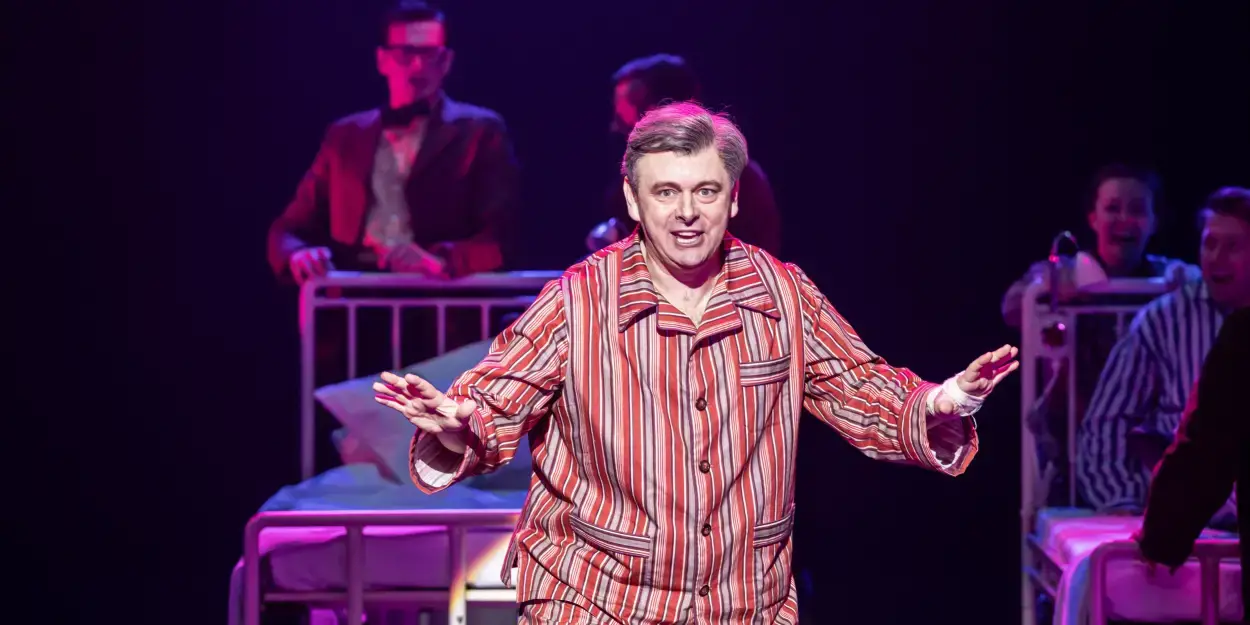
Michael Sheen in Nye. Photo: Johan Persson

Nye tells the life story of the Labour minister who drove the formation of the NHS. While most reviewers plumped for 3 or 4 stars, there was one 5 and one 2 star review. In the title role is Michael Sheen who received widespread praise. He performs the show in pyjamas as a patient dying in an NHS hospital. Nye’s delirious moments in which he remembers a fantasy version of his past reminded quite a few reviewers of The Singing Detective. Director Rufus Norris‘s swansong production as Artistic Director of the National Theatre was also warmly received, as was Vicki Mortimer’s set. A number of critics were disappointed with Tim Price‘s script.

[Links to full reviews are included but a number are behind paywalls and therefore may not be accessible]

However, not Fiona Mountford reviewing in the i (5★). She complimented ‘Tim Price’s satisfying meaty, yet never less than nimble study’.

Sarah Hemming at the Financial Times (4✭) described Nye as ‘unashamedly, a play about principle, passion and compassion, driven by a fantastic ensemble and an electrifying performance from Sheen. ‘ She continued: ‘Director Rufus Norris stages all this with wit and drive.’ For Clive Davis in The Times (4★), ‘Sheen burns with passion’ adding ‘His charisma fills the gaps in the script.’  Dominic Cavendish in the Telegraph (4★) was also taken with  Michael Sheen’s performance, saying “Sheen is in his element here…by turns down to earth and messianic, tender and full of clenched tenacity.’ Gary Naylor for Broadway World (4) had reservations- ‘flawed, sprawling and unmanageable – but when it works, it’s magnificent.’ Michael Sheen is given considerable credit: ‘carrying the play and the man with equal passion’  Mr Naylor also picked out ‘Jon Driscoll’s video work is as good as I’ve seen in a theatre, a tour de force.’ Neil Norman’s review in the Express (4★) described Nye as ‘a moving but unsentimental portrait of the man who changed British healthcare’.

Time Out‘s Andrzej Lukowski (3★) found it hard to get excited at what he called ‘a fairly conventional drama, jumbled up’ but was compensated by the fact that: ‘Sheen is a delight’  and ‘if the whole isn’t quite there, most of the individual scenes are scintillating.’ Alice Saville in The Independent (3★) had a similar thought: ‘a bit of a tired theatrical set-up, to have an ageing famous figure reliving his life in convenient vignettes,’ but she said: ‘Norris’s direction keeps things nimble and strange.’ Nick Curtis in the Evening Standard (3★) was unimpressed by the ‘lumpy and obvious script.’ ‘the narrative is too long-reaching and schematic’ complained Arifa Akbar in The Guardian (3★). Possibly alone, she had reservations about Michael Sheen’s performance: ‘He brings a curious fey playfulness and vulnerability but does not plumb the depths of his commanding character.’

While Sarah Crompton at Whats On Stage (3★) was impressed by ‘a central performance from Michael Sheen of charm and charisma, and an energetic and stylish production from Rufus Norris’. She was less happy with the script:  ‘It’s engaging, never less than interesting, but it doesn’t always find the balance between great gobbets of historical information and reaching the heart of the man and his vision.’  For Sam Marlowe in The Stage (3★) ‘It’s crammed with information but remains surface-skimming’ although she did think: ‘Michael Sheen is a terrifically engaging Bevan’ and ‘Vicki Mortimer’s set is a kaleidoscope of green hospital screens’. The Sunday Times‘ Dominic Maxwell (3★) said it felt like ‘an artfully staged Wikipedia entry,’ commenting  ‘while Nye gives its man some good lines, it goes light on big set pieces’. He didn’t feel ‘as if we’ve done more than traced the surface of an extraordinary man and his nation-changing achievement.’ Nevertheless, he concedes ‘there’s good stuff in Nye, and Sheen is tremendous’.

Susannah Clapp in The Observer (2★) called it ‘a wasted opportunity’. She said ‘the form is fractured, giddy’ and ‘interesting nuggets become mechanical explanation’. However she complimented Michael Sheen as ‘fiery’.

Average critic rating 3.4★

Value rating  38 (Value rating is the Average critic rating divided by the most common Stalls ticket price. In theory this means the higher the score the better value but, because of price variations, a West End show could be excellent value if it scores above 30 while an off-West End show may need to score above 60. This rating is based on opening night prices- theatres may raise or lower prices during the run.)

Nye can be seen at the National Theatre until May 11 (Tickets directly from the theatre here) then May 18-June 1 at Wales Millennium Centre, Cardiff, (Tickets directly from the theatre here). National Theatre Live cinema screenings from March 23 (Details at nye.ntlive.com)

Read Paul Seven’s 5 star review here

If you’ve seen Nye, you are welcome to add your review and rating below (but please keep it relevant and polite)
 

Reviews round-up: Hadestown 3.6★

Lyric Theatre, Shaftesbury Avenue, London

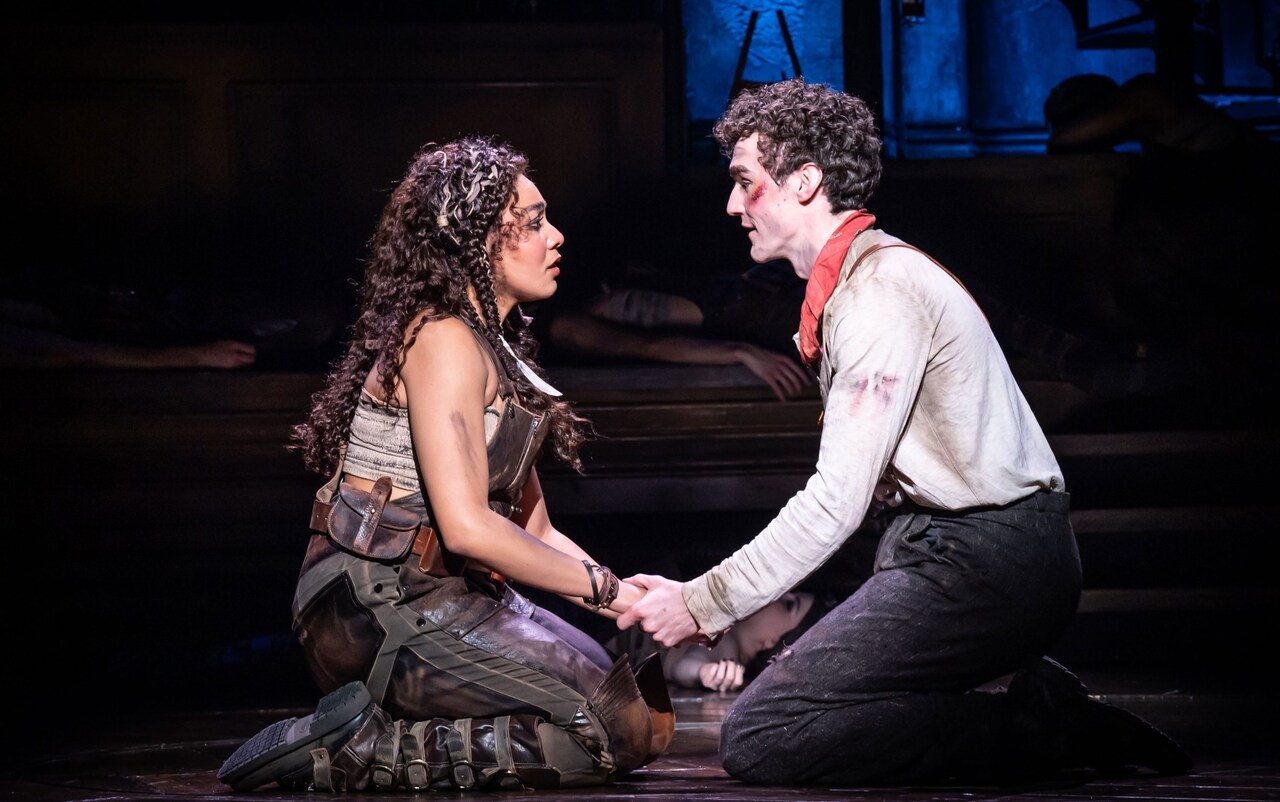
Grace Hodgett-Young and Donal Finn in Hadestown. Photo: Marc Brenner

Hadestown is an American sung-through musical version of the Greek myth about Orpheus’ attempt to rescue his late wife and love of his life Eurydice from the Underworld (i.e. Hell) with Persephone’s story added to the mix. Written by Anais Mitchell, it began its life 18 years ago as a community project in Vermont and was presented at the National Theatre in 2018 before scooping 8 Tony Awards on Broadway.

[Links to full reviews are included but a number are behind paywalls and may not be accessible]

Clive Davis in The Times (5★), possibly our most parsimonious critic when it comes to handing out stars, gave Hadestown top marks, saying it’s ‘a reminder of what musical theatre can achieve when it sets its sights beyond the lowest common denominator. ‘ He loved the band: ‘a glorious noise’; he loved the singers ‘Grace Hodgett-Young’s voice has a raw northern edge…Gloria Onitiri is a thunderous, sexy Persephone.’ He concluded that Orpheus and Eurydice’s  ‘final ill-starred journey still touches the heart.’

The Guardian‘s Arifa Akbar (4★) may have held back a star but she still enthused: ‘This is one of the best West End musicals around.’ ‘Every scene becomes a set piece: big, beautiful and emotionally blasting,’ she said in her review.  Sarah Crompton at WhatsOnStage (4★) was similarly smitten: ‘the most exhilarating ride. That band, with its bluesy trombone and folksy guitar is consistently thrilling, the songs are vibrant and smart, the sung-through text is compelling..(Rachel) Chavkin’s direction is direct and impassioned.’ Her only reservation was, ‘the material just doesn’t quite coalesce into the ending I long for.’ Time Out‘s Andrzej Lukowski (4★) was particularly taken by the music: ‘It is essentially a staged concert, but it’s done with such pulsing musical intensity, physical dynamism and heft of meaning that it never feels like one..It’s a musical of beautiful texture and tone.. Mitchell has penned some flat-out brilliant songs.’ Marainka Swann at londontheatre.co.uk (4★) enjoyed ‘the quiet power of this singular show, which demonstrates the magic of a shared story, and how such a collective effort can change the world, is undeniable. This spellbinding West End production was well worth the wait.’ Fiona Mountford in the i (4★) talked about being ‘wooed by the hazy, dazy atmosphere of this splendidly sultry show’. Cindy Marcolina at Broadway World (4★) called the singers: ‘an exciting team who carry the intensity and high-stake energy of the tale with precise delivery’ and described Grace Hodgett-Young’s performance as Eurydice as ‘astounding’.

Dominic Cavendish in the Daily Telegraph (3★) couldn’t summon quite the same level of enthusiasm: ‘Yes, it can feel like one damned song after another. But it washes over you like a steam bath.’ He praised ‘the rich attention to detail in costuming, choreography, lighting and ensemble flamboyance’ and noted that ‘Donal Finn’s Orpheus can hit heavenly high notes.’ The Stage‘s Sam Marlowe (3★) just about managed to contain her excitement: ‘An uneven, unsatisfying creation, it is light on plot, heavy on pretentious portent – yet it’s fitfully seductive, with Mitchell’s New Orleans jazz-inflected score and Rachel Chavkin’s fever dream of a production both oozing spicy flavour. And the electrifying energy and knockout vocals of the cast come close to blasting away objections.’ The Observer‘s Susannah Clapp (3★) suggested ‘Rachel Chavkin’s production nudges the musical world along but does not remake it.’

It was left to Nick Curtis in the Evening Standard (2★) to sound a sour note: ‘The writer-composer’s score is catchy and eclectic but often bombastic, her lyrics pretentious or nonsensical…the endless reprises start to drag and, oh dear, the words within and in between the songs can be dire’

David Neumann’s choreography was widely but not universally praised: ‘energetic yet precise’ (WhatsOnStage), ‘ethereal’ (Times), ‘pneumatic’ (Time Out).

Hadestown at Lyric Theatre, Shaftesbury Avenue, London, is booking until 27 September 2026. Buy tickets directly here.

Average Rating 3.6★

Value Rating 40 (Value rating is the Average critic rating divided by the most common Stalls/Circle ticket price.)

If you’ve seen Hadestown, please add your review and rating below (but we ask you keep it relevant and polite)
Till The Stars Come Down – Review

Hilarious comedy reveals home truths about Britain

★★★★

A bridfe and her aunt played by actors are doing their makeup and hair in Till The Stars Come Down at the National Theatre February 2024
Lorraine Ashbourne & Sinéad Matthews in Till The Stars Come Down. Photo: Manuel Harlan

Till The Stars Come Down written by Beth Steel is a shocking insight into the despair of post industrial Britain disguised as a hilarious comedy about a working class family wedding. It may also turn out to be the best new play of 2024.

At the heart of Till The Stars Come Down are three sisters. We meet these delightful characters in the excitement of the morning when the youngest Sylvia is getting married. You positively glow in the warmth of this ebullient, raucous occasion of bickering and bonding.
Hazel played by Lucy Black is the eldest, the mother hen in the absence of their late actual mother. Overworked and over cheerful, she is also begrudging and bigoted. Lisa McGrillis plays Maggie, glittery and wild but unsettled. Sinéad Matthews as Sylvia, naturally nervous but the most forward-looking of the siblings.
They are joined by Aunty Carol. She’s a force of nature who deals with life in sarcastic quips that are funny enough to have the audience in stitches. Her hard mouth shoots out words like a nail gun. From her opening line, directed at Sylvia, ‘How you doing, sugar tits?’,  Lorraine Ashbourne‘s larger-than-life portrayal commands the stage in every one of her scenes.
In the beginning, all is lighthearted conversation and affectionate jibes. The women’s banter- especially Aunty Carol’s- is full of outrageous metaphors and vulgar observations: she talks of a woman who shaved pubic hair as a ‘trailblazer with a razor’. An unfaithful man would have ‘shagged a frog if he could gerrit to hold still long enough’. Maggie liked the way a man looked at her, making her feel ‘like I was a potato in a famine’. Hazel can’t wear a fascinator because she’s ‘got a flat head’.
We also meet Helen’s children. Leanne played by Ruby Stokes is a teenager who wants to save the planet while being depressed by the possibility it is beyond saving. Sarah is a confident little girl who dreams of being an astronaut.
A scene from Till The Stars Come Down at the National Theatre February 2024
Till The Stars Come Down at the National Theatre. Photo: Manuel Harlan

It’s an intimate setting that keeps us involved with Beth Steel’s complex family. The audience is on all four sides looking at a stage floor almost filled with a revolve that, when it turns, enables us to get a fair view of all the characters. Props- usually tables and chairs- are taken on and off for the changing scenes. Samal Blak’s set enables director Bijan Sheibani’s deftly choreographed production to keep moving slickly.

In this stereotypical working-class society of strong women and weak men, they chat and interrupt and talk over one another most naturally.  In Beth Steel’s finest work to date, she juggles many characters and situations. And the performances are so real that you almost feel you are members of the wedding party rather than an audience. The ensemble cast are first-rate actors, many of whom you will recognise from the better quality TV dramas like Happy Valley and Sherwood.
Hazel’s husband John, a shell of a man, is given a mighty characterisation by Derek Riddell. His rabbit-like eyes are soft and nervous, his body trembles with feeling. Alan Williams plays Tony the father of the bride, a stolid man of few words who oozes disappointment but who in a magical moment suddenly comes to life when he remembers winning a Tarzan competition in his youth. His brother Pete played by Philip Whitchurch is a joker with weakness lurking behind his twinkling eyes.
But for Leanne’s mobile phone, it could be 50 years ago in this East Midlands mining community. Except that the mines have shut down and Sylvia is marrying an enterprising Polish immigrant of whom there are quite a few in the area these days. ‘The Team Leaders are all Eastern European and they look after their own’ says Hazel, explaining why she failed to get a promotion.
The guests are celebrating outdoors when a downpour sends them running for cover. Having warmed to these characters, we find ourselves journeying into a sometimes shocking discovery of the truth about their lives.
The wedding is a chance for the sisters to slip into the past, when they were carefree and their beloved mother was still in their lives. For a few hours, nostalgia fuelled by drink brings out, in some of them, their true feelings and their desire to live a more fulfilling life. Onto the stage tumble unconsummated love, unrealised ambition, and a longstanding feud between the father and his brother.
The title appears to derive from W H Auden‘s poem Death’s Echo about our short, meaningless lives and how we should dance while we can. There is certainly plenty of ecstatic dancing in the play. However, existential talk about the age of the universe and the destruction of humanity seems out of place in an already rich portrait of turmoil within a family.

A rollicking start leads to a deeper, darker conclusion

After the rollicking start, you look forward to two-and-a-half hours of laugh-out-loud comedy but it doesn’t last. The humour never quite stops but the play becomes deeper and darker, because this is a play about a community laid low by the loss of the mines around which it prospered. The once proud working class population now work in meaningless jobs in warehouses and supermarkets. Hazel talks of ‘Lost men, lost boys, who once thought they’d have a better life.’ It’s a story that could be repeated in so many parts of post-Industrial Britain, the parts that punished the country’s elite by voting for Brexit, you may think.
If the community has been crushed, so have the dreams of the older characters. Of the sisters, only the youngest Sylvia remains an optimist, looking forward to married life, and embracing change, even if she does sometimes mystically wish she could freeze her moments of happiness. The other two and Helen’s husband John as well as the senior generation have seen their dreams crushed and they bemoan their unhappy, disappointing lives.
By contrast, the outsider, the Pole, is positive about life. Marek, played by Marc Wootton, is willing to work hard at ‘shit jobs’ as he calls them- the kind in which the others feel trapped- to build a better life. He exposes the sense of entitlement and lack of ambition of the British natives. Like the pigs in the abattoir he once worked in, they know their fate.
He is also an outsider in this play, an underdeveloped character and seemingly without any family or friends at the wedding. Of course, we are meant to be concentrating on the state of the British working class but it still feels like a clumsy piece of writing.
Bigotry and racism among Sylvia’s family, kindled by their frustrations and lost power and frustrations, simmer and eventually boil over into a violent climax. The empty shell of a community cracks and the sisterly bond is tested to the limit.
And all praise to the National Theatre for presenting Beth Steel‘s superb play with its impressive large cast. Some other theatres have all but abandoned new writing in the face of funding cuts but the National, also operating on a reduced budget, continues to nurture new writing.
Till The Stars Come Down was performed at the National Theatre until 16 March 2024. It is playing the Theatre Royal Haymarket 1 July – 27 September 2025 (cast may change). Tickets here
Paul was given a review ticket by the theatre.

Operation Mincemeat- West End review

​From fringe to hit West End musical

★★★★★

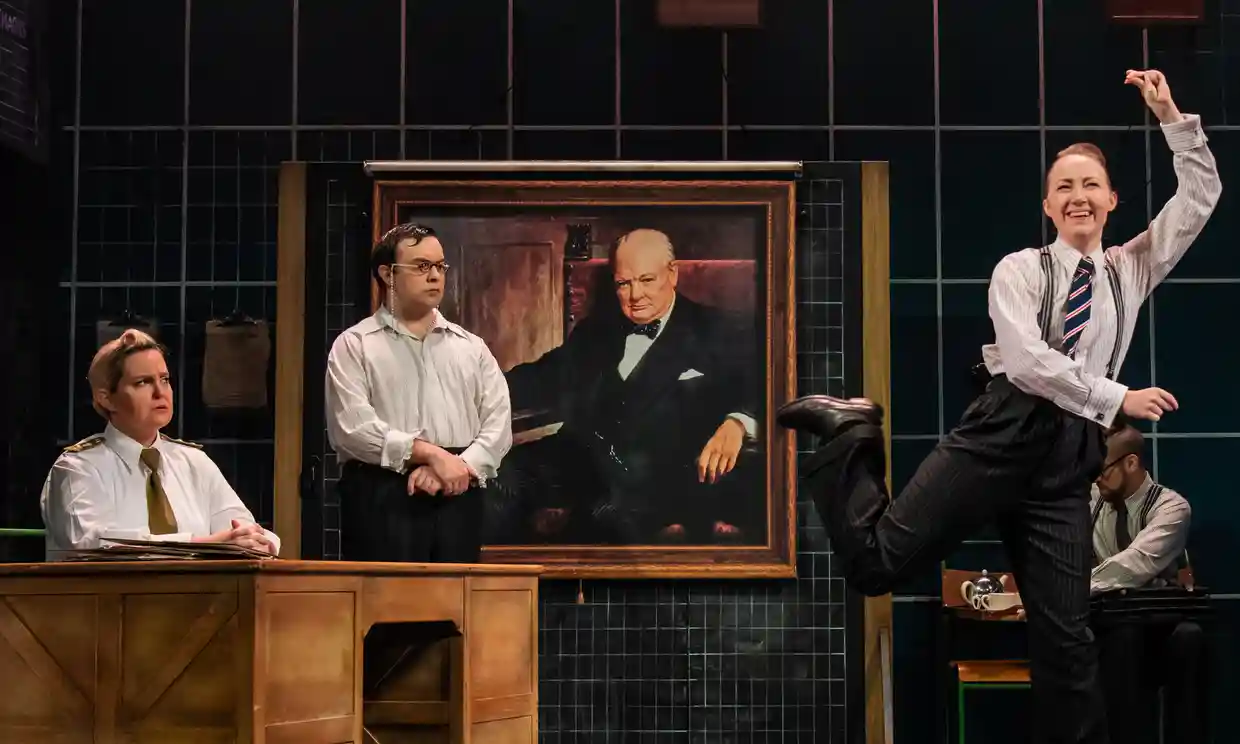
Two actors watch as another dances in front of a painting of Winston Churchill in the stage musical Operation Mincemeat at the Fortune Theatre June 2023
Zoe Roberts, Jak Malone & Natasha Hodgson in Operation Mincemeat Photo: Matt Crockett

This was my first ever visit to the Fortune Theatre, because for the last 33 years it has been the home to The Woman In Black. Now it’s hosting Operation Mincemeat and while it may not match the previous occupant’s three decades, this accomplished, fast-moving musical comedy certainly deserves a long run.

From the moment the yellow curtain goes up on Operation Mincemeat, you know you’re in for a treat. It begins with a chorus number by the five cast members, who start as they mean to go on. They fill the stage with their larger than life characters, exuberant performances and the sheer enjoyment of being there.
Over a couple of hours, we are told the true, albeit embellished, story from World War Two of an MI5 plan to use a dead body with fake papers to fool the German army into thinking the British will invade Sardinia rather than Sicily. However, this is not really a tribute to MI5, more a satire on male chauvinism in general and the Old Boy network in particular.
Operation Mincemeat is written and composed by David Cumming, Felix Hagan, Natasha Hodgson and Zoë Roberts, developed from an idea that became a run at the tiny New Diorama theatre in London and then polished into a West End show. Currently, all of the creators, less composer Felix Hagan, are in the cast and are joined by Claire Marie Hall and Jak Malone who have fantastic singing voices. The others sing well too. I’m pretty sure the four understudies who are given equal billing in the programme are also multi-talented.
The cast play many parts of both male and female gender, and this adds an additional layer of humour, as when Natasha Hodgson, playing the group’s leader Ewen Montagu, struts with old Etonian entitlement and masculine pomposity. His response to the question ‘Is it legal?’ is ‘Does it matter?’ And he tells us in song:
​For we were made to give the orders / While lesser men take heed / For some were born to follow / But we were born to lead.

Outstanding performances

Outstanding is Jak Malone as the secretary Hester, who sings the most moving song of the evening, Dear Bill, a fictitious letter to a soldier on the front line. Zoë Roberts is constantly hilarious as Johnny Bevan, the bureaucratic man ultimately in charge, Ian Fleming with his eccentric ideas for a spy novel, and Haselden, our out-of-his-depth ‘man in Spain’. David Cumming is a riot as the shy, panicking, nerdy Charles, while Claire Marie Hall excels as the artless young assistant Jean.
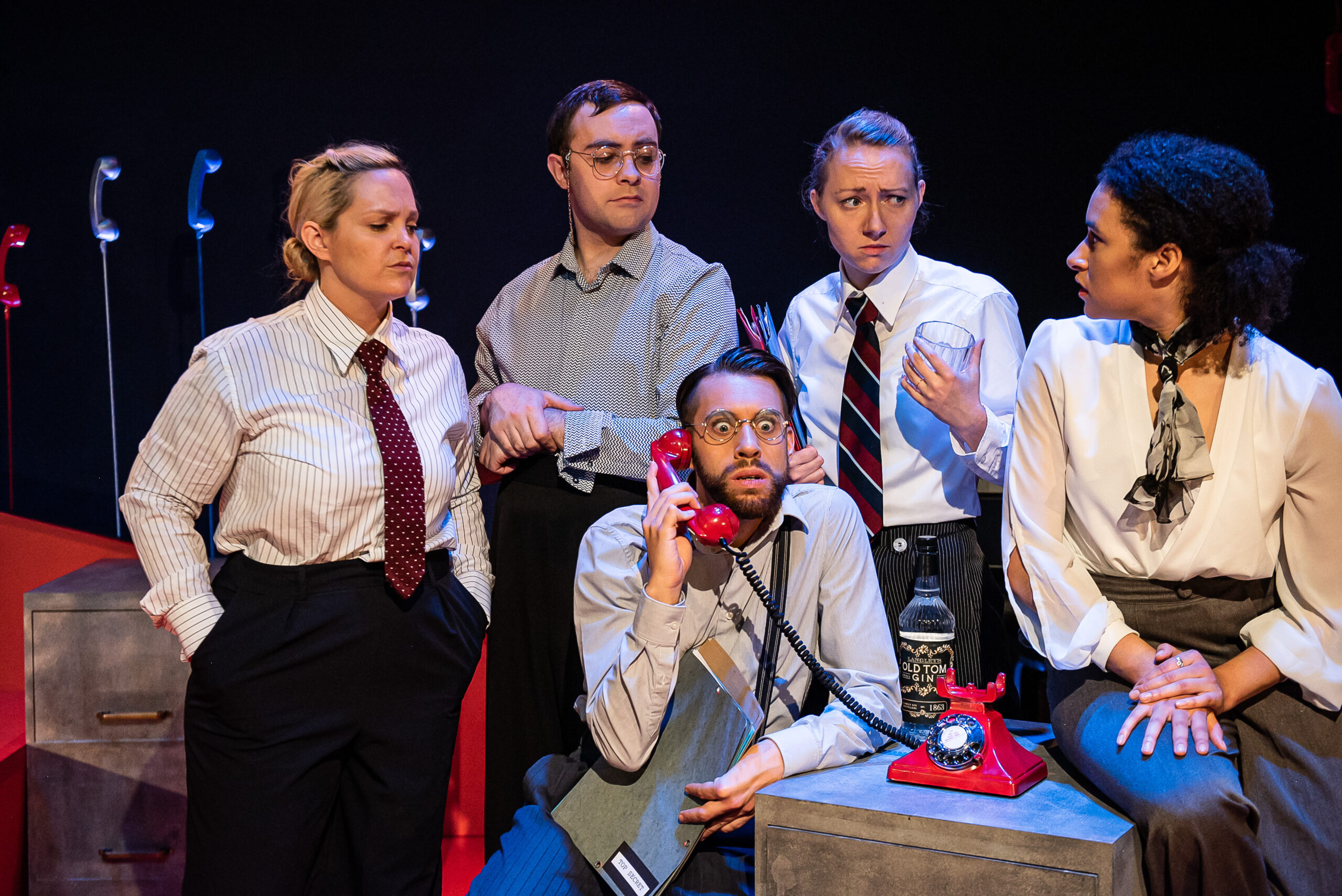
The cast of Operation Mincement, a stage musical at the Fortune Theatre in London. Three actors are standing, one is sitting on a desk, the fifth is seated holding a phone.
Zoe Roberts, Jak Malone,, David Cumming, Natasha Hodgson & Claire-Marie Hall in Operation Mincemeat. Photo: Matt Crockett

Many of the routines seem like classic comedy- music hall even. For example, there’s a scene where all five are exchanging and getting tangled in hats, phones and a briefcase, with clockwork precision. And there are moments of stage magic when they change characters and costumes in the blink of an eye.

The cast are greatly aided by having director Robert Hastie and choregrapher Jenny Arnold on board. Both are highly experienced and it shows in the slickness of the production. And yet Operation Mincemeat retains the feel and excitement of a fringe show. The theatre is one of the smallest in the West End with a stage to match.  Ben Stones‘ set is deliberately sparse with a couple of desks and chairs, a display board and a mobile staircase, plus a backdrop reminiscent of a map, and, that staple of farces, lots of doors. Until that is, we launch into a very non-fringe-like finale, complete with glittering Nazis, which really is as ‘glitzy’ as they announce.
The songs cross a number of musical genres, with clever, witty lyrics that are often delivered at the sort of breakneck speed that may remind you of Gilbert and Sullivan or Frank Loesser. How about this?
If we cannot storm the beaches / It’s sure to spell defeat / If the muscle-men can’t do it / Call the masters of deceit.
In a way, there is a parallel between the small MI5 team that pulled off this unlikely deceit that helped an invasion, and the small group that created this unexpected hit that invaded the West End. It is an incredibly polished, laugh-out-loud musical, and one that deserves to run and run.
Operation Mincemeat is at the Fortune Theatre until at least 4 November 2023. operationmincemeat.com
Paul paid for his ticket.
Visit our YouTube channel: Theatre.Reviews With Paul Seven (3200+ subscribers; 450,000+ views)
Website: theatre.reviews

Tel 07946 981733

Dear England – National Theatre – Review

Joseph Fiennes hits the back of the net as Gareth Southgate

★★★★★

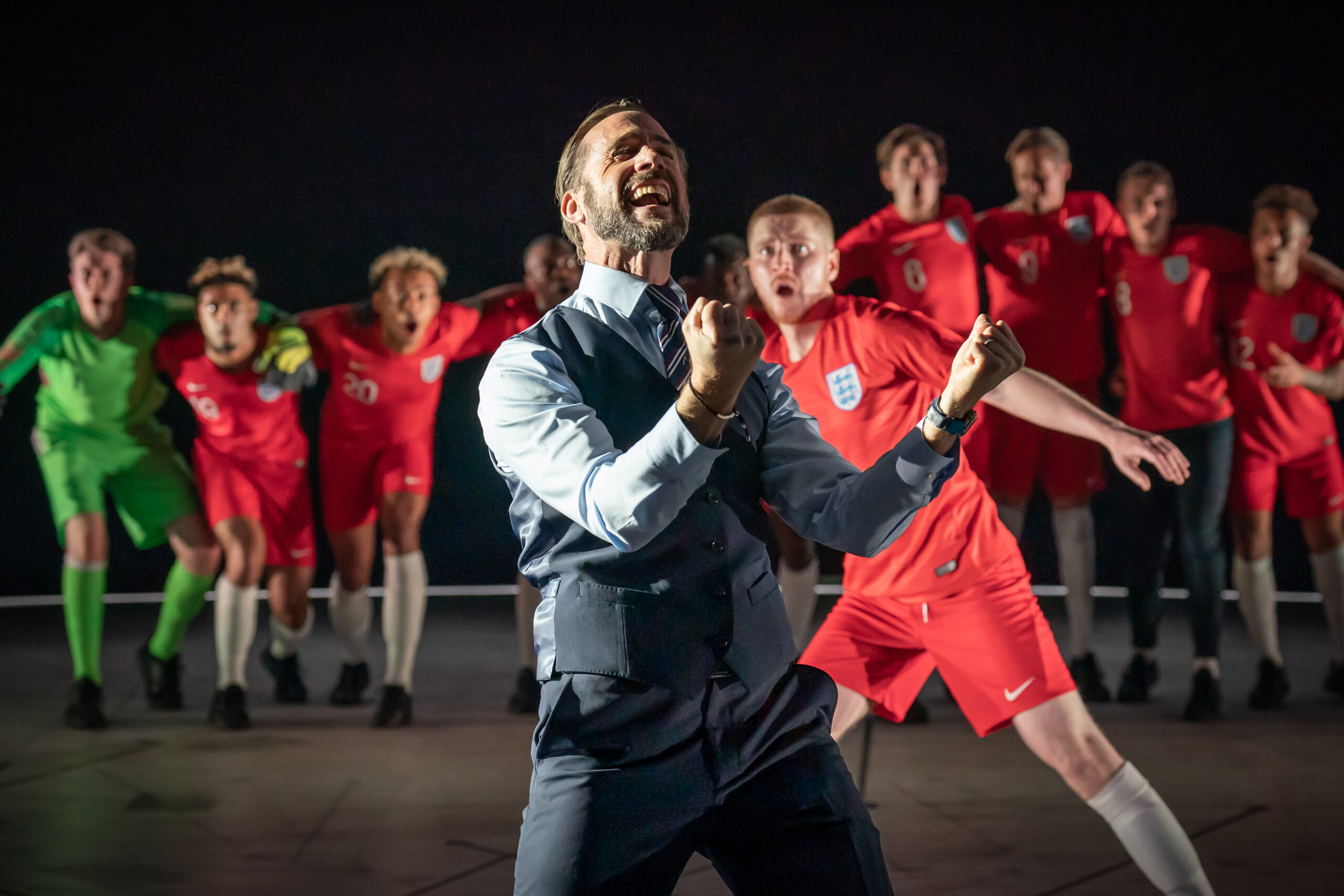
Joseph Fiennes playing Gareth Southgate in front of actors playing footballers in the National Theatre production of Dear England in June 2023
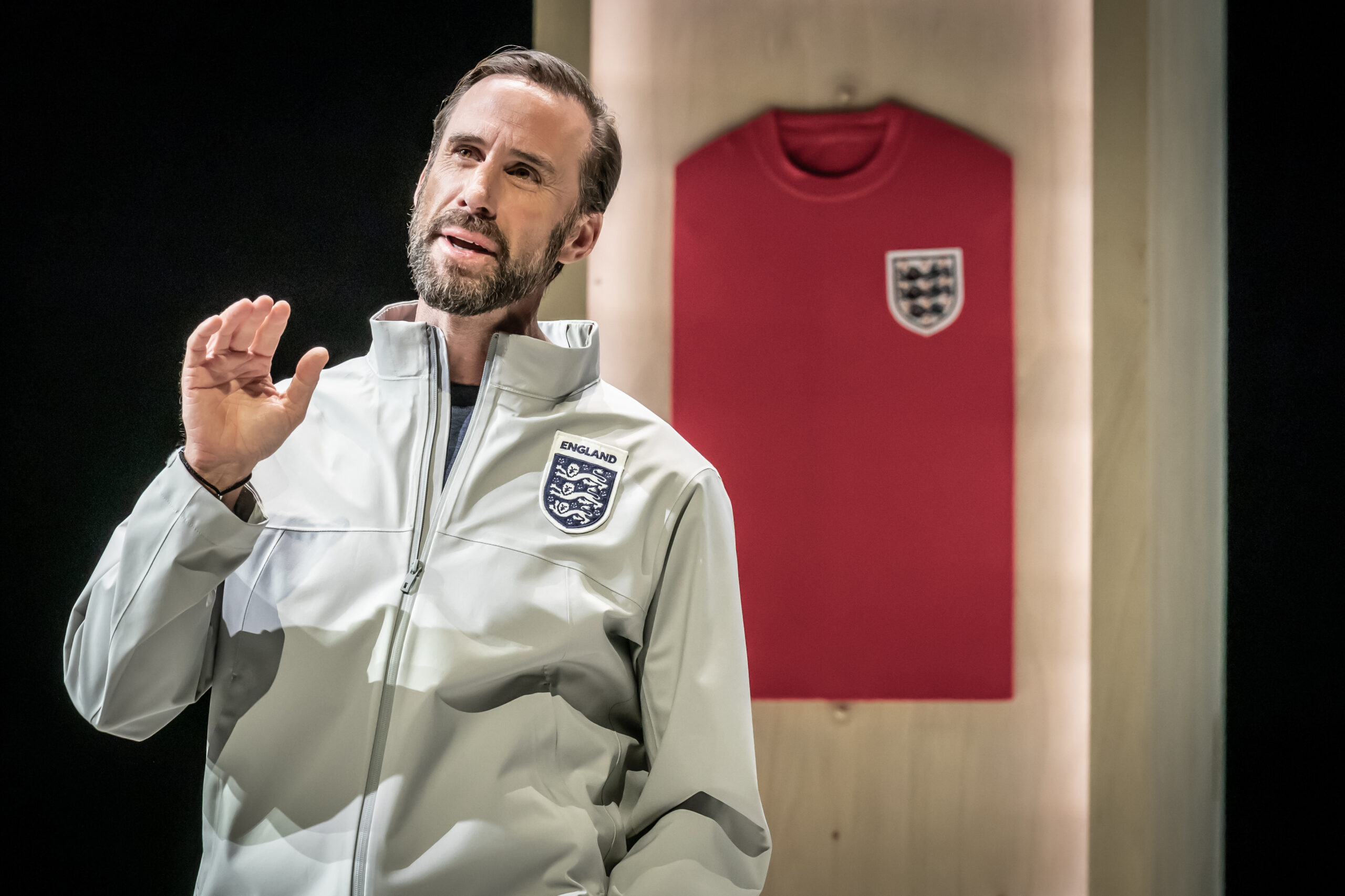
Joseph Fiennes and company in Dear England. Photo: Marc Brenner

You might think if you’re seeing a play about the manager of the England men’s football team, you need to know about football. You don’t. There’s hardly a football in sight. Dear England is the story of a clash of cultures rather than a battle between teams on the pitch. It tells the story of how a self effacing nice guy tries to change the culture of a macho group that is paralysed by fear. In the process it provides us with a lot of comedy, as well as some thoughts about the state of the nation

I know next to nothing about football and that actually helped when I saw Dear England because I was probably more excited for not knowing the outcome of some of the matches than if I’d known what was going to happen. But the thing is, it’s not really about the results. I think we all know England didn’t win the World Cup last year. Or even the Euros the year before. Or it would have been all over the front pages, because one thing we do know is how important England the football team is to a significant part of England the nation.
James Graham has built Dear England around the idea that the team is a microcosm of the country.  One other footballing event we probably know about is the infamous missed penalty, the one taken by Gareth Southgate back in 1996 that meant England lost to Germany in a Euros semi-final.

It’s a failure that hangs over him throughout this play, because, for some reason, it has come to symbolise the moment when everybody realised there was something rotten at the core of the England team.

That’s where we begin. Rupert Goold’s production takes place sandwiched between the glare of two harsh neon circles, one above and another at stage level, recreating the feel of a stadium but also emphasising the pressure on the players of being in the middle of a pitch and indicating the magnifying glass focus of a nation’s expectations. On the stage floor are a mass of dotted lines and arrows of the kind that show attacking manoeuvres.

On stage are cubicles through which people enter and exit, symbolising perhaps the changes that take place in cubicles but also in a practical way cutting down the immense distance from the actual wings where actors appear and disappear. It is an imaginative and effective use of the Olivier’s large thrust stage by designer Es Devlin and lighting designer Jon Clark.

There’s a quick run through of a succession of England managers, who in amusing cameo impressions have plenty to say about their management style and why they have failed. Until eventually, Gareth Southgate takes over and, in his reticent way, asks why, with some of the world’s best players, they are not a winning team. He concludes it’s all in the mind.

Joseph Fiennes in Dear England. Photo: Marc Brenner

So he calls in a psychologist Pippa Grange. And this is where the fun begins. Well, actually it’s already begun when Mr Southgate (Call me Gareth) first meets his coaching team. Played by Joseph Fiennes, this is not simply an impressionist’s turn, although I’m guessing his mannerisms- the looking down, the pointing when he agrees with somebody, the precise use of language, the slightly nasal tone, the nervous grin, are all reasonably accurate.

What we get in an outstanding performance is a rounded character who admits he doesn’t know everything, who listens, who isn’t confrontational, who doesn’t shout (I have heard of another famous manager’s hairdryer treatment) but who ultimately has a steel resolve. We realise that when he lets players go or when he stands up to racism.

Or when he meets Mike, the assistant he has inherited. I think this character has been invented to represent the antithesis of Gareth. He is a blustering ‘man’s man’, who has no time for losers or psychology and woke thinking. Played hilariously by Paul Thornley, he is red-faced and always on the brink of boiling over. Gareth lets Mike have his rant, and then ignores him.

I think we must assume that Mike and the new senior assistant coach Steve Holland, brought in by Gareth, continue to support the schooling of the players in physical training and tactics elsewhere, while the work on their minds takes place in front of us.

I only saw one football for the whole length of the play. Probably just as well because they are actors. I mean they’re physically fit and go through some balletic movements, thanks to movement directors Ellen Kane and Hannes Langolf, but they wouldn’t have convinced as professional footballers if they’d tried to kick a ball. In fact a feature of Rupert Goold’s direction is constant, feverish movement, heightened by the regularly turning stage.

Together Gareth and Pippa work on moving the team away from being individuals whose loyalty is to their club to a team who know and support one another. And away from people who bottle up their feelings to ones who are open about their emotions. And most importantly, away from a fear of failure to embracing and learning from it (echoing Samuel Beckett’s ‘Fail again. Fail better’).

There is immense enjoyment is in seeing the players gradually change from resistance to embracing the new approach- as well as each other. Near the beginning, Gareth tells his squad that it will be a long haul to victory, like a three act play. You could feel the sigh of relief from the theatre lovers that he was finally talking their language.

Apart from Gareth Southgate and to an extent Pippa Grange, all the other characters are caricatures. It is James Graham’s style in his many plays and TV dramas based on real people to create the truth of a person’s character through humour rather than a nasty or saintly portrait. You may remember his Brexit: The Uncivil War, Tammy Faye, Ink, Best Of Enemies, Quiz or This House. In this play, James Graham can’t resist introducing our recent prime ministers- all trying and failing to score.

So good, so good, so good

I can’t say how accurate the portrayals of the players are but I did end up feeling for them. England captain Harry Kane, as portrayed by Will Close, is barely articulate but seen to inspire the others through his lack of ego and a simple confidence in his ability. Josh Barrow’s goalkeeper Jordan Pickford is gloriously hyperactive.
Darragh Hand’s Marcus Rashford stands out as a young man from a deprived background with a bit of a chip on his shoulder who is inspired to become an enthusiastic leader. Adam Hugill is the solid defender and plain speaking Yorkshireman Harry Maguire.

It’s such a good cast that it’s hard not to mention everybody. I must pick out Gunnar Cauthery who gives us terrific impressions of a wisecracking Gary Lineker, a cool Sven-Goran Eriksson, a blustering Boris Johnson and a sanguine Wayne Rooney. And Crystal Condie who does the same for ex-footballer and now commentator Alex Scott and Theresa May.

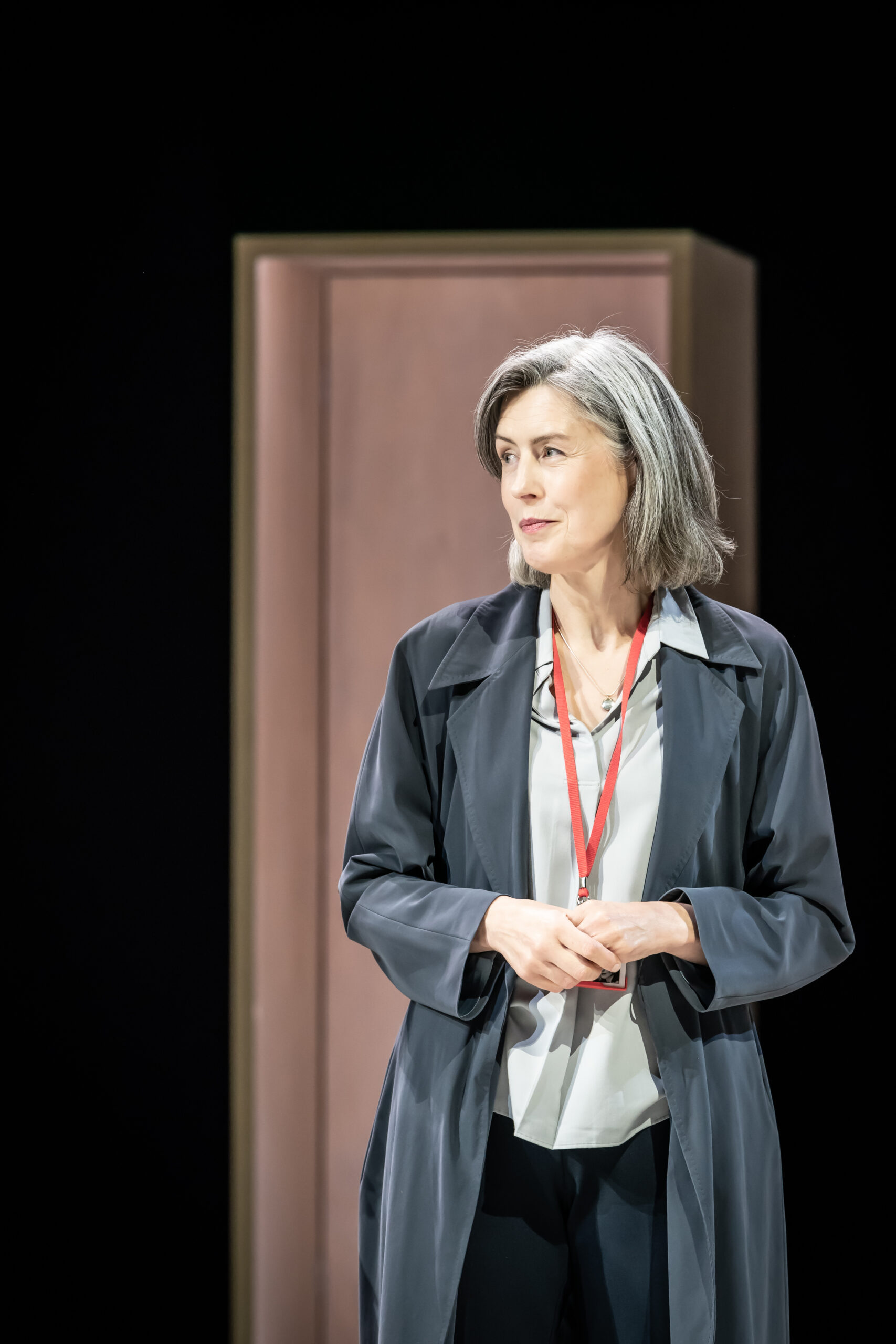
Gina McKee in Dear England. Photo: Marc Brenner

I haven’t said enough about Gina McKee whose twinkling eyes and turned-up corners of the mouth are like the smile of a tiger, and whose soft northern vowels sugarcoat a hard centre. She made the most of a part that seemed to me slightly superficial, but this may be because Mr Graham didn’t want to distract too much from his main character.

The idea of someone coming to a football club and creating a successful team by getting them in touch with their feelings and believing in themselves may make you think of Ted Lasso. Both shows clearly touch the zeitgeist of the 21st century.

But unlike the Apple TV hit comedy, Dear England explores some big issues. At the beginning, the expectations the nation has of its team reflect the nation’s view of itself. The fans are steeped in a history of England as the birthplace of football, as the winners of the 1966 World Cup, as the home of the finest league football. The team should have success on the world stage by right. If it doesn’t, the frustration leads to riots.

Although this is not explicitly stated, I would be surprised if Mr Graham doesn’t intend a parallel with England the country, which historically once ruled half the world, invented so much, and won World War 2, leading many of its people- at least an older generation- to expect that the country should by rights be a successful world power.

‘Believe in people, care about people, be kind’ is Gareth Southgate’s message to the new generation of England players but it is also a vision of the kind of nation England is in the new century or, at least, can be.

I was caught up in this journey and moved by its outcome, and loved being in a National Theatre audience singing along to Sweet Caroline.

Dear England can be seen at the National Theatre in London until 11 August 2023.

Paul received a complimentary review ticket.

Click here to watch this review on the YouTube channel Theatre.Reviews With Paul Seven

Retrograde- review

Must-see new play by Ryan Calais Cameron with rising star Ivanno Jeremiah

★★★★★

Ivanno Jeremiah standing hands in pockets in the Kiln Theatre production of Retrograde by Ryan Calais Cameron
Ivanno Jeremiah in Retrograde. Photo: Marc Brenner

Retrograde, receiving its premiere at the Kiln Theatre in Kilburn London, is a tense, passionate play about racism and censorship, featuring a dynamite performance from rising star Ivanno Jeremiah. It is written by Ryan Calais Cameron, who recently achieved a West End hit with For Black Boys Who Have Considered Suicide When The Hue Gets Too Heavy. Thank goodness his new play has a shorter title!

Set in 1955, Retrograde describes Sidney Poitier’s early days in the film industry when he came up against racism and the so-called Hollywood blacklist which aimed to ‘cancel’, as we might say today, anyone with so-called anti-American views.

Sidney Poitier was a fabulous actor at a time when segregation was still legal and black performers were largely playing servants. We find him on the verge of getting a leading role. His experience could be that of anyone finds their career threatened because they want to exercise their right to free speech, or indeed anyone who has been asked to compromise their integrity for the sake of a job.

How, as an actor, do you play one of the greatest actors of all time, especially one with the added value of charisma? The challenge for Ivanno Jeremiah is made even greater because the play begins with a young writer Bobby and a long-established Hollywood lawyer Mr Parks discussing Sidney Poitier’s great qualities, thus building up the anticipation. Add to which, Mr Jeremiah looks nothing like Mr Poitier.

It doesn’t matter. He makes us believe he is Sidney Poitier. When he enters, there is the kind of still centre, the confidence, the relaxed style, the impeccable American English that he learnt to disguise his Caribbean accent, all of which were such a part of Poitier’s appeal. When he’s on the stage it’s hard to look anywhere else, excellent as the other two actors are. 
This is a play about the racist treatment he received, the torment of having to make a decision between his principles and fame and fortune in the film industry. As it becomes clear to Sidney that he isn’t there simply to sign a contract that recognises his talent, Mr Jeremiah’s startled eyes and slumping body portray confusion, nervousness, vulnerability, and even panic. It’s a monumental performance that marks Ivanno Jeremiah out as one of the great actors of his generation.
But even the greatest actors need words put in their mouths. Writer Ryan Calais Cameron has intentionally evoked those great scripts from the golden age of Hollywood. The play sparks with fast rhythmic exchanges, verbal dexterity and passion.
There is also a great deal of humour, lots of it bouncing around Mr Parks, although this tails off as the seriousness of the situation grows. When Bobby asks Mr Parks: ‘What do you think of me, be honest’, Parks replies: ‘I never think of you’. Here’s another Parksism: ‘If your phone doesn’t ring, it’s me.’ My favourite funny line was said about him: ‘Your ass must be pretty jealous of your mouth with all the shit that’s coming out if it.’
Mr Cameron builds the tension as if stretching a rubber band until you feel it must break.  If there is a fault in the play, it would only be that it is prolonged a little too much at the end, as we wait for Sidney’s decision, although this is redeemed by a couple of powerful polemic speeches from him.
There is also a conflict between the other characters, who represent two kinds of white people of that time- and probably modern times. Bobby is a writer and Sidney’s close friend. Played by Ian Bonar, he represents the white liberal who believes in equality and is anti-racism, but hasn’t himself been the victim of racism.  His early statement ‘I’d jump a bullet for that guy’ proves wanting when tested against threats from Daniel Lapaine’s frightening Mr Parks.
He’s there to oversee Sidney’s signing of the contract to play the lead role in Bobby’s TV movie. But he wants more. The studios, and as it turns out other powerful forces, want Sidney, as a tame black star. So he is required to sign an oath of loyalty to the United States and to denounce Paul Robeson, at that the highest profile black actor and an activist in anti-racism and pro-communism campaigns.
To give you some context, at this time many Americans were frightened of both communism and of the rise to power of black people. Hollywood had become the focus of these fears and many actors, writers and directors were blacklisted. This meant they were prevented from working, because they were communists, or simply insisted on their right not to talk.
And if it seems incredible to us today that this could happen in the USA, a country in which the first amendment to the constitution protects freedom of speech, and in which being a member of the communist party wasn’t actually illegal, I suppose we ought to ask how many people today, and maybe still black people in particular, are being careful about what they say for fear of offending the left or the right or some other powerful group and thereby not getting work in the creative industries. I may be wrong but I imagine the play is called Retrograde because Mr Cameron thinks we’re taking steps backward at the moment.
Mr Parks represents fascism, with its denial of facts, its bullying, its call to patriotism and its identification of those that disagree as enemies of the state. Mr Cameron makes little attempt at subtlety but that doesn’t stop Mr Parks’ words and his shark-like smile sending a chill down your spine.
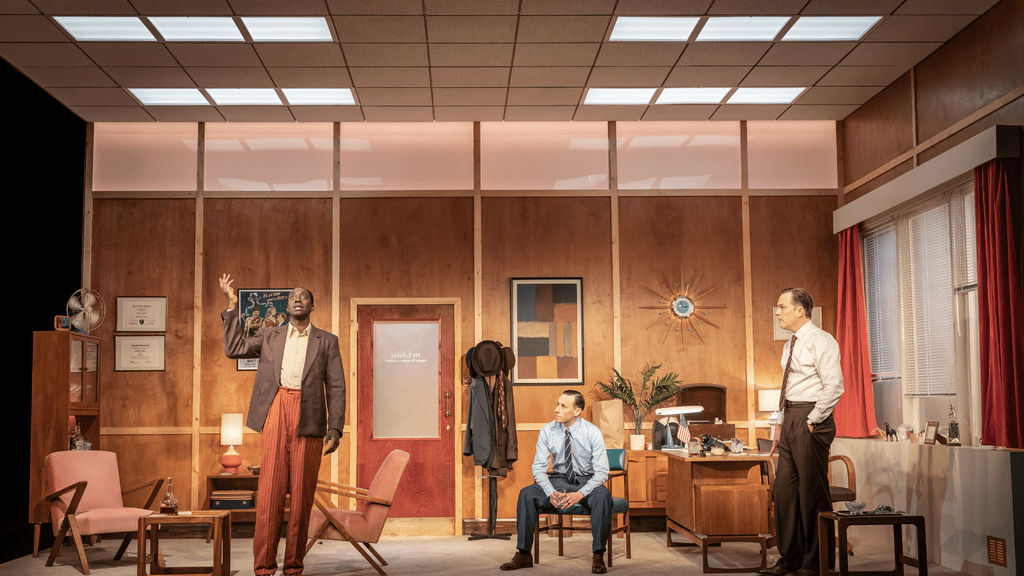
Set depicting a 1950s office with three actors in Retrograde at the Kiln Theatre
Ivannop Jeremiah, Ian Bonar and Daniel Lapaine in Retrograde. Photo: Marc Brenner

Director Amit Sharma does a great job at maintaining the tension through what is one real-time 90-minute scene. I am guessing that Mr Sharma is responsible for the way clothes and furniture play an important part in the production. All three men wear hats, jackets and ties, as was the fashion then, although Sidney’s clothes are much brighter than the others’ plain suits. Early on, Mr Parks bullies Sidney into taking off his tie, thus establishing superiority over him, just as he forces whisky on him. At various points, the level of tenseness is reflected by hats and jackets being taken off or put on.

The set is a naturalistic, convincingly 1950s office, designed by Frankie Bradshaw, whose imaginative versality and eye for detail have been responsible for Blues For An Alabama Sky at the National, her award-winning Donmar and West End production of Sweat, and Kiss Me Kate in the cramped confines of The Watermill. The creation of two areas, one of comfortable chairs, the other a desk and more formal seats, allows for continuous movement around the stage. Placing the rectangular platform on which the set is built at an angle to the stage floor, adds to the taut situation.
To sum up: an unforgettable performance by Ivanno Jeremiah in an electrifying play by Ryan Calais Cameron. It thoroughly deserves a West End transfer.
Finally , a quick word about The Kiln. I’d not been there before, not even when it was called the Tricycle. It’s a theatre for the local community in Kilburn, and what a lucky community they are, because it has been the launch pad for many new plays, including, in its early days, Return To The Forbidden Planet, and more recently Moira Buffini’s Handbagged and Florian Zeller’s The Father.  You can easily get to it via the Jubilee tube line and it’s a welcoming, comfortable place to see a show.
Retrograde can be seen at the Kiln until 27 May  2023. It transferred to the Apollo Theatre for a limited run until 14 June 2025
Paul paid for his ticket 

Pride & Prejudice* (*sort of) – review

The Funniest Show in The West End


★★★★

Production shot featuring the cast of Pride asnd Prejudice Sort Of at the Criterion Theatre London
Pride & Prejudice* (*sort of) at The Criterion

Some critics have acclaimed Pride & Prejudice* (*sort of) as the funniest show currently in London’s West End. I was late seeing this little gem at The Criterion, but I can’t disagree.

It is an outstanding achievement by Isobel McArthur. She not only wrote it, with a little help from Jane Austen, she also co-directed it with Simon Harvey, and stars in it.

What’s particularly clever about her take on Pride & Prejudice is that, although it’s a spoof, it is extremely faithful to the story.  Much of the comedy derives from the same situations that are funny in the book, and it is, at key moments, quite moving. I was surprised at how touched I was by the ending.
So, she has paid homage to the qualities of the story and some of the dialogue, while extracting a great deal more lol.

It’s funny before it even starts, when we’re presented with the concept of five modern working class women playing early 19th century maids who recreate the story with makeshift costumes and props. So we have the bathos of this classic story and its characters being presented from today’s perspective. There’s 21st century language, including a lot of swearing: Darcy is described as a ’twat’ (and that’s one of the milder insults). Elizabeth tells Mr Collins exactly what he can do with his marriage proposal. So, there’s the shock of seeing Jane Austen’s reserved characters, who normally use sensitive language, mouthing expletives. But there’s also the anachronism of party food at a ball being Pringles and Wagon Wheels.

Is there no end to Isobel McArthur’s talents?

Of course, the basic material is great. Pride & Prejudice is not only Jane Austen’s most popular work but one of the most read novels written in the English language. That’s thanks in no small part to the character of Mr Darcy, played over the years on screen by Laurence Olivier, Colin Firth and Matthew McFadyen. To that pantheon, we can now add Isobel McArthur.

There have been many excellent takes on Pride & Prejudice, like Lost In Austen, Bridget Jones’ Diary, Pride & Prejudice & Zombies and a Bollywood musical Bride & Prejudice. It is without question a crowded market, but Pride & Prejudice* (*sort of) manages to stand out.

To add to the enjoyment, it’s actually a musical comedy. The story is interspersed with moments when the characters grab a microphone and sing classic romantic pop songs like Will You Still Love Me Tomorrow, Holding Out For A Hero, Young Hearts Run Free and You’re So Vain (about Darcy of course). And Lady in Red, a song by Lady Catherine de Bourgh’s relative Chris de Burgh! It’s tremendous fun, a bit like karaoke at a hen night.

The cast of five take on all the parts. Isobel McArthur is a wonderful Darcy. She conveys very well the stiff reserve that conceals a romantic heart. In addition, she plays an even more coarse than usual Mrs Bennet. Tori Burgess creates a truly obnoxious Mr Collins, Christina Gordon plays Lizzie’s sister Jane and the appalling Lady Catherine de Bourgh.

There were two understudies on the night I saw it, which is par for the course at the moment in theatre, mainly because of the Covid. I had been looking forward to seeing Hannah Jarrett-Scott and Meghan Tyler who are both highly experienced actors and were very well reviewed. However Annabel Gordon did well as quietly desperate Charlotte trapped in her hellish marriage, as well as playing the soppy Charles Bingley. Leah Jamieson acquited herself well as the strong-willed but annoyingly self-satisfied Elizabeth Bennet.

Sometimes the characters are too much of a caricature and I did expect, having set the idea in motion, that the play would give us more of the maids’ angle on events than it actually did. But it is rich in ideas and displays non-stop creativity.

I particularly liked the moment when Elizabeth looks at a painting of Darcy and Isobel McArthur slides behind the empty frame to pose as the portrait, whose eyes then follow Lizzie round the room.

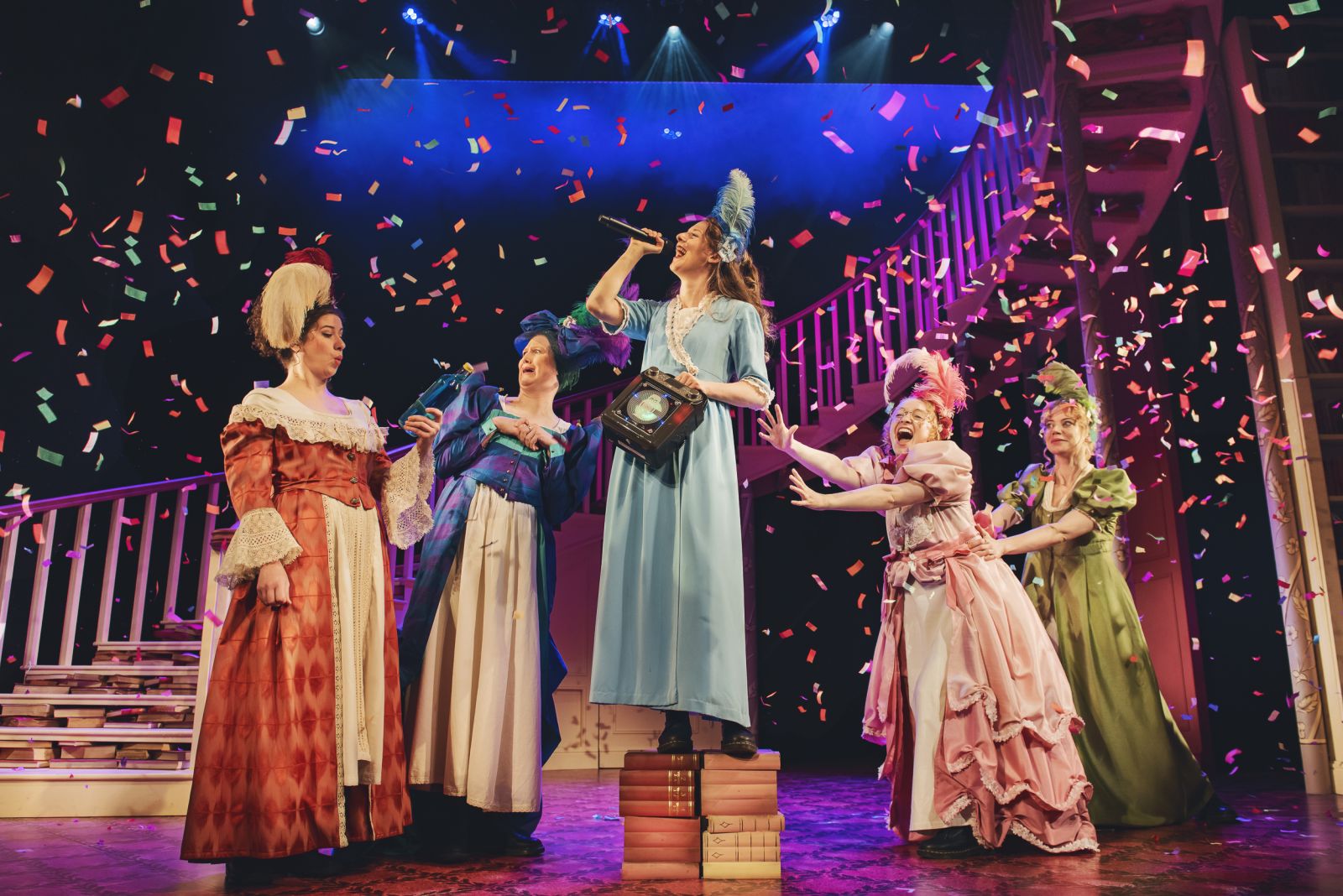
There is one simple set, designed by Ana Inés Jabares-Pita, that suggests a rich household, not dissimilar in décor to the lovely Criterion Theatre, using minimal props, and with books as a motif. It features a magnificent centrepiece of a wide staircase that winds all the way up to the flies, with steps supported by books.

This is a light hearted and lightweight play. It doesn’t have the depth of Laura Wade’s Austen inspired comedy The Watsons, which I saw at The Menier, and which was due a West End transfer before Covid struck. Nevertheless, it’s just what you need to cheer you up in a year that has started as depressingly as the last one ended.

Covid is scaring audiences away from theatres, which is a shame, because this is a show that should be selling out, and looking forward to a long run, rather than closing prematurely. I recommend you to see it while you can.

Pride & Prejudice* (*sort of) is performing at the Criterion Theatre in London until 6 February. An autumn 2022 tour is planned with a possible return to London in 2023.

Click here to watch this review on YouTube


The Mirror And The Light – review

Hilary Mantel and Ben Miles provide a fitting end to a great theatrical trilogy.

★★★★

Production photo of Ben Miles and Nathaniel Parker in The Mirro And The Light at the Gielgud Theatre London
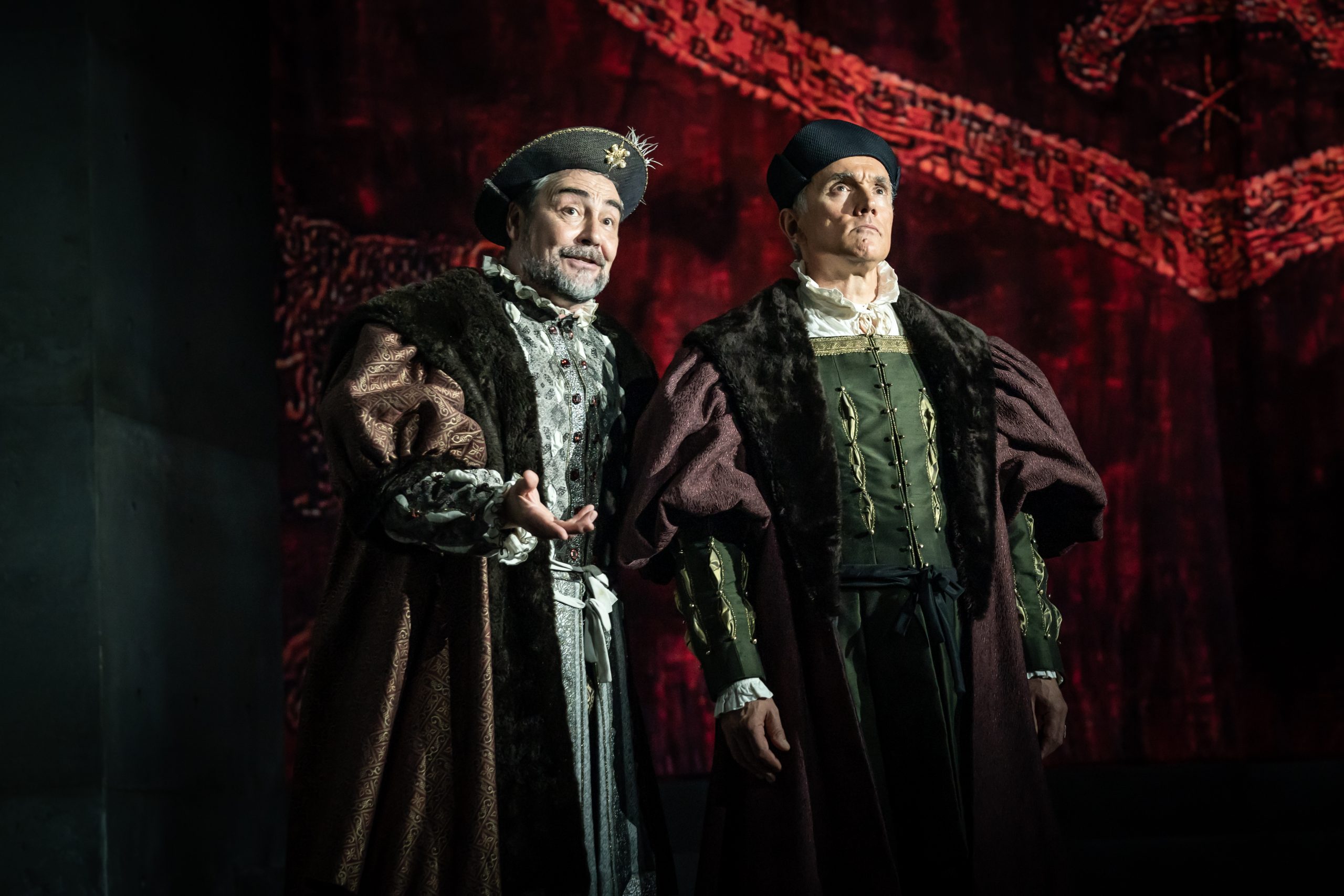
Nathaniel Parker and Ben Miles in The Mirror And The Light

It’s a few years since the Royal Shakespeare Company‘s outstanding stage versions of the first two books in Hilary Mantel‘s trilogy about the rise and fall of Thomas Cromwell.  At last, we arrive at the final volume The Mirror And The Light. So did episode three reach new heights or fall from grace?

Just in case you don’t know your history or haven’t read the book, we begin with Cromwell in prison, his fate already sealed. We see who his enemies are and who among his allies has betrayed him.

The prison set is dark and foreboding with high steely grey walls, designed by Christopher Oram. Then we go back in time to when Cromwell was still riding high, and, with a jolt, we realise the court is almost identical to the prison.
Even the King is trapped by what is required of his position but the rest are prisoners to his whims, as well as constantly vulnerable to enemies in the court.

The story of Cromwell’s fall then plays out and is more, not less, tense for our knowing the fate that awaits him. This is not a simple adaptation of a novel. It is a gripping piece of theatre, as if writers Hilary Mantel and Ben Miles have taken the story of Cromwell and written a play about it from scratch.

So we’re not inside Cromwell’s head, as in the book, but rather witnessing this central character’s interaction with those around him, showing how others see him and how he works the court. We see the fragility of his power and his own awareness of his vulnerability.

Jeremy Herrin’s production feels Shakespearean

The play feels Shakespearean, and under Jeremy Herrin’s direction, it looks like a traditional production of one of the history plays, with everyone looking like they’ve stepped out of a painting by Hans Holbein. The language while not as poetic has an Elizabethan style, but also pace and a natural flow. The resemblance to modern day politics or even office politics is striking.

Cromwell, hated by his fellow councillors and by the people, is dependent on the goodwill of the King. British prime minister Harold Macmillan said the greatest challenge for politicians was ‘events, dear boy, events.’ So it proves for Cromwell. A mishandled northern rebellion, the death of Jane Seymour, a disastrous marriage to Anna of Cleves and the king begins to have less faith in his right-hand man. It’s all his enemies need, chief of which is the Duke of Norfolk, played by Nicholas Woodeson as a little weasel of a man, who resents the rise of a blacksmith’s boy above his ancient aristocratic family, and takes every opportunity to bring about his downfall.

Cromwell is always either on stage or being discussed. He is not exactly a good man, actually he’s a greedy manipulator, but he comes across as honourable, at least by the standards of the day, and compassionate, for example to Princess Mary, in a way that few of the others do.

Ben Miles and Nathaniel Parker head a well chosen cast

Ben Miles‘ performance as this complex man- laughing, worrying, macho, submissive- his eyes constantly flicking round the room- is a tour de force.
Both he and the King are lonely at the top. Nathaniel Parker’s Henry, the mirror and the light of the title, is a capricious child in an oversized man’s body, self indulgent, self pitying, isolated. A telling moment sees him by alone, feeling the cold, desperate for the warmth of the fire.

With a cast of 24, this Royal Shakespeare Company production has an epic feel. And it is a well chosen, diverse cast, who are a compliment to the RSC’s casting director Helena Palmer.

Melissa Allan reveals the steel in Mary Tudor. You can see Bloody Mary waiting to emerge. Geoffrey Lumb as Thomas Wriothesley and Leo Wan as Richard Riche make you recoil at their sliminess. Terrique Jarrett as Cromwell’s son Gregory adds a bright presence, and Jordan Kouamé was moving as Cromwell’s ally Rafe Sadler, desperate to save him without offending the King. Matthew Pidgeon’s double act as the friendly ambassador Eustache and the vicious Bishop Gardiner was impressive.

Inevitably death hangs over this evening. The two most influential people in Cromwell’s life appear as ghosts:  his old mentor Cardinal Wolseley, played by a jolly Tony Turner, and his father, played with a spitting nastiness by Liam Smith.

I’m sorry if I’ve made the evening sound grim, it’s actually leavened with a great deal of humour. Paul Adeyefa brings much comedy as Cromwell’s faithful French servant Christophe. Nicholas Boulton is a Tigger-like Duke Of Suffolk, a friend to Cromwell in the sense of ‘with friends like these who needs enemies’. Jo Herbert is a cynical Lady Rochford. One of the funniest moments of the evening is when the new queen Jane Seymour, played as a likeable young woman by Olivia Marcus, complains to Cromwell about Henry’s unreasonable demands. An embarrassed Thomas, assuming them to be sexual, tries to coax more detail out of her, only to discover she is referring to the King wanting her to ride with him to inspect the fortifications at Dover.

After the rollercoaster of events leading to Cromwell’s arrest, the ending is downbeat. This is partly because Cromwell accepts his fate with dignity. Despite a dramatic beheading orchestrated by illusionist Ben Hart, it’s a  climax that didn’t leave me quite as shocked or drained as I expected. Nevertheless the play is a fitting conclusion to a fine trilogy.

The Mirror And The Light is due to run at the Gielgud Theatre until 23 January 2022. Tickets from delfontmackintosh.co.uk

Click here to watch the video of this review on YouTube


Theatre To Watch At Home

The Best Stage Shows Online or on TV

Let’s face it, for many of us, the only way we’re going to get to see some theatre in the foreseeable future is on a screen, either online or on TV. So here are the best theatre shows that you can watch in your own home.

All my recommendations come with a health warning. This is because films of stage shows rarely convey what makes theatre unique. Film can offer highly realistic spectacle whereas spectacle in a theatre requires more imagination. On the other hand,  its physical reality in the form of a massive set or two dozen dancing feet can be eyepopping, and the physical presence of actors performing in front of you creates a tension that can’t be replicated in a film where things are re-filmed and edited to predictable perfection. Also, what seems totally natural when you’re watching it- the louder voice, the bigger gesture- looks totally unnatural when you see it on a screen because the language of film is about small facial expressions in close-up and words delivered at conversational levels.

Experienced theatre goers can of course allow for this but I worry that people new to theatre will simply think how ‘stagey’ it all is.

Hamilton

Publicity photo of Hamilton
Hamilton. Photo credit: Joan Marcus

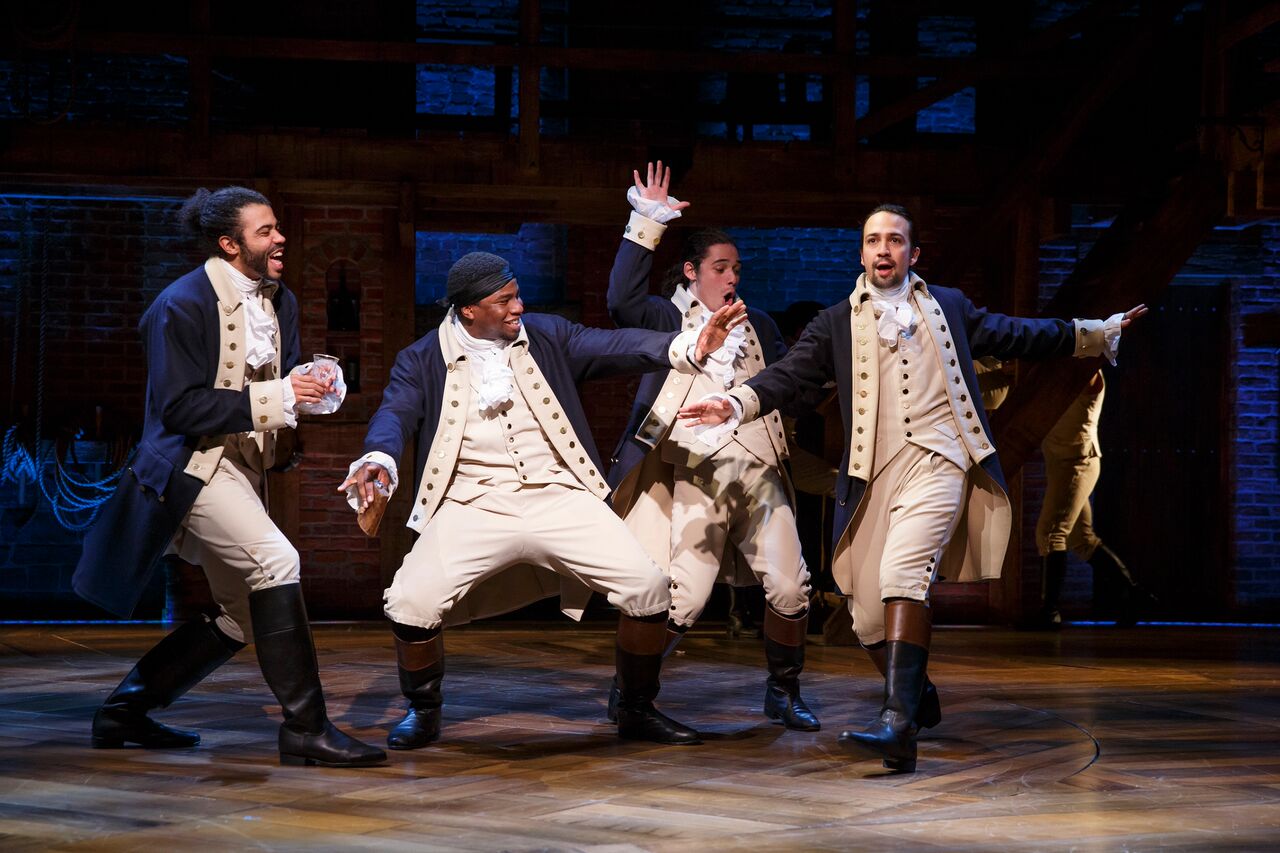
Top of my list is Hamilton. It’s one of my favourite musicals so disappointment at a film version was almost inevitable but, against all my expectations, the film of the Broadway show is a triumph. It remains a theatrical show but the music and movement carry you along. As a bonus, you get to see the original cast including Lin-Manuel Miranda. Even if you’re not interested in Toy Story and Frozen, take a month’s subscription to Disney Plus, just for Hamilton.

Uncle Vanya

Uncle Vanya on BBC4

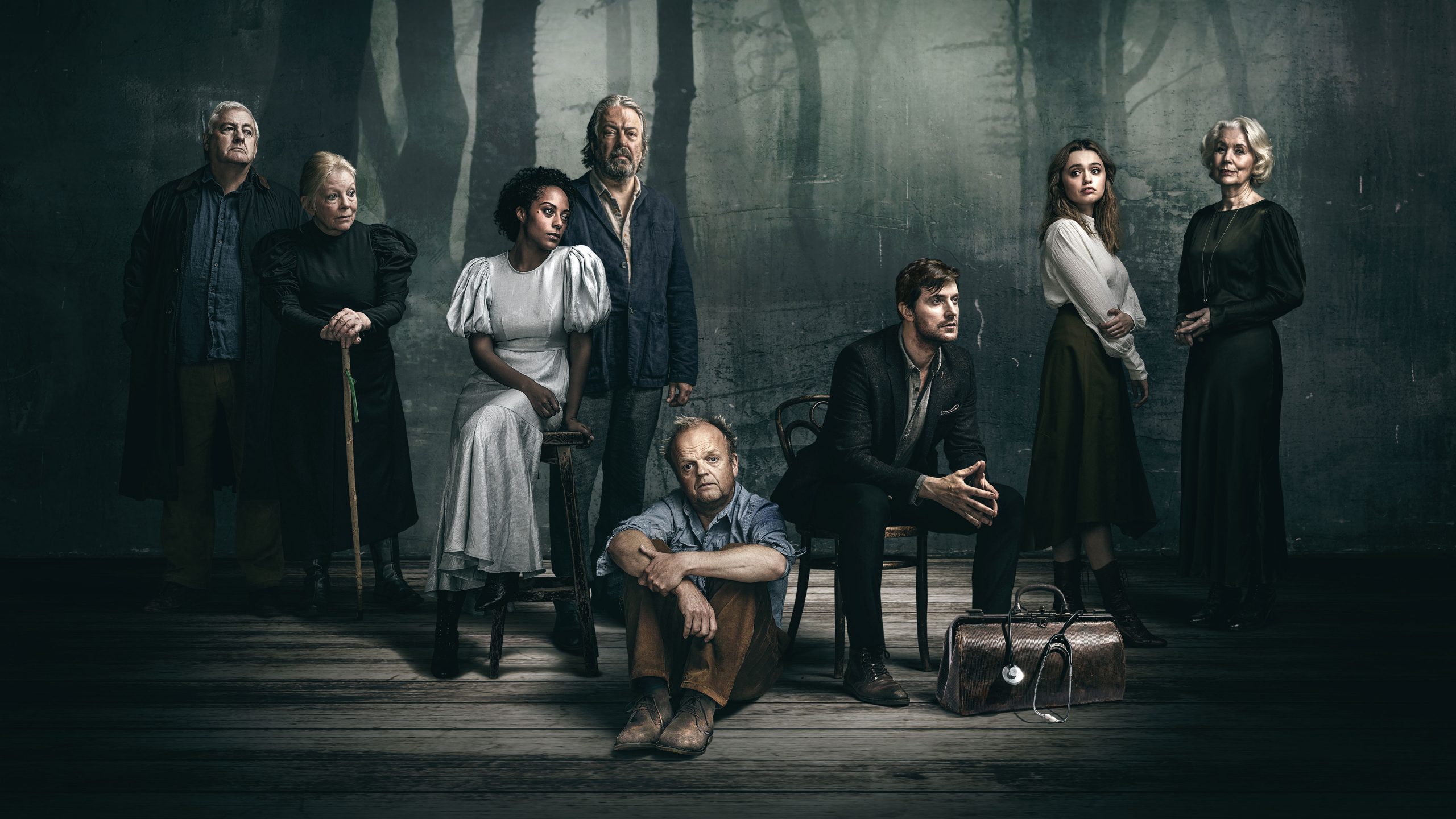
Uncle Vanya, Chekhov’s classic play about getting old and wasted time and unrequited love, sensitively modernised by Conor McPherson, was having a phenomenally successful run at the Harold Pinter Theatre when Covid cut it short. So the producers decided to film it and what we get is not simply the play filmed but a stage play enhanced by film. In some ways, because the cast can speak normally and to camera, it’s better than the original and that’s saying something of a production that got pretty much universal five star reviews. The leads Toby Jones, Richard Armitage and Roger Allam live up to the epithet ‘stars’. It’s on BBC4 at 10pm on 30 December and then I assume on BBC iPlayer.

Sea Wall

Frame from film of Sea Wall featuring Andrew Scott
Andrew Scott in Sea Wall

Sea Wall by Simon Stephens starring Andrew Scott is another stage play specially filmed without an audience. It’s a one man show in which the camera barely wavers from looking at Scott as he recounts a tragic event that engulfed him. It is devastating as a play and in no small part because of the visceral performance by Andrew Scott. and you can buy it for about £5.00. Find out more at seawallandrewscott.com

A Christmas Carol at The Old Vic

Andrew Lincoln in A Christmas Carol

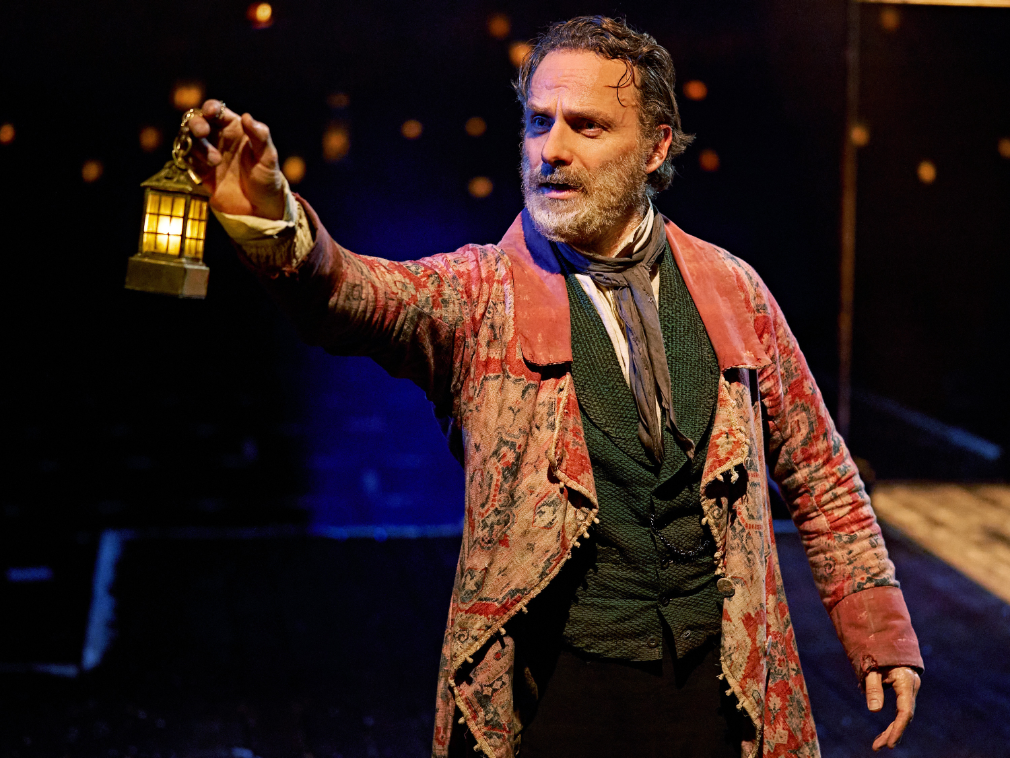
One of the most anticipated Christmas shows in recent years has been the annual revival of the Old Vic’s A Christmas Carol. This year’s Scrooge is Andrew Lincoln. I saw the show a couple of years and it was one of the most enjoyable evenings I’ve spent in a theatre. I was a little worried when I heard that the Old Vic were streaming it because the production relies so much on being an immersive performance where actors and props are coming at you from all directions. However what the Old Vic are doing, even though the theatre is closed to the public, is to continue to stage live performances until Christmas Eve and stream them. Again, like Uncle Vanya, they can adapt it for the camera. Some of the best bits of immersion, such as all the food flowing from the circle to the stage, can’t be conveyed, and some of the use of Zoom is clunky, but it’s still an uplifting experience. Tickets are available from oldvictheatre.com

Pantomime

Lots of enterprising theatres have made their pantos available online including the National Theatre’s Dick Whittington. It’s radical, it’s politically correct and rather garish but an excellent production. You watch Dick Whittington for free on their YouTube channel from 3pm on Wednesday 23 December, then available on demand until midnight on Sunday 27 December. More details here on the National Theatre website.

Peter Duncan in Jack And The Beanstalk

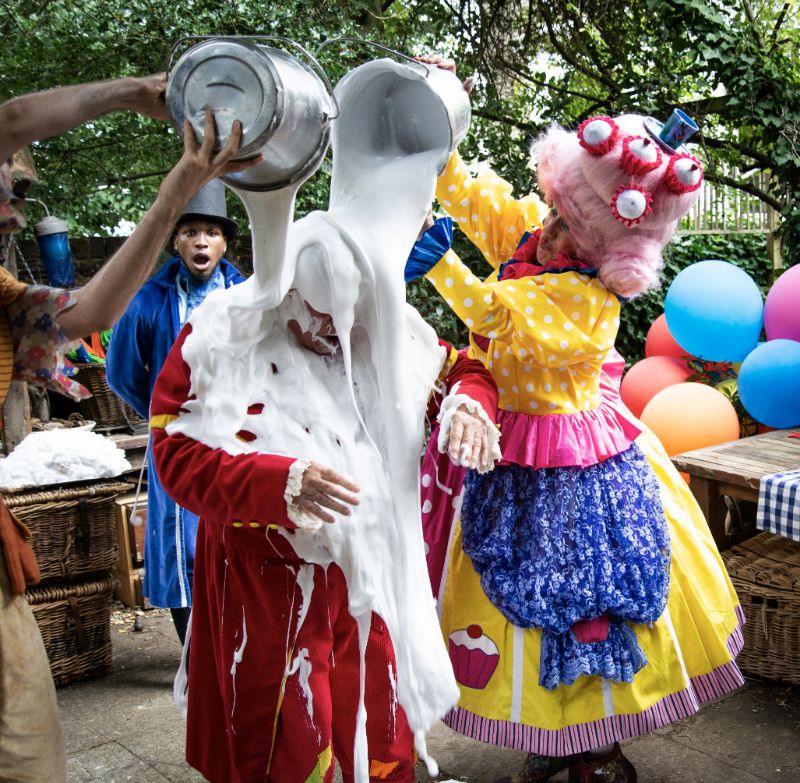
For me the panto to watch with the family this Christmas is Peter Duncan’s traditional Jack And The Beanstalk. He understands panto and does everything you’d expect from a panto, including lots of audience participation. It may be old fashioned in many ways but I found that rather comforting in these troubled times, like a Christmas pudding- and its saving the planet theme is bang up to date.

I’ll mention a couple more children’s shows that the whole family can enjoy. The Wind in The Willows with a script by Julian fellowes and an hilarious performance as Mr Toad by Rufus Hound can be streamed for £4.99 from willowsmusical.com  And you can watch the delightful Timpson The Musical in which gigglemug Comedy imagine how the high street cobblers came also to cut keys by portraying the warring houses of Montashoes and Keypulets united by a pair of star-crossed lovers. And that’s free on YouTube.

Streaming

Yerma starring Billie Piper at the Young Vic reviewed by Paul Seven Lewis of One Minute Theatre Reviews
Yerma starring Billie Piper at the Young Vic. Photo: Johan Persson

Lots of arts streaming services have been springing up this year, the biggest of which from a theatre goer’s point of view is NationalTheatreAtHome who are gradually making available their vast archive of productions. Right now you can watch Tom Hiddleston’s Coriolanus, Helen Mirren’s Phedre, Adrian Lester and Rory Kinnear in Othello, and for one month only War Horse (in the UK only). There are many more National Theatre productions and some by other theatres including the Young Vic’s Yerma. This is one of the best stage productions I’ve seen but I’ve no idea how it will come across on film, since the set involved viewing through a glass careen with the rest of the audience opposite, giving the effect of a fish tank. Still, it should be worth seeing if only for Billie Piper’s performance of a lifetime as the anguished would-be mother.. You can rent individual shows or take a monthly subscription at just under £10.

It’s True, It’s True, It’s True

Other streaming services worth looking at are digitaltheatre.com which hosts the excellent Sheridan Smith in Funny Girl, which I thoroughly enjoyed in the theatre) , Zoe Wanamaker and David Suchet in All My Sons, Richard Armitage in The Crucible, the Regents Park Open Air production of Stephen Sondheim‘s Into The Woods and Breach Theatre’s It’s True, It’s True, It’s True which is a funny but shocking dramatization of the trial of the man who raped painter Artemisia Gentileschi which turned into a trial of herself. That alone would be worth a month’s subscription of £9.99 but you can rent it as a single film for £7.99.

At Stage2View you can rent such treats as 42nd Street, Kinky Boots, An American in  Paris and Red starring Alfred Molina as Mark Rothko. Each costs £5 or so.

Amazon & Netflix

Ma Rainey’s Black Bottom (Netflix)

Finally, if you subscribe to Netflix, check out Ma Rainey’s Black Bottom, a film of August Wilson’s play which stars Viola Davis

Over on Amazon Prime, try Antoinette Nwandu’s play Pass Over. Inspired by Waiting For Godot, it’s about two men who are trapped by being black and persecuted by the police. It was filmed by Spike Lee in front of a live audience and Mr Lee knows how to make theatre work on film.

View Theatre To Watch At Home on YouTube

Hamilton – review of Disney+ recording

The best film of a live stage show I’ve seen

★★★★★

Publicity photo of Hamilton
Broadway production of Hamilton. Photo ©: Joan Marcus

Hamilton was filmed during the initial Broadway run. The recording of the live show was meant to saved for later but with theatres dark, the creator Lin-Manuel Miranda decided to make it available now. After some intense bidding, it was Disney+ who secured the rights.

So, these are the questions: If you’ve already seen Hamilton, is this film of the Broadway show worth watching? If you haven’t seen Hamilton, does the film do justice to the stage production? Finally, if you’re not interested in Frozen II and Star Wars, is it worth subscribing to the Disney+ streaming service just to see Hamilton?

The answers, in my opinion, are ‘yes’, ‘yes’ and ‘oh yes’. I’ve been quite critical of live recordings of large scale stage shows as removing the excitement of theatre while being too theatrical for film but, if anything, this is better than the stage show. Of course, you can’t being ‘in the room’ with live actors but here you’re able to appreciate every aspect of this great musical.  You can watch a dance sequence from the best seat in the circle, then see the faces of the performers as if you’re in the front row of the stalls.

It doesn’t harm that you get to see the first and quite possibly the best cast, including the writer Lin-Manuel Miranda as Alexander Hamilton. His character is driven to make a difference in the world at all cost to his personal life (“I’m not going to waste my shot”). He helps lead the American revolution, which is over before the end of act one, then is one of the founding fathers of the American republic. His single-mindedness makes him enemies leading to political fights that drive the second half. His flaws, as in any great tragedy, lead to his downfall. Thanks to the music, his story is told with excitement, passion, and humour.

There are two other characters who develop through the course of the show. Aaron Burr, beautifully sung and played by Leslie Odom Jr, is the narrator and ‘damn fool who shot him’ as he says of the end of his difficult friendship with Hamilton. He starts off uncommitted but, in a moment of tremendous excitement, realises that the important decisions are being made behind closed doors and he needs to be ‘in the room where it happens’.

Hamilton’s wife Eliza, played with poignancy and the sweetest voice by Phillipa Soo, changes from a love-struck girl through pain to a powerful woman.

There is an excellent supporting cast including Renee Elise Goldberry as Angelica, Eliza’s intelligent, sensual sister who is Hamilton’s love, if not lover. Daveed Diggs is the Marquis de Lafayette and later Thomas Jefferson, both larger than life and played to great comic effect.

The background is the birth of the United States and the midwives are immigrants or the offspring of immigrants. Hamilton himself is an immigrant from a poor background. To underline the point, a mainly non-white cast play the rebels and their musical numbers are Hip-hop, the music of the disadvantaged.

We’re always aware that we are looking back from today. This is emphasised by the use of a narrator and by other asides to the audience. ‘Who lives? Who dies? Who tells your story?’ is a question asked by the musical, because our view of history changes with each generation. Miranda has said that this is ‘the story of America then told by America now’. We notice the parallels with today. One song says: ‘Immigrants- we get the job done’ to a cheer from the audience.

Lin-Manuel Miranda‘s music is clever, subtle and catchy. It’s no wonder millions have bought the soundtrack who haven’t even seen the show. Hip-Hop dominates but he plunders other genres as needed. For example, when Jefferson returns from France, he sings a jazz song, thus showing that he not only missed the War Of Independenceshows but also a change in musical taste. The love songs exude the pain of love.

Hip-Hop is a terrific dance music and, in the poetic language of rap, Miranda has found the perfect form to tell a story and communicate the thoughts and feelings of his characters.

The original director of the Broadway production Thomas Kail directs the film which means he knows exactly what he wants to put across. Every change of shot, whether a close-up or the whole stage, seems to come at exactly the right moment. I never felt I wanted to be looking somewhere else.

The show looks great too, thanks to set designer David Korins and Paul Tazewell‘s costumes. What a clever idea to remove the female dancers’ voluminous dresses and show off their moves in 18th century underwear.

Well worth a month’s subscription to Disney+ and you get to see Frozen II as well.

Hamilton is streaming on Disney+. When theatres re-open, the British production can be seen at Victoria Palace Theatre, London.

Click here to watch this review on YouTube

×