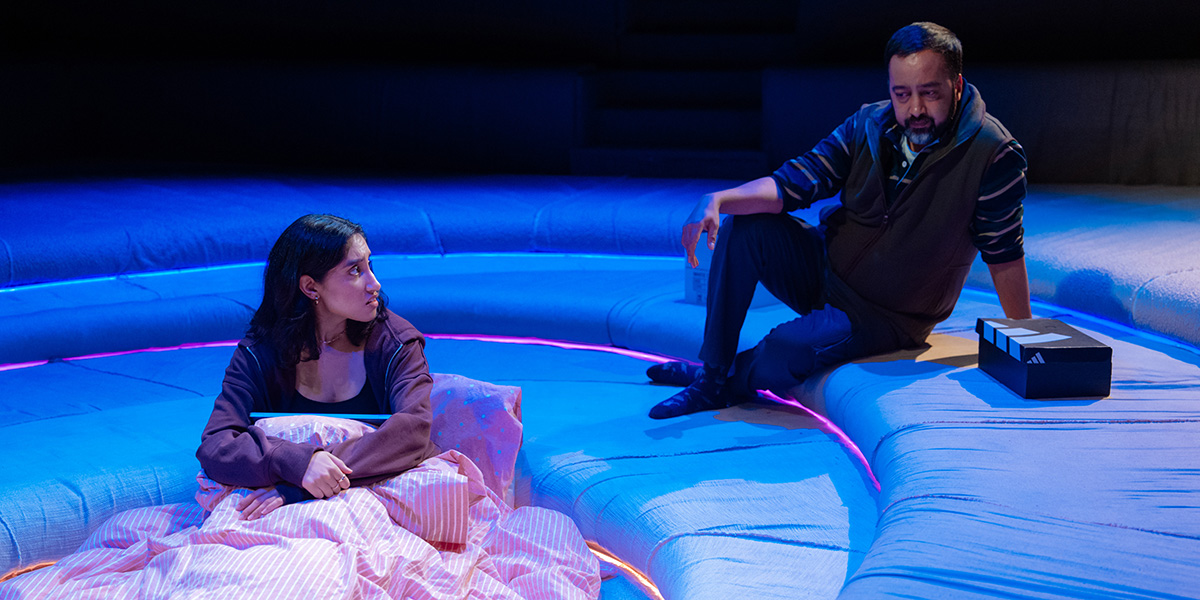
Ambika Mod and Lizzy Connolly in Porn Play. Photo: Helen Murray
Sophia Chetin-Leuner’s new play is about addiction. Unexpectedly the addiction in question is to violent pornography and the addict is a woman.
In case you’re thinking this is a little recherché for the subject of a play, we’re told almost straightaway that more women than men search for violent porn. Even so, she seems to be something of an outlier in the world of porn addicts, the clue being she’s the only woman at a porn addicts anonymous group. It may be about a niche subject, but the play presents a moving portrait of addiction and poses an intriguing question as to why a woman would become addicted to violent pornography.
If you’re easily shocked, this is one to avoid. Ambika Mod’s character Ani spends a significant chunk of the evening playing with herself. She also gives us enough vivid descriptions of what she watches to leave us in no doubt that we are talking about nasty stuff, even if she insists, in that addict’s self deceptive way, that it’s fake.
You might also want to avoid it if John Milton isn’t your thing. She’s an academic specialising in the great poet and we learn a lot about paradise, for which read sexual pleasure, and paradise lost, for which read the pain of grief. It may make you want to pick up a volume of his verse and look at it with new eyes, or not.
Ambika Mod is exceptionally good in this part, communicating desperate need, and the shame, fear and helplessness that go with it, all the while presenting a public façade of normality as she pursues her career as a university lecturer and academic. This actor has such an ability to communicate complex feelings that she is surely heading for the top.
Josie Rourke directs with precision.
Yimei Zhai’s set compliments the action superbly. We the audience are given shoe covers to wear before entering the auditorium. This is because the entire area is covered in soft pale carpet. The circular stage area and its softness may suggest a woman’s gentitalia but also, because of the whorls that take it down through a number of levels, it may signify a downward spiral. In a stroke of genius, the set is designed so the cast can reach between the joins in the fabric to retrieve props, such as a phone, a tablet or larger items like a pillow, much as you might look for a lost coin down the side of your settee, . This is wondrous in itself, but it mainly reinforces the idea that Ani’s addiction is hidden.
Not that it stays hidden for long. She takes out her phone or laptop at every opportunity to masturbate while looking at porn. This could be when someone leaves the room for a moment, or even when they are asleep in the same bed. Those close to her- her boyfriend, her best friend, her father all realise she has a serious problem. Soon her life starts to fall apart. Her exasperated boyfriend leaves her, her job is in jeopardy.
Will Close portrays with sensitivity the boyfriend’s struggle between love and disgust. He also gives us other examples of masculinity in the course of the play: a male porn addict’s macho mansplaining, a young student’s rampant hormones.
The arc of Ani’s addiction is depicted well. She maintains the violence is not really that shocking because it’s ‘fake’, but after trying it for herself she acknowledges that her enjoyment is in watching the women get hurt. She is, after Milton, a ‘brutal woman’. Eventually she reaches a point where she knows she needs to stop. Her addiction seems sad for much of the play. However, when she reaches the end of the road, sitting at one corner of the stage stroking herself robotically while the one person who cares enough to help her is in the opposite corner, it is heartbreaking.
Someone commented on The Fifth Step, another play about addiction, that while the subject is no laughing matter, it can be very funny. Sophia Chetin-Leuner seems to take this view. A couple of scenes spring to mind. Because of her continual rubbing, she has made herself sore and succumbed to an infection. She visits a gynecologist, played by Lizzy Connolly who cloaks her in that brisk matter-of-fact indifference, not even looking at Ani, that many patients will be familiar with.
Ambika Mod & Asif Khan in Porn Play. Photo: Helen Murray
During an event at which she is to receive her award for her book on Milton, Ani is approached by an old man who thinks she’s a waiter simply because she’s a young woman. Women are not expected to win top academic awards any more than they’re expected to be as sexually active as men. The old man is played by Asif Khan, who also gives an exquisitely gentle performance as Ani’s father.
In her mind, people begin to say sexual things to her. A woman seems to say to her: ‘I don’t know how you do it, spend all your time giving head’ which is then corrected as ‘in the head of that vile old man Milton.’ Milton crops up frequently when Ani addresses the audience. She talks about his poems at length, that he identified the way good and evil live in parallel, and pleasure masks pain. This does perhaps explain how her addiction arises from grief. And how Eve, the first woman, is a rebel against the patriarchy but also submissive to it. But it does start to feel like a lecture.
There are other moments when it seems the author has not entirely relevant axes to grind. For example, there’s a scene between Ani and one of her students, another fine creation from Lucy Connolly. To an extent it illustrates the gap between millennials and Gen Z. The ‘woke’ student has been triggered by Ani talking about a rape scene in one of Milton’s poems. Ani representing an older generation (that of the author) is tolerant of different times and wants to study a great poet warts and all. The younger generation has no tolerance and wants to cancel Milton. ‘Why would you want to read him and analyse all these horrible men?’ She asks. It’s a bit of a cliché and doesn’t really add to the story.
Porn Play tries to cram too much in but it is a play well worth seeing for its moving, insightful portrait of the effect of easily available pornography on 21st century sex and relationships.
Joseph Fiennes hits the back of the net as Gareth Southgate
★★★★★
Joseph Fiennes and company in Dear England. Photo: Marc Brenner
You might think if you’re seeing a play about the manager of the England men’s football team, you need to know about football. You don’t. There’s hardly a football in sight. Dear England is the story of a clash of cultures rather than a battle between teams on the pitch. It tells the story of how a self effacing nice guy tries to change the culture of a macho group that is paralysed by fear. In the process it provides us with a lot of comedy, as well as some thoughts about the state of the nation
I know next to nothing about football and that actually helped when I saw Dear England because I was probably more excited for not knowing the outcome of some of the matches than if I’d known what was going to happen. But the thing is, it’s not really about the results. I think we all know England didn’t win the World Cup last year. Or even the Euros the year before. Or it would have been all over the front pages, because one thing we do know is how important England the football team is to a significant part of England the nation. James Graham has built Dear England around the idea that the team is a microcosm of the country. One other footballing event we probably know about is the infamous missed penalty, the one taken by Gareth Southgate back in 1996 that meant England lost to Germany in a Euros semi-final.
It’s a failure that hangs over him throughout this play, because, for some reason, it has come to symbolise the moment when everybody realised there was something rotten at the core of the England team.
That’s where we begin. Rupert Goold’s production takes place sandwiched between the glare of two harsh neon circles, one above and another at stage level, recreating the feel of a stadium but also emphasising the pressure on the players of being in the middle of a pitch and indicating the magnifying glass focus of a nation’s expectations. On the stage floor are a mass of dotted lines and arrows of the kind that show attacking manoeuvres.
On stage are cubicles through which people enter and exit, symbolising perhaps the changes that take place in cubicles but also in a practical way cutting down the immense distance from the actual wings where actors appear and disappear. It is an imaginative and effective use of the Olivier’s large thrust stage by designer Es Devlin and lighting designer Jon Clark.
There’s a quick run through of a succession of England managers, who in amusing cameo impressions have plenty to say about their management style and why they have failed. Until eventually, Gareth Southgate takes over and, in his reticent way, asks why, with some of the world’s best players, they are not a winning team. He concludes it’s all in the mind.
Joseph Fiennes in Dear England. Photo: Marc Brenner
So he calls in a psychologist Pippa Grange. And this is where the fun begins. Well, actually it’s already begun when Mr Southgate (Call me Gareth) first meets his coaching team. Played by Joseph Fiennes, this is not simply an impressionist’s turn, although I’m guessing his mannerisms- the looking down, the pointing when he agrees with somebody, the precise use of language, the slightly nasal tone, the nervous grin, are all reasonably accurate.
What we get in an outstanding performance is a rounded character who admits he doesn’t know everything, who listens, who isn’t confrontational, who doesn’t shout (I have heard of another famous manager’s hairdryer treatment) but who ultimately has a steel resolve. We realise that when he lets players go or when he stands up to racism.
Or when he meets Mike, the assistant he has inherited. I think this character has been invented to represent the antithesis of Gareth. He is a blustering ‘man’s man’, who has no time for losers or psychology and woke thinking. Played hilariously by Paul Thornley, he is red-faced and always on the brink of boiling over. Gareth lets Mike have his rant, and then ignores him.
I think we must assume that Mike and the new senior assistant coach Steve Holland, brought in by Gareth, continue to support the schooling of the players in physical training and tactics elsewhere, while the work on their minds takes place in front of us.
I only saw one football for the whole length of the play. Probably just as well because they are actors. I mean they’re physically fit and go through some balletic movements, thanks to movement directors Ellen Kane and Hannes Langolf, but they wouldn’t have convinced as professional footballers if they’d tried to kick a ball. In fact a feature of Rupert Goold’s direction is constant, feverish movement, heightened by the regularly turning stage.
Together Gareth and Pippa work on moving the team away from being individuals whose loyalty is to their club to a team who know and support one another. And away from people who bottle up their feelings to ones who are open about their emotions. And most importantly, away from a fear of failure to embracing and learning from it (echoing Samuel Beckett’s ‘Fail again. Fail better’).
There is immense enjoyment is in seeing the players gradually change from resistance to embracing the new approach- as well as each other. Near the beginning, Gareth tells his squad that it will be a long haul to victory, like a three act play. You could feel the sigh of relief from the theatre lovers that he was finally talking their language.
Apart from Gareth Southgate and to an extent Pippa Grange, all the other characters are caricatures. It is James Graham’s style in his many plays and TV dramas based on real people to create the truth of a person’s character through humour rather than a nasty or saintly portrait. You may remember his Brexit: The Uncivil War, Tammy Faye, Ink, Best Of Enemies, Quiz or This House. In this play, James Graham can’t resist introducing our recent prime ministers- all trying and failing to score.
So good, so good, so good
I can’t say how accurate the portrayals of the players are but I did end up feeling for them. England captain Harry Kane, as portrayed by Will Close, is barely articulate but seen to inspire the others through his lack of ego and a simple confidence in his ability. Josh Barrow’s goalkeeper Jordan Pickford is gloriously hyperactive. Darragh Hand’s Marcus Rashford stands out as a young man from a deprived background with a bit of a chip on his shoulder who is inspired to become an enthusiastic leader. Adam Hugill is the solid defender and plain speaking Yorkshireman Harry Maguire.
It’s such a good cast that it’s hard not to mention everybody. I must pick out Gunnar Cauthery who gives us terrific impressions of a wisecracking Gary Lineker, a cool Sven-Goran Eriksson, a blustering Boris Johnson and a sanguine Wayne Rooney. And Crystal Condie who does the same for ex-footballer and now commentator Alex Scott and Theresa May.
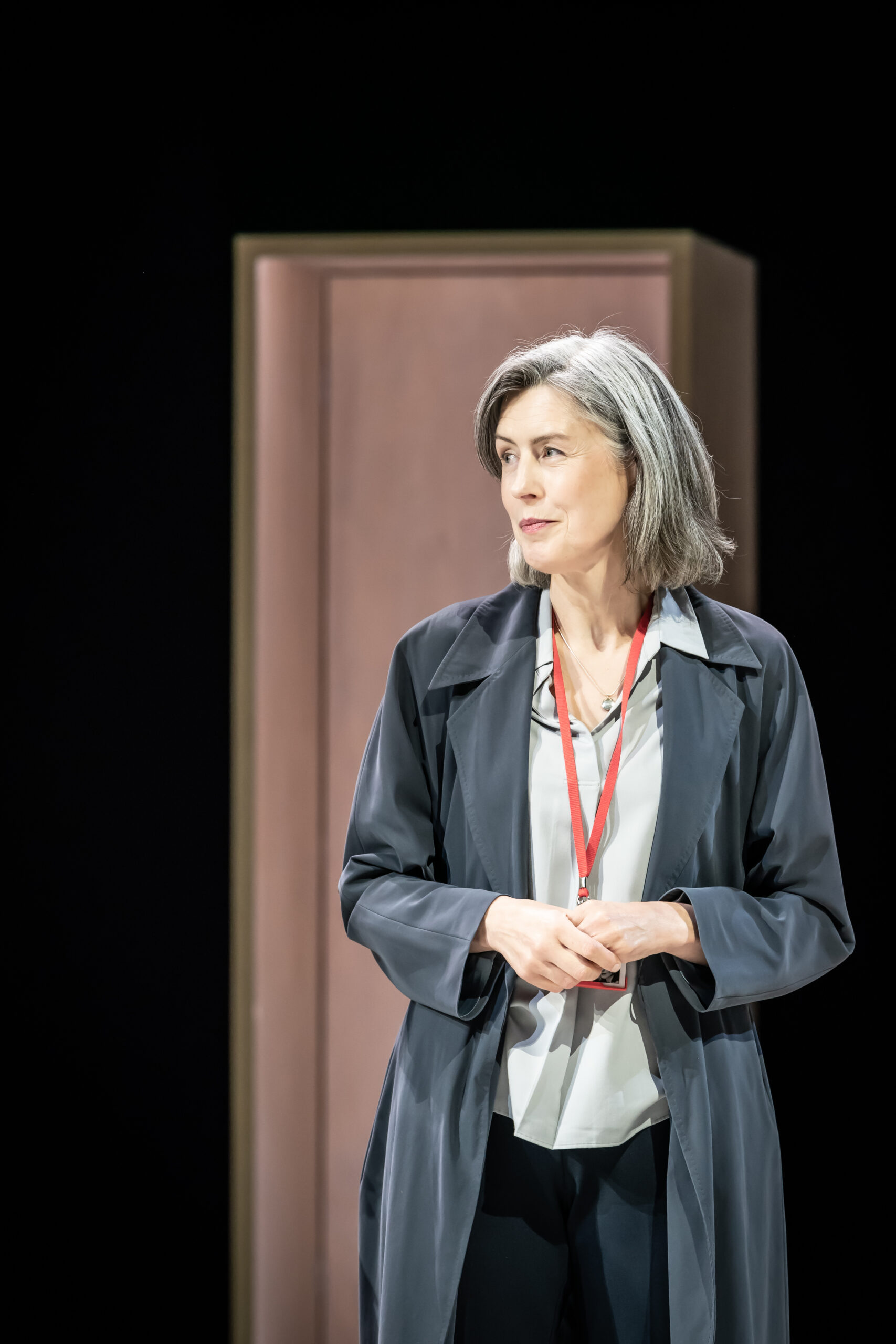
Gina McKee in Dear England. Photo: Marc Brenner
I haven’t said enough about Gina McKee whose twinkling eyes and turned-up corners of the mouth are like the smile of a tiger, and whose soft northern vowels sugarcoat a hard centre. She made the most of a part that seemed to me slightly superficial, but this may be because Mr Graham didn’t want to distract too much from his main character.
The idea of someone coming to a football club and creating a successful team by getting them in touch with their feelings and believing in themselves may make you think of Ted Lasso. Both shows clearly touch the zeitgeist of the 21st century.
But unlike the Apple TV hit comedy, Dear England explores some big issues. At the beginning, the expectations the nation has of its team reflect the nation’s view of itself. The fans are steeped in a history of England as the birthplace of football, as the winners of the 1966 World Cup, as the home of the finest league football. The team should have success on the world stage by right. If it doesn’t, the frustration leads to riots.
Although this is not explicitly stated, I would be surprised if Mr Graham doesn’t intend a parallel with England the country, which historically once ruled half the world, invented so much, and won World War 2, leading many of its people- at least an older generation- to expect that the country should by rights be a successful world power.
‘Believe in people, care about people, be kind’ is Gareth Southgate’s message to the new generation of England players but it is also a vision of the kind of nation England is in the new century or, at least, can be.
I was caught up in this journey and moved by its outcome, and loved being in a National Theatre audience singing along to Sweet Caroline.
Dear England can be seen at the National Theatre in London until 11 August 2023.
To provide the best experiences, we use technologies like cookies to store and/or access device information. Consenting to these technologies will allow us to process data such as browsing behaviour or unique IDs on this site. Not consenting or withdrawing consent, may adversely affect certain features and functions.
Functional
Always active
The technical storage or access is strictly necessary for the legitimate purpose of enabling the use of a specific service explicitly requested by the subscriber or user, or for the sole purpose of carrying out the transmission of a communication over an electronic communications network.
Preferences
The technical storage or access is necessary for the legitimate purpose of storing preferences that are not requested by the subscriber or user.
Statistics
The technical storage or access that is used exclusively for statistical purposes.The technical storage or access that is used exclusively for anonymous statistical purposes. Without a subpoena, voluntary compliance on the part of your Internet Service Provider, or additional records from a third party, information stored or retrieved for this purpose alone cannot usually be used to identify you.
Marketing
The technical storage or access is required to create user profiles to send advertising, or to track the user on a website or across several websites for similar marketing purposes.