Theatre review: 1536

Delightful and devastating, controlled and convincing drama

Ambassadors Theatre


⭑⭑⭑⭑⭑
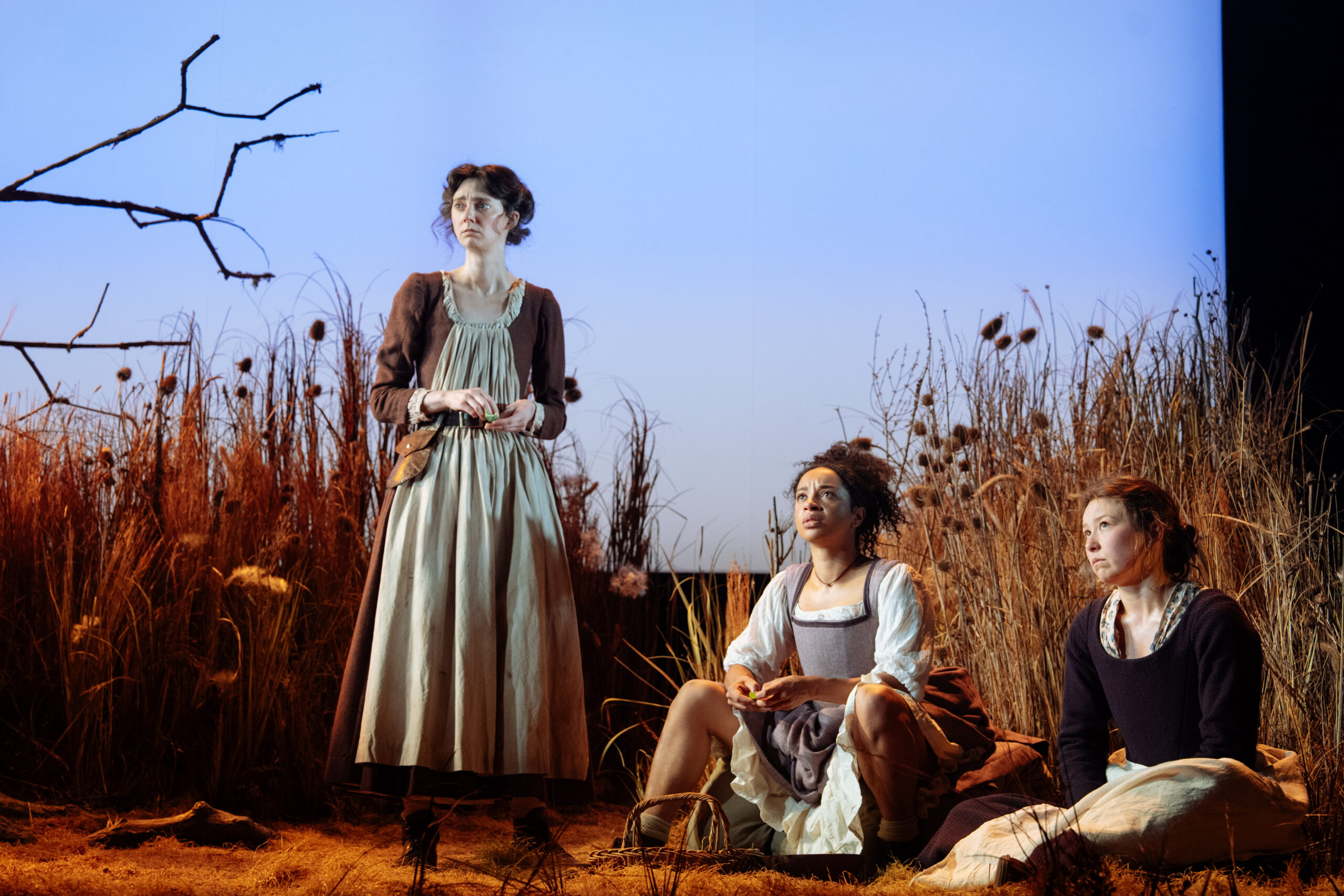
Tanya Reynolds, Siena Kelly, Liv Hill in 1536. Photo: Helen Murray

Don’t be fooled by the posters showing women in smart Tudor dresses. SIX it ain’t. 1536 is the year Henry the 8th accused his wife Anne Boleyn of treason and killed her. Ava Pickett’s play imagines the effect this might have had on women at the lowest levels of society, and, by implication, how the behaviour of powerful men today might influence other men in their attitude to women. And what a well written, superbly acted drama, it is.

It looks at three, I suppose we’d call them, peasant women- their camaraderie, their mutual support, and their ultimate downfall at the hands of men, who are emboldened by the King’s actions. It starts out with some very funny scenes as Ava Pickett’s fast-moving, scintillating dialogue establishes the characters of the women, but it ends in overwhelming tragedy.

Anna played by Siena Kelly enjoys sex. She knows she looks attractive and makes sure she exploits what she sees as an asset. It’s her power over men. She has a sharp tongue and a ribbing sense of humour. The butt of her jokes is usually Jane, played by Liv Hill, Anna’s polar opposite: slow-witted, shy and a virgin. Tanya Reynolds plays the conciliatory Mariella, a worldly midwife saddened by thwarted ambitions.

It’s a joyous portrait of female friendship. The conversation between them is so easy and natural- they speak like modern Essex women (Ms Pickett is from Colchester), which adds to the sense that you could bump into them on a night out.

Then they are shaken by the news (two days old) that the King has imprisoned the Queen. They find it impossible to believe. Inevitably rumours abound but the word is she has had many lovers, including her brother. She may even have plotted to assassinate the monarch. Can it be true? It doesn’t matter. If the King says it is, it must be.

We meet two of the men in their lives. Richard, played by Oliver Johnstone, is one of Anna’s lovers, even while he is courting Jane (for her dowry). George Kemp is William, a married property owner who has a relationship with Mariella. Both appear to be mild mannered.

When things start to go wrong, the male hierarchy follows the King’s example. Anna is labelled a whore while Richard is seen as having been seduced. The other two are also treated badly and (what’s new?) not believed. It’s clear men call the shots and the play proceeds to become very dark indeed, as the bonds with men on which the women relied start to break. As in any oppressive society, the oppressed women not only take the blame for men’s wrongs but start to turn on each other.

It would be so good to be able to say how much society has changed. Shamefully, far too many of today’s powerful men set an example of verbal and physical abuse of women.

Tender and tragic
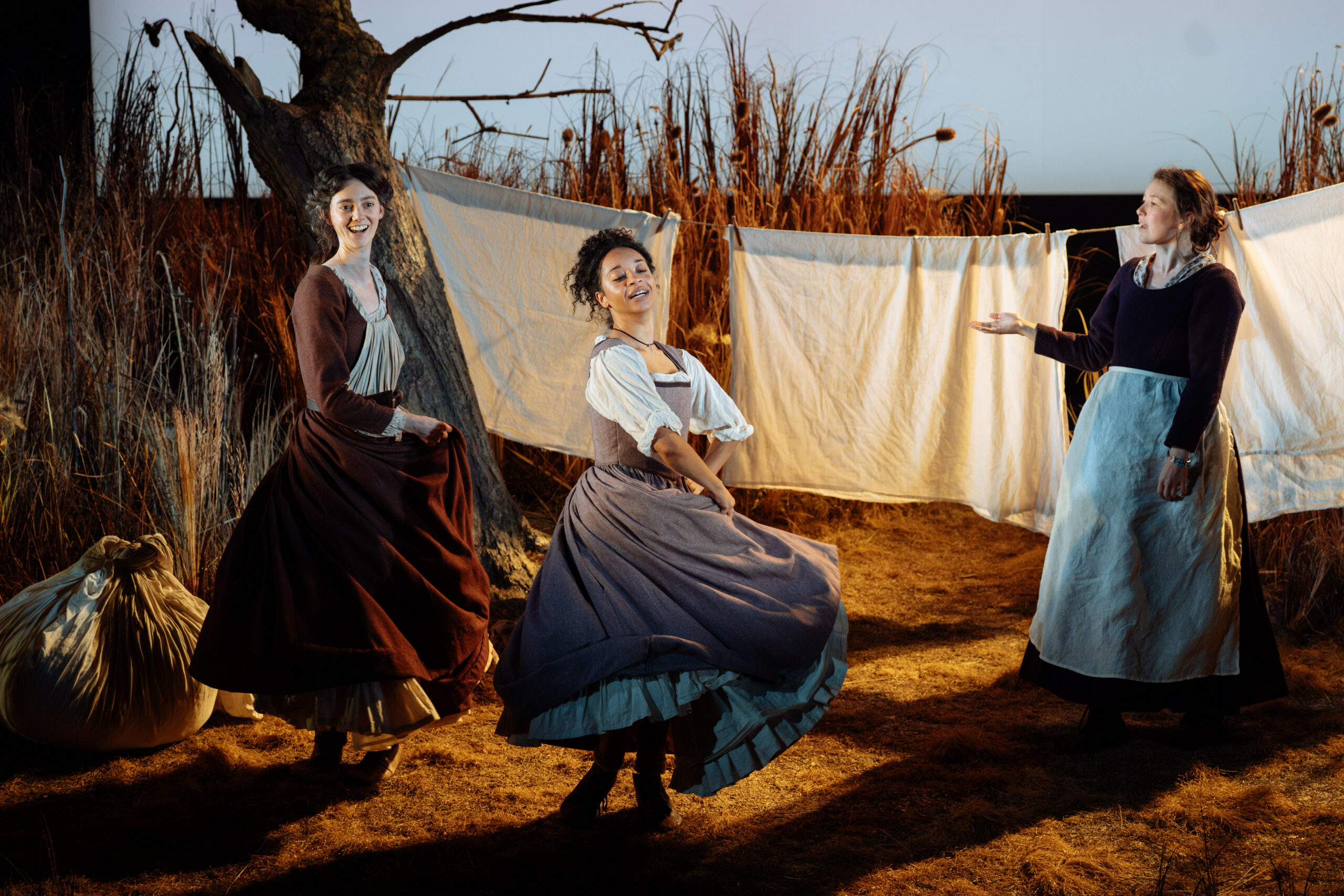
Liv Hill, Siena Kelly & Tanya Reynolds in 1536. Photo: Helen Murray

All this is acted out on a single set cleverly designed by Max Jones. Clumps of dry trodden down grass, a dead tree and scrubby bushes symbolise the oppressive country. It is meant to be excessively hot, and we feel the heat that is beating the women down at the same time as it stirs the men to cheer the execution of the King’s wife without ever questioning her guilt. Then as now people in power control the information, and gossip (for which read social media) whips up the fake news.

The lighting by Jack Knowles contributes to the atmosphere, and between scenes plunges us into impenetrable blackouts that parallel the darkness in which the local population is kept.

It’s a stunning achievement for a debut play. Credit to the Genesis Almeida scheme for commissioning it, and to the Almeida for this pacey production directed by Lyndsey Turner. West End transfers from small theatres sometimes don’t work but the Ambassadors is appropriately intimate. 1536 is tender and tragic, delightful and devastating, controlled and convincing.

1536 can be seen at The Ambassadors Theatre until 1 August 2026.

Paul was given a review ticket by the producer.

Read a roundup of other critics’ reviews of 1536 here

Click here to watch a video of this review on the YouTube cahnnel Theatre Reviews With Paul Seven
Jonny Lee Miller in A Mirror – Almeida – review

Jonny Lee Miller excels as actor playing censor

★★★★

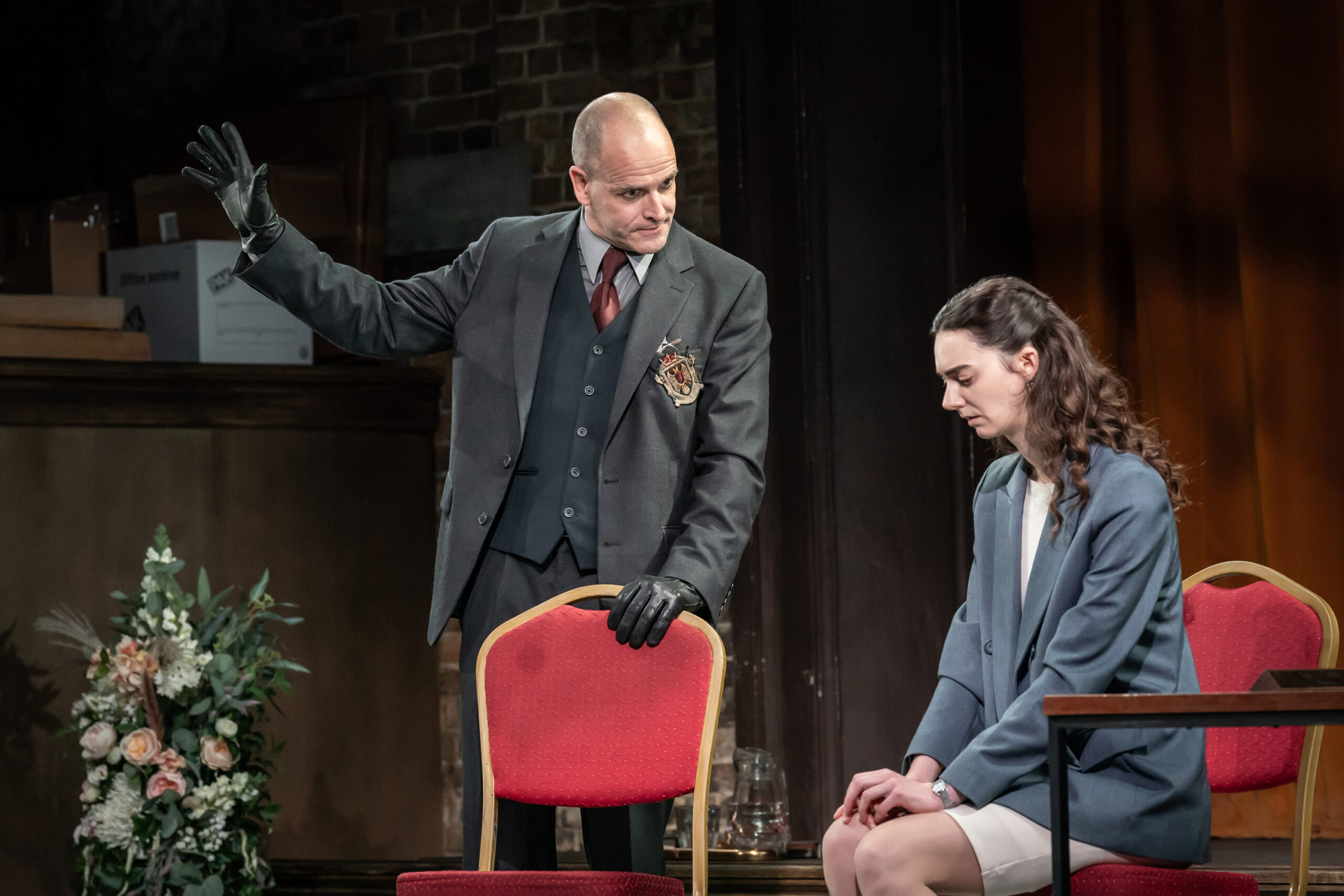
A male actor stands looking down at a female actor on a chair
Jonny Lee Miller and Tanya Reynolds in A Mirror. Photo: Marc Brenner

It may seem like we’re attending a wedding but it’s clear there’s something else going on. There are posters telling us ‘This Play Is A Lie’. There’s a massive Oath of Allegiance in the foyer. The smaller poster warning against subversion. Even as you sip your delicious coffee from the bar, you realise that you are meant to be in some kind of authoritarian state and this is going to be one of those evenings when you are part of the play. The play in question is A Mirror, a new work by Sam Holcroft that explores state censorship and the state of theatrical writing.

Inside the auditorium, a wedding is taking place. Except it isn’t. That’s just a cover to fool the authorities. We’re really here to watch an unlicensed play, apparently at some danger not only to the actors but to ourselves.
Sam Holcroft was inspired to write this play by a visit to North Korea. Then again, censorship comes in many forms: self censorship under the pressure of social media mobs or powerful people being the most pernicious.
The play- the illegal play- begins with a government censor Mr Čelik interviewing a new young playwright Adem. Those who have come to the show primarily to see Jonny Lee Miller will be very happy. The star of the film Trainspotting, the TV series Elementary, and theatre such as the National’s Frankenstein commands the stage. As Čelik, his leather gloves, his stiff stance, his tight smile, his clipped way of speaking, even his moments of vulnerability and self delusion, give him a sinister air no matter how charming he appears to be.
It’s really quite hard to take your eyes off him, which is a shame because Micheal Ward from TV’s Top Boy who plays Adem is tremendous in his stage debut. His character’s sincerity and naivety are pitched perfectly so that his puzzlement at the criticism leveled at his writing and his eagerness to please, even as he inadvertently produces ever more provocative work, is always believable.
What has attracted Čelik to Adem’s first play is that he can write dialogue that rings true. The problem is, the subject matter is unacceptable- a prostitute and her client, drug dealing, a man masturbating, and much more expose the failings of the country. It turns out that Adem has the ability to remember word for word what people say and that his work is transcripts of conversations he has heard through the walls of his flat, which is why his play is so true to life.
Things get decidedly more complicated- and funnier- when he returns with a new effort which is a transcript of his first meeting with Čelik. Why is this controversial? Because by holding up a mirror to Čelik, the government officer sees his own behaviour as a censor exposed.
The theme of the play- that is, both the play within the play and the overall play- is that art should be a mirror to us, to life and to society. This is an entertaining satire so I’m sure Sam Holcroft doesn’t mean us to take literally that art is better when it offers verbatim dialogue, but the point is, the best art tells a truth, whereas the Ministry of Culture wants it to tell a lie– to offer heroic tales with happy endings that glorify the motherland.
Čelik takes his new assistant Mei under his wing. Alongside an awkward seduction, he attempts to educate her about the power of art. One of the tragedies of this story is that the censor is only too well aware of its power, which is why it needs to be censored. He introduces her to Shakespeare, particularly Romeo And Juliet which has been banned because of its downbeat ending.
One of the joys of this production is the performance of Tanya Reynolds in which Mei blossoms before our eyes. At first, she is a nervous newcomer worried about expressing an opinion but aware that the little, and officially approved, theatre she has seen doesn’t have the ring of truth. All the while she is trying to manage her boss’s amorous intentions. Then she grows in confidence as she gets to know great plays: a perfect illustration of the power of art.

She also gets some of the funniest lines, as when the only thing she likes about one officially approved play is that the trees were realistic.

Two male actors exchange a joke
Micheal Ward and Geoffrey Streatfeild in A Mirror. Photo: Marc Brenner

Some of the most enjoyable moments in A Mirror are when the characters do readings from plays, usually badly, with Mei the most stilted of all. It’s a hilarious parody of theatre, illustrating the important role of actors in interpreting writing. Two versions of a real wartime event are set alongside one another- one a heroic fairytale by an official playwright Bax, Čelik’s star protégé, the other raw and truthful by Adem.

It could be argued that Sam Holcroft presents some of her arguments against censorship too simplistically. After all, much great art has been produced in censorious times: before 1968, Wilde, Coward, Shaw, Rattigan, even Joe Orton, had to submit to the blue pencil of the Lord Chamberlain, and Shakespeare’s plays required the approval of his predecessor, the Master of Revels. Many classic films of the forties were made under the Hays Code.  But Ms Holcroft and director Jeremy Herrin keep the satire moving in a way that doesn’t give you time to question the details too closely.
The state-sponsored playwright Bax is pleased with his fame but cannot come to terms with his compromises. Geoffrey Streatfeild gives his character the right mix of arrogance and self-loathing.

The Power of Theatre

There are various interruptions because police are apparently in the vicinity, during which the cover story of the ‘wedding’ resumes. Characters rush around the auditorium checking doors. These are the occasions when we are reminded that Jonny Lee Miller is an actor playing an actor pretending to be a censor. Again, a first-hand example of the power of theatre.
I won’t go any further in describing the story because it ends with a major twist, albeit one that makes perfect sense when you review what you’ve seen.
Instead, let me describe Max Jones’ set. It begins as a wedding venue. The audience is on three sides, and a raised thrust stage features a cake on a table. This is cleared to be replaced by a desk and chairs. Further back is a half-curtained area indicating a backstage but also suggesting, to me anyway, the kind of curtain that concealed the reality of the puffed-up Wizard of Oz.
Nick Powell’s music played by cellist Miriam Wakeling is a constant addition to the tense atmosphere. And tense is the word I would return to again and again in Jeremy Herrin’s robust production of Sam Holcroft’s exploration of the importance of art and the many ways, crude and subtle, in which it can be censored.                                       
Thank goodness for the Almeida Theatre and its artistic director Rupert Goold for continuing to stage bold new work when so many are playing safe.
Parts of this review have been redacted by the Minister of Culture
A Mirror runs at the Almeida Theatre in London until 23 September 2023.

Paul was given a review ticket by the theatre.

Follow Paul on Threads, Mastodon, X, Instagram and Facebook

×