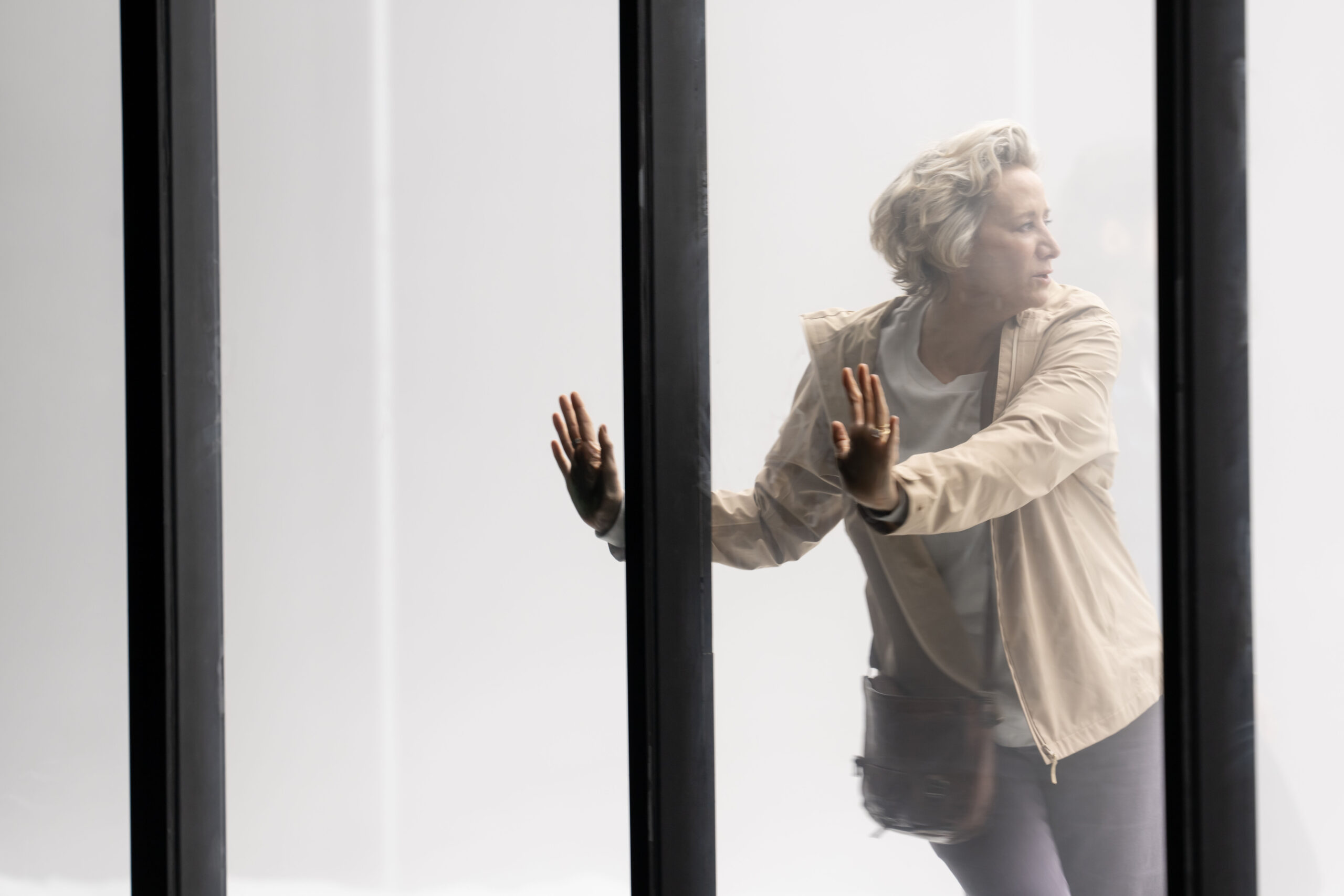
Theatre review: The Lady From The Sea with Alicia Vikander & Andrew Lincoln

Watery family drama floats my boat

Bridge Theatre

⭑⭑⭑⭑

Andrew Lincoln & Alicia Vikander in The Lady From The Sea. Photo: Johan Persson

Simon Stone brought us Yerma with Billie Piper, one of the finest productions I have ever seen, and Phaedra with Janet McTeer which was pretty good too. He likes to take a classic, tear it apart, get down to its basics, and rebuild it for the modern world. So did he pull it off with Henrik Ibsen, father of theatrical realism, and stars Alicia Vikander and Andrew Lincoln? The answer is, yes, with style. It is an entertaining, amusing, gripping, unique piece of theatre.

The evening starts (and continues) with much would-be witty repartee of the kind that you find in fiction rather than real life, except this production often presents it as  crass or cringeworthy, and characters talk over one another, and mock one another. Ibsen was an early proselytiser of theatrical realism which meant believable conversations featuring middle class families that middle class theatre audiences could identify with, as opposed to the previous focus on royalty and gods. This play, with a script developed by the actors in conjunction with writer director Simon Stone, pays full homage to Ibsen with its realistic dialogue.

The subject matter is serious but this version is also very funny. One of exchanges that made me laugh, given the title of the play, was when someone said to Ellida: ‘You must be the lady of the house’ and she responded: ‘Did he just call me a lady?’

The play is set in the modern day in the Lake District, which makes a change from the Cotswolds, and is sprinkled with contemporary references, to OnlyFans and Just Stop Oil and the like, but the themes of love, loss and the effect of the past on the present are eternal and universal.

Edward and his second wife Ellida seem happy. Although his daughters from his first marriage are rebellious and rude, the couple are able to shrug it off. Then a former lover appears and Ellie must make a choice between an unfinished relationship and her current love.

Death hangs over the narrative: there are suicides, one by Edward’s first wife; Edward and Ellida have lost a child through miscarriage; a visiting young sculptor has a terminal illness. While the presence of death in their lives messes up some of the characters’ lives, it also acts as a reminder that life is short and unpredictable, and needs to be lived, not postponed.  Dramatic choices and revelations continue to the end.

The acting is uniformly excellent but none better than the two leads- Andrew Lincoln is totally convincing as a man lacking confidence, despite being a leading neurologist. This is revealed to be the result of a cold father. Events test Edward’s  liberal attitudes to breaking point. He, like the script, is funny, angry and anguished.

Alicia Vikander is a more subdued presence playing a quietly confident mature woman, with a slightly flat, stuttering delivery that made all the more powerful her passion, when it came out. At that point, she seemed to revert to the nervous, vulnerable youngster from twenty years earlier, who made decisions that would shape her life.

The young people- two teenage daughters planning the first stages of adulthood, and the dying sculptor- remind us of the turbulence of life as a young person. I loved Isobel Akuwudike and Gracie Oddie-James as the stroppy but ultimately caring daughters, and Joe Alwyn is wonderfully neurotic as the sculptor. John Macmillan is spot-on as the blunt, faithful family friend Lyle. Brendan Cowell is suitably charismatic as Finn, the lover from the past.

The Lady From The Sea at The Bridge. Photo: Johan Persson

Lizzie Clachan’s magnificent set isn’t in keeping with ideas of realism. It is pure theatre. The show is set in the round, bringing the audience close to the actors in this intimate family drama. There are minimal props- a table and chairs in one corner and a sun lounger opposite. (Avoid seats near the right corner as you enter the auditorium and the opposite corner on the far side, as these bits of furniture will sometimes obscure your view.)

During the interval, the entire set, both the floor and the small number of props are changed from completely white to totally black. Straightaway, you feel there will trouble ahead! The beginnings of scenes increasingly overlap with the ends of the previous ones, as the tension increases- as if we can’t wait to see what happens next.

Much of the baggage Ellida carries is weighed down by events at sea, so , in an eye-popping moment in the second act, water appears, first as heavy rain, then as shallow water when part of the stage drops. Two lovers make out in it with echoes of From Here To Eternity, before it becomes a swimming pool. It may not be an immersive production from the audience’s point of view but some of the actors are fully immersed in the pool. It could only happen in theatre. But, far from being gloomy, the water- like the play itself- is ultimately cleansing.

This is an intense piece of theatre I wouldn’t have wanted to miss.

The Lady From The Sea can be seen at The Bridge until 8 November 2025. Buy tickets direct from the theatre

Paul purchased his ticket.

Click here to watch a video of this review on the YouTube channel Theatre Reviews With Paul Seven
Theatre reviews roundup: The Lady from the Sea

Ibsen update: intense or mundane?

Bridge Theatre
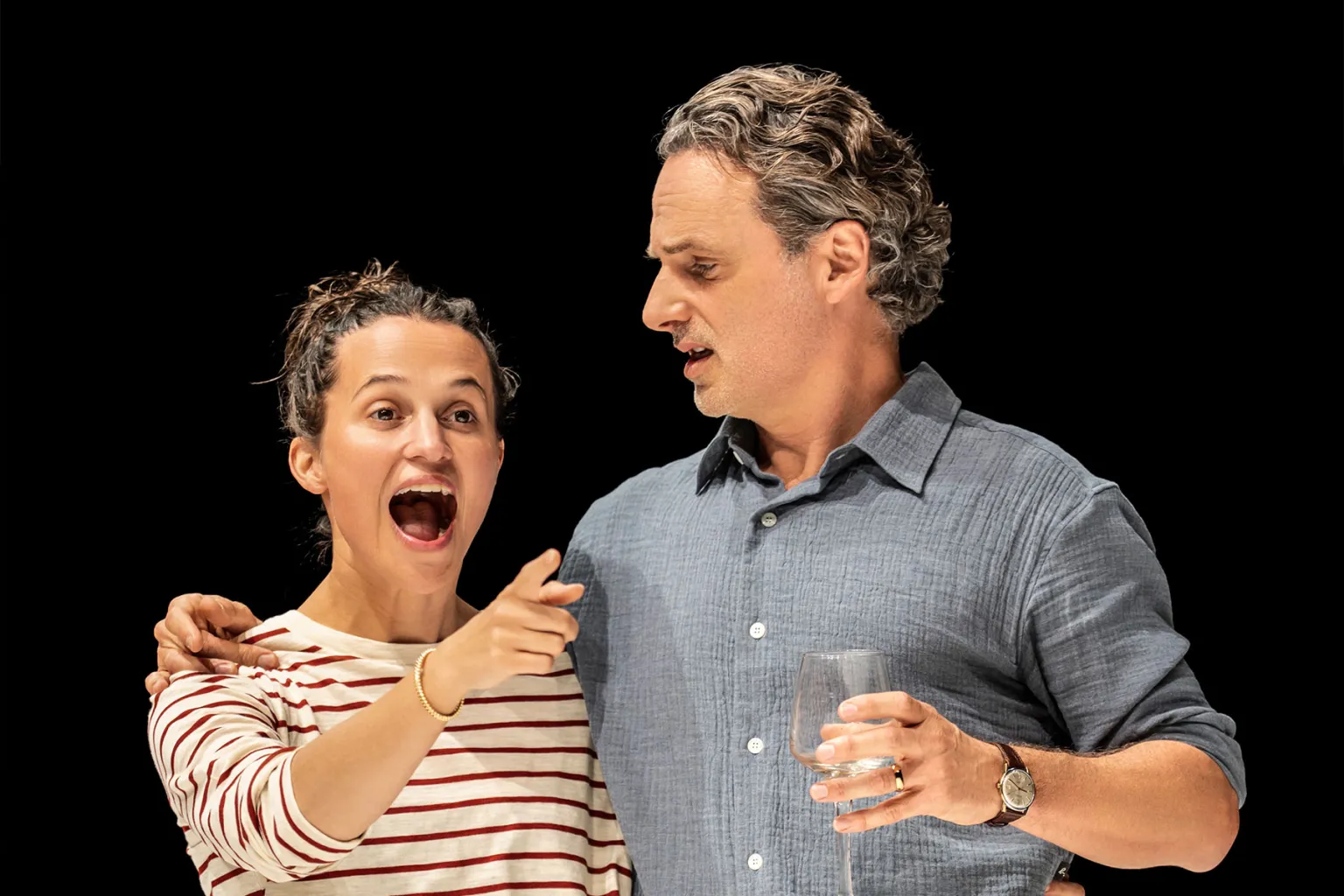
Alicia Vikander and Andrew Lincoln in The Lady from the Sea. Photo: Johan Persson

Following his visceral adaptations of Yerma and Phaedra, writer/director Simon Stone has turned his attention to Ibsen’s The Lady From The Sea. Screen stars Alicia Vikander and Andrew Lincoln, plus Joe Alwyn and Brendan Cowell, impressed the critics but opinions varied on the quality of the adaptation. As a modern day middle class marriage comes under fire, some found it intense, others thought it was meandering and an insult to Ibsen. Lizzie Clachan’s traverse set uses a lot of water in the second act to metaphorical effect, which most critics enjoyed but some found over the top.

[Links to full reviews are included but a number are behind paywalls and therefore may not be accessible]

4 stars ⭑⭑⭑⭑

The Guardian’s Arifa Akbar commented: ‘Simon Stone is known for his rock’n’roll takes on the classics. This is a characteristically high-octane version of Ibsen’s play: loud, modern and led by screen stars Alicia Vikander and Andrew Lincoln. Yet his script, again created in the rehearsal process, retains all of Ibsen’s layers and adds some of its own in the updating’. She talked of : ‘the full-bodied intensity of the production, which is fantastically original, gripping and magnificent to the end.’

The Standard’s Nick Curtis called it ‘a dense, emotionally intense and often hilarious three hours – and god knows, belly laughs aren’t common with Ibsen – marred by a certain glibness.’ He explained: ‘As he formerly did with Lorca’s Yerma and Seneca’s Phaedra, Stone rebuilt the play in rehearsal with his cast, and they’ve worked hard to create a psychological and narratively coherent modern parallel for Ibsen’s ocean-worshipping mysticism…It works, but it reduces the play to being all about daddy issues.’

Dave Fargnoli of The Stage praised the stars and the writer: ‘Heading a uniformly strong cast, Oscar-winner Alicia Vikander’s Ellida roils with subdued emotion, her anxieties and divided loyalties visibly bubbling under the surface’…’Andrew Lincoln gives a consummate performance as neurologist Edward, maintaining an air of focused calm and fairness in the face of continual provocation’…’Stone’s contemporary dialogue is fast-paced and ferociously entertaining, equal parts realistic rhythms and deliberately grandiose pronouncements.’

WhatsOnStage’s  Sarah Crompton  said: ‘The script is demotic, flowing, beautifully written, and the entire cast inhabit it with ease, drawing the lines of character with power and subtle’ but complained: ‘The production, however, is clumsier than the script. I took against Lizzie Clachan’s staging – in long traverse, with the audience surrounding the playing area – that means from where I was sitting, I viewed events through a table, or from the back of a sun lounger.’ She concluded: ‘It is a hugely enjoyable evening, full of insight and provocation.’

3 stars ⭑⭑⭑

Matt Wolf writing for The Arts Desk declared: ‘Like the lighting that crackles now and again to indicate an abrupt change of scene or mood, Simon Stone’s version of The Lady from the Sea is illuminated by the sense of adventure and excitement one has come to expect from this singular artist.’

The Financial Times’ Sarah Hemming found: ‘Stone’s dialogue crackles with wit…It’s peppered too with truths about love, the competing urges for freedom and security, the intensity of youthful emotions that blaze in the memory, the legacy of parental failings and frailties. Above all there’s the uncertainty and restlessness of living in such a messed-up world. It’s also superbly acted.’

Tongue in cheek, Andrjez Lukowski of TimeOut described a pattern in Stone’s adaptations: ‘rewrite the whole thing into aggressively modern English that revolves around long, light hearted stretches of posh people swearing amusingly, season with a bit of Berlin-indebted stage trickery, and finally change tack and wallop us with the tragedy, right in the guts.’ He concluded: ‘when it’s serious, it’s very good. And when it’s silly it remains maddeningly entertaining.’

Dominic Maxwell of The Times commented: ‘It’s full of skill and ingenuity. But the 21st-century self-awareness drowns out Ibsen’s alluring strangeness as much as it makes it resonate.’

The Telegraph’s Dominic Cavendish felt: ‘The snag is that the staging, by Australian hotshot Simon Stone (with semi-abstract design by Lizzie Clachan), leaves his cast first high and dry on an exposing platform, then drowning in directorial overkill, as a deluge turns the set into a raised pool.’

Fiona Mountford of the i started positively: ‘The great news is that Andrew Lincoln …and… Alicia Vikander – in her London stage debut – make for a phenomenal central pairing as a distinguished older man on his second marriage and an attractive younger woman on her first.’ However, ‘The trouble with Stone’s updating of this story – of past loves returning to haunt current lives – is that he attempts to afford too many characters too great a slice of the dramatic action.’

2 stars ⭑⭑

Alice Saville of The Independent was damning about Stone’s adaptation: ‘He’s taken Henrik Ibsen’s tragic fable and extended it into something both lengthy and oddly mundane, bloated with new dialogue that namechecks OnlyFans and Nineties rap groups. It’s an unlikely showcase for the talents of a confident Andrew Lincoln..and..Alicia Vikander, who seems understandably adrift making her stage debut in this directionless play.’ She went on: ‘it feels as though, in laboriously engineering a plausible 21st-century setting for Ibsen’s story to unfold in, Stone has lost sight of what this play’s actually about.’ She decided: ‘It’s all a bit undignified for poor Ibsen… this play thoroughly retools his dialogue without finding a language for his symbolism.’

The Mail’s Patrick Marmion was also disappointed, describing the main characters as ‘a blandly homogenous bunch of wittering, health-conscious hedonists, without a cultural, moral, or political compass between them.’

Critics’ Average Rating 3.2⭑

Value rating 35 (Value rating is the Average Critic Rating divided by the typical ticket price.)

The Lady from the Sea can be seen at the Bridge Theatre until 8 November 2025.  Buy tickets directly from the theatre

Click here to read Paul Seven Lewis’ review of The Lady From The Sea

If you’ve seen The Lady from the Sea at The Bridge, please leave your rating and review below


Phaedra with Janet McTeer – National Theatre- Review

Janet McTeer excels in a dramatic tale of forbidden love by Simon Stone


★★★★

Production shot from Phaedra at the National Theatre in February 2023 showing the cast standing in a sitting room
Phaedra at the National Theatre. Photo: Johan Persson

On the whole, I loved Phaedra by Simon Stone at the National Theatre‘s Lyttelton auditorium. There was just one element I didn’t like. First, let me tell you what was so good about it.

Don’t worry if you’re not keen on Greek tragedy. This is not a production full of togas and choruses. It’s a bang-up-to-date tale of a politician who has an affair. The essential story of Phaedra is still there, as told in Ancient Greece by Euripides, in Ancient Rome by Seneca the Younger, in the middle of the last millennium by Racine, and many times over since including relatively recently by Sarah Kane.

It’s always been a tale of forbidden love, originally of a princess falling in love with her stepson, but in this new version, the young man is already in his forties and he’s the son of a former lover. So, not a stepson, and certainly not a young man being taken advantage of. I guess most of us can understand the way love, or lust, can overtake reason. The forbidden love is, on the face of it, that of someone whose passionate feelings lead her into infidelity- simple adultery, although not so simple, as it turns out.

Our protagonist, called not Phaedra but Helen, is a shadow cabinet minister. You might think her forbidden love is not so much for someone other than her husband but her love for herself.  This play is dominated by an examination of a certain kind of liberal middle-class people who have no moral code beyond what they feel.

We first meet a family bickering over breakfast. A teenage son is uncontrolled in his language or subject matter in front of and towards his parents. The older daughter, just visiting, is not much less restrained. The affable father jokes with them about sex. It seems to be a family without boundaries. You may or may not approve of the liberal principle of treating the children as equals, as quasi-grown-ups but, in this case, the children seem to have become self-centred and lacking in respect. Helen, the mother, leads by example. This is brought home by the way they speak over one another, barely listening. You may find this scene appalling or laugh-out-loud funny or both.

The self obsession extends beyond family to the rest of the world. Helen can be seen as the patronising face of first world- imperialist, even- attitudes towards other cultures. For example, when Helen spent time in Morocco, she didn’t bother to learn the language, and she hasn’t taken the trouble to find out where her black, best friend was born.

Production shot from Phaedra at the National Theatre in London February 2023 showing Mckenzie Davis holding Assaad Bouab's face and staring into his eyes
McKenzie Davis and Assaad Bouab in Phaedra. Photo: Johan Persson

Then Sofiane arrives. He reminds Helen of his father- her past Moroccan lover, a man who died in a car crash and whose letter to his son provides an intermittent sub-titled voiceover expressing hope and regret. Sofiane makes clear he reciprocates the feelings Helen has for him. It’s not just that he’s like his father physically, he too is a political activist and that reminds her even more of how she not only has traded physical excitement for a boring marriage but has given up the thrill of activism for the compromise of party politics. I don’t need to tell you how often an older person has an affair to try to recapture lost youth.

Despite changes to the plot and the modern setting, this is still a Greek tragedy in its structure. I won’t go any further with the story, except to say Simon Stone has retained those ancient ideas that people who misbehave get punished, and revenge moves through the generations. So, there are many twists, and it does all end badly. In fact, the ending is very dramatic, almost melo-dramatic.

It’s a well-told story with much comedy and many great set scenes. One in particular takes place in a restaurant where the family and close friends are gathered for Helen’s 60th birthday. Revelation follows revelation in a scene that wouldn’t go amiss in a farce, with glasses smashing, home truths spewing out, and Helen all the while lamenting loudly about the distraction from her celebration.

Production shot from Phaedra at the National Theatre in February 2023 showing Janet McTeer leaning against a glass wall
Janet McTeer in Phaedra. Photo: Johan Persson/

The acting is marvellous.  Janet McTeer is so on point as this totally self-absorbed politician. She talks at speed, with passion and intensity, and expresses her feelings so naturally, that you forget she’s acting. The script gives her the platform for what will surely turn out to be one of the acting performances of the year.

Paul Chahidi as her husband Hugo is terrific too in the role of this put-upon husband and father who manages to keep afloat with jokes and diplomacy. He’s charming and likeable, but also exudes insignificance. You can see why he appealed to the dominating Helen, but also why she was ready to be unfaithful to Sofiane, played by the handsome, charismatic Assaad Bouab.

All the cast impress but a special word for Akiya Henry as Helen’s friend and fellow shadow cabinet member Omolara. She portrays an easy-going person who seems to take Helen’s ignorance of her background and her mockery of her religion with good humour, but you sense an iron core that emanates from her moral grounding (something Helen lacks) and she has the kind of painted smile that conceals an objective, calculating mind.

Canadian screen star Mckenzie Davis makes an impressive stage debut, riding a rollercoaster of emotions as Helen’s daughter Isolde.

No thinking outside the box

So what didn’t I like? The design. All the action takes place within a revolving glass box . This was an interesting coincidence because only the night before I saw Phaedra, I saw The Lehman Trilogy which also features a revolving glass box. But, whereas the latter worked, this didn’t. The effect is perhaps of making the audience feel like the Greek and Roman Gods who would look down on humans and their folly. Or it could suggest the way in which the characters are trapped, in this case in a cycle of betrayal and revenge. The many uprights may have been intended to reinforce the idea of the characters being in a prison but they too often obscured the faces of the actors. It was a shame not to see the agonies their characters were going through.

The biggest problem caused by the design is that every change of scene took forever. Sometimes the scene change was longer than the following scene! When you’re dealing with a raised box with awkward access and egress, everything takes much longer than it would if the action had taken place on the stage floor and scenery could be rolled on and off easily. The extended blackouts would have been intolerable but for Stefan Gregory’s hypnotic sound which played as we waited.

Designer Chloe Lamford’s talent is beyond question, and the sets within the box did look fantastic. It’s just the box that didn’t work.  I don’t want to lay all the blame at her door because it could well be that she was simply doing what director Simon Stone wanted. The last production by him that I saw was Yerma at the Young Vic, and that too took place behind glass walls, so maybe it’s his thing.

Phaedra performed at the National Theatre until 8 April 2023

Paul received a free review ticket from the producer.

Click here to watch this review on the YouTube channel Theatre.Reviews with Paul Seven

Yerma starring Billie Piper at Young Vic – Review

Billie Piper’s Performance Of A Lifetime

★★★★★

Yerma starring Billie Piper at the Young Vic reviewed by Paul Seven Lewis of One Minute Theatre Reviews
Yerma starring Billie Piper at the Young Vic. Photo: Johan Persson

I was worried that looking through the action at members of the audience in the opposite seats would be distracting. Fortunately there was no chance of that in the Young Vic production of Yerma, thanks to a riveting script by Simon Stone and a visceral performance by Billie Piper.

The traverse stage not only puts the audiences on two sides of the stage but designer Lizzie Clachan encases the acting area in glass. This means you are much more aware that you are part of an audience watching performers, as if in a goldfish bowl or on a catwalk fashion show. You feel you are examining what is being presented before you.

Simon Stone’s brilliant production

Before the play began, for a few moments it was difficult to tell whether you were seeing a reflection of yourself or different but very similar people in very similar seats. I fully expected the glass to fly out but it stayed in place. As a result, I felt I was looking at fish or lizards or some other animal trapped in a tank. This was enhanced by there being no exits for most of the performance (actors entered and exited between scenes under cover of darkness). Not to mention moments when Billie Piper fell against the glass and more.

Director and writer Simon Stone has updated the classic Lorca story cleverly. The central character is still a woman who wants a child but the emphasis has changed from her being pressured by Catholic society to her inability to fulfil her desire driving her to destruction. Billie Piper’s portrayal of a gradual descent from an intelligent, fun woman to someone driven mad by her inability to conceive left me shaking.

This is theatre at its best: a brilliant production serving the acting performance of a lifetime.

A version of this review has appeared on my website seven experience.co.uk

See my video review below or at One Minute Theatre Reviews on YouTube

×