Theatre review: The BFG

A magical show for all ages

Chichester Festival Theatre

⭑⭑⭑⭑

The BFG at Chichester Festival Theatre. Photo: Marc Brenner

This joint production by Chichester Festival Theatre and the Royal Shakespeare Company is hugely impressive — no pun intended. If The BFG lacks quite the same tug at the heartstrings as that other celebrated Roald Dahl adaptation, Matilda, it more than compensates with its magical staging, inventive effects, and the delightful interplay between human performers and puppetry.

The set for The BFG is perfectly suited to the thrust stage at Chichester. We, the audience, are placed right in the heart of the giant’s world, as enormous figures loom out towards the front row and Chris Fisher’s illusions dazzle and surprise.

You probably know the story — the book has sold more than 40 million copies — but just in case: Sophie is a little girl living in an orphanage. One night she encounters a mysterious giant who is out collecting dreams. To preserve his secrecy he carries her off to Giant country, but the two soon become friends, and Sophie christens him the Big Friendly Giant.

The BFG explains that his nightly mission is to capture pleasant dreams and deliver them to unhappy children, while destroying nightmares. He also reveals that other giants roam the land — far larger and far less friendly — and that they have a taste for what he calls “human beans”. Together, Sophie and the BFG devise a plan to enlist the Queen’s help in capturing the fearsome giants.

John Leader in The BFG. Photo: Marc Brenner

Central to the success of this production is its ingenious use of puppets, designed by Toby Olié. At times the BFG appears as a puppet alongside a human actor playing Sophie; at others the roles are reversed, with Sophie represented as a puppet while the BFG is portrayed by an actor. The transitions between these forms are executed so seamlessly that you barely notice them happening.

The puppeteers are magnificent. The BFG puppet is operated by four performers, who imbue him with life through wonderfully subtle movements and gestures. When he appears at human scale, John Leader gives us a warm, endearing BFG, and much of the comedy arises from his exuberant ‘squiff-squiddling’ of the English language: wondercrump, winksquiffler, gobblefunking, and so on.

On the night I attended, Sophie was confidently played by Martha Bailey Vine, who navigated the character’s emotional journey — from fear and frustration to sadness and delight — with assurance. The adaptation by Tom Wells also introduces a friend for Sophie called Kimberley, excellently portrayed on that occasion by Uma Patel.

The Queen, played with relish by Helena Lymbery, is enormous fun, evolving from ceremonial figurehead to decisive leader. Indeed, this is very much a story in which females ultimately save the day.

Support comes from two hapless RAF men, played with great humour by Philip Labey and Luke Sumner. Sargon Yelda is Tibbs the butler, who begins stiffly formal but grows increasingly animated as events unfold. And there’s the villainous giant Bloodbottler, played at human scale by Richard Riddell, which creates another fascinating puppetry dynamic: the BFG becomes a small puppet, and Sophie an even tinier mannequin.

And this is perhaps where the production reveals both its greatest strength and its one slight weakness. As wonderful as the puppetry is, it can sometimes be harder to emotionally connect with the smaller puppets. The sense of danger is therefore somewhat diminished, along with the emotional stakes. That said, I suspect this may simply be the perspective of an adult — younger audience members are likely to be completely enthralled.

The BFG is a magical show from former CFT Director Daniel Evans, who is now at the RSC. Glasses of frobscottle all round!

The BFG can be seen at Chichester Festival Theatre until 11 April 2026 (buy tickets directly from cft.org.uk) and then in Singapore.

Paul was given a review ticket by the theatre.

Click here to watch this review on the YouTube channel Theatre Reviews With Paul Seven.
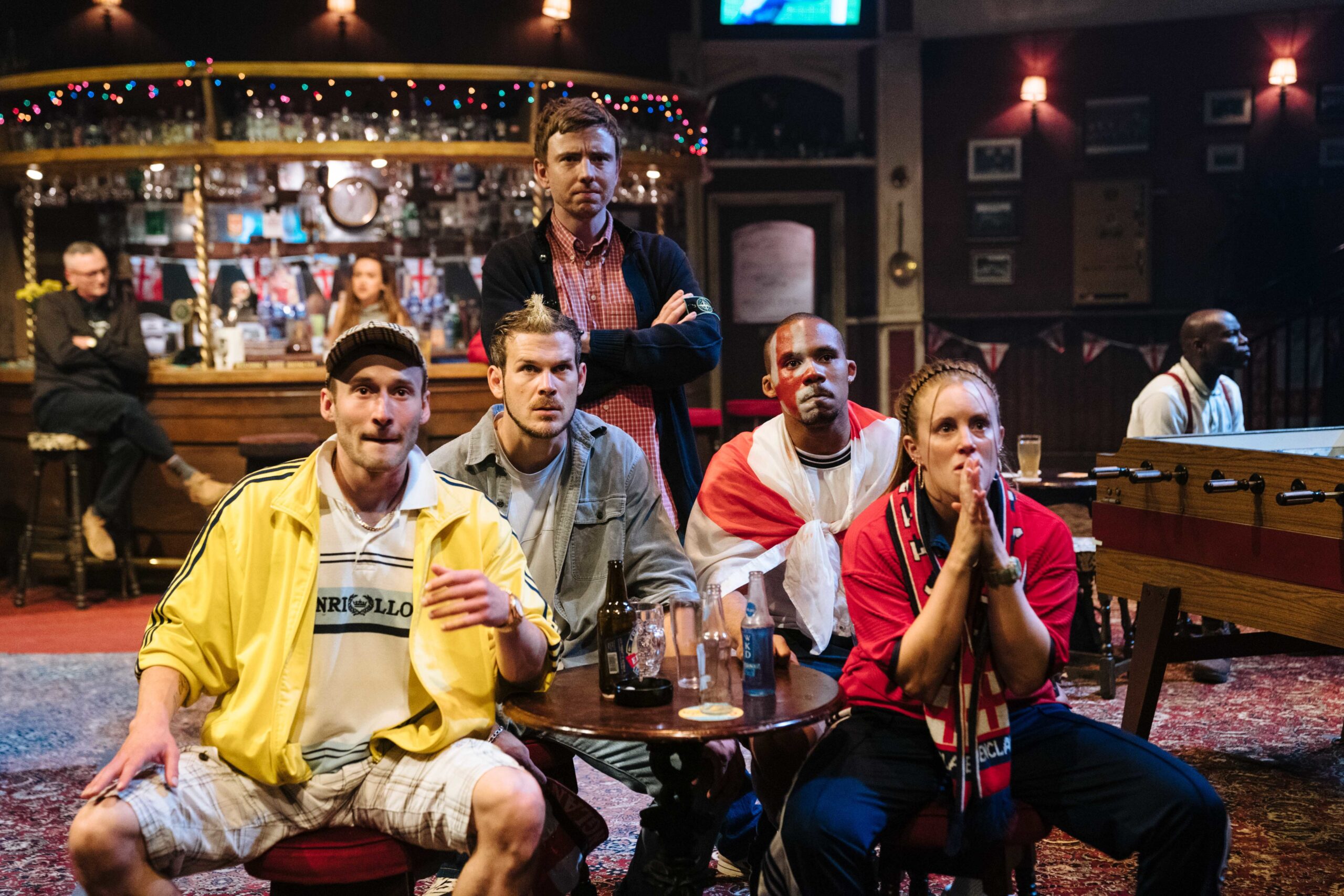
Sing Yer Heart Out For The Lads – Chichester – review

Roy Williams’ portrayal of racist England supporters retains its power

★★★★★

Production photo from Sing Yer Heart Out For The Lads at Chichetser 2022 showing members of the cast
Sing Yer Heart Out For The Lads. Photo: Helen Murray

Seeing Roy WilliamsSing Yer Heart Out For The Lads is not a comfortable experience but this is an important play in a flawless production from Chichester Festival Theatre. I suspect some people may think this is a play about football. It isn’t. It takes us to the heart of the dark side of English football supporters- the so-called hooligans, the ones who chant racist remarks, the ones who nowadays abuse black players on social media- and those who let it happen.

Racism exists in all corners of society but this play looks at a microcosm, the working class (or mainly working class) tribalism that afflicts the national game. It has its funny moments but for the most part, Sing Yer Heart Out For The Lads is horrifying.  I came out shocked to the core by this forensic exposure of racist, nationalist England.

We meet the all too believable characters in the King George pub in London where they have assembled to watch England play Germany in the year 2000. To an extent, they are representative of various kinds of working class people, but Roy Williams imbues them with a complexity that takes them far beyond stereotypes. He writes natural-sounding dialogue that is fitting for each character but that also sparkles and punches. (If you’ve heard his BBC Radio 4 series The Interrogation, you’ll be familiar with his ability to create convincing conversation.) He is truly one of our finest living playwrights.

The play was first performed in 2002. I’d like to think we’ve moved on to a more equal and tolerant society since then, and perhaps we have a little, but there is still an unacceptable amount of racism around, as the Black Lives Matter campaign has shown, and as revealed, for example, by the report into racism at Yorkshire County Cricket Club.

Connected with racism, as the ‘England supporters’ in the play show, we are plagued by a kind of nationalism that goes beyond pride in one’s country to hatred of foreigners and immigrants. As Billy Bragg said recently: ‘Not everyone who voted Brexit is racist, but every racist voted Brexit.’

Fun set houses a serious play

This is a revival of the Chichester production which was first performed in 2019 in the so-called Spiegeltent. Nearly all of that cast has reassembled, and the immersive set, conceived by the original director Nicole Charles, is also reproduced but on a larger scale.

The first thing you see is the set, designed by Joanna Scotcher. It replicates in painstaking detail a traditional London pub, which overflows into and beyond the auditorium. Some of the audience sit around the perimeter of the set like drinkers in the pub. It’s actually a working bar and I had a drink there during the interval, perched on a barstool. Screens that show the match double as CCTV showing us private conversations.

But the fun stops as soon as the play begins. We meet and get to know these characters, some of whom are members of the pub’s football team, all there to watch England playing Germany in a game of football. Some are out-and-out racist; some are covert racists; some hide and are maybe even unaware of their racism, however it comes out at times when emotion takes over.

Production photo from Sing Yer Heart Out For The Lads at Chichester's Minerva Theatre 2022 showing Michael Hidgson and Richard Riddell
Michael Hodgson & Richard Riddell in Sing Yer Heart Out For The Lads. Photo: Helen Murray

At one extreme is Lawrie, an angry skinhead played by Richard Riddell as so close to boiling point that his face is lobster red. We can see that all of these people have reasons to resent their lowly position in society and that aggressively supporting their football team may give them some reflected status. But Lawrie is more than that. He is a psychopath looking for anyone to kick. At his side, whispering in his ear, is Alan, played with a cold voice and dispassionate demeanour by Michael Hodgson. He’s an articulate man who proudly justifies his sense of racial superiority. Like the leaders of fascist parties through the ages, he manipulates ignorant people like Lawrie to do his dirty work.

There are two black people in the group: Mark and his younger brother Barry. Mark has been in the army and fought for his country only to find that his country doesn’t seem to regard him as truly British. We discover that his own behaviour as a soldier has been brutal. Mark Springer plays him as superficially calm but with a low-key resentment that rumbles across the pub floor.

Makir Ahmed is Barry, the team’s star player. He knows that his teammates are racist, to a greater or lesser extent, but chooses to ignore that in an attempt to fit in. He even chants about winning World War Two (an event over 40 years before, even in 2000) and describes in mysoginistic detail what he’d like to do sexually to Victoria Beckham. These moments are cringeworthy but show how the disenfranchised fantasise about having power.

Also trying to fit in is Jess, played by Kirsty J Curtis, who goes over the top in what I interpreted as an attempt to be one of the lads, by using the most continuously and aggressively obscene language of any of them.

Steven Dykes is Jimmy, the father of the pub landlady. He represents an older generation which doesn’t like change. The play begins as he’s preparing the pub and singing a Kinks song. A deliberate choice, I suspect, as the Kinks started by playing a version of American rhythm and blues before they went on to epitomise a certain kind of English nostalgia. Ironically Jimmy can’t understand why his grandson Glen (Jem Matthews) is attracted to American rappers, and he bullies the sensitive teenager for being too soft.

Gina is the woman whose name is above the door. In a nuanced performance, Sian Reese-Williams shows her as someone used to getting her way through charm but having no control over her son or her customers. She threatens but never takes action over racist or aggressive behaviour. In this respect, she can be seen as a symbol of the rest of us, the majority in society who are against racism but don’t confront it.

Lawrie’s brother Lee is another example. He is an off-duty police officer, ostensibly against prejudice, but constantly turning a blind eye to Lawrie’s violence and racism. ‘I didn’t hear that’, he quips. His conflicted personality is conveyed brilliantly through haunted eyes, sagging shoulders and sudden violence by Alexander Cobb.

We do see that confronting bad behaviour works when teenager and would-be gangster Bad T (Duramaney Kamara) is not allowed to get away with bullying.

Harold Addo, Simon Armfield, Rob Compton and Jennifer Daley make the remainder of this talented, pitch perfect cast.

Well orchestrated crescendo of violence

As the match progresses, and goes badly for England, the tension grows, and an explosion by Lawrie becomes ever more likely. His racist comments are more and more explicit but, when the violence comes, it’s from an unexpected direction. I won’t say more about that for fear of spoiling the end but I will say that, in a shocking play, the crescendo of action was so well orchestrated that I was shaking at the end.

Massive credit must be given to the original director Nicole Charles, the director of the revival Joanna Bowman, movement director Chris Whittaker and fight director Kate Waters.

I felt I needed a shower after being in the company of this group of ‘England supporters’. If there is a message in this play, it is that racism will flourish unless we all take a stand against it whenever we encounter it on a personal level. And that you can’t fight something unless you understand it. Not only will this play give you greater understanding, it will stay with you.

Sing Yer Heart Out For The Lads performed  at Chichester until 13 August 2022. Click here for CFT website

Paul was given a review ticket by the producers.

Click here to watch a video of this review on the One Minute Theatre Reviews YouTube channel


×