Review: Cabaret at the KitKat Club

Total Theatre with a message for our times

The KitKat Club at The Playhouse

⭑⭑⭑⭑

Hannah Dodd, Rob Madge & the company of Cabaret at the KitKat Club. Photo: Marc Brenner

It’s taken me four years to get round to seeing Cabaret at the KitKat Club, the venue formerly known as The Playhouse. The original stars of Rebecca Frecknall‘s production, Eddie Redmayne and Jessie Buckley, have long gone, and indeed many other pairs have played The Emcee and Sally Bowles in the intervening years. Even Rob Madge and Hannah Dodd, whom I saw, have now moved on.  But Cabaret at the KitKat Club remains the best show in London’s West End, and should be seen by anyone who loves musical theatre. Having said that, in my opinion, it’s not the best production of Cabaret ever. 

Rebecca Frecknall isn’t the first director to come up with the idea of turning the whole theatre into the KitKat Club, that being the name of the venue where the cabaret part of the musical takes place. I saw a production in Berlin back in 2018 that did just that. And most famously, and possibly the first to do it, was Sam Mendes‘ production at the Donmar Warehouse back in 1993. But I doubt anyone has done it with such complete dedication and thoroughness as Ms Frecknall.

You, the audience, are invited to get to the theatre an hour or more before the show begins. Even the outside of the old Playhouse has been rebranded the KitKat Club. You enter through the Stage Door, and go straight into the basement. Normally the secret home of dressing rooms, the main corridor has been changed into a bar area with subdued lighting and performers playing music and generally standing around looking degenerate. significantly, the signage is in English and German. Oh, and you’re offered a free shot of Schnapps. So, from the start, you are immersed in the decadence of Berlin’s hedonistic nightlife.

Then, it’s up the stairs to another bar where sexily clad dancers and musicians of indeterminate genders entertain in the sultry style of the Jazz Age. And so into the main house. The first shock is that the seating and layout of the old Playhouse has been completely ripped out. Instead of a proscenium arch stage and straight rows of seats, the circular stage area is in the middle of the auditorium with the audience on two sides, traverse style. Tables and chairs are in the immediate areas on either side of the stage. These are very expensive by the way, and have given the show its reputation for being high priced.  Beyond them are much more reasonably priced rows of seats, which are curved thus adding to the feeling of intimacy.

My row, which was G about six from the front, had a great rake, fantastic legroom and even a shelf for drinks. There are similarities with the Mendes production- it too utilised a small bare stage with some of the audience sitting at tables in front of it but in this production, we are all  in the KitKat Club circa 1929. This is total theatre that couldn’t be anything but a live show. Special credit here to Tom Scutt‘s set and costume design.

The dance and music continues as we wait for the show to begin. Our Emcee tonight is Rob Madge, who is fabulous as a threatening clown. It’s a part that can be played more sympathetically but Rebecca Frecknall chooses to go with the ‘leave your troubles outside’ cue and makes him lascivious, waspish, amoral and apolitical. So when he sings I Don’t Care Much in the second act, a song you won’t recognise if you only know the movie, there is no bravado, no irony, he really doesn’t seem to care.

Interestingly when Hal Prince first put together the musical in 1966, the Emcee was there to hold the show together but was not considered a major character. Joel Grey- and the audiences- changed all that. Now he is the conduit between us and the stories. And because he is our guide, and this is theatre, where the relationship between each other and with those on stage is uniquely intense, we are carried along by the fun of the cabaret, and become onlookers at the world outside the club.

That’s where we meet the gay, or maybe bi-sexual, American journalist Cliff – a sensitive performance from Daniel Bowerbank when I saw it- who becomes friendly with a Nazi called Ernst and a nightclub singer called Sally Bowles with whom he falls in love. More of her in moment, but first the other love story. Cliff’s landlady Fraulein Schneider falls in love with a Jewish fruiterer called Herr Schultz. It is a delicate romance between two lonely people in their autumn years, touchingly conveyed by Vivien Parry and Fenton Gray. Their songs It Couldn’t Please Me More and What Would You Do tighten the chest. As Act One ends, their relationship is broken up by the Nazis.

All this is taking place on the same bare stage that is the focal point of the KitKat Club. So we can quickly switch to cabaret songs which are a commentary on the stories: The Emcee sings and performs Two Ladies, parodying Cliff’s bisexuality. We hear the strirringTomorrow Belongs To Me quite early on, showing the apparently innocent but faintly sinister appeal of patriotism, that will drive the Nazi campaign. And If You Could See Her (the gorilla song) exposing the way the Nazis portray the Jews as sub-human.

The score is one of the best of all musicals with its evocation of the period, its exposition of character and plot, and its commentary on the action. There are so many great songs but two of the best are sung by Sally Bowles. I wasn’t sure about the jolly hockey sticks voice adopted by Hannah Dodd. Possibly Sally is meant to be putting on an act of speaking like the high society of the period, or perhaps she is simply a product of a 1920s finishing school. Anyway, Ms Dodd came into her own with the songs. Maybe This Time, first performed in the 1972 movie but now an integral part of the stage show, shows how on the edge Sally is. Desperate for love but also desperate to be something this naive English girl really isn’t- a hedonistic showbiz star. Her life is an vitreous act that could shatter at any moment, as it eventually does.

By the time, we reach the climactic singing of Cabaret, she has fallen apart, and hardly believes the sentiment of her late debauched friend Elsie that life is or should be a cabaret. She sees the mess of her own life and the way her idealised Berlin is succumbing to a sinister political group that won’t ‘live and let live’. The song is sung with anger and despair, not at all like the defiant Lisa Minelli version.

The second act sees the greatest divergence from the Sam Mendes production. In the earlier version, the KitKat Club carries on in its own blinkered way to the end, ignoring or mocking the Nazis until it is destroyed by them, in a shattering finale. In Rebecca Frecknall’s interpretation, the Nazi style gradually infiltrates the club. The costumes become bland, sandy coloured suits reflecting the Nazi uniform of brown shirts. We continue to be entertained but now, looked at objectively, we’re applauding or at least being complicit in the rise of the Nazis.

Either way works, and although I prefer the shock of Sam Mendes’ approach, the result is the same- a stark warning by the writer of the musical’s book Joe Masteroff and its composers John Kander and Fred Ebb against standing by and ignoring the rise of racist, authoritarian politicians under a banner of patriotism.

You leave having witnessed an evening of theatrical entertainment unequalled in the West End today, while this regime was being constructed round you.  Point made.

If you would like a flavour of the Sam Mendes production, there is a slightly blurry film of it, made for television, and available on YouTube.

Paul paid for his ticket.

Click here to watch this review on the YouTube channel Theatre Reviews With Paul Seven


Review: Ruth Wilson & Michael Shannon in A Moon For The Misbegotten

A long evening lit up by Ruth Wilson

Almeida Theatre


⭑⭑⭑⭑⭑

Ruth Wilson & Michael Shannon in A Moon For The Misbegotten. Photo: Marc Brenner

I admit there were moments when I thought Eugene O’Neill’s A Moon For The Misbegotten could hurry I up a bit but I came to appreciate this is a play where every word- and the unspoken words- count, and I appreciated the way that director Rebecca Frecknall deliberately made space to let this time bomb of a play achieve its impact.

It’s a kind of sequel , or perhaps an epilogue, to A Long Day’s Journey Into Night. It features Jamie Tyrone, one of the sons from that play, now known as Jim, and refers to his late mother and father. He is landlord to Josie Hogan and her father Phil. He seems benign but Phil fears he will sell their farm, so hatches a plot by which Josie will seduce Jim and he will be forced to marry her. Which is ironic because they do actually desire one another.

At first Josie comes across as a confident, independent woman, able to handle herself and the men around her, including her cynical, mean father. Playing the part is Ruth Wilson, at first swaggering and fearless, striding confidently and literally wielding a big stick. But from the beginning we sense a brittleness behind the bravado. We also see she is selfless, and, as the play progresses, this aspect of her character manifests itself in her approach to Jim and Phil. The gradual cracking of the shell she has built around herself is shown by Ms Wilson in multiple small ways. She becomes increasingly tender, as she admits the truth about herself and sees the reality of others   It could be the acting performance of the year.

Michael Shannon’s Jim, an alcoholic, is clearly a broken man but a gentle one who seems to be drowning his sorrows not only in booze but in casual encounters with women. His falsetto laugh and sad face hint there is more to him than a drunken womaniser, and his deliberate movements are not only those of a bourbon-soaked body but also of a man who hates his own being. As he moves from destructive self hate to a kind of temporary redemption, a calm takes over his body.

Ruth Wilson & David Threlfall in A Moon For The Misbegotten. Photo: Marc Brenner

What emerges over the length of the play is a gradual peeling off of the images Josie and Jim project to cover their insecurity and the discovery of the reasons they feel vulnerable, which are very much tied up with their parents- hence the ‘misbegotten’ of the title.

There are wrong assumptions and misunderstandings, especially over what they actually desire, and many moments in which there are two steps forward and one step backward, before a finale when their true feelings are laid bare. I called it a bomb earlier but I don’t want to imply the end is explosive- it’s softer and more moving than that, but there are some dramatic incidents on the way.

Rebecca Frecknall’s slow unwinding of the play would not be so mesmerising  without actors of the calibre of Ruth Wilson and Michael Shannon, not to mention the inimitable David Threlfall, who totally convinces as a wily old farmer whose twinkling eyes betray his love for his daughter.

Tom Scutt’s circular set, made of battered wood conveys the poverty of the farm business. Jack Knowles’ lighting design centres on a moving spot high up at the back of the stage which moves its beam across the scene and the characters. It powerfully represents a moon which witnesses and encourages their revelations.

Maybe O’Neill could have written a shorter play, but I wouldn’t want to mess in any way with this perfect production.

A Moon For The Misbegotten can be seen at the Almeida Theatre until 16 August 2025. Buy tickets direct from the theatre.

Paul paid for his ticket.

Watch this review on YouTube

Read a roundup of other critics’ reviews here

The House Of Bernada Alba – National Theatre – Review

Harriet Walter leads first rate cast in revitalised Lorca classic

★★★★

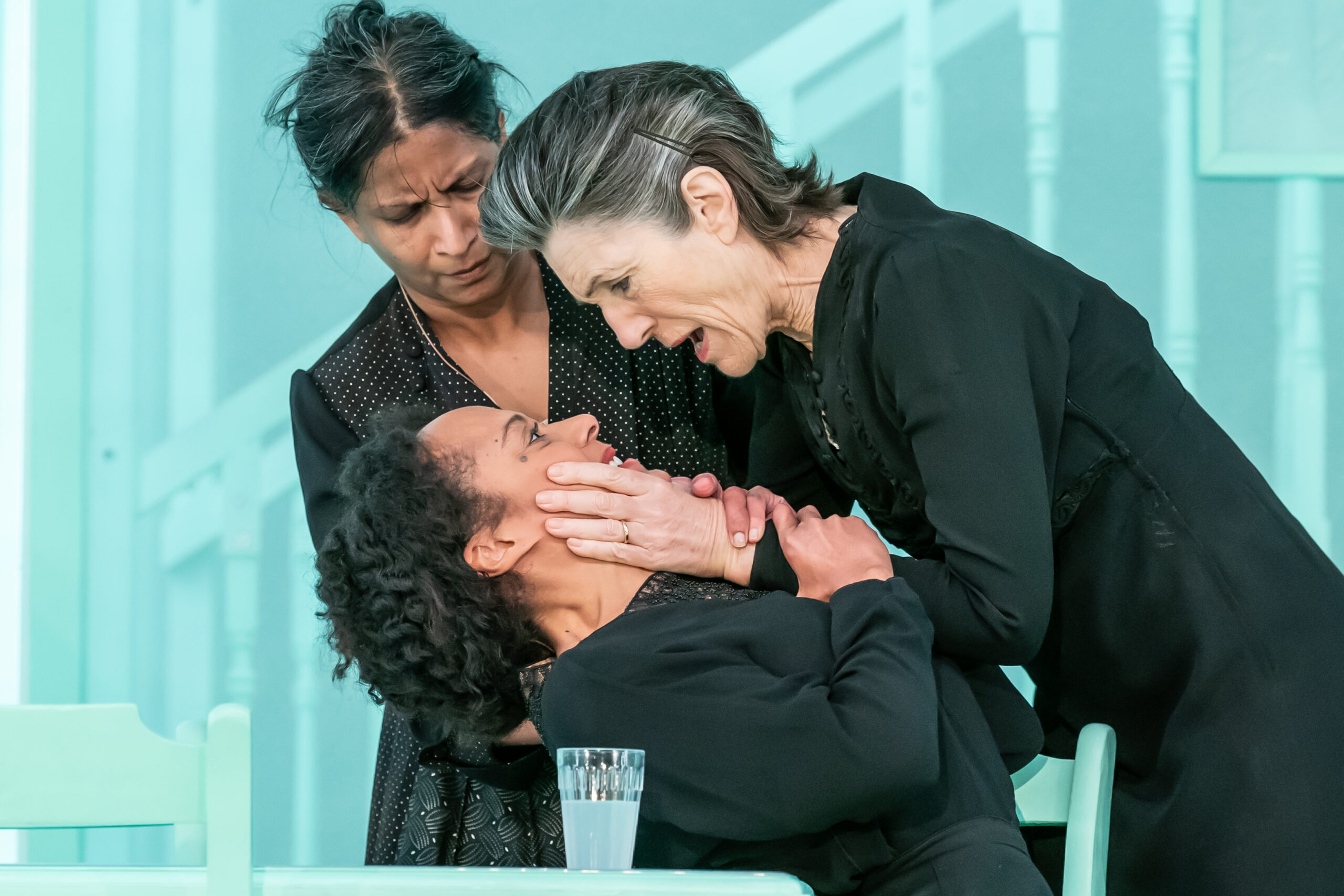
Rosalind Eleazar, Thusitha Jayasunde & Harriet Walter in The House of Bernarda Alba. Photo: Marc Brenner


This National Theatre production isn’t for everybody. If you’re familiar with The House of Bernada Alba by Federico Garcia Lorca, you’re going to have to put it out of your mind. Alice Birch‘s version is a devastating dissection of an authoritarian household and the malign influence of men. Rebecca Frecknall‘s production offers some of the finest acting you could hope to see, and not just from Harriet Walter. If the beginning is a little disjointed, messy even, the second half is theatre at its best.

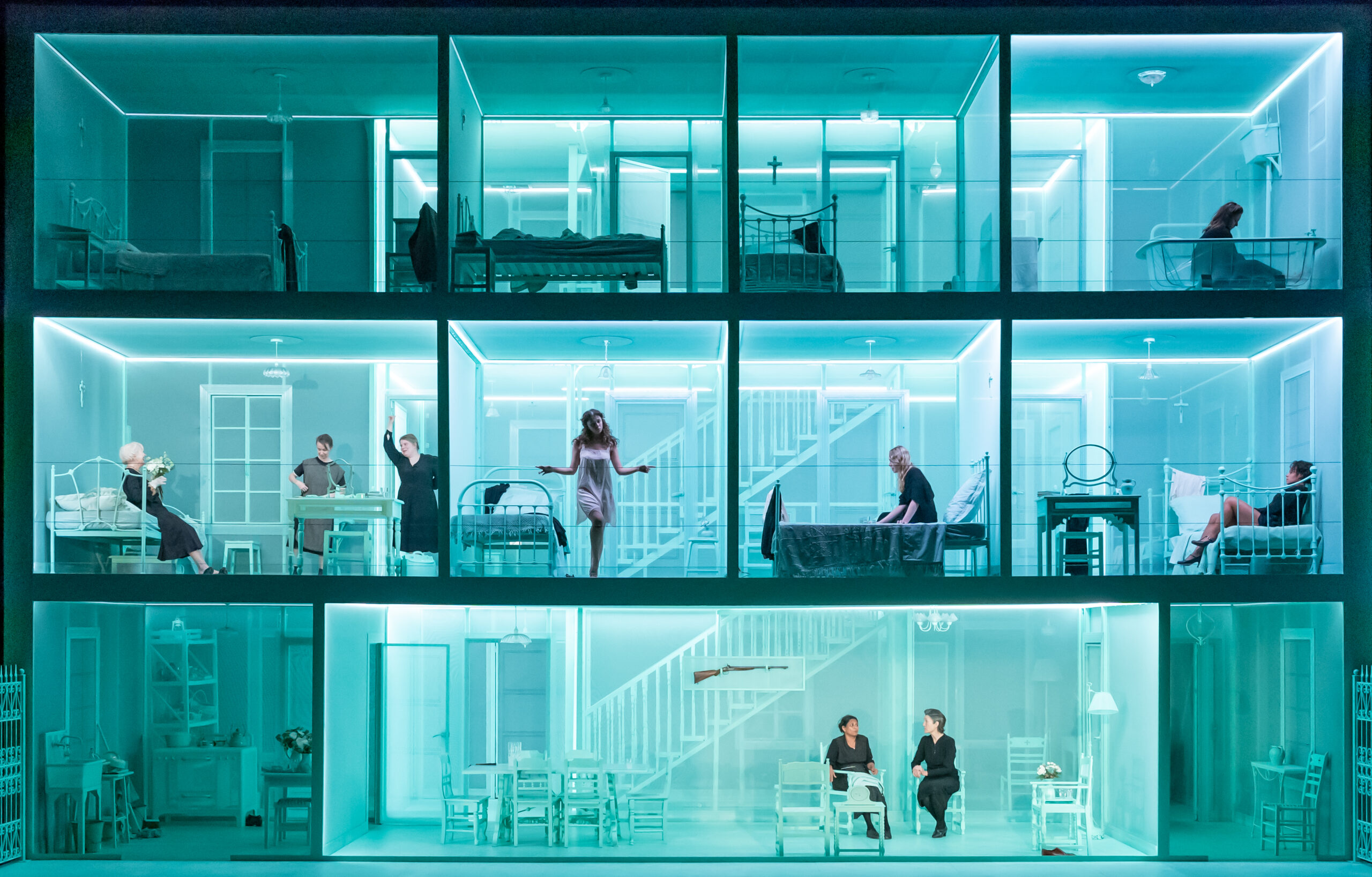
Sometimes you enter an auditorium and the set is already laid out before you. Not on this occasion. Instead you wait for the Lyttelton safety curtain to open. When it does, it reveals Merle Hensel’s magnificent house, filling the giant stage from top to bottom and right to left. It’s on three storeys with seven separate bedrooms and a bathroom on the top two levels, and, thanks to transparent walls, you can see its full depth. So there is no escape, no privacy for the five daughters of Bernarda Alba, we even see one of them masturbating. And that’s very much the dominant theme of this production: Bernarda rules her daughters and believes she knows everything that’s going on.

The complete set including props is a pale green colour, except for a rifle sinisterly centre stage, which is the trigger- no pun intended- for the devastating end. The colour is not only the least distracting you could choose but it provides the starkest of contrasts to the black clothes of the women, whose husband and father has been buried that day. Bernarda declares eight years of mourning to the horror of her unmarried daughters.


The House of Bernarda Alba at the National Theatre. Photo: Marc Brenner

At first, as we get to know the household, there is much chatter and gossip from many women who have gathered after the funeral. Bernada says nothing but sits rigidly. She is a woman of few words. Harriet Walter gives a masterful performance in which less is more. She exhibits a cold stare, an imperious pose, and, when she does speak, it is without emotion. Bernada Alba has learned to survive in a man’s world by revealing no weakness.

The daughters are rebellious individuals but this is 1930s Spain and there is no escape for them. So, they are cowed by Bernarda and contain their thoughts, breaking out occasionally as when the oldest puts on makeup or the youngest a bright green dress. They are forbidden to fraternise with men, however Angustias, who is from Bernada’s first marriage, is the only daughter with money, which gives her an escape route. Her wealth has attracted a suitor, Pepe de Romans, and she is due to wed. Her fiance is an obsession of at least two of her sisters who both exhibit a dangerous jealousy. All the women are fearful of and fascinated by men generally, and Pepe in particular.

Spain in the 1930s was a patriarchal society. No doubt Lorca intended his audience to see parallels with an authoritarian society in which the people are forced into conformity, and this is why the play retains such power today. Bernarda Alba, like many in such a situation, does the job of the patriarchy for it by teaching, and expecting, her daughters to treat men with caution and respect.

She makes the house a female bastion against the male-dominated outside world, female but not feminist. ‘Men are capable of anything’ it is said, and there are hints, and more than hints, that men have and do behave despicably.
Her rule is cruel and dictatorial. Toward the end of act one, when one of her daughters does something wrong, the punishment is brutal and disproportionate. The first act ends with a shocking scene in which the house is invaded by a lynch mob chasing an ‘sinful’ young woman.

In Lorca’s original play, we never see Angustias’s fiance. In Alice Birch’s generally superb rewriting of the play, we see him silently moving across the stage in balletic manner. This underlines that he is a romantic fantasy, because we can see that in the flesh he is quite ordinary. Even so, I still prefer Lorca’s idea of him living in the imagination as an invisible presence hanging over the household.

As the play progresses to its tragic end, we see that Bernada is not as all-seeing as she thinks, and that her control is illusory.

The cast is uniformly brilliant. Angustias, the sickly and psychologically damaged eldest daughter, is played with layers of aloofness and vulnerability by Rosalind Eleazar. Isis Ainsworth provides an extraordinarily strong performance as the youngest sister Adela, in love with Pepe, defiant, and with emotions out of control. Lizzie Annis, Eliot Salt and Pearl Chanda are the other three sisters, also excellent. Eileen Nicholas is the senile grandmother who is locked in her bedroom. Thusita Jayasundera and Bryony Hannah are the servants who provide both honest comments and humour.

Rebecca Frecknall, after her recent successes directing Cabaret at The Playhouse and A Streetcar Named Desire at the Almeida, has triumphed again with this forceful production.

The House Of Bernarda Alba can be seen at the National Theatre until 6 January 2024

Paul was given a review ticket by the theatre.

Watch this review on the YouTube channel Theatre Reviews With Paul Seven

×