She Did It! Rachel Kavanaugh’s production and newcomer Keziah Ibe’s Eliza hit the right notes
Chichester festival Theatre
⭑⭑⭑⭑
Keziah Ibe & Hadley Fraser in My Fair Lady. Photo: Johan Persson
Let’s start at the beginning. Except, where is the beginning? The overture is missing! I love an overture. It sets the mood and fills you with anticipation.
But it seems churlish to complain when Rachel Kavanaugh‘s production plunges you straight into the uplifting story of an impoverished cockney flower seller called Eliza Doolittle. She soon encounters and confronts Professor Henry Higgins, an expert in phonetics. The musical establishes their characters from the get-go, so we the audience glimpse from the start the quality of the two stars on which the musical stands or falls.
Higgins is entitled, lacking social skills, self centred, insensitive and misogynistic but in Hadley Fraser’s hands, this is leavened by his child-like enthusiasm. He’s often shown in production as stiff and distant but here his sheer bullheaded enthusiasm- and Groucho Marx-like postures- make him more loveable than expected.
Eliza is feisty and ultra aware of her inferior position in society. Keziah Ibe, making her theatrical debut, gets the mix right. And she nails the first big song of the night Wouldn’t It Be Loverly? That’s a relief because a lot of big songs are coming her way, which she goes on to sing beautifully and with expression.
So it’s game on as Higgins and his friend Colonel Pickering set about transforming this ‘squashed cabbage leaf’ as he calls Eliza into a Lady. It’s worth noting that Eliza initiates the process by offering to pay for lessons- an entrepreneurial move that flies in the face of Higgins’ sexist views, as expressed in Why Can’t A Woman Be More Like A Man?
This is the first time 60 year old Chichester Festival Theatre has presented My Fair Lady. So how do the open spaces of the huge thrust stage with no capacity to fly in scenery convey the spectacle? Not with big sets. The lavish Embassy Ball at which the transformed Eliza triumphs is represented by, in effect, a few standard lamps, the ‘street where she lives’ is two lengths of iron fencing, Ascot Races an empty stage. The Chichester ‘wow’ factor, picking up from the musical’s use of the ensemble to provide a kind of Greek chorus, is to fill the stage with people.
So we have Gary Milner as Eliza’s dustman father Alfred P Doolittle leading an exuberant chorus of around twenty through Stephen Mear’s complex choreography in With A Little Bit Of Luck and I’m Getting Married In The Morning, as well as a more restrained but still impressive circle of racegoers. It’s not completely sparse of scenery. There is one magnificent set, namely Henry Higgins’ study. Designer Peter McIntosh has created a massive truck that sweeps on and off stage, full of cluttered corners and different levels for the actors to weave and jump through.
It’s easy to understand why some consider My Fair Lady the perfect musical. Lerner and Loewe‘s songs consistently reveal character or advance the narrative, possibly even more so than those of the great Rodgers And Hammerstein who invented the modern musical. And they’re nicely played by a small orchestra under Cat Beveridge.
Keziah Ibe performs the songs with great eloquence. Her high point is also the apex of the musical itself, the moment when she is so excited at getting the pronunciation right in The Rain In Spain. It’s a moment of euphoria for Higgins, Pickering and Eliza that leads her into the incomparable I Could Have Dance All Night.
There is also a lot of dialogue, perhaps this was because Lerner, who wrote the book as well as the lyrics, wanted to give due respect to George Bernard Shaw‘s socialist message in Pygmalion, on which the musical is based. There’s a lot of conversation about class divisions and the importance of language as a marker of class: Shaw’s point being we’re all people with the same qualities and faults under our disguises. So you need good actors, which this production has assembled in spades.
A loverly production
Gary Milner & company in My Fair Lady. Photo: Johan Persson
In the end, Eliza undergoes more than a superficial transformation. She realises there is more to happiness than a romantic husband and a ‘loverly’ room. And she has learned from those around her that there is more to class than how you speak. From Colonel Pickering, well played by Tony Jayawardena, she learns politeness and respect, although he is shown to be a bit of a dunderhead. From her father, she acquires cynicism. From Higgins, she not only acquires received English but the value of being honest to oneself and others. She also learns what she doesn’t want when she is courted by the full hearted but empty headed Freddie, nicely played by Ben Culleton. He performs On The Street Where You Live. It’s my favourite song from the musical even if it is, as the programme points out, evidence that ‘his head is too much in the clouds’. I guess I’m an old romantic.
Eliza also observes the women in Higgins’ life as a model for dealing with him. His housekeeper Mrs Pearce and his mother, given strong, humorous portrayals by Finty Williams and Belinda Lang respectively, maintain a balance between loving him and being honest with him.
Eliza initially leaves because she feels unrecognised for her achievement. (Higgins and Pickering take all the credit in the song You Did It, behaving as so often like two little boys). Ultimately Eliza recognises he can’t help being what he is, but, more than that, he has a depth of character that the featherweight Freddie or the pliant Pickering haven’t. Most importantly, in this production, it is clear she realises she wants to be with him as an equal.
For his part, Higgins seems more stuck in his ways and shows less development, but he learns to feel love for another person, or as he puts it, I’ve Grown Accustomed To Her Face. Hadley Fraser delivers the song with great poignancy from the front of the stage, despite the difficulty of bringing emotion to songs that are virtually spoken, this in deference to the non-singing Rex Harrison who first played Higgins. Rex? Forget him. Hadley takes the crown.
As a love story, it’s highly unlikely and potentially offensive to feminists. The problem is exacerbated because the coming together of Higgins and Eliza was not the climax intended by Shaw. Quite the opposite: the professor was to be left a sad and sorry man by the newly independent woman. However, Rachel Kavanaugh, supported by her fabulous cast, makes it work by avoiding extreme portrayals and emphasising friendship and respect as the basis for their relationship. Well done, Ms Kavanaugh, You Did It!
Lucy St Louis & Phillip Attmore in Top Hat. Photo: Johan Persson
Every year I look forward to the Chichester Festival Theatre musical. Among the first class revivals of recent years have been Oliver!, South Pacific, Crazy For You with the incomparable Charlie Stemp, and Gypsy with Imelda Staunton. This year, they have chosen Top Hat, and, while it may not reach the heights of the aforementioned hits, it does not disappoint. There’s already an extensive UK tour booked for it, so you will have the chance to see for yourself.
Once again, Chichester have put together a mouth watering feast. Top Hat is primarily a tap dance show- it was written for Fred Astaire- and the dancing here is creme de la creme. Choreographed, as well as directed, by the great Kathleen Marshall, who was responsible for the London hit Anything Goes, the solo dances, the what you might call Fred and Ginger numbers and the chorus line work are all masterclasses in how it should be done. The sound of the tap is music in itself and 16 dancers or thereabouts combining to stamp the floor at the same time is explosive. The discipline, especially of the chorus lines, is genuinely awesome, as arm-in-arm they make a circular movement, all the while high kicking. Ms Marshall’s choreography is exuberant, uplifting and joyous.
A brief word about the story. A superstar tap dancer called Jerry falls in love with a woman called Dale but, owing to a misunderstanding, she thinks he’s his friend Horace, husband of her friend Madge. Spoiler alert- it all works out in the end.
Then there’s the music. Irving Berlin wrote 1500 songs throughout a long career but the five he wrote for the original film represent him at his peak and extending his ability to write songs that serve the story: No Strings establishes the carefree character of Jerry, as well as his prowess as a tap dancer; Isn’t This A Lovely Day starts with Jerry and Dale in a standoff but reveals her increasing attachment to him as the song progresses; Cheek To Cheek, the centrepiece of the musical, shows Jerry seducing Dale through the power of dance- a true representation of the saying ‘dance is the vertical expression of a horizontal desire, with climactic moments as he swings her through the air; and then there are the two big chorus line numbers Top Hat, White Tie And Tails and The Piccolino, which end the first act and begin the second in the stage version. All praise to Stephen Ridley and the 10 piece orchestra for their swinging sound.
Top Hat, released in cinemas in 1935, only became a stage musical in 2011 when it was adapted by Matthew White and Howard Jacques. There are many more Berlin tunes added, quite a few plundered from other Fred and Ginger movies, including Puttin’ On The Ritz, I’m Putting All My Eggs in One Basket, Let Yourself Go and Let’s Face The Music And Dance.
Top Hat at Chichester Festival Theatre. Photo: Johan Persson
The six principals are superb, and the ensemble is wonderful. The hardest task goes to Phillip Attmore. How to step into the shoes of Fred Astaire? Not to mention that the show itself refers to him as a world-class dancer. And, unlike the legendary star, he has to perform live. He may not quite be Fred Astaire (who is?) but he is a likeable lead and an accomplished dancer.
Lucy St Louis as Dale is the full package. She has a powerful singing voice, acts well and dances beautifully. For me she was a revelation, although I shouldn’t be surprised, because she’s already played Glinda in Wicked and Christine in The Phantom Of The Opera (you may have seen her perform at the Platinum Party At The Palace).
Clive Carter and Sally Ann Triplett as Horace and Madge provide a weight of experience and a huge dose of comedy. James Clyde as Horace’s servant Bates in various disguises, and Alex Gibson-Giorgio as Alberto, a comical Italian fashion designer and Dale’s would-be lover also keep the laughs coming. I know it’s no longer acceptable to make fun of foreigners who don’t speak English as well as us- ‘I am very displeased to meet you!’- but such lines were written a long time ago.
There is a great deal of funny lines, or perhaps corny jokes would be a better description. Here are a couple of examples: Horace is afraid of flying because the first word you see on signs at the airport is ‘Terminal’. He also explains that a man is incomplete until he’s married- ‘Then he’s finished.’ But that’s very much in the mood of this light comedy which, as I said, is about dance first, then music, and only then comedy to fill the gaps.
Peter McIntosh‘s luminous art deco set is very clever. The thrust stage is kept clear for dancing, although there are semi-circular rises. At the back there is a revolve that swiftly takes us from one bedroom to another bedroom to a bar. He along with Yvonne Milnes also designed the costumes which have the loose, easy-going feel of the 1940s rather than slavishly copying the 1930s style of the film.
I left the auditorium on a high. Top Hat on stage may not have the wow factor of Crazy For You or Anything Goes. But then again there were no equivalent films to compare them with, so it is disadvantaged by not being able to match the perfection of the film. On the other hand, the fact that it is performed live, and you can see a group of supremely talented people right there in front of you creating beautiful, athletic, complex dance together to some of the greatest songs ever written, makes Top Hat at Chichester Festival Theatre, despite any imperfections, a joy better than any flickering screen.
Crown star Emma Corrin is mesmerising in comedy about gender freedom
★★★★
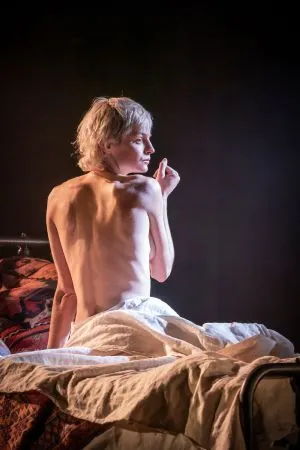
Emma Corrin in Orlando. Photo: Marc Brenner
It may be nearly a hundred years since Virginia Woolf wrote the novel Orlando, but it’s only todat that our society has caught up with its story about the fluidity of gender, desire and time. As the novel, quoted in the play, says: ‘If you can just live another century.’
Emma Corrin, probably best known as young Princess Diana in The Crown, plays the eponymous protagonist. When the play begins, Orlando is a young male aristocrat in the court of Queen Elizabeth I.
In our first encounter with him, we catch a glimpse of a penis. It’s a startling and funny moment that sets the scene for the rest of the evening. His trusty servant-come-dresser-come-tutor-come-guardian angel Mrs Grimsditch tries to get him to put his trousers on. Deborah Findlay is funny, warm and down-to-earth, providing a necessary foil for Emma Corrin who gives a mesmerising performance as the romantic, confused, freedom-loving hero. The symbolic trouser-wearing is a motif throughout the play.
Even if they prefer the non-binary pronoun ‘they’, Emma Corrin, of course, doesn’t have a penis. It’s a theatrical prop. Before long, Orlando has lost that organ and mysteriously become a woman, as well as moving on many years to the court of James I without getting much older. To confirm the sex change, we catch a glimpse of her breasts, which I think were real but this is theatre, a world of pretence, so who knows?
In fact, theatre is a theme of this play. It moves through many theatrical styles as Orlando navigates from Elizabethan (a hint of Shakespeare) to Jacobean to Regency to Victorian times to the gradual liberation of the modern era. This substitutes for the literary journey that Orlando undertakes in the original novel. Theatre is not as effective a barometer for the changing attitudes to women, but it works nicely as a metaphor for being whatever you want to be.
To support the theme, Michael Grandage and designer Peter McKintosh have created a set that looks like a bare stage with brickwork and a large metal door. It’s populated with the trappings of a theatre- ropes and counterweights, a large costumes basket, a clothes rail, a stepladder and more. The set frequently features a bed that starts large and becomes much smaller in Victorian times (the worst of all periods for women). Having set up the theme, I think Neil Bartlett could have put it across more strongly in the script. There seems to be no equivalent of the constantly changing book that Orlando is writing and that provides a unifying thread through the novel.
From the start, this dramatised version offers the kind of inventive freewheeling imagination found in the original novel, because no less than nine Virginia Woolfs appear, speaking together and separately, to tell us the multi-faceted story of Orlando.
Emma Corrin in Orlando. Photo: Marc Brenner
Much as she liked being a man, Orlando likes being a woman more and that’s how they remain, as the play develops into a romp through three centuries of the history of women in our society. And just as there are many different Virginia Woolfs, Orlando discovers there are many different ways we can desire. They also realise that time is elastic rather than linear, and that (spoiler alert) life needs to be enjoyed go the full in the here and now. It is above all a story that lauds the freedom of poetic imagination above the prosaic.
Orlando finds out what it is to be a woman, an experience made more shocking by them having been a man. They experience the disturbing effect a bare leg can have on heterosexual men and the way misogynistic men subjugate women. They realise that women can love each other, that love and betrayal go hand in hand. They find that men and women can dress up as each other for practical as well as sexual purposes.
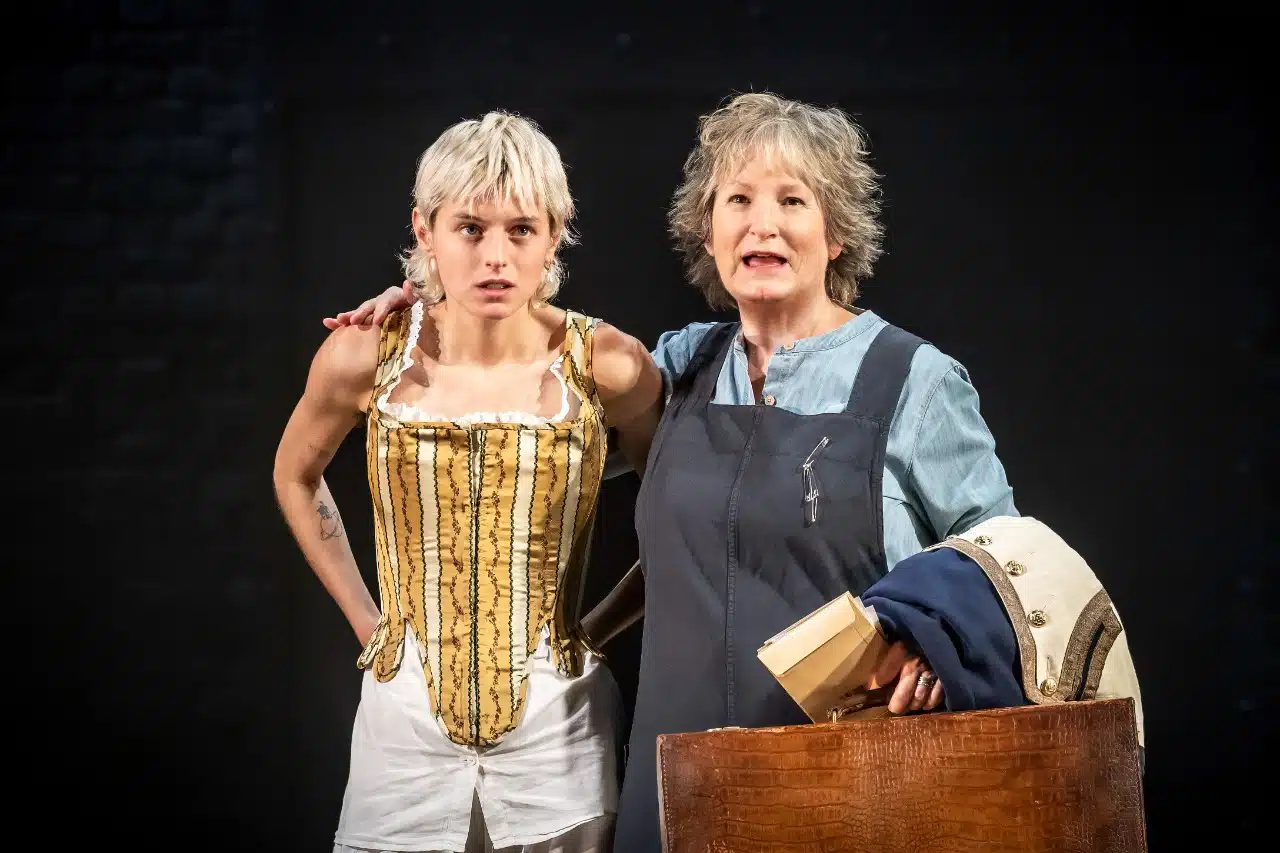
Emma Corrin and DEborah Fidnlay in Orlando. Photo: Marc Brenner
Orlando is an everyperson rather than an intrepid hero or overpowering genius. Emma Corrin is tremendous at portraying the inarticulacy of the character, the frequent lack of understanding, but also the enthusiasm and optimism. They dominate the stage with their wide eyes, knotted features, hesitant speech, squirming body and sparkling smile. It’s a performance that is both funny and sad, and thoroughly engaging. As with the relationship between Orlando and Mrs Grimsditch, Emma Corrin’s youthful exuberance is balanced by the twinkly-eyed experience of Deborah Findlay.
In a play where gender is fluid, an entirely female cast bar one takes on all the roles, which of course leads to some mockery of men. Lucy Briers memorably plays a blustering naval officer who moves like a bantam cock. She also provides a haughty Queen Elizabeth.
Although writer Neil Bartlett couldn’t hope to convey the depth and complexity of Virginia Woolf’s novel, he does pick the important themes and moments, and by introducing the author onto the stage we get to hear direct quotes from the novel in her stream-of-consciousness way of writing.
Missing, in this fast moving 80 minute play, were the deeper relationships. Orlando’s first love Sasha whom they never forget, is played with verve by Millicent Wong, and their last Marmaduke is given a sensitive portrayal by Jodie McNee. But these lovers flash by as we skim across the surface of Orlando’s life. Their journey is not always pleasant, but it is ultimately optimistic.
Orlando is an entertaining evening thanks in no small part to Emma Corrin who displays all the signs of being a great star of the stage.
Orlando is playing at the Garrick Theatre in London until 25 February 2023.
To provide the best experiences, we use technologies like cookies to store and/or access device information. Consenting to these technologies will allow us to process data such as browsing behaviour or unique IDs on this site. Not consenting or withdrawing consent, may adversely affect certain features and functions.
Functional
Always active
The technical storage or access is strictly necessary for the legitimate purpose of enabling the use of a specific service explicitly requested by the subscriber or user, or for the sole purpose of carrying out the transmission of a communication over an electronic communications network.
Preferences
The technical storage or access is necessary for the legitimate purpose of storing preferences that are not requested by the subscriber or user.
Statistics
The technical storage or access that is used exclusively for statistical purposes.The technical storage or access that is used exclusively for anonymous statistical purposes. Without a subpoena, voluntary compliance on the part of your Internet Service Provider, or additional records from a third party, information stored or retrieved for this purpose alone cannot usually be used to identify you.
Marketing
The technical storage or access is required to create user profiles to send advertising, or to track the user on a website or across several websites for similar marketing purposes.