Theatre review: All My Sons with Bryan Cranston

Bryan Cranston, Paapa Essiedu & Marianne Jean-Baptiste are the perfect cast

Wyndham’s Theatre


⭑⭑⭑⭑
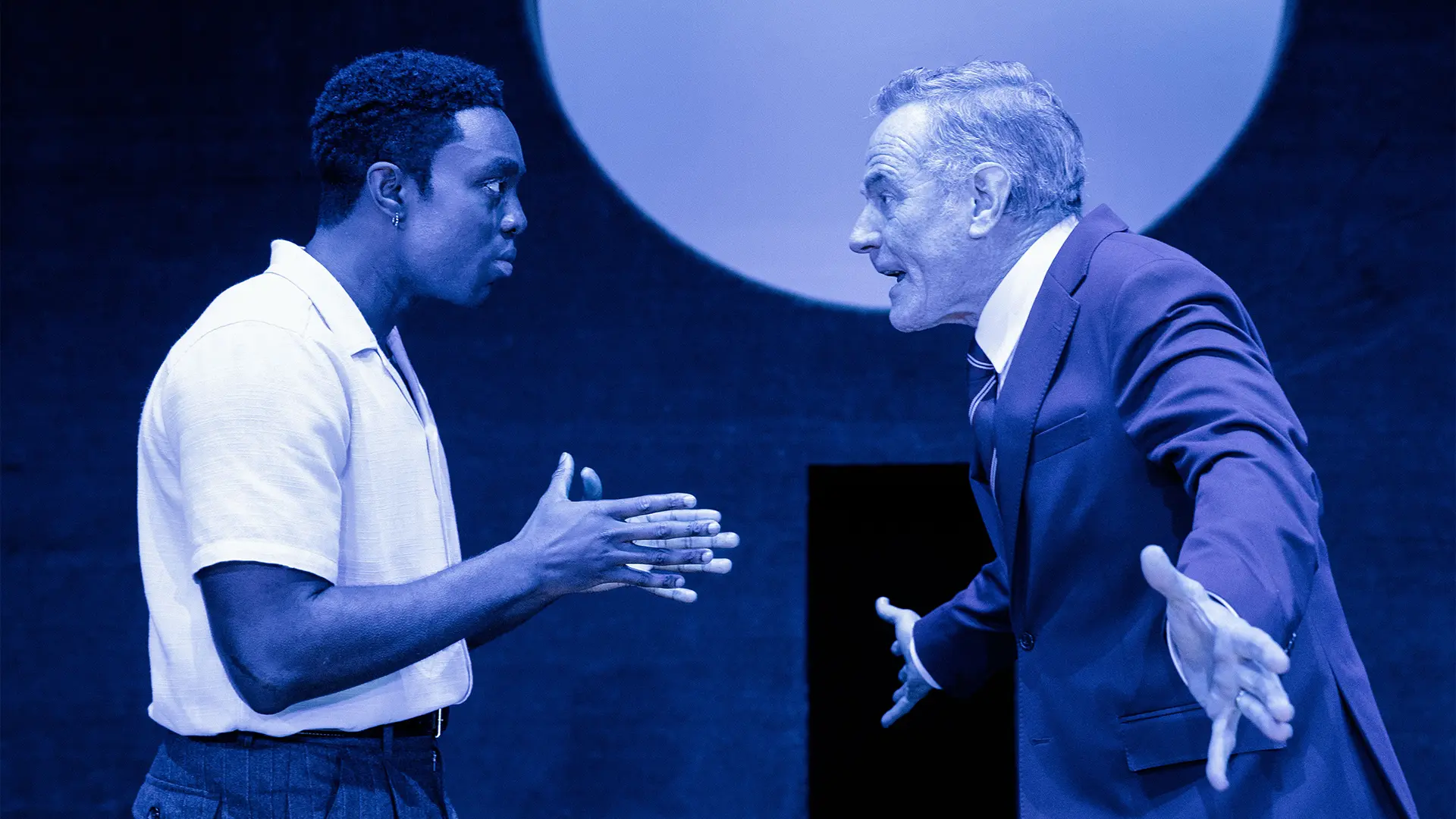
Paapa Essiedu & Bryan Cranston in All My Sons. Photo: Jan Versweyveld

When asked to name my favourite theatre production, I invariably cite Ivo van Hove and Jan Versweyveld’s stark staging of A View from the Bridge. Their return to Miller, this time with All My Sons—and with Bryan Cranston, Paapa Essiedu and Marianne Jean-Baptiste leading the cast—was therefore an enticing prospect. The result is a formidable, if not flawless, revival.

All My Sons remains a meticulously engineered dramas: the early hints, the incremental revelations, and the inexorable tightening of tension culminate in a climax of crushing inevitability. Its moral architecture—examining the corrosion that follows when a man, and indeed a society, elevates profit above humanity—remains chillingly contemporary. Miller’s characters, drawn with psychological acuity and emotional precision, still compel.

Van Hove and Versweyveld strip the stage of naturalistic detail, replacing Miller’s suburban garden and household façade with a bare stage. Lighting rigs stand in for hedges; the house becomes a blank wall with an aperture and a large circular window that variously evokes a sun, a moon, and, perhaps, an unblinking moral eye. It is a yellow circle when the play begins at dawn, before it unfolds over a single day. This follows an added prologue— we see the violent storm that fells the tree representing the missing eldest son. The fallen trunk remains onstage, the lone scenic element, a constant reminder of where the play is heading.

Versweyveld’s set is ingenious in its austerity, it anchors the play in the heart of mid Western industrial America but it is also universal in time as well as space. His lighting design holds the hand of the play throughout, carrying the emotional arc from the gentlest morning glow to a brutal, unforgiving glare.

Cranston’s Joe Keller is immediately persuasive: genial, grounded, radiating decency. Too good to be true? That’s the pleasure of acting of this calibre: for a time, we truly can’t tell as he walks the tightrope between public charm and private guilt. Paapa Essiedu as his son Chris charts a substantial arc, moving from principled idealism to profound disillusionment. He suggests, with remarkable nuance, the fragility of Chris’s outlook—an annoying idealism propped up by the wealth of the family business and his distance from its harsher realities; his life shaped by his experience of war. Paapa Essiedu matches Bryan Cranston in the depth of emotion he conveys.

Gradually we learn that the family lives beneath a shadow. During the recently ended Second World War, Joe’s factory produced a batch of faulty aircraft parts, leading to the deaths of several pilots. Joe was accused of knowingly shipping them, but ultimately his employee Steve was convicted and imprisoned.

His older son, Larry, was declared missing in action four years ago—but not because his plane contained one of the faulty parts (that would be too neat). His mother, Kate, refuses to accept his death. To do so would shatter the brittle righteous world she clings to. Marianne Jean-Baptiste is superb as Mother, revealing both the warmth that holds the family together and the ferocious denial that threatens to tear it apart. Her breakdown is executed with such controlled intensity that it becomes genuinely difficult to watch.

A catalyst arrives in the form of Ann, Larry’s former fiancée, now intending to marry Chris—and, crucially, she’s Steve’s daughter. Wearing a red dress that contrasts with everyone’s else’s duller browns and blues, she’s a spark tossed into a powder keg. The character can easily feel like a functional supporting role, but in Hayley Squires’ hands she is resolute, textured, and quietly courageous, weathered by hard experience yet capable of deep compassion.

This depth of casting extends throughout: the neighbours and relatives, each seem like real human beings with their own moral dilemmas. Take George, Ann’s brother, who storms through the auditorium in a frenzy of grief and fury to accuse Joe of framing Steve. Tom Glynn-Carney gives him the haunted volatility of someone consumed by pain yet desperate to believe he might be mistaken.

Bold in conception, thrilling in execution, and unquestionably relevant
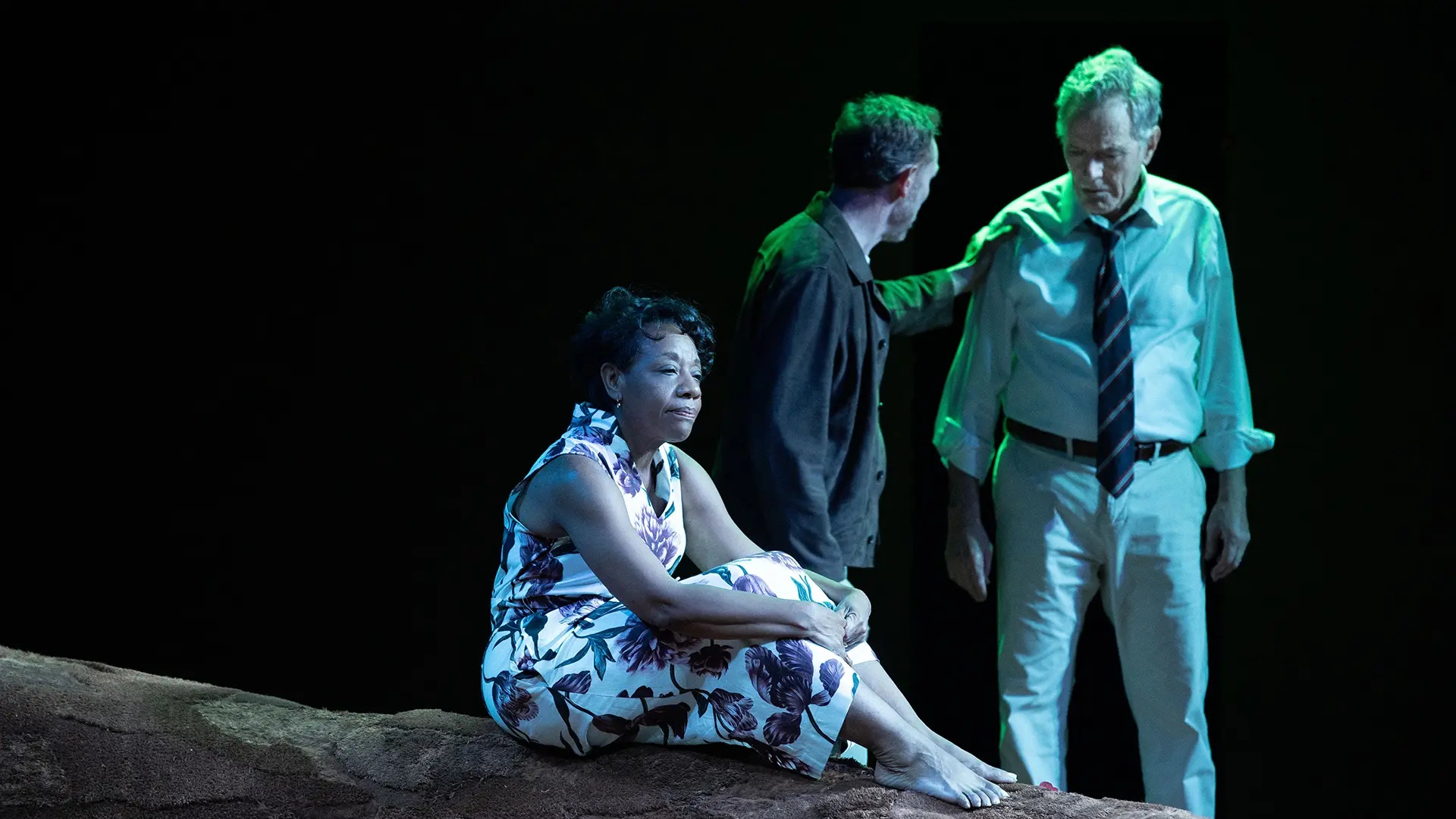
Marianne Jean-Baptiste & Bryan Cranston in All My Sons. Photo: Jan Versweyveld

As Joe offers his catalogue of justifications—military pressure, contractual anxiety, the reassurance that “everyone else was doing it”. These excuses echo across the decades: Boeing overlooking fatal design flaws; suppliers profiting from shoddy PPE during the COVID pandemic; water companies concealing pollution; social-media giants resisting regulation despite the harm to children, vulnerable people and democratic processes; politicians using public office to enrich themselves and their allies. The play has never felt more painfully relevant.

We are left in no doubt that there is no justification for placing profit above human life—even for the most seductive of all reasons: Joe’s claim that he did it for his family. And it is that very family we watch torn apart. “I know you’re no worse than most men,” Chris says, “but I thought you were better. I never saw you as a man. I saw you as my father.”

As the play progresses, Joe’s facade begins to crack, his easygoing selling of his image becomes more desperate, until he is finally confronted with the horror of what he has done. I swear, you can see the life draining from Bryan Cranston, as his face and body sag.

Miller never dilutes his central argument—that business must be governed by conscience and social responsibility—but the greatness of the play is in thw ay it shows us the humanity of the characters and acknowledges the agonising complexity of moral choice. All My Sons may begin in the realm of Ibsenite naturalism, but it concludes as a Greek tragedy of cause and consequence.

Van Hove and Versweyveld deliver a stark, intellectually rigorous interpretation that honours Miller’s ethical inquiry. That said, the production is not without missteps. The fallen tree which is only meant to be four years old is oversized, overly dominant  and overstates its symbolism. For someone who adores minimalism, I surprised myself by wishing for a modest table and chairs downstage and a smaller tree upstage. Then there was the incidental music- the persistent, plaintive plinking of piano and string. Though tastefully executed, it ultimately competes with, rather than elevates, the drama. Given the exceptional performances and the potency of Miller’s dialogue, such embellishment feels unnecessary.

These reservations notwithstanding, this is an incisive, superbly performed revival—bold in conception, often thrilling in execution, and unquestionably relevant. Not quite a five-star triumph, but a richly deserved and emphatic four.

All My Sons can be seen at the Wyndham’s Theatre until 7 March 2026. Buy tickets directly at allmysonsplay.com

Click here to watch this review on the YouTube channel Theatre Reviews With Paul Seven

Paul paid for his ticket.

Click here to read a roundup of other critics’ reviews of All My Sons at Wyndham’s Theatre
 

Lucy Prebble’s The Effect – National Theatre – Review

Intimate play swamped by huge theatre despite Paapa Essiedu’s giant performance


★★★

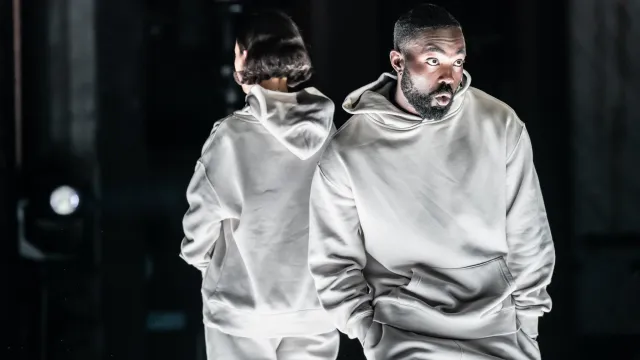
Taylor Russell & Paapa Essiedu in The Effect. Photo: Marc Brenner

How much does our brain make us what we are, and how much does our behaviour influence our brain, particularly when it comes to love? In The Effect, Lucy Prebble examines what makes us human and the nature of love. It’s a dizzying journey, ful of emotion, shock and stimulation for that blob of grey matter. The dialogue is not only snappy and funny and sad, but extraordinarily natural. It’s a gift to the actors who include Paapa Essiedu and Taylor Russell on top form.

The Effect was premiered over ten years ago in the National Theatre’s smallest auditorium. Since then, its author Lucy Prebble has received global acclaim as a writer for the TV series Succession, as well as I Hate Suzie. Now it’s back, and given pride of place in the National’s large Lyttelton Theatre. However, despite one massive star performance, this revival of The Effect is a disappointment.

The Lyttelton is a cavernous auditorium, and that’s the problem, because everything about this play says ‘intimate’. There are only four characters, two of whom are taking part in the trial of a drug, two of whom are supervising doctors. And it nearly all takes place in the confines of a clinic.
I assume it’s the idea of director Jamie Lloyd to reconstruct the auditorium into a traverse configuration. There is now a massive bank of stalls seating on what would be the back of the stage, facing the usual (albeit reduced) stalls and the circle. The stage has been brought forward so both sides are given equal weight. It’s a good way to try to bring the audience closer to the action and restore some of that lost intimacy. But it wasn’t enough for me, because this is still a huge space with around 900 paying customers.
Like theatre-in-the-round, a traverse stage demands minimal props. (Don’t get me started about how the sink and bed blocked views during Brokeback Mountain at sohoplace.) In this production, there is an empty platform with a chair at each end. Any physical representation of a clinic is replaced in Soutra Gilmour’s striking set by varying uplit rectangular sections indicating different scenes. It’s still clinical but in more of a sci-fi film way. Yet, this is not a futuristic play: it’s very much about today’s world, and in particular our reliance on medicine and what being human means.
So this entire setting has the effect (sorry, no pun intended) of making us, the audience, feel like clinicians looking dispassionately at an experiment. This may be the intention, but, if it is, it undermines the strength of the play which is the way it draws us into the feelings of the characters, feelings which basically wreck the clinical testing.
There is superb music by Mikey J Asante that helps ratchet up the tension and release the euphoria.
Beyond that, everything hinges on the actors. And they do well, but it’s a lot to ask of them: to provide an intimate performance in a vast auditorium. Inevitably they’re mic’d, as is usually the case these days, to amplify their voices. So, at least they sound normal rather than strained, but it is also a reminder that they are playing to a large crowd.
This is the story. A man and a woman are taking part in a four week trial of a new anti-depression drug and the effect it has on the brains of healthy volunteers. I don’t speak as an expert but my understanding is that antidepressants rely on raising dopamine levels- the chemical in the brain that makes us feel good. So, when two participants fall in love, we ask ourselves, just as the doctors do: ‘is it really love or the effect of the drug?’ This inevitably leads us to question: ‘what is love?’ We do eventually get some answers as we go beyond the end of the trial but I’ll say no more about that, because I don’t want to spoil how this marvellously written play pans out.

Paapa Essiedu and Taylor Russell are a believable couple

Paapa Essiedu is the man, Tristan. It’s the latest in a string of impressive performances that must cement his position as one of the top actors of the new generation. Appropriately this experienced actor plays a seasoned participant in scientific tests, which he does for the payments, and doesn’t take too seriously. Triss is an East London boy, fast-talking, edgy, constantly jigging up and down. He gets the funniest lines as he pushes boundaries or steps with both feet into delicate situations. When he falls in love, he is puzzled and deliriously happy, but skeptical that chemicals are playing a part. It’s a bravura performance, full of complexity and authenticity.
The woman he meets- Connie- is a psychology student who gets involved in a trial for the first time out of what you might call professional and possibly personal interest. She is serious-minded, knows a lot about the way the trials are conducted, and believes the chemical affects the brain. But she is also needy in her relationships with the doctor and with Triss whom she finds amusing and intriguing, but also irritating.
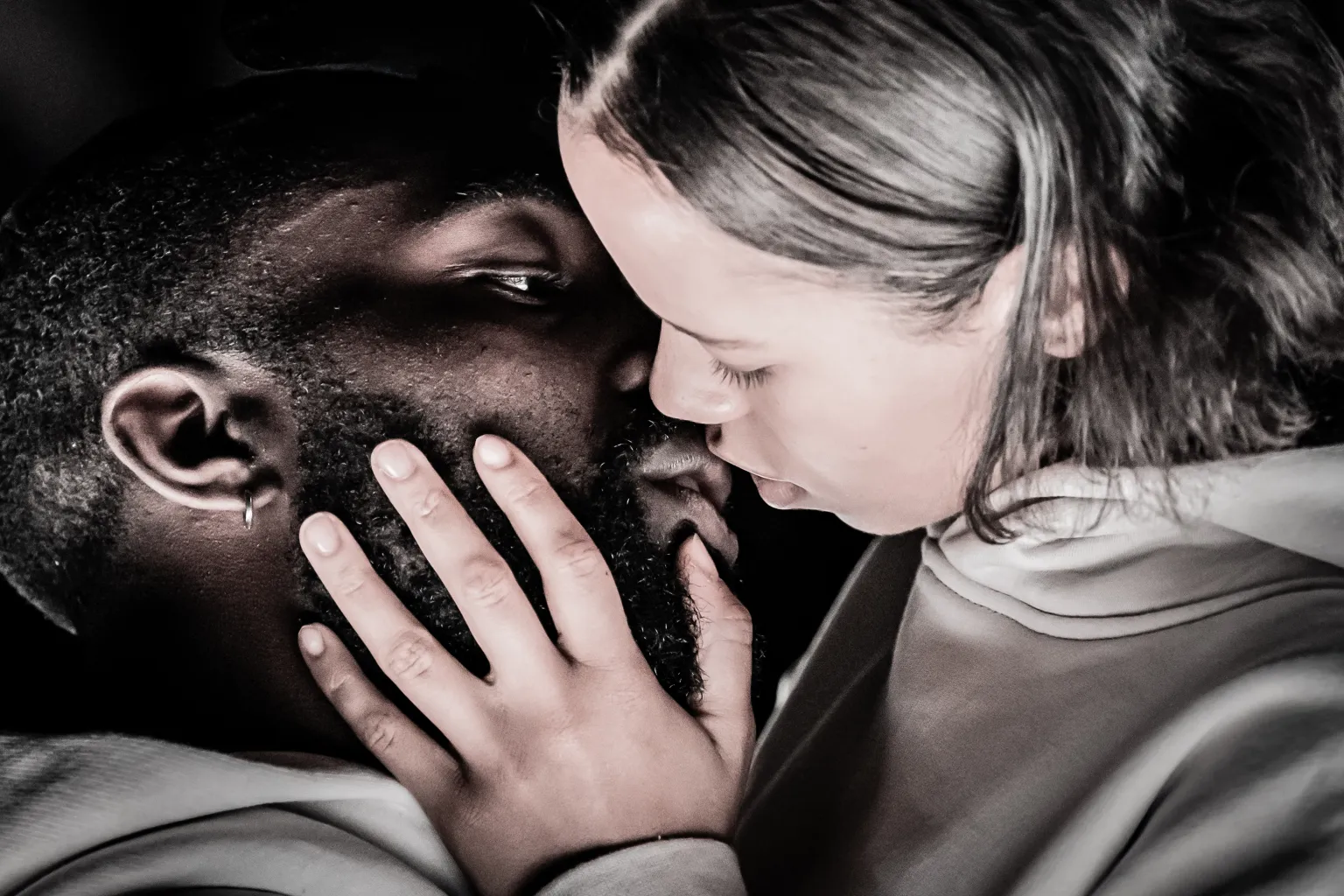
A close up of two actors Paapa Essiedu and Taylor Russell kissing in Lucy Prebbele's play The Effect at the National theatre in London in August 2023. The woman holds the man's face
Paapa Essiedu & Taylor Russell in The Effect. Photo: Marc Brenner
Just as Connie is new to being a participant in scientific trials, the part is played by a newcomer to the stage, Taylor Russell.
So there is a parallel here between the experience of the characters and of the people playing them. I don’t know if this affected the dynamics between them as actors, but they are certainly believable as a couple. There is a series of rapid short scenes in which they escape the clinic and play games with each other and explore each other’s bodies with laughter and euphoria, that left me as giddy as them.
It’s a high profile debut but Taylor Russell proves to be a talented actor who takes it in her stride.
There are twists and misdirections that make us, the audience, constantly reassess this relationship, and the question of how much is the result of the dopamine they are being fed and how much comes from the dopamine they are producing naturally.
In the same way, we are asked to consider whether depression is biological or psychological. It’s a debate that concerns the two doctors: Dr Lorna James who is supervising the test, and Dr Toby Sealey who is supervising her. Just to complicate matters further, it turns out they have had a relationship in the past.
Toby, in an authoritative performance by Kobna Holdbrook-Smith, is totally committed to the idea that depression can be cured by pharmaceuticals, and at one point he is seen giving a well-rehearsed, smug lecture on the subject. Lorna is not so sure. It emerges that she herself suffers from depression and does not trust the drugs used to treat it. In one of the most powerful scenes in the play, she talks about the parts of her brain and what function they have: ‘Here’s my impulse to kill myself. Here is my controlling that impulse.’ Michele Austin, in a strong performance, delivers most of her lines in the flat monotone you might expect of someone suffering from depression.
The play has been changed to accommodate, among other things, the background of the actors (London and Canada), and the fact that the cast is all black. Michele Austin‘s character is given the wonderful line: ‘I’m a working-class Black woman. Getting out of bed is a political act’, which generated applause from some of the audience.
The two doctors discuss the effects of the drug but, like the participants, or indeed any human being, they have their opinions, their experience, and their secrets that influence what happens in the trial. It seems Lucy Prebble is saying there is no possibility of a truly objective scientific trial, despite the use of placebos and bias testing.
And she really piles it on to make the point. In a confined space, I suspect we would be carried along by the characters’ passion, but, in the arms’ length environment of the Lyttelton, I for one was left wondering how these people ever got to be on the trial or supervising it, in the first place.
The nature of depression is one thread running through the play but the more dominant one is about the nature of love: why do we fall in love, why do we sacrifice for love, why does it last long after the initial dopamine infatuation fades? In her convincing story of Triss and Connie, Lucy Prebble covers a lot of ground, and establishes that, in a world in which medical science may sometimes seem to have all the answers, love remains one of life’s mysteries.
The Effect is performing at the National Theatre until 7 October 2023.
Paul paid for his ticket to see a preview performance of The Effect
This review was revised (mainly reorganised) on 11 August 2023. 
×