Theatre review: The Price with Henry Goodman

Veteran actor steals the show

Marylebone Theatre


⭑⭑⭑⭑
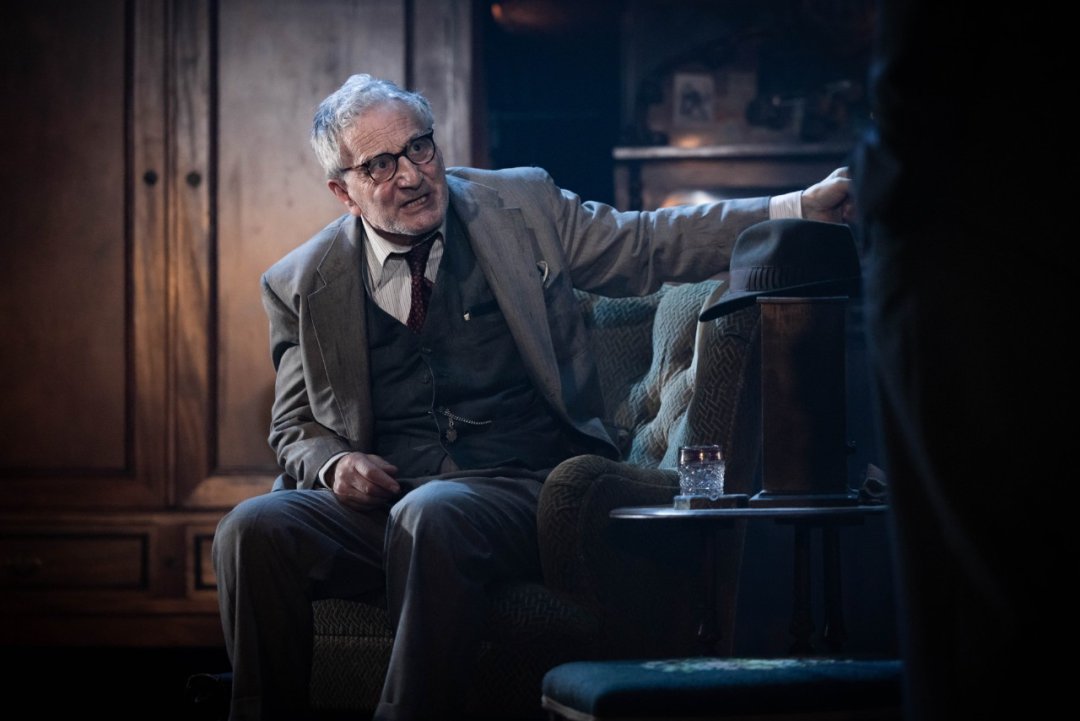
Henry Goodman in The Price. Photo: Mark Senior

What a coup for the 270-seat, three-and-a-half year old Marylebone Theatre, managing to attract theatrical great Henry Goodman to perform in Arthur Miller’s The Price. Director Jonathan Munby has put together a marvellously tense production populated by a  perfect cast.

In the first minutes, we meet Vic and his wife Esther and find out pretty much everything we need to know about what is going to unfold. There’s the obsession with placing a monetary value on everything- Vic has cinema tickets: “Better be great” he says, “Two-fifty apiece”. It seems everything has a price in a country built on capitalism, as the socialist Miller saw it. Even the unhappiness explored in the play stems from the financial crash of 1929.

The questions are already there- how much was Vic forced to do what he did with his life, how much was his choice? Now he’s turned 50 and can retire and pursue a more satisfying career, will he have the confidence to do it? They could do with money but will he accept help from his brother? He’s here to sell their late father’s possessions to a dealer, but will he drive a hard bargain? We suspect not.

Enter Gregory Solomon. He is there to assess the furniture and other objects, but this wily salesman is clearly also assessing who he is dealing with. So, let me tell you about 75 year old Henry Goodman as 89 year old Gregory Solomon. About a quarter way into the play, he comes on stage, wheezing and coughing. He appears frail but is full of life.  His character is fully rounded and we can’t help but be charmed by his stories and homilies, even when his eyes shiftily scan the room, or when he stiffens as he refuses to let go of the opportunity to make one last deal. Once Esther is out of the room, he laughs and ingratiates himself with Vic. By the end of act one he has taken charge and undoubtedly conned the other man out of what he should rightfully be receiving. I could be talking about how Henry Goodman steals the show.

It’s almost a shame for Elliot Cowan, who plays Vic, because he is so good at conveying his character’s weakness, stubbornness, and love. His expressive face glowers or smiles, his eyes stare into the distance in suspicion or pain, almost begging the audience to empathise.  So convincing was he that I could hardly restrain myself from calling out in frustration: “Stop being so pig headed.” Mr Cowan should be getting all the accolades at the end of the show, but Henry Goodman is so phenomenally good, that he dominates a play in which he is barely on stage for more than a quarter of the time.

In 1968, when the play was first produced, the USA was mired in the Vietnam War, and alternative ways of thinking about how to value life, other than by monetary price, were being considered.  ”We worry about it, we talk about it, but we can’t seem to want it.” says Esther about money. What’s bugging her and Vic is, when the brothers grew up, Walter went to college and pursued a successful career as a surgeon, while Vic stayed home to look after his widowed father. In doing so, he took on a relatively low paid job as a cop, which he hates. The resentment has led to an estrangement between the brothers. Esther, played by Faye Castelow, supports her husband but berates him too, in a nicely balanced expression of marital love and frustration.

Riveting dialogue
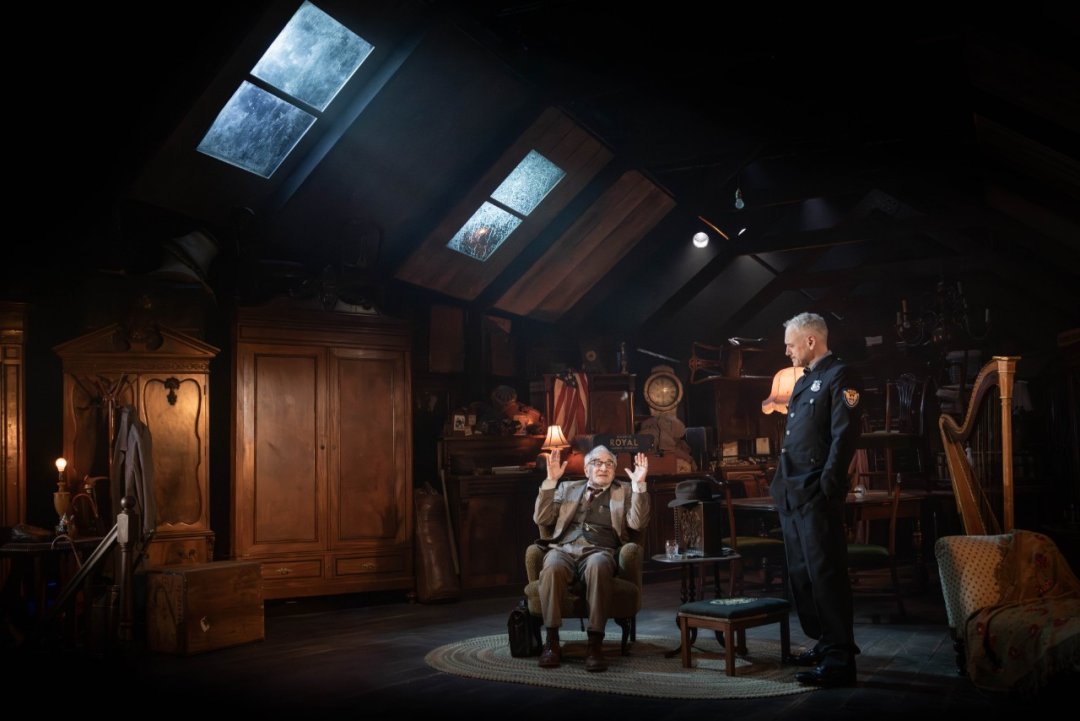
Henry Goodman & Elliot Cowan in The Price. Photo: Mark Senior

All the action takes place in an attic that was once the impoverished family’s home after the father’s wealth was wiped out. Among the furniture are two chests. One was Vic’s, one his brother’s. Significantly, they are on opposite sides of the room. Jon Bausor‘s naturalistic set is just as depicted in Miller’s script: no clever interpretation by a director trying to make their mark.  It makes full use of the Marylebone Theatre’s large proscenium arch stage and crams it full of old furniture, dusty, dimly lit, claustrophobic. It’s so overwhelming, you feel you’re in the room with these people.

Having shown how Vic’s lack of a killer instinct is manipulated by Solomon in the first act, the second act concentrates on the confrontation between Vic and  Walter, with Esther periodically supporting her brother-in-law and jabbing at her husband, and Solomon popping in occasionally to make a conciliatory comment.

The brothers’ conversation is riveting, as they go round in circles, edging nearer and nearer to the facts about what happened to shape both their lives. In this respect, the format is typical Miller but no less engaging for that, even if the dialogue is overly portentous at times. What separates it for the earlier classics like Death of a Salesman, All My Sons and A View From The Bridge is that there is no devastating revelation, more a profound reflection on the paths we take.

Each brother has a different view of past events. They learn from each other the truth about the price they have both had to pay for choices they did or did not make. How each took “different roads out of the same trap”, as Walter puts it, but became unhappy in the new traps they found themselves in. Walter has reached a clearer view than Vic about the past, and John Hopkins conveys brilliantly his broken dreams and  desperate wish to reconcile with his brother.

We also learn that, in relation to his wife and sons, their father may have been a con man, not dissimilar to Solomon.  Walter says of their parents: “What was unbearable is not that it fell apart, it was that there was never anything here.” And (back to money): “There was nothing (…) but a straight financial arrangement.”

There is no sense in which their lives will greatly change, only perhaps that they may live more comfortably with themselves in the present, much in the way Solomon does. For him, the past is like a dream, and the present rewrites the past. As he says, “Good luck you can never know until the last minute.”

Arthur Miller, despite having strong political views, is not a writer to lay things out in black and white, as good or bad. Each character is a complex human being with complicated relationships and, like all his great work, The Price gives no simplistic analysis of the brothers’ lives. Repeated viewings are rewarded with ever deeper understanding of human nature and society, especially when performed by actors who can plumb those depths.

Elliot Cowan should be a contender for Best Leading Actor awards but, if there’s any justice, Henry Goodman has Best Supporting Actor in the bag.

The Price can be seen at Marylebone Theatre until 7 June 2026. Buy tickets directly from the theatre

Paul was given a review ticket by the theatre.

Read a roundup of other critics’ reviews here

Click here to watch this review on the YouTube channel Theatre Reviews With Paul Seven
Bleak Expectations – Criterion Theatre – review

Plenty of fun but not enough steam

★★★

Th cast of Bleak Expectations at The Criterion Theatre in London May 2023
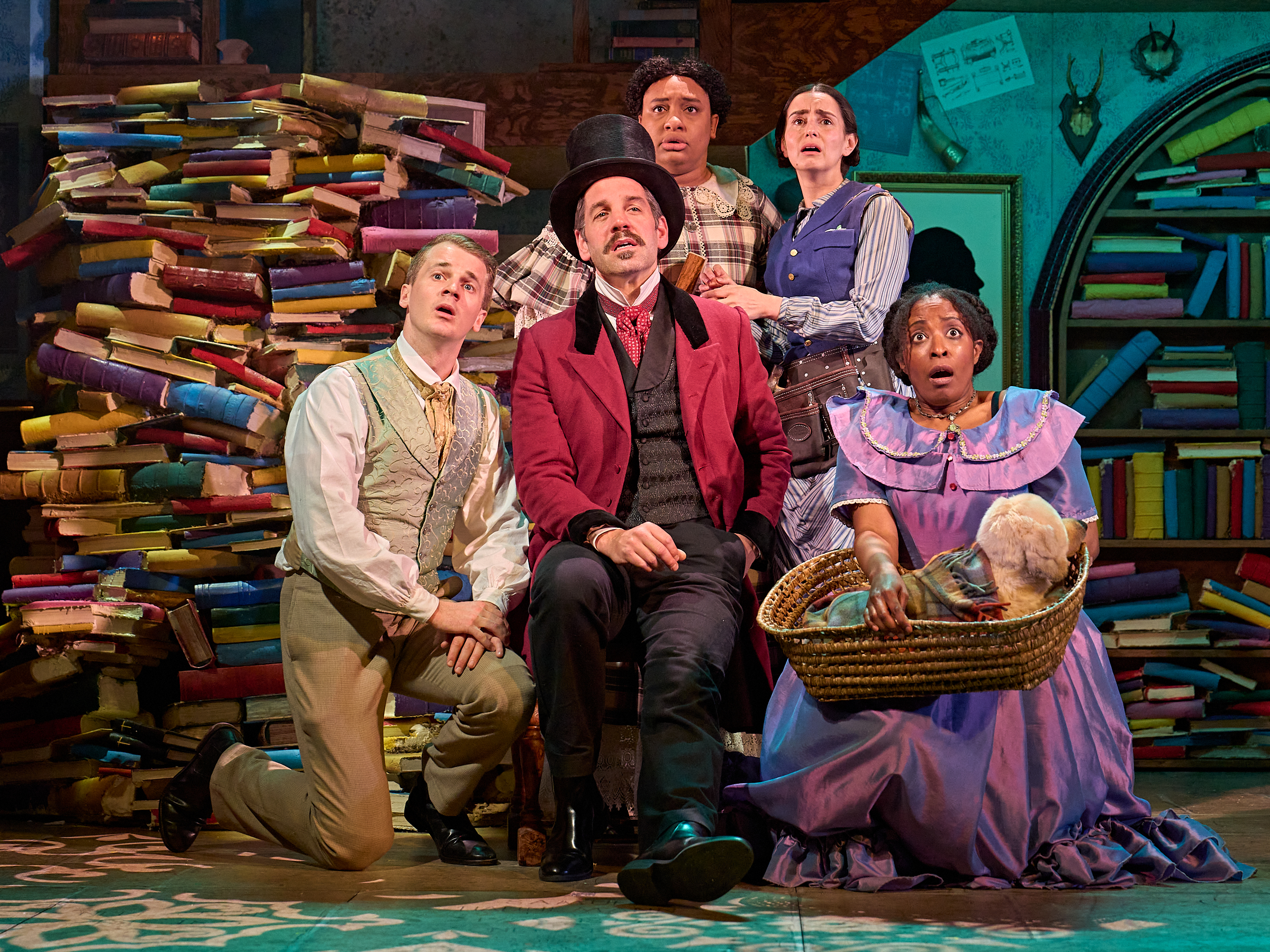
Dom Hodson, John Hopkins, Ashh Blackwood, Serena Manteghi and Rachel Summers in Bleak Expectations. Photo: Manuel Harlan

Whether or not you’ve read any Dickens or heard the BBC Radio 4 comedy Bleak Expectations, you’ll find plenty to keep you amused in this send-up of Dickens’ novels and of Victorian values.

If you’re not familiar with the show, the nearest comparison I can give you is probably Blackadder. Mark Evans is a talented comedy writer who shares that series’ love of outlandish similes, anachronisms and silly names. He peppers the play with them, although he could have been more liberal with this seasoning because what he has cooked up doesn’t quite provide the feast of laughter you might hope for.
The jokes offer the best of times: ‘it was as if a giant teapot had poured sorrow upon the household and no one had said when’ (or something like that). Or the twisting of famous Dickens phrases, as when in response to awful food: ‘Please, Sir, may I have some less.’
There is a familiar mocking of Victorian society that you will recognise from pretty much every Victorian parody. We love to laugh at its patronising attitude to women, its prudery, and its toxic masculinity, as if contemporary society has wiped these things out. The play might be stronger if it had a message relevant to today, and some character development.
One difference from the radio show is, of course, visual humour. It may have lost the power of the imagination that the outlandish verbal descriptions evoke but the show takes full advantage of the opportunity to introduce a great deal of physical comedy: slapstick, gurning expressions, fighting (a duel between sword and a baguette is particularly funny), lots of falling over, and a French farce amount of going in and out of doors.
Caroline Leslie’s slick direction ensures the visual element never flags. Katie Lias’ set, as well as being suitably Dickensian, incorporates countless doors through which the farce can flourish.
The evening greatly benefits from having a celebrity guest playing Pip, the narrator who tells us the story of his life. He is the author of many semi-autobiographical novels bearing a similarity to the works of Dickens- such as ‘Massive Dorrit’. Each guest is engaged for a week and you can look at the schedule to choose whom you would like to see. Our storyteller was Sally Phillips. Complete with false moustache, deadpan delivery, knowing eyes, and the air of someone who would rather not be there, she provides one of the highlights of the show.
The cast are excellent as they take Pip and his cohort through numerous trials and tribulations inspired by Mr Dickens, from tragic childhood to horrific boarding school, to having his fortune stolen in a court case, to constantly losing people he loves.
Dom Hodson makes a bright-eyed and bushy-tailed hero, J. J. Henry is his warm but dim friend Harry, Serena Manteghi plays his plucky sister Pippa, Rachel Summers is a young woman dripping with sexual frustration, Shane David-Joseph and Ashh Blackwood bounce around in many roles. John Hopkins is an excellent pantomime villain while Marc Pickering made the most of the opportunity to play multiple members of the nasty Hardthrasher family, rolling his eyes and hamming it up for all he was worth.
Bleak Expectations is great fun when concentrated into a half hour episode, but when spread over two hours, it begins to seem like a lot of variations of the same few jokes.  Like a Victorian railway train, the play chugs nicely down the track at first, but the novelty doesn’t last and, by the end, it runs out of steam.
I found I had enjoyed my evening but I was not thinking: ‘Please, sir, may I have some more?’
Bleak Expectations, originally produced at The Watermill Newbury, can be seen at The Criterion Theatre until 3 September 2023.
Paul received a press ticket from the producer.

The Sex Party – Menier – Review

Terry Johnson’s new play about ‘Swingers’ is a mess

★★

Man and two women in conversation in a scene from the play The Sex Party
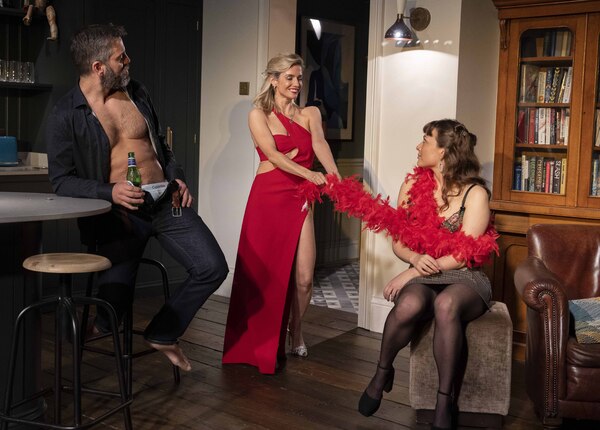
John Hopkins, Lisa Dwan and Molly Osborne in The Sex Party. Photo: Alistair Muir

It’s hard to describe how disappointed I was by my visit to the Menier Chocolate Factory to see The Sex Party. In the past, I have laughed at and thoroughly enjoyed plays by Terry Johnson, from Insignificance and Dead Funny to the recent Prism, but The Sex Party, both written and directed by Mr Johnson, turns out to be a very po-faced comedy.

There’s no sex and not much partying. But that’s not why I was disappointed. I fully expected Terry Johnson to be dissecting the party-goers rather than, metaphorically, taking off his undies and joining in. It had hints of the play it could been, one that used laughter to skewer middle-class liberal hypocrisy, and provoked thoughts about gender and sexuality. Instead, The Sex Party is so sensitive about doing and saying the right thing, all the light-heartedness has been sucked out of it.

At every turn, something else is thrown in to expose the limits of the apparent libertarianism of the people who are taking part in this orgy. So thick and fast do they come, that you hardly have time to consider the implications of one point, before we move on to the next one, until you wonder how much more will be loaded onto the ship before it sinks. Add to which, the play’s characters are just too lightweight to carry its heavyweight themes.

The play is entirely set in Tim Shortall’s naturalistic set which wonderfully recreates a kitchen in affluent Islington. Now, I know it’s not unusual for people at a party to gather in the kitchen, but there was meant to be an orgy taking place. That was through the door to the right. There was also a door to the left leading into the garden. A perfect set-up for a French farce, you might think. Think again. No, this is about what happens in the kitchen.

That’s where we meet all the couples. That’s where we learn about their relationships, and what happens when sexual permissiveness puts those relationships to the test. And that’s not the only trial these party-goers face.

 man and two women in conversation in a scene from the play The Sex Party at The Menier Theatre
Molly Osborne, Jason Merrells & Lisa Dwan in The Sex Party. Photo: Alistair Muir

So, couples start to arrive. The host Alex is friendly and organised but somewhat world-weary and dissatisfied- and reluctant to leave the kitchen. Jason Merrells is very good at portraying that point when a mature man is going from craggy to seedy. His much younger partner Hetty, played by Molly Osborne, is bright-eyed and bushy-tailed and looking forward to lots of sex with lots of men. Jake and Gilly, played by John Hopkins and Lisa Dwan, are first timers and are there to watch and maybe have sex with each other, but not with anybody else. However, it seems Gilly is keener to experiment than uptight Jake, but she needs a lot of alcohol, as do most of the characters.

In an interview with Terry Johnson in the programme, he talks of the need to get a big laugh in early, so the audience knows it’s a ‘laughing audience’. The play succeeds in that respect when Gilly says that her safe words during sex are ‘Don’t stop’.

Other couples- and more very good actors- follow. Jeff is played by the great Timothy Hutton. What a coup to get this Oscar-winning film actor and splendid stage performer to make his London debut in this play. His character is , and Mr Hutton is magnificent in the role of a rich, right-wing American. He and his plain talking Russian wife Magdalena, played with a heavy accent by Amanda Ryan, are both experienced partygoers. The insults this couple throw at each other certainly liven up the evening, but then, insulting each other turns out to be par for the course for all the guests.

The final couple are Tim, high on drugs, and Camilla, an uptight radical feminist, played by Boris Johnson lookalike Will Barton and Kelly Price. I don’t think we ever find out what they have in common, except perhaps that he likes to be dominated and she likes to have the keys to the cage.

So, they’re there to take part in an orgy. But we’re not. It’s clear we’re not here to be titillated, nor to exploit these actors. There’s no sex going on in the kitchen: a little bit of kissing, but no other physical contact. And, whatever might be going on elsewhere, there’s no nudity. The women do wear lingerie, and two of the men bare their chests, but that’s the extent of it. This is a serious comedy.

A major problem with this play is that, with the possible exception of the host Alex, all these characters are caricatures. They all seem like they’re from a 1960s bedroom farce.  I suspect this is a deliberate ploy by Terry Johnson, so that our expectations can be eventually confounded. The difficulty is, when it seems like they’re only there for the laughs, it is extremely hard to believe in them, or their situations.

Act One seems to go round in circles, arriving again and again at the same question of will they, won’t they do whatever it is they are arguing about doing, or not doing.

An aggressive man is held back in a confrontation with a trans woman in a scene from the play The Sex Party
John Hopkins, Timothy Hutton, Kelly Price & Pooya Mohseni in The Sex Party. Photo: Alistair Muir

Then at the end of act one, the arrival of Lucy, a single person, changes everything, because Lucy is a trans woman. And to the great credit of the production, she is played by a trans woman Pooya Mohseni, who is an excellent actor and brings elegance and sensitivity to the role. So act two resumes with the gang cross-examining Lucy but soon the situation is reversed as the play explores the attitude of these heterosexual cis men and women’s toward sex with a trans woman. The limits of their liberal views are severely tested.

In that interview I mentioned, Mr Johnson says: ‘ Everyone is very careful now. I was full of resentment about it before I took this play on. But I’ve had to adjust to a whole new vocabulary and attitudes.’ Well, he certainly has. The play feels sanitised. Even innuendoes are given short shrift. I understand that many sexual jokes that once had people rolling in the aisles may now be considered offensive, but good comedy is grounded in the world as it is, not as we’d like it to be. I find it hard to believe that a largely middle-aged and often nervous set of people at a sex party wouldn’t have made the occasional double-entendre. Still, perhaps we should be thankful that we were spared the ‘thank you for coming’, ‘thank you for having me’ kind of humour.

I think The Sex Party could have worked well as a play, if it had been less concerned about causing offence, and if it hadn’t tried to shoehorn every gender and sexuality issue you can think of into its two-and-a-bit hours. I’m exaggerating, of course, but here are a few examples: a reference to trans women competing in women’s sport events is lobbed in and batted out within seconds; there’s an interesting but fleeting moment when it’s suggested that although the women appear to be enjoying the freedom of choosing their lovers, the men may still be calling the shots; someone reads out a list of the many genders we can identify with in our modern world that is so tedious, the play loses all momentum. By the time two more serious incidents occurred, instead of taking in the implications of them, I was wondering how much more would be stacked on and taken away from this Jenga of a play.

It also ties itself in knots. There’s a moment in the first act, a kind of precursor to the transgender debate of the second act, when it’s pointed out there are no black people at the party. I thought this could have been explored further but the play moved on, leaving me, at least, to ponder the irony that there are no black actors in the cast.

Every so often there were noises off in the form of loud bangs. I know it was probably a loose door but I couldn’t help wondering if it was the sound of so many half-baked ideas clunking to the floor.

The Sex Party can be seen at the Menier Chocolate Factory until 7 Jnuary 2023

Click here to watch this review on our YouTube channel Theatre Reviews With Paul Seven


×