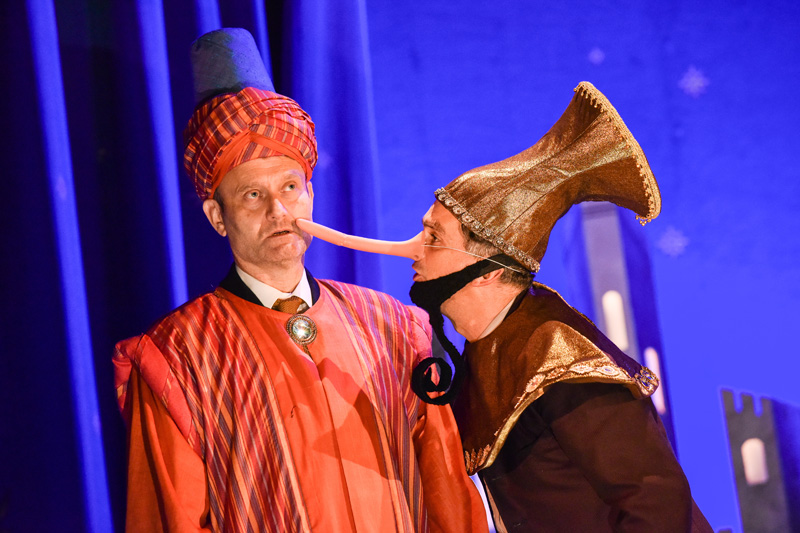
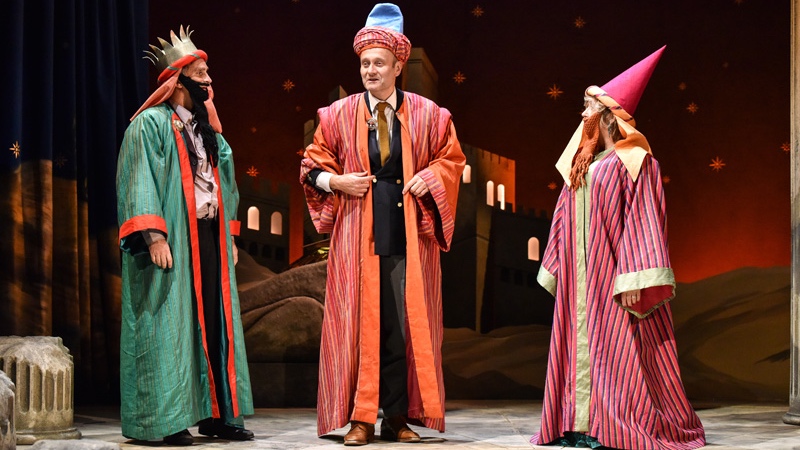
Stephen Fry in The Importance of Being Earnest. Photo: Marc Brenner
I gave a lukewarm review to this production of The Importance of Being Earnest when it premiered at the National Theatre. Part of the reason was, I love this play and, even though I still enjoyed the witty dialogue and the ingenious story of identity and hidden truth, I felt the queer interpretation was laid on a bit thick. I accepted that the two main characters’ double lives could be taken as a metaphor for gay men’s secrecy in past times, but, to my mind, Max Webster‘s decision to foreground the subtext undermined the power of Wilde’s actual text. I now think my prejudice blinded me to the quality of what was in front if me
So I wanted to give it a second chance, and go in more prepared for this approach. And I wanted to compare Olly Alexander‘s Algernon and Stephen Fry’s Lady Bracknell with Ncuti Gatwa and Sharon D Clarke.
It’s not only the twostars, there’s a complete new cast. Each actor captured the distinctive cadence of Oscar Wilde’s prose, delivering lines with clarity. Putting my gratitude for that aside, I fully expected Alexander and Fry to lack the power of Gatwa‘s dazzle and Clarke’s swagger. And in a way I was right, neither has the charisma of the National’s original casting. However, their more restrained interpretations of Algie and Lady Bracknell create a more balanced production.
They make the parts their own, as judges on talent shows are apt to say. Olly Alexander delivers an exemplary performance, imbuing Algie with endearing boyish charm, while Stephen Fry relied on a quiet, clipped delivery (and to be fair his height) to exert his authority. This is not the pantomime dame I feared but rather a totally believable version of the snobbish, domineering representative of the aristocracy. Where the previous larger-then-life characterisations almost suffocated Wilde’s delicate plot construction, toning them down seems to allow it to breathe a little more.
The rest of the West End cast are as good if not better than their National Theatre counterparts. Outstanding are the two young women, Gwendolen and Cecily, played by Kitty Hawthorne and Jessica Whitehurst respectively, and the object of Jack and Algie’s affections. I still found their overt expressions of sexual frustration somewhat incongruous with the period context, but I went with it, and actually the tongue waggling and the attention they pay to their fiery loins is pretty funny. Come to think of it, their obsession with their husband being called Ernest is just as silly.
Another highlight is Hayley Carmichael playing the manservants Lane and Merriman. It’s hard not to laugh at Merriman’s every entrance, when this diminutive figure dressed in oversized wig and tailcoat moves with mechanical stiffness and an air of complete bewilderment.
Shobna Gulati and Hugh Dennis extract plenty of humour from the relationship between Miss Prism and Canon Chasuble. Their suppressed passions form a delightful counterpoint to the younger lovers’ unbridled emotions. Nathan Stewart-Jarrett is a fine, likeable Jack Worthing.
Olly Alexander and Hayley Carmichael in The Importance of Being Earnest. Photo: Marc Brenner
Far from going further in laying on thick this gay interpretation, the transferred production seems to have reined it in ever so slightly. I admit I was expecting, and therefore was less concerned about the opening where Algie is in a cocktail dress at a cross dressing party, or the men and women being sexually excited by their own as much as the opposite sex, or by the references to modern pop songs.
It may have avoided becoming the pantomime I feared but the production is still deliciously over the top. Rae Smith’s colourful costumes and lavish sets, complete with masses of blooming bushes and two naked male statues, create an exuberant atmosphere. And the curtain call does provide a panto-style walkdown, with the cast dressed in giant petals.
I would still prefer a version of The Importance of Being Earnest that allows the lines to speak for themselves, but I am very happy to concede that Wilde’s timeless comedy is big enough to take a joke, and this is a particularly good joke.
I wouldn’t say The Messiah, written and directed by Patrick Barlow, does justice to the nativity story but it certainly provides great Christmas entertainment.
It’s a tale of hubris as two fallible human beings with very few resources attempt to tell an epic story, stoically ploughing on when things go wrong. Both are aware of the other’s inadequacies but not their own, which leads to much verbal and physical humour.
Hugh Dennis is wonderful as the pompous, egocentric, bullying Maurice whose lack of skills in English or drama has not prevented him writing and directing this story of the birth of Jesus.
John Marquez is exceptionally funny as his put-upon fellow actor Ronald who is so absorbed in his part that he is oblivious to not only of his lack of skill but also whatever else might be going on. His clowning and timing are in the tradition of Norman Wisdom or Eric Morecambe.
John Marquez and Hugh Dennis are comedy gold
Typical is the moment when Ronald was playing the Virgin Mary and got so into his role as a nine month pregnant woman that he went off script to berate Joseph, played by Maurice, for leaving her on her own. And the confusion between a handle you hold and Handel the composer was comedy gold.
It must be the most challenging of roles for an actor to play an actor who can’t act but when it’s done as well as this, the reward is an evening of constant laughter.
You have to admire these characters’ determination to create something meaningful despite their limited talent and resources – yes I know you’re thinking a bit like a YouTube blogger but actually like all humans. As the performance reaches an inevitable crisis, there also comes a recognition- appropriate to the time of year- that love is the greatest gift they and we possess.
John Marquez, Hugh Dennis & Lesley Garrett in The Messiah
The third member of the cast is a singer who provides appropriate songs at various points. It was a bonus to see and hear the great in this role although I would have liked to see her more integrated into the comedy.
For me, The Messiah stands alongside Nativity! as one of the funniest, most uplifting Christmas entertainments I’ve seen.
I saw the last performance of The Messiah at Richmond Theatre prior to its Christmas run at The Other Palace in London which ended on 5 January 2019
Watch The Messiah reviewed on the YouTube channel One Minute Theatre Reviews
Manage Consent
To provide the best experiences, we use technologies like cookies to store and/or access device information. Consenting to these technologies will allow us to process data such as browsing behaviour or unique IDs on this site. Not consenting or withdrawing consent, may adversely affect certain features and functions.
Functional
Always active
The technical storage or access is strictly necessary for the legitimate purpose of enabling the use of a specific service explicitly requested by the subscriber or user, or for the sole purpose of carrying out the transmission of a communication over an electronic communications network.
Preferences
The technical storage or access is necessary for the legitimate purpose of storing preferences that are not requested by the subscriber or user.
Statistics
The technical storage or access that is used exclusively for statistical purposes.The technical storage or access that is used exclusively for anonymous statistical purposes. Without a subpoena, voluntary compliance on the part of your Internet Service Provider, or additional records from a third party, information stored or retrieved for this purpose alone cannot usually be used to identify you.
Marketing
The technical storage or access is required to create user profiles to send advertising, or to track the user on a website or across several websites for similar marketing purposes.