Veteran actor steals the show
Marylebone Theatre
⭑⭑⭑⭑
What a coup for the 270-seat, three-and-a-half year old Marylebone Theatre, managing to attract theatrical great Henry Goodman to perform in Arthur Miller’s The Price. Director Jonathan Munby has put together a marvellously tense production populated by a perfect cast.
In the first minutes, we meet Vic and his wife Esther and find out pretty much everything we need to know about what is going to unfold. There’s the obsession with placing a monetary value on everything- Vic has cinema tickets: “Better be great” he says, “Two-fifty apiece”. It seems everything has a price in a country built on capitalism, as the socialist Miller saw it. Even the unhappiness explored in the play stems from the financial crash of 1929.
The questions are already there- how much was Vic forced to do what he did with his life, how much was his choice? Now he’s turned 50 and can retire and pursue a more satisfying career, will he have the confidence to do it? They could do with money but will he accept help from his brother? He’s here to sell their late father’s possessions to a dealer, but will he drive a hard bargain? We suspect not.
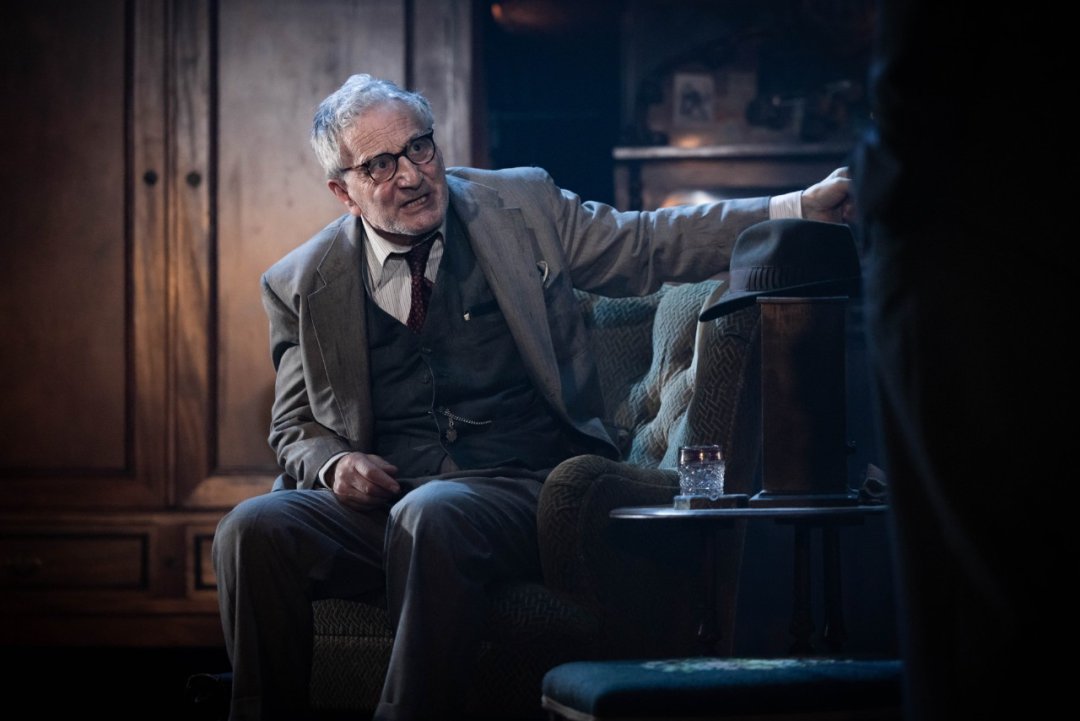
Enter Gregory Solomon. He is there to assess the furniture and other objects, but this wily salesman is clearly also assessing who he is dealing with. So, let me tell you about 75 year old Henry Goodman as 89 year old Gregory Solomon. About a quarter way into the play, he comes on stage, wheezing and coughing. He appears frail but is full of life. His character is fully rounded and we can’t help but be seduced by his stories and homilies. Even when the way his eyes shiftily scan the room, or he stiffens as he refuses to let go of the opportunity to make one last deal suggest his dithering charm may be an act. Once Esther is out of the room, he laughs and ingratiates himself with Vic. By the end of act one he has taken charge and undoubtedly conned the other man out of what he should rightfully be receiving. I could be talking about how Henry Goodman steals the show.
It’s almost a shame for Elliot Cowan, who plays Vic, because he is so good at conveying his character’s weakness, stubbornness, and love. His expressive face glowers or smiles, his eyes stare into the distance in suspicion or pain, almost begging the audience to empathise. So convincing was he that I could hardly restrain myself from calling out in frustration: “Stop being so pig-headed.” Mr Cowan should be getting all the accolades at the end of the show, but Henry Goodman is so phenomenally good, that he dominates a play in which he is barely on stage for more than a quarter of the time.
In 1968, when the play was first produced, the USA was mired in the Vietnam War, and alternative ways of thinking about how to value life, other than by monetary price, were being considered. ”We worry about it, we talk about it, but we can’t seem to want it.” says Esther about money. What’s bugging her and Vic is, when the brothers grew up, Walter went to college and pursued a successful career as a surgeon, while Vic stayed home to look after his widowed father. In doing so, he took on a relatively low paid job as a cop, which he hates. The resentment has led to an estrangement between the brothers. Esther, played by Faye Castelow, supports her husband but berates him too, in a nicely balanced expression of marital love and frustration.
Riveting dialogue
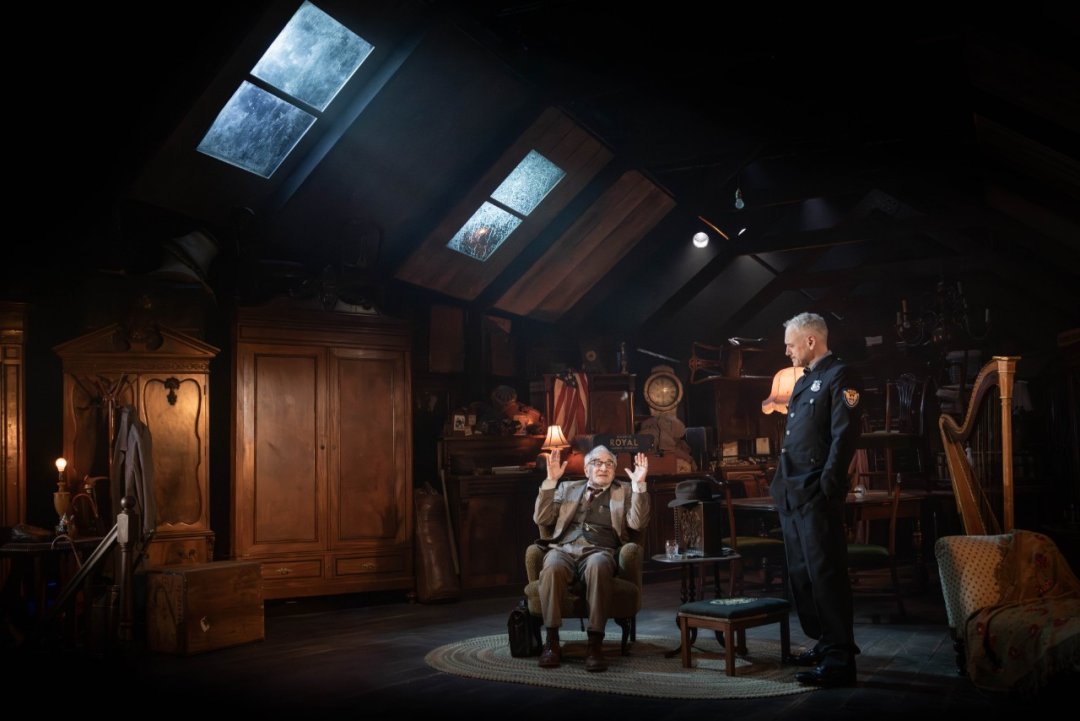
All the action takes place in an attic that was once the impoverished family’s home after the father’s wealth was wiped out. Among the furniture are two chests. One was Vic’s, one his brother’s. Significantly, they are on opposite sides of the room. Jon Bausor‘s naturalistic set is just as depicted in Miller’s script: no clever interpretation by a director trying to make their mark. It makes full use of the Marylebone Theatre’s large proscenium arch stage and crams it full of old furniture, dusty, dimly lit, claustrophobic. It’s so overwhelming, you feel you’re in the room with these people.
Having shown how Vic’s lack of a killer instinct is manipulated by Solomon in the first act, the second act concentrates on the confrontation between Vic and Walter, with Esther periodically supporting her brother-in-law and jabbing at her husband, and Solomon popping in occasionally to make a conciliatory comment.
The brothers’ conversation is riveting, as they go round in circles, edging nearer and nearer to the facts about what happened to shape both their lives. In this respect, the format is typical Miller but no less engaging for that, even if the dialogue is overly portentous at times. What separates it for the earlier classics like Death of a Salesman, All My Sons and A View From The Bridge is that there is no devastating revelation, more a profound reflection on the paths we take.
Each brother has a different view of past events. They learn from each other the truth about the price they have both had to pay for choices made, and how they subsequently blamed others for those choices. Each took “different roads out of the same trap”, as Walter puts it, but became unhappy in the new traps they found themselves in. Walter has reached a clearer view than Vic about the past, and John Hopkins conveys brilliantly his broken dreams and desperate wish to reconcile with his brother.
We also learn that, in relation to his wife and sons, their father may have been a con man, not dissimilar to Solomon. Walter says of their parents: “What was unbearable is not that it fell apart, it was that there was never anything here.” And (back to money): “There was nothing (…) but a straight financial arrangement.”
There is no sense in which their lives will greatly change, only perhaps that they may live more comfortably with themselves in the present, much in the way Solomon does. For him, the past is like a dream, and the present rewrites the past. As he says, “Good luck you can never know until the last minute.”
Arthur Miller, despite having strong political views, is not a writer to lay things out in black and white, as good or bad. Each character is a complex human being with complicated relationships and, like all his great work, The Price gives no simplistic analysis of the brothers’ lives. Repeated viewings are rewarded with ever deeper understanding of human nature and society, especially when performed by actors who can plumb those depths.
Elliot Cowan should be a contender for Best Leading Actor awards but, if there’s any justice, Henry Goodman has Best Supporting Actor in the bag.
The Price can be seen at Marylebone Theatre until 7 June 2026. Buy tickets directly from the theatre
Paul was given a review ticket by the theatre.
Slight revisions (in italic) were made to this review on 30 April 2026.
Read a roundup of other critics’ reviews here
Click here to watch this review on the YouTube channel Theatre Reviews With Paul Seven