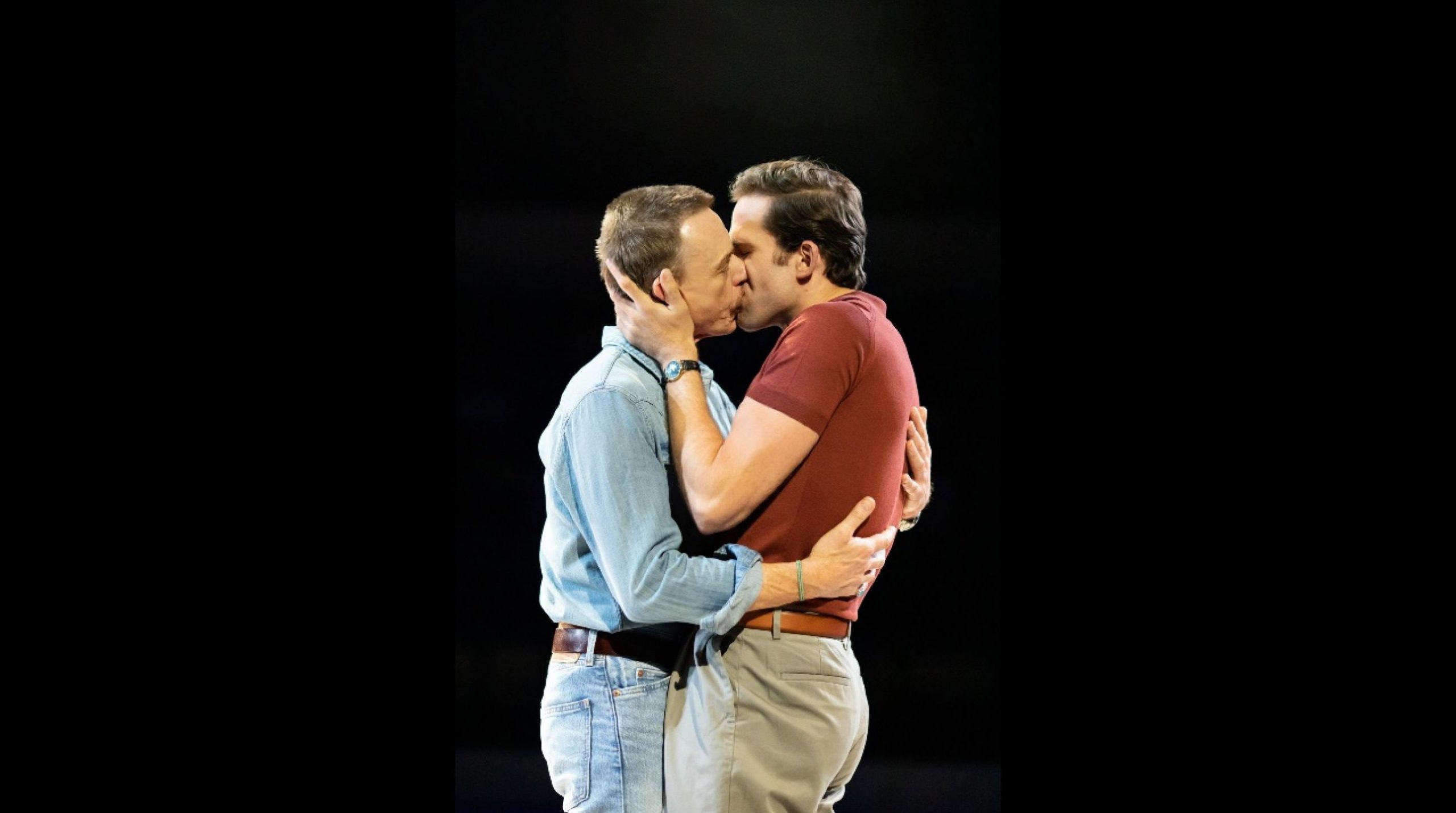
Terence Rattigan’s play is overpowered by Ben Daniels’ thrilling performance
⭑⭑⭑⭑
Ben Daniels in Man And Boy. Photo: Manuel Harlan
Terence Rattigan is now recognised as one of our great playwrights, spoken of as a successor to Ibsen and Chekov. But this wasn’t always so. After his pre-eminence in the 1940s and 50s, he was swept aside by the new wave of so-called kitchen sink and absurdist drama from the likes of Osborne and Pinter. So when Man And Boy arrived in 1962, it was pretty much dismissed by audiences and critics. It took until 2005 before there was a revival in London, which, although well received, still didn’t bring it into the repertoire of regularly performed Rattigan plays such as The Winslow Boy, The Browning Version, The Deep Blue Sea, and Separate Tables.
Is it then a problem play? Well, the National Theatre is giving us a chance to find out, albeit clothed in a thoroughly modern makeover. The trouble is, Anthony Lau‘s stripped down treatment featuring Ben Daniels leaping on and off tables, tends to overpower the play itself. Then again, it’s such a thrill, maybe that doesn’t matter.
Man And Boy, set in the early 1930s, when financial markets were unstable, centres an amoral, sociopathic millionaire and his relationship with his son. Gregor Antonescu is said to the richest, cleverest financier in the world. Ben Daniels, suited and booted, knocks the role into the acting stratosphere, brilliantly conveying a fast talking charm while occasionally revealing his savage contempt for all around him. He smiles, he bares his teeth, he moves like a raptor.
Ben Daniels in Man And Boy. Photo: Manuel Harlan
‘Liquidity and confidence’ keep him afloat, and it’s a phrase he often repeats. As the play begins, liquidity has deserted him in this world where loans are moved around and called in at dizzying speed, and with that has gone his backers’ confidence in him. Matters are made worse when criminal charges are brought against him. ‘In finance, man makes his own miracles,’ says Gregor, and sets about proving his point. A radio provides an urgent commentary. It’s a searing, damning portrait of the world of the super rich, that resonates today.
Trying to avoid the media while he attempts to make a deal that will save him, he holes up in his estranged son Basil’s pokey apartment in a poor part of New York. It turns out the venue is not random. He has set up a meeting with a major banker Mark Herries, played with a combination of smarm and steel by Malcolm Sinclair. Herries is a closet gay man, whom Gregor hopes to manipulate by passing off his son as a rent boy that he can link up with.
Basil is played with a moving mixture of sadness and surliness by Laurie Kynaston. He is a sensitive musician with a social conscience, hence ‘weak’ in Gregor’s eyes. At first, Basil is hostile to his father- ‘you are nothing’ he says- yet still shows filial loyalty when his father is under threat. So, the second half of the play looks more closely at this damaged relationship, with a broken Gregor who has previously said ‘love is a commodity I can’t afford’ wondering whether he has underestimated the importance of love, and Basil doing everything he can to gain that missing paternal affection.
So, what about the tables? On the stage of Georgia Lowe‘s traverse-style set are three long tables that are moved into different configurations for no reason that was apparent to me, unless it was an elaborate pun to do with turning the tables on his enemies. In addition, there are a few simple chairs, a piano, a telephone, a radio, and I think that was it.
On one wall at the back of the theatre is projected the cast list and above the stage entrance the neon words ‘Knock Knock’, although it’s always a doorbell that rings. Why? It could be an attempt at Brechtian alienation, intended to make us step back from emotional involvement, and think about the moral issues. I doubt Rattigan would have approved.
Do the tables help or hinder?
So do the tables help or hinder our understanding of the play? Looked at positively, they create some dramatic moments when Ben Daniels jumps onto them and looks down on all around him. At these times, he is the colossus the world believes him to be, and when he crouches on his haunches and leans over his son, he is like an alpha male silverback gorilla. But, also, they are only cheap kitchen tables, an apt metaphor for the flimsy foundations of Gregor’s power. Credit here to Choreographer and Movement Director Aline David.
Ben Daniels & Laurie Kynaston in Man And Boy. Photo: Manuel Harlan
Then again, when other characters clamber onto a table, the effect feels mannered and a bit distracting. Are they isolating themselves from those close to them, as they are already doing emotionally? Maybe. Or are they just doing it because the tables are there? Any way you interpret it, I will always think of this as the ‘table production’.
I guess we’re used to seeing plays by Rattigan’s contemporaries, writers like Arthur Miller and Tennessee Williams, being given minimalist settings, not to mention those by the father of naturalism, Ibsen. But a naturalistic background has come to seem integral to Rattigan’s work. Very few of us have had the opportunity to see Man And Boy in a conventional production, so it’s hard to judge what is gained or lost in this stripped-bare version.
While the first half dominance of Ben Daniels was thrilling, and his breakdown in the second half shocking, yet his sheer theatrical force, and (yes) the tables, stopped me from getting fully engaged with the evolution of the father-son relationship. This may be intentional, since the play’s centre of gravity is undeniably Gregor.
The other characters we encounter are very much secondary, albeit well played. Phoebe Campbell brings verve to Basil’s girlfriend Carol. Gregor knows all about her, because he has spies, and information is power in his world (that’s how he knows about Mark Harries’ secret life). Leo Wan is David Beeston, an accountant at first confident and aggressive when he tries to prove Gregor’s corruption, but who breaks down in the face of humiliation and frustration. Isabella Laughland gives a delightful performance as Gregor’s semi-detached wife, enjoying the high life but annoyed at the lack of attention from her husband. Nick Fletcher plays Sven, Gregor’s cynical consigliere. It is significant that when Gregor hits rock bottom and craves some human touch, his Wife and his closest friend both make their excuses.
By the way, although I said the set is two-sided, there are gallery and circle seats on the other two sides. I would advise you that those areas offer severely restricted views.
Man And Boy make lack the finesse of Rattigan’s best plays, but Anthony Lau’s bold staging and Ben Daniels mighty performance make the revivial well worthwhile.
Man And Boy can be seen at the National Theatre until 14 March 2026.Buy tickets directly from nationaltheatre.org.uk
You may well be familiar with the horror story of Medea. It began as an Ancient Greek myth and was immortalised in a play by Euripides. In this review, I’ll be talking about how it ends. If you don’t know, and want to have the extra tension of wondering whether or not she will commit the terrible act of violence that is threatened from the beginning, you may want to stop reading. Although, if you do, you’ll miss me talking about a stunning theatre production featuring Sophie Okonedo and Ben Daniels giving two of the most powerful performances I’ve seen.
In Euripides’ version of the myth, Medea kills her children as an act of vengeance against her husband who has left her for a richer, more influential and younger woman. Stories of parents murdering their children make headlines to this day, and no doubt such an act was just as shocking to the Ancient Greeks. But what Euripides does, while not in any way whitewashing the monstrosity of the act, is to lay out everything that led to it.
Unlike the other ancient classic currently gracing the London stage, namely Phaedra at the National which I saw and enjoyed last week, this production makes no attempt to modernise the story. Yes, the characters wear modern dress but it’s fairly plain, and the set, designed by Vicki Mortimer, is almost bare. Such details as there are, are telling– a low wall concealing a staircase to a basement (where the final horrors take place) is made of stone (a word that is used frequently in the play to describe Medea); high above hangs a giant golden headband or crown which parallels the circular stage and predicts the headband that is weaponised later in the play. Even a table and chairs which could denote the possibility of sitting and talking things through are removed before a word is spoken.
And this is all happening in the round, at the wonderful new theatre @sohoplace. So it’s like being in an Ancient Greek amphitheatre, where the audience was all around, drawn into the play and treated as witnesses and judges. Even more so, because no-one is more than a few rows from the actors. In fact, the chorus of three women sits among the audience, making us all feel like we’re the women of Corinth trying in vain to understand and intervene.
Even the adaptation is a classic, the 1947 version by American poet Robinson Jeffers, which has both the natural flow of modern English and an accentuated use of metaphor. ‘Stone’, ‘bone’ and ‘dog’ run like a motifs through the play.
Medea has been wronged and she wants revenge. She played a major part in the success of her husband Jason (of Argonaut and Golden Fleece fame) only for him to betray her by leaving her for the daughter of Creon, the King of Corinth . The play is a series of ‘interviews’ between Medea and the powerful men in her life: Creon, Aegheus the King of Athens, and of course Jason.
From the very beginning of Robinson Jeffers’ adaptation, Medea is full-on angry and prepared to be as evil as required in response to the perceived evil of Jason and of the male-controlled society that has demeaned her. And what this means is that Sophie Okonedo can let rip with her anger and her anguish from the start.
I guarantee you will rarely have seen a performance like that of Sophie Okonedo as Medea. She’s mad with anger, yet able to outargue and deceive these men with smiles and guile. She cries proper snotty tears, she smiles like a tiger, her eyes turn to stone, all in a minute. You may know what’s going to happen, but the tension is palpable, because, even when given an out, the men patronise her, and, even though they know she is to be feared, underestimate her.
As modern people, we are more into the idea of atonement and forgiveness but we understand the visceral need for revenge, and while we may not see it as noble in the way the Greeks did, this play helps us comprehend why Medea feels she has no alternative but to carry out her gruesome vengeance and we feel her heart breaking at the thought of it.
Ben Daniels in Medea. Photo: Johan Persson
In an astonishing piece of theatre, director Dominic Cooke has one actor Ben Daniels play all the male parts, thus emphasising that it is men generically who rule society. Even so, Mr Daniels, in a performance as powerful as Miss Okenedo’s, gives each of them a distinct personality: the selfish Jason, the weak King Creon, the shallow King Aegheus. And he constantly walks round the edge of the stage, usually in slow motion, showing she is encircled and trapped by men who disrespect Medea and take all chance of justice away from her.
The panic of the women around Medea, especially Marion Bailey as the Nurse, piles on the stress.
This is a most tense and ultimately devastating 90 minutes. You don’t actually see any of the deaths but I can tell you the hairs on my neck stood up when Medea went down the stairs to kill her children.
And this is where it goes wrong as a play. It may, or may not, have worked for the ancient Greeks- but for a modern sensibility, murdering your children crosses a line, even with all of Euripides’ explanation, and Ben Daniels’ provocation, and Sophie Okonedo’s persuasion. It is too much like a terrorist justifying killing innocent people.
Medea can be seen at sohoplace theatre in London until 22 April 2023.
Larry Kramer’s blistering attack on prejudice and complacency in the early days of AIDS epidemic
★★★★
Ben Daniels & Dino Fetscher in The Normal Heart at the National Theatre. Photo: Helen Maybanks
The Normal Heart, written in 1985 as the AIDS epidemic was finally beginning to be acknowledged, is based on author Larry Kramer’s own experience of this period. It’s a play that highlights prejudice and ignorance, fighting for what is right, and what it’s like to live in a time of plague.
The lead character Ned is semi-autobiographical and it’s great to see Ben Daniels given the starring role. He’s an excellent actor who always delivers on stage or screen. These days is probably best known for playing Princess Margaret’s husband in The Crown but in this production, directed by Dominic Cooke, he shows how he can carry a whole show.
This production was stopped in its tracks by the COVID -19 pandemic. So, inevitably, now that it’s finally made it onto the Olivier stage, we view it in the light of our experience of what’s happened over the last year and a half. We recognise the authorities’ slowness to respond to what was going on, albeit nothing like the fatal head-in-the-sand attitude to the early deaths within New York’s gay community. In the unwillingness of people to do what’s necessary to save lives, we can see a parallel with some gay men back then refusing to modify their sex lives. We are also familiar with wide-ranging and sometimes wild theories about causes and cures that have since gone by the wayside. In the play, you get the sense of bewilderment and panic about where this so-called ‘gay plague’ has come from and how it’s being spread.
What’s also happened between the postponement of this production and now is the joyous but devastating TV series It’s A Sin by Russell T Davies. That was set in the UK rather than New York and took us into the 90s but anyone who has seen it will recognise the way some newly liberated gay men became highly promiscuous during the 70s and 80s, and again the slowness to react, and the crushing sadness of friends dying all around, and the reconciliation between some parents, especially mothers, and their dying sons.
The Normal Heart is much more overtly political than It’s A Sin. It might be better compared with Albert Camus‘ The Plague, in which an outbreak of bubonic plague follows a similar trajectory and is intended as an analogy for the rise of Nazism.
The Normal Heart follows closely the developments in early 1980s New York: the early deaths, the uncertainties, one doctor flagging up the concern, and the forming of an organisation intended to warn gay men of the danger, help those that contracted AIDs, and pursue the authorities for support.
It’s hard to know what’s more depressing: people faced with the possibility of contracting a fatal disease still carrying on with a reckless lifestyle, or the authorities and media trying to pretend it wasn’t happening because this seemed to be only to do with gay men, and not something they wanted to be associated with. So both familiar and yet still shocking.
Ned is instantly at odds with his fellow campaigners. He is all for directness and shouting from the rooftops in order to pressurise those in power into action, and his fellow gay men to refrain from sex. I guess he’s the kind of person who these days would be gluing himself to the motorway. Others, some still in the closet, argue for a more softly softly approach.
Humour, pain, anger and compassion
Because the abrasive Ned is never afraid to tell it like it is, he has some barnstorming moments, but the other actors in Ned’s circle including Luke Norris, Dino Fetscher, Daniel Monks and Danny Lee Wynter, take hold of their well drawn, varied characters and fill this evening with humour, pain, anger and compassion.
Liz Carr in The Normal Heart at the National Theatre. Photo: Helen Maybanks
Liz Carr plays Doctor Brookner who first notices the increase in this distinctive illness and goes from compassionate but objective medic to militant campaigner, with a blistering speech in the second act. ‘How does it always happen that all of the idiots are always on your team?’ she asks her opponents.
Ned is also in conflict with his straight brother Ben, given a nicely nuanced performance by Robert Bowman, who shows the love he feels for his brother while barely able to disguise his homophobia.
Not only does Kramer give the various members of the group the space to express their differing feelings and opinions, he digs deep into his main protagonist’s character. Despite all the risks of intimacy, the previously lonely Ned falls in love and suddenly the story of this epidemic becomes very personal. Love is what makes Ned a human ding rather than a simple polemicist
The end is heartbreaking, compounded by the misery of the latter stages of the disease and, even after their death, the continuing prejudice in the treatment of their bodies. If you are not in tears by the end, I would question whether you have a heart.
Although the setting is specifically the gay community of New York in the early 80s, the behaviour it shows can be seen again and again in many other situations. We’re reminded by Ned in the play how governments turned a blind eye to the Nazis’ treatment of Jews. And if we look around today, we could take the example of the way a male-dominated, misogynistic judicial system consistently fails to take effective action against the number of rapes and other violence against women. Or the way elderly people in care homes were treated during the COVID -19 outbreak (see Help by Jack Thorne on All4). Or the daily discrimination against black people (see my review of Typical).
A word about the set. The Olivier at the National Theatre has been converted into a theatre-in-the round. The stage is a circle with a thin light all the way round the circumference, perhaps suggesting the way gay men were seen at that time as separate from the rest of society. It’s pretty much bare apart from a few benches so this production is all about the acting, and that to be frank is a relief after many productions I’ve seen in this large space where the set design has dwarfed the play. The set, designed by Vicki Mortimer, also has a flame burning high up throughout. I took this to represent the kind of eternal flame you find at a tomb of the unknown soldier, as if to say these thousands who died through the prejudice and ignorance should not be forgotten.
To make this truly in-the-round, there are seats on what would normally be the stage, though it was my impression, sitting in the circle that the actors faced to the traditional front the majority of the time. A word of warning: there are lighting towers positioned around edge of the circular stage. These will inevitably give you a restricted view if you sit in the right or left stalls and circle. I know this to be true because a delayed train caused me to arrive at the last moment, so I was sitting to the side for the first act before I was able to take my central seat.
The Normal Heart is a deeply moving play, with scintillating, witty, powerful dialogue that deserves this well acted revival.
Revision made on 1 October 2021 to add more about the significance of love and the universality of the message
To provide the best experiences, we use technologies like cookies to store and/or access device information. Consenting to these technologies will allow us to process data such as browsing behaviour or unique IDs on this site. Not consenting or withdrawing consent, may adversely affect certain features and functions.
Functional
Always active
The technical storage or access is strictly necessary for the legitimate purpose of enabling the use of a specific service explicitly requested by the subscriber or user, or for the sole purpose of carrying out the transmission of a communication over an electronic communications network.
Preferences
The technical storage or access is necessary for the legitimate purpose of storing preferences that are not requested by the subscriber or user.
Statistics
The technical storage or access that is used exclusively for statistical purposes.The technical storage or access that is used exclusively for anonymous statistical purposes. Without a subpoena, voluntary compliance on the part of your Internet Service Provider, or additional records from a third party, information stored or retrieved for this purpose alone cannot usually be used to identify you.
Marketing
The technical storage or access is required to create user profiles to send advertising, or to track the user on a website or across several websites for similar marketing purposes.