Anne-Marie Duff is chilling in 20th century classic
★★★★
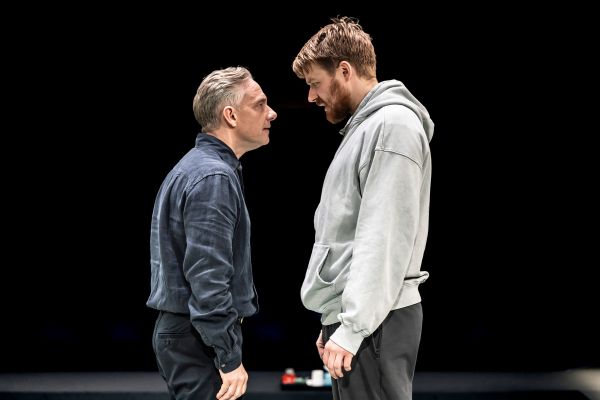
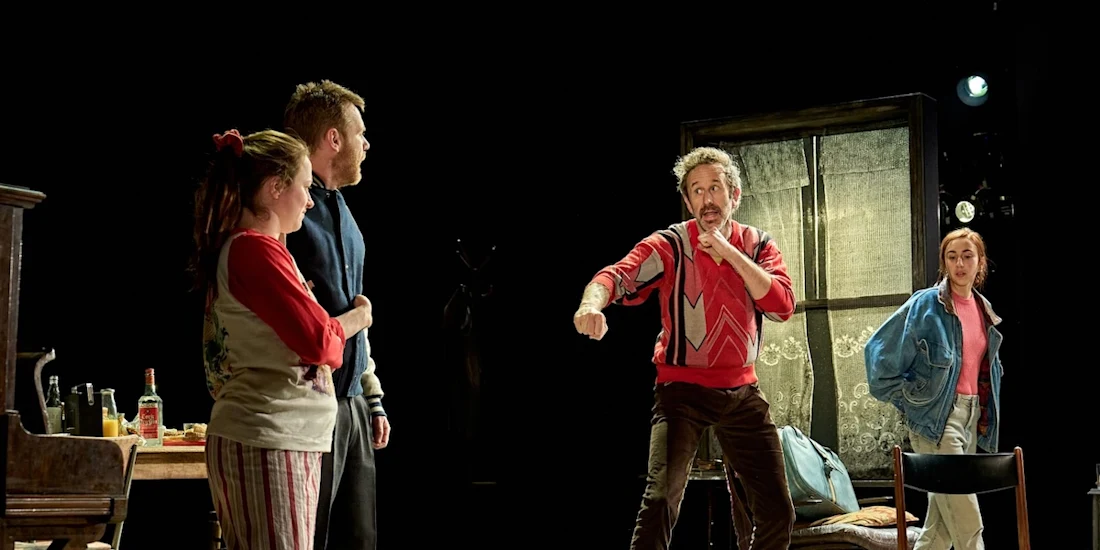
Anne-Marie Duff & Mark Bonnar in The Little Foxes. Photo: Johan Persson
Like me, you probably see more acting on TV than in the theatre. That means I’m always interested to see whether a favourite actor can make that transition from screen to stage. The Little Foxes at the Young Vic was packed with faces from British television. Mark Bonnar who you will have seen in Shetland and Guilt; Steffan Rhodri best known as Dave Coaches from Gavin & Stacey; Anna Madeley who is Mrs Hall in All Creatures Great And Small; and one certifiable star in Anne-Marie Duff most recently seen in Bad Sisters.
I have seen all these actors on stage before, but it is still a thrill to be reminded that, like so many other screen actors, they are often only giving us a glimpse of their skills when they’re in front of a camera. The real test of their acting ability comes when they are trapped in the time and space of a theatre show, communicating directly with a live audience. This cast passed the test with distinction.
Lillian Hellman’s The Little Foxes was premiered in 1939 but this attack on capitalism focuses on a family of landowners from the American South around 1900. So, the first question you might ask is, why did Lillian Hellman, who was a communist by the way, set her play around 40 years in the past? I’m guessing it’s because 1939 was not the best time for an anti-capitalist message. America had just experienced successful state intervention in their free market system in the form of Roosevelt’s New Deal, so a mixed economy may have seemed more attractive than a communist one. More than that, communists, capitalists, rich and poor were in the process of uniting in a fight against fascism, or at least that was the perception. So it might have been easier to show unadulterated capitalism, raw in tooth and claw as it were, from a couple of generations earlier.
The first half introduces us to the Hubbard family. There are two brothers- Ben played by Mark Bonnar, cunning as a fox and arrogant as a peacock, initially strutting about the stage, nonchalantly shrugging off challenges. Ben boasts of the way his family, who were traders, took advantage of the Civil War to buy up property while the Southern grandees were being defeated, fighting for their principles. He is even proud of their exploitation of what he calls ‘coloured people’.
The other brother Oscar, a weak bully, is played by Steffan Rhodri with a rat-like blend of slyness and nerves. The lead character is their sister Regina played by Anne-Marie Duff. Her bravura performance dominates the evening, entrancing us with her hyperactive character, who is by turn charming, quivering with frustration or displaying a diamond hard will power that is genuinely chilling. Her sparkling eyes and wide smile are a mask that covers her amorality.
The brothers inherited their father’s money. When they have an investment opportunity that will make them a huge fortune, Regina is shocked and angry to find she has been left out of the spoils. She plots to get both her share and revenge, by using her ailing husband’s money to make up the additional investment her brothers need.
After a slow first half that establishes the characters and their situation, the play takes off like a SpaceX rocket, as these greedy siblings ruthlessly trick and use one another. Regina becomes more ruthless than any of them in her ambition.
It’s a savage expose of people whose greed trounces love, loyalty and all other moral values. But, is it relevant today? I guess the answer to that partly depends on your politics, but the fact is, capitalism remains the dominant system, despite regulation and the welfare state. Add to which, we appear to be entering an era of less regulation, in America at least, and we have seen the privatisation of public services in the UK. So I suppose it is a good time to be reminded that however high the quality of service or product we receive from companies, their number one priority is profit, not people.
Powerful performance from Anna Madeley
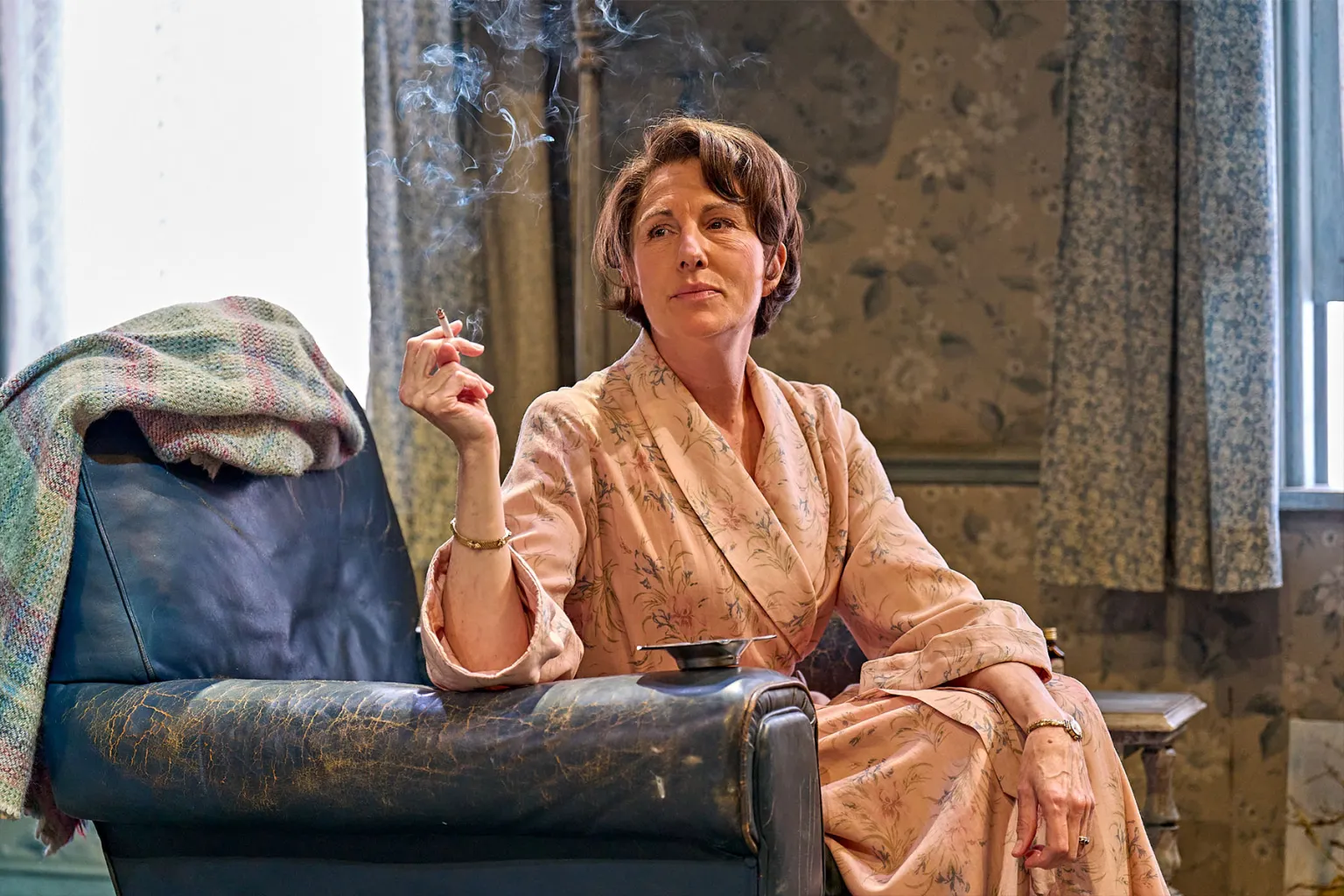
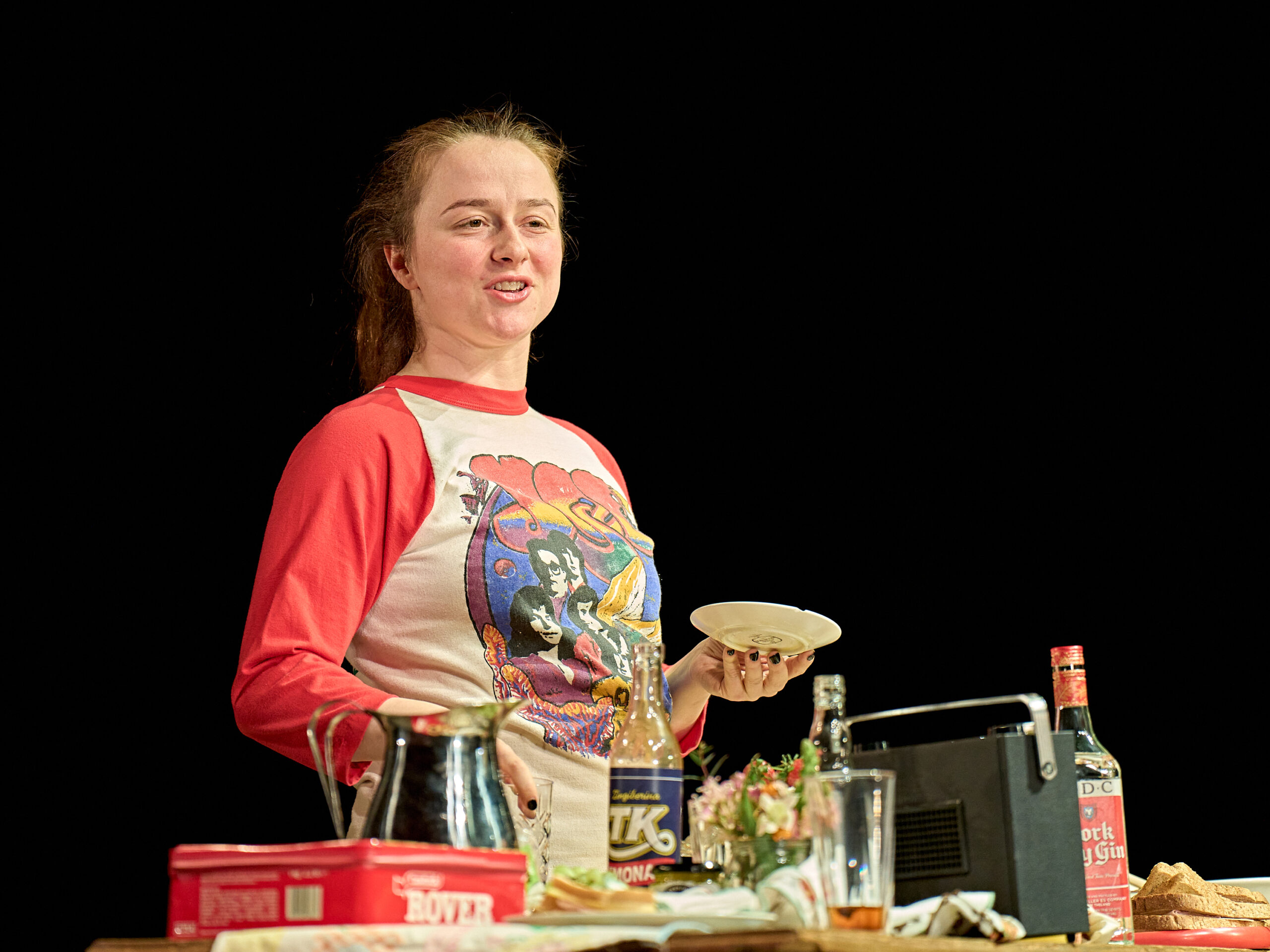
Anna Madeley in The Little Foxes. Photo: Johan Persson
The play presents some alternatives. Oscar’s wife Birdie is from an aristocratic family. She represents the ‘old values’ based on patronage, duty and responsibility. She is an alcoholic, bullied by her husband, and ghosted into a lack of confidence. She may be brittle- she laughs nervously, she looks down, there’s fear in her eyes- but still expresses her beliefs. It’s a powerful performance from Anna Madeley, showing Birdie beaten down but still proud. The quality and depth of her acting won’t surprise you if you’ve seen her as Mrs Hall, giving much-needed weight to the cosiness of All Creatures Great and Small.
Regina’s husband and daughter show that behaving morally is an option. They are played by John Light and Eleanor Worthington-Cox, the latter subtly showing how her character grows in strength as events force her to choose between standing up for her beliefs or standing by watching. In fact, the play’s strongest message is that most of us stand by watching bad things happening and do nothing about it. In stark contrast, Oscar’s son, played by Stanley Morgan, is morally bankrupt, like his father.
The black servants show two different sides of the class that has been most exploited and abused by this family. Freddie MacBruce as Cal goes about his job without question, but Andrea Davy’s Addie is firm in her opinions and tenderly loyal to those who treat her well.
Quite a few reviewers criticised the design, suggesting that its mid 20th century look was not appropriate, and even confusing, when used in a play set in 1900. On the contrary, I think Lizzie Clachan’s design is a stroke of genius. First and foremost, it doesn’t distract. A turn of the century design could have made the story seem of a bygone age, irrelevant to today. On the other hand, modern day clothes would have been too anachronistic for a play that’s set over a hundred years ago and mentions horses and carriages.
Instead, Ms Clachan cleverly plumps for the neutrality of clothes of the time it was written. The dominant beige reinforces this. The absence of the trappings of the life of the well-off suggests these are people who want wealth for its own sake. They aren’t even that interested in enjoying the luxuries that come with it.
It’s a damning picture of capitalism but I think it’s unfair to suggest, as some critics did, that it fails because the main character doesn’t evoke enough sympathy. I found that I had plenty of sympathy with her over the way she was treated and therefore cheered her on as she exacted revenge. But that sympathy only heightened the shock of seeing just how far she would go and what sacrifices she would make. Yes, she does become a monster but it seems possibly sexist to me to suggest that this portrait of a greedy capitalist woman can only can only be of interest if we have sympathy for her. I don’t think you have to sympathise with the murdering Macbeth to get involved in his character and story, or with the greedy Lehman Brothers to find them fascinating. I didn’t like Regina as a human being but it was gripping to see how far she would go and whether she would finally realise there is more to life than money.
Director Lyndsey Turner delivers a powerful interpretation and the excellent cast squeeze every ounce of drama out of it. Before the interval I was wondering whether it was ever going to take off but when it did it was riveting. And if you love watching great acting, this is one not to miss.
Till The Stars Come Down at Theatre Royal Haymarket. Photo: Manuel Harlan
The ecstatic reaction to the National’s tiny Dorfman Theatre production of Beth Steel’s Till The Stars Come Down in early 2024 earned it a West End transfer. The critics were once again bowled over by this story of a working class wedding, which appeals not only because it’s very funny but also for its ‘Chekhovian sense of loss and yearning’, as Nick Curtis put it in his Standard review.
Scroll down for the 2024 reviews.
[Links to full reviews are included but a number are behind paywalls and therefore may not be accessible]
Five stars ★★★★★
Clive Davis harked back to the production’s first manifestation in the tiny Dorfman Theatre, when he awarded it four stars: ‘If anything, the more expansive setting means the occasionally self-conscious thrusts of pure theatricality, when realism gives way to sudden flights of visual poetry, actually seem even more convincing. On a second viewing, Steel’s portrait of a working-class community in red wall Nottinghamshire, immaculately directed by Bijan Sheibani…looks even more of a modern classic.’ He explained: ‘Steel’s writing is a magnificent combination of earthiness and explosions of half-suppressed emotion… It’s a mighty achievement. As the night rolls on, fragments of real life spill in front of us like splinters of light from the glitterball.’
Greg Stewart’s TheatreWeekly review was also happy with the larger scale: ‘it loses none of its raw intimacy or emotional punch in the process. This is a production that crackles with authenticity, humour, and heartbreak; a richly textured portrait of a working-class family on the edge of transformation.’ Greg has been impressed by a lot of shows this year, so his is a significant recommendation: ‘If you see one show this summer, make it this.’
4 stars ★★★★
The Telegraph‘s Dominic Cavendish disagreed with the 5 star reviewers on the matter of scaling up: ‘Bijan Sheibani’s production was seen to its best advantage in-the-round at the National’s Dorfman last year; its intimacy made everyone feel part of the emotionally volatile occasion’. Despite awarding one star less than previously, he acknowledged: ‘it remains a manifestly riveting evening, a testament to the actors’ ability to invest larger-than-life ebullience with truthfulness, and to the subject matter’s rare immediacy.’
Julia Rank for LondonTheatre described it as ‘a tangy, multi-layered soap opera presented in a terrifically theatrical production by Bijan Sheibani that’s staged in the round (designed by Samal Blak) with a disco ball at the centre. Whether the characters are throwing shapes on the dance floor, creating a human solar system or having a blazing row, the tone is always matched by Paule Constable’s superb lighting.’ She summed up: ‘It’s a play about three sisters at the end of their tethers, but Chekhov would never be so salty in his language, nor would he throw a pair of Spanx into the audience like a bouquet. A wild, messy and beautiful piece of theatre.’
The Standard’s Nick Curtis also highlighted the connection to the great Russian playwright: ‘It’s no accident that this is a play about three sisters. Steel imbues her story with a Chekhovian sense of loss and yearning, its characters suspended as the world moves on without them. It has a cosmic perspective on the passing of time but is intensely focused on the personal, bringing the politics of globalization to a local level.’ It is, he said, ‘demotically witty and profoundly affecting’.
Isobel Lewis, writing for Time Out said: ‘Director Bijan Sheibani sucks you right into this world through fast-paced dialogue and artfully constructed tableaus. It is heady, hilarious and emotional; the wedding itself might be a car crash, but this imaginative production is anything but.’
Dave Fargnoli for The Stage liked many aspects of the evening: ‘Steel’s script is sharply observed and often very funny, enlivened by spikily natural dialogue…Dorothy Atkinson particularly stands out as Sylvia’s aunt Carol, flawlessly delivering each of her many one-liners to elicit peals of laughter or gasps of shock from the audience.’
Calling it a ‘sharply comic and deeply touching family drama’, Aliya Al-Hassan for BroadwayWorld continued: ‘Messy and melancholy, ‘Till The Stars Come Down is a beautiful and important piece of theatre.’
Chris Omaweng at LondonTheatre1 had some minor reservations: ‘some of the scene changes rattle on a bit too long, and the dramatic tension dissipates during the waiting. All things considered, however, it’s a wedding like no other, for better or for worse, and definitely worth attending.’
Critics’ average rating 4.2★
Value Rating 50
Till The Stars Come Down can be seen at Theatre Royal Haymarket until 27 September 2025. Buy tickets direct from tillthestarscomedown.com
If you’ve seen Till The Stars Come Down at the Dorfman or the Theatre Royal Haymarket, please leave your rating and review at the bottom of this roundup
2024 reviews of Dorfman premiere
5 stars ★★★★★
The Telegraph‘s Dominic Cavendish was pleased to ‘get that rare thing, a family drama about the white working-class today, with ramifications for us all, taking in the impact of immigration, financial insecurity, and uncertainty, plus love, death and the whole complex kaboodle of getting through life. It’s often deliriously funny, but also has a stabbing sense of insoluble pain.’
The Guardian‘s Arifa Akbar loved the way ‘the wedding party whirls into melodrama of a high order – rollicking, complex and bearing the tragic inevitability of Greek drama.’
LondonTheatre‘s Marianka Swain called it ‘properly funny, fiercely loving and piercingly perceptive …It’s a state-of-the-nation drama told through the prism of one family, and a generational tale boiled down to one day; brilliantly specific in its references, yet universal in its hilarious, heart-stopping storytelling.’
Sarah Crompton at WhatsOnStage said a ‘sense of vitality fills the entire play and the richness of every character … gives a superb ensemble cast roles to play with their entire heart and soul. Their warmth, their subtlety and their ability to portray a family in love and at war make this rewarding, utterly unmissable play a theatrical event to remember. It’s sensational.’
4 stars ★★★★
The Times‘ Clive Davis was delighted that ‘Beth Steel’s debut for the National…plunges us into the middle of a clan whose passions, jokes and prejudices are utterly authentic.’
The Standard‘s Nick Curtis pointed out: ‘It’s no accident that the play centres on three sisters; Steel creates a Chekhovian blend of comedy and tragedy, amped up by booze and ribald East Midlands bluntness. One of these women married a man because he looked at her “like a potato in a famine”.’
The Observer‘s Susannah Clapp described how ‘Sheibani’s production brims with vivacity. How wonderfully the stage heaps up with stuff – from hairdryers to cheese hedgehogs – and is gradually drained. How spot-on are Samal Blak’s costumes: the tight scarlet satin frock, the wedding dress that gapes. How marvellously a first-rate cast pull together as their characters pull apart. And just look at Lorraine Ashbourne and Lisa McGrillis suddenly recognising in each other, though decades apart, the same lost loves and lives. Those of a struggling post-industrial Britain.’
Fiona Mountford at the i-paper found ‘Bijan Sheibani’s lively, loving, in-the-round production revels in the earthy humour of Steel’s script, which instantly convinces in its depiction of family dynamics.’
‘I loved its sweaty honesty, its big, generous canvas, its energy and its deep sympathy for its characters. Steel resists easy answers too,’ said Sarah Hemming in The Financial Times. ‘the muscular immediacy of Steel’s dialogue is undeniable, with laugh-out-loud lines flung about like confetti while hearts quietly break. It’s a gloriously messy affair, compassionate, hilarious, and tangy with fear and longing,’ said Sam Marlowe in The Stage.
The Independent‘s Alice Saville began: ‘A pair of elasticated Spanx pings into a near-hysterical audience in the first act of Beth Steel’s zingy comedy, set at a small town Northern wedding where all decorum breaks down. It’s typical of the cheeky spirit of this crowd-pleasing play – but peel off the layers and there’s tragedy underneath.’
Time Out‘s Andrjez Lukowski was critical of the way the Polish groom was portrayed, saying, ‘As much as anything else it’s just frustrating to have this sloppiness in an otherwise meticulous play. ‘Till the Stars Come Down’ is a funny, heartbreaking piece of writing, wonderfully acted, tenderly directed… except when it isn’t.’
For Black Boys Who Have Considered Suicide… Photo: Johan Persson
Looking back at this year’s reviews roundups, I see two of the best reviewed shows this year were returns: People Places And Things with Denise Gough and The Lehman Trilogy. They scored a critics’ average rating of 4.6★ as did the best new play of the year For Black Boys. The other big winners were The Open Air Theatre’s Fiddler on The Roof (4.5★), Imelda Staunton in Hello Dolly (4.4★), Til The Stars Come Down (4.4★), and The Cabinet Minister (4.4★).
This year’s turkeys were The Duchess (2.6★) with Jodie Whitaker, Barcelona (2.6★) with Lily Collins, and The Tempest (2.7★) with Sigourney Weaver, the latter being rated Worst Value of the year thanks to the eye-watering prices. The lowest average critics’ rating this year went to Shrek The Musical (1.8★) followed by Eddie Izzard’s Hamlet (2.0★).
The Observer’s Susannah Clapp is my Critic of the Year for combining insight, intelligence and wit. Add to which, she is the queen of the putdown. This is what she said about Barcelona: ‘the range of feeling remains small: from giggle to whimper’, and here’s her description of Sigourney Weaver: ‘not only unsure of her lines but apparently uncertain of what a line is’.
Dickie Beau and Simon Russell Beale in The Invention of Love. Photo: Helen Murray
In Tom Stoppard’s revived 1997 play, the poet and classicist A E Housman finds himself dead in Hades, meets his younger self and explores his memories. Simon Russell Beale as the older Houseman garnered great praise, but some of the critics found the play too clever by half.
Matt Wolf popping up at LondonTheatre (5★) noted, ‘Abstruse as Stoppard’s hyper-erudite text can sometimes be, it is suffused at every turn with feeling. You watch in continual awe – and perhaps occasional confusion – as classical references get lobbed across the footlights, only to clock the deepening ache of this near-definitive portrait of unrequited love.’
Tim Bano in The Independent (4★) said, ‘Blanche McIntyre’s subtle, uncluttered production…delivers a pretty good case for the play being …a bona fide masterpiece.’
The Telegraph’s Dominic Cavendish (4) was also impressed: ‘There’s more to chew on in two or so hours than at the amplest festive feast.’ He said Simon Russell Beale ‘makes every line resonate with fresh thought and feeling’.
David Jays in The Guardian (3★) said, ‘The quicksilver Russell Beale is a vocal glory, leaping in a breath from flute to poignant bassoon, from wit to sorrow.’
Alexander Cohen at BroadwayWorld (3★) also liked SRB but was unsure about the play: ‘this is Stoppard at his most frustrating: lapping tides of stuffy self-referentiality, self-congratulatory smirks, and pats on the back for every reference you can count pull you under the waves.’
Chris Omaweng for LondonTheatre1 (3★) wrote, ‘A demanding and yet not completely inaccessible show, it is at least consistent in its intense analysis of ancient works as well as the world inhabited by Housman and his contemporaries.’
Dominic Maxwell of The Times (3★) said ‘it offers plenty of pleasures, not least a characteristically lucid and tender central turn from Simon Russell Beale. It’s wise, witty, dense, dazzling, opaque. And sometimes it’s a slog.’ To put it another way, ‘this is a play with great monents, not a great play ‘
The i-paper‘s Fiona Mountford (2★) found it ‘unbearable’. About Stoppard, she said, ‘too often his lofty intellect cowers audience members into submission’. But not Ms Mountford with her ‘Oxbridge classics degree’. She explained, ‘we have three hours of often indistinguishable men exchanging achingly arch lines about the minutiae of classical grammar and quoting screeds and screeds of Latin at each other.’ To put it more plainly: ‘it feels less like drama and more like intellectual masturbation’. Est quodest! as Fiona might say.
Daisy Edgar-Jones and Kingsley Ben-Adir in Cat On A Hot Tin Roof
Hopes must have been high at the Almeida when they announced Cat On A Hot Tin Roof. Director Rebecca Frecknall has had spectacular success with her previous productions of Tennessee Williams. Daisy Edgar-Jones, Kingsley Ben-Adir and Lennie James play, respectively, a sexually frustrated wife, an alcoholic, possibly gay husband, and a bullying, dying family patriarch. As the Time Out review said, ‘the horror here is the hell of other people. Everyone is trapped with everyone else’.
Unfortunately for The Almeida, a number of critics felt trapped by this long production, although most gave favourable reviews. Kingsley Ben-Adir and Lennie James received high praise but the reviewers didn’t agree about Daisy Edgar-Jones with comments ranging from ‘so good’ to ‘irritating’.
[Links to the full reviews are given but some websites may be blocked unless you have a subscription]
In fact, it was Time Out’s Andrjez Lukowski (5★) who loved it most of all. Daisy Edgar-Jones, he proclaimed, ‘is so, so good, inhabiting Maggie with a burning, vivacious swagger, alternatively self-mocking, self-pitying, compassionate and vicious’. Kingsley Ben-Adir displays, he said, ‘terrific acting, but sacrificing showing off to the greater good of the play.’.
The Standard’s Nick Curtis (4★) too praised the cast in this ‘striking and vivid interpretation’. He said Daisy Edgar-Jones ‘gives an intense and physically exact performance as a woman born poor and aware of the currency of her body and its fecundity. There’s intention in every tilt of her shoulders or arch or her bare instep.’ He talked of ‘Kingsley Ben-Adir, bringing nuance to stumbles and slurs’ and ‘Lennie James, terrifying…he’s magnetic.’
‘Performances are strong all round,’ agreed Holly O’Mahony for LondonTheatre (4★). The Financial Times’ Sarah Hemming (4★) spoke of ‘Rebecca Frecknall’s bruising, claustrophobic production, in which bad faith seems to hang in the air like mist, pooling in the corners of Chloe Lamford’s coldly opulent set.’ ‘What a savage, poisonous, ugly work this semi-autobiographical piece proves anew in Frecknall’s unflinching, if overlong revival,’ observed Clare Allfree in the Telegraph (4★).
Siobhan Murphy for The Stage (3★) declared: ‘if baroque, red-in-tooth-and-claw intensity is what you seek from a Williams play, you won’t feel short-changed.’ Arifa Akbar in The Guardian (3★) decided, ‘Ultimately this is a production that you admire rather than one that moves you.’ Sarah Crompton at WhatsOnStage (3★) had a similar reaction: ‘illuminating, but strangely passive’.
The Independent’s Alice Saville (2★) didn’t like it: ‘Frecknall’s play runs long and slow at 180 minutes – and it feels unbalanced, too, with Maggie’s thin scenes outweighed by her husband’s bloated ones.’
Adam Bloodworth for CityAM (2★) found ‘this version of Cat on a Hot Tin Roof only skims the surface, rarely getting into the darkness at the heart of Williams’ play about trauma, ageing and identity.’ For him, ‘Daisy Edgar-Jones is irritating, never defusing from a perpetual state of angry-shouty indoor voice.’ The Times’ Clive Davis (2★) was another left cold by the Hot Roof: ‘this weirdly off-kilter production, alternately ponderous and manically overheated, could almost be a parody of Williams’s gothic manner.’
Sigourney Weaver in The Tempest. Photo: Marc Brenner
Garnering some of the worst reviews of the year, The Tempest has turned out to be a disappointing start to Jamie Lloyd‘s Shakespeare season at the mighty Theatre Royal Drury Lane. All eyes were on Sigourney Weaver (still seen as Ripley from Alien by many) but her flat delivery of the lyrical language was decried by the critics. As if that wasn’t enough, the barbs thrown in the direction of Jamie Lloyd’s stark production suggest a rare failure after his string of hits ranging from his 2018 Pinter season to Evita, Cyrano, The Seagull, The Effect and most recently Sunset Bouevard. Views were mixed on the matter of Soutra Gilmour‘s dark set and Matthew Horne‘s comedic turn but everyone praised Mason Alexander Park as Ariel.
[Links to full reviews are included but a number are behind paywalls and therefore may not be accessible]
‘Weaver is not a masterful Prospero: her verse delivery is flat and featureless, which leaves a vacuum in this key role,’ said Arifa Akbar in her Guardian (4★) review. However, there were compensations: ‘The swirling black emptiness around the set looks fathomless, blasts of light bring tremendous visual drama, and sheer silken sheets spanning the length of the stage are used in simple but sensational ways. The production creates its own dark magic with large-scale grandeur.’ She concluded, ‘It’s all thoroughly odd, but in an audacious and enlivening way.’
Neil Norman in the Express (4★) said ‘Weaver is a supremely confident presence, dressed in grey and white and delivering Prosero’s great speeches with a clarity of diction that is characteristic of the entire production.’ As for the production, it ‘rarely falters throughout’. He expanded: ‘Lloyd’s vision is spectacular but spare’ and ‘Soutra Gilmour’s design is simple but epic’.
The Telegraph‘s Dominic Cavendish (3★) found, ‘Weaver fails to weave the requisite magic.’ He spoke of ‘much woodenness in her delivery – an even-keel approach that verges on the automaton.’
Andrzej Lukowski in Time Out (3★) said about the Hollywood star: ‘She’s not a good verse speaker, delivering everything in a concerned-mom monotone that fails to hold this big, weird play together.’ but he did call the production ‘an awesome spectacle’.
The Standard‘s Nick Curtis (3★) too was disappointed: ‘instead of lightning in a bottle, it’s a damp squib.’ He declared, ‘An interesting thematic suggestion that Prospero’s island is a place of rebirth gets lost amid the sonorous intonation and tedious comic relief. For all its stark visual boldness, this is a curiously old-fashioned take.’
Sarah Hemming in The Financial Times (3★) described how ‘Lloyd and lighting designer Jon Clark sculpt the space, sending the characters hurtling across the stage in a glowing burst or silhouetting them stock-still on the set’s dark hills.’ However, ‘human intricacy and intimacy often elude this staging. There’s a lack of jeopardy and it’s curiously unmoving’.
Patrick Marmion for the Mail (3★) commented that Jamie Lloyd’s ‘insistence on using mics not only makes everyone look like they’re lip-synching, it paradoxically renders some of the Bard’s finest verse in muttered whispers.’ He was disappointed with the use of the star: ‘I’d like to have seen Weaver’s emotional range stretched a bit more than simply deploying her as an alpha-female observer on her own story. It’s a bit like renting a vintage Cadillac and using it for the weekly shop.’
LondonTheatre‘s Olivia Rook (3★) found Sigourney Weaver ‘too detached to have much impact, often simply speaking the lines rather than offering up a new interpretation.’ But she did like the look of the production: ‘Soutra Gilmour’s grey-scale, futuristic, moon-like set, with mountainous rock face and rubble, is visually striking and, once lit by Clark’s lighting, aptly captures the hostile environment of this rough, wild island. There’s little substance in this production, but plenty of style. It’s worth a trip just to see Gilmour’s beautifully bleak set.’
Dave Fargnoli in The Stage (3★) described ‘a terse, unfussy minimalism to the performers’ delivery that builds an effectively eerie atmosphere, but leaves Shakespeare’s poetry feeling underserved, its meaning adrift.’ He liked ‘Soutra Gilmour’s bold design (that) sets the action in a bleak, blackened wasteland, where shreds of white smoke crawl across an undulating landscape of glimmering volcanic sand. He found Sigourney Weaver’s ‘delivery flat and frequently tentative’.
For Alice Saville in The Independent (3★), Sigourney Weaver ‘doesn’t have the charisma to anchor this fanciful story’. She comes up with an interesting analogy for the setting: ‘This island feels like a queer fetish club at 4am, where time stands still’. Well, now we know what Ms Saville does after a hard night’s reviewing!
Sarah Crompton at WhatsOnStage (2★) called it ‘misconceived and under-achieved’. She continued, ‘The unremitting mood of darkness is not leavened by any move towards hope or redemption. There is no sense that this is a play about revenge and forgiveness; the tone is unremitting.’
Clive Davis in The Times (2★) wasn’t impressed by Ms Weaver: ‘she turns in a strangely impersonal performance’. As for the production: ‘as the colours of the backdrop and Gilmour’s costumes are so muted, Lloyd’s vision of a magical kingdom soon grows monotonous’.
BroadwayWorld‘s Alexander Cohen (2★) didn’t get on with it. ‘The three times Oscar-nominated Hollywood veteran mumbles through Prospero’s lyricism with barely a glint of an attempt to grasp the coiled intricacies of the language’ he said. And the production? ‘Lloyd’s chuck-it-at-the-wall-and-see-what-works vision doesn’t help. The auteur’s trademark visual austerity strips the island of specifics, with piles of black ash flecked by glaring crepuscular light forming a planetary hellscape.’
Heather Neil at The Arts Desk (2★) said ‘Lloyd and his designer Soutra Gilmour have conjured a strange, otherworldly, hilly, inhospitable place’. ‘There’s not much evidence of the “sweet airs” Caiban speaks of’, she added. She said she ‘would have preferred a more actively engaged Prosopero’. Like nearly all the other critics, she praised Mason Alexander Park’s Ariel as ‘the central energetic force throughout’.
Fiona Mountford in the re-branded i paper (1★) called it a ‘dismal non-event of a production’ and awarded a dismal one star. She said Weaver’s ‘wooden delivery never wavers from a tone of blank meditation’. The Observer’s Susannah Clapp (2) delivered the knockout blow: ‘She is flat: not only unsure of her lines but apparently uncertain of what a line is, delivering phrases as if she were measuring portions on a plate, without a roll or much driving sense.’
Critics’ Average Rating 2.7★
Value Rating 16 (Value rating is the Average Critic Rating divided by the typical ticket price)
Dave Malloy’s award-winning sung-through musical version of a short but eventful section of Tolstoy’s War and Peace has taken ten years to travel from Broadway, but the critics thought it was worth the wait. With some exceptions, they loved the music, the production (directed by Tim Sheader) and the performances. So, another hit for Mr Sheader in his first season as Artistic Director of The Donmar.
[Links to the full reviews are given but some websites may be blocked unless you have a subscription]
Sarah Crompton at WhatsOnStage (5★) was captivated: ‘both epic and intimate, vast and tiny. It is magnificent, infinite riches in a little room.’ She concluded, ‘It’s a riveting journey, true to Tolstoy’s themes yet compressing his mighty thoughts into one of the best new musicals for years, both hugely entertaining and deeply intelligent.’
The Observer’s Susannah Clapp (5★) said it was ‘aswirl with colour and movement, alive with decisive characterisation and rending story’.
Marianka Swain at LondonTheatre (5★) described it thus: ‘Dave Malloy’s gonzo, knowing, blisteringly funny and wildly creative chamber opera only takes one small section of the novel, and although it is undoubtedly, excitingly ambitious, this big-hearted show invites the audience into his dazzling world.’ She continued: ‘the most luminous element by far is the fantastic cast and onstage band laying into Malloy’s magpie score, which brilliantly fuses Slavic folk with EDM, rock-pop, jazz, and yearning ballads.’
Claire Allfree for the Telegraph (5★) said, ‘Malloy’s score is a gypsy carnival of sound…The singing throughout is outstanding and allows for expressive individual moments’.
Debbie Gilpin at BroadwayWorld (5★) found ‘The heady mix of ballads and uptempo numbers, not to mention drama and comedy, in the relatively intimate environment of the Donmar makes for a unique musical theatre experience.’
Arifa Akbar in The Guardian (4★) called it a ‘dynamic new production, which has stratospheric levels of energy’ but tempered her praise by saying, ‘the show is held back by its own polished larkiness though it is hugely and amusingly original all the same.’ She concluded, ‘this is a terrific creation and at its best it soars.’
‘Sparkling and strange, Dave Malloy’s EDM-fuelled rock opera is a thing to marvel at’ declared The Independent’s Alice Saville (4★). She went on, ‘Malloy’s … musical is a masterclass in prosody, with its often-thin lyrics given emotional heft and depth by orchestration choices, which elicit their meaning.’
Laurie Yule writing for The Stage (4★) picked out ‘Most notable, though, are the jaw-dropping performances from an energetic and passionate ensemble.’ Andrzej Lukowski of Time Out (4★) called it ‘one of the great musicals of our day’.
There were dissenters. The Standard’s Nick Curtis (3★) described it as a ‘massively audacious, massively pretentious musical’. Clive Davis of The Times (3★) was unmoved: ‘if its sheer theatricality is never less than dazzling, the relentlessly quirky tone…kept me at a distance from the characters. I laughed, I grinned, but I never really felt inclined to shed a tear.’
Julian Clary and Jane McDonald in Robin Hood at The London Palladium
In only a few years, The London Palladium panto, directed by Michael Harrison, has become a Christmas tradition, renowned for its star-packed bill, lavish sets and borderline smut. Joining Julian Clary this year are Jane McDonald, Nigel Havers, Charlie Stemp, Marisha Wallace and ventriloquist Paul Zerdin. Most of the critics had fun but some were unimpressed by the lack of panto traditions and the rude jokes.
[Links to full reviews are included but a number are behind paywalls and therefore may not be accessible]
‘Harrison throws just about everything at this gloriously over-the-top show,’ said Paul Vale in The Stage (5★), perilously close to going over the top himself. ‘The technical wizardry on stage is a marvel, from a 3D sequence through the perils of Sherwood Forest to the special effects…It may play fast and loose with the traditions of pantomime, but nobody breaks the rules quite like Harrison and his team.’
‘The London Palladium pantomime has scored another bullseye!’ proclaimed Tom Millward in WhatsOnStage (4★). About the star of the show, Olivia Rook at LondonTheatre (4★) found ‘most of his jokes remain classic Clary smut’ She concluded, ‘There are many of the hallmarks of a traditional panto here — the show is full of razzmatazz, double entendre, and an eye-watering amount of spectacle — but it is a truly unique theatrical experience. You’ll certainly leave feeling merry.’
Nick Curtis for The Standard (3★) declared, ‘the smut is as OTT as the sets, costumes and effects, and no one cares too much about the plot.’ He observed ‘No expense has been spared for the razzmatazz,’ and ended, ‘I’d have liked less video, and a plot that at least gestured towards narrative coherence. But otherwise, Michael Harrison’s production is an effective celebration of the showy elements of panto that mark most people’s introduction to theatre.’
The Times’ Dominic Maxwell (3★) had reservations. It was, he said, ‘too chaotic and too bawdy to be suitable for children’ However, ‘It’s still an enjoyable evening. Lovingly done, beyond lavish, laugh-out-loud funny when Clary is clicking into gear. Yet there is a thin line between a sense of abundance and a sense of clutter.’
Claire Allfree for the Telegraph (2★) couldn’t stand it: ‘Each year, it’s the same glitteringly wrapped package – retina-burning megabucks sets, a wardrobe department to make Busby Berkeley weep, a prat-falling Nigel Havers whose exclusive purpose is to be the butt of Clary’s jokes, and of course a steady stream of smut from Clary who can rarely get through a scene without mentioning the back passages.’
Critics’ Average Rating 3.5★
Value Rating 29 (Value rating is the Average Critic Rating divided by the typical ticket price)
Anne-Marie Duff and Mark Bonner in The Little Foxes
Lillian Hellman’s classic play from 1939 is rarely performed nowadays because, if some of the critics are to be believed, that’s because its hectoring style, unsympathetic hero, and even its subject matter are considered dated. Some critics even wondered why it was being revived. Others were bowled over by the power of the play.
The story concerns a family that has made a fortune from cotton. The men of the family have all the money and are looking to make more. Their sister Regina, like all women at that time (1900), has no inheritance but is determined to have her share. Her machinations tear apart the greedy family.
The acting was praised, particularly that of Anne-Marie Duff, but director Lyndsey Turner’s updating the period from the late 19th century to the 1940s, and Lizzie Clachan’s beige set caused some heads to be scratched.
My own view is that it was a gripping drama and the production’s 1940s design made perfect sense by being in the past but not seeming to be from a bygone age. My 4-star review is here
[Links to the full reviews are given but some websites may be blocked unless you have a subscription]
The Standard’s Nick Curtis (4★) was bowled over: ‘A fine ensemble is anchored by a standout performance from Duff. She mines pathos and empathy from the character of Regina Giddens’. He declared, ‘I basically loved it’ and joked that he ‘also admired the audacity of the timing. Family tensions, rampant capitalism, excessive drinking, someone falling over. Yes, this is definitely a Christmas show.’
Sarah Crompton at WhatsOnStage (4★) said, ‘Little Foxes may be old-fashioned, but it still packs a desolate and depressing punch.’ She pointed out, ‘it has at its heart an absolute stunner of a role for an actor – Regina Hubbard, disempowered wife of the weak and sick Horace, who is manipulating her way to a share of the spoils of her brothers’ business machinations. It’s a role …that Anne-Marie Duff seizes here with charismatic power.’
Dave Fargnoli in The Stage (4★) found ‘Hellman’s writing has a masterly restraint. Her characters hide threats and double meanings behind a veneer of crisp manners and affected politeness, which they break only in the greatest extremity, consummately constructed masks slipping to reveal the violence and viciousness boiling beneath. Director Lyndsey Turner controls the tone of the piece skilfully, gradually and inexorably building tension with an unhurried but never slack pace’. Included in much that he liked was ‘The stylish set, designed by Lizzie Clachan’.
JonThan Marshall for LondonTheatre1 (4★) concluded, ‘As bleak as it all might sound, there is a satisfyingly soapy melodrama to the play we can’t help but buy into. Due to its occasionally archaic writing, it’s clear that a high-calibre cast is needed for the piece to stand up in 2024. This incarnation of The Little Foxes pleasingly does just that.’
Alice Saville in The Independent (3★) said, ‘Duff is a fascinatingly nasty creation here, exuding a brittle glamour in her blood-red gown’. ‘Turner’s staging makes the calculated decision not to romanticise this family, showing them as the grasping parasites they are.’ ‘Turner heightens the story’s early moments of violence, which dims its power to shock later on.’
Time Out’s Andrzej Lukowski (3★) found ‘In Lyndsey Turner’s elegant revival, Anne-Marie Duff …is icy-cold and laser focused’. ‘It’s a grim story, lacking in catharsis. But it’s impressively done.’ However, he had a complaint: ‘The strangest thing about Turner’s revival is the aggressively beige ’60s boardroom aesthetic to Lizzie Clachlan’s set and costumes. The play is very, very definitely set in the Deep South of 1900 and it feels somewhat jarring to, on the one hand, remove this from the production visually, but on the other hand replace it with something relatively non-specific.’
The i’s Fiona Mountford (3★) had many reservations: ‘For all the excellence of the performances, Lyndsey Turner’s production stubbornly refuses to coalesce into a compelling whole…It doesn’t help that the action unfolds on Lizzie Clachan’s long and unlovely set of unadorned beige walls, which provides no anchoring sense of time, place or family history. The greater problem, however, lies with the script’s structuring: too many key events happen offstage and are reported to us second hand, stranding us at one crucial remove from full involvement.’
Natalie Evans for The ArtsDispatch (3★) said, ‘This is, for all intents and purposes, a fantastic production of impeccable quality.’ However, ‘I simply cannot bring forth an answer to the question of ‘Why this? Why now?’ Hellman wrote this piece 85 years ago when it would no doubt have been groundbreaking. However, in 2024, nothing overly new is said, or even implied here.’
Patrick Marmion in the Mail (3★) said, ‘Despite top-of-the-range acting and portentous sound effects, urging us to feel the tension, Hellman’s writing is simply too schematic to make us care about the outcome.’ Holly O’Mahony at LondonTheatre (3) called it ‘a tricky, hard-nosed play that seems to hold its audience at a distance.’ The Telegraph’s Dominic Cavendish (3) called the production ‘fuzzy, unfocused’.
The Times’ Clive Davis (2★) was ground down: ‘A steely-eyed Anne-Marie Duff drips venom as Regina. Steffan Rhodri is persuasive as the charmless Oscar…Anna Madeley’s character, a sort of proto-Blanche DuBois is, in fact, the most interesting of all of them…In the end, however, she, like the rest of the cast, is ground down by the gears of the clockwork plot.’
Helen Hawkins writing for The ArtsDesk (2★) was also highly critical: ‘Turner’s production doesn’t really present us with a play focusing on American racism or the iniquities of the South. These issues are in the text but not at this staging’s core. Ditto feminism. What we are left with is a patchwork: a plot about family finances and double-crosses yoked to a melodrama – emphasised by the ominous rumbling sounds that accompany the climax. As a tragedy of failed dreams, though, it doesn’t engage.’
Critics’ average rating 3.2★
The Little Foxes can be seen at The Young Vic until 8 February 2025 Buy tickets direct from the theatre youngvic.org
If you’ve seen The Little Foxes at the Young Vic, please leave a review and/or rating below
Andy Nyman & Marc Antolin in The Producers at the Menier Theatre. Photo: Manuel Harlan
It’s been a while since Mel Brooks‘ one-time megahit musical has been seen in London. There was much surprise that such a spectacular show should be produced at the small Menier Theatre. Nevertheless, the critics were universally impressed by the witty, faithful direction of Patrick Marber, the stage-filling choreography by Lorin Latarro, and the all-round excellence of the cast. So much so, that it has transferred to the West End.
Some reviewers managed to praise the two stars Andy Nyman and Marc Antolin while also saying they weren’t as good as the originals, but most thought they brought a great chemistry to the roles of two producers trying to put on a loss-making show in order to keep their investors’ money. The most famous song Springtime For Hitler seems to have lost little of its hilariously funny bad taste. No reviewer gave it less than 4 stars, the main reservation seeming to be that it’s a little dated.
[Links to full reviews are included but a number are behind paywalls and therefore may not be accessible]
Reviews of the Menier Presentation
Aliya Al-Hassan in BroadwayWorld (5) gave top marks: ’It’s far from subtle, but is funny, irreverant and witty.’ She praised the stars: ‘Nyman revels in his lank-haired, slightly chaotic persona. He has a palpable chemistry with Marc Antolin‘s adorably coy and neurotic Bloom.’ And the creative team: ‘Patrick Marber shows astute direction in his first musical. LorinLatarro’s vibrant choreography defies the constrictions of the space, never seeming to be over-crowded or too busy.’
Helen Hawkins on The Arts Desk (5) called it ‘an uproarious adult panto.’ She said, ‘Andy Nyman is the dynamo of the show, a convincing wheeler-dealer…His Leo Bloom, Marc Antolin, is spot on too, nervous and silly, but equallyamiable’
The Guardian’s Arifa Akbar (4) said, ‘Still so original, and delightfully – daringly – funny, it is revived by director Patrick Marber with such vigour, sparkle and controlled wildness that it renders itself the London show of the festival season – funnier, camper and more outre than pantomime.’ She found it ‘irresistible, absurd and joyful, both celebrating and sending up the power of theatre. A blast of a show.’
WhatsOnStage’s Sarah Crompton (4) declared, ‘It’s not at all subtle, but speeds along with such pleasure at its own absurdity that it’s hugely entertaining.’ She said, ‘Nyman and Antolin anchor the show while everyone else goes so far over the top that the roof is in danger of coming off. Both Harry Morrison as the Nazi-loving author of the show and Trevor Ashley as the fabulously gay director Roger de Bris are unleashed into wild excess’.
Matthew Hemley for The Stage (4) pointed out, ‘this is a musical that still guarantees laugh after laugh after laugh, with a genuinely brilliant score from Brooks.’ He continued, ‘Marber keeps the show whizzing along, and Lorin Latarro’s slick choreography makes brilliant use of a tight space’. He described the stars: ‘Nyman and Antolin work delightfully together, Nyman a ball of frustrated energy, Antolin on top form as his nervy, blanket-hugging sidekick. They sing and dance wonderfully, and they’re very funny, too – both the physical and verbal comedy is a genuine treat.’ He went on, ‘The highlight, however, comes in the form of Trevor Ashley’s Roger De Bris, the director tasked with helming Springtime for Hitler, who eventually finds himself playing the Nazi leader…(his) expressions, voice and comic timing are spot on. His Judy Garland-infused Hitler is a wonder.’
The Financial Times‘ Sarah Hemming (4★) said, ‘director Patrick Marber, choreographer Lorin Latarro and the versatile cast go at it with unadulterated glee, plundering every cliché in the book and mischievously pickpocketing the musicals tradition.’ She continued, ‘At its heart are Nyman and Antolin, both terrific and a wonderful double act’ and concluded, ‘Despite all the absurdity…it’s rather sweet: a ridiculous love-letter to friendship and to the sheer craziness and passion of show business.’
Over at LondonTheatre (4) Olivia Rook showered praise all round and picked out various members of the cast: ‘Trevor Ashley is perfectly cast as the scene-stealing director Roger De Bris…Harry Morrison also gives a stand-out performance as the crazed Hitler fanatic Franz, spitting out his words with relish in a throaty German accent, and Joanna Woodward’s endearing, Marilyn Monroe-esque Ulla is a delight.’
Time Out’s Andrzej Lukowski (4) decided, ‘The Producers is a bit dated, a bit slow in getting going… But its pillorying of fascist iconography remains hysterically funny and steely sharp – perhaps sharper than it was before.’
Although Dominic Cavendish at The Telegraph (4) spent a chunk of his review comparing Nyman and Antolin unfavourably with the stars of the original movie, nevertheless he found it ‘perfectly suited for the festive need for cheer’.
Louis Chilton in The Independent (4) commented, ‘as a satire both of fascist nationalism and showbiz, The Producers remains ever-relevant. Directed by Patrick Marber … this production does a lot with a small, intimate stage; Lorin Latarro’s choreography is showy and dynamic – but lets the comedy rightfully hoard the focus…The jokes are rapid, the satire outrageous. How could it possibly fail?’
If you’ve seen The Producersat the Menier Theatre or the Garrick Theatre, please add your review and rating below
Manage Consent
To provide the best experiences, we use technologies like cookies to store and/or access device information. Consenting to these technologies will allow us to process data such as browsing behaviour or unique IDs on this site. Not consenting or withdrawing consent, may adversely affect certain features and functions.
Functional
Always active
The technical storage or access is strictly necessary for the legitimate purpose of enabling the use of a specific service explicitly requested by the subscriber or user, or for the sole purpose of carrying out the transmission of a communication over an electronic communications network.
Preferences
The technical storage or access is necessary for the legitimate purpose of storing preferences that are not requested by the subscriber or user.
Statistics
The technical storage or access that is used exclusively for statistical purposes.The technical storage or access that is used exclusively for anonymous statistical purposes. Without a subpoena, voluntary compliance on the part of your Internet Service Provider, or additional records from a third party, information stored or retrieved for this purpose alone cannot usually be used to identify you.
Marketing
The technical storage or access is required to create user profiles to send advertising, or to track the user on a website or across several websites for similar marketing purposes.