Climate change negotiations become entertaining thriller
@sohoplace
Stephen Kunken & Kristin Atherton in Kyoto at @sohoplace. Photo: Manuel Harlan
Kyoto by Joe Murphy and Joe Robertson, directed by Steven Daldry and Justin Martin, was first presented by the Royal Shakespeare Company at the Swan Theatre in Stratford-upon-Avon, before transferring to @sohoplace in London. As many critics commented, the idea of negotiations about climate control offering a good night out seems unlikely but they all found it entertaining. The lead Stephen Kunken was universally praised (‘demonic charm’ Metro).
[Links to full reviews are included but a number are behind paywalls and therefore may not be accessible]
Many media representatives reviewed the production when it was first performed at Stratford-Upon-Avon:
Michael Davis for WhatsOnStage (5★) acknowledged that climate change talks might be off-putting as a subject for a play but assured us it was a ‘drama with a deeply powerful message, delivered with sleight of hand and considerable theatricality, and disguised in a hugely entertaining production’. Suzy Fey for the Financial Times (4★) agreed: ‘Kyoto is more exciting than it has any right to be’. The Observer‘s Susannah Clapp (4★) called it ‘a whirligig show’. Dave Fargnoli in The Stage (4★) said ‘the directing team of Stephen Daldry and Justin Martin instil proceedings with a similar breathless energy’. Mark Lawson for The Guardian (4★) quipped, ‘this play about the diplomatic consequences of commas deserves a string of exclamation marks’.
More reviews followed when Kyoto transferred to London:
Cindy Marcolina at BroadwayWorld (5★) commented, ‘The facts and figures are embroidered into a beckoning, snappy dialogue, naturalistic and throbbing with energy.’ Like others, she praised ‘ Miriam Buether’s exceptional design. Walking into the auditorium feels like entering a conference centre’. She ended her review: ‘Definitely one you can’t miss.’
Nick Curtis of The Standard (4★) called it ‘a taut and gripping thriller’. Time Out‘s Andrzej Lukowski (4★) joked it was ‘so indecently entertaining it almost feels like the result of a bet to choose the dullest, worthiest subject imaginable and make it as fun as humanly possible.’ ‘it’s impressively dynamic’ said Holly O’Mahony at LondonTheatre (4★). Dominic Maxwell in The Times (4★) found it ‘alive with drumming, stand-up comedy monologues, self-aware jokes, nods to the present day.’ (His colleague Clive Davis gave 3 stars in his Stratford review- ‘buckets of primary colours and a fair amount of knockabout humour’.)
Calire Allfree for the Telegraph (3★) acknowledged that ‘this near-three-hour marathon consistently moves with effervescent vigour’ but felt it ‘had little to say about climate change’.
Steve Pemberton & Reece Shearsmith in Inside No 9: Stage/Fright
Inside No 9 ran for a highly successful nine (of course) series. The spin-off stage show is clearly one for the fans but it embraces the medium of theatre, according to the critics. Some of them found it inventive and frightening, others thought it was funny but not that original.
[Links to full reviews are included but a number are behind paywalls and therefore may not be accessible]
‘It isn’t to be missed’ declared a besotted Katelyn Mensah for Radio Times (5★). And in case you missed the message, she ended her review ‘it’s a thrilling ride that shouldn’t be missed.’
For Dominic Cavendish of the Telegraph (4★) was more measured: ‘this is an evening that tallies the need to give us a good laugh and a valuable fright – encapsulating their relish for the absurd and macabre – with reflections on mortality and loss.’
For The Guardian (4★), Brian Logan called it ‘a slickly produced spooky wheeze, distinguished by Shearsmith and Pemberton’s clearly personal obsession with the double-act dynamic and old-school entertainment, and with theatres and their ghosts.’
‘There’s a lot that’s absurdly funny, as well as one sequence that is genuinely hair-raising. Meanwhile a deeper, more moving thread works through the piece about the interplay between acting, memory and haunting,’ said Sarah Hemming in The Financial Times (4★).
The i-paper’s Culture Editor Sarah Carson (4★) took on reviewing duties for this show, calling it ‘riotously fun’ and ‘raucously entertaining’. She praised ‘ writing and wordplay that is so clever and quick that it is impossible not to miss every reference.’ Not sure that’s what she meant to say but you get the message.
‘It’s not radical, or even as ground-breaking as the television shows which have spawned it. But it is great, all-encompassing fun,’ said Sarah Crompton at WhatsOnStage (4★).
Annabel Nugent for The Independent (4★) said, ‘if nothing else, this is one play you won’t be checking your watch in. Tonight, on stage, the spirit of Inside No 9 is alive and kicking.’
Anya Ryan from LondonTheatre (3★) seemed like she was hoping for more originality, nevertheless: ‘Recycled gags? Tick. An element of surprise? Tick. And the cherished pair giving it their everything? Oh absolutely.’
The Stage’s Sam Marlowe (3★) said, ‘It’s a show in need of a stronger sense of purpose and identity: it’s not quite funny, emotionally involving or frightening enough, even though it has flickers of all those elements.’
Nick Curtis of The Standard (3★) called it ‘a mix of the intelligent and the obvious – part smart reinvention and part lazy cash-in.’ Patrick Marmion had a similar reaction in the Mail (3★): ‘The show has a distinct feeling of using up the comedians’ off-cuts, out-takes and left-overs for the amusement of themselves and their fervid fan-base. ‘
At the start of 2025, it seemed that The Times’ Clive Davis (2★) had made a New Year resolution to be nicer to the shows but, if he did, he hasn’t stuck to it. In his latest outing, he reverted to the hard-to-please, sting-like-a-scorpion critic that we know and love. In a review was more frightening than the show, he warned, ‘Prepare to be underwhelmed… by this laboured set of ghoulish sketches’
Critics’ average rating 3.6★
Value Rating 42 (Value rating is the Average Critic Rating divided by the typical ticket price)
Nadi Kemp-Sayfi and Gabrielle Brooks in Cymbeline at Shakespeare’s Globe. Photo: Marc Brenner
William Shakespeare’s Cymbeline is one of his lesser known works for the very good reason that it’s a bit of a mess but director Jennifer Tang has made a good attempt at making it work, according to the critics, especially by swapping the genders of the eponymous lead and some of the other characters. Even so, some remained unenthusiastic about the play itself.
Matt Wolf for LondonTheatre (4) praised ‘Tang’s ability to find an emotional throughline to a sometimes wayward text’ ‘The vagaries of romance between Gabrielle Brooks’s superb Innogen and Nadi Kemp-Sayfi’s impassioned Posthumus, raised within the royal household, drive the newly queer narrative.’
Nick Curtis in The Standard (4★) found it ‘gets a bold, vivid production from Jennifer Tang that matches its hectic mix of comedy, horror and absurdity. ‘
Miriam Sallon writing for WhatsOnStage (4★) declared ‘if a lesser-loved, mishmash, three-hour, tragi-comic Shakespeare isn’t going to sell it for you, you should absolutely just go for the music. Led by composer Laura Moody, the musical trio, completed by Heidi Heidelberg and Angela Wai Nok Hui, are mesmerising all on their own.’
Alexander Cohen for BroadwayWorld (3★) said, ‘Tang’s directorial vision alone charges it with the momentum it needs. She has a solid grasp of a slippery play.’ Dave Fargnoli in The Stage (3★) seemed to agree, ‘Although the production’s bold ideas don’t all gel, this is an original and engaging reinterpretation that offers thought-provoking new perspectives on Shakespeare’s contrived historical drama.’
Dominic Maxwell in The Times (3★) opined, ‘while you’d be pushed to say that the director Jennifer Tang’s female-led sometimes resexed retelling of this romantic mishmash is either very tragic or very funny, even at almost three hours long, it keeps stubbornly finding ways to be interesting.’ The Guardian‘s Arifa Akbar (3★) wasn’t sure what to make of it: ‘it felt like a play trotting from one plot-turn to another to reach its exhausting end.’
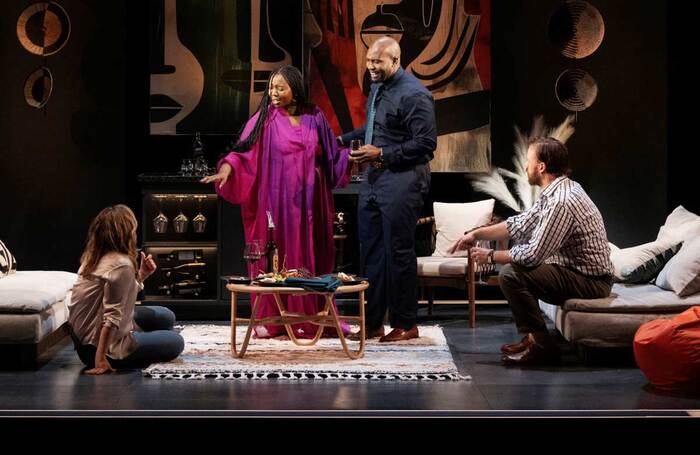
David Byrne‘s first season as Artistic Director of the Royal Court continues to impress. His latest offering is Amy Jephta‘s play is set in South Africa where a middle-aged white couple enlist wealthy black neighbours whom they’ve previously ignored to improve the effectiveness of their bid to remove an unauthorised shack in their enclave. The critics mostly liked it but were split between those who thought it was ‘perceptive provocative fun’ and those who thought it didn’t quite convince.
[Links to full reviews are included but a number are behind paywalls and therefore may not be accessible]
Arifa Akbar in The Guardian (4★) found it was a play with layers: ‘Do they want to be insiders at all or remain wilful outsiders, keeping a connection to the imaginary invaders in the shack – and their own past geographies? How does being on the “inside” compromise the integrity of their identity politics, as well? The layers to this line of questioning are what gives this play its depth.’
Dave Fargnoli in The Stage (4★) liked the way the director Nancy ‘Medina takes a methodical approach, allowing conflict to escalate gradually, the debates eventually descending into rapid-fire shouting matches. This allows for some brilliantly judged comic timing, as the residents twist themselves into exquisitely awkward knots, trying to mask their toxic entitlement with hollow civility.’
The Times‘ Clive Davis (4★) began ‘this quirky domestic drama sends you home with awkward questions buzzing around in your head.’ He was happy that ‘there’s an intensity to all the performances that keeps agitprop at bay. Jephta’s mischievous portrait of life in a far-away country has a universal flavour.’
WhatsOnStage‘s Sarah Crompton (4★) called it ‘fast-moving and very funny, puncturing assumptions and attitudes with swift and searing observation’. The Standard‘s Nick Curtis (4★) said, ‘This isn’t perfect but it’s perceptive, provoking fun.’
Aleks Sierz at TheArtsDesk (3★) said it was ‘perceptive and provocative, but it’s also an imperfect mix of styles and topics.’ While calling it ‘a worthy exploration of prejudice and privilege’, Holly O’Mahony at LondonTheatre (3★) decided, ‘this play, with its cracking premise, still has room to grow.’
Alexander Cohen at Broadway World (2★) was disappointed, describing it as ‘A case of never being more than the sum of its parts, even if those parts have promise in themselves.’
Lionel Bart’s Oliver! is one of the few, perhaps the only, bona fide British musical from the Golden Age when shows were packed with memorable songs. The legendary producer Cameron Mackintosh has loved Oliver! since childhood and returned to it again and again. His latest production was praised in many 5 star reviews for Matthew Bourne‘s choreography, Paule Constable’s dramatic lighting, Lez Brotherston’s intimate set, Simon Lipkin‘s portrayal of Fagin and for being a little darker than past incarnations. But some found it too old-fashioned and lacking in bite.
[Links to full reviews are included but a number are behind paywalls and therefore may not be accessible]
Marianka Swain at LondonTheatre (5★) delivered her customary thoughtful analysis: ‘Bart’s musical can be something of a tonal challenge: steeped in the darkness of Dickens’ novel, yet simultaneously packed with jaunty tunes and cockney knees-up dance numbers. Bourne (who choreographs and co-directs with Jean-Pierre van der Spuy), manages that balancing act perfectly, giving us plenty of grime and grit alongside transporting pleasures.’ She declared ‘the true star is Paule Constable and Ben Jacobs’s sublime lighting design, which brings quite literal light and shade to the production. It’s genuinely terrifying when the villainous Bill Sikes looms out of the smoky darkness, his menacing shadow the first thing we see.’
WhatsOnStage‘s Sarah Crompton (5★) noted, ‘Its quality lies in the way that the collaborators … make a contrast between constant movement and stillness, allowing the focus to slide from broad, bright dance scenes full of life, to powerfully arresting moments of peril and sadness.’ Adam Bloodworth at CityAM (5★) declared, ‘director and choreographer Matthew Bourne has surely opened the musical of the year with his astounding dance sequences. It’s especially the ensemble numbers that are sheer staggering feats of imagination, offering insane levels of detail to bring Victorian London back to life.’
Helen Hawkins on the Arts Desk (5★) praised the ‘impeccable singing and dancing, teamed with a brilliant set, atmospheric lighting and a Poor Theatre design that makes the staging oddly intimate’. Allya Al-Hassan at Broadway World (5★) pointed out, ‘Whilst retaining the joy and exuberance of Bart’s music, it does not shy away from the dark heart of child poverty, exploitation and violence of Charles Dickens’ story. It also manages to have moments of pure theatrical comedy. It is a deft and masterful achievement.’
Neil Fisher for The Times (5★) added a star to his colleague Clive Davis’ previous Chichester review: ‘you can’t fault the verve with which Bourne drills the big numbers, nor the cast’s bonhomie.’ Of the show’s Fagin, he said, ‘Lipkin captures both the plight of the traumatised immigrant – and of anyone trying to lead a good life in a dark and devious world’. The Telegraph‘s Dominic Cavendish (5★) enjoyed ‘dollops of theatrical delight’, and said ‘the whole thing is delivered with such tightly choreographed panache’.
Dominic Maxwell in The Sunday Times (4★) described how ‘Matthew Bourne’s sumptuous production at the Gielgud Theatre in London gives us a Victorian London of shadows, spotlights and smoke. It looks dangerous, but gorgeous. Nice job.’
The Observer’s Susannah Clapp (4) picked out ‘Superb lighting by Paule Constable and Ben Jacobs shows the action as if through Oliver’s eyes: a harsh glitter of grey over the workhouse; a deceptive golden glow for Fagin’s den.’
The Stage‘s Sam Marlowe (4★) described how ‘Designer Lez Brotherston delivers a murky London of steel gantries, pawnshops, pubs and coffee houses, bustling with picture-perfect denizens: self-important men with mutton chops, moustaches and stovepipe hats, and purse-lipped women in mob caps with formidable bosoms. Bourne’s buoyant, nimble choreography is wrapped around darker drama that makes its mark in broad strokes.’
Not everyone was so impressed. Fiona Mountford at i-news (3★) said ‘rarely have I felt so awkwardly aware of a piece’s fundamental pretence…Everything here looks precise and lovely, immaculately well-drilled, but it’s almost impossible to feel emotionally invested.’
Andrjez Lukowski at Time Out (3★) felt it lacked punch. Take Simon Lipkin’s Fagin: ‘Making him so nice he won’t offend anyone is certainly one idea, but it does further defang Dickens’s yarn.’ He contended ‘The biggest flaw, though, is one that’s haunted the show for decades: Oliver himself is just pretty bland.’
Having reviewed it in Chichester, The Guardian decided the production didn’t require a second review
Critics’ Average Review 4.4
Value Rating 46 (Value rating is the Average Critic Rating divided by the typical ticket price)
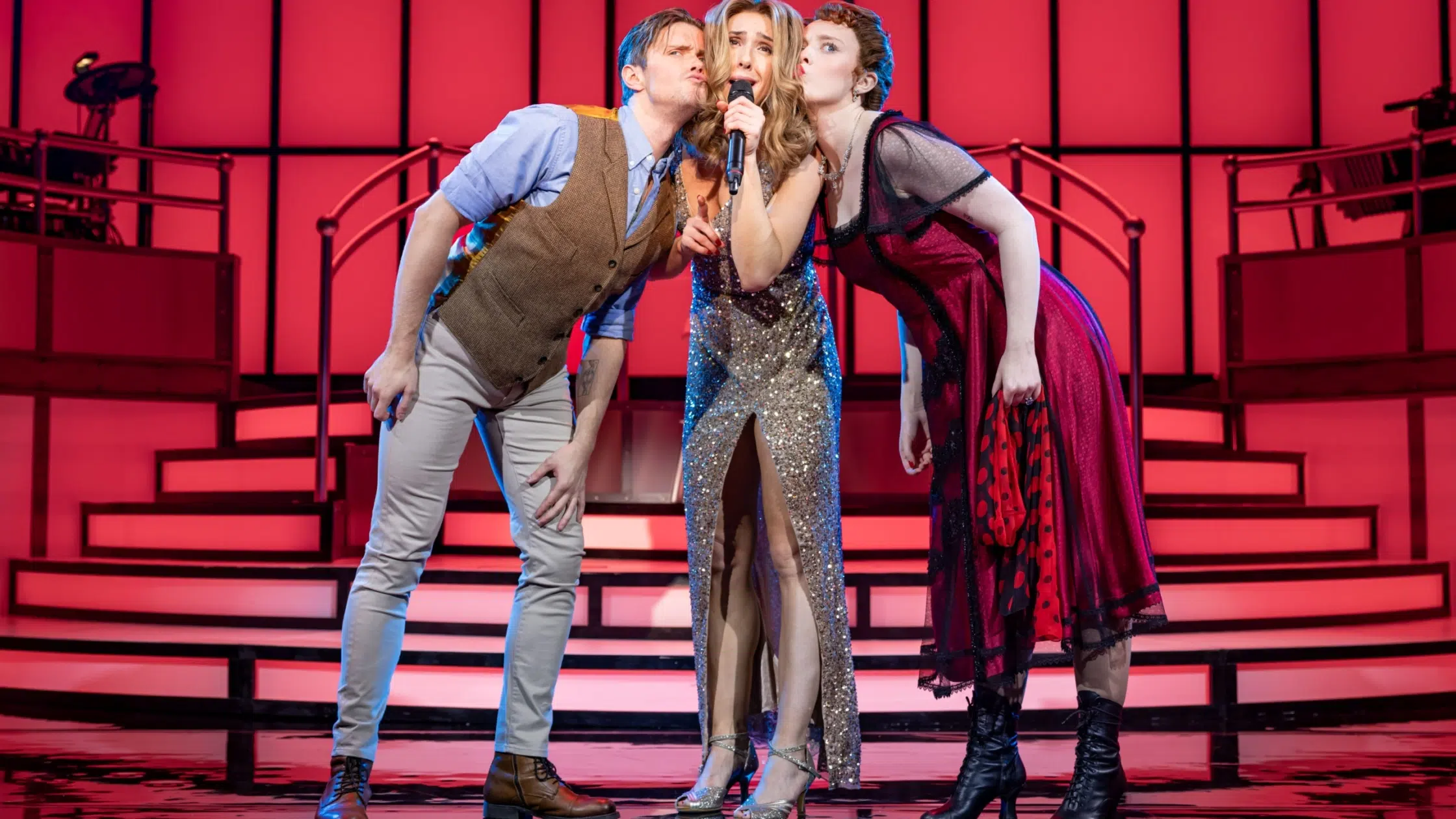
Luren Drew & cast members in Titanique at the Criterion. Photo: Mark Senior
It started as a one-off cabaret concert and became a Broadway hit. However Titantique has never lost its roots as a gay parody of the film Titanic (as well as of musicals and much else), which features ‘Celine Dion’ recounting her experience as a passenger on board the fated ship. Lauren Drew impressed as Dion, as did Layton Williams.
The show sounds, and is, crazy, but most of the critics found it fun (to a greater or lesser degree) except one. The term ‘mixed reviews’ is often used in these roundups, but it’s rare for a show to receive both a five and a one star review.
[Links to full reviews are included but a number are behind paywalls and therefore may not be accessible]
Our most curmudgeonly critic The Times’ Clive Davis (5★) loved it: ‘Raiding the Canadian singer’s back catalogue, the show delivers a demented jukebox musical. An inspirational cast led by Lauren Drew, playing Dion in all her sequinned glory, rises to the challenge of delivering a script that turns the madness up to 11 and beyond. It’s Airplane! with a musical theatre twist.’ In the Daily Mail (5★), Patrick Marmion wrote, ‘This is one of the merriest performances I’ve seen in the West End’.
Nick Curtis in the Standard (4★) explained why it cheered him up: ‘It comes from the American school of wilfully schlocky, sloppy gay parody, packed with pop culture references, always seemingly on the brink of hysteria and collapse.’ Sarah Crompton at WhatsOnStage (4★) said, ‘it is quite frankly, riotously absurd. But it’s also endearing. And although neither quite as clever or hilarious as it sets out to be, it is so strongly sung and energetically performed under the direction of Blue and the musical direction of Adam Wachter, that it is impossible not to have a good time.’
’Fans of the film will certainly be satisfied, but there is no doubt that Titanique is largely a show for pop-culture-loving, queer theatre kids,’ advised Olivia Rook at LondonTheatre (4★). She drew attention to ‘Drew as Dion who is a revelation’ and Layton Williams who ‘gives one of the show’s stand-out performances, taking on a variety of roles from camp museum guide and a suggestive Seaman (plenty of double entendres here), to a Tina Turner-inspired “Iceberg B-tch”, who sets the stage alight during a rendition of “River Deep, Mountain High”.’
City AM’s Adam Bloodworth (4★) declared this ‘is probably the most brazenly weird thing on in the West End right now.’ He explained, ‘This is more like an east London queer cabaret show than heteronormative homage.’ Despite finding it exhausting, he said, ‘I’ll admit I do want it all over again.’
Arifa Akbar in The Guardian (3★) called it ‘a big queer cabaret with renegade energy. Outre and amped up to 11 in pace and humour, it is billed as “camp chaos.” That’s an understatement.’ Andrzej Lukowski for Time Out (3★) wasn’t so impressed. What it made exceptional for him was the portrayal of Celine Dion: ‘‘ultimately it’s an affectionate, funny and thoroughly lovable turn from Drew, who lights up the stage every time she steps on it.’ However, ‘it’s undeniably a fun way to start 2025’.
Paul Vale for The Stage (3★) ‘There’s little to disguise the fact that this is essentially a fringe show…But it’s relentlessly funny’. The Telegraph’s Dominic Cavendish (3★) had reservations (‘My enthusiasm sank as the disconnect between mirth and tragedy became inescapable’) but decided that ‘on its own terms, guying epic cinema with a shoestring theatricality, it’s hard to fault’. Fiona Mountford in the i paper (3★) pointed out it is ‘not the most heteronormative show you will ever see’. She said she ‘was by turns amused and bewildered, but I did not constitute the optimum audience demographic.’
Gary Naylor on The Arts Desk (1★) didn’t like it at all: ‘The vibe, on a rudimentary set that suggests, but no more than that, a generic liner, is of an undergraduate show brought to Edinburgh for a boozy midnight house. Worse still, just when you think you can consign panto to the back burner for 11 months, the fourth wall collapses, the dread fear of audience participation descends on the front rows and the double, though more often just single, entendres start to batter your ears in wave after wave. That they are crude is fine, that they are devoid of wit isn’t.’
Critics’ Average Rating 3.5★
Value Rating 45 (Value rating is the Critics’ Average Rating divided by the typical ticket price)
Till The Stars Come Down at Theatre Royal Haymarket. Photo: Manuel Harlan
The ecstatic reaction to the National’s tiny Dorfman Theatre production of Beth Steel’s Till The Stars Come Down in early 2024 earned it a West End transfer. The critics were once again bowled over by this story of a working class wedding, which appeals not only because it’s very funny but also for its ‘Chekhovian sense of loss and yearning’, as Nick Curtis put it in his Standard review.
Scroll down for the 2024 reviews.
[Links to full reviews are included but a number are behind paywalls and therefore may not be accessible]
Five stars ★★★★★
Clive Davis harked back to the production’s first manifestation in the tiny Dorfman Theatre, when he awarded it four stars: ‘If anything, the more expansive setting means the occasionally self-conscious thrusts of pure theatricality, when realism gives way to sudden flights of visual poetry, actually seem even more convincing. On a second viewing, Steel’s portrait of a working-class community in red wall Nottinghamshire, immaculately directed by Bijan Sheibani…looks even more of a modern classic.’ He explained: ‘Steel’s writing is a magnificent combination of earthiness and explosions of half-suppressed emotion… It’s a mighty achievement. As the night rolls on, fragments of real life spill in front of us like splinters of light from the glitterball.’
Greg Stewart’s TheatreWeekly review was also happy with the larger scale: ‘it loses none of its raw intimacy or emotional punch in the process. This is a production that crackles with authenticity, humour, and heartbreak; a richly textured portrait of a working-class family on the edge of transformation.’ Greg has been impressed by a lot of shows this year, so his is a significant recommendation: ‘If you see one show this summer, make it this.’
4 stars ★★★★
The Telegraph‘s Dominic Cavendish disagreed with the 5 star reviewers on the matter of scaling up: ‘Bijan Sheibani’s production was seen to its best advantage in-the-round at the National’s Dorfman last year; its intimacy made everyone feel part of the emotionally volatile occasion’. Despite awarding one star less than previously, he acknowledged: ‘it remains a manifestly riveting evening, a testament to the actors’ ability to invest larger-than-life ebullience with truthfulness, and to the subject matter’s rare immediacy.’
Julia Rank for LondonTheatre described it as ‘a tangy, multi-layered soap opera presented in a terrifically theatrical production by Bijan Sheibani that’s staged in the round (designed by Samal Blak) with a disco ball at the centre. Whether the characters are throwing shapes on the dance floor, creating a human solar system or having a blazing row, the tone is always matched by Paule Constable’s superb lighting.’ She summed up: ‘It’s a play about three sisters at the end of their tethers, but Chekhov would never be so salty in his language, nor would he throw a pair of Spanx into the audience like a bouquet. A wild, messy and beautiful piece of theatre.’
The Standard’s Nick Curtis also highlighted the connection to the great Russian playwright: ‘It’s no accident that this is a play about three sisters. Steel imbues her story with a Chekhovian sense of loss and yearning, its characters suspended as the world moves on without them. It has a cosmic perspective on the passing of time but is intensely focused on the personal, bringing the politics of globalization to a local level.’ It is, he said, ‘demotically witty and profoundly affecting’.
Isobel Lewis, writing for Time Out said: ‘Director Bijan Sheibani sucks you right into this world through fast-paced dialogue and artfully constructed tableaus. It is heady, hilarious and emotional; the wedding itself might be a car crash, but this imaginative production is anything but.’
Dave Fargnoli for The Stage liked many aspects of the evening: ‘Steel’s script is sharply observed and often very funny, enlivened by spikily natural dialogue…Dorothy Atkinson particularly stands out as Sylvia’s aunt Carol, flawlessly delivering each of her many one-liners to elicit peals of laughter or gasps of shock from the audience.’
Calling it a ‘sharply comic and deeply touching family drama’, Aliya Al-Hassan for BroadwayWorld continued: ‘Messy and melancholy, ‘Till The Stars Come Down is a beautiful and important piece of theatre.’
Chris Omaweng at LondonTheatre1 had some minor reservations: ‘some of the scene changes rattle on a bit too long, and the dramatic tension dissipates during the waiting. All things considered, however, it’s a wedding like no other, for better or for worse, and definitely worth attending.’
Critics’ average rating 4.2★
Value Rating 50
Till The Stars Come Down can be seen at Theatre Royal Haymarket until 27 September 2025. Buy tickets direct from tillthestarscomedown.com
If you’ve seen Till The Stars Come Down at the Dorfman or the Theatre Royal Haymarket, please leave your rating and review at the bottom of this roundup
2024 reviews of Dorfman premiere
5 stars ★★★★★
The Telegraph‘s Dominic Cavendish was pleased to ‘get that rare thing, a family drama about the white working-class today, with ramifications for us all, taking in the impact of immigration, financial insecurity, and uncertainty, plus love, death and the whole complex kaboodle of getting through life. It’s often deliriously funny, but also has a stabbing sense of insoluble pain.’
The Guardian‘s Arifa Akbar loved the way ‘the wedding party whirls into melodrama of a high order – rollicking, complex and bearing the tragic inevitability of Greek drama.’
LondonTheatre‘s Marianka Swain called it ‘properly funny, fiercely loving and piercingly perceptive …It’s a state-of-the-nation drama told through the prism of one family, and a generational tale boiled down to one day; brilliantly specific in its references, yet universal in its hilarious, heart-stopping storytelling.’
Sarah Crompton at WhatsOnStage said a ‘sense of vitality fills the entire play and the richness of every character … gives a superb ensemble cast roles to play with their entire heart and soul. Their warmth, their subtlety and their ability to portray a family in love and at war make this rewarding, utterly unmissable play a theatrical event to remember. It’s sensational.’
4 stars ★★★★
The Times‘ Clive Davis was delighted that ‘Beth Steel’s debut for the National…plunges us into the middle of a clan whose passions, jokes and prejudices are utterly authentic.’
The Standard‘s Nick Curtis pointed out: ‘It’s no accident that the play centres on three sisters; Steel creates a Chekhovian blend of comedy and tragedy, amped up by booze and ribald East Midlands bluntness. One of these women married a man because he looked at her “like a potato in a famine”.’
The Observer‘s Susannah Clapp described how ‘Sheibani’s production brims with vivacity. How wonderfully the stage heaps up with stuff – from hairdryers to cheese hedgehogs – and is gradually drained. How spot-on are Samal Blak’s costumes: the tight scarlet satin frock, the wedding dress that gapes. How marvellously a first-rate cast pull together as their characters pull apart. And just look at Lorraine Ashbourne and Lisa McGrillis suddenly recognising in each other, though decades apart, the same lost loves and lives. Those of a struggling post-industrial Britain.’
Fiona Mountford at the i-paper found ‘Bijan Sheibani’s lively, loving, in-the-round production revels in the earthy humour of Steel’s script, which instantly convinces in its depiction of family dynamics.’
‘I loved its sweaty honesty, its big, generous canvas, its energy and its deep sympathy for its characters. Steel resists easy answers too,’ said Sarah Hemming in The Financial Times. ‘the muscular immediacy of Steel’s dialogue is undeniable, with laugh-out-loud lines flung about like confetti while hearts quietly break. It’s a gloriously messy affair, compassionate, hilarious, and tangy with fear and longing,’ said Sam Marlowe in The Stage.
The Independent‘s Alice Saville began: ‘A pair of elasticated Spanx pings into a near-hysterical audience in the first act of Beth Steel’s zingy comedy, set at a small town Northern wedding where all decorum breaks down. It’s typical of the cheeky spirit of this crowd-pleasing play – but peel off the layers and there’s tragedy underneath.’
Time Out‘s Andrjez Lukowski was critical of the way the Polish groom was portrayed, saying, ‘As much as anything else it’s just frustrating to have this sloppiness in an otherwise meticulous play. ‘Till the Stars Come Down’ is a funny, heartbreaking piece of writing, wonderfully acted, tenderly directed… except when it isn’t.’
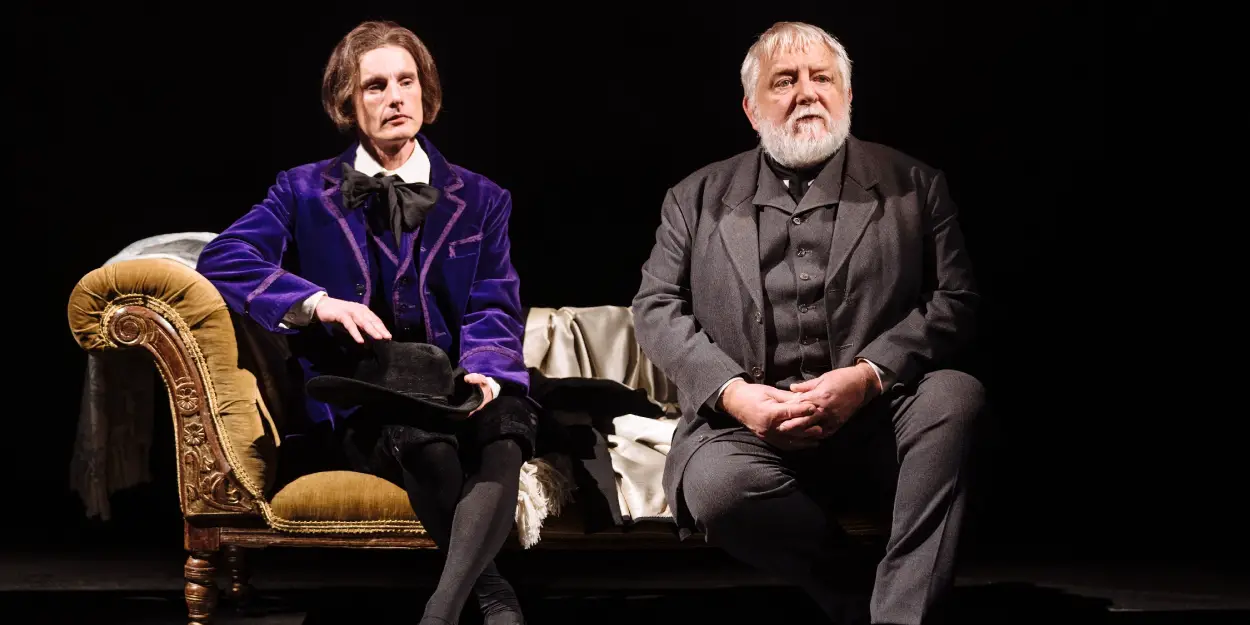
Dickie Beau and Simon Russell Beale in The Invention of Love. Photo: Helen Murray
In Tom Stoppard’s revived 1997 play, the poet and classicist A E Housman finds himself dead in Hades, meets his younger self and explores his memories. Simon Russell Beale as the older Houseman garnered great praise, but some of the critics found the play too clever by half.
Matt Wolf popping up at LondonTheatre (5★) noted, ‘Abstruse as Stoppard’s hyper-erudite text can sometimes be, it is suffused at every turn with feeling. You watch in continual awe – and perhaps occasional confusion – as classical references get lobbed across the footlights, only to clock the deepening ache of this near-definitive portrait of unrequited love.’
Tim Bano in The Independent (4★) said, ‘Blanche McIntyre’s subtle, uncluttered production…delivers a pretty good case for the play being …a bona fide masterpiece.’
The Telegraph’s Dominic Cavendish (4) was also impressed: ‘There’s more to chew on in two or so hours than at the amplest festive feast.’ He said Simon Russell Beale ‘makes every line resonate with fresh thought and feeling’.
David Jays in The Guardian (3★) said, ‘The quicksilver Russell Beale is a vocal glory, leaping in a breath from flute to poignant bassoon, from wit to sorrow.’
Alexander Cohen at BroadwayWorld (3★) also liked SRB but was unsure about the play: ‘this is Stoppard at his most frustrating: lapping tides of stuffy self-referentiality, self-congratulatory smirks, and pats on the back for every reference you can count pull you under the waves.’
Chris Omaweng for LondonTheatre1 (3★) wrote, ‘A demanding and yet not completely inaccessible show, it is at least consistent in its intense analysis of ancient works as well as the world inhabited by Housman and his contemporaries.’
Dominic Maxwell of The Times (3★) said ‘it offers plenty of pleasures, not least a characteristically lucid and tender central turn from Simon Russell Beale. It’s wise, witty, dense, dazzling, opaque. And sometimes it’s a slog.’ To put it another way, ‘this is a play with great monents, not a great play ‘
The i-paper‘s Fiona Mountford (2★) found it ‘unbearable’. About Stoppard, she said, ‘too often his lofty intellect cowers audience members into submission’. But not Ms Mountford with her ‘Oxbridge classics degree’. She explained, ‘we have three hours of often indistinguishable men exchanging achingly arch lines about the minutiae of classical grammar and quoting screeds and screeds of Latin at each other.’ To put it more plainly: ‘it feels less like drama and more like intellectual masturbation’. Est quodest! as Fiona might say.
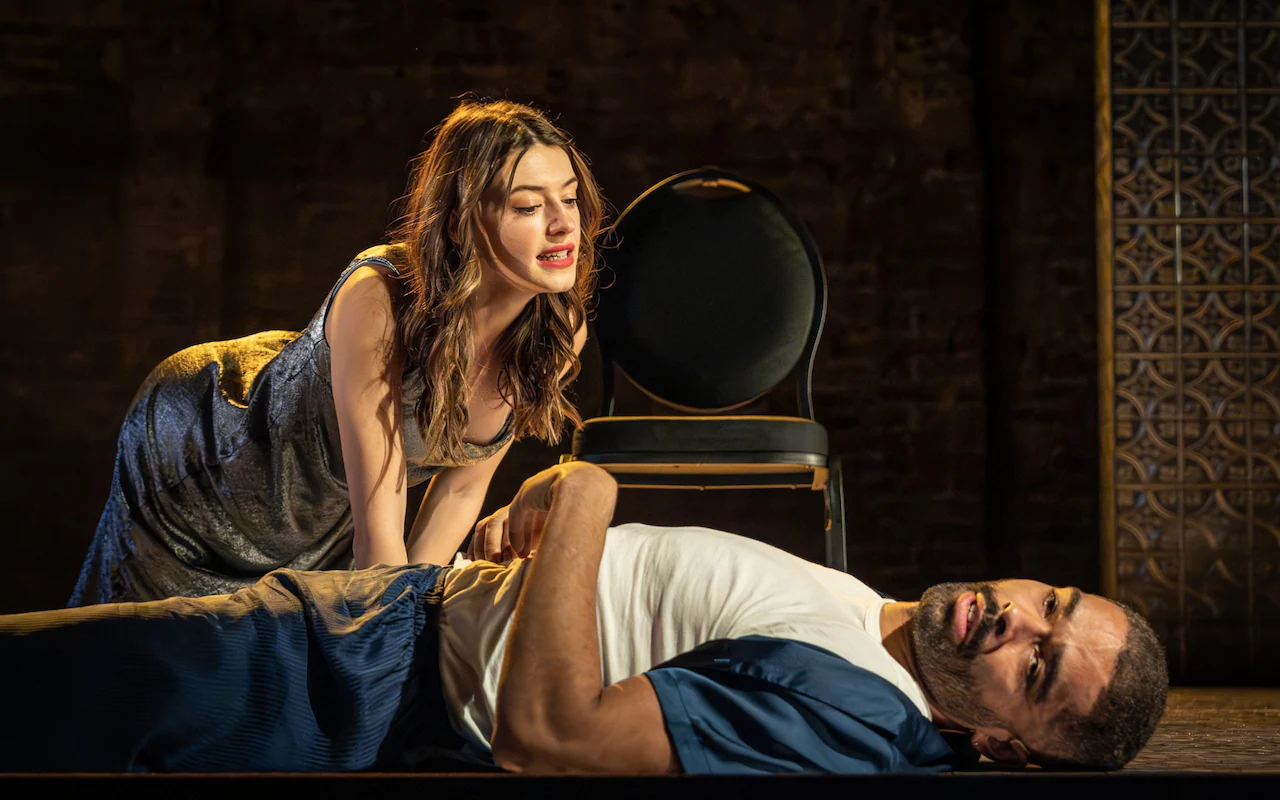
Daisy Edgar-Jones and Kingsley Ben-Adir in Cat On A Hot Tin Roof
Hopes must have been high at the Almeida when they announced Cat On A Hot Tin Roof. Director Rebecca Frecknall has had spectacular success with her previous productions of Tennessee Williams. Daisy Edgar-Jones, Kingsley Ben-Adir and Lennie James play, respectively, a sexually frustrated wife, an alcoholic, possibly gay husband, and a bullying, dying family patriarch. As the Time Out review said, ‘the horror here is the hell of other people. Everyone is trapped with everyone else’.
Unfortunately for The Almeida, a number of critics felt trapped by this long production, although most gave favourable reviews. Kingsley Ben-Adir and Lennie James received high praise but the reviewers didn’t agree about Daisy Edgar-Jones with comments ranging from ‘so good’ to ‘irritating’.
[Links to the full reviews are given but some websites may be blocked unless you have a subscription]
In fact, it was Time Out’s Andrjez Lukowski (5★) who loved it most of all. Daisy Edgar-Jones, he proclaimed, ‘is so, so good, inhabiting Maggie with a burning, vivacious swagger, alternatively self-mocking, self-pitying, compassionate and vicious’. Kingsley Ben-Adir displays, he said, ‘terrific acting, but sacrificing showing off to the greater good of the play.’.
The Standard’s Nick Curtis (4★) too praised the cast in this ‘striking and vivid interpretation’. He said Daisy Edgar-Jones ‘gives an intense and physically exact performance as a woman born poor and aware of the currency of her body and its fecundity. There’s intention in every tilt of her shoulders or arch or her bare instep.’ He talked of ‘Kingsley Ben-Adir, bringing nuance to stumbles and slurs’ and ‘Lennie James, terrifying…he’s magnetic.’
‘Performances are strong all round,’ agreed Holly O’Mahony for LondonTheatre (4★). The Financial Times’ Sarah Hemming (4★) spoke of ‘Rebecca Frecknall’s bruising, claustrophobic production, in which bad faith seems to hang in the air like mist, pooling in the corners of Chloe Lamford’s coldly opulent set.’ ‘What a savage, poisonous, ugly work this semi-autobiographical piece proves anew in Frecknall’s unflinching, if overlong revival,’ observed Clare Allfree in the Telegraph (4★).
Siobhan Murphy for The Stage (3★) declared: ‘if baroque, red-in-tooth-and-claw intensity is what you seek from a Williams play, you won’t feel short-changed.’ Arifa Akbar in The Guardian (3★) decided, ‘Ultimately this is a production that you admire rather than one that moves you.’ Sarah Crompton at WhatsOnStage (3★) had a similar reaction: ‘illuminating, but strangely passive’.
The Independent’s Alice Saville (2★) didn’t like it: ‘Frecknall’s play runs long and slow at 180 minutes – and it feels unbalanced, too, with Maggie’s thin scenes outweighed by her husband’s bloated ones.’
Adam Bloodworth for CityAM (2★) found ‘this version of Cat on a Hot Tin Roof only skims the surface, rarely getting into the darkness at the heart of Williams’ play about trauma, ageing and identity.’ For him, ‘Daisy Edgar-Jones is irritating, never defusing from a perpetual state of angry-shouty indoor voice.’ The Times’ Clive Davis (2★) was another left cold by the Hot Roof: ‘this weirdly off-kilter production, alternately ponderous and manically overheated, could almost be a parody of Williams’s gothic manner.’
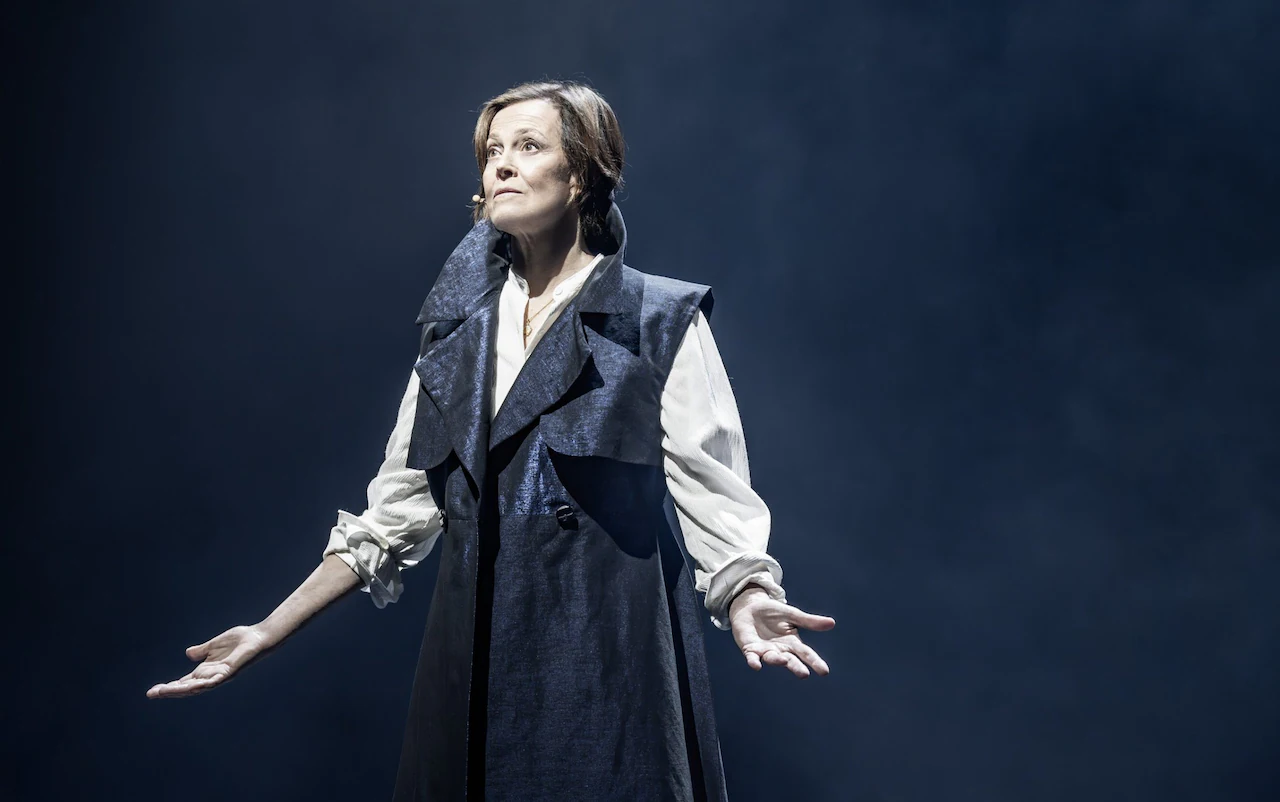
Sigourney Weaver in The Tempest. Photo: Marc Brenner
Garnering some of the worst reviews of the year, The Tempest has turned out to be a disappointing start to Jamie Lloyd‘s Shakespeare season at the mighty Theatre Royal Drury Lane. All eyes were on Sigourney Weaver (still seen as Ripley from Alien by many) but her flat delivery of the lyrical language was decried by the critics. As if that wasn’t enough, the barbs thrown in the direction of Jamie Lloyd’s stark production suggest a rare failure after his string of hits ranging from his 2018 Pinter season to Evita, Cyrano, The Seagull, The Effect and most recently Sunset Bouevard. Views were mixed on the matter of Soutra Gilmour‘s dark set and Matthew Horne‘s comedic turn but everyone praised Mason Alexander Park as Ariel.
[Links to full reviews are included but a number are behind paywalls and therefore may not be accessible]
‘Weaver is not a masterful Prospero: her verse delivery is flat and featureless, which leaves a vacuum in this key role,’ said Arifa Akbar in her Guardian (4★) review. However, there were compensations: ‘The swirling black emptiness around the set looks fathomless, blasts of light bring tremendous visual drama, and sheer silken sheets spanning the length of the stage are used in simple but sensational ways. The production creates its own dark magic with large-scale grandeur.’ She concluded, ‘It’s all thoroughly odd, but in an audacious and enlivening way.’
Neil Norman in the Express (4★) said ‘Weaver is a supremely confident presence, dressed in grey and white and delivering Prosero’s great speeches with a clarity of diction that is characteristic of the entire production.’ As for the production, it ‘rarely falters throughout’. He expanded: ‘Lloyd’s vision is spectacular but spare’ and ‘Soutra Gilmour’s design is simple but epic’.
The Telegraph‘s Dominic Cavendish (3★) found, ‘Weaver fails to weave the requisite magic.’ He spoke of ‘much woodenness in her delivery – an even-keel approach that verges on the automaton.’
Andrzej Lukowski in Time Out (3★) said about the Hollywood star: ‘She’s not a good verse speaker, delivering everything in a concerned-mom monotone that fails to hold this big, weird play together.’ but he did call the production ‘an awesome spectacle’.
The Standard‘s Nick Curtis (3★) too was disappointed: ‘instead of lightning in a bottle, it’s a damp squib.’ He declared, ‘An interesting thematic suggestion that Prospero’s island is a place of rebirth gets lost amid the sonorous intonation and tedious comic relief. For all its stark visual boldness, this is a curiously old-fashioned take.’
Sarah Hemming in The Financial Times (3★) described how ‘Lloyd and lighting designer Jon Clark sculpt the space, sending the characters hurtling across the stage in a glowing burst or silhouetting them stock-still on the set’s dark hills.’ However, ‘human intricacy and intimacy often elude this staging. There’s a lack of jeopardy and it’s curiously unmoving’.
Patrick Marmion for the Mail (3★) commented that Jamie Lloyd’s ‘insistence on using mics not only makes everyone look like they’re lip-synching, it paradoxically renders some of the Bard’s finest verse in muttered whispers.’ He was disappointed with the use of the star: ‘I’d like to have seen Weaver’s emotional range stretched a bit more than simply deploying her as an alpha-female observer on her own story. It’s a bit like renting a vintage Cadillac and using it for the weekly shop.’
LondonTheatre‘s Olivia Rook (3★) found Sigourney Weaver ‘too detached to have much impact, often simply speaking the lines rather than offering up a new interpretation.’ But she did like the look of the production: ‘Soutra Gilmour’s grey-scale, futuristic, moon-like set, with mountainous rock face and rubble, is visually striking and, once lit by Clark’s lighting, aptly captures the hostile environment of this rough, wild island. There’s little substance in this production, but plenty of style. It’s worth a trip just to see Gilmour’s beautifully bleak set.’
Dave Fargnoli in The Stage (3★) described ‘a terse, unfussy minimalism to the performers’ delivery that builds an effectively eerie atmosphere, but leaves Shakespeare’s poetry feeling underserved, its meaning adrift.’ He liked ‘Soutra Gilmour’s bold design (that) sets the action in a bleak, blackened wasteland, where shreds of white smoke crawl across an undulating landscape of glimmering volcanic sand. He found Sigourney Weaver’s ‘delivery flat and frequently tentative’.
For Alice Saville in The Independent (3★), Sigourney Weaver ‘doesn’t have the charisma to anchor this fanciful story’. She comes up with an interesting analogy for the setting: ‘This island feels like a queer fetish club at 4am, where time stands still’. Well, now we know what Ms Saville does after a hard night’s reviewing!
Sarah Crompton at WhatsOnStage (2★) called it ‘misconceived and under-achieved’. She continued, ‘The unremitting mood of darkness is not leavened by any move towards hope or redemption. There is no sense that this is a play about revenge and forgiveness; the tone is unremitting.’
Clive Davis in The Times (2★) wasn’t impressed by Ms Weaver: ‘she turns in a strangely impersonal performance’. As for the production: ‘as the colours of the backdrop and Gilmour’s costumes are so muted, Lloyd’s vision of a magical kingdom soon grows monotonous’.
BroadwayWorld‘s Alexander Cohen (2★) didn’t get on with it. ‘The three times Oscar-nominated Hollywood veteran mumbles through Prospero’s lyricism with barely a glint of an attempt to grasp the coiled intricacies of the language’ he said. And the production? ‘Lloyd’s chuck-it-at-the-wall-and-see-what-works vision doesn’t help. The auteur’s trademark visual austerity strips the island of specifics, with piles of black ash flecked by glaring crepuscular light forming a planetary hellscape.’
Heather Neil at The Arts Desk (2★) said ‘Lloyd and his designer Soutra Gilmour have conjured a strange, otherworldly, hilly, inhospitable place’. ‘There’s not much evidence of the “sweet airs” Caiban speaks of’, she added. She said she ‘would have preferred a more actively engaged Prosopero’. Like nearly all the other critics, she praised Mason Alexander Park’s Ariel as ‘the central energetic force throughout’.
Fiona Mountford in the re-branded i paper (1★) called it a ‘dismal non-event of a production’ and awarded a dismal one star. She said Weaver’s ‘wooden delivery never wavers from a tone of blank meditation’. The Observer’s Susannah Clapp (2) delivered the knockout blow: ‘She is flat: not only unsure of her lines but apparently uncertain of what a line is, delivering phrases as if she were measuring portions on a plate, without a roll or much driving sense.’
Critics’ Average Rating 2.7★
Value Rating 16 (Value rating is the Average Critic Rating divided by the typical ticket price)
If you’ve seen The Tempestat the Theatre Roayl Drury Lane, please add your review and rating below
Manage Consent
To provide the best experiences, we use technologies like cookies to store and/or access device information. Consenting to these technologies will allow us to process data such as browsing behaviour or unique IDs on this site. Not consenting or withdrawing consent, may adversely affect certain features and functions.
Functional
Always active
The technical storage or access is strictly necessary for the legitimate purpose of enabling the use of a specific service explicitly requested by the subscriber or user, or for the sole purpose of carrying out the transmission of a communication over an electronic communications network.
Preferences
The technical storage or access is necessary for the legitimate purpose of storing preferences that are not requested by the subscriber or user.
Statistics
The technical storage or access that is used exclusively for statistical purposes.The technical storage or access that is used exclusively for anonymous statistical purposes. Without a subpoena, voluntary compliance on the part of your Internet Service Provider, or additional records from a third party, information stored or retrieved for this purpose alone cannot usually be used to identify you.
Marketing
The technical storage or access is required to create user profiles to send advertising, or to track the user on a website or across several websites for similar marketing purposes.