Theatre reviews roundup: Brian Cox in The Score

Acting giant rises above disappointing play

Theatre Royal Haymarket
Brian Cox in The Score. Photo: Manuel Harlan

Brian Cox has brought his well-received 2023 portrayal as Bach from Theatre Royal Bath to London’s West End. Oliver Cotton‘s play that sets the great composer in opposition to a warmongering Frederick II of Prussia was too long (and meandering) for most reviewers but redeemed by the central performance. Trevor Nunn‘s period production went down well.

[Links to full reviews are included but a number are behind paywalls and therefore may not be accessible]

4 stars

Greg Stewart for Theatre Weekly found much to like: ‘This is a play that is intellectually stimulating more than entertaining, but it also resonates on an emotional level, exploring universal themes of power, faith, and artistic integrity. The pacing is generally strong, though the whole thing could benefit from tighter editing.’ Like all the other critics, he found ‘Brian Cox delivers a masterclass performance as Bach, capturing the composer’s inner turmoil and unyielding principles with gravitas and nuance.

Laurie Yule for The Stage declared, ‘ it’s a treat to hear Cox…in an auditorium, where his vocal technique, pitch and projection can really grab you.’ She stated, ‘The story, as with all worthwhile historical plays, resonates with our times, and the portrayal of Bach is irresistible and bittersweet.’

Two prominent outlets decided not to review the West End run, presumably because they reviewed it in Bath-

This is what Dominic Cavendish of the Telegraph said in 2023 of the moment the composer and the King meet: ‘After a slow-burn set-up, it’s a blazing scene that plays to Cox’s strengths as a stage animal, forbidding as he stoutly stands his ground and locks eyes with Stephen Hagan’s haughty Frederick, but also invested with deep humanity.’

3 stars

Lucinda Everett for WhatsOnStage called it a ‘musing, meandering play’ ‘Despite Robert Jones’s sumptuous set and costumes, free-flowing jokes, and the kind of consummate directing you’d expect from Trevor Nunn, it feels turgid at times.’ ‘But this play has a trick up its sleeve: its Bach is Brian Cox …and he is mesmerising.’

Tim Bano writing for the Standard states ‘while the play has lofty ambitions and director Trevor Nunn knows how to stage them grandly, and despite a towering Cox as the main man, unlike Bach’s music too often the whole thing clunks and flounders.’

Theo Bosanquet from LondonTheatre said ‘Trevor Nunn’s detailed, expansive production makes for a long evening (two hours 40 minutes) and there are several longueurs, particularly in the first act, that could be excised. But it’s a fascinating chapter of history that feels deeply pertinent in light of the current European conflict – particularly when Bach and Frederick argue over whether his military operation constitutes an invasion.’

Dominic Maxwell for The Times had his own gripe: ‘while much of the acting is strong, while the ideas are intriguing if underdeveloped, the musical element is only just adequate.’ The reason being what he called ‘naff’ miming. At the Bath premiere, The Times’ Clive Davis gave four stars.

Back in 2023, Arifa Akbar in The Guardian said ‘The production is redeemed by its star billing in Brian Cox, who plays the genius musician with such magnetism that he almost singlehandedly saves this play…Even when the script is careening from period comedy to philosophical debate on doubt and salvation, Cox has the ability to dart from light to dark which the others can’t quite navigate.’

2 stars

Rachel Halliburton at The Arts Desk summarised her reaction: ‘The Score is a curious beast of a play – part comedy of manners, part Blackadder-style history, part impassioned rhetoric against the abuse of power. The higher the emotional stakes, the more compelling Cox is in his disgruntled disdain for Frederick’s gilded tyranny, but the rest of the play just doesn’t hold together.’

Cindy Marcolina of BroadwayWorld felt she was shortchanged: ‘The marketing makes it out to be an explosive meeting between church and state, between a god-fearing, scripture-quoting composer and an atheist, belligerent, ruthless monarch. That’s not exactly how it goes and the theatricality of the event is rather underwhelming.’ She blamed ‘a lengthy and inconsistent script that swiftly turns into a vehicle for anecdotal politics and bite-size philosophy.’

Critics’ Average Rating 3.1★

Value rating  31 (Value rating is the Average Critic Rating divided by the typical ticket price)

The Score can be seen at Theatre Royal Haymarket, until April 26. Buy tickets direct from trh.co.uk

If you’ve seen The Score starring Brian Cox, please add your review and rating below

Theatre reviews roundup: Alterations at the National Theatre

A worthwhile revival or simply worthy?

Lyttelton Theatre
Arinzé Kene in Alterations at the National Theatre

Michael Abbensetts‘ play seemed all but forgotten when the National Theatre chose to revive it on their large Lyttelton stage. Arinzé Kene plays Walker Holt, a Windrush immigrant, dreams of opening his own tailor shop in Carnaby Street London and has the opportunity, providing he completes a major alteration order overnight. A few critics thought this was a worthy revival, some thought it simply ‘worthy’, and one didn’t think it was worth it.

[Links to full reviews are included but a number are behind paywalls and therefore may not be accessible]

‘Abbensetts’s words zing and crackle on the Lyttelton stage with fire and might,’ proclaimed Anya Ryan at LondonTheatre (4★). She gives much credit to the director: ‘Linton takes this history and amplifies it into colour; we see visions of people from their past, back home, as vivid memories. The future generation is there too, just a stretch away, almost in reach.’

The Telegraph‘s Dominic Cavendish (4★) called it a ‘riveting slice of life from the turbulent Seventies.’ He explained ‘Michael Abbensetts documents a period of social transformation and attempted assimilation while addressing- with timeless, tragicomic flair- the way that self-sacrifice can result in frayed hopes and dreams.’ He continued, ‘Using some nifty textual enhancements (by Trish Cooke), Linton’s richly textured production reclaims him as a major voice’. On top of that, ‘Kene confirms his top-drawer skillset’.

WhatsOnStage‘s Sarah Crompton (4★) ‘Directed by Lynette Linton with the most delicate sense of balance, it emerges as warm, wistful and as full of richly coloured threads as the clothes that hang on rails above Frankie Bradshaw’s crowded set, rising and falling like waves’ She concluded, ‘The play has a subtle sadness to it, a sense of hopes betrayed but also achieved. It’s a fascinating addition to the repertory, one that points the way to the future, but also offers a vivid portrait of its own time.’

Dave Fargnoli in The Stage (3★) thought it a worthy offering: ‘Though the play shows its age in places, it remains engaging and relatable, offering valuable insights into the experiences and motivations of members of the Windrush generation. Rediscovering and retelling those previously sidelined stories marks an important step towards positive change.’ much helped by ‘Kene’s charismatic performance’.

Time Out‘s Adrjez Lukowski (3★) thought director Lynette Linton ‘does a typically great job here at capturing the camaraderie and the tension that defines the lives of Walker and his colleagues.’ However he was unsure about the star: ‘It seems to me that Walker is a relatively simple character, but Kene’s combination of freakish good looks and a determination to burden Walker with a load of physical business and a somewhat incongruous pernickity middle manager vibe leaves the character feeling weirdly elusive and ill-defined compared to literally everyone else on stage.’

LondonTheatre1‘s Chris Omaweng (3★) found it all a bit too much: ‘The dialogue lurches from the mechanics of getting bags (and bags, and bags, and bags) of clothes in and out of the shop to substantially deeper issues, and back again. When combined with a stage that rotates between the front and back of Walker’s shop so many times that I couldn’t help but think of the New Scotland Yard sign, it was frankly rather dizzying. It was at least, a very eventful narrative, and one delivered by a cast with commitment and conviction.’

The Times‘ Clive Davis (2★) was the harshest critic of the play. He declared ‘the script tries to squeeze too many themes into a rambunctious sitcom-style format’ and found ‘Although Kene injects energy into Holt, the script gives him little to work with’.

Critics’ Average Rating 3.3★

Value rating  48 (Value rating is the Average Critic Rating divided by the typical ticket price)

Alterations can be seen at the National Theatre until 5 April 2025. Click here to buy direct from the  theatre 

If you’ve seen Alterations at the National Theatre, please add your review and rating below
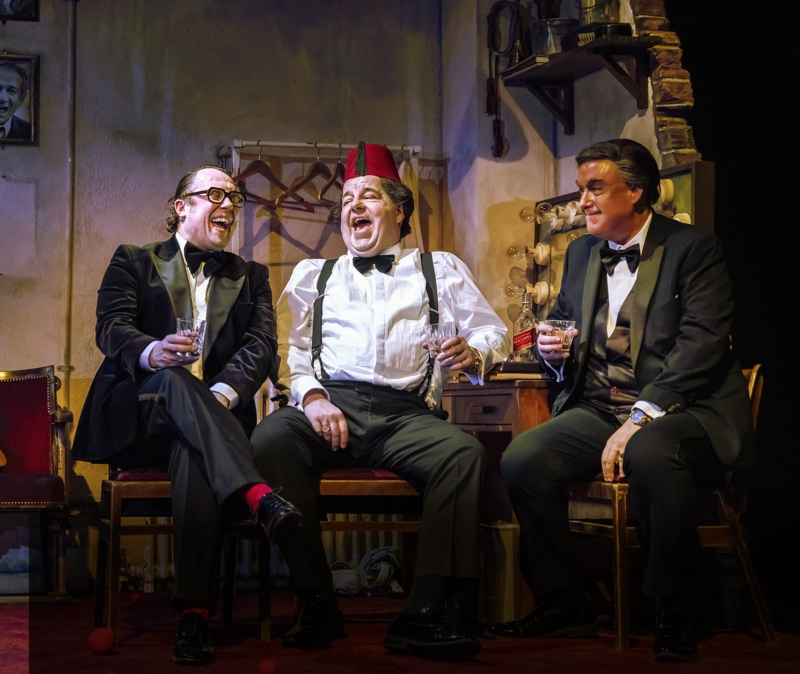
Theatre reviews roundup: The Last Laugh

Morecambe, Cooper & Monkhouse generate laughter & nostalgia

Noel Coward Theatre
Bob Golding, Damian Williams & Simon Cartwright in The Last Laugh. Photo: Pamela Raith

Paul Hendy‘s The Last Laugh imagines Eric Morecambe, Tommy Cooper and Bob Monkhouse meeting in a dressing room. For many of the critics, it was more of a tribute show than a fully formed drama but most enjoyed the laughter and nostalgia. All three actors were complimented for their impressions of the great comics: Bob Golding as Morecambe, Simon Cartwright as Monkhouse and Damian Williams as Cooper, with the latter receiving the highest praise.

[Links to full reviews are included but a number are behind paywalls and therefore may not be accessible]

Gary Naylor at BroadwayWorld (5★) loved it: ‘we’re indulged in the incomparable pleasure, that greatest of therapies, the opportunity to sit in a room and laugh and laugh and laugh in commune with the men who sacrificed much for that rare, joyous and uniquely human(e) experience.’

Chris Omaweng for LondonTheatre1 (4★) was feeling nostalgic: ‘It might be easy for some to dismiss a show of this nature as an unnecessary venture into an era that has gone and will not return. But it was a pleasant reminder, or otherwise a pleasant revelation, that there was a time when ‘eff, cee and effing cee’ was never required to draw laughs from an audience, and the comedic appeal was more than sufficiently universal that it would be unlikely they would be cancelled even by today’s supposedly over-sensitive standards. The dialogue was very, very contrived, but that doesn’t matter too much when a show is as entertaining and engaging as this.’

LondonTheatre‘s Aliya Al-Hassan (4★) said, ‘The Last Laugh is a gently funny, affectionate, poignant show, and as comfortable to watch as putting on your favourite slippers.’ She described each performer: ‘Golding (as Morecambe) has lovely, amiable energy, wiggling his glasses and chuckling at everything. Williams is a hard-drinking, throaty-voiced, slightly morose Cooper. Physically he is an excellent version of the comic, lumbering around and getting laughs effortlessly. Cartwright likewise is an uncanny Monkhouse with pitch-perfect vocal cadences and a creosote-coloured face. He also shows the sadness behind the facial animation beautifully.

Theo Bosanquet at WhatsOnStage (4★) felt ‘Much of it feels like an elongated gag-off as the three trade one-liners and compete for the last laugh’, however, ‘This is a welcome chance to remember what made them so beloved’. Greg Stewart for Theatre Weekly (4★) called it ‘a nostalgic yet fresh exploration of humour, legacy, and camaraderie’, concluding ‘this play is an unmissable treat.’

Brian Logan for The Guardian (3★) explained: ‘There is no plot, there are no narrative surprises, just chat and banter among the threesome about their lives and the nature of comedy. Oh, and jokes. Lots of – usually terrific – jokes.’ ‘The script doesn’t dig deep,’ said the Telegraph‘s Dominic Cavendish (3★), ‘but still cuts below the surface, broaching what lasts and what doesn’t’.

The Times’ comedy expert Dominic Maxwell (3★) wrote, ‘This nostalgia act..is an excuse for talking, reminiscing, analysing.’ He declared, it ‘is thoughtful, often pretty funny, not quite as substantial as it wants to be, but done with enough panache that the time goes quickly all the same.’ Tom Wicker for The Stage (3★) commented: ‘What makes something funny? And what makes a comedian? Writer-director Paul Hendy’s production…is fairly compelling when answering the first question. It’s less successful as theatre when tackling the second.’

Nick Curtis of the Standard (2★) acknowledged there were ‘impressive impersonations’ and that it ‘generates easy chuckles from their old gags, gurning and bits of physical business’ but ‘the script is one of the laziest I’ve come across in a long time, with the three men merely insulting and encouraging each other to do old routines by turns.’ He ends with a paraphrase of one of Bob Monkhouse’s jokes: ‘I laughed when I heard this play was coming to the West End. I’m not laughing now.’

Critics’ Average Rating 3.5★

Value rating  45 (Value rating is the Average Critic Rating divided by the typical ticket price)

The Last Laugh can be seen at the Noel Coward Theatre until 22 March 2025 and then embarks on a UK tour. Click here to buy direct from the  theatre 

If you’ve seen The Last Laugh, please add your review and rating below

Theatre reviews roundup: Otherland

Critics disagree about play on womanhood

Almeida theatre
Fizz Sinclair & Jade Anouka in Overland. Photo: Marc Brenner

Chris Bush, best known for Standing At The Sky’s Edge, has written a play with music that draws on her experience as a trans woman. It asks ‘what is womanhood?’ and tells the story of two women, one born a woman, the other trans. The second half moves into magic realism involving an alien as a metaphor for a trans woman. The critics took very different views- many admired the story and the poetic writing, while others thought it saccharine and confusing.

[Links to full reviews are included but a number are behind paywalls and therefore may not be accessible]

Dave Fargnoli of The Stage (5★) said, ‘Bittersweet, uplifting and profoundly enlightening, this deeply felt drama from Chris Bush brings remarkable clarity to some knotty and tremendously contentious topics.’

Unexpectedly, perhaps, it was the anti-woke Telegraph (4★) that provided one of the most positive reviews. Dzifa Benson described it as ‘a thoughtful and ultimately moving examination of womanhood and its implications – personal, familial, romantic and societal – in a world lacking gender parity and full of stereotypical expectations.’ Ms Benson, a poet herself, talked of ‘the poetic tendencies of Bush’s language’ and said, ‘the music works multiple duties here by heightening emotions, moving the story forward, containing the poetry and counterpointing the beautiful singing in close harmonies by the eight-strong female cast.’ The shocked readers’ comments remind us why Chris Bush wrote the play.

Emma John for The Guardian (4★) said it ‘brims with humour and compassion’ and called it ‘a powerful reminder of how theatre lets us live beyond our own bodies’. Rachel Halliburton writing at TheArtsDesk (4★) was impressed: ‘The visceral emotion, the poetry and the wry humour about the quirks of humanity sweep you through a story that’s as heart-breaking as it’s funny.’ She spoke of her ‘fascination with where each character’s story is taking them’.

Chris Omaweng for LondonTheatre1 (3★) wasn’t as fascinated as the previous reviewer: ‘I didn’t come away with any takeaway messages. Everyone seemed to be getting on with life, and so I came away thinking I had better just carry on and get on with mine.’

‘What a quietly radical act it is to lay a trans and cis experience side by side, and say look: this is what it is to be a woman,’ claimed Kate Wyver for Time Out (3★). She went on, ‘Though at times the storytelling feels heavy-handed, with lyrics pointing out the obvious and messages overstated, in other moments the story challenges us with knotty, thorny, nuance.’

The Standard’s Nick Curtis (3★) appreciated that ‘Though dramatically uneven and necessarily inconclusive, it’s very thoughtful, which is welcome in this era of yammering culture-war hatred.’

Alexander Cohen for BroadwayWorld (3★) described how ‘Otherland playfully melts into a swirling magical realist standoff between gothic and sci-fi.’ He advised, ‘It’s not perfect, but embrace it’s bittersweetness, especially when the sweetness triumphs.’

Dominic Maxwell in The Times (3★) praised the actors: ‘Jade Anouka is outstanding…Fizz Sinclair impresses’. As for the play, ‘it ends up taking us somewhere memorably surprising and satisfying’.

Julia Rank at LondonTheatre (3★) had this to say: ‘As a whole, it is an unwieldy and erratic piece of work but nevertheless big-hearted and watchable, bringing home the point that transgender people are not a threat and aren’t trying to “steal” anything’.

Miriam Sallon for WhatsOnStage (2★) complained ‘Chris Bush has attempted to grapple with the behemoth question of the zeitgeist: “What is womanhood?” Unfortunately, she stumbles under the weight of it, and her answer, in the end, is simply and unsatisfactorily: “it’s hard to define.”’ She had more to criticise: ‘This attempt at portraying a nourishing, knowing sisterhood is admirable, but the results are saccharine, and any individuality from the supporting characters is lost in a mulch of earnestness.’ For good measure, she also said, ‘The second half loses the plot, or rather it clings desperately to it, losing all subtlety of message’.

Steve Dinneen at City AM (2★) didn’t like it: ‘it’s a play with two gears: boring and daft, forever gravitating towards the saccharine and the melodramatic, eventually drowning in a paddling pool of good intentions.’

Critics’ Average Rating 3.3★

Overland can be seen at the Almeida Theatre until 15 March 2025. Click here to buy tickets direct

If you’ve seen Overland at the Almeida, please add your review and rating below

Reviews roundup: Backstroke with Tamsin Greig & Celia Imrie

Imrie & Greig convince in fractious mother-daughter relationship

Donmar Warehouse
Amiddle-aged woman and an old woman sit opposite each other at a kitchen table
Tamsin Greig & Celia Imrie in Backstroke

Tamsin Greig is a menopausal daughter who remembers and reassesses her relationship with her dying mother played by Celia Imrie. Their acting received universal praise from the critics although the play elicited mixed opinions. There was general agreement that it was too long but some found Anna Mackmin’s debut play, which she also directed, ‘emotional’ and ‘involving’, others thought it ‘unbelievable’ and ‘perfunctory’.

[Links to full reviews are included but a number are behind paywalls and therefore may not be accessible]

Helen Hawkins at TheArtsDesk (4★) called it ‘extraordinary because it puts the audience inside the maelstrom of these characters’ lives, forcing us to focus on how we interpret them and how our lives might resemble theirs.’ She declared ‘Imrie and Greig are superb in all the different manifestations of these two women’.

Clive Davis in The Times (4★) described Celia Imrie and Tamsin Greig as ‘mesmerising’. He said ‘Mackmin, who also directs, alternates moments of pathos and flashes of gallows humour.’

Michael Sidhu for Radio Times (4★) said, ‘Make no mistake, this is an emotional and intimate play. There is a tenderness in the way Greig and Imrie play against one another. There are moments where it is uncomfortable to watch. It’s a cathartic experience that stays with you long after you leave the theatre behind.’

The Stage’s Sam Marlowe (3★) said, ‘There are some beautiful passages of writing, both terrifying and tender, and exquisite acting in Mackmin’s production’. ‘there’s also a huge amount of laughter here’ ‘The narrative can ultimately lead only in one direction, and its inevitability leaves you craving more. But this is a heartfelt, unsentimental portrayal of the slippery cord of maternal connection.’

Holly O’Mahony at LondonTheatre (3★) felt  ‘the play feels generally repetitive, with too many scenes exploring the same dynamic, even if Imrie and Greig are always gripping to watch.’

’Celia Imrie as the mother and Tamsin Greig as daughter give immense performances’ said Arifa Akbar in The Guardian (3★). She had mixed feelings about the writing, calling it ‘an unruly and frustrating play but also original and moving, which captures sometimes searing pieces of mother-and-daughterhood’

Dominic Cavendish in the Telegraph (3★) asserted ‘the production confirms Greig as one of our finest actresses – her deadpan features a surface beneath which churns so much; she can convey incredulity with a raised eyebrow, exhaustion with a sustained blink.’

Sarah Crompton of WhatsOnStage (2★) felt ‘the director doesn’t tell Mackmin the writer when enough is enough. Everything is given equal honour and nothing ever reaches clear water. A disappointment.’

The Standard’s Nick Curtis (2★) went further: ‘the opposite of a good night out’.  He explained, ‘the story’s humour and pathos feel synthetic and unearned, the depiction of the issues surrounding end-of-life care glib and perfunctory.’

Tim Bano writing for Time Out (no rating) concluded ‘these two characters – partly hard to like, partly hard to believe – mean that by the irritatingly platitudinous ending, we’ve long had enough.’

Critics’ average rating 3.1★

Backstroke can be seen at Donmar Warehouse, London, until 12 April 2025. Buy tickets direct from donmarwarehouse.com

Read Paul’s 4 star review here

Watch Paul’s review on YouTube

If you’ve seen Backstroke at the Donmar, please add your review and rating below
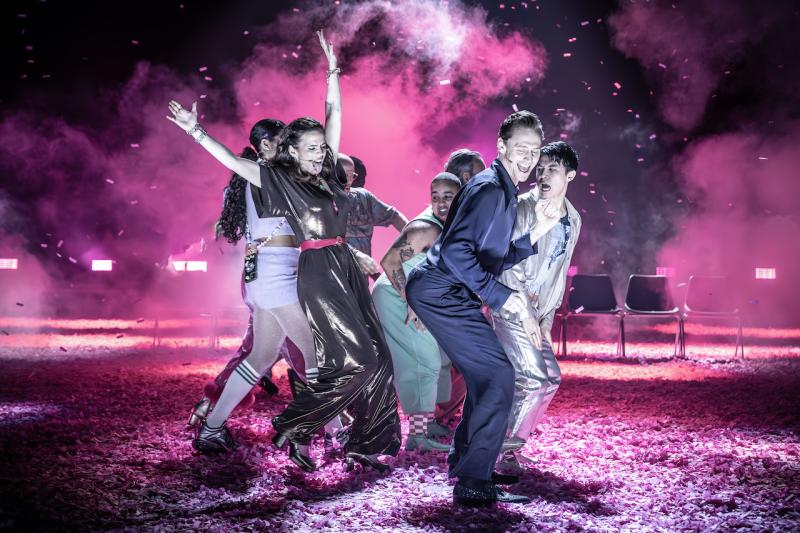
Reviews roundup: Tom Hiddleston & Hayley Atwell in Much Ado About Nothing

Party Time with Tom Hiddleston and Hayley Atwell

theatre royal drury lane
Hayley Atwell & Tom HIddleston in Much Ado About Nothing

Director Jamie Lloyd has turned Shakespeare’s romantic comedy into a confetti strewn party. The critics loved the production and the stars Tom Hiddleston and Hayley Atwell. It received a tidal wave of 5 star reviews plus a handful awarding a ‘mere’ 4 stars, making it the highest rated limited-run show in the West End.

[Links to full reviews are included but a number are behind paywalls and therefore may not be accessible]

Andrzej Lukowksi in Time Out (5★) declared ‘it is very funny, it looks incredible, and if Lloyd has festooned it in millennial silliness then I guess what’s actually more significant is the way he, Hiddleston and Atwell have teased the Beatrice-Benedick romance into a poignant story about middle aged loneliness and being left behind as your friends settle.’

Sarah Hemming of The Financial Times (5★) certainly liked it: ‘Hiddleston’s Benedick is impishly charming, savouring his own waggishness, flirting with the audience…Atwell responds with a Beatrice of mercurial intelligence and emotional truth…Heartbreak, hope, healing — it’s all here in this gorgeous, big-hearted production.’

Dominic Cavendish of the Telegraph (5★) thought ‘The boldest stroke (design: Soutra Gilmour) is a sustained shower of pink confetti. It’s faintly magical to behold; on another level, it chimes with the play’s tragicomic mix of autumnal wistfulness and amorous adventure.’

The Standard’s Nick Curtis (5★) was awestruck: ‘The rain of flamingo confetti, the sexually androgynous and brightly-coloured costumes, the charisma and chemistry of two good-looking stars, the air of hedonism and the drama of the big, bare stage… this is altogether gorgeous.’

The Guardian’s Arifa Akbar (5★) said, ‘This is a thoroughly weird and absolutely wonderful re-conceptualisation, turning Shakespeare’s comedy, which narrowly swerves tragedy, into an old school house party cum modern romcom.’ Aliya Al-Hassan of BroadwayWorld (5★) called it ‘Hugely camp, incredibly romantic and wildly fun.’

Marianka Swain at LondonTheatre (5★) was impressed: ‘A very game Hiddleston leans into the hamminess of the posturing Benedick, from his rock-star entrance amid a cloud of dry ice to his eyebrow-waggling audience flirtation (“I am loved of all ladies” indeed), madcap dad-dancing, or teasing of a buff chest by undoing his shirt buttons…Atwell also handles that tonal balance with incredible aplomb. Her Beatrice is a quick-witted, passionate, uncompromising force of nature, but she is capable of profound stillness too.’

Sarah Crompton WhatsOnStage (5★) also raved about the two stars’ ‘ability to take Shakespeare’s words and make them both truthful and incredibly funny today.’ About Tom Hiddleston, she said, ‘he brings the full weight of his charm and his impeccable timing to bear both on Beatrice and on the gallery. He weaves through the lines with revealing precision, finding lovely pauses between thoughts’. Her praise for Hayley Atwell was just as fulsome: ‘Few actresses have her power to summon emotion and show thought, not just through her face, but in her entire body.  She is clever, quick with the lines, but also completely in touch with her feelings.’

Stefan Kyriazis for the Express (5★) ‘This show is camp, mischievous, exuberant, romantic, life, love and laughter-affirming bliss.’ Rachel Halliburton at The Arts Desk (5★) summed it as ‘one of the best parties in town’.

I’m not sure why Clive Davis of The Times (4★) dropped a star but he was full of praise: ‘Lloyd’s mischievous club-culture reinvention of Much Ado About Nothing has colour, passion and, in the form of Tom Hiddleston, a head-miked leading man who is absolutely in command. His Benedick leers and winks at the audience, gives his fans a peek of an ultra-chiselled six-pack and demonstrates that he’s light on his feet too. Hayley Atwell more than holds her own as a wilful Beatrice strutting her stuff in a catsuit.’

The Independent‘s Alice Saville (4★) told us ‘Soutra Gilmour’s fantastically ballsy design fills the stage with a gigantic, floor-to-ceiling inflatable love heart while seemingly-neverending drifts of pink confetti speckle the air around them…Fluffy though his staging might look, Lloyd strips the frills from this story to reveal the push and pull of rejection and reconciliation at its heart.’

Dave Fargnoli for The Stage (4★) described it as ‘Joyous, unashamedly silly and shot through with real tenderness’. He was pleased that ‘Shakespeare’s language is made breezy and lucid by a uniformly strong cast with an absolute grasp of the piece’s poetry and humour.’ Greg Stewart of Theatre Weekly (4★) called it ‘an exhilarating theatrical experience anchored by stellar performances from its leads and ensemble.’

Critics’ Average Rating 4.7★

Value rating 49 (Value rating is the Average Critic Rating divided by the typical ticket price)

Much Ado About Nothing can be seen at the Theatre Royal Drury Lane until 5 April 2025. Click here to buy direct from the  theatre 

If you’ve seen Much Ado About Nothing at the Theatre Royal Drury Lane, please add your review and rating below

Theatre Reviews Roundup: Jonathan Bailey as Richard II

Jonathan Bailey gives a regal performance

Bridge theatre
Jonathan Bailey as Richard II at The Bridge

There was a mostly positive reaction from the critics to Jonathan Bailey‘s portrayal of Richard II. The Bridgerton star has the chance to show a range of emotion as a man born to be king but unfit for the role.  Shakespeare‘s play covers the last two turbulent years’ of his reign . There was slightly less enthusiasm for Nicholas Hytner‘s production which many felt was uninspired.

[Links to full reviews are included but a number are behind paywalls and therefore may not be accessible]

The Guardian‘s Arifa Akbar (4★) enjoyed it: ‘Nicholas Hytner, as director, smooths away most of the play’s creakiness with a pared-down production that has the pace and intrigue of a thriller. It is muscular in its look and Bailey singularly shines, his luminosity putting the others slightly in the shade.’

Olivia Rook at LondonTheatre (4★) was another fan: ‘Bailey reveals and revels in all facets of this magnetic king and as Hytner has said in multiple interviews, he speaks Shakespeare “as though it is his first language”.’ Neil Norman in the Express (4★) thought ‘Bailey is effectively ineffectual as Richard, viciously petulant and deluded throughout’. He called Hytner’s production ‘illuminating’.

Sarah Crompton for WhatsOnStage (4★) was also on board: ‘The most compelling quality of the staging – driven on by a Hitchcockian score by Grant Olding – is the way that it treats the unfolding events not as historical inevitability, but as if they are changing moment to moment.’ She continued, ‘It’s propulsively driven, and often surprisingly funny, wheeling along with an absolute confidence. It’s been a long time since Hytner’s directed a history play and it feels worth the wait.’

Cindy Marcolina for BroadwayWorld (4★) liked the star but not the production: ‘Bailey now takes on a complicated head of state, breaking him open and thinning the lines between divisive, problematic political figure and sardonic, villainous poet. It’s Jonathan Bailey’s world and we’re merely living in it, but Nicholas Hytner’s production sees a five-star cast stuck in a three-star show. A drastic lack of identity keeps this Richard II moored, making it a standard modern-day adaptation that refuses to delve into anything particular.’

The Standard‘s Nick Curtis (4★) opined, ‘Jonathan Bailey gives the best performance I’ve ever seen of Shakespeare’s flawed monarch, an erratic tyrant who gains dignity once deposed.’ The Telegraph‘s Dominic Cavendish (3★) had had better: ‘He acquits himself well…even if, despite impressive splenetic flourishes, he doesn’t attain the recent greatness of Ben Whishaw and David Tennant in the part.’

The Times’ Clive Davis (3★) mischievously reported, ‘Jonathan Bailey gives us a monarch who is forever teetering on the edge of hysteria, with a touch of camp too…a surprising amount of laughter kept rippling through the stalls…Had we stumbled into a pilot episode of Blackadder?’

Andrzej Lukowski in Time Out (3★) was lukewarm: ‘Bailey’s king…at his best presents the air of a smug but inept middle manager’. He continued: ‘There is interesting territory to be explored in the hinterlands between Richard’s supposedly divine appointment and his mediocrity as a person. But too often Hytner’s production gets lost in them.’

The Stage’s Sam Marlowe (3★) felt Jonathan Bailey rose above the production: ‘The staging is solid rather than exceptional. But Bailey makes a transfixing Richard, his plight engaging to the last, despite the nastier excesses of his capricious behaviour.’

Critics’ Average Rating 4.0

Value rating 48 (Value rating is the Average Critic Rating divided by the typical ticket price)

Richard II can be seen at the Bridge Theatre until 10 May 2025. Click here to buy direct from the  theatre 

If you’ve seen Jonathan Bailey in Richard II at the Bridge Theatre, please add your review and rating below
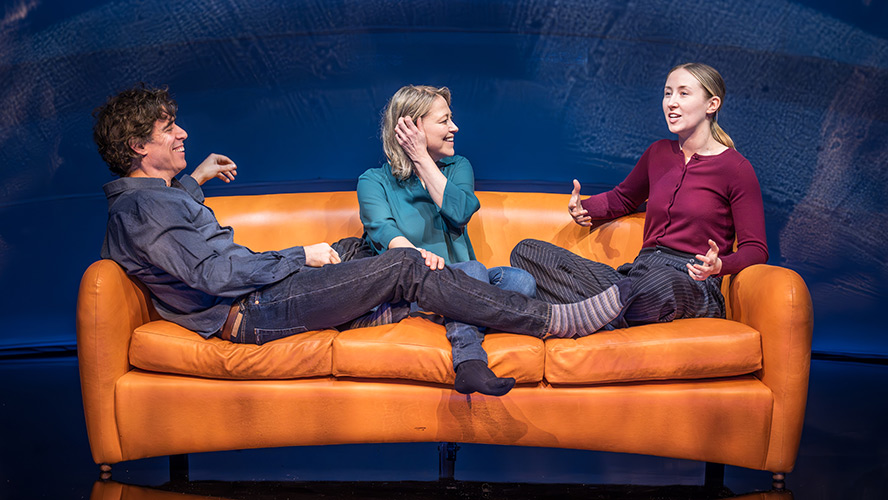
Theatre reviews roundup: Unicorn with Nicola Walker, Stephen Mangan & Erin Doherty

Which critics fancied a threesome?

Garrick Theatre
Stephen Mangan, Nicola Walker & Erin Doherty in Unicorn. Photo: Marc Brenner

A threesome featuring Nicola Walker, Stephen Mangan and Erin Doherty sounds like somebody’s sexual fantasy. In fact, some theatre critics decided the plot of Unicorn was a fantasy.  They found it funny and well acted but they didn’t believe Mike Bartlett’s story. Others were impressed by the idea of a middle-aged couple considering linking up with a young woman to spice up their sex life, then finding it leads to something more profound, driven by the needs of the ‘unicorn’.

[Links to full reviews are included but a number are behind paywalls and therefore may not be accessible]

LondonTheatre‘s Marianka Swain (4★) appreciated the quality of the play, calling it ‘gloriously funny and deeply empathetic’. She also extolled the virtues of the actors: ‘Walker is a fierce joy as Polly, barrelling through roller-coaster monologues in which she talks herself in and out of her desires. Mangan is unsurpassable at that very British self-deprecating discomfort: witness his horror when, trying to sound hip, he praises Kate’s “clobber”. Erin Doherty lends Kate an effective cool self-assurance, although all three later exhibit raw vulnerability.’

Praising it for its ‘sophistication, wit and insight’, The Telegraph‘s Dominic Cavendish (4★) said ‘this menage a trois is steeped in an acid understanding of ageing and mortality.’ He declared the cast to be ‘a dream team – every shifty look, pause and understated gesture hits home.’

Susannah  Clapp of The Observer (4★) noted, ‘I have rarely seen actors change from within so subtly and definitively. Doherty becomes harder though still hopeful; Walker stops whirring and settles into stillness; Mangan stops lounging and consolidates. Together they humanise what at first appears as a mechanical arrangement’. Greg Stewart for Theatre Weekly (4★) thought it was ‘a modern play that’s deeply thought provoking and surprisingly funny.’

The Standard’s Nick Curtis (4★) went deep:  ‘On the surface Unicorn…is a snappy comedy full of quotable lines, exploring the awkwardness of challenging norms and admitting one’s own desires. On a deeper level it asks – still hilariously, thank goodness – how we should find meaning and joy in the face of a world going to ruin, and the inevitability of death.’ He wasn’t satisfied with the ending: ‘Though the play has flaws, and falls apart completely at the end, it’s never less than a rollicking, stimulating ride. If you’ll pardon the expression.’

CityAM’s Adam Bloodworth (4) loved it: ‘it features some of the sharpest writing on in the West End right now, if not ever’. He also praised it for being ‘“fuss free”: a triplet of good actors playing interesting people delivering interesting lines’.

Sarah Crompton at WhatsOnStage (3★) said, ‘It’s never dull and often devastating, but somehow it fails to land with the weight for which it is striving.’ It is ‘often very, very funny,’ she went on, ‘Bartlett’s writing hits its targets with unerring precision, but in the second half, as the action darkens and develops in unexpected ways, his themes seem more diffuse.’ For her, Erin Doherty gave ‘a lovely, subtle, darting performance.’ Time Out‘s Andrzej Lukowksi (3★) was lukewarm about it: ‘It’s pretty MOR! But there’s enough of a twinkle in its eye that it never feels entirely conventional.’

The Guardian’s Arifa Akbar (2★) found ‘their relationships are peculiarly devoid of passion, too declarative of their desires. However intimate the conversation becomes, the chemistry in this throuple never quite ignites.’

Clive Davis at The Times (2★) found ‘The first half offers some provocative questions about the unsettling power of desire, but an overlong series of conversational tableaux loses its grip well before the end.’

Aliya Al-Hassan for BroadwayWorld (2★) felt ‘What is missing from the production is some real passion and a tangible build in the sexual tension between all characters.’ Although ‘The first half is sparky, often clever and has some genuinely funny moments’, she found ‘the play really stutters in the second half. The realities of being in a throuple are never explored, beyond an incredibly idealistic portrayal.’

Sam Marlowe in The Stage (2★) wrote, ‘In a polished production by James Macdonald, it’s coolly intelligent and smartly acted by Erin Doherty, Nicola Walker and Stephen Mangan. But for a drama that is concerned with desire, it’s verbose and oddly passionless, and its circuitous musings verge on frustrating.’

Dominic Maxwell in The Sunday Times (2★) summed up the antis, calling it a ‘talk-heavy, action-light, unconvincing and overlong quasi-comedy.’

Critics’ Average Rating 3.1

Value rating 35 (Value rating is the Average Critic Rating divided by the typical ticket price)

Unicorn can be seen at the Garrick Theatre until 26 April 2025. Click here to buy direct from the  theatre

Read Paul Seven’s 4 star review here or watch it on the YouTube channel Theatre Reviews With Paul Seven

If you’ve seen Unicorn at the Garrick Theatre, please add your review and rating below

Reviews Roundup: Brie Larson in Elektra

Another Greek tragedy for a Hollywood star

DUKE OF YORK’S THEATRE
Brie Larson in Elektra. Photo: Helen Murray

Another day, another Hollywood star in a Sophocles tragedy given a major overhaul by a dynamic young director. And if you thought the critics’ average rating of 2.9★ for Rami Malek in Oedipus was bad, wait until you get to the bottom of this roundup to see what they collectively thought of Brie Larson in Elektra. Daniel Fish, whose dark reinterpretation of Oklahoma! had plenty of fans, went full weird in the opinion of many of the reviewers. Brie Larson hid her acting talent beneath a lot of shouting and loud speakers. Only Stockard Channing emerged unscathed.

[Links to full reviews are included but a number are behind paywalls and therefore may not be accessible]

The Guardian’s Arifa Akbar (4★) continued to be a fan of Hollywood stars in extreme interpretations of Sophocles’ classics. Having been one of the few critics to give Rami Malek’s Oedipus four stars, she duplicated her rating but this time was a lonely voice.  Here’s part of her commendation: ‘Part spoken, part sung through in recitative and partly shouted in fury, this is a lyrical, avant garde creation, like a long lamentation, bare in its staging and emotions.’ ‘The anger is never shrill or flatly pitched – her delivery captures not only anger but also grief, resembling Hamlet when at her most melancholy. It is a magnetic performance, fearless for a West End debut.’

Sarah Crompton at WhatsOnStage (3★) found  ‘the production, full of strangeness and insight, feels half-baked, as if all its elements haven’t quite had time to gel. It simultaneously compels attention and frustrates it.’ She described how ‘Lines are spoken out rather than to one another, formalised and ritualistic rather than naturalistic…The effect is to turn the piece into an abstract meditation rather than drama, a gloss on Elektra not the thing itself. I rather loved it, but it never quite becomes the sum of its parts.’

Olivia Rook for LondonTheatre (3★) described Brie Larson thus: ‘her detached, reflective performance style makes it difficult to feel a connection with her character. Her voice is deliberately flat, which often jars, particularly when she is reunited with her brother and her reaction is borderline emotionless.’

Time Out’s Andrzej Lukowski (3★) said, ‘The biggest problem for me was the use of Anne Carson’s poetic but starchy 2001 verse adaptation – there is some mordant wit in there but I’m not convinced the formality of the verse helped the drama.’

‘It’s haunting, punchily feminist and perverse, all at once’ said Alice Saville in The Independent  (3★). She continued: ‘this staging is full of a mesmerising but near-stagnant stillness’ She concluded, ‘It’s a fascinating experiment, one that’s beautiful, but ultimately impenetrable.’

Tim Bano in The Standard honed his sarcasm: ‘It’s not entirely clear if it was Elektra, or an exercise in alienation. A 75-minute test as to whether an audience can keep an open mind.’ He skewered the director: ‘It’s directed (boy is it directed) by the experimental American director Daniel Fish…(he) doesn’t let a single line go un-weirded.’ He ended, ‘“Let me go mad in my own way,” Larson cries – and that’s the whole show, really. Always baffling, never boring, and completely mad in its own way.’ No stars given, which may be intentional, but I’ve put it down as 2★.

The Stage’s Sam Marlowe (2★) was damning: ‘It is so self-consciously stylised, so artful and so devoid of any genuine sense of humanity in extremis that it’s more likely to provoke a yawn or a weary eye roll than pity or terror. You sense that it’s straining for austere elegance and intellectual heft; it comes off simply as sterile and insufferably pretentious.’ Matt Wolf for The Arts Desk (2★) said, ‘The hipster vibe might seem to invite us all to this pathological party only to leave us on the threshold awaiting some way in.’

The Telegraph’s Dominic Cavendish (2★) wasn’t impressed: ‘what gets confused swiftly is where our attention should fall. The problem of over-emphasis is redoubled by Larson’s jolting, forceful delivery into a microphone, sometimes with added distortion and with an almost tic-like need to amplify and draw out every use of the word “no”.’ He wasn’t entirely negative: ‘The laurels go to Stockard Channing (Greece is the word…), giving us a Clytemnestra of stately bearing and stirring defensiveness and lending the pivotal mother-daughter battle an urgency, danger and truthfulness.’

The Times’ Clive Davis (2) recalled happier times at the theatre: ‘Some shows you walk home from humming the songs or cooing at the acting. After Elektra, which gives us Brie Larson as a punk princess agitating against something rotten in the state of ancient Argos like some shaven-haired proto-Hamlet, you go home still boggling at the misguided avant-gardery of it all.’ His last words offered an olive branch to the star: ‘Larson is clearly a gifted, authoritative performer. But she is hemmed into a concept that makes her Elektra only a raging bore.’

Describing it as a ‘droning dud’, Broadway World’s Alexander Cohen (1★) had many questions: ‘Why is there a dangling blimp? Why is there a paint canon sporadically spritzing the chorus? Why does Larson wail atonally like a brat-like banshee into a microphone without any momentum to propel her? It took about three minutes for me to realise that it’s not meant to make sense. This is theatre where the #vibe rules supreme.’

Critics’ Average Rating 2.5★

Value Rating 31 (Value rating is the Average Critic Rating divided by the typical ticket price)

Elektra continues at the Duke of York’s Theatre until 12 April 2025. Buy direct from the theatre

If you’ve seen Elektra at the Duke of York;’s Theatre, please add your review and rating below


Reviews Roundup- Oedipus with Rami Malek & Indira Varma

Rami Malek’s performance is a tragedy

old vic
Rami Malek and Indira Varma in Oedipus. Photo: Manuel Harlan

Two new versions of Sophocles’ Oedipus went head-to-head either side of Christmas- Robert Icke‘s which starred Mark Strong and Lesley Manville versus this newly opened production at the Old Vic starring Rami Malek and Indira Varma. We have a winner, and it wasn’t the one featuring Freddie Mercury. Hardly any critic actually liked Malek’s style of acting and there was little praise for the adaptation by Ella Hickson. There were contrasting opinions about the production in which co-director Matthew Warchus conceded time and space to the loud sound and frantic choreography of Heofesh Schecter. It was, you might say, a Marmite decision. Only co-star Indira Varma was universally liked by the critics.

[Links to full reviews are included but a number are behind paywalls and therefore may not be accessible]

For a change, I’m going to present the reviews in reverse order of enthusiasm for the show. The most critical came from Claire Allfree in the Telegraph (2★). She began ‘The question of whether Rami Malek can actually act has always hung over this most idiosyncratic of performers.’ Her answer? ‘ Malek is almost entirely at sea with Oedipus, his curious tic-ridden delivery strangling almost every word at birth.’ He was, she said, ‘like an unholy blend of Trump at his most disingenuous and Biden at his most incoherent.’ She doesn’t stop there: ‘his relationship with Varma, who outclasses everyone on stage, is consistently jarring…it resembles a confused arrangement between two people of almost entirely different species’.’One has to wonder,’ she pondered, ‘if the craze for celebrity casting has this week reached its nadir.’

The i-paper‘s Fiona Mountford (2★) thought ‘Malek speaks in a strange drawl that suggests he has toothache’ and described him as ‘all adrift in a bewilderingly centrifugal production’. She wasn’t keen on the use of dance either, saying it was ‘undoubtedly powerful and emotive, but the trouble with these lengthy, wordless episodes is that they fatally disrupt the momentum of what should be the undiluted hurtle of Sophocles’ storytelling’.

Alice Saville in The Independent (2★) was no more enamoured: ‘Ultimately this Oedipus is one for contemporary dance fans…theatre lovers hoping for a coherent take on this often-told story should seek elsewhere.’ ‘It’s gorgeous to look at,’ she said,  ‘but there’s more tension in a single chorus member’s bent finger than in its whole slack plot.’

Clive Davis in The Times (3★) was barely more enthusiastic but he did find an extra star. The text, he suggested, ‘For long stretches, in fact, sounds more like the work of an AI programme commissioned to generate soap opera chat laced with the sort of noirish boilerplate that would sit nicely in a Tarantino film.’ For him, Rami Malek gave a ‘curiously stilted central performance…his rigid facial expressions evoking all those socialite millionaires who’ve gone in for a few too many injections of Botox.’ Having praised the sound, dance, set and lighting, he damned it with faint praise: ‘We can’t help being drawn into a harsh, elemental world. If only it had a more charismatic presence at its centre.’

Dave Fargnoli for The Stage (3★) began, ‘Bursting with bold visuals and angsty, unsubtle performances, this ambitious, often incoherent take on Sophocles’ classic myth puts style firmly ahead of substance’ but in the end he managed to winkle out some substance: ‘Indira Varma gives a consummate, focused performance as Jocasta, grounding the production with heartfelt naturalism.’

‘The opening is dazzling,’ said Sarah Crompton at WhatsOnStage (3★). Unfortunately, ‘it can’t sustain the intensity it promises. By the end, there’s not much catharsis and without that, there’s not much tragedy.’ She pointed out that Malek’s ‘lack of emotion is emphasised by a script that chooses to offer an unusually tentative ending rather than searing revelation and despair.’

The Mail‘s Patrick Marmion (3★) found that Rami Malek’s ‘inward looking method acting is not well suited to ritualistic staging that’s meant to evoke Greek religious cults from antiquity’. He also berated ‘Ella Hickson’s wooden adaptation’.

Inevitably there were unfavourable comparisons with the recently closed Oedipus directed by Robert Icke. Take this from Tim Bano in The Standard (3★): ‘Where Icke’s was all sleekness and surgical precision, this one…takes Aristotle’s unities and rubs them in the old philosopher’s face. Why have unity when you can have the mad and slightly ridiculous chaos of several different creative visions squeezed into 100 minutes?’ He explained in more detail: ‘Hickson’s doing one thing, Warchus another, Schechter a third, Malek something else besides, possibly on another planet.’ Talking of the Hollywood Oscar winner: ‘Sinister and expressionless, he delivers every line in a strangely mannered way, and every word sounds like one long vowel.’

The Guardian‘s Arifa Akbar (4★) was one of the few genuinely enthusiastic reviewers. She liked the dance and the loud music and even Rami Malek’s performance: ‘He brings outsider vibes to Oedipus – speaking in an elusive American drawl, adopting the mantle of leadership like a haunted robot.’

Perhaps most impressed was Alexander Cohen for BroadwayWorld (4★). He was immediately taken by ‘a frenetic whirlwind of theatre and dance …that returns the power back to the people’ (i.e. the Greek chorus). As for Rami Malek: ‘It takes time to acclimatise to his slinky weirdness and syrupy southern drawl. But Oedipus is supposed to be an outsider welcomed in, the tendrils of his otherness bleeding deep into his paranoid psyche. Ella Hickson’s wily adaptation hints at scathing insecurity bubbling beneath his calm demeanour which Malek subtly preys upon in his angular mannerisms.’

Critics’ average rating: 2.9★

Value Rating 34 (Value rating is the Average Critic Rating divided by the typical ticket price)

Oedipus can be seen at the Old Vic Theatre until 29 March. Buy tickets direct form the theatre.

If you’ve seen Oedipus at the Old Vic Theatre, please add your review and rating below

×