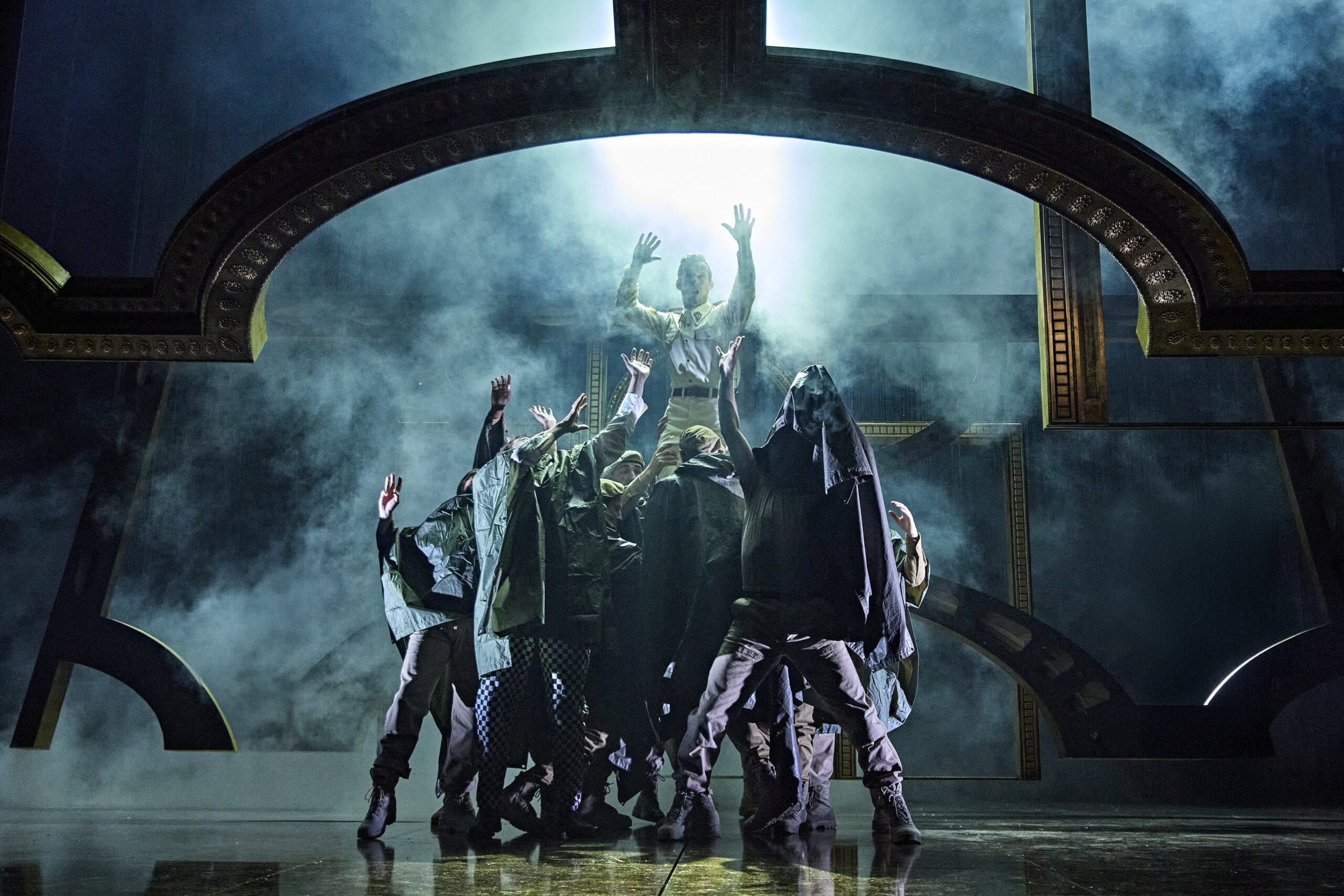
Longer versions of reviews featured on the YouTube channel and podcast One Minute Theatre Reviews, mainly London shows and selected regional and touring productions
It’s not Coward’s words, it’s the women that makes this a hit
Menier Chocolate Factory
⭑⭑⭑⭑⭑
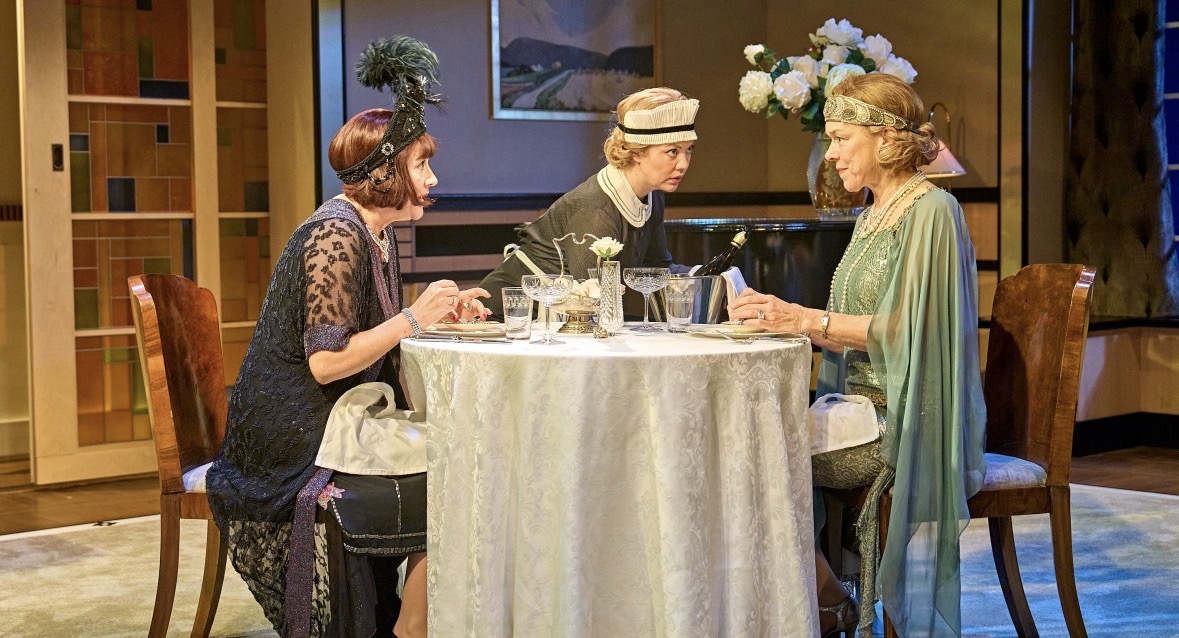
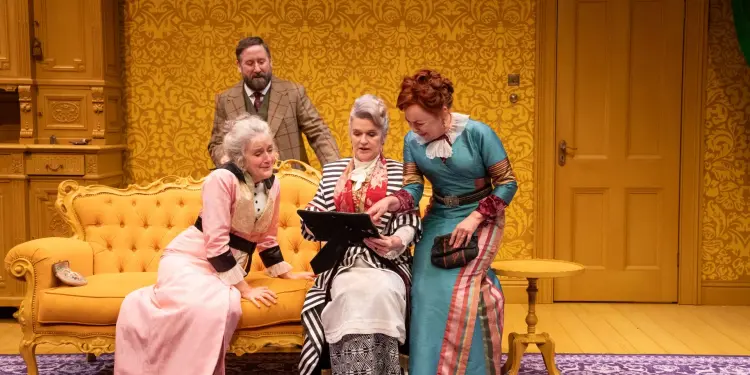
Alexandra Gilbreath, Sarah Twomey & Janie Dee in Fallen Angels. Photo: Manuel Harlan
I’ve been to three shows this year in which women in unsatisfactory marriages assess the alternatives. All were written in the years between the two world wars, all are funny, but the one that made me laugh the most was Fallen Angels by Noel Coward, and, surprisingly, it wasn’t because of The Master’s legendary wit.
J B Priestley’s When We Are Married at The Donmar depicts three couples who discover they are not legally married. The husbands learn a lesson about how they should treat their wives. And that, unfortunately, is about it. An opportunity wasted. Somerset Maugham’s The Constant Wife, given a stylish makeover by Laura Wade and now touring, finds a wife turning the tables on her adulterous husband to considerable comic effect.
All the authors have a way with words. What makes Fallen Angels at the Menier Chocolate Factory the funniest play I’ve seen in a long time is not Coward’s witty aphorisms. They’re there all right, but it’s no Private Lives or Present Laughter. What elevates it to comedy heights is the production itself, directed by Christopher Luscombe with lightness and pace, and the dazzling physical comedy of its three female stars.
First, a brief outline of the plot. Julia and Jane’s husbands, played by Richard Teverson and Christopher Hollis, go off on a golfing weekend, conveniently coinciding with the anticipated return of Maurice, a Frenchman with whom both women had pre-marital relationships. A clue as to what might follow comes when Julia informs her husband Fred that while they may love one another, after ten years of marriage, they are no longer ‘in love’. The play places women’s unfulfilled sexual desire firmly in the spotlight. No wonder it caused a scandal back in 1925, although that wasn’t the only reason, as we’ll see.
Noel Coward’s dialogue is amusing, especially during the women’s giggling memories of their past romances and breathless anticipation of their former lover’s arrival. He gave the hint of how they’re feeling with lines as close to being censored as he could get, as when Jane says, ‘Oh I adore a little sausage with my egg’. Yet, Janie Dee as Julia and Alexandra Gilbreath as Jane, barely need the nudge. You can feel the heat radiating from them.
However, what had the audience rolling in the aisles is the physical humour. In Act One, we meet the new maid, Saunders, played by Sarah Twomey. The notion of a servant more clever than his or her employer is not novel. It’s been around since Ancient Greece and P G Wodehouse’s great creations Jeeves and Wooster would have been familiar to Mr Coward.
In Fallen Angels, she swiftly demonstrates that she can play the piano better than Julia, knows more about golf than Fred, and speaks French better than any of them. Her standout moment comes when she prepares the room for dinner while performing ballet, every gesture from placing flowers to laying a table cloth is choreographed perfectly to the music. Credit here to movement director Nicola Keen– and Noel Coward is nowhere in sight.
A masterpiece of physical comedy
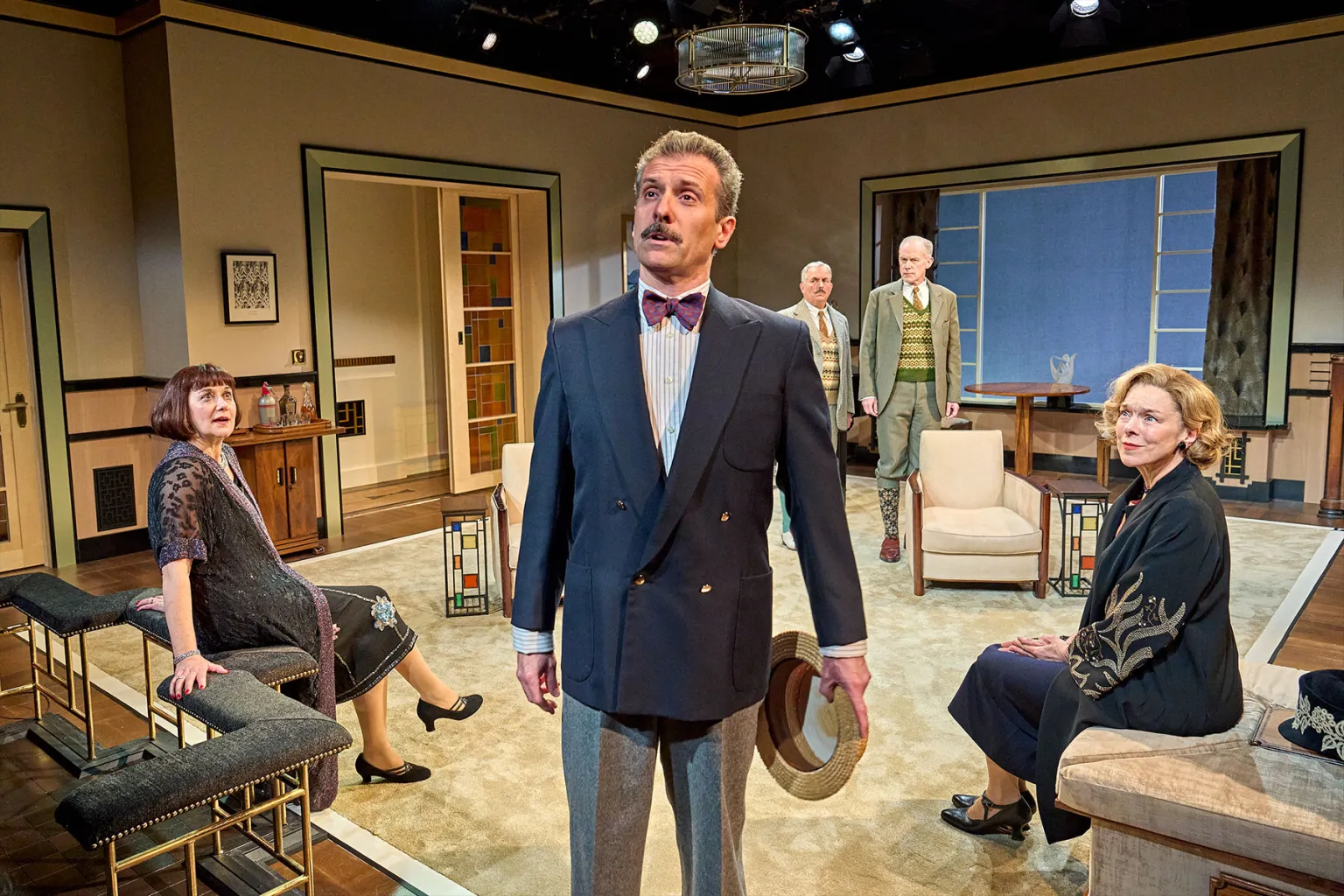
The cast of Fallen Angels at The Menier. Photo: Manuel Harlan
Sarah Twomey would steal the show, except that in Act Two, Julia and Jane, waiting for the arrival of Maurice, consume an entire meal (I lost track of how many courses) and get increasingly inebriated in the process. Women getting drunk was the other reason the play was a cause célèbre. In the hands of Janie Dee and Alexandra Gilbreath, the physical comedy builds with the courses of the meal. They begin pleasantly tipsy on cocktails reminiscing with giddy nostalgia about their time with Maurice. By the end of the act they are blind drunk on champagne, falling over, bickering and nearly coming to blows over their former lover.
Slow reactions, shocked looks, ungainly postures abound. The success lies in the minutiae – for example, there’s a moment when Jane kicks her shoes off in an extravagant gesture, then gingerly places her aching feet on the floor; or when Julia goes to lean on the piano and misses. It’s a masterpiece of comic observation that had the audience in stitches. There are also – thank you, Mr Coward- outlandish insults: ‘I’d like to rush up and down Bond street with one of your tiny heads on a pole’ snarls Jane.
Simon Higlett‘s art deco set beautifully recreates a London flat from the inter war years, and reinforces that this was an era in which elegance ruled, making the women’s behaviour all the more comical (and shocking back then).
After the interval, Act Three is something of an anti-climax. Hangovers seem to afflict characters and audience alike. But the arrival of Maurice, played with suave sophistication by Graham Vick, and the return of the two husbands (slowly realising with shocked looks that their wives might prefer their old flame to them) give us much to enjoy and a satisfyingly neat conclusion.
Fallen Angels can be seen at The Menier Chocolate Factory until 21 February 2026.
Mel Brook’s musical is almost as offensive as ever (Thank goodness)
Garrick Theatre
⭑⭑⭑⭑⭑
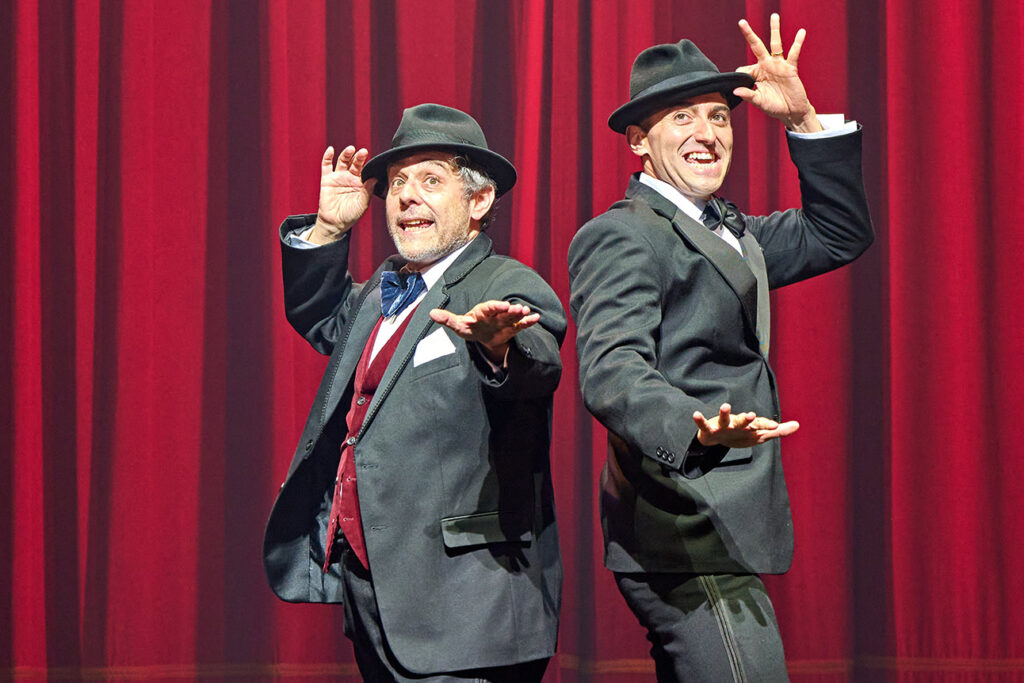
Andy Nyman & Marc Antolin in The ~producers. Photo: Manuel Harlan
The Producers was and still is one of the great musical comedies, so why was I slightly disappointed in the current West End production? Not so let down by it that I didn’t find it laugh-out-loud funny nor so dissatsified that I wouldn’t recommend it, but left with the feeling that it is unwise to mess with perfection.
This production is the first one in London that Mel Brooks has allowed that doesn’t have to stick to Susan Stroman‘s original Broadway direction. It was probably necessary to have that agreement simply to be able to present it in the tiny space of The Menier Chocolate Factory, where it was created pre-transfer.
The spectacle may be reduced but there is still enough going on to dazzle the audience and fill the Garrick stage. As well being effective in puncturing the vainglory of fascism, The Producers is (like Spamalot!) an affectionate send-up of Broadway musicals. No matter how much fun there is along the way, the success of the show is founded on it being a great musical itself. Director Patrick Marber shows he is aware of this: the clever songs, the slapstick and the dancing are done to perfection.
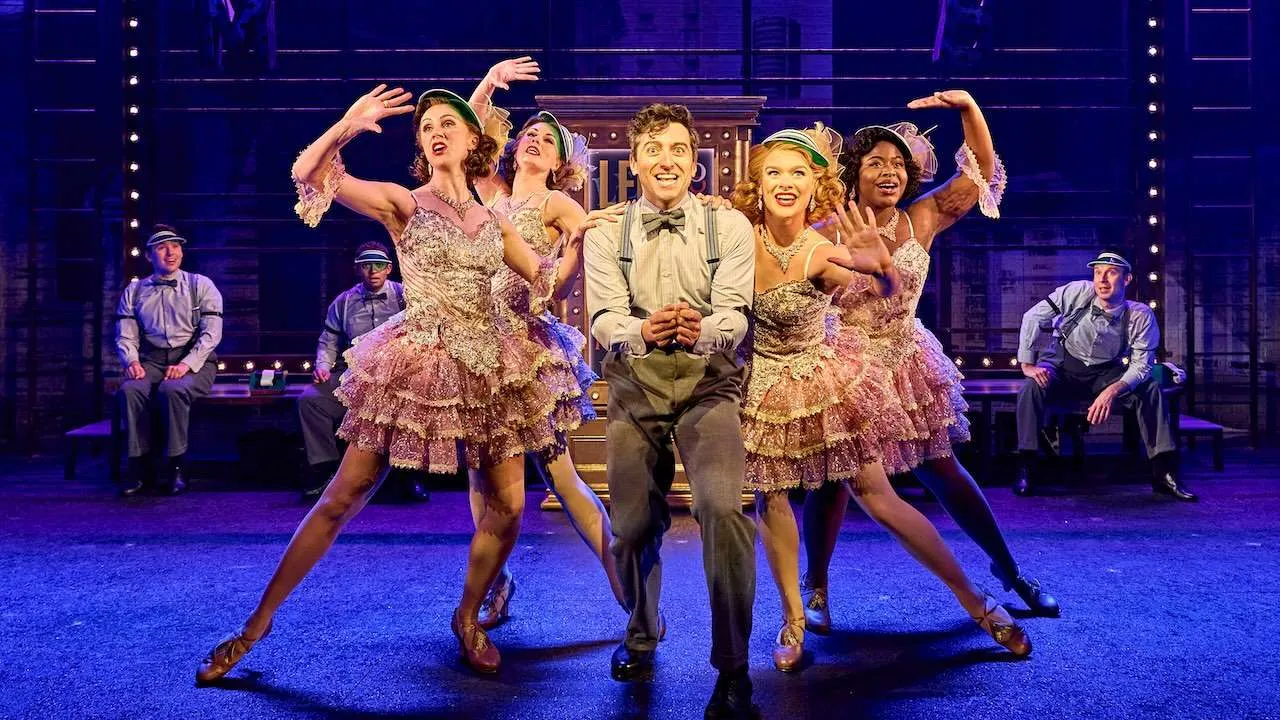
You wallow in the glory of the big build of Springtime for Hitler number with its goosestepping troopers in Busby Berkeley style formation, King of Broadway, where Max (played by Andy Nyman) lamenting his failure becomes a pastiche of Fiddler On The Roof, the hilarious zimmer frame number danced by the old ladies who give Max cheques in exchange for sex, and I Wanna Be A Producer sung by Leo played by Marc Antolin, who brilliantly develops his character from a nervous accountant to confident impresario. Mr Marber, directing his first musical, has been well served by choreographer Lorin Latarro and set designer Scott Pask.
However a slight reduction in scale isn’t the only change. There is a noticeable shift from the 2001 production that may, or may not, be designed to accommodate changing sensitivities. That may seem an odd thing to say about a show that is renowned for shocking audiences with its offensiveness, ever since the film was released in 1967. It was written to shock liberal audiences with its swastikas, campness, and more.
That’s all still there. If anything, it’s even more camp, and the Nazis even more shocking. The scene where the producers recruit director (and transvestite) Roger de Bris now contains a living statue with an enormous penis (which Roger slaps), and a Jesus in a nappy that could have stepped straight out of Jerry Springer The Musical. Trevor Ashley as Roger and Raj Ghatak as Carmen Ghia are on a Liberace level of campness that still somehow remains rooted in real characters.
The idea of camp as synonymous with being gay dates from a time when it was necessary to negate and subvert homophobia. On the other hand, while there is no longer a stereotype gay person, unapologetically camp celebrities like Alan Carr and Julian Clary remain popular gay icons. In the case of The Producers, you’ll remember that when the two producers Max and Leo plan to create a musical flop, they decide to put on a show celebrating Hitler, written by a Nazi pigeon fancier played by Harry Morrison, who is all the more funny for being serious. Their mistake is to make everything as camp as possible (Keep It Gay), which, in mocking Hitler and the Nazis, transforms their musical Springtime For Hitler into a hit.
Not offensive enough?
So the campness is essential, but something has changed. To understand what, you only have to look at Umma’s scene. This is where a woman auditions before Max and Leo. Inevitably she is Swedish, partly because in the world of Mel Brooks stereotypes, Sweden is synonymous with sexual liberation, and also because in that same world, accents are always funny. She sings When You’ve Got It Flaunt It. Only, in this production, she doesn’t. Flaunt it, I mean. In the original production, she showed a great deal of cleavage, fulfilling Max’s request for ‘big tits’, which she thrusts under their noses, and her legs couldn’t have got further apart when she danced around the stage.
Marc Antonlin & cast in The Producers. Photo: Manuel Harlan
In this version of Umma, as portrayed by Joanna Woodward, she has a wonderful voice and is undoubtedly beautiful, but she dresses and dances demurely. It is hard to believe her audition would generate the famous punchline from Max: ‘We may be sitting but I can assure you we are giving you a standing ovation.’
So, despite the book (script) remaining untouched, the really noticeable change in the treatment of it is in the sexism. Patrick Marber was quoted in an interview as saying: ‘Things have changed a lot… and it is quite old fashioned in some of its attitudes. We’ve tried to do what we can with that.’ It seems that the attitudes to women have been the focus of his concern.
All the women who once showed legs and cleavage, here keep their flesh quite well covered by looser and less revealing garments than seen 25 years ago. I can see the sexism can be problematic for today’s audience, but then again The Producers is a period piece, so why not embrace it, as being of its time?
Mel Brooks is equal opportunities in his offensiveness. Just as he can laugh at Nazis and camp theatricality, he also sees the funny side of sex. His musical does not endorse sexism: his character Max was always seedy, as played by the great Zero Mostel in the film and Nathan Lane on Broadway. Here, perhaps acknowledging a (rightly) less tolerant time, he is presented as downright sleazy. Andy Nyman, unshaven with greasy hair plastered to his scalp and yellowing teeth, still gives Max a soft centre, but there is no way you could approve this man’s attitude to women. The women’s dancing was always a parody of the sexist fantasies of male directors, so there is no reason why we shouldn’t laugh if they were to ‘flaunt it’ in this iteration. It’s ironic that a production of a musical which doesn’t care who it offends should on this score, apparently, be so timid about causing offence.
Nevertheless, it’s great to see The Producers back on a London stage, and this production is a triumph that both pays homage to the original and sets the stage alight once more.
John Hodgkionson, Marc Wootton & Jim Howick in When We Are Married. Photo: Johan Persson
Bah ‘eck, I’m puzzled as to why director Tim Sheader chose to revive J B Priestley‘s When We Are Married. In its day, it was a very popular comedy, but that day has passed. Three couples celebrating their silver weddings find they were never legally married. There’s much potential for comedy but little of it is developed. Most of the fun seems to derive from puncturing the pomposity of these people, and having a laugh at their Yorkshire dialect. Fortunately, the cast are exceptional and they can generate laughter from the smallest facial flicker or vocal inflection, despite the mediocre script.
John Hodgkinson plays Joseph Helliwell, a domineering, self-righteous community leader, with relish. As his wife Maria, Siobhan Finneran is a delight: a snob who appears to be permanently sniffing something unpleasant under her nose. Mark Wootton is perfectly cast as a bombastic loudmouth, his beard almost as outsized as his voice. Sophie Thompson, as his submissive wife Annie, steals the acting honours with her exquisitely contemptuous looks and increasing confidence.
The final couple, Clara and Herbert Soppitt, are played by Samantha Spiro and Jim Howick. Herbert is a textbook—by which I mean clichéd—henpecked husband, but the dynamic is handled with real finesse: his repeated attempts to speak, only to be briskly cut off, are timed to perfection. Herbert’s tender moment with Annie is a rare hint that more could made of this marital crisis.
Instead, although all the couples are forced to reassess their relationships and view their partners afresh, the socialist J. B. Priestley concentrates on satirising the two pompous businessmen, while advancing a broader message about the need to value and respect women.
Director Tim Sheader has streamlined the play by cutting and consolidating roles: the maid and housekeeper, for instance, are merged into a single, gloriously disruptive character, played with gleeful, mischievous cackling by veteran performer Janice Connolly. Likewise, a newspaper reporter and photographer are combined, allowing Ron Cook to deliver some superb physical comedy as his increasingly inebriated character stumbles out of control—an act that may evoke fond memories, for those of a certain age, of the great Freddie Frinton.
The remaining supporting roles are all convincingly cast. Tori Allen-Martin brings far more nuance than expected to Lottie, who arrives to claim her newly single lover. Reuben Joseph and Rowan Robinson acquit themselves well in the thankless parts of the rather bland young couple, whose marriage-for-love is held up as a moral counterpoint. Leo Wringer is engaging as the priest tasked with untangling the marital chaos, beginning with calm authority before becoming progressively—and amusingly—exasperated. The reduced cast lends the production focus and momentum, sharpening the pace throughout.
That said, the script itself feels dated, and I’m not convinced it would survive without such a skilled ensemble to carry it over the finishing line. Comic sensibilities have shifted: contemporary audiences tend to favour sharper wit over broad humour and an exploration of transgression over a reliance on funny accents.
Imaginative production
Jim Howick, Sophie Thompson, Siobhan Finneran & Samantha Spiro in When We Are Married. Photo: Johan Persson
Even so, Sheader’s production is peppered with thoughtful and imaginative touches. I particularly enjoyed the way each half opens with a period song and closes with a contemporary one. The Biggest Aspidistra in the World, written around the time of the play, speaks to pride and status—and is echoed visually by the enormous aspidistra dominating Peter McKintosh’s largely naturalistic set. The first half ends with Beyoncé’s feminist anthem All the Single Ladies, signalling the freedoms now beckoning the women.
The second half opens with the music-hall number A Little of What You Fancy (Does You Good), written at the time the play is set and rich in a sexual innuendo sadly absent from Priestley’s text, hinting at possibilities that ultimately remain both unrealised and largely unaddressed. We depart the theatre to the strains of Bruno Mars’ celebratory Marry You, neatly puncturing the pomposity of the powerful. These musical bookends add a layer of commentary that the script alone mostly lacks.
I also have a fundamental problem with staging a play like this on a thrust stage. Too often, you experience a sense of theatrical FOMO. Sitting in one of the side blocks, I had my view completely obscured by an actor, for what must have been five minutes of Ron Cook’s comic business—quite possibly some of the funniest moments. I’ll never know. I might well have enjoyed the production more from a central seat.
While audience-surrounded staging can heighten intimacy—as demonstrated recently by The Lady from the Sea at the Bridge Theatre—in this instance I can’t help feeling the play would benefit from a traditional proscenium setup, with a single, shared viewpoint. It would certainly make life easier for the actors, who currently have to accommodate multiple sightlines.
Perhaps the production will transfer to a more conventional West End theatre. Judging by the largely enthusiastic reviews, it may well do so. Tim Sheader has an impressive track record from his time at the Open Air Theatre of successfully reviving classics and sending them on to the West End, much to the benefit of the balance sheet. He may repeat that success with this Donmar production. That said, I hope revivals of dated plays remain the exception. There is a place for revisiting a genuine classic but I don’t believe the Donmar is it. I hope Mr Sheader concentrates on the new work and inventive revivals of more recent plays that have characterised his time in charge there, such as Natasha, Pierre & the Great Comet of 1812, The Fear of 13, The Maids, and, one of my favourite plays of 2025, Intimate Apparel.
When We Are Married can be seen at the Donmar Warehouse until 7 February 2026.
Bryan Cranston, Paapa Essiedu & Marianne Jean-Baptiste are the perfect cast
Wyndham’s Theatre
⭑⭑⭑⭑
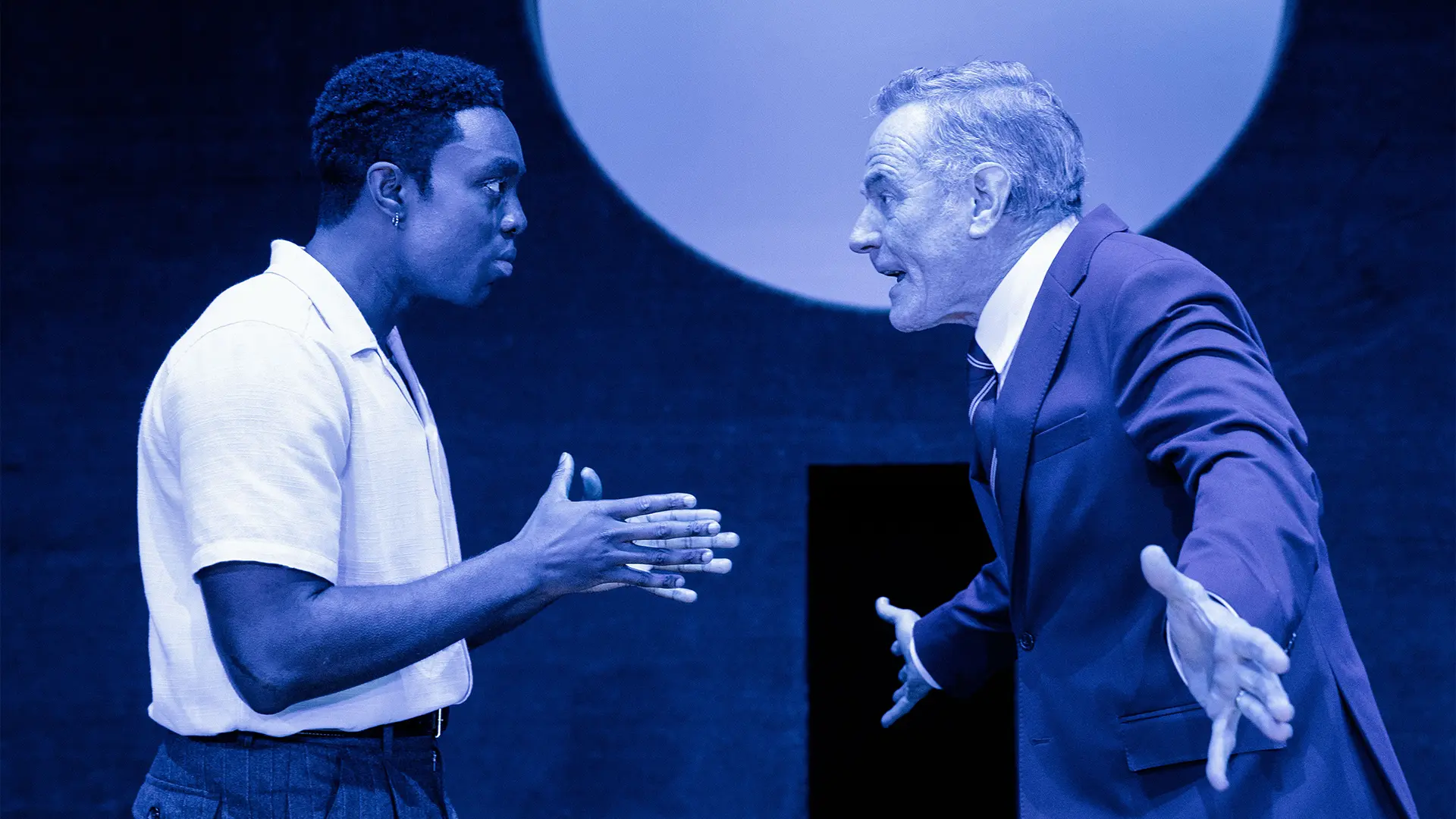
Paapa Essiedu & Bryan Cranston in All My Sons. Photo: Jan Versweyveld
When asked to name my favourite theatre production, I invariably cite Ivo van Hove and Jan Versweyveld’s stark staging of A View from the Bridge. Their return to Miller, this time with All My Sons—and with Bryan Cranston, Paapa Essiedu and Marianne Jean-Baptiste leading the cast—was therefore an enticing prospect. The result is a formidable, if not flawless, revival.
All My Sons remains a meticulously engineered dramas: the early hints, the incremental revelations, and the inexorable tightening of tension culminate in a climax of crushing inevitability. Its moral architecture—examining the corrosion that follows when a man, and indeed a society, elevates profit above humanity—remains chillingly contemporary. Miller’s characters, drawn with psychological acuity and emotional precision, still compel.
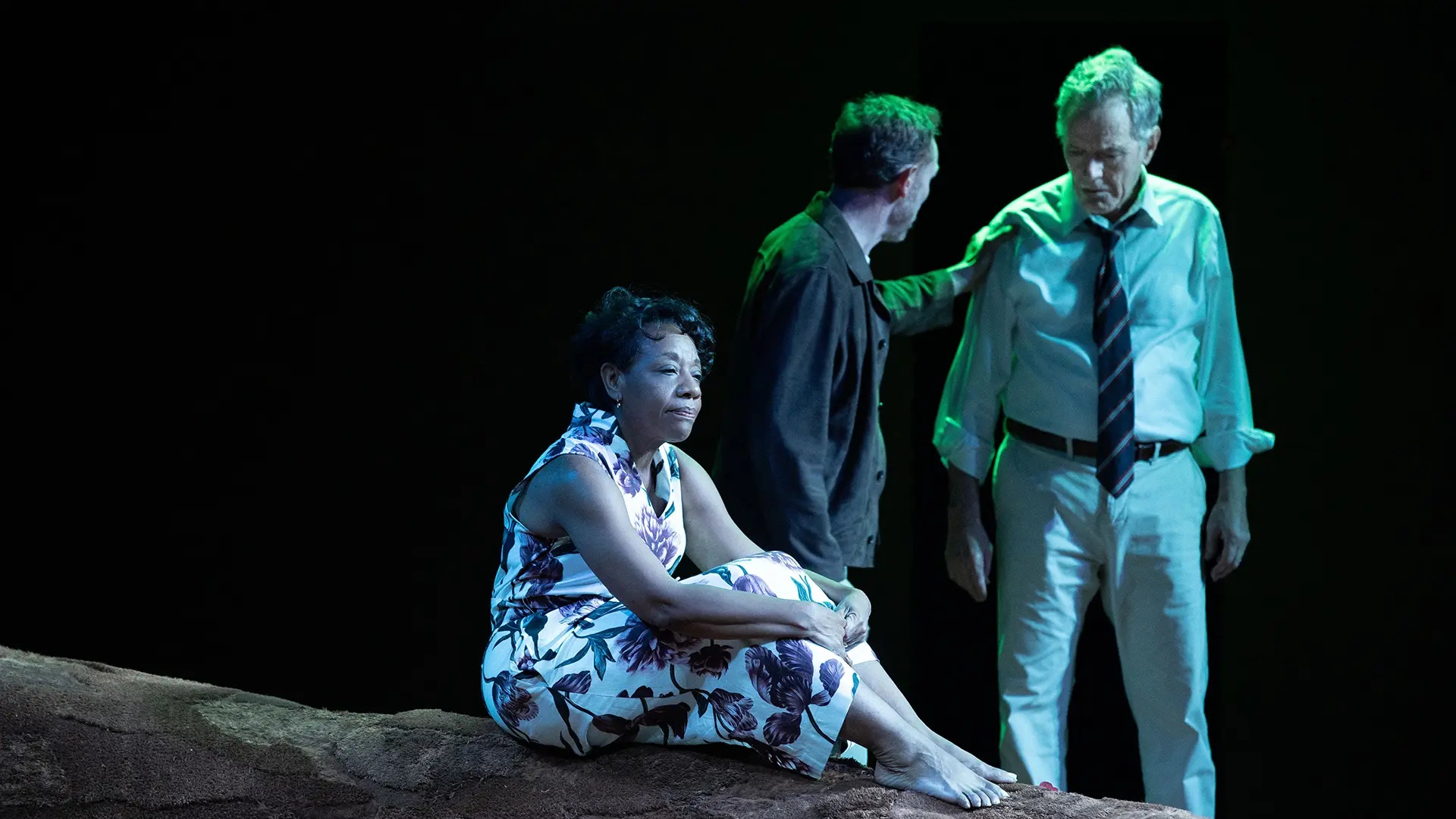
Van Hove and Versweyveld strip the stage of naturalistic detail, replacing Miller’s suburban garden and household façade with a bare stage. Lighting rigs stand in for hedges; the house becomes a blank wall with an aperture and a large circular window that variously evokes a sun, a moon, and, perhaps, an unblinking moral eye. It is a yellow circle when the play begins at dawn, before it unfolds over a single day. This follows an added prologue— we see the violent storm that fells the tree representing the missing eldest son. The fallen trunk remains onstage, the lone scenic element, a constant reminder of where the play is heading.
Versweyveld’s set is ingenious in its austerity, it anchors the play in the heart of mid Western industrial America but it is also universal in time as well as space. His lighting design holds the hand of the play throughout, carrying the emotional arc from the gentlest morning glow to a brutal, unforgiving glare.
Cranston’s Joe Keller is immediately persuasive: genial, grounded, radiating decency. Too good to be true? That’s the pleasure of acting of this calibre: for a time, we truly can’t tell as he walks the tightrope between public charm and private guilt. Paapa Essiedu as his son Chris charts a substantial arc, moving from principled idealism to profound disillusionment. He suggests, with remarkable nuance, the fragility of Chris’s outlook—an annoying idealism propped up by the wealth of the family business and his distance from its harsher realities; his life shaped by his experience of war. Paapa Essiedu matches Bryan Cranston in the depth of emotion he conveys.
Gradually we learn that the family lives beneath a shadow. During the recently ended Second World War, Joe’s factory produced a batch of faulty aircraft parts, leading to the deaths of several pilots. Joe was accused of knowingly shipping them, but ultimately his employee Steve was convicted and imprisoned.
His older son, Larry, was declared missing in action four years ago—but not because his plane contained one of the faulty parts (that would be too neat). His mother, Kate, refuses to accept his death. To do so would shatter the brittle righteous world she clings to. Marianne Jean-Baptiste is superb as Mother, revealing both the warmth that holds the family together and the ferocious denial that threatens to tear it apart. Her breakdown is executed with such controlled intensity that it becomes genuinely difficult to watch.
A catalyst arrives in the form of Ann, Larry’s former fiancée, now intending to marry Chris—and, crucially, she’s Steve’s daughter. Wearing a red dress that contrasts with everyone’s else’s duller browns and blues, she’s a spark tossed into a powder keg. The character can easily feel like a functional supporting role, but in Hayley Squires’ hands she is resolute, textured, and quietly courageous, weathered by hard experience yet capable of deep compassion.
This depth of casting extends throughout: the neighbours and relatives, each seem like real human beings with their own moral dilemmas. Take George, Ann’s brother, who storms through the auditorium in a frenzy of grief and fury to accuse Joe of framing Steve. Tom Glynn-Carney gives him the haunted volatility of someone consumed by pain yet desperate to believe he might be mistaken.
Bold in conception, thrilling in execution, and unquestionably relevant
Marianne Jean-Baptiste & Bryan Cranston in All My Sons. Photo: Jan Versweyveld
As Joe offers his catalogue of justifications—military pressure, contractual anxiety, the reassurance that “everyone else was doing it”. These excuses echo across the decades: Boeing overlooking fatal design flaws; suppliers profiting from shoddy PPE during the COVID pandemic; water companies concealing pollution; social-media giants resisting regulation despite the harm to children, vulnerable people and democratic processes; politicians using public office to enrich themselves and their allies. The play has never felt more painfully relevant.
We are left in no doubt that there is no justification for placing profit above human life—even for the most seductive of all reasons: Joe’s claim that he did it for his family. And it is that very family we watch torn apart. “I know you’re no worse than most men,” Chris says, “but I thought you were better. I never saw you as a man. I saw you as my father.”
As the play progresses, Joe’s facade begins to crack, his easygoing selling of his image becomes more desperate, until he is finally confronted with the horror of what he has done. I swear, you can see the life draining from Bryan Cranston, as his face and body sag.
Miller never dilutes his central argument—that business must be governed by conscience and social responsibility—but the greatness of the play is in thw ay it shows us the humanity of the characters and acknowledges the agonising complexity of moral choice. All My Sons may begin in the realm of Ibsenite naturalism, but it concludes as a Greek tragedy of cause and consequence.
Van Hove and Versweyveld deliver a stark, intellectually rigorous interpretation that honours Miller’s ethical inquiry. That said, the production is not without missteps. The fallen tree which is only meant to be four years old is oversized, overly dominant and overstates its symbolism. For someone who adores minimalism, I surprised myself by wishing for a modest table and chairs downstage and a smaller tree upstage. Then there was the incidental music- the persistent, plaintive plinking of piano and string. Though tastefully executed, it ultimately competes with, rather than elevates, the drama. Given the exceptional performances and the potency of Miller’s dialogue, such embellishment feels unnecessary.
These reservations notwithstanding, this is an incisive, superbly performed revival—bold in conception, often thrilling in execution, and unquestionably relevant. Not quite a five-star triumph, but a richly deserved and emphatic four.
All My Sons can be seen at the Wyndham’s Theatre until 7 March 2026. Buy tickets directly at allmysonsplay.com
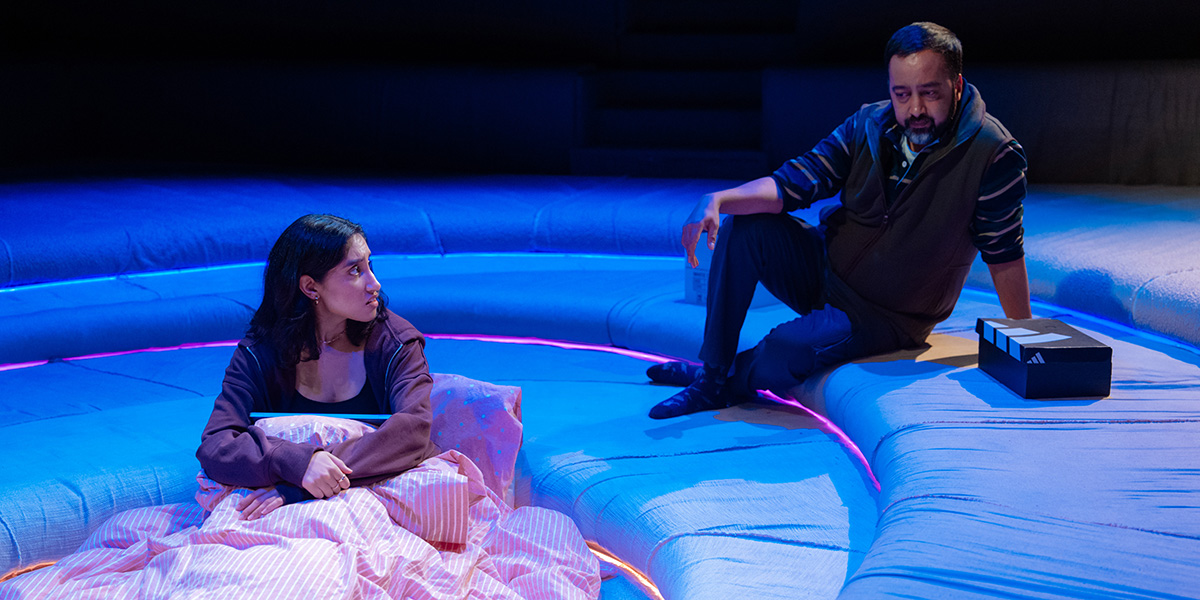
Ambika Mod and Lizzy Connolly in Porn Play. Photo: Helen Murray
Sophia Chetin-Leuner’s new play is about addiction. Unexpectedly the addiction in question is to violent pornography and the addict is a woman.
In case you’re thinking this is a little recherché for the subject of a play, we’re told almost straightaway that more women than men search for violent porn. Even so, she seems to be something of an outlier in the world of porn addicts, the clue being she’s the only woman at a porn addicts anonymous group. It may be about a niche subject, but the play presents a moving portrait of addiction and poses an intriguing question as to why a woman would become addicted to violent pornography.
If you’re easily shocked, this is one to avoid. Ambika Mod’s character Ani spends a significant chunk of the evening playing with herself. She also gives us enough vivid descriptions of what she watches to leave us in no doubt that we are talking about nasty stuff, even if she insists, in that addict’s self deceptive way, that it’s fake.
You might also want to avoid it if John Milton isn’t your thing. She’s an academic specialising in the great poet and we learn a lot about paradise, for which read sexual pleasure, and paradise lost, for which read the pain of grief. It may make you want to pick up a volume of his verse and look at it with new eyes, or not.
Ambika Mod is exceptionally good in this part, communicating desperate need, and the shame, fear and helplessness that go with it, all the while presenting a public façade of normality as she pursues her career as a university lecturer and academic. This actor has such an ability to communicate complex feelings that she is surely heading for the top.
Josie Rourke directs with precision.
Yimei Zhai’s set compliments the action superbly. We the audience are given shoe covers to wear before entering the auditorium. This is because the entire area is covered in soft pale carpet. The circular stage area and its softness may suggest a woman’s gentitalia but also, because of the whorls that take it down through a number of levels, it may signify a downward spiral. In a stroke of genius, the set is designed so the cast can reach between the joins in the fabric to retrieve props, such as a phone, a tablet or larger items like a pillow, much as you might look for a lost coin down the side of your settee, . This is wondrous in itself, but it mainly reinforces the idea that Ani’s addiction is hidden.
Not that it stays hidden for long. She takes out her phone or laptop at every opportunity to masturbate while looking at porn. This could be when someone leaves the room for a moment, or even when they are asleep in the same bed. Those close to her- her boyfriend, her best friend, her father all realise she has a serious problem. Soon her life starts to fall apart. Her exasperated boyfriend leaves her, her job is in jeopardy.
Will Close portrays with sensitivity the boyfriend’s struggle between love and disgust. He also gives us other examples of masculinity in the course of the play: a male porn addict’s macho mansplaining, a young student’s rampant hormones.
The arc of Ani’s addiction is depicted well. She maintains the violence is not really that shocking because it’s ‘fake’, but after trying it for herself she acknowledges that her enjoyment is in watching the women get hurt. She is, after Milton, a ‘brutal woman’. Eventually she reaches a point where she knows she needs to stop. Her addiction seems sad for much of the play. However, when she reaches the end of the road, sitting at one corner of the stage stroking herself robotically while the one person who cares enough to help her is in the opposite corner, it is heartbreaking.
Someone commented on The Fifth Step, another play about addiction, that while the subject is no laughing matter, it can be very funny. Sophia Chetin-Leuner seems to take this view. A couple of scenes spring to mind. Because of her continual rubbing, she has made herself sore and succumbed to an infection. She visits a gynecologist, played by Lizzy Connolly who cloaks her in that brisk matter-of-fact indifference, not even looking at Ani, that many patients will be familiar with.
Ambika Mod & Asif Khan in Porn Play. Photo: Helen Murray
During an event at which she is to receive her award for her book on Milton, Ani is approached by an old man who thinks she’s a waiter simply because she’s a young woman. Women are not expected to win top academic awards any more than they’re expected to be as sexually active as men. The old man is played by Asif Khan, who also gives an exquisitely gentle performance as Ani’s father.
In her mind, people begin to say sexual things to her. A woman seems to say to her: ‘I don’t know how you do it, spend all your time giving head’ which is then corrected as ‘in the head of that vile old man Milton.’ Milton crops up frequently when Ani addresses the audience. She talks about his poems at length, that he identified the way good and evil live in parallel, and pleasure masks pain. This does perhaps explain how her addiction arises from grief. And how Eve, the first woman, is a rebel against the patriarchy but also submissive to it. But it does start to feel like a lecture.
There are other moments when it seems the author has not entirely relevant axes to grind. For example, there’s a scene between Ani and one of her students, another fine creation from Lucy Connolly. To an extent it illustrates the gap between millennials and Gen Z. The ‘woke’ student has been triggered by Ani talking about a rape scene in one of Milton’s poems. Ani representing an older generation (that of the author) is tolerant of different times and wants to study a great poet warts and all. The younger generation has no tolerance and wants to cancel Milton. ‘Why would you want to read him and analyse all these horrible men?’ She asks. It’s a bit of a cliché and doesn’t really add to the story.
Porn Play tries to cram too much in but it is a play well worth seeing for its moving, insightful portrait of the effect of easily available pornography on 21st century sex and relationships.
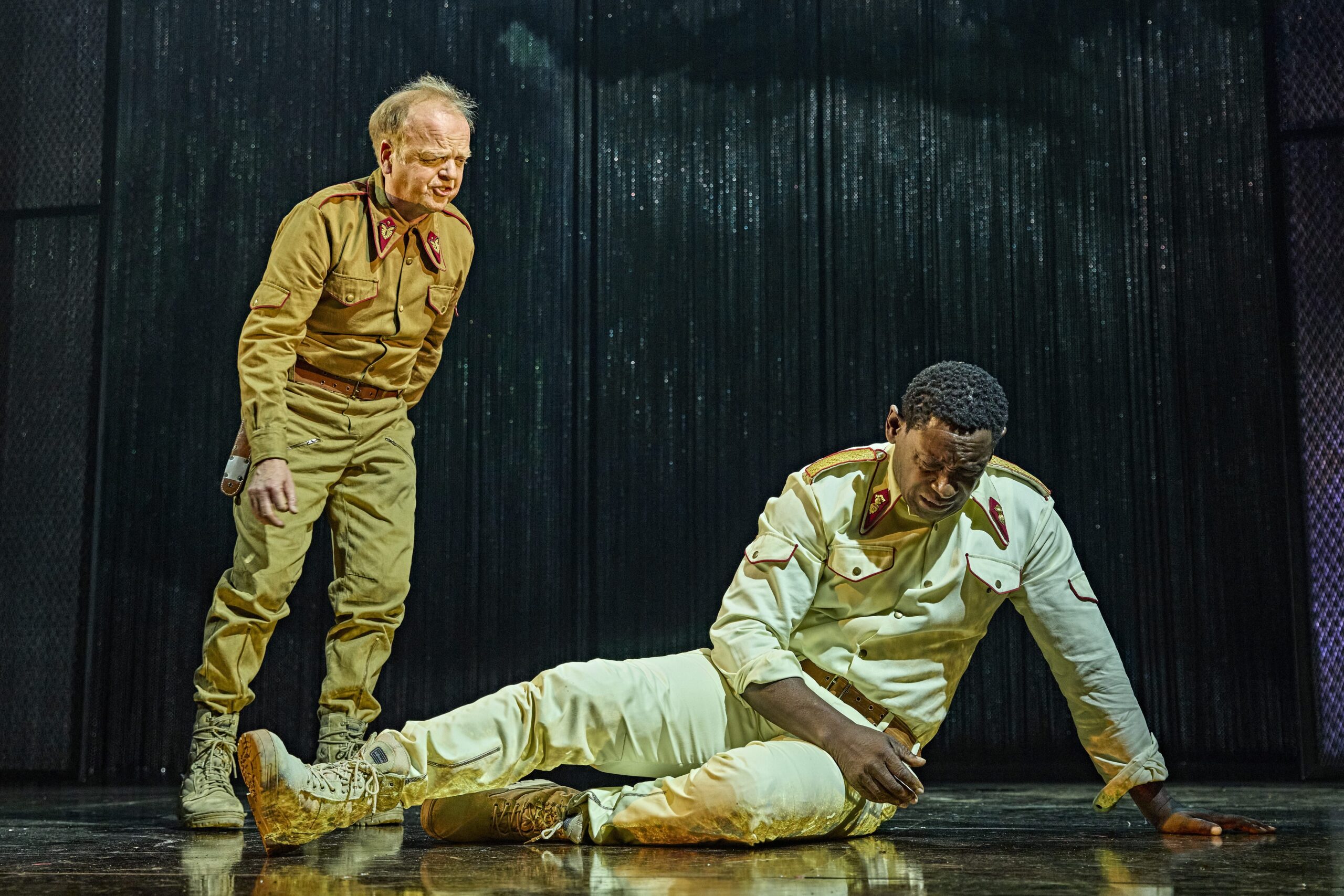
Toby Jones, Caitlin FitzGerald & David Harewood in Othello. Photo: Brinkhoff/Moegenburg
The new production of Othello at the Theatre Royal Haymarket is the finest I have seen—and I have seen a few. Director Tom Morris has achieved this triumph by keeping the production straightforward and by casting David Harewood at precisely the right point in his distinguished career to inhabit the title role completely. Added to that are two further superb performances from Toby Jones and Caitlin FitzGerald, plus an additional standout who doesn’t receive above-the-line billing.
If you’re not familiar with the plot, then please stop reading now, because I’m going to assume you know that it’s about a man who is tricked by a cynical liar into believing his wife has cuckolded him and prompting him to murder her.
You can tell from that crude summary, Othello is a at heart a domestic tragedy. Of all the lead characters in Shakespeare’s tragedies, Othello is the least grand. He’s not a King or even a noble, By comparison with Macbeth, Lear or Mark Anthony, he is strikingly ordinary. What makes him stand out is that he’s successful in his career, and an outsider. For audiences, he is very easy to identify with, as he falls victim to someone determined to wreck his life. The play is also Shakespeare’s most plot- as opposed to character- driven tragedy, and presented with such clarity (there’s no subplot) that it is inevitable an audience will be gripped and carried along.
Director Tom Morris understands this and, to his credit, has not imposed any show off interpretation. He trusts Shakespeare’s language to carry the drama, and in the hands of his exceptional cast, it does.
The background is military. Othello is a soldier who has won great victories for Venice. He knows his worth yet still wrestles with a form of impostor syndrome, aware that his race renders him inferior in the eyes of many and that his high standing derives only from his battlefield prowess. His secret marriage to a white woman from patrician Venetian society underscores his fear that the union will be condemned. His insecurity makes him wonder whether it was merely his storytelling that enchanted Desdemona into marrying an ageing black man. It’s a part bursting with contradictions.
Into these polished shoes steps David Harewood, perfect for the part. Wearing a beautiful silky green suit (Shakespeare later refers to jealousy as a ‘green-eyed monster’), he is elegant, poised, and physically imposing. He radiates authority and speaks lyrical lines beautifully and lucidly. But we can also see straightaway why the rigidity of a military man and the lack of confidence of an outsider set him up for his downfall at the hands of Iago.
Toby Jones and David Harewood in Othello. Photo: Brinkhoff/Moegenburg
Toby Jones has the task of creating a rounded picture of someone whose history we learn remarkably little about, despite him having more lines than Othello, and indeed more lines than any character in Shakespeare except Hamlet and Richard The Third. He does it brilliantly.
Iago is perceived to be an ‘honest’ soldier. The word occurs over 50 times in the play, as Shakespeare piles on the irony, thus giving the audience something to laugh about in an otherwise serious drama. The important thing is, he is trusted by Othello as a good ‘honest’ soldier.
Toby Jones deploys his familiar genial countenance when addressing others, then swivels toward the audience with a face hardened and eyes glacial.
All the cast are superb
He is aggrieved that he has been passed over for promotion. Othello has appointed Michael Cassio as second-in-command, He seeks vengeance for the slight. Spotting Othello’s vulnerability—Desdemona—he devises a plan to humiliate him. That Othello is so easily convinced his wife is having an affair is, in context, quite plausible: they married in haste and in secret. So, how well does he truly know her? Her enraged father, played with distinction by Peter Guinness, warns him early on, ‘She has deceived her father, and may thee.’ Iago then improvises his way through a thrilling campaign of insinuation, his plot evolving with each new contingency, something Toby Jones conveys with wonderful darting eyes.
Even if you did still have any doubt that Othello would fall for this villain’s machinations, you have only to recall Celebrity Traitors to see how difficult people find it to detect deception, and how trusting they are of appearances. Not that I’m comparing Alan Carr with Iago. More generally, we all know how hard it is to differentiate between truth and falsehood in the mouths of con artists.
Jealousy pervades the play, as does a corrosive sense of inferiority. Both Othello and Iago are driven by these impulses, Jones’s Iago, despite the chip on his shoulder, remains implacably steely, while Harewood’s Othello disintegrates visibly. His once-perfect outfit becomes dishevelled; his tongue which initially roamed nervously around the inside of his mouth, now flicks out of the corner; he spits out words that previously he would have modulated. A tragic flaw has enabled a villain to bring him down, but, once he accepts the supposed evidence of Desdemona’s betrayal, the military tactician resurfaces, coldly orchestrating her destruction.
As for Desdemona: I was initially sceptical about casting an older actor. The text seems to suggest she is young and disingenuous—initially she is seen as having been ‘stolen’ by Othello, and later she is naively oblivious to Othello’s changing temperament. But Caitlin FitzGerald, a mature performer, illuminates the role in unexpected ways. She conveys the giddy rapture of early love while also interacting with Othello on equal footing, asserting herself in their arguments with a modern feminist inflection.
Othello at Theatre Royal Haymarket. Photo: Brinkhoff/Moegenburg
Similarly, Emilia — wife to Iago and maid to Desdemona — receives a powerful push from Vinette Robinson. Though nearly as cynical as her husband, Emilia possesses a moral core he lacks. In this production, she seems to speak for all women as she voices her views on men and on the catastrophe unfolding around her with bruising, heart-breaking passion.
Other parts are deftly realised: Luke Treadaway is a sensitive Cassio, not at all arrogant as he is often portrayed; Tom Byrne as Roderigo is the perfect fool as Iago’s dupe.
Although the dress is modern, Ti Green‘s set is neutral. Gilded geometric structures evoke the opulence of a Venetian palace before reconfiguring into corridors, chambers, and shadowed streets. Nothing distracts from the momentum of the drama. Even PJ Harvey’s atmospheric music—almost continuous—never competes with the action.
In this production, Toby Jones’ portrayal of evil personified remains the driving force, but it is David Harewood’s subtle, flawed Othello who takes centre stage.
Nicola Walker in The Unbelievers. Photo: Brinkhoff/Moegenburg
A boy vanishes without a trace just before his sixteenth birthday. His mother, Miriam, played by Nicola Walker, is devastated. We witness her and her family’s unravelling in the days immediately after his disappearance, one year later, and then seven years later. It’s a harrowing experience for them — but does it make for compelling theatre?
The point of the play is also the problem with it. While the boy’s two siblings and his father gradually attempt to reconcile themselves to his absence, Miriam refuses to accept that her son will not return. The timeline jumps back and forth, as if to show that she never changes, that time has stood still. The family find it increasingly difficult to coexist with her, despite their evident compassion. Their struggle stems partly from her obsessive focus on her missing son and partly from her perpetual anger. Unfortunately, this unchanging emotional state eventually alienates us as well, or alienated me at least.
Nick Payne’s play examines what happens when someone is psychologically unable to move beyond trauma. It’s a fascinating concept in theory, yet as drama, it can feel repetitive — despite the best efforts of the superb director Marianne Elliott, who injects pace and passion into the production.
Nicola Walker delivers an intense and characteristically nuanced performance, complete with her familiar tics and stutters, and emotional authenticity. However, and I hate to say this, after a while her sarcastic giggling at others’ perceived absurdities and repeatedly saying people should go fuck themselves become somewhat wearisome. Convincing as she is, it becomes difficult to remain emotionally invested.
The supporting characters remain sketchily drawn, defined mainly by their reactions to Miriam. Paul Higgins, as the husband, spends much of his time shouting. Alby Baldwin, portraying the elder sibling, grieves in silence. Miriam’s ex-husband, a priest played by Martin Marquez, flounders helplessly. Only the younger daughter (Lucy Thackeray) develops — she finds a partner, becomes pregnant, and tries hardest to reconnect with her mother. “I just want my mum back,” she pleads poignantly.
The Unbelievers at The Royal Court. Photo: Brinkhoff-Moegenburg
Walker is on stage almost continuously, while other actors, when not in a scene, sit silently in a dimly lit upstage area. Ordinarily, performers would exit, allowing the illusion that their lives continue offstage. Here, however, the visible ‘waiting room’ seems to symbolise how, for Miriam, her missing son Oscar remains ever-present, whereas everyone else is out of sight out of mind. Defending her attitude, she says that if any of them had disappeared, she wouldn’t give up on them either, but ironically she has. The spare set, designed by Bunny Christie, effectively mirrors Miriam’s single-minded preoccupation.
We glimpse Miriam’s experience over the course of the seven years: the early dealings with the police, subsequent false sightings and internet trolls, and the desperation of spiritualism and prayer. These should-be heart-wrenching moments but they failed to resonate with me, because I never felt sufficiently connected to the characters.
Because there is no story arc, no character development, and no resolution (we never know how or why Oscar disappeared, or whether he is alive or dead), I found the journey a little monotonous and felt deflated rather than emotionally drained by the end. On the other hand, it was interesting and unexpectedly humorous. And, as always, Nicola Walker delivered good value.
Kip Williams’ comedy about superficial lives is full of depth
Donmar Warehouse
⭑⭑⭑⭑⭑
The Maids at The Donmar. Photo: Marc Brenner
Jean Genet’s 1947 play about class jealousy and working class revenge has been reimagined by Kip Williams as a biting satire on social media and influencers. Reviews ranged from 5 stars to 1 star (My roundup is here). The more critical called it ‘superficial’ and ‘exhausting’. I couldn’t disagree more. If you think nothing happens in Waiting For Godot or in plays by Pinter, then fair enough, this may not be for you. For me, it was a searing exposure of the human condition told with acerbic wit and incisive insight.
For a start, let’s not confuse depicting the performative superficiality of our curated age, with actually being superficial. This production, directed as well as written by Kip Williams, is in the tradition of Theatre of Cruelty and Theatre of Absurdity which Genet was part of. Theatre of Cruelty is intended to break down our distancing intellectual approach to art and jolt us viscerally with the nastiness of human existence. Theatre of the Absurd does as it says on the tin, and is a response to the meaninglessness of existence. These are movements that were born out of the inhumanity of the first and second world wars. It may be that these forms of theatre are less effective today. Perhaps for younger people, human existence doesn’t seem so nasty or absurd, or is simply a given.
The existence we are talking about here is that of two maids, who are also sisters, repeatedly playing a game in which one is their mistress and the other, one of the maids. The ‘servant’ is so verbally and physically abused by the ‘mistress’, that they fantasise about killing her. They are clearly psychologically unhinged.
Both speak in a high speed, declaratory way using the language of a generation brought up on socials. I cannot understate the achievement of Lydia Wilson and Phia Saban in spewing out the words with such pace and venom. The dialogue given to them by Kip Williams is musical, poetic and very funny. I think I need to emphasise that latter adjective, because, on the night I saw The Maids, the audience for the most part received it in silence, and those of us who did laugh were sometimes subjected to puzzled looks. So maybe I am an outlier in my reaction.
Their mistress is a media influencer on matters of beauty and fashion, with 28 million followers. When she finally appears, gloriously played by Yerin Ha, she is a spoilt rich girl, but not the abuser she was made out to be. She is undeniably entitled but it is more the assumption of superiority that makes her obnoxious, and darkly humorous for it. Her conversation is littered with the words ‘literally’ and ‘actually’. She is a drama queen but it’s hard to think she deserves to die.
The thing is, the maids may talk about killing their mistress but they don’t really want to end the dominance of what we may see as fake imagery and the malign influence of social media. They are totally obsessed by it. They may want to destroy their mistress’s career but they aspire to live her life. They use their mistress’s makeup and wear her clothes. They use apps on their phones to create fake images of themselves. These are images we see on screens at the back, which, I repeat, are crazily funny. The existential futility we observe is a metaphor for the absurdity of all human life- ‘a tale told by an idiot, full of sound and fury signifying nothing’, as an earlier playwright described it.
Disquieting eroticism
The Maids at The Donmar. Photo: Marc Brenner
Genet wanted his play to be a comment on the ‘class struggle’ and this version be seen as an allegory of the exploitation of the poor by the rich and the struggle of the working class to overthrow their oppressors. But it seems that the sisters are really using their rituals to abuse each other. Their criticism of each other’s characters may speak to the way the political left tears itself apart, rather than really attacking their rulers. At times, this interplay is charged with a disquieting eroticism.
There is also a swipe at religion, more obvious perhaps when the play was written. Genet was inspired by the repeated rituals of the church which serve to reinforce the believers’ common faith and their superiority over non believers. So the sisters are in a world of their own, existing in the echo chambers of social media.
A word about the set designed by Rosanna Vize. We begin with the action taking place behind a gauze. So, we are encouraged to see the sisters as in a separate world from us, muted and mediated,. Then the curtain is pulled back to reveal dazzlingly vivid hues, packed with big blooming peonies and other flowers, bathed in eyeball-searing light. Suddenly, their world is alive and overwhelming.
In the story, such as it is, the maids have faked evidence against their mistress’s lover, and he’s now in jail. This is ostensibly to destroy her reputation, which they, for self deceptive reasons, believe will benefit them. Their plan falls apart when the lover is released on bail and their conspiracy looks like being exposed. The only way out seems to be to kill their mistress for real. As the play reaches its climax, the sisters retreat further into their digital fantasy, until it becomes entirely real to them. I don’t want to say more about that but it is very well done and ends literally, and I mean ‘literally’, with a denouement.
Rather than dismissing as superficial the fantasy world of unattainable beauty and imaginary murder, the play seems to suggest it may be a valid way of coping with the futility and nastiness of life. A way that may be more fun, if less heroic, than being two tramps ever hopeful that Godot will turn up.
Stephen Fry in The Importance of Being Earnest. Photo: Marc Brenner
I gave a lukewarm review to this production of The Importance of Being Earnest when it premiered at the National Theatre. Part of the reason was, I love this play and, even though I still enjoyed the witty dialogue and the ingenious story of identity and hidden truth, I felt the queer interpretation was laid on a bit thick. I accepted that the two main characters’ double lives could be taken as a metaphor for gay men’s secrecy in past times, but, to my mind, Max Webster‘s decision to foreground the subtext undermined the power of Wilde’s actual text. I now think my prejudice blinded me to the quality of what was in front if me
So I wanted to give it a second chance, and go in more prepared for this approach. And I wanted to compare Olly Alexander‘s Algernon and Stephen Fry’s Lady Bracknell with Ncuti Gatwa and Sharon D Clarke.
It’s not only the twostars, there’s a complete new cast. Each actor captured the distinctive cadence of Oscar Wilde’s prose, delivering lines with clarity. Putting my gratitude for that aside, I fully expected Alexander and Fry to lack the power of Gatwa‘s dazzle and Clarke’s swagger. And in a way I was right, neither has the charisma of the National’s original casting. However, their more restrained interpretations of Algie and Lady Bracknell create a more balanced production.
They make the parts their own, as judges on talent shows are apt to say. Olly Alexander delivers an exemplary performance, imbuing Algie with endearing boyish charm, while Stephen Fry relied on a quiet, clipped delivery (and to be fair his height) to exert his authority. This is not the pantomime dame I feared but rather a totally believable version of the snobbish, domineering representative of the aristocracy. Where the previous larger-then-life characterisations almost suffocated Wilde’s delicate plot construction, toning them down seems to allow it to breathe a little more.
The rest of the West End cast are as good if not better than their National Theatre counterparts. Outstanding are the two young women, Gwendolen and Cecily, played by Kitty Hawthorne and Jessica Whitehurst respectively, and the object of Jack and Algie’s affections. I still found their overt expressions of sexual frustration somewhat incongruous with the period context, but I went with it, and actually the tongue waggling and the attention they pay to their fiery loins is pretty funny. Come to think of it, their obsession with their husband being called Ernest is just as silly.
Another highlight is Hayley Carmichael playing the manservants Lane and Merriman. It’s hard not to laugh at Merriman’s every entrance, when this diminutive figure dressed in oversized wig and tailcoat moves with mechanical stiffness and an air of complete bewilderment.
Shobna Gulati and Hugh Dennis extract plenty of humour from the relationship between Miss Prism and Canon Chasuble. Their suppressed passions form a delightful counterpoint to the younger lovers’ unbridled emotions. Nathan Stewart-Jarrett is a fine, likeable Jack Worthing.
Olly Alexander and Hayley Carmichael in The Importance of Being Earnest. Photo: Marc Brenner
Far from going further in laying on thick this gay interpretation, the transferred production seems to have reined it in ever so slightly. I admit I was expecting, and therefore was less concerned about the opening where Algie is in a cocktail dress at a cross dressing party, or the men and women being sexually excited by their own as much as the opposite sex, or by the references to modern pop songs.
It may have avoided becoming the pantomime I feared but the production is still deliciously over the top. Rae Smith’s colourful costumes and lavish sets, complete with masses of blooming bushes and two naked male statues, create an exuberant atmosphere. And the curtain call does provide a panto-style walkdown, with the cast dressed in giant petals.
I would still prefer a version of The Importance of Being Earnest that allows the lines to speak for themselves, but I am very happy to concede that Wilde’s timeless comedy is big enough to take a joke, and this is a particularly good joke.
Hannah Dodd, Rob Madge & the company of Cabaret at the KitKat Club. Photo: Marc Brenner
It’s taken me four years to get round to seeing Cabaret at the KitKat Club, the venue formerly known as The Playhouse. The original stars of Rebecca Frecknall‘s production, Eddie Redmayne and Jessie Buckley, have long gone, and indeed many other pairs have played The Emcee and Sally Bowles in the intervening years. Even Rob Madge and Hannah Dodd, whom I saw, have now moved on. But Cabaret at the KitKat Club remains the best show in London’s West End, and should be seen by anyone who loves musical theatre. Having said that, in my opinion, it’s not the best production of Cabaret ever.
Rebecca Frecknall isn’t the first director to come up with the idea of turning the whole theatre into the KitKat Club, that being the name of the venue where the cabaret part of the musical takes place. I saw a production in Berlin back in 2018 that did just that. And most famously, and possibly the first to do it, was Sam Mendes‘ production at the Donmar Warehouse back in 1993. But I doubt anyone has done it with such complete dedication and thoroughness as Ms Frecknall.
You, the audience, are invited to get to the theatre an hour or more before the show begins. Even the outside of the old Playhouse has been rebranded the KitKat Club. You enter through the Stage Door, and go straight into the basement. Normally the secret home of dressing rooms, the main corridor has been changed into a bar area with subdued lighting and performers playing music and generally standing around looking degenerate. significantly, the signage is in English and German. Oh, and you’re offered a free shot of Schnapps. So, from the start, you are immersed in the decadence of Berlin’s hedonistic nightlife.
Then, it’s up the stairs to another bar where sexily clad dancers and musicians of indeterminate genders entertain in the sultry style of the Jazz Age. And so into the main house. The first shock is that the seating and layout of the old Playhouse has been completely ripped out. Instead of a proscenium arch stage and straight rows of seats, the circular stage area is in the middle of the auditorium with the audience on two sides, traverse style. Tables and chairs are in the immediate areas on either side of the stage. These are very expensive by the way, and have given the show its reputation for being high priced. Beyond them are much more reasonably priced rows of seats, which are curved thus adding to the feeling of intimacy.
My row, which was G about six from the front, had a great rake, fantastic legroom and even a shelf for drinks. There are similarities with the Mendes production- it too utilised a small bare stage with some of the audience sitting at tables in front of it but in this production, we are all in the KitKat Club circa 1929. This is total theatre that couldn’t be anything but a live show. Special credit here to Tom Scutt‘s set and costume design.
The dance and music continues as we wait for the show to begin. Our Emcee tonight is Rob Madge, who is fabulous as a threatening clown. It’s a part that can be played more sympathetically but Rebecca Frecknall chooses to go with the ‘leave your troubles outside’ cue and makes him lascivious, waspish, amoral and apolitical. So when he sings I Don’t Care Much in the second act, a song you won’t recognise if you only know the movie, there is no bravado, no irony, he really doesn’t seem to care.
Interestingly when Hal Prince first put together the musical in 1966, the Emcee was there to hold the show together but was not considered a major character. Joel Grey- and the audiences- changed all that. Now he is the conduit between us and the stories. And because he is our guide, and this is theatre, where the relationship between each other and with those on stage is uniquely intense, we are carried along by the fun of the cabaret, and become onlookers at the world outside the club.
That’s where we meet the gay, or maybe bi-sexual, American journalist Cliff – a sensitive performance from Daniel Bowerbank when I saw it- who becomes friendly with a Nazi called Ernst and a nightclub singer called Sally Bowles with whom he falls in love. More of her in moment, but first the other love story. Cliff’s landlady Fraulein Schneider falls in love with a Jewish fruiterer called Herr Schultz. It is a delicate romance between two lonely people in their autumn years, touchingly conveyed by Vivien Parry and Fenton Gray. Their songs It Couldn’t Please Me More and What Would You Do tighten the chest. As Act One ends, their relationship is broken up by the Nazis.
All this is taking place on the same bare stage that is the focal point of the KitKat Club. So we can quickly switch to cabaret songs which are a commentary on the stories: The Emcee sings and performs Two Ladies, parodying Cliff’s bisexuality. We hear the strirringTomorrow Belongs To Me quite early on, showing the apparently innocent but faintly sinister appeal of patriotism, that will drive the Nazi campaign. And If You Could See Her (the gorilla song) exposing the way the Nazis portray the Jews as sub-human.
The score is one of the best of all musicals with its evocation of the period, its exposition of character and plot, and its commentary on the action. There are so many great songs but two of the best are sung by Sally Bowles. I wasn’t sure about the jolly hockey sticks voice adopted by Hannah Dodd. Possibly Sally is meant to be putting on an act of speaking like the high society of the period, or perhaps she is simply a product of a 1920s finishing school. Anyway, Ms Dodd came into her own with the songs. Maybe This Time, first performed in the 1972 movie but now an integral part of the stage show, shows how on the edge Sally is. Desperate for love but also desperate to be something this naive English girl really isn’t- a hedonistic showbiz star. Her life is an vitreous act that could shatter at any moment, as it eventually does.
By the time, we reach the climactic singing of Cabaret, she has fallen apart, and hardly believes the sentiment of her late debauched friend Elsie that life is or should be a cabaret. She sees the mess of her own life and the way her idealised Berlin is succumbing to a sinister political group that won’t ‘live and let live’. The song is sung with anger and despair, not at all like the defiant Lisa Minelli version.
The second act sees the greatest divergence from the Sam Mendes production. In the earlier version, the KitKat Club carries on in its own blinkered way to the end, ignoring or mocking the Nazis until it is destroyed by them, in a shattering finale. In Rebecca Frecknall’s interpretation, the Nazi style gradually infiltrates the club. The costumes become bland, sandy coloured suits reflecting the Nazi uniform of brown shirts. We continue to be entertained but now, looked at objectively, we’re applauding or at least being complicit in the rise of the Nazis.
Either way works, and although I prefer the shock of Sam Mendes’ approach, the result is the same- a stark warning by the writer of the musical’s book Joe Masteroff and its composers John Kander and Fred Ebb against standing by and ignoring the rise of racist, authoritarian politicians under a banner of patriotism.
You leave having witnessed an evening of theatrical entertainment unequalled in the West End today, while this regime was being constructed round you. Point made.
If you would like a flavour of the Sam Mendes production, there is a slightly blurry film of it, made for television, and available on YouTube.
To provide the best experiences, we use technologies like cookies to store and/or access device information. Consenting to these technologies will allow us to process data such as browsing behaviour or unique IDs on this site. Not consenting or withdrawing consent, may adversely affect certain features and functions.
Functional
Always active
The technical storage or access is strictly necessary for the legitimate purpose of enabling the use of a specific service explicitly requested by the subscriber or user, or for the sole purpose of carrying out the transmission of a communication over an electronic communications network.
Preferences
The technical storage or access is necessary for the legitimate purpose of storing preferences that are not requested by the subscriber or user.
Statistics
The technical storage or access that is used exclusively for statistical purposes.The technical storage or access that is used exclusively for anonymous statistical purposes. Without a subpoena, voluntary compliance on the part of your Internet Service Provider, or additional records from a third party, information stored or retrieved for this purpose alone cannot usually be used to identify you.
Marketing
The technical storage or access is required to create user profiles to send advertising, or to track the user on a website or across several websites for similar marketing purposes.