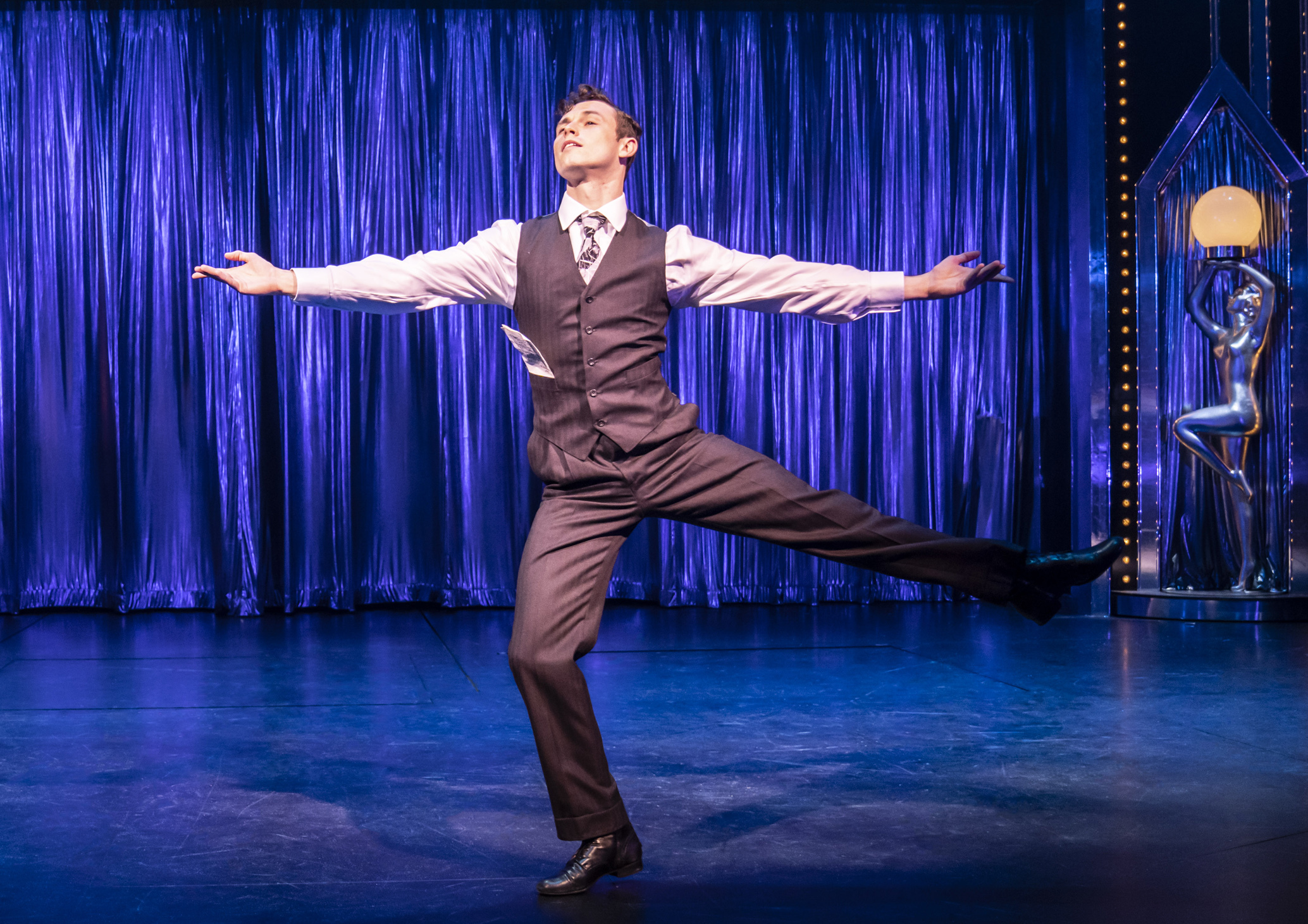
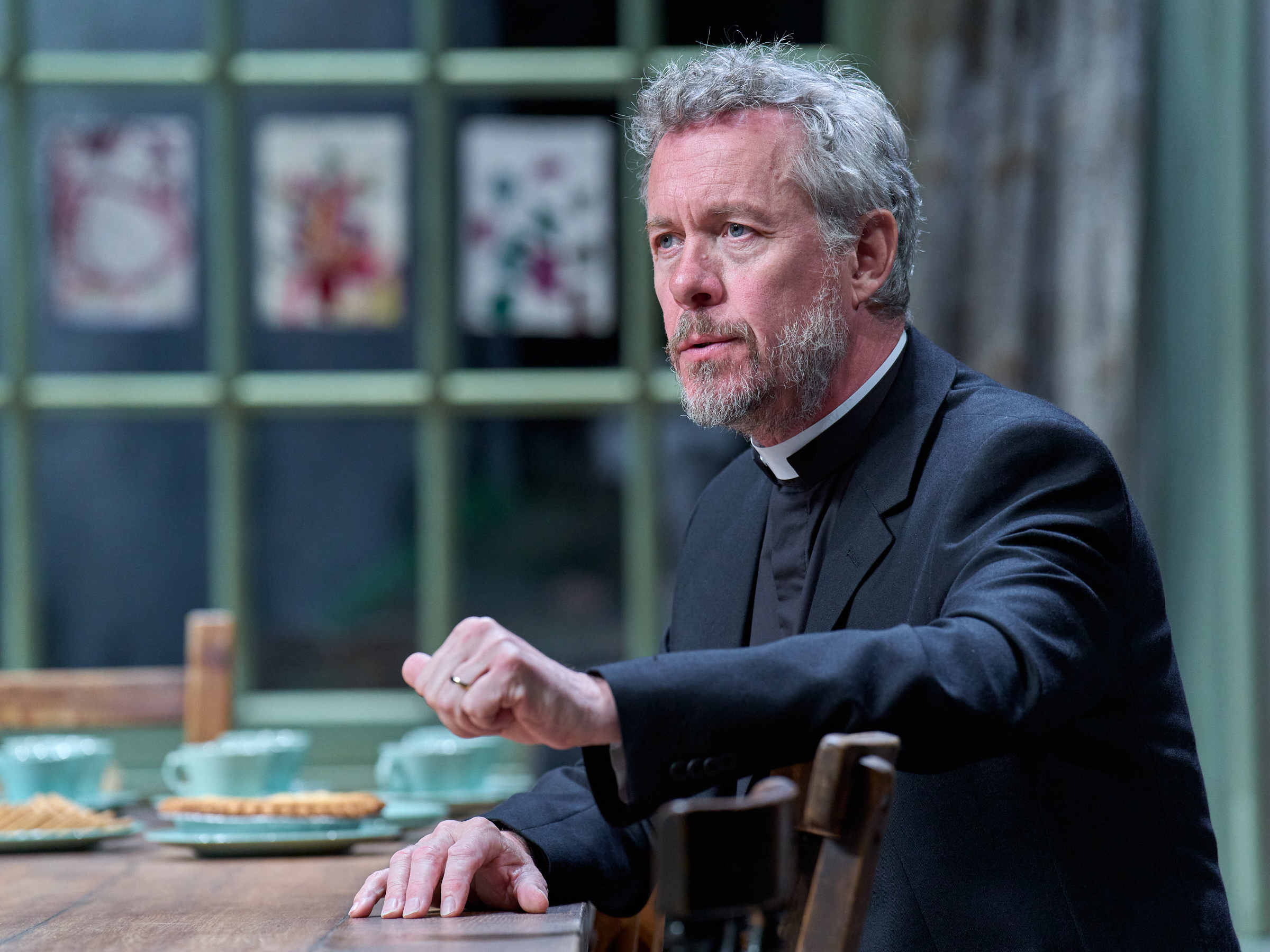
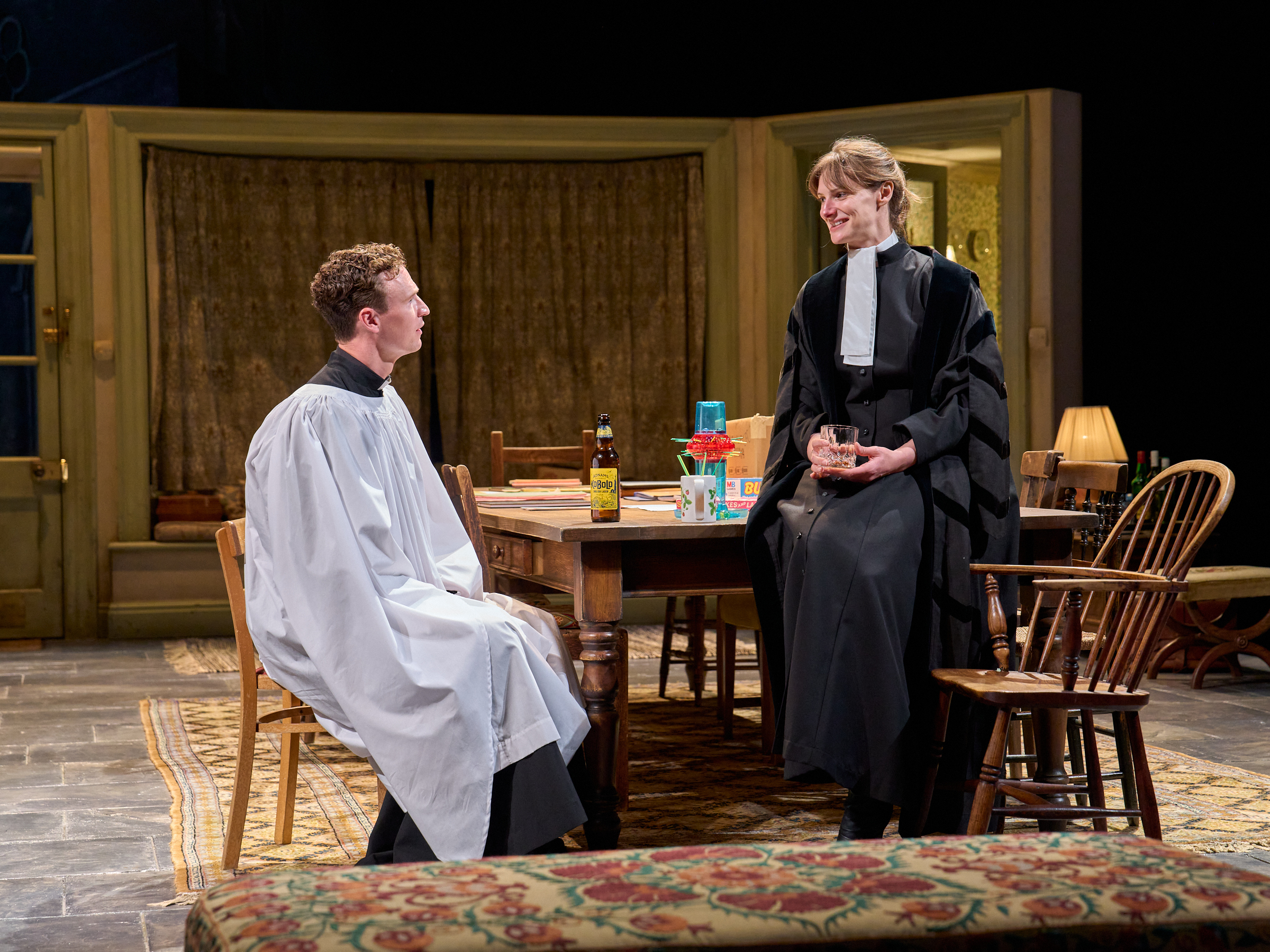
Watermill version of Tolkien musical is small but beautiful
★★★★
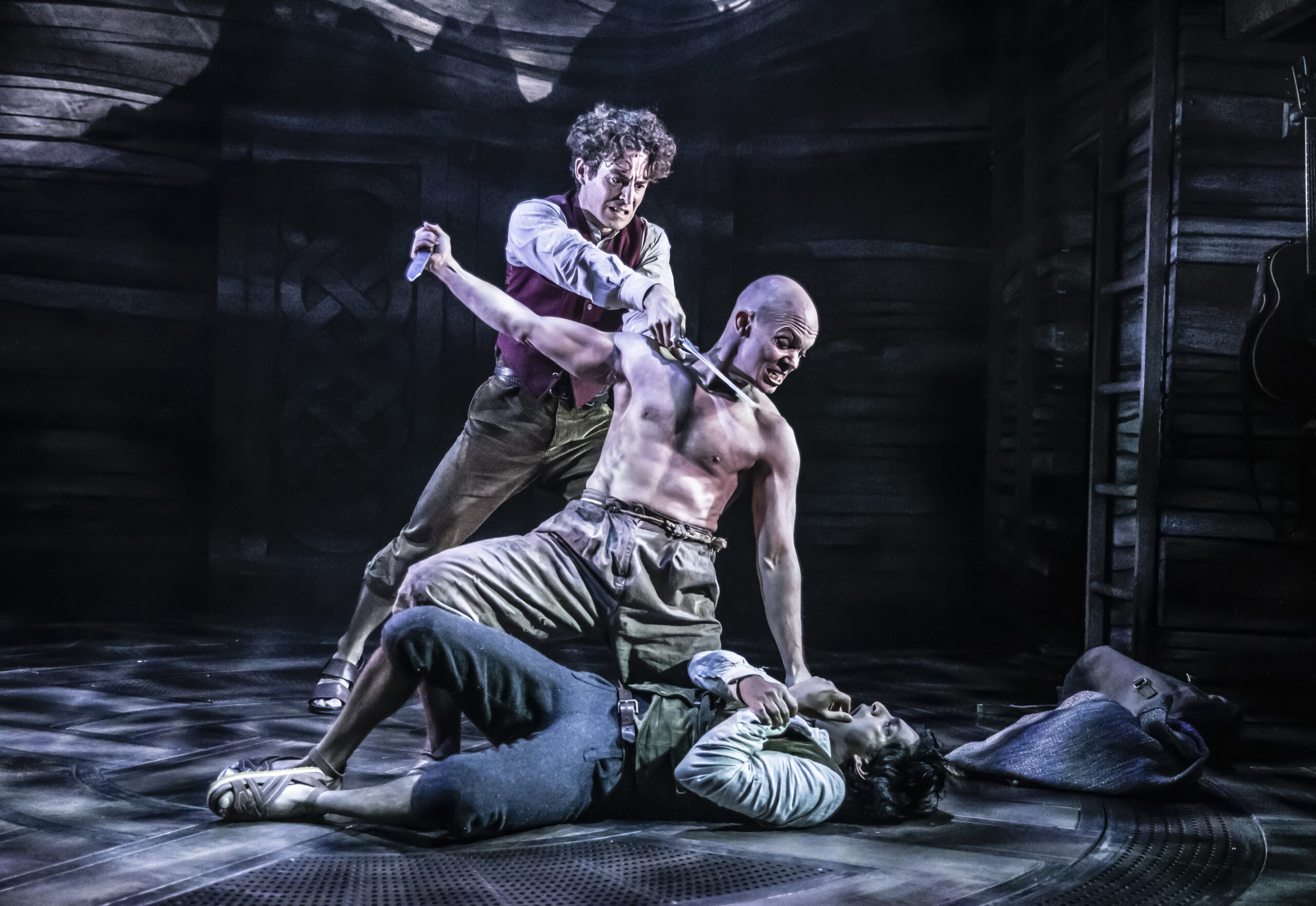
Louis Maskell, Matthew Bugg & Nuwan Hugh Perera in The Lord of the Rings. Photo: Pamela Raith
This musical version of The Lord Of The Rings was once a no-expense-spared spectacular that became the West End’s most expensive flop, described by one critic as ‘bored of the rings’.
This revival at The Watermill Theatre in Newbury, Berkshire, is a more modest affair that focuses on the small fellowship at the centre of the story. It relies on the power not of the ring but of acting, and gives more weight to the innate quality of the musical itself.
I have seen the films and read the books, but so long ago it was almost in the Second Age. I certainly wouldn’t describe myself as a fan of Sword and Sorcery in general, or Tolkien’s combination of nostalgia and whimsy in particular, so I probably wouldn’t choose to go to this show if I hadn’t been invited to review it. However, I took a major devotee of The Lord of the Rings with me for a different perspective.
When I think of the films, I remember huge battle scenes but, when I think of the books, I remember those ordinary, frightened hobbits finding strength when it’s needed. Director Paul Hart’s emphasis in this version of the musical is very much on the latter, showing the effect war has on the everyday people who are called to serve a cause. This is at the heart of why his magical production triumphs.
The Watermill team has gone all out to make this a special event. When we arrived at the front lawn, we found a hog roast and other food, and a beer and wine stall, perhaps reflecting the hobbits’ passion for food and drink. Then it’s round the back to the Watermill’s garden, a verdant setting perfectly suited to represent the Shires, the bucolic homeland of the hobbits that must be defended. We join the celebrations for Bilbo Baggins’ eleventy first birthday. John O’Mahony combines perkiness with wistfulness in the role of the old hobbit.
It’s here that we first meet our heroes- Frodo and Sam, as well as their fellow travellers Merry and Pippin, and the wizard Gandalf, given an authoritative but kindly demeanour by Peter Matrinker.
Soon the quest to destroy the One Ring and thereby curb the power of the evil Sauron begins, and we transfer to the auditorium where the adventure will take place. You may be relieved, given the current summer, that you can put aside any worry that this might be a largely outdoor production requiring a mac and wellies.
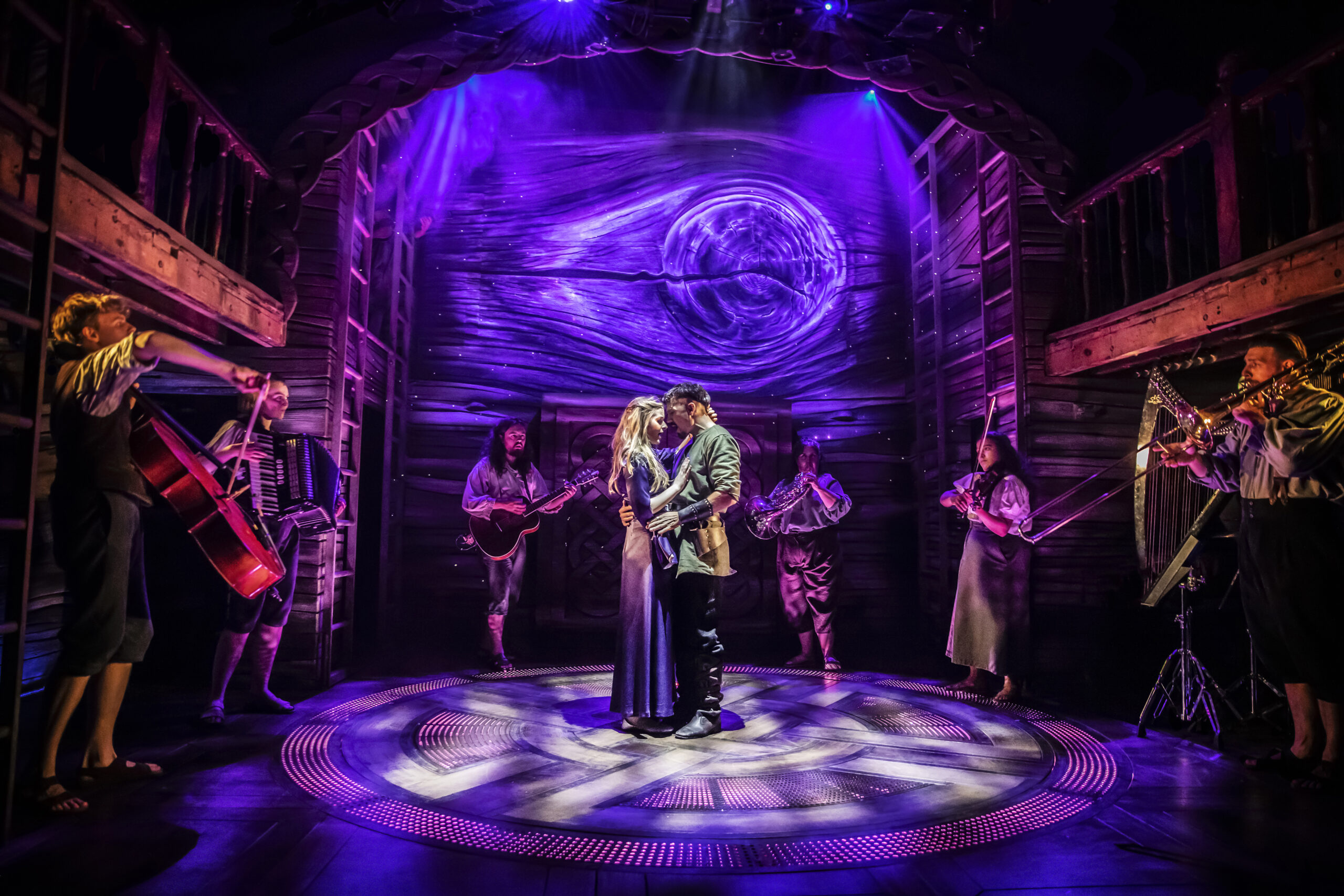
If you’re familiar with The Watermill, you will know that it has a hobbit-scale stage, so Simon Kenny has designed a deceptively bare set to allow room for the many characters and their encounters. However, he has covered the floor and back of the stage in wood that blends with the existing wood of the auditorium to create an all-encompassing atmosphere.
There are double doors at the back, decorated with Celtic knots, and a lift that raises characters above the action. Vivid back projections by George Reeve create a sense of place, from the Elven settlement of Rivendell to the fires of Mount Doom.
Since the floor is empty, it’s mostly down to the quality of the acting of the cast of twenty to create each scene. There are also no concessions to height, even though the story repeatedly makes the point that hobbits are small creatures, so the actors’ achievement is all the greater.
You may gather this is the polar opposite of a spectacular production. We begin, end, and are always rooted in the simple home-loving community of the hobbits, and we see the great war between good and evil from the viewpoint of these ordinary people plus the small band of allies they acquire. We only observe those major battles that so impressed in the films in microcosm, as our heroes engage in one-on-one fights. And the fights, directed by Dani McCallum, are tremendous. There is excitement in buckets as they swing their weapons and duck and dive, sometimes in slow motion, and starkly lit by Rory Beaton.
Great acting is at the heart of the production
Mostly it is the intimacies of the relationships that take centre stage, often in the form of warm or tense exchanges. We witness the growing bravery of the pacifist hobbits, such as the timorous Pippin played by Amelia Gabriel overcoming her fear of trees and the bouncing enthusiasm of Geraint Downing as Merry. We see the warm-hearted but melancholic Frodo displaying inner conflict as the ring tempts him to the dark side (sorry, I’ve gone a bit Star Wars there). It’s a riveting performance from Louis Maskell.
We observe Nuwan Hugh Perera‘s Sam subtly growing from a bright-eyed and bushy-tailed follower to a strong clear-eyed leader as the story progresses. The separated lovers Arwen and Aragorn, played by Aoife O’Dea and Aaron Sidwell, add poignancy. Then there’s the growing respect between the brave but hotheaded dwarf Gimli, played by Folarin Akinmade, and the proud elf Legolas played by Yazdan Qafouri. Tom Giles doubles up as two contrasting leaders- the wise elf Elrond and the scheming wizard Saruman. Peter Dukes (who impressed in The Watermill’s version of Sondheim’s Assassins) reveals bravery and vulnerability as Boromir.
The Lord of the Rings at The Watermill. Photo: Pamela Raith
Not that the production is without spectacle. The most startling and frightening moment comes when a giant spider emerges from the back of the stage and advances on Frodo and Sam. Puppetry designer and maker Charlie Tymms and puppetry director Ashleigh Cheadle deserve credit for that and for some other impressive creatures like the Black Riders.
The intimate nature of this production allows the music to shine. As is a trademark of The Watermill, many of the actors play instruments and sing, beautifully in the case of Yazdan Qafouri and Georgia Louise who also gave an authoritative performance as the Elfin leader Galadriel. The music is by A R Rahman, Värttinä and Christopher Nightingale. The combination of English folk, haunting ballads and Indian style songs works very well in conveying the Peter mood and emotion of the show. There is much exhilarating dancing too choreographed by Anjali Mehra.
It has been described as an immersive production. This is not really the case. We stay in our seats and on the whole the actors stay on the stage. When they don’t though, as when Gollum climbs, almost slithers, around the gallery rail hissing ‘my precious’, it emphasises how much we are part of this journey. Matthew Bugg’s athletic, contorting, slimy Gollum is a star turn, as he wavers between virtue and sin.
The Watermill has been severely hit by the loss of its Arts Council grant, so it’s even more extraordinary that this small theatre in Newbury has been able to achieve what major producers with millions at their disposal were not.
The only reservation I have is that I wished I could have engaged more with these characters and Tolkien’s world of elves and orcs, but there was always a voice whispering in my ear: ‘what a load of tosh’. And, no, that wasn’t the voice of my companion. He loved it and would give it 5 stars.
I loved it too but I do think, at over three hours, it’s a bit too long for the simple story this musical has to tell, and too short to do justice to the complexity of Tolkien’s three weighty books.
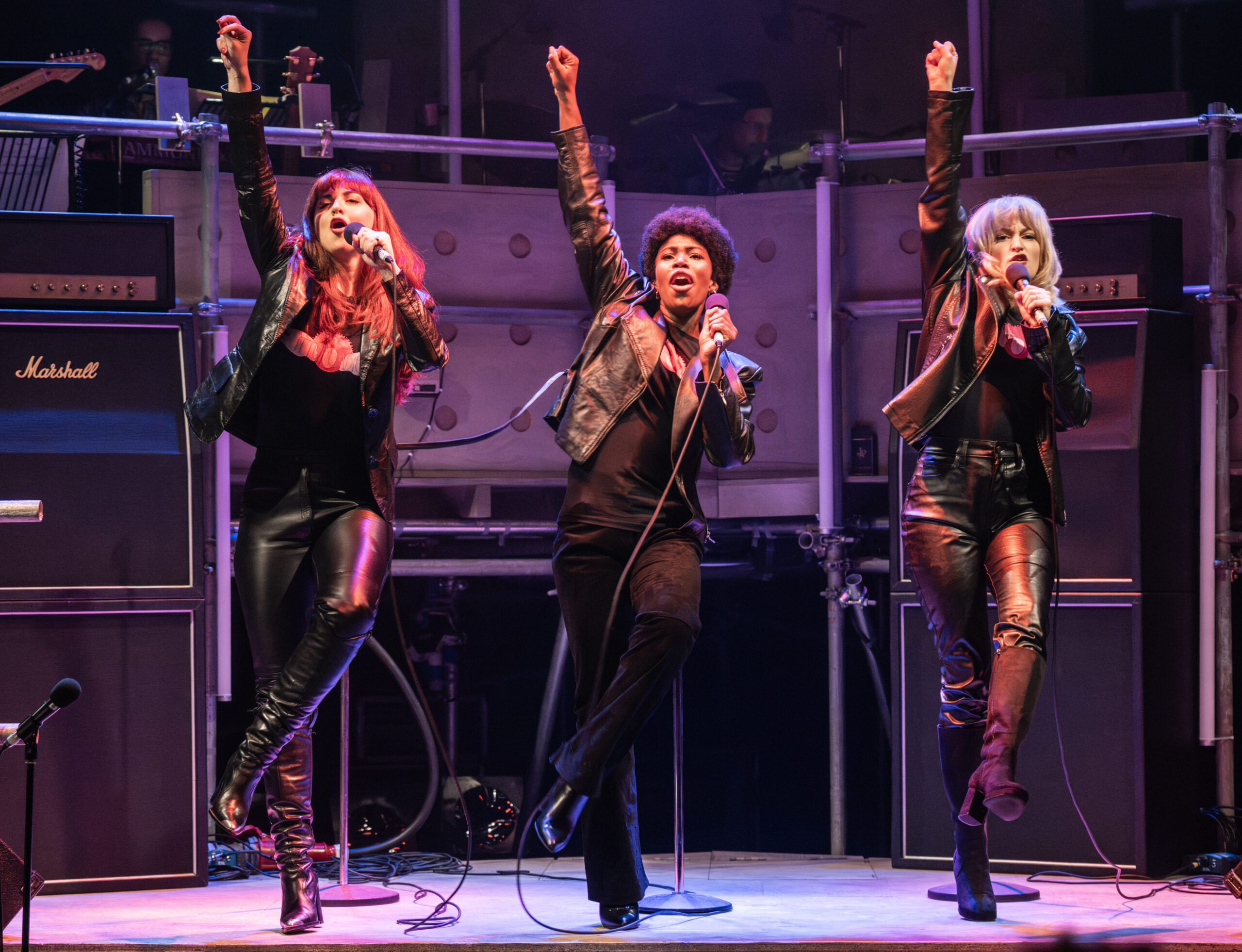
Zizi Strallen, Angela Marie Hurst & Carly Bawden in Rock Follies. Photo: Johan Persson
Back in 1976, when Rock Follies first appeared on the nation’s screens, TV was very different to today. There was no satellite or streaming, not even recorders, so whereas nowadays 3 million viewers is considered a success, back then Rock Follies had 15 million people watching live.
Consequently, many older people will remember it well, however anyone under, say, 60, may be puzzled as to what the fuss is about. So first, a bit of background. It’s hard to imagine now but in the 1970s, women were rare in the British pop charts and female groups were non-existent. The pop industry was dominated by men both on and off stage. Rock Follies imagined the fate of a female singing group.
And that fate at that time was always likely to be one of chauvinism and exploitation. Equal pay for women had only come into law a few months before the series began. The assumption was still that women in the music industry would be secretaries or groupies. It was a very different world, although the Me-Too movement has shown that less has changed than we might hope.
The title Rock we understand, but why Follies? I’m not sure. Perhaps the creators wanted to reassure an older audience who might be wary of a TV drama about rock music that it would be in the tradition of the spectacular song and dance ‘Follies’ from the early part of the 20th century. Or maybe it was meant to be an ironic suggestion that the idea of a female rock group was a foolish fantasy.
In fact, there’s a lot of irony involved in Rock Follies. Given the way the three singers are treated in the drama, it’s ironic that the people who actually came up with the original idea were also three women but it was used without payment or credit by the television company. Only after a court case are Diane Langton, Gaye Brown and Annabel Leventon getting the recognition they deserve, including a credit in the programme for this new musical version at the Minerva Theatre.
And, although it is a story of three feminist women who challenge the male world by writing and singing their own songs, the original screenplay and lyrics were written by a man, Howard Schuman. That’s not a criticism. Mr Schuman created great characters and a compelling story. The songs were also composed by a man, the talented Andy Mackay from Roxy Music.
In the current production, the backing musicians are all men. A good band, by the way, led by Toby Higgins.
So when the women call themselves The Little Ladies and then have to explain ‘it’s ironic’, the question is always there: how ironic is it when they are patronised, abused and exploited by men from the music industry, and manipulated into being something they don’t want to be? The women also encounter chauvinist journalists, drugs and messy personal relationships. They do try to stand their ground and some of the best moments are when the men are put in their place. Eventually, they are driven apart by internal rivalry and differences. (By the way, a lot of young male pop artists were also abused and exploited.)
It’s been the job of Chloë Moss to take all the riches of ten hours of TV drama and reduce them to a two-and-a-half hour musical, while integrating nearly all of two albums worth of songs. On the whole, she does a good job, retaining the essential elements, and making a few changes for the sake of a much shorter story arc. Where I think she could have done better is to have slowed the pace a little. We rush through scene after scene. This is partly because there are over 30 songs to fit in. Good as they are, and often accompanied by some delightful choreography by Carrie-Anne Ingrouille, they don’t tend to advance the story or reveal character.
Consequently, there is even less time to get to know the characters and be involved in their experiences. The dialogue is often a brief exchange that can sound stilted. Having said that, the musical could have done with the women performing more than one song in a row, maybe at the end. That way, they could have got the audience clapping along and appreciating the women united in ‘girl power’.
Strong singers
Philippa Stefani and cast in Rock Follies. Photo: Johan Persson
The main characters are well drawn. Dee is a strong feminist and the driving force of the group. Played by Angela Marie Hurst, she has, and is meant to have, the best voice- a stirring top note-hitting soul sound. Anna, played by Carly Bawden is the intellectual. She’s thoughtful but also unable to cope with pressure. Zizi Strallen is the funny, privileged Q, who avoids confrontation, and has, as someone says, splinters in her bottom from sitting on the fence.
The two people who try to guide them with some degree of care are Harry, played as kindly but weak, by Samuel Barnett and Kitty, a plain speaking, forceful American, played by Tamsin Carroll, who probably gets the most laughs. Philippa Stefani, a late addition to the group, is a plain-speaking Geordie called Roxy who adds another powerful voice.
The others are pretty much one dimensional but, in the time available, it would unfair to expect them to be anything more. The cast including Fred Haig, Stephenson Ardern-Sodje and Sebastian Torkia bring them to life.
Designer Vicki Mortimer makes clever and appropriate use of flight cases (those black boxes with metal edges that are on wheels and contain sound equipment) to represent all the furniture as needed- dressing tables, chairs, even a bed. They roll easily on and off and around the otherwise empty stage floor with the minimum of fuss but the maximum of effect.
In such an open space, lighting plays a vital part. Paule Constable‘s design is excellent at conveying the varying atmospheres of a pub, an office, a recording studio, a dressing room, a TV chat show, and of course a concert stage.
For me, Rock Follies didn’t quite work in the Chichester Festival Theatre’s Minerva Theatre. It’s an intimate theatre with the audience on three sides. There’s no reason why a musical shouldn’t work there. I recall a brilliant production of The Pajama Game. But it does require the actors to play to all three sides.
Unfortunately, the back of the stage is filled with a structure that accommodates the live band at the top and a small stage for the occasional song sung at a concert. I don’t doubt this was brought about by necessity but it has the effect of forcing the cast too far forward into the open space. Director Dominic Cooke moves the cast around in a smooth flowing performance but they inevitably pitch too much of the show to the centre with their backs, or at best their sides, often being all that can be seen from the extreme edges of the seating. If you do decide to see this show, I strongly recommend that you sit in that centre block.
Nevertheless, Rock Follies is an entertaining musical blessed with some very good performances.
Rock Follies runs at the Minerva until 26 August 2023
Gina Beck and children in The Sound of Music. Photo: Manuel Harlan
I arrived at Chichester Festival Theatre with a lot of prejudice against The Sound Of Music. I’ve never liked nuns (don’t ask), the use of children is so often manipulative, the story is sweeter than aspartame, and the plot is flimsy to nonexistent. And yet Adam Penford‘s production conquered me as surely as Maria wins over Captain Von Trapp.
You’ve almost certainly seen the film version of The Sound Of Music. You’ve definitely heard some of the songs because the soundtrack was the UK’s second best selling album of the 1960s (only Sgt Pepper’s Lonely Hearts Club Band outsold it) and it’s still the third best selling soundtrack album of all time. So, even though it came first, the stage show is overshadowed by its screen offspring.
Not that there’s a problem with Maria. Gina Beck brings out all her inner Julie Andrews and more besides to give us a joyful but conflicted character torn between her wish to serve God and her love of the secular world. Her voice is terrific. As is that of Janis Kelly who plays the Mother Abbess. It’s an inspired idea to have an opera singer in this role, giving the part an added authority, and a striking contrast between her maturity and Maria’s youth, when they duet on My Favorite Things. She sends us out of the auditorium at the end of both acts with a rendition of Climb Ev’ry Mountain that is spine tingling.
No matter how saccharine you think the film is, the stage musical is sweeter. If there were ever any sharp edges to any of the characters, they’ve been well and truly sandpapered. The plot verges on the invisible: there’s a romance with the smallest of bumps in the road to marriage, and a slight touch of peril at the end. (At least the film increases the peril.)
Just to remind you, a novice nun goes to help a widower bring up his children, he is buttoned up, she is open in her emotions, he relaxes, they fall in love. In the background, there’s a battle between good and evil as the Nazis from Germany take over Austria and the von Trapps are forced to flee. Although, when I say ‘evil’, the Nazis’ main fault seems to be bad manners.
Then there’s what we sometimes refer to as the attitudes of the time it was written, in this case 1958 when a woman is encouraged to follow every rainbow till she finds her dream, provided her dream is to find a man who will protect her and whom she can look after.
But none of this matters, because we have the gift of Rodgers and Hammerstein’s songs. There have been some recent productions of their musicals where a modern eye has been cast over their perceived shortcomings, but here director Adam Penford has decided not to mess with this classic, and simply let those songs speak from the hearts of their creators to the hearts of the audience.
While The Sound Of Music can seem like a massive step backward from the ground-breaking Oklahoma! which launched their partnership, not to mention South Pacific, Carousel and The King And I. I mean, where is the grittiness, where are the challenges to our thoughts and feelings, where is the driving narrative? But in some ways, it is more modern than its predecessors in that the plot is treated as an excuse to show off a concept about the power of song. Song is the driving force for good in the musical: the hills are alive with it, and it’s the pure emotion of the songs, rather than a narrative, through which characters are explored and developed.
From the title song, to Maria (as in How do we solve a problem like), to My Favorite Things, Do-Re-Mi, Sixteen Going On Seventeen, The Lonely Goatherd, So Long Farewell, Edelweiss and Climb Ev’ry Mountain, the songs provide a lasso that captures your heart, so that what your head thinks really doesn’t matter.
Not that the songs are entirely beyond criticism- I can’t knock Richard Rodgers’ music but Oscar Hammerstein’s lyrics can grate a bit at times. It’s a shame the soaring power of Climb Ev’ry Mountain is slightly undermined by the greetings card lyrics:
A dream that will need, All the love you can give
Every day of your life, For as long as you live.
Then again, he wrote: How do you keep a wave upon the sand? How do you hold a moonbeam in your hand? And of course: Raindrops on roses and whiskers on kittens, Bright copper kettles and warm woollen mittens, which may sound like a random search for videos on YouTube but work perfectly.
Exceptional singing
Indeed, the greatest strengths of this production are to do with the sound of the music: the exceptional quality of singing of all the cast, the stirring orchestral adaptations by Larry Blank and Mark Cumberland, and the vigorous orchestra under Matt Samer.
In contrast to the film, some of the key characters are much less interesting in the original stage version. Maria’s love rival Elsa is very nice and that’s about it. even though she is given a vivacious portrayal in this production by Emma Williams. In fact, this is the one aspect of the original stage musical with which Adam Penford appears to have messed. In both the stage and film versions, Elsa is a ‘wealthy socialite’ or, to put it another way, a member if the idle rich. Here she is described as the CEO of a large corporation which, and if I’m wrong I apologise, appears to be an addition to the dialogue. It may be an attempt to acknowledge to a modern audience that marriage and motherhood are not the only choices available to women. However, since she is the rival of our heroic singing housewife Maria, there is a risk that, far from being admired, Elsa may be disparaged for being a career woman.
The character of Captain Georg von Trapp has none of the depth of Christopher Plummer’s movie version. Likeable as his portrayal is, Edward Harrison simply doesn’t have enough to work with. Ako Mitchell impresses as his warm, humorous but ultimately spineless friend Herr Detweiler.
And of course, dammit, along with whiskers on kittens and warm woollen mittens, there are the children. Much as you know you’re being manipulated, it’s hard for your resistance not to crumble when the children are as good as this. Let’s not count the almost adult Liesl, who is beautifully played by Lauren Conroy. It’s the other six, and of course the smallest, Gretl, most of all, who touch us with their enthusiasm and innocence. In fact, on the night I saw the show, Gretl disappeared almost as soon as the show began, and after a short break was replaced by Felicity Walton who was superb.
They may be children but they are not amateurish. Two teams alternate (I saw the Yellow team plus Felicity from the Green team). I don’t doubt each team is equally accomplished, as they confidently sing, act and dance.
The Sound of Music. Photo: Manuel Harlan
This is a good point at which to compliment the choreographer Lizzi Gee, a name always associated with the highest quality of work. You can also see the results of her creativity currently in Groundhog Day at The Old Vic. In this production, she presents one joyous routine after another inspired by and enhancing the music. There’s the gaucheness of young love between Liesl and Rolf (played by Dylan Mason) in Sixteen Going On Seventeen which sees them at first tentative in their contact until they end up splashing delightfully in a fountain. The Captain and Maria share a thrilling first dance which tells you all you need to know about their feelings for one another. The complex movements of the seven children show both their capacity for fun and their unity as a family. (Captain Von Trapp himself could not have produced more disciplined kids.)
I have one disappointment to report: the set. It’s surprising because Robert Jones has a great track record but I just don’t think his design works on this occasion. Leaving the thrust stage pretty empty is a good idea because there’s a big cast and a lot going on, without bits of set to manoeuvre around. However, the backdrop is dark hewn rock capped off by the shape of a mountain range. This may be intended to represent the Alps but, unlike those ‘friendly’ peaks, it is gloomy and claustrophobic. The abbey, the von Trapp house and the concert hall are conjured up by pieces of scenery in front of it. There is no sense of the Austrian open air, sky and nature that Maria and the Captain love and that is meant to add contrast to the confines of the Abbey and the darkness of the Nazis.
Where it does work is in the concert hall, venue for the von Trapp family’s public performance, when it is draped with swastikas, while Nazi soldiers stand in the aisles of the auditorium- a truly chilling moment.
So my prejudices were swept aside by the sound of Rodgers and Hammerstein. Whatever your mood going in, you will feel better when you leave, having seen good conquer evil, and love conquer all.
Assassins looks and sounds great but misses its target
★★★
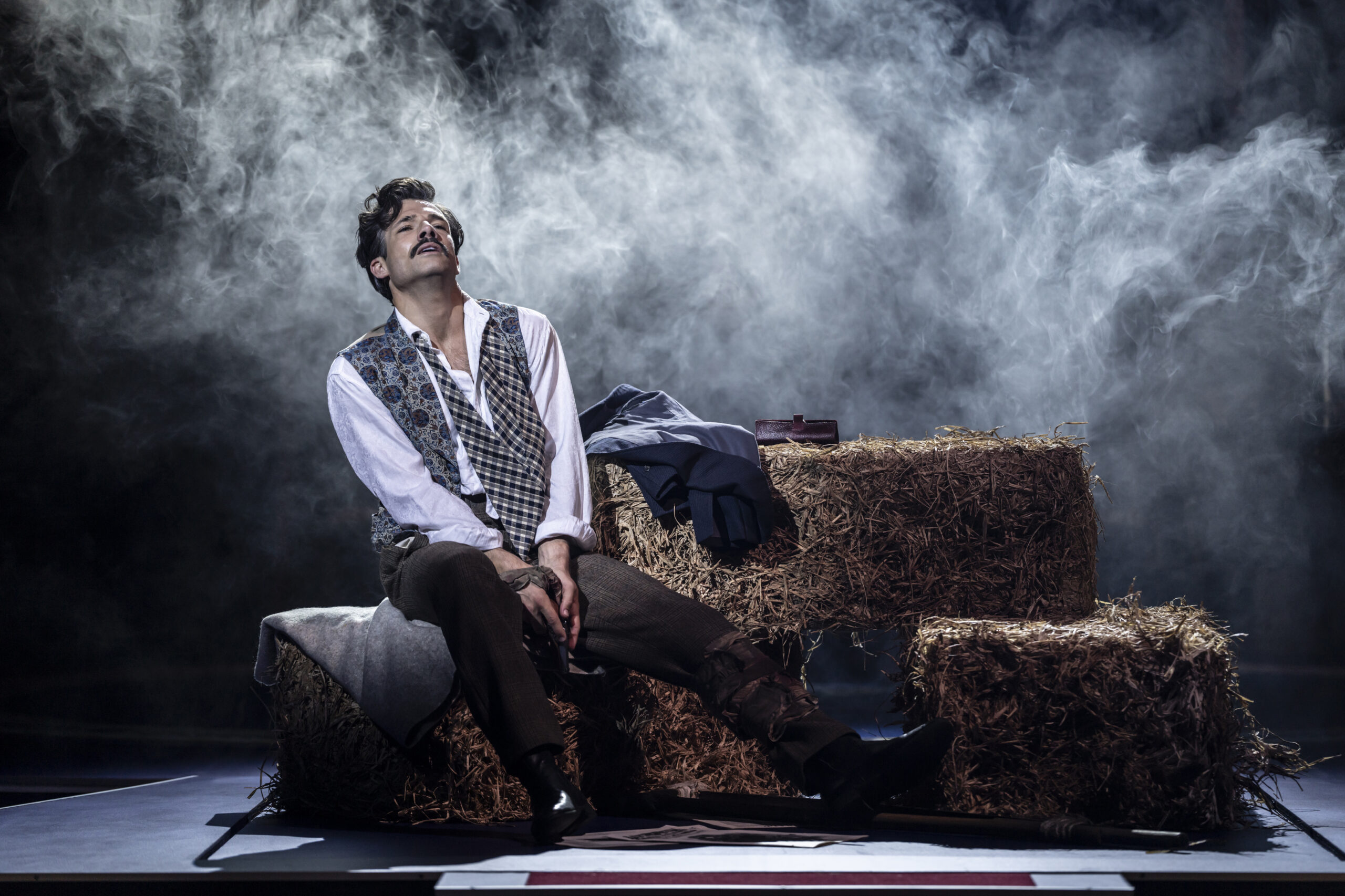
Danny Mac in Assassins.Photo: Johan Persson
Chichester Festival Theatre’s reputation as musicals producer is second to none but its latest revival is, for me, a rare mis-step.
Stephen Sondheim’s Assassins may not rank as one of his greatest works, but its reputation has grown since its premiere in 1990. The bleak musical comedy, with book by John Weidman, shows how the American Dream- that anyone can be a success- has become a nightmare. Its bleak view is that celebrity has become a replacement for real achievement, and that one particular short cut to fame is assassinating a President.
A string of would be assassins follows the precedent set by John Wilkes Booth, who shot Abraham Lincoln, and leads ultimately to the traumatic loss of John Kennedy at the hands of Lee Harvey Oswald. However, we gain little understanding of the individuals beyond their desire for fame for themselves or their cause (if they have one).
There is a lot to enjoy along the journey. There are songs for a start, which are mainly pastiches of various kinds of popular American music. They may not be Sondheim’s finest tunes but the use of popular music styles to talk about murder is horrifying. There’s the jaunty anthem Everybody’s Got The Right, the right to their dream that is, that bookends the show; and Gun Song, a romantic love song to a killing weapon; and Something Just Broke, a hauntingly sad reaction to the death of Kennedy.
The show originally used the device of a fairground shooting gallery in which contestants are given a gun and invited to take a shot at a President for the prize of fame if they succeed. It’s a metaphor that serves well the concept of the randomness of celebrity. As each takes his or her shot, they sink into oblivion, forming a disappointed community until together they encourage Oswald to commit a presidential assassination that shocked the world.
So where did the Chichester production go wrong?
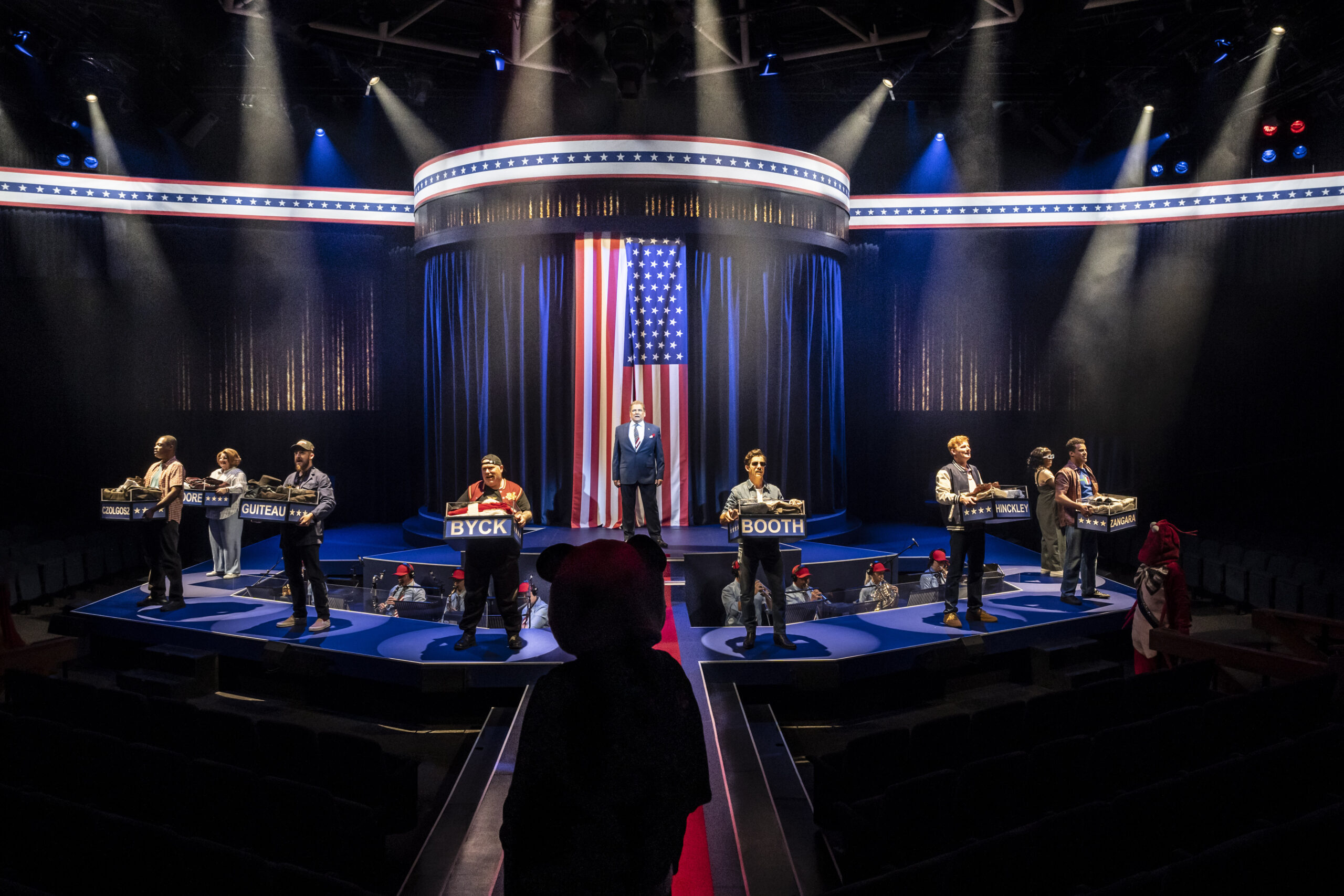
Not with the performers, who are excellent. The characters they play do not have much depth, but are nevertheless given performances both vivid and amusing. Peter Forbes is suitably authoritative and sinister as The Proprietor or host; Danny Mac, with a strong singing voice, is the handsome and manipulative John Wilkes Booth, who you can believe would inspire the others; Harry Hepple is outstanding as the easy-going Charles Guiteau, who killed President Garfield because he believed he should have been made French ambassador; Sam Oladeinde shines as Leon Czolgosz, the shy, angry killer of President McKinley; Nick Holder as Samuel Byck wanders around the auditorium in a soiled Santa Claus outfit ranting about President Nixon (and Leonard Bernstein, for that matter) in a funny but frightening performance; Amy Booth-Steel is Sarah Jane Moore, the would be assassin of President Ford whose inability to shoot straight gains the most laughs; and Samuel Thomas is a chilling Lee Harvey Oswald, a man so feeble in his resolve as to make you squirm in your seat at the arbitrary nature of Kennedy’s death.
Why improve the perfect musical?
For me, the problem with the production was the way director Polly Findlay updated the concept to cover the modern cult of celebrity, starting with a reference to the recent celebrity President, Donald Trump. So, the on-stage band wear red baseball caps, and, as the audience enter, there are actors in animal mascot costumes encouraging Mexican waves.
The host looks very like Mr Trump. But why is the President handing out the guns? Trump may have encouraged the storming of the Capitol building, but this updating means you straightaway lose the distinction between people who achieve their dream of celebrity through assassinating a President and the Presidents themselves, who achieved their fame through a political and fairly democratic process.
Assassins at Chichester Festival Theatre. Photo: Johan Persson
In support of this change of emphasis, Lizzie Clachan’s wonderful set places the Oval Office rather than a fairground in the centre. Giant video screens on either side show the choice of targets, turning the original shooting gallery concept into a game show, suggesting the way TV turns nonentities into household names. Three TV news reporters replace the single Balladeer to provide the commentary. They hold their mics like guns, perhaps indicating the media’s contribution to the cult of celebrity killers. It’s certainly a long way from the fairground. This is all the more surprising since Stephen Sondheim once said he couldn’t think how to improve Assassins.
This is a musical that takes a superficial meander through various would-be Presidential assassins. It’s loosely held together by a concept that they are a corruption of the American Dream. Its fabric is too delicate to accommodate the tacking on of references to modern day celebrity. The Watermill Theatre production of 2019 didn’t stray from the fairground concept until the death of Kennedy, and was, in my opinion, the better for that single focus.
That quibble aside, Assassins is a musical worth reviving and Chichester Festival Theatre has come up with a fabulous looking production with superb performances.
Assassins can be seen at Chichester Festival Theatre until 24 June 2023.
Paul received a complimentary review ticket from the theatre.
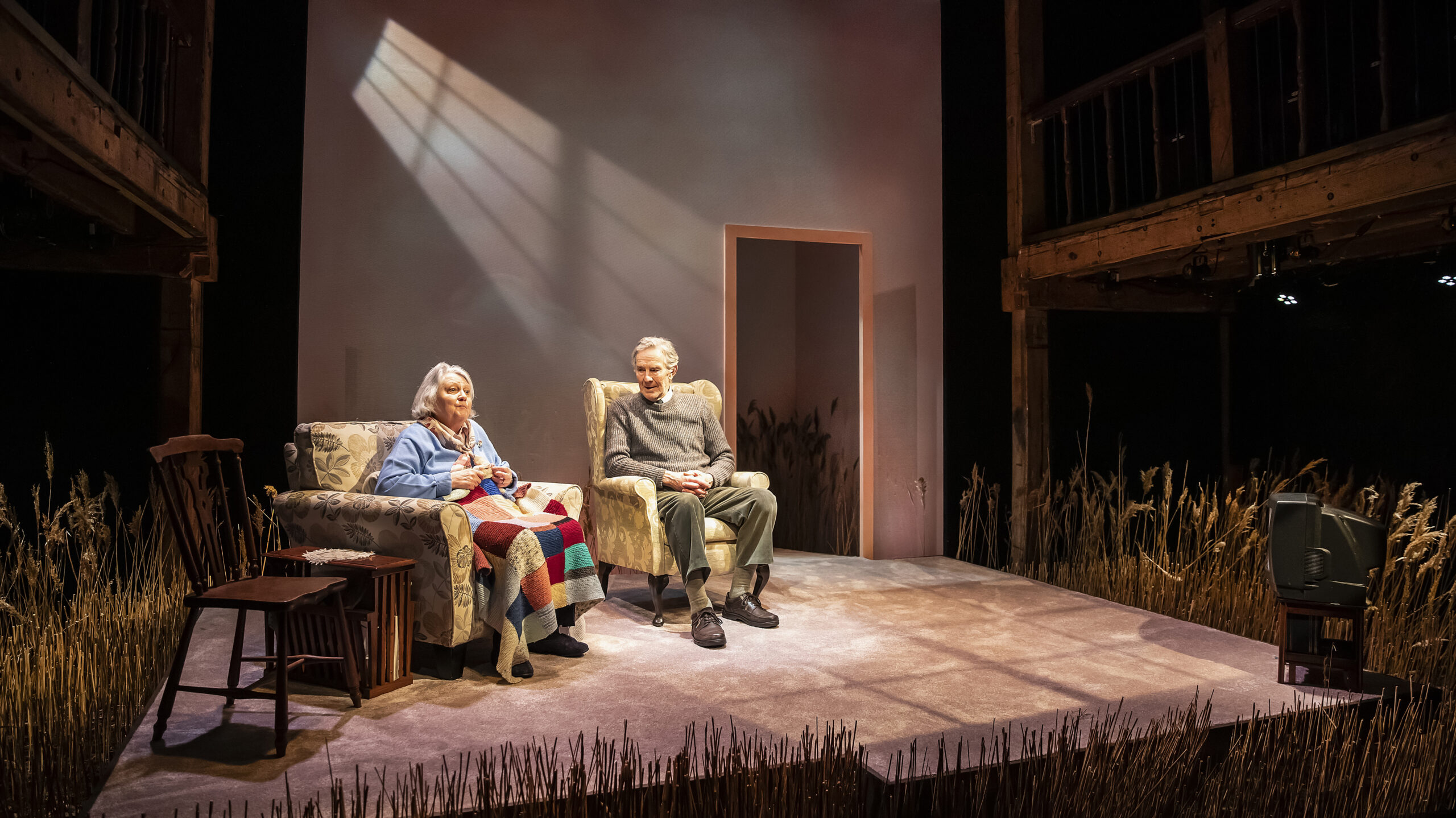
Tessa Bell-Briggs and Christopher Ravenscroft in Visitors. Pamela Raith Photography
The Arts Council has cut its annual funding to The Watermill Theatre in Newbury which will be a tragedy for UK theatre if they are no longer able to produce shows like last year’s Whistle Down The Wind, Bleak Expectations (soon to open in the West End), or their current production of Visitors.
Visitors was written by Barney Norris about ten years ago and has been revived with the author now directing. It is a sad but ultimately uplifting play about the long-lasting relationship of an elderly couple, one of whom is succumbing to dementia, contrasted with the rootlessness of newer generations. It is beautifully written, both in its construction and in its language.
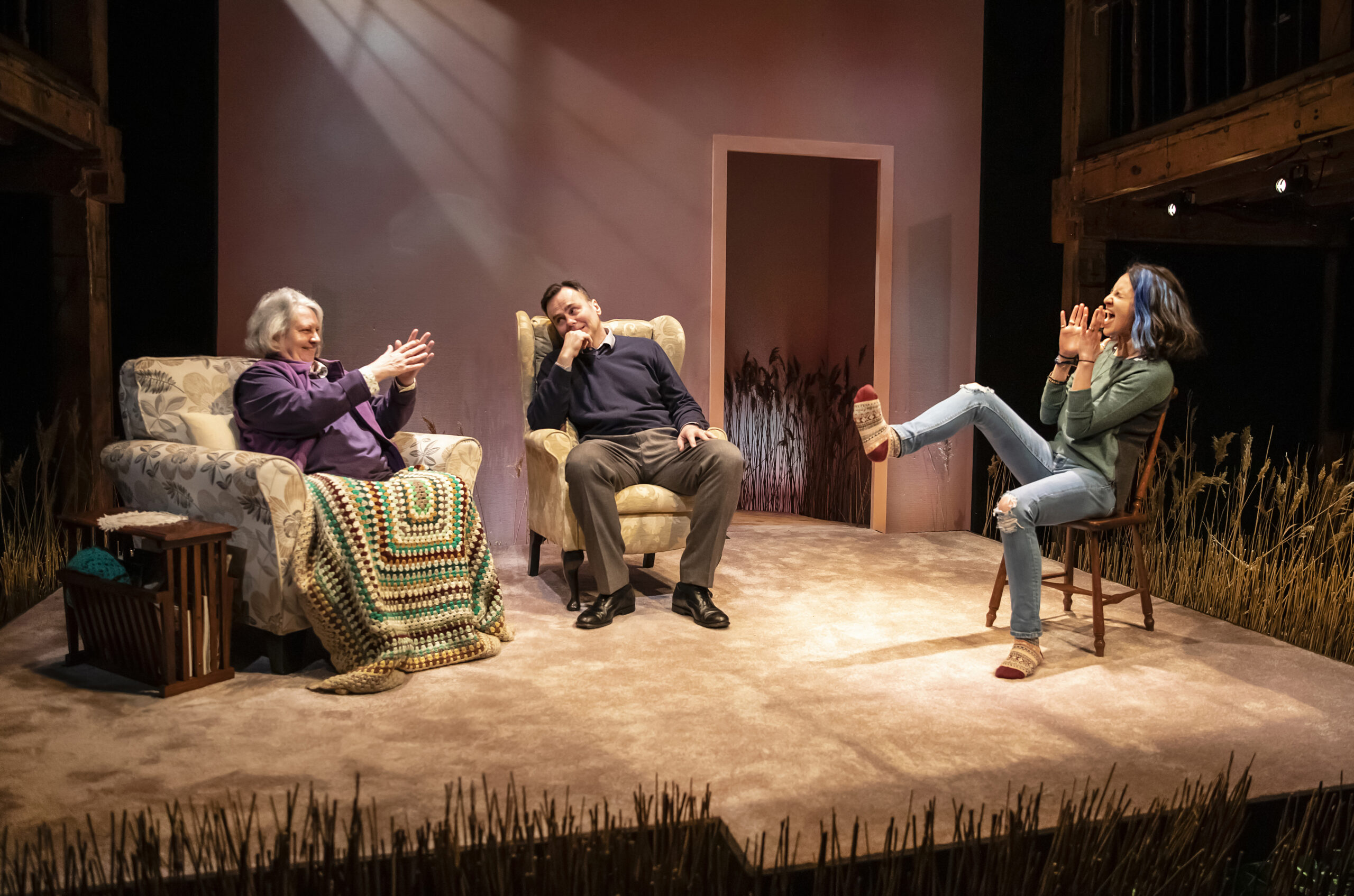
After my recent visit to A Little Life where I was bombarded with blood, violence and video, it was something of a relief to be witnessing a play that relies on actors and words- pure but never simple. The Watermill has a small stage and the designers Good Teeth use it well to create a farmhouse sitting room made for two and, to the sides, a suggestion of the ripe wheat fields that were the business of the farm and now being symbolically harvested.
The occupants are Edie and Arthur, now well into their old age. In many ways, the play is a eulogy to a rural way of life that has been lost in our consumer-driven metropolitan world. They met as very young people and have adapted to each other in the same way as they have lived their lives, with a kind of make-do-and-mend. They may not have had the family or the holidays they would have liked, but they have happy memories, especially of a wedding on a beach. They have come to rely on one another and take strength from their shared experience. They talk, well Edie talks mainly, but now, as Edie puts it, her dementia has created a dam that holds back what she wants to think and say.
Barney Norris is clearly interested in the power of roots and tradition. His adaptation of Lorca’s Blood Wedding at Salisbury Playhouse in 2020 was firmly set in the community of Salisbury Plain. In Visitors, the Wiltshire farm has been in Arthur’s family for three generations, but the continuity that it, and the elderly couple who have lived there all their married life, represents is under threat. Their son Steve isn’t interested in taking over the farm and has pursued a career in insurance. A young carer, Kate, has been drafted in to help them in their old age but she is neither skilled nor certain to stay.
The restless attitude of the newer generations contrasts with the stoicism and acceptance of the older one. Steve is dissatisfied with his life and whose marriage is on the rocks. The millennial Kate is drifting aimlessly. As Edie says to her: ‘You’re unsure because you could be anyone, really, and you don’t know which life to have.’ Edie may wonder what other lives she might have led, but is content with the one she did.
If Steve and Kate are visitors to Edie and Arthur, Edie in her more lucid moments regards us all as visitors to the earth for the duration of our lives, and sees that we must make the most of it, which she fears Steve and Kate will not, given the illusion of choice that today’s rootless world offers.
As the play moves towards the inevitable closing of the door on Edie and Arthur’s life together, we learn more about all four characters.
An authentic portrait of old age
Edie is revealed to be well-read and quite a philosopher, and, in her use of language, a poet. Her brain may now be letting her down in her interactions with others but she sees the patterns of sunlight across the room and over the wheat fields, changing but eternal. Tessa Bell-Briggs as Edie seamlessly segues between warm awareness and drowning in dementia, while always retaining the sense of who she is.
Tessa Bell-Briggs, Patrick Toomey and Nathalie Barclay in Visitors. Pamela Raith Photography
Arthur is quiet and, like many men of that generation, not given to showing his emotions, which makes the moment all the more poignant when, contemplating the prospect of Edie going into a home, he breaks down in tears. Christopher Ravenscroft gives a deep performance as a shy, gentle man whose eyes twinkle with contentment and who is horrified when his lack of social skills causes him to say the wrong thing. It’s a portrayal so authentic, you feel you know him from somewhere.
Patrick Toomey plays the middle-aged, but yet to grow up, son. As we find out more about him, his initial crassness gives way to a sense that, despite his different life choices, he is like his father in his inarticulacy and social blunders.
Nathalie Barclay is Kate, the slightly on edge young woman with blue hair who finds temporary security by caring for his parents.
Despite how I have described the play, Visitors is celebratory rather than depressing. Yes, all life is temporary and usually ends badly, but Edie and Arthur have had a fulfilled life, made so by things that can’t be accounted for by economists and marketers, like tradition, love and acceptance. I thank Barney Norris for putting it on record before people like Edie and Arthur end their visit to our world and their way of life disappears forever.
Visitors is running at The Watermill until 22 April 2023. https://www.watermill.org.uk/
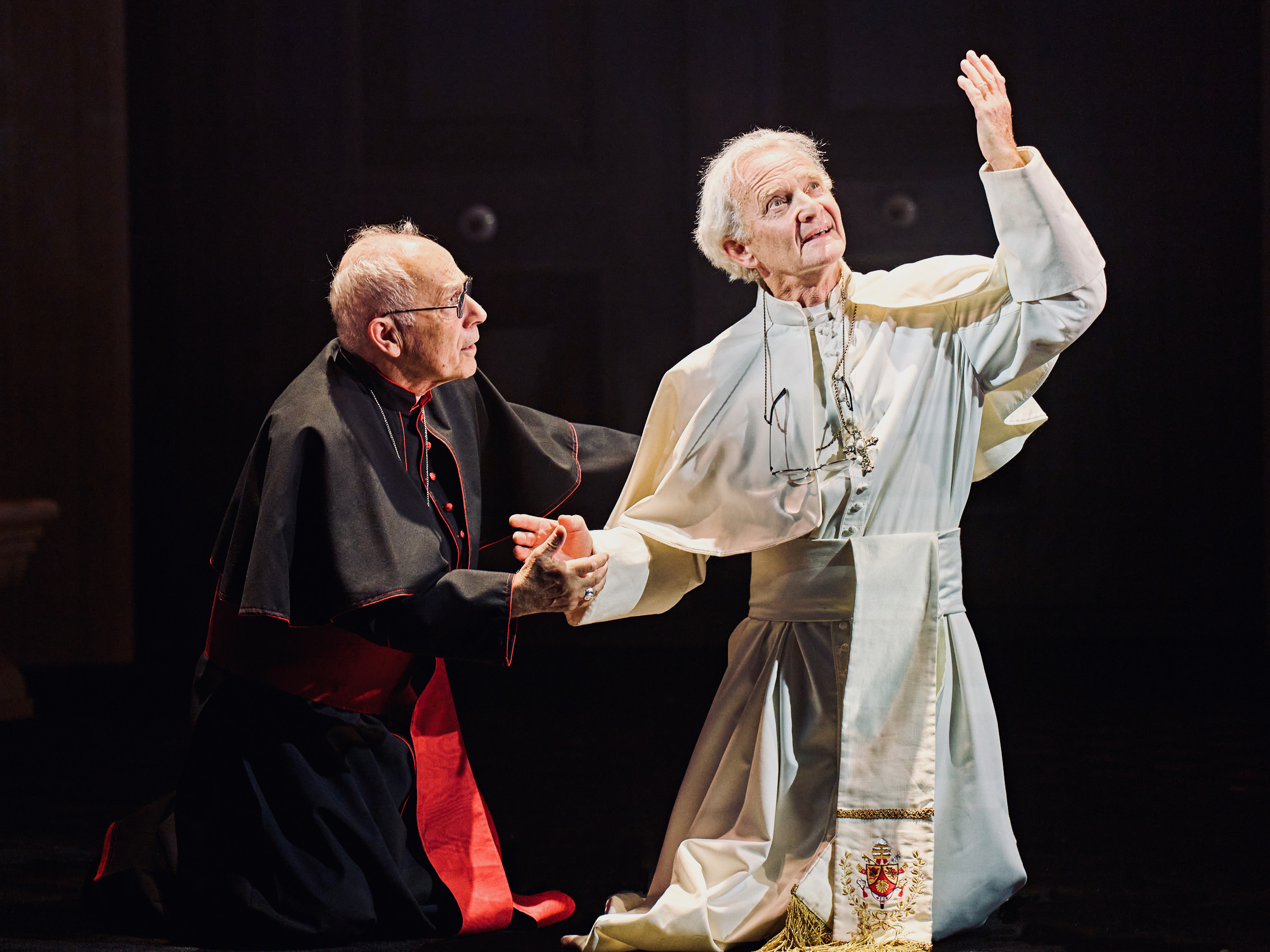
Nicholas Woodeson & Anton Lesser in The Two Popes. Photo: Manuel Harlan
If like me, you have little knowledge of the Roman Catholic Church and even less interest in it, you might think an evening with not one but two popes would be akin to a visit to the Spanish Inquisition. In fact, this combative conversation between Pope Benedict XVI, who abdicated in 2013, and Pope Francis, who replaced him, is both intriguing and amusing.
It helps that one is deeply conservative and the other highly liberal, so there is plenty of room for conflict. It helps even more that these two contrasting kings of Catholicism are played by two sovereigns of the stage, Anton Lesser and Nicholas Woodeson.
Benedict XVI’s abdication was almost unprecedented. (I say ‘almost’, because a pope did abdicate 700 years previously.) Anthony McCarten’s play about this conservative German and his successor, the liberal Argentinian Cardinal Bergoglio, was first produced by Northampton’s Royal & Derngate Theatre in 2019, before Covid intervened. Their Artistic Director James Dacre directs this revived co-production, which I saw at the Rose Theatre in Kingston before its tour to a number of regional theatres.
Mr McCarten, who previously wrote The Theory Of Everything, Darkest Hour and Bohemian Rhapsody as well as the film version of this play, recently penned The Collaboration. It’s another play about two people with contrasting characters and views, the artists Andy Warhol and Jean-Michel Basquiat. It was very enjoyable and is now on its way to Broadway following a run at the Young Vic.
You can see why the idea of a meeting between these two very different popes intrigued Anthony McCarten. The facts of the transfer of power are true but the details of what conversations may have taken place come from his fertile imagination.
The two popes don’t get together straightaway. Initially, we meet each of them separately, beginning with Pope Benedict played by Anton Lesser. We find him in his apartment with a German nun, played by Lynsey Beachamp. They share a conservative nostalgia for their country of birth that manifests itself in the food they eat and the German whodunit series that they watch enthusiastically on TV. He moves stiffly, conveying both old age and, metaphorically, a rigidity of views. Mr Lesser has a clipped but silky way of speaking, that conveys both authority and warmth. The warmth is important because he is publicly perceived as ‘God’s rottweiler’. The reality is, we learn, that he is more shy than cold, more a scholar than a front man. He didn’t want the job of Pope and he still doesn’t.
Without this insight into Benedict’s human side, this would be a very one-sided play between a cold fish and the warm human being that is Cardinal Bergoglio. We meet the latter on a visit to a slum church in his home country of Argentina. Played by Nicholas Woodeson, he has an impish smile and bounces round the stage like a Duracell bunny. He too chats with a nun, played by Leaphia Darko, but this time about his liberal views, which appeal to the poor of the developing world. Ironically, he too wants to retire from his job.
Although they are as different as The Telegraph and The Guardian, Pope Benedict is aware that the Cardinal is his likely successor, and that he can prevent this from happening simply by accepting the Cardinal’s resignation. He decides to meet him and check him out.
The first meeting is very much a clash of views, which frankly I found a little tedious, but I suspect someone more interested in the Catholic Church might find it fascinating.
Anton Lesser & Nicholas Woddeson in The Two Popes. Photo: Manuel Harlan
The second act really takes off, as the two find out that despite their differences, what they have in common may be what is important. We know the outcome so it’s not exactly edge-of-your-seat stuff but the exchanges are funny at times, interesting at others, and sometimes quite moving, as when the two confess their weaknesses and shortcomings. It is a joy to see the interaction between these two great actors.
The set, designed Jonathan Fensom, comprises an artificial proscenium arch onto which a marble surface and the scene locations are projected- in Latin! This reinforces that what is happening is contained within the solidity of a church that has been around for two thousand years. So maybe these two popes, while appearing to be taking the church from one extreme to another, merely represent a natural adjustment that has and will take place again and again over time.
Roy Williams’ portrayal of racist England supporters retains its power
★★★★★
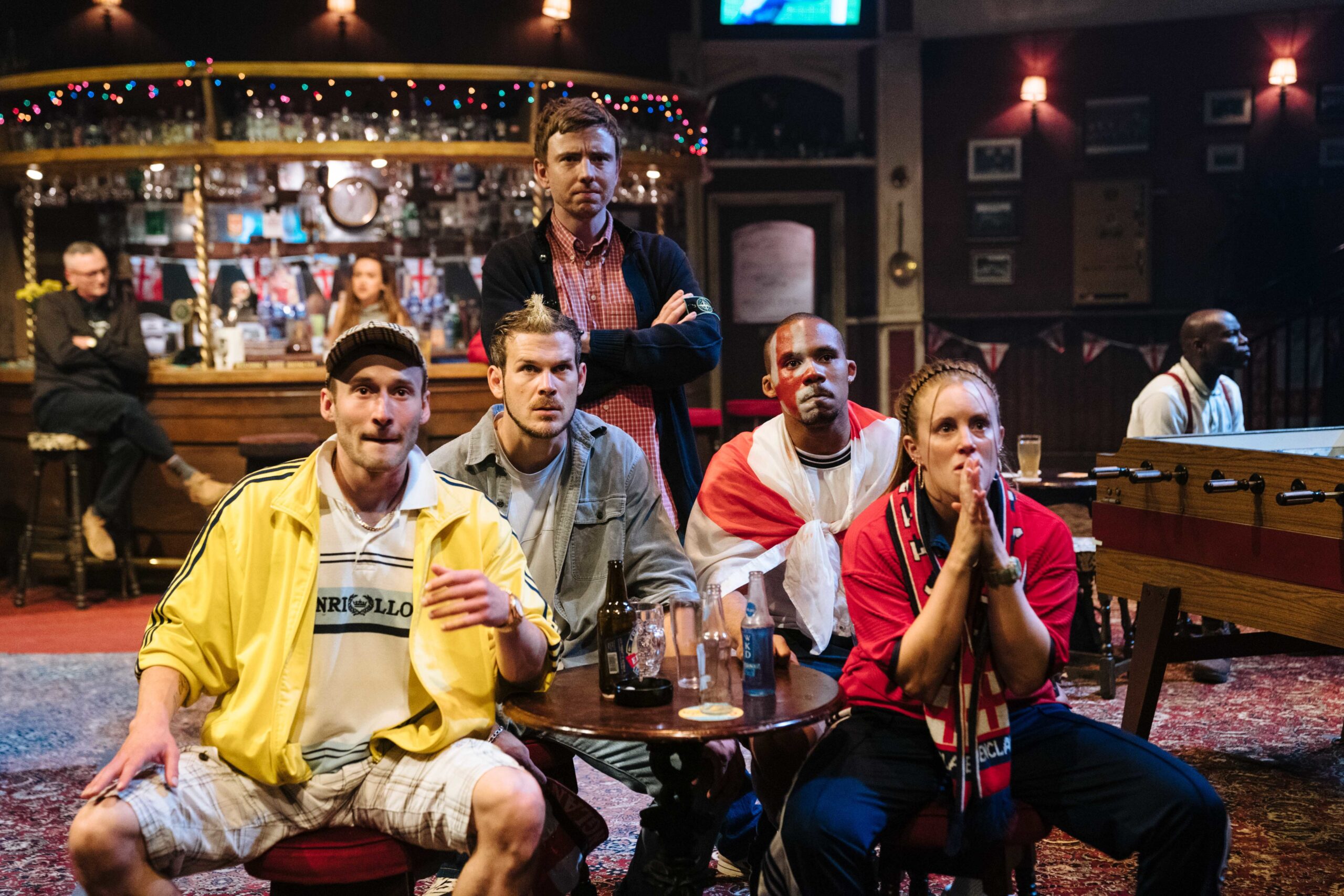
Sing Yer Heart Out For The Lads. Photo: Helen Murray
Seeing Roy Williams’ Sing Yer Heart Out For The Lads is not a comfortable experience but this is an important play in a flawless production from Chichester Festival Theatre. I suspect some people may think this is a play about football. It isn’t. It takes us to the heart of the dark side of English football supporters- the so-called hooligans, the ones who chant racist remarks, the ones who nowadays abuse black players on social media- and those who let it happen.
Racism exists in all corners of society but this play looks at a microcosm, the working class (or mainly working class) tribalism that afflicts the national game. It has its funny moments but for the most part, Sing Yer Heart Out For The Lads is horrifying. I came out shocked to the core by this forensic exposure of racist, nationalist England.
We meet the all too believable characters in the King George pub in London where they have assembled to watch England play Germany in the year 2000. To an extent, they are representative of various kinds of working class people, but Roy Williams imbues them with a complexity that takes them far beyond stereotypes. He writes natural-sounding dialogue that is fitting for each character but that also sparkles and punches. (If you’ve heard his BBC Radio 4 series The Interrogation, you’ll be familiar with his ability to create convincing conversation.) He is truly one of our finest living playwrights.
The play was first performed in 2002. I’d like to think we’ve moved on to a more equal and tolerant society since then, and perhaps we have a little, but there is still an unacceptable amount of racism around, as the Black Lives Matter campaign has shown, and as revealed, for example, by the report into racism at Yorkshire County Cricket Club.
Connected with racism, as the ‘England supporters’ in the play show, we are plagued by a kind of nationalism that goes beyond pride in one’s country to hatred of foreigners and immigrants. As Billy Bragg said recently: ‘Not everyone who voted Brexit is racist, but every racist voted Brexit.’
Fun set houses a serious play
This is a revival of the Chichester production which was first performed in 2019 in the so-called Spiegeltent. Nearly all of that cast has reassembled, and the immersive set, conceived by the original director Nicole Charles, is also reproduced but on a larger scale.
The first thing you see is the set, designed by Joanna Scotcher. It replicates in painstaking detail a traditional London pub, which overflows into and beyond the auditorium. Some of the audience sit around the perimeter of the set like drinkers in the pub. It’s actually a working bar and I had a drink there during the interval, perched on a barstool. Screens that show the match double as CCTV showing us private conversations.
But the fun stops as soon as the play begins. We meet and get to know these characters, some of whom are members of the pub’s football team, all there to watch England playing Germany in a game of football. Some are out-and-out racist; some are covert racists; some hide and are maybe even unaware of their racism, however it comes out at times when emotion takes over.
Michael Hodgson & Richard Riddell in Sing Yer Heart Out For The Lads. Photo: Helen Murray
At one extreme is Lawrie, an angry skinhead played by Richard Riddell as so close to boiling point that his face is lobster red. We can see that all of these people have reasons to resent their lowly position in society and that aggressively supporting their football team may give them some reflected status. But Lawrie is more than that. He is a psychopath looking for anyone to kick. At his side, whispering in his ear, is Alan, played with a cold voice and dispassionate demeanour by Michael Hodgson. He’s an articulate man who proudly justifies his sense of racial superiority. Like the leaders of fascist parties through the ages, he manipulates ignorant people like Lawrie to do his dirty work.
There are two black people in the group: Mark and his younger brother Barry. Mark has been in the army and fought for his country only to find that his country doesn’t seem to regard him as truly British. We discover that his own behaviour as a soldier has been brutal. Mark Springer plays him as superficially calm but with a low-key resentment that rumbles across the pub floor.
Makir Ahmed is Barry, the team’s star player. He knows that his teammates are racist, to a greater or lesser extent, but chooses to ignore that in an attempt to fit in. He even chants about winning World War Two (an event over 40 years before, even in 2000) and describes in mysoginistic detail what he’d like to do sexually to Victoria Beckham. These moments are cringeworthy but show how the disenfranchised fantasise about having power.
Also trying to fit in is Jess, played by Kirsty J Curtis, who goes over the top in what I interpreted as an attempt to be one of the lads, by using the most continuously and aggressively obscene language of any of them.
Steven Dykes is Jimmy, the father of the pub landlady. He represents an older generation which doesn’t like change. The play begins as he’s preparing the pub and singing a Kinks song. A deliberate choice, I suspect, as the Kinks started by playing a version of American rhythm and blues before they went on to epitomise a certain kind of English nostalgia. Ironically Jimmy can’t understand why his grandson Glen (Jem Matthews) is attracted to American rappers, and he bullies the sensitive teenager for being too soft.
Gina is the woman whose name is above the door. In a nuanced performance, Sian Reese-Williams shows her as someone used to getting her way through charm but having no control over her son or her customers. She threatens but never takes action over racist or aggressive behaviour. In this respect, she can be seen as a symbol of the rest of us, the majority in society who are against racism but don’t confront it.
Lawrie’s brother Lee is another example. He is an off-duty police officer, ostensibly against prejudice, but constantly turning a blind eye to Lawrie’s violence and racism. ‘I didn’t hear that’, he quips. His conflicted personality is conveyed brilliantly through haunted eyes, sagging shoulders and sudden violence by Alexander Cobb.
We do see that confronting bad behaviour works when teenager and would-be gangster Bad T (Duramaney Kamara) is not allowed to get away with bullying.
Harold Addo, Simon Armfield, Rob Compton and Jennifer Daley make the remainder of this talented, pitch perfect cast.
Well orchestrated crescendo of violence
As the match progresses, and goes badly for England, the tension grows, and an explosion by Lawrie becomes ever more likely. His racist comments are more and more explicit but, when the violence comes, it’s from an unexpected direction. I won’t say more about that for fear of spoiling the end but I will say that, in a shocking play, the crescendo of action was so well orchestrated that I was shaking at the end.
Massive credit must be given to the original director Nicole Charles, the director of the revival Joanna Bowman, movement director Chris Whittaker and fight director Kate Waters.
I felt I needed a shower after being in the company of this group of ‘England supporters’. If there is a message in this play, it is that racism will flourish unless we all take a stand against it whenever we encounter it on a personal level. And that you can’t fight something unless you understand it. Not only will this play give you greater understanding, it will stay with you.
Sing Yer Heart Out For The Lads performed at Chichester until 13 August 2022. Click here for CFT website
Paul was given a review ticket by the producers.
Click here to watch a video of this review on the One Minute Theatre Reviews YouTube channel
Do dance and a dead mother improve Lloyd Webber’s ‘problem’ musical?
★★★
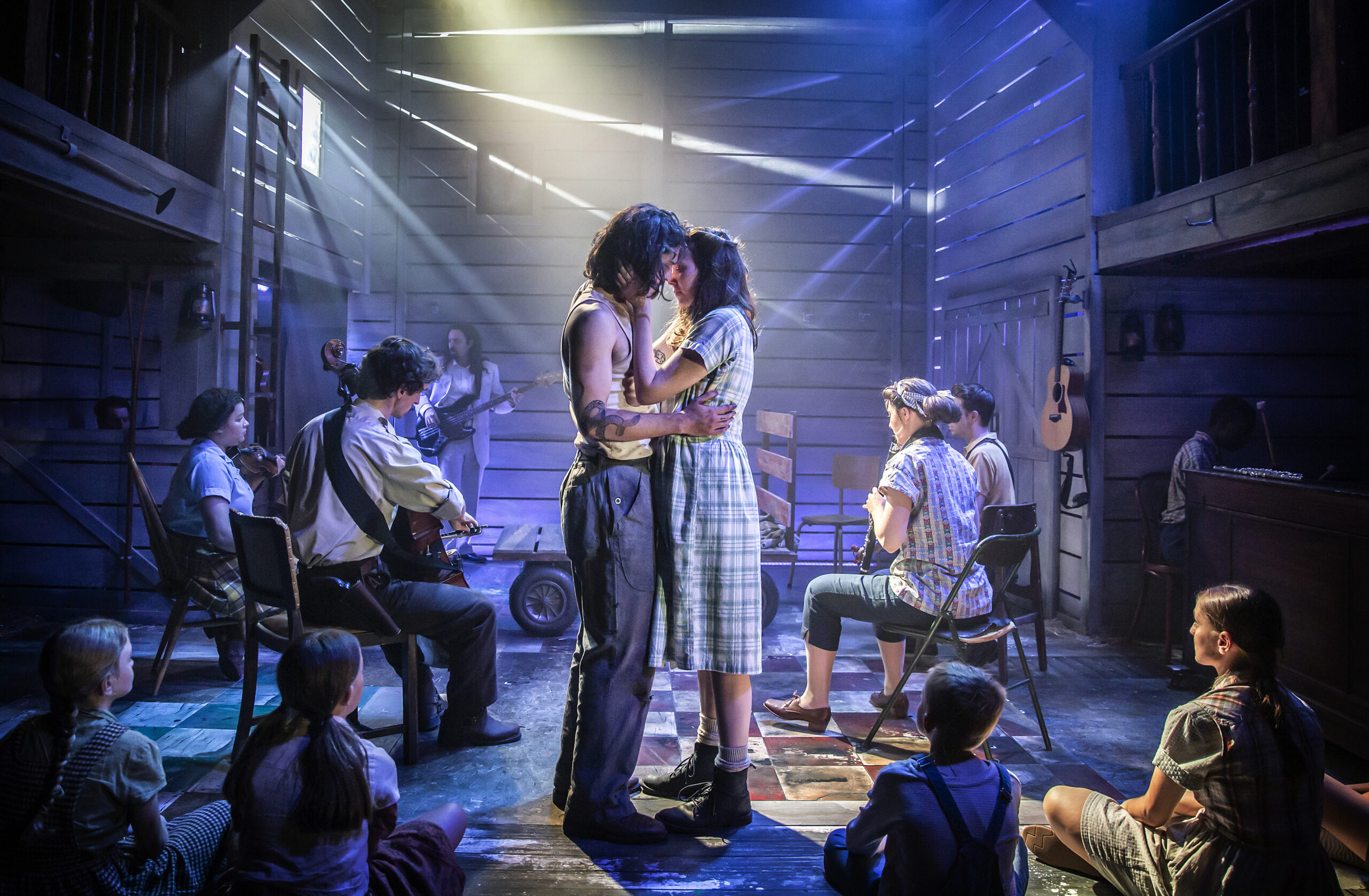
Robert Tripolino & Lydia White in Whistle Down The Wind. Photo: Pamela Raith
This energetic production of Whistle Down The Wind at The Watermill Theatre offers a radical re-interpretation of Andrew Lloyd Webber’s problem musical. I say ‘problem’ because it’s never quite been the hit many of us thought it would be. The musical was launched in the USA back in 1998. I think it has one of Lloyd Webber’s better scores, the country rock style being preferable to his attempts at being a modern day Puccini.
You might think a clash of beliefs would be just right as a story for our times. In this case, the conflict is between children who believe an escaped prisoner (called The Man in the cast list) is Jesus and adults who think he is the devil incarnate. Yet, despite this, and Jim Steinman’s gothic lyrics, Whistle Down The Wind never made it to Broadway.
I suspect the fundamental flaw is that the leader of the children, Swallow, is not a child, as she was in the earlier book and film. Instead, she is portrayed as an adolescent and, really, too old to be so credulous. Maybe the decision was made so that an adult lead could be cast, maybe the authors thought it would be more interesting to include some sexual content. Whatever the reason, the wind never got into the musical’s sails.
Now Tom Jackson Greaves has been given a chance to resurrect this musical about a man mistaken for Jesus, and he has some radical ideas about how to make it work. So does his new interpretation solve the problem? I’m afraid not.
The show begins well. The set, a terrific design by Simon Kenny, is the interior of a building constructed of wide wooden planks, which merges with the auditorium and doubles as the church and the barn. The Watermill Theatre is an intimate space, so, from the start, it is as if we are part of the congregation and of the children’s conspiracy. And we feel the claustrophobia of this closed, deeply religious community, back in 1950s Louisiana. It’s a community that is wary of strangers and over protective of its children.
A spirited interpretation
So far so good, but, as I said, this is a major new interpretation. Tom Jackson Greaves has a long list of credits as a choreographer and, as director, he introduces a considerable amount of dance and stylised movement. This works well to enhance the emotional story and ratchets up the fraught atmosphere, as, for example, when the two sides circle to form impressive physical barriers against each other. And the clever use of dance as a metaphor enables The Man to move among them, right into the centre of scenes in which he would normally be hidden. This is done most notably in the powerful song Wrestle With The Devil in which the townspeople imagine The Man as The Devil.
The biggest change concerns Swallow’s dead mother. In previous productions, she has been an unseen presence, a catalyst in alienating Swallow from her father and therefore giving her greater motivation for wanting a parent figure in her life. In this production, her mother is an actual presence, watching over her shoulder and dancing with her. It brings grief to the forefront and therefore changes the balance of the musical, and indeed the balance of her mind. Grief seems to guide her every thought and deed. It may be an attempt to explain her irrational behaviour but there is, in my view, nothing in the script to justify this interpretation. In the end, it confuses rather than clarifies.
The Mother- beautifully danced by Stephanie Elstob– mostly gets in the way. In the A Kiss Is A Terrible Thing To Waste scene where Amos wants to kiss Swallow and The Man watches and comments, the Mother gets involved too and the tense musical trio becomes a muddled dance quartet. The stage is small enough as it is without squeezing a supernumerary.
Grief or Belief?
Much more than grief, Whistle Down The Wind is a musical about belief, particularly extreme beliefs. Its most well known song, the bland No Matter What, is an anthem for anti-vaxxers and climate change deniers. ‘What you believe is true’ is the essence of a divided society in which the two sides will not listen to a different point of view or accept evidence or be prepared to compromise. The children believe The Man is Jesus, the adults believe he is the Devil.
The musical is also about belief in people. We see that it can help redeem an individual, as in the moving scene between The Man and Swallow in which he sings Nature Of The Beast and realises that his life could have been different if someone had believed in him.
Robert Tripolino is outstanding as The Man. He has the right haunted look but also a powerful voice that moves up into a gorgeous falsetto. Lydia White as Swallow is also excellent. Her singing and acting display all the conflicting emotions of this adolescent girl and she plays the part of a grieving daughter with a convincing edge of anger.
Among the other actors, I liked Chrissie Bhima who gives a strong performance as Candy, cheated in love, and the only character with the willpower to leave.
As usual with The Watermill’s musicals, the hard working actors also play instruments. I noted particularly Emma Jane Morton, a one woman wind section including plaintive playing of a flute and saxophone. And she musters a wonderfully stern look as one of the townspeople. Alfie Richards plays his electric guitars beautifully, and sings well. Lewis Cornay as Amos, the rebel without a cause, could have stepped out of a boy band.
So, it’s a vigorous production but the problem of this musical is still to be solved.
Whistle Down The Wind can be seen at The Watermill Theatre until 10 September 2022. Tickets from watermill.org.uk
Chichester’s Crazy For You is magnificent but how does it compare to Anything Goes?
★★★★★
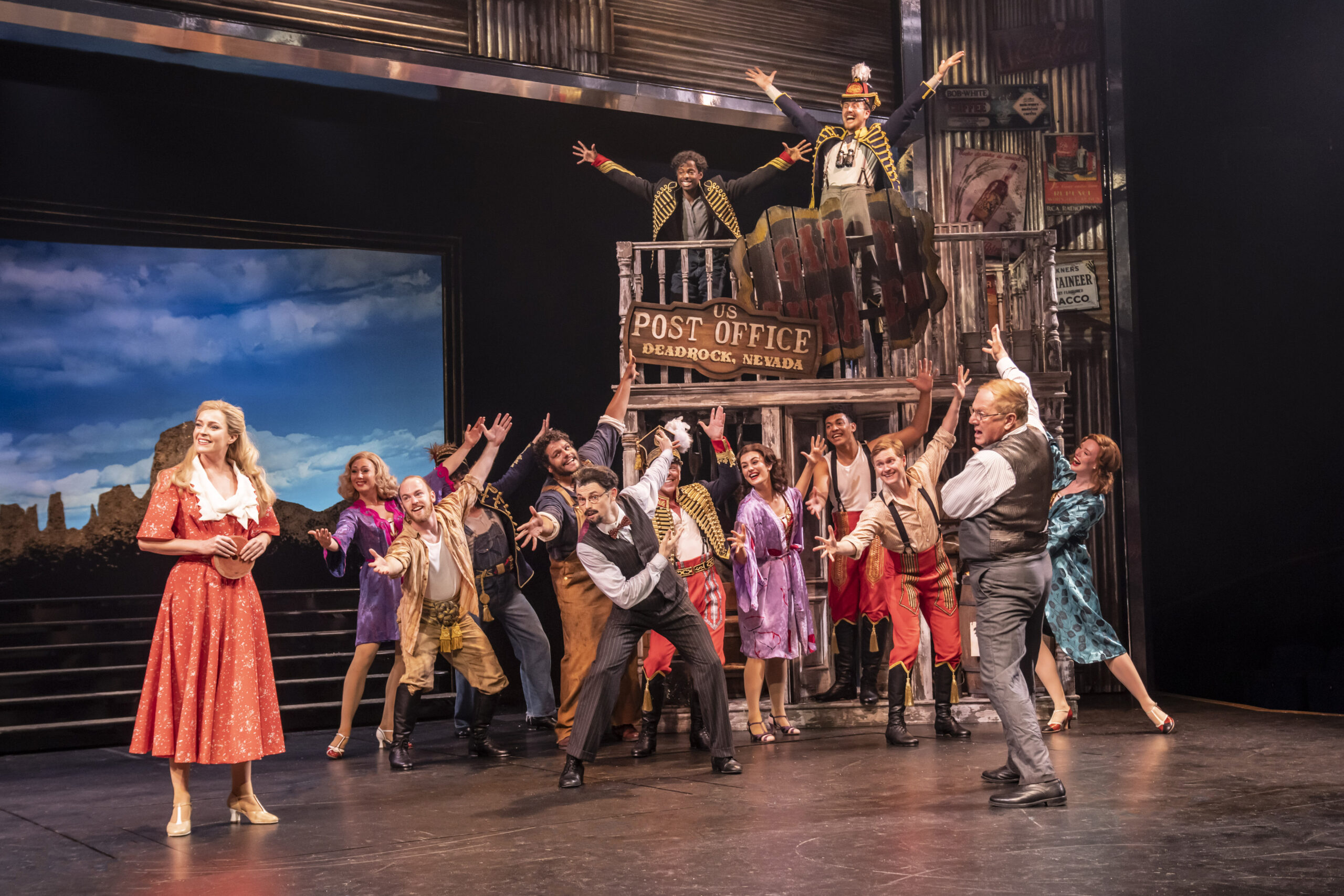
Crazy for You. Photo: Johan Persson
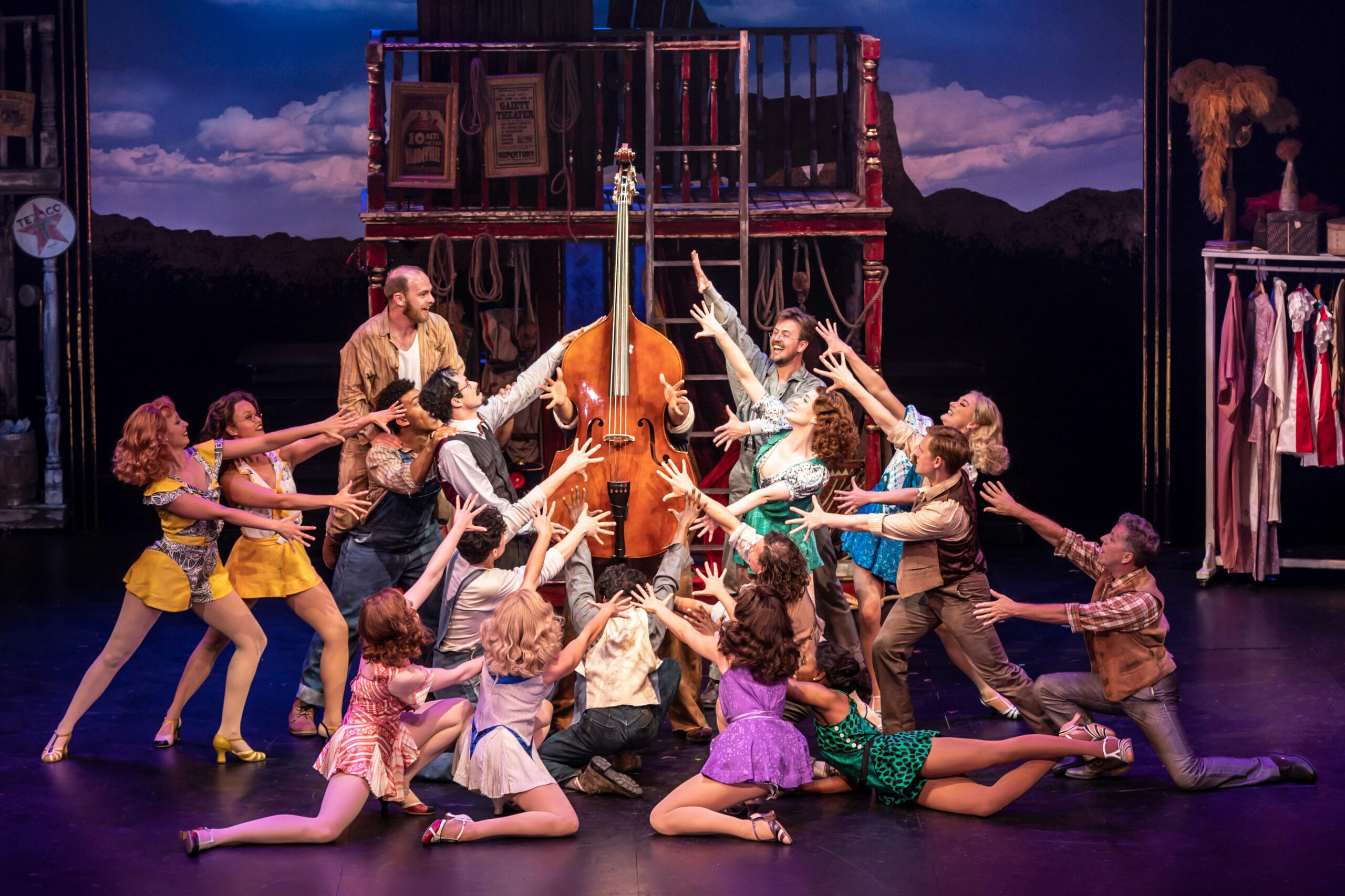
Crazy For You at Chichester Festival Theatre is a faultless production. Just like Anything Goes, another song-and-dance Broadway musical that also originated in the 1930s, it is a joyous, jaw-dropping spectacle with some of the best songs ever written and the best dancing you will ever see.
Charlie Stemp who has already impressed in Half A Sixpence, Mary Poppins and more is here stretched – literally – into twists and leaps and other astounding physical feats. He is not only athletic, his dancing conveys emotion and is beautiful to watch.
It’s interesting to compare and contrast Crazy For You with its rival, both in the 1930s and now, Anything Goes.
Crazy For You was created in 1992 but based on a 1930 musical called Girl Crazy by George and Ira Gershwin. Cole Porter’s Anything Goes followed in its 1934. This was the first golden age of the Broadway musical. The modern musical, in which a serious plot and deep characters drive the show, was still a decade away. It was the time not only of the Gershwins and Cole Porter but of Irving Berlin, Jerome Kern and Rodgers and Hart. The Jazz Age was at its peak. Light-hearted song and dance with a romantic plot were the order of the day.
Both musicals were revived in the late 20th century as Broadway made something of a comeback after the invasion of weighty British musicals. The sheer escapism of both musicals, and their predecessor 42nd Street, was just what audiences were yearning for. While the 1987 return of Anything Goes left it largely intact, with a few song changes and a rewriting of the plot, the 1992 revival of Girl Crazy, now called Crazy For You, involved a root and branch reappraisal. The plot was substantially altered, many of the original songs were excised and loads of additional Gershwin songs introduced. The result was, and is, a triumph for the book writer Ken Ludwig, director the late Mike Okrent and choreographer Susan Stroman.
The Plots are fun
So, what about those plots? Well, they’re both simple fun. Anything Goes features a romance aboard an ocean-going liner, Crazy For You is a romance taking place in a run-down theatre in Nevada. Both involve bumps on the road to love and, of course, disguises. Here, I think, Crazy For You has the edge, for a plot that is a little more coherent and more muscular, by which I mean Anything Goes is almost too frothy.
The Music is divine
So, dare we compare the music? I think this is going to be a matter of taste. I love Cole Porter’s work. It’s such a perfect marriage of music and lyric. The melodies seem effortlessly elegant. The words always clever and witty. But sometimes this elegance and wit makes them seem removed from real life. His greatest love songs are up there with the best in the Great Amercian Songbook- Night And Day and Ev’ry Time We Say Goodbye (‘There’s no love song finer, but how strange the change from major to minor’)- but they’re not included in Anything Goes which nevertheless has some of the cleverest songs ever written (‘Good authors too who once knew better words / Now only use four-letter words / Writing prose / Anything goes’).
In my opinion, George Gershwin was the finest popular composer of his day and Ira Gershwin is a contender for the finest lyricist (although I might award that title to Lorenz Hart). Ira has a way of finding the unexpected rhyme. Take Someone To Watch Over Me: ‘I’d like to add his initial to my monogram
Tell me, where is the shepherd for this lost lamb?’ or the internal rhyme in Embraceable You: ‘I love all the many charms about you
Above all, I want these arms about you’. Fabulous.
It’s very hard but I have to choose the Gershwins for that extra feel of real emotion. And in Crazy For You, you get almost the best of the Gershwins, with Shall We Dance?, I Got Rhythm and possibly my all time favourite love song They Can’t Take That Away from Me all thrown in. The new orchestrations by Doug Besterman display a masterful lightness of touch, by the way.
The productions are extraordinary
Carly Anderson, Charlie Stemp & the company of Crazy For You. Photo: Johan Persson
So what about these two revivals of the revivals? Anything Goes undoubtedly scores on its set, with a huge ship occupying the back of the stage. Chichester’s thrust stage makes large sets impossible, so, although the great Broadway designer Beowulf Boritt’s sparkling curtain representing a Broadway theatre sent a tingle down my spine when the lights went up, and his trucks showing the exteriors of a Nevada hotel and theatre are effective, the Chichester production of Crazy For You never feels as lavish as you might hope for a major musical. Anything Goes also features a cast about twice the size of the pretty big Chichester ensemble.
The Performers are outstanding
The current production of Anything Goes at the Barbican in London, originally starred Sutton Foster and Robert Lindsay, and now features the equally enjoyable Kerry Ellis and Denys Lawson. The co-lead is a comic gangster and not, as might have been the case in previous productions, Miss Ellis’s romantic interest. Crazy For You features Charlie Stemp and Carly Anderson as the two lovers, Boby and Polly.
Both musicals are well led and offer a talented cast in depth. In Crazy for You’s 26 strong cast, it’s difficult to pick out individuals but I must mention Tom Edden as Bela Zangler, the exasperated producer, and who extracted maximum laughs. The mirror scene in which he and Charlie Stemp match each other’s actions is hilarious. Meryl Ansah is Bobby’s desperate, dominant would-be fiancée who gets to sing the delightful Naughty Baby. Gay Soper is Bobby’s imperious mother, and Matthew Craig is Lank, Bobby’s threatening but ultimately comical rival in love.
The performers in both productions sing well. Kerry Ellis is possibly the finest singer of the bunch, but I did love Carly Anderson’s moving versions of Embraceable You and Someone To Watch Over me.
Charlie Stemp in crazy For You. Photo: Johan Persson
As for the dancing, of course they are all great. The chorus line tap dancing in Anything Goes, led by Miss Ellis, is eye-popping. But, when it comes to individual dancing, Charlie Stemp is in a different class to the others. Superlatives fail when it comes to his ability to spin and jump over and over again. He combines this athleticism with beauty and emotional truth. Crazy for You is worth the ticket price just to see him. He’s also nice looking and sings and acts well.
The Directors are geniuses
Both musicals have a combined choreographer and director. The great Kathleen Marshall brings her skills to Anything Goes and the result is very slick and impressive, especially in the chorus work. Susan Stroman, who choreographed the original 1992 Crazy For You, now directs as well. I left feeling I’d like her choreograph every musical I see from now on. There is so much invention in the solo, duet and chorus numbers.
I have one reservation about Crazy For You. Act one ends in an overwhelming routine for I Got Rhythm. It builds and it builds, and just when you think it can’t build any more, it does. A standing ovation halfway through a show is a rare thing. But it also happens in Anything Goes, when the title song is given a similarly exhausting work out. You think, how can they follow this? Well, Anything Goes does with Blow Gabriel Blow, and a big ending. Crazy for You continues to excite with brilliant song and dance but never again hits the height of I Got Rhythm. The end is more of a walk down than a finale. Then again, that soaring final line of ‘Who Could Ask For Anything More’ did bring the audience to its feet once again.
I’d love to see both these shows again but if I was offered tickets for them both right now, which would I choose? At the end of last year, I said Anything Goes with Sutton Foster had given me my best night in a theatre since they reopened. But, right now, I would choose the exuberant Crazy For You at Chichester Festival Theatre starring Charlie Stemp.
Crazy For You ran at Chichester Festival Theatre until 4 September 2022. It will transfer to the Gillian Lynne Theatre in London’s West End from 24 June 2023 to 20 January 2024
Powerful play by Stephen Beresford about tradition versus populism
★★★★
Alex Jennings in The Southbury Child. Photo: Manuel Harlan
What timing! The Prime Minister’s ethics advisor resigns and here’s a new play about sticking to your principles. A child has died, a child with the surname Southbury. The mother wants the church to be festooned with Disney balloons; the vicar says this is inappropriate for a church service. It becomes an unlikely cause célèbre and a test of wills that involves the whole community. What follows is an interesting, funny, emotional play about a battle between tradition and modernity.
The stage is a place for conversation. Creators of TV and cinema feel the need to keep us interested by constantly adding action or changing shots or putting on loud music. In a theatre play, the main currency is talk. So Stephen Beresford‘s The Southbury Child has lots of conversation exploring conflicts within today’s society, and, of course, conflict is the basis of drama. Physical acts whether violent or loving have all the more power for being rare.
The play looks at the importance of the past versus the need for change, principles versus populism, minority religion versus a secular society, a patrician elite versus the masses. Such rich content. The obvious comparisons are with Ibsen’s Enemy of the People and Chekhov‘s.. well, anything by Chekhov. I was also reminded of those drawing room plays of the mid 20th century that explored matters of morality, like T S Eliot’s The Cocktail Party or JB Priestley’s An Inspector Calls. In some ways, the dialogue could come from one of those plays. There’s an old fashioned feel to the way that the characters don’t mumble or pause or talk over one another, but it still sizzles. And there is a 21st century feel about the casual swearing and the popular references to Waitrose and Kerplunk.
The specific argument is over what a funeral is for. The vicar David Highland takes the high ground and says he won’t give the mother what she wants but what she needs. I’ve been to plenty of secular funeral services- I’m sure you have- where we’ve celebrated with lighthearted fun a life that has now ended, but, for those of faith, death is not an end but a beginning, and the funeral service offers hope of resurrection as well as a tried and tested way of dealing with grief. His decision throws up far more moral questions.
The vicar himself is far from moral. He’s had an affair, he drinks too much, he’s been in a drunken car crash. So is he a hypocrite? ‘You’re not exactly the poster boy for unshakable principles,’ says his curate. But do we expect too much of our leaders? After all, they’re only human, and isn’t it supposed to be what they represent that we respect, be it a spiritual post or a political position of power? Should we take their lead, even if we disagree with it, or should leaders follow the people?
There’s a lot of emotional conflict going on then, but the dialogue is full of humour. One character says, ‘These days you’re expected to be happy, like you’re expected to be hydrated’ or something like that. David imay be flawed but he seems kind, and well-meaning (which does make his stand against the balloon seem odd).
Alex Jennings gives a towering performance as the vicar. He employs a slightly higher voice than his usual rich voice which means he almost slips into an almost Alan Bennett impression, which is just right for some deliciously waspish sarcasm, like imagining heaven would have a branch of Waitrose. (He did play Alan Bennett in The Lady In The Van.) It’s not exaggerated so there is still warmth and authority in his impeccable middle-class speech.
Jack Greenlees and Jo Herbert in The SDouthbury child. Photo: Manuel Harlan
His is the only character given real depth. The others seem to be there to expose or test him. Nevertheless, the sketched outlines of these characters are clever enough to suggest that they have depth. His daughters are both following in his footsteps, in a way. Susannah is a teacher, and his verger, but not fitting well in the world. Her awkward but efficient character is played by Jo Herbert.
The other, Naomi, is an adopted black girl (providing an opportunity to criticise patronising white people). She’s become an actor and, by the way, much is made in the play of the way church services are like shows and priests like actors. David says that the annual blessing of the river is ‘the biggest house I play to’. Racheal Ofori gives a strong performance as the rebellious and somewhat wild young woman.
David’s wife Mary buttons up her feelings and finds it hard to cope with today’s touchy-feely world until it all comes spilling out in one tremendous moment. I did enjoy the way Phoebe Nicholls was able to hunch her body into a shy stiffness.
Craig, the new curate and the candidate for succeeding David, is played by Jack Greenlees. He may be holier than thou or indeed holier than David, but he is a gay man who is required by the church to deny his partner in order to pursue his vocation. Yet another cause and conflict thrown into the mix. As well as the interesting conversations- well, you might call them duels- with David, the other characters also have moments when they bounce off each other. There’s a lot going on.
One character David doesn’t spend much time with is the girl’s mother Tina, played by Sarah Twomey. She is the spark that started the fire but, to give more time to her grief would probably have unbalanced this largely sympathetic look at the way the vicar’s life spirals out of control.
The key opposition from the dead child’s family comes not from Tina but from the child’s young uncle Lee, played with a snarl by Josh Finan. I found myself shuddering every time he was on stage. Lee’s a nasty piece of work without any obvious redeeming feature, yet David as a Christian will not reject him. Lee returns again and again to challenge and needle the vicar.
The play takes place entirely in one room, maybe a drawing room. I don’t know much about the Church of England, however I do know that vicars are not well paid but they are often given a big house to live in. So there’s an appropriately shabby middle-class feel about Mark Thompson‘s set. There’s always a potential problem at Chichester, or any theatre using a thrust stage with an audience on three sides, iun that you can’t have much in the way of scenery. So, apart from a window and a few other pieces at the back, Mark Thompson‘s inspired main features are an image of the church at the back that towers over proceedings and a long wooden table that comes out towards the audience. Around it are 14 odd chairs, symbolic of the broad church perhaps.
Not that people sit down very often. This is a production showing the firm hand of director Nicholas Hytner in which people stand a lot, because that’s more aggressive than sitting, and stride around creating distance or nearness, as the conversation ebbs and flows.
You may find it hard to believe such a conflict could arise from something so trivial seeming, even though the play is apparently inspired by a real incident, but the beginning is nowhere near as contrived as the ending. Be that as it may, the grief at the loss of a child finally comes to the centre stage. And the final scene confirms that this is a play about loss of many kinds, both personal for many of the characters and for society, in terms of our traditions and heritage.
The Southbury Child performed at Chichester Festival Theatre until 25 June 2022 (tickets cft.org.uk) then at the Bridge Theatre from 1 July – 27 August London SE1 (bridgetheatre.co.uk)
To provide the best experiences, we use technologies like cookies to store and/or access device information. Consenting to these technologies will allow us to process data such as browsing behaviour or unique IDs on this site. Not consenting or withdrawing consent, may adversely affect certain features and functions.
Functional
Always active
The technical storage or access is strictly necessary for the legitimate purpose of enabling the use of a specific service explicitly requested by the subscriber or user, or for the sole purpose of carrying out the transmission of a communication over an electronic communications network.
Preferences
The technical storage or access is necessary for the legitimate purpose of storing preferences that are not requested by the subscriber or user.
Statistics
The technical storage or access that is used exclusively for statistical purposes.The technical storage or access that is used exclusively for anonymous statistical purposes. Without a subpoena, voluntary compliance on the part of your Internet Service Provider, or additional records from a third party, information stored or retrieved for this purpose alone cannot usually be used to identify you.
Marketing
The technical storage or access is required to create user profiles to send advertising, or to track the user on a website or across several websites for similar marketing purposes.