Theatre reviews roundup: Troilus and Cressida

Problem play is still a problem

Shakespeare’s Globe
Lucy McCormick in Troilus And Cressida at The Globe

A rare production of Shakespeare’s romantic story set within a satirical look at the Trojan War. Many of the critics’ reminded us this is a ‘problem play’, incoherent in tone, and neither comedy nor tragedy. Some thought Owen Horsley’s comic interpretation skewing toxic masculinity was inspired, others found it inappropriate. The reviews were a good example of the way critics can help our understanding of a play. Many displayed their knowledge of this obscure play and provided analyses of why it is a ‘problem’ and the extent to which this interpretation did or did not succeed in solving it.

[Links to full reviews are included but a number are behind paywalls and therefore may not be accessible]

4 stars ★★★★

The Standard’s Nick Curtis declared: ‘Owen Horsley’s bracingly ribald, mordant staging is a study of toxic masculinity in which war is treated as a game, or a reality show, that suddenly stops being funny.’ He pointed out: ‘Horsley’s greatest stroke is to gender-swap (some of the roles). Samantha Spiro – a mistress of grotesque comedy – exudes bawdy relish as “auntie” Pandarus, tottering on her heels and twittering filth. Meanwhile, the dazzling Lucy McCormick folds the role of prologue into that of her goth-girl Thersites…who generates an easy, sardonic rapport with the audience.’
The evening is, he said, ‘a vivid, kaleidoscopic exploration of human foibles’.

Rachel Halliburton for The Times came down in favour of the interpretation: ‘for my money this bawdy, ballsy interpretation…arrestingly captures the play’s spirit.’ She explained: ‘Horsley captures the cynical disillusion in a script that punctures heroic myth to convey a nihilistic wasteland of war.’ Against this backdrop, the two lovers pursue their romance: ‘Kasper Hilton-Hille presents a nuanced, sensitive Troilus, alert to his world’s pain and absurdity. There’s real warmth in his connection with Charlotte O’Leary’s cheerful no-nonsense Cressida, a sense that amid the turbulence here is something worth living for.’

Debbie Gilpin at BroadwayWorld liked the comedic treatment but didn’t think it was a total success. She was swayed by the actors: ‘An almost omnipresent Lucy McCormick is the key to the tone and entertainment value of the production. As Thersites, she is part of the Greek camp but also acts as a de facto Chorus’.

Time Out’s Andrzej Lukowski warned: ‘May the gods help you if this is your first Shakespeare play, or you’re unfamiliar with the basic plot outline of the Iliad. But…Horsley’s production is rewarding, an engaging mix of jet-black cynicism and unfettered silliness.’

3 stars ★★★

Matt Wolf for LondonTheatre also wondered: ‘Quite what audiences new to the play will take away from this production by Owen Horsley, here making his Globe debut, is anyone’s guess. You have to admire both the vigour and rigour of an exceptionally committed cast…Horsley’s judicious cuts to the text keep proceedings from resembling a fusty history lesson, but this play’s singular dark, depraved centre never quite lands.’

The Guardian’s Arifa Akbar pointed out it was a difficult play to mount but seemed happy with the director’s response to it: ‘this is satire – if not war-farce – in which the “heroes” of classical antiquity are roundly ridiculous.’ She concluded: ‘It is a heroic attempt at comedy all round.’

Helen O’Mahony for The Stage found the production ‘straddles light and dark, leaning into the play’s lack of clear emotional direction or resolution, to varying effect.’ While finding elements enjoyable, she wasn’t happy overall: ‘it’s a production that never wants you to get too invested in the story’s pretence, and this can be jarring.’

Julia Rank at WhatsOnStage damned with faint praise: ‘it’s probably about as accessible as this deliberately un-crowdpleasing play ever will be.’

2 stars ★★

Fiona Mountford, writing for the Telegraph, made clear she loves the play and didn’t take kindly to the interpretation: ‘the magnificence of the work is lost in an ill-advised attempt to jolly things along by introducing moments of comedy.’

Critics’ average rating 3.3★

You can see Troilus And Cressida at Shakespeare’s Globe, London until 26 October 2025. Buy tickets directly from the theatre 

If you’ve seen Troilus And Cressida at The Globe , please leave your rating and review below 

Theatre reviews roundup: Susan Sarandon in Mary Page Marlowe

Star performances in a fragmented play

Old Vic Theatre
Susan Sarandon in Mary Page Marlowe. Photo: Manuel Harlan

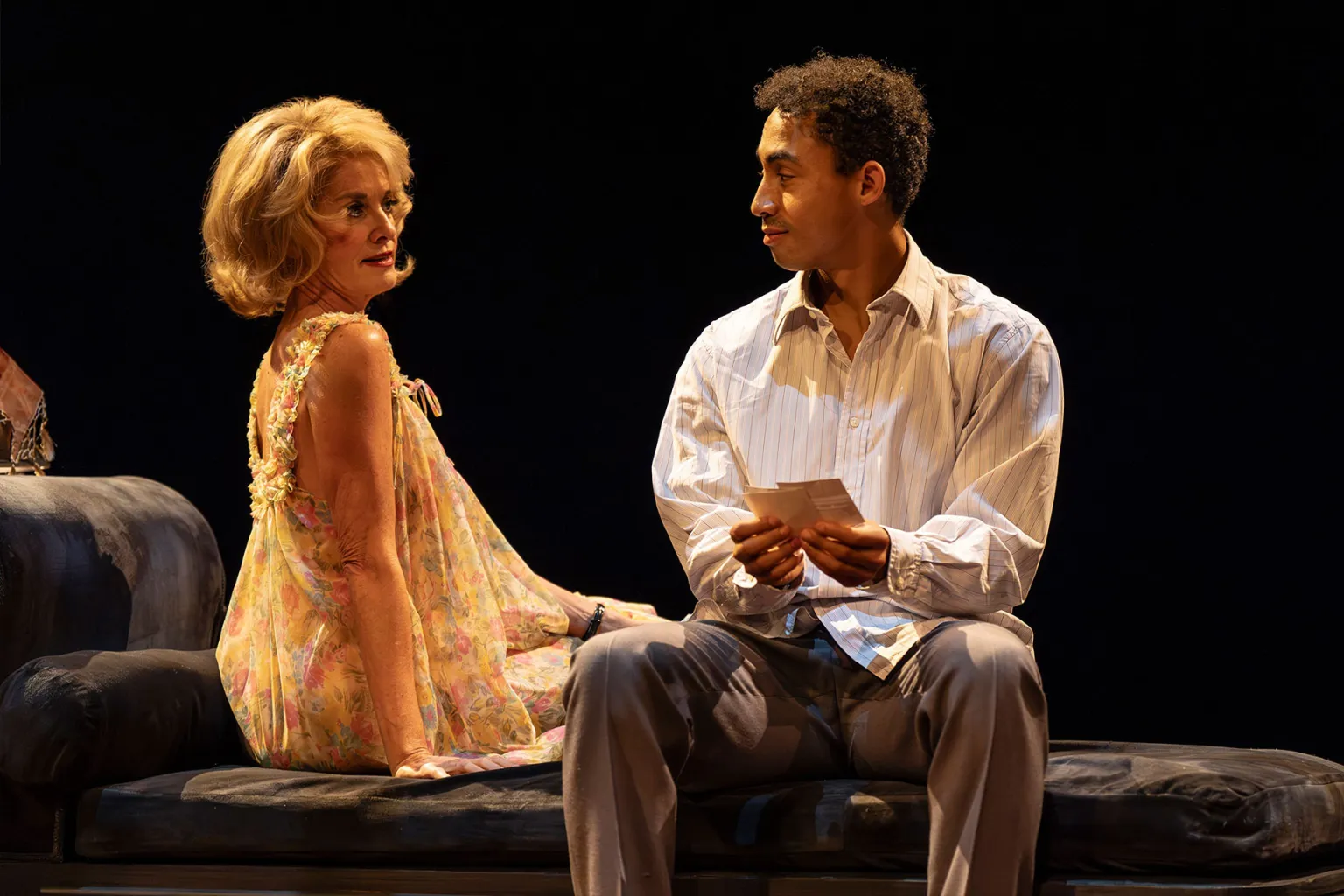
In Tracy Letts’ play, eleven scenes go back and forth through a woman’s life.  The theme of the play, as explained by Sarah Crompton at WhatsOnStage, is: ‘What is the significance of an ordinary life? Are there turning points where we could engineer change or does existence just unfold with an inevitability that we barely notice?’ Questions that were not really answered, said the critics. Even if the play itself left them unsatisfied, reviewers liked Matthew Warchus‘ in-the-round production, and loved the cast, including the screen luminaries Susan Sarandon and Andrea Riseborough.

[Links to full reviews are included but a number are behind paywalls and therefore may not be accessible]

4 stars ⭑⭑⭑⭑

Aliya Al-Hassan at LondonTheatre liked what she saw: ‘Matthew Warchus has reconfigured the space to make an intimate in-the-round experience for the audience. We may see Mary from every angle, but never know the complete person; it is a clever conceit. Warchus handles the fractured timeline well, creating fluidity and really allowing the quieter scenes to breathe. It is the excellent acting that vividly brings every Mary to life, as Letts asks (but never answers) the eternal question of what is fated to happen in a life and what we can control.’

WhatsOnStage‘s Sarah Crompton found: ‘The effect is like watching fragments of a shattered vase, glued back together. The pieces don’t quite fit and the cracks start to show, but the truthfulness of the writing – and of the performances – is the way that they suggest that behaviour is not always tangential. Bad choices are made, and generational trauma is handed down. But also, things happen. Dreams die.’

The Stage’s Sam Marlowe was impressed: ‘Matthew Warchus’ production, performed by an impeccable cast led by Hollywood royalty Susan Sarandon and Andrea Riseborough, could hardly be more finely calibrated.’ She fixed on what she thought might be ‘the nub of Letts’ play: the impossibility of truly knowing another human being, the many selves we all inhabit and present to the world. It’s an elusive piece of writing that changes shape as you stare at it, wriggles away if you try to pin it down. The impact is muted, but the overall effect is disquieting. The execution is faultless.’

The i’s Fiona Mountford noted: ‘Playwright Tracy Letts offers us tantalising “fragments of a life” and leaves it to us to piece them together and fill in the gaps.’ She commented on the set: ‘The Old Vic auditorium has been strikingly reconfigured into an in-the-round setting, which adds to the thrilling sense that we are being allowed to eavesdrop on something fiercely personal, the inner workings of another person’s world.’ She praised ‘Matthew Warchus’s sensitive direction (that) points up the question that Letts floats throughout: how much agency do we really have in our own lives? Is it more or less than we think?’

‘The play is not as profound as it thinks it is’ opined Nick Curtis in The Standard ‘…But it is a subtle and elegantly constructed piece of work.’ Like many of the other critics, it was the acting opportunities that interested him most: ‘The fireworks go to a shifty, slippery Rosy McEwen and a wracked and haunted Andrea Riseborough who play the title character from her later 20s to the age of 50, as a wife, mother, adulteress, divorcee and alcoholic.’ And ‘Sarandon reappears at the end as a 59-year-old Mary Page, careworn but upbeat and absolutely radiant. Pretty amazing.’

3 stars ⭑⭑⭑

The Guardian‘s Arifa Akbar acknowledged: ‘It is beautifully directed by Matthew Warchus, who elicits magnificent performances from the ensemble. Sarandon performs with ease, assurance and total ownership of her character; Riseborough, in scraped back ponytail, is astonishing as a woman whose life has hurtled off-course. Rosy McEwen, as an unfaithful wife who feels like an actor in her own life, is a scintillating, dangerous force on stage.’ However, ‘The play raises (…) questions and then lets them fall away, unanswered.’

Time Out’s Andrjez Lukowski was delighted to see Andrea Riseborough back on stage: ‘chewing the scenery, yes, but with nuance and feeling and a devastating arsenal of facial expressions: she elevates the blank stare into art, and her delicate face acting is probably the best justification for the in-the-round set up.’

The Times’ Dominic Maxwell said Susan Sarandon is ‘so casually excellent in her three shortish scenes that you want the Old Vic to impound her passport and keep her here for an entire season.’ He loved the individual scenes but: ‘You sit waiting in vain for them to add up to something greater than the sum of their parts…Letts wants to let us join the dots for ourselves, but the end result can feel more like a writing exercise than a fully satisfying play.’

For BroadwayWorld, Laura Jones concluded it was: ‘a thoughtful and often moving exploration of a life lived. The performances from each Mary and the excellent supporting cast give the piece its heartbeat, even when the episodic structure keeps the audience slightly at bay. It is a production worth seeing for its remarkable acting and for the way it asks us to piece together, from fragments, the mysteries of an ordinary, complicated life.’

Alice Saville of The Independent noted: ‘To be a woman is to play a part, we’re told. And if all these bodies somehow fail to fit together into a single living, breathing portrait of an actual person, each still brings some brilliance of its own to this fractured story.’

Referring to The Years, Clare Allfree for the Telegraph observed: ‘it’s hard to shake the nagging feeling that we have seen this theatrical conceptualising of a woman struggling to fit inside the various pieces of her life before.’ Nevertheless, she was captured by Susan Sarandon: ‘her deceptively artless performance at once sexy, tricky, playful, effortlessly lived in.’ Even so, ‘she is, whisper it, outclassed here by Andrea Riseborough (who..) delivers a masterclass in pathetic, bravado-charged despair.’

Critics’ average rating 3.4⭑

Value rating 26 (Value rating is the Average Critic Rating divided by the typical ticket price.)

Mary Page Marlowe can be seen at The Old Vic theatre until 1 November 2025. Click here to buy tickets direct from the theatre.

If you’ve seen Mary Page Marlowe at The Old Vic Theatre, please leave your rating and review below

Theatre review: The Importance of Being Earnest – Stephen Fry & Olly Alexander

The importance of being fun

Noel Coward Theatre


⭑⭑⭑⭑

Stephen Fry in The Importance of Being Earnest. Photo: Marc Brenner

I gave a lukewarm review to this production of The Importance of Being Earnest when it premiered at the National Theatre. Part of the reason was, I love this play and, even though I still enjoyed the witty dialogue and the ingenious story of identity and hidden truth, I felt the queer interpretation was laid on a bit thick. I accepted that the two main characters’ double lives could be taken as a metaphor for gay men’s secrecy in past times, but, to my mind, Max Webster‘s decision to foreground the subtext undermined the power of Wilde’s actual text. I now think my prejudice blinded me to the quality of what was in front if me

So I wanted to give it a second chance, and go in more prepared for this approach. And I wanted to compare Olly Alexander‘s Algernon and Stephen Fry’s Lady Bracknell with Ncuti Gatwa and Sharon D Clarke. 
It’s not only the twostars, there’s a complete new cast. Each actor captured the distinctive cadence of Oscar Wilde’s prose, delivering lines with clarity. Putting my gratitude for that aside, I fully expected Alexander and Fry to lack the power of Gatwa‘s dazzle and Clarke’s swagger. And in a way I was right, neither has the charisma of the National’s original casting. However, their more restrained interpretations of Algie and Lady Bracknell create a more balanced production.
They make the parts their own, as judges on talent shows are apt to say. Olly Alexander delivers an exemplary performance, imbuing Algie with endearing boyish charm, while Stephen Fry relied on a quiet, clipped delivery (and to be fair his height) to exert his authority. This is not the pantomime dame I feared but rather a totally believable version of the snobbish, domineering representative of the aristocracy. Where the previous larger-then-life characterisations almost suffocated Wilde’s delicate plot construction, toning them down seems to allow it to breathe a little more.
The rest of the West End cast are as good if not better than their National Theatre counterparts. Outstanding are the two young women, Gwendolen and Cecily, played by Kitty Hawthorne and Jessica Whitehurst respectively, and the object of Jack and Algie’s affections. I still found their overt expressions of sexual frustration somewhat incongruous with the period context, but I went with it, and actually the tongue waggling and the attention they pay to their fiery loins is pretty funny. Come to think of it, their obsession with their husband being called Ernest is just as silly.
Another highlight is Hayley Carmichael playing the manservants Lane and Merriman. It’s hard not to laugh at Merriman’s every entrance, when this diminutive figure dressed in oversized wig and tailcoat moves with mechanical stiffness and an air of complete bewilderment.
Shobna Gulati and Hugh Dennis extract plenty of humour from the relationship between Miss Prism and Canon Chasuble. Their suppressed passions form a delightful counterpoint to the younger lovers’ unbridled emotions. Nathan Stewart-Jarrett is a fine, likeable Jack Worthing.
Olly Alexander and Hayley Carmichael in The Importance of Being Earnest. Photo: Marc Brenner

Far from going further in laying on thick this gay interpretation, the transferred production seems to have reined it in ever so slightly. I admit I was expecting, and therefore was less concerned about the opening where Algie is in a cocktail dress at a cross dressing party, or the men and women being sexually excited by their own as much as the opposite sex, or by the references to modern pop songs.

It may have avoided becoming the pantomime I feared but the production is still deliciously over the top. Rae Smith’s colourful costumes and lavish sets, complete with masses of blooming bushes and two naked male statues, create an exuberant atmosphere. And the curtain call does provide a panto-style walkdown, with the cast dressed in giant petals.
I would still prefer a version of The Importance of Being Earnest that allows the lines to speak for themselves, but I am very happy to concede that Wilde’s timeless comedy is big enough to take a joke, and this is a particularly good joke.
The Importance of Being Earnest can be seen at the Noel Coward Theatre until 10 January 2026. Buy tickets direct from the theatre

Theatre reviews roundup: Hamlet

Not to be

Lyttelton, National Theatre
Hiran Abeysekera in Hamlet. Photo: Sam Taylor

After Bacchae provided a faltering start to Indhu Rubasingham’s launch season, she might have hoped her deputy Artistic Director Robert Hastie would get it back on track by directing a memorable modern dress Hamlet. Sadly, it was not to be. The Olivier Award-winning Hiran Abeysekera was thought by most reviewers to be fast and funny at the expense of the play’s depth. One bright point was the praise heaped on Francesca Mills’ Ophelia.

[Links to full reviews are included but a number are behind paywalls and therefore may not be accessible]

5 stars ⭑⭑⭑⭑⭑

For Debbie Gilpin at BroadwayWorld, ‘This is exactly the kind of Hamlet you would hope to see at The National Theatre. Challenging, entertaining, and compelling, it takes one of the most well-known plays in the English language and shows us something new.’ The main reason she was an outlier in her five star review is that she had a different opinion to other critics on Hiran Abeysekera’s hyperactive approach to the part: ‘We recognise now that grief can manifest itself in many different ways, so our titular prince doesn’t have to mope around and be visibly melancholic throughout the play; he can outwardly appear to be coping, whilst his interior monologue says all sorts of things. As an audience we are given an insight into this via his soliloquies, which almost spill out of him at times – Hiran Abeysekera’s Hamlet’s mind is working at 100mph as it tries to process everything that’s going on around him. There’s a ring of truth to this, as your mouth can often struggle to keep up with your brain in times of stress.’ She falls in line with the others in her opinion of Francesca Mills’ Ophelia: ‘her breakdown is all-consuming and visceral, the raw emotion from Mills enough to shatter even the iciest of hearts.’

3 stars ⭑⭑⭑

‘It’s very funny but does it mean anything?’ wrote Andrjez Lukowksi at TimeOut, ‘I’m not sure it does. Abeysekera’s character basically seems to be ‘crazy guy’, which is entertaining scene to scene but it’s hard to remain sympathetic or invested in his fate as he ruins an ever increasing number of lives without a twinge of self-doubt.’

The Standard‘s Nick Curtis had this insight: ‘Hiran Abeysekera brings a manic, impulsive, boyish energy to Shakespeare’s Hamlet in Robert Hastie’s uneven production. It’s the first I’ve seen that implies the 30-year-old prince has ADHD or some similar disorder. This arguably makes sense of the character’s mood swings, his introspection and inertia, and his complete inability to read a room or recognise others’ emotional needs.’ As for the production as a whole:’Hastie’s interpretation is full of novel ideas and subtly revelatory touches but feels ponderous and staid overall.’

Anya Ryan for LondonTheatre picked out many qualities, such as: ‘Abeysekera is marvellous as the Danish prince – impish, breathless and full of new ideas. Visually, too, everything is done well.’ But she was confused: ‘It’s an active, pacy production that doesn’t pause for breath. And all of it makes for a perfectly pleasant night out at the theatre. But with so many ideas thrown at it with no explanation, it remains unclear what Hastie is actually trying to say.’

WhatsOnStage’s Sarah Crompton disagreed: ‘Hastie has provided a handsome, clear-sighted production.’ However, ‘It’s original to see a Hamlet who isn’t a melancholic poet, but the disadvantage of the approach is that it strips the play of its thoughtful centre.’ She thought: ‘Francesca Mills’s Ophelia…brings this intelligent, thoughtful production to its most vivid life.’

The Guardian’s Arifa Akbar agreed about Ophelia: ‘Mills …steals the show with her astonishing portrayal of Ophelia’. She summed up the production as ‘a well-put together, beautifully choreographed production but one with a frustrating emotional vacuum at its centre.’

Dominic Cavendish in the Telegraph was disappointed with Hiran Abeysekera: ‘In broad terms, he contends capably with the heaving cargo of lines yet goes overboard with his frenzied attacks on the soliloquies, rushing trains of thought so you’re left short-changed of lyrical beauty and psychological insight. For all his charisma, the evening winds up fast-paced but fatally unmoving.’ ‘The noble idea implicit in the production that “anyone” can play Hamlet translates into something too conversationally workaday.’ Like others, he reserved his highest praise for a relatively minor part : ‘The true star of the night is Francesca Mills, who is an irresistible and irrepressible Ophelia, every line, and look, hits home. The actor, who has a form of dwarfism, commands the stage’.

The i’s Fiona Mountford started with praise: ‘Where Hastie scores most highly is in the sense of hurtling momentum that his slick and sinuous production creates’. She had mixed feelings about the star: ‘Abeysekera gives his tortured modern prince a manic energy and a smile of deep existential emptiness…but the performance is let down by the fact that he takes the soliloquies at an almighty lick, racing through “To be or not to be” with little sense of truth or profundity. This lack of gravitas creeps insidiously outwards to colour everything else’.

The Independent‘s Alice Saville took a different slant: ‘it does feel fitting that this Hamlet’s catharsis should come through laughter, not through mass murder. It creates a posh, slick, morally bankrupt vision of a court that takes nothing seriously, until they’re forced to. And in a theatre climate where showy, weighty revivals of Shakespeare with big stars and massive concepts are the norm, it’s a reminder that a lighter touch can be powerful, too.’

2 stars ⭑⭑

Dave Fargnoli of The Stage stuck the sword in. Here are some of the elements of the production he skewered: ‘After a taut, promisingly eerie opening sequence, the production loses momentum, lurching to a boisterous modern wedding scene full of recognisably awkward family interactions, then on to a half-hearted stab at the palace intrigue’; ‘Hiran Abeysekera is a manic, wild-eyed Hamlet, more stand-up comedian than prince. He races through his lines in a breathless blur, rarely pausing to consider the intention behind his words, but straining to turn everything into a joke as a defence mechanism, quipping and mugging to the audience’; ‘its lack of focus means it never grips as it should’.

The Times‘ Clive Davis was another strong critic: ‘Hiran Abeysekera spends so much time smirking and joshing with the audience that it’s hard to care what happens to him in that final duel.’ He still had fresh in his mind Giles Terera’s triumphant Hamlet in Chichester: ‘Abeysekera — who, to be fair, does look every bit the wayward student — possesses a thinner voice and rattles along at such a frantic tempo that the effect is like listening to a podcast where someone has been toying with the speed settings.’ He summed up: ‘we’re left with a fitful evening that lurches from one lush tableau to another.’

Critics’ Average Rating 3.0⭑

Value rating 43

Hamlet can be seen at the National Theatre until 22 November 2025. Buy tickets direct from the theatre.

If you’ve seen Hamlet at the National Theatre, please add your rating and review below

Review: Cabaret at the KitKat Club

Total Theatre with a message for our times

The KitKat Club at The Playhouse

⭑⭑⭑⭑

Hannah Dodd, Rob Madge & the company of Cabaret at the KitKat Club. Photo: Marc Brenner

It’s taken me four years to get round to seeing Cabaret at the KitKat Club, the venue formerly known as The Playhouse. The original stars of Rebecca Frecknall‘s production, Eddie Redmayne and Jessie Buckley, have long gone, and indeed many other pairs have played The Emcee and Sally Bowles in the intervening years. Even Rob Madge and Hannah Dodd, whom I saw, have now moved on.  But Cabaret at the KitKat Club remains the best show in London’s West End, and should be seen by anyone who loves musical theatre. Having said that, in my opinion, it’s not the best production of Cabaret ever. 

Rebecca Frecknall isn’t the first director to come up with the idea of turning the whole theatre into the KitKat Club, that being the name of the venue where the cabaret part of the musical takes place. I saw a production in Berlin back in 2018 that did just that. And most famously, and possibly the first to do it, was Sam Mendes‘ production at the Donmar Warehouse back in 1993. But I doubt anyone has done it with such complete dedication and thoroughness as Ms Frecknall.

You, the audience, are invited to get to the theatre an hour or more before the show begins. Even the outside of the old Playhouse has been rebranded the KitKat Club. You enter through the Stage Door, and go straight into the basement. Normally the secret home of dressing rooms, the main corridor has been changed into a bar area with subdued lighting and performers playing music and generally standing around looking degenerate. significantly, the signage is in English and German. Oh, and you’re offered a free shot of Schnapps. So, from the start, you are immersed in the decadence of Berlin’s hedonistic nightlife.

Then, it’s up the stairs to another bar where sexily clad dancers and musicians of indeterminate genders entertain in the sultry style of the Jazz Age. And so into the main house. The first shock is that the seating and layout of the old Playhouse has been completely ripped out. Instead of a proscenium arch stage and straight rows of seats, the circular stage area is in the middle of the auditorium with the audience on two sides, traverse style. Tables and chairs are in the immediate areas on either side of the stage. These are very expensive by the way, and have given the show its reputation for being high priced.  Beyond them are much more reasonably priced rows of seats, which are curved thus adding to the feeling of intimacy.

My row, which was G about six from the front, had a great rake, fantastic legroom and even a shelf for drinks. There are similarities with the Mendes production- it too utilised a small bare stage with some of the audience sitting at tables in front of it but in this production, we are all  in the KitKat Club circa 1929. This is total theatre that couldn’t be anything but a live show. Special credit here to Tom Scutt‘s set and costume design.

The dance and music continues as we wait for the show to begin. Our Emcee tonight is Rob Madge, who is fabulous as a threatening clown. It’s a part that can be played more sympathetically but Rebecca Frecknall chooses to go with the ‘leave your troubles outside’ cue and makes him lascivious, waspish, amoral and apolitical. So when he sings I Don’t Care Much in the second act, a song you won’t recognise if you only know the movie, there is no bravado, no irony, he really doesn’t seem to care.

Interestingly when Hal Prince first put together the musical in 1966, the Emcee was there to hold the show together but was not considered a major character. Joel Grey- and the audiences- changed all that. Now he is the conduit between us and the stories. And because he is our guide, and this is theatre, where the relationship between each other and with those on stage is uniquely intense, we are carried along by the fun of the cabaret, and become onlookers at the world outside the club.

That’s where we meet the gay, or maybe bi-sexual, American journalist Cliff – a sensitive performance from Daniel Bowerbank when I saw it- who becomes friendly with a Nazi called Ernst and a nightclub singer called Sally Bowles with whom he falls in love. More of her in moment, but first the other love story. Cliff’s landlady Fraulein Schneider falls in love with a Jewish fruiterer called Herr Schultz. It is a delicate romance between two lonely people in their autumn years, touchingly conveyed by Vivien Parry and Fenton Gray. Their songs It Couldn’t Please Me More and What Would You Do tighten the chest. As Act One ends, their relationship is broken up by the Nazis.

All this is taking place on the same bare stage that is the focal point of the KitKat Club. So we can quickly switch to cabaret songs which are a commentary on the stories: The Emcee sings and performs Two Ladies, parodying Cliff’s bisexuality. We hear the strirringTomorrow Belongs To Me quite early on, showing the apparently innocent but faintly sinister appeal of patriotism, that will drive the Nazi campaign. And If You Could See Her (the gorilla song) exposing the way the Nazis portray the Jews as sub-human.

The score is one of the best of all musicals with its evocation of the period, its exposition of character and plot, and its commentary on the action. There are so many great songs but two of the best are sung by Sally Bowles. I wasn’t sure about the jolly hockey sticks voice adopted by Hannah Dodd. Possibly Sally is meant to be putting on an act of speaking like the high society of the period, or perhaps she is simply a product of a 1920s finishing school. Anyway, Ms Dodd came into her own with the songs. Maybe This Time, first performed in the 1972 movie but now an integral part of the stage show, shows how on the edge Sally is. Desperate for love but also desperate to be something this naive English girl really isn’t- a hedonistic showbiz star. Her life is an vitreous act that could shatter at any moment, as it eventually does.

By the time, we reach the climactic singing of Cabaret, she has fallen apart, and hardly believes the sentiment of her late debauched friend Elsie that life is or should be a cabaret. She sees the mess of her own life and the way her idealised Berlin is succumbing to a sinister political group that won’t ‘live and let live’. The song is sung with anger and despair, not at all like the defiant Lisa Minelli version.

The second act sees the greatest divergence from the Sam Mendes production. In the earlier version, the KitKat Club carries on in its own blinkered way to the end, ignoring or mocking the Nazis until it is destroyed by them, in a shattering finale. In Rebecca Frecknall’s interpretation, the Nazi style gradually infiltrates the club. The costumes become bland, sandy coloured suits reflecting the Nazi uniform of brown shirts. We continue to be entertained but now, looked at objectively, we’re applauding or at least being complicit in the rise of the Nazis.

Either way works, and although I prefer the shock of Sam Mendes’ approach, the result is the same- a stark warning by the writer of the musical’s book Joe Masteroff and its composers John Kander and Fred Ebb against standing by and ignoring the rise of racist, authoritarian politicians under a banner of patriotism.

You leave having witnessed an evening of theatrical entertainment unequalled in the West End today, while this regime was being constructed round you.  Point made.

If you would like a flavour of the Sam Mendes production, there is a slightly blurry film of it, made for television, and available on YouTube.

Paul paid for his ticket.

Click here to watch this review on the YouTube channel Theatre Reviews With Paul Seven


Theatre review: Bacchae at the National

National’s new director turns ancient tragedy into modern comedy

Olivier stage at the National Theatre

⭑⭑⭑

Clare Perkins in Bacchae. Photo: Marc Brenner

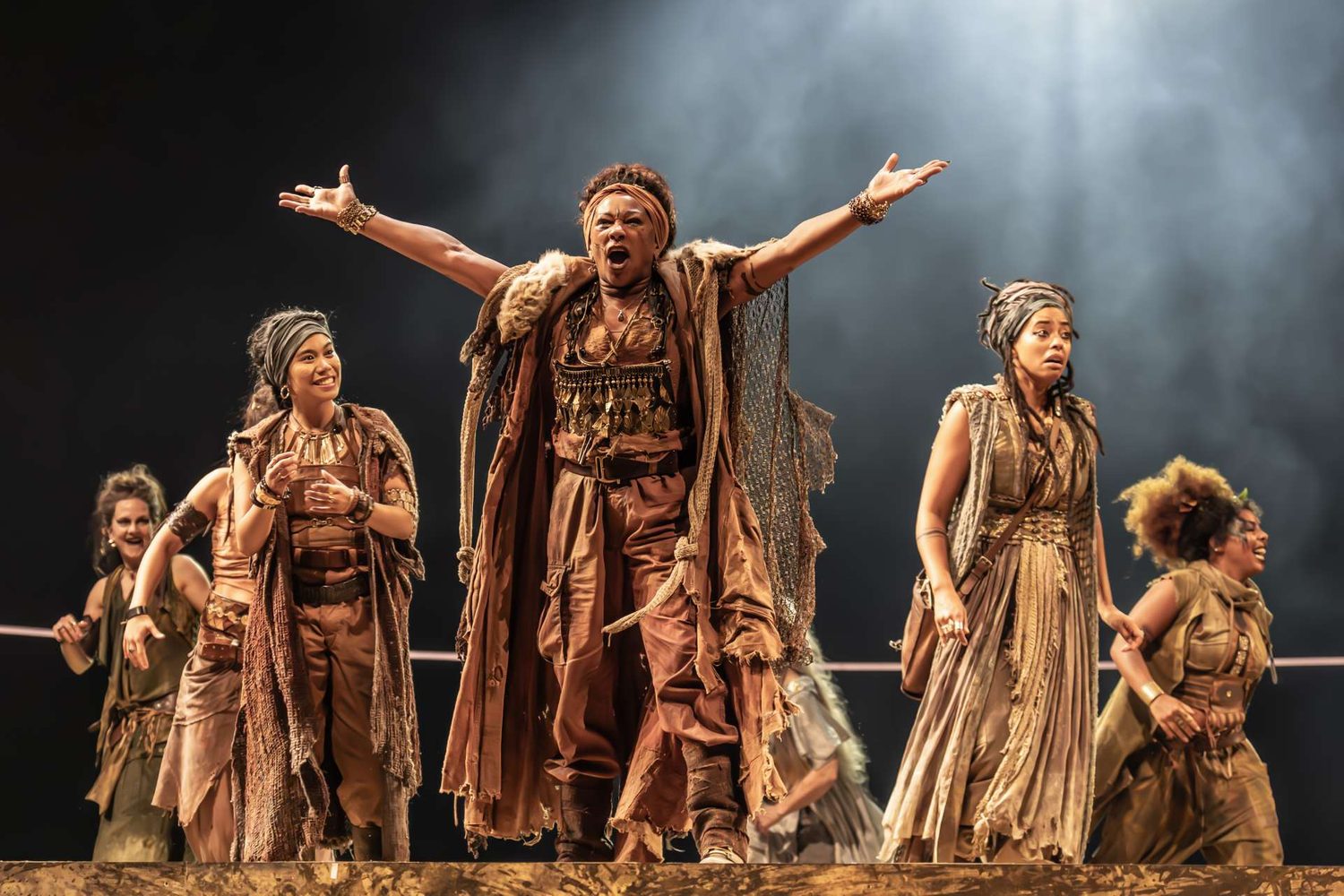
I was excited at the prospect of Indhu Rubasingham‘s first production as the National Theatre’s Director. She is after all the first woman and first person of colour to run the country’s leading theatre, and she came up with another first- it was the first time an author’s debut play had been produced in the Olivier, the National’s largest auditorium. And what a start from Nima Taleghani. It was a very modern, feminist interpretation of the Euripides’ Bacchae in both the contemporary language he used and the way he placed the chorus at the centre of the action. It was as if Ms Rubasingham wanted to say: ‘from now on this is the people’s theatre.’ A good message, and show had all the makings of a triumphant start to her reign. It was certainly pacey and eye-catching, but I was left a little disappointed.

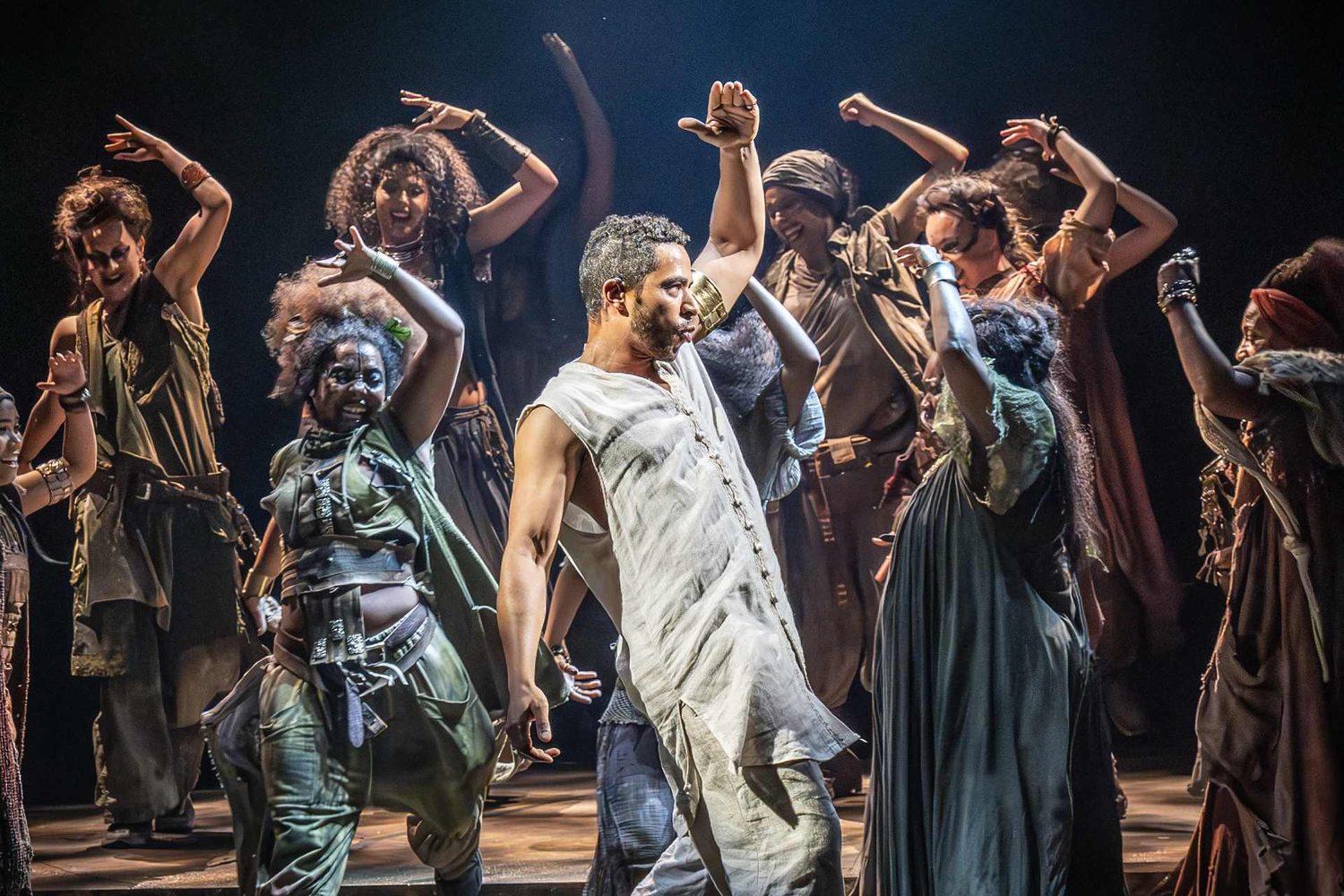
Bacchae opens as dramatically as you could wish, with a gigantic horsecovered in blood dominating the stage. In fact, Robert Jones‘ moving tiers of stage floors and eye-catching costumes- some Mad Max style, others simply dazzling- along with Oliver Fenwick‘s flashing, whirling lighting, are a continual spectacle. Indhu Rubasingham’s tight direction keeps the pace moving, despite the large number of chorus members that she needed to move.

Choruses are a constant in Ancient Greek drama but usually they are a homogenous group witnessing and commenting on events. Sometimes they have a role beyond that, as in Bacchae, when they are the group of women who worship the demi-god Dionysus. They follow him through his triumphs and troubles, and Euripides extends their role to more active participation in the action. Nima Taleghani has gone even further, making them the driving force in the events that take place on the Olivier stage, a group determined to bring down authoritarian regimes run by men oppressing women.

I don’t want to say too much about what happens in case you don’t know the twists of the story, but suffice to say there is considerable bloodshed and one terrible key moment involving a mistaken victim of a murder. It’s a great play that asks lots of questions about religious fanaticism and the way passion can override reason.

In this adaptation, the chorus are given individual personalities and even split into factions. One is led by Clare Perkins, who brings authority, reason and humour to the part of Vida, the other by a blood-soaked Sharon Small whose demonic eyes that suggest a career in horror films might beckon.

The dispute between King Pentheus and Dionysus is central to the play. The former has banned the latter’s religion and denied his divinity.  In this version, the two characters are somewhat maginalised, although James McArdle‘s portrayal of the King as uncertain of his masculinity and Ukweli Roach‘s Dionysus, shown as an unworldy man more into love than war, provided an amusing contrast to the bloodthirsty women. Simon Startin was a dryly funny Tiresias, and so traditional in style that he seemed like a deliberate contrast to the radical changes all around.

Tragedy lost in comedy

Ukweli Roach in Bacchae. Photo: Marc Brenner

Ultimately, far from pondering on the madness of what has taken place at their instigation, the chorus latches onto the fact that Dionysus is, among his many responsibilities for promoting pleasure, the god of theatre. And Vida promises that the theatre they are in will from now on reflect real people’s lives.

All of this is done using some, at times, witty and amusing poetry and rap, peppered with strong language, and many crude references to women enjoying sex. Kate Prince choreographed rambunctious dancing to DJ Walde‘s insistent beats. For my taste, the many rousing speeches were shouted rather than delivered, and had me reaching in my bag for an aspirin. Don’t misunderstand me, it was fun, but Bacchae was written as a tragedy, and that essential element of it is lost in all the comedy. The remoulding of the plot to support the positive message, not only makes the story confusing, it undermines events that should leave us shell-shocked.

So, I did find Bacchae entertaining, and I am looking forward to what else  Indhu Rubasingham will bring to our national theatre, but I hope there will be less messing about and more substance.

Bacchae can be seen at the National Theatre until 1 November 2026. Buy tickets direct from the theatre

Paul was given a review ticket by the theatre.

Click here to read a roundup of other critics’ reviews

Click here to watch this review on YouTube


Theatre reviews roundup: The Importance of Being Earnest

Olly Alexander & Stephen Fry excel in panto-style Wilde

Noel Coward Theatre
Stephen Fry in The Importance of Being Earnest. Photo: Marc Brenner

After a sell-out run at the National Theatre, Max Webster’s ‘queer’ interpretation of Oscar Wilde’s light-hearted romantic comedy has moved across the river to the West End. All the new cast went down well with the critics- Olly Alexander has replaced Ncuti Gatwa, Stephen Fry has become Lady Bracknell. The reviews of the production were similar to the ones that greeted its last outing: some loved the OTT outing of the queer subtext, others felt it didn’t do justice to Wilde ‘s subtle wit. The average rating is almost identical.

Below are extracts from reviews of the West End version. Click here to read reviews of The National premiere.

[Links to full reviews are included but a number are behind paywalls and therefore may not be accessible]

4 stars ⭑⭑⭑⭑

‘it’s the thinking person’s panto this season, and a revival to remember’ declared The Telegraph‘s Dominic Cavendish. Describing its Lady Bracknell, he said: ‘Clad in garish bustle-dresses, Fry, 68, lends his intellectual fluency and towering presence to Wilde’s verbally pyrotechnic and subtly anarchic script. He doesn’t attempt much female impersonation, and instead gives us the crisp, snooty essence of Lady B: demanding, commanding, formidable. This is a stately, mannish creature with pursed lips and a withering stare.’ (Not sure why the reviewer tells us Mr Fry’s age.)

Julia Rank for LondonTheatre declared: ‘pop star Olly Alexander proves himself to be the genuine article as a stage star. Diminutive and fey, his Algernon is like a spoiled-sweet child who knows just how precociously clever and charming he is’. As for Stephen Fry: ‘In full regalia, he resembles the great Hermione Gingold in A Little Night Music, but he doesn’t ham it up and remains grounded, beginning in a fairly mellow mood and building up to the crescendo of “A handbag?”.’ She was also pleased with the look of the show: ‘Rae Smith’s enchanting production design is filled with the bright, often gaudy colours that the Victorians adored.’

The Mail‘s Patrick Marmion spent much of his review of this ‘joyfully exuberant production’ praising Stephen Fry: ‘(he) becomes a 6ft 5in taffeta tank as Wilde’s memorably scathing widow.’ (In point of fact, she wasn’t a widow, she specifically mentions her husband more than once.) Mr Marmion wasn’t quite so impressed by the other big name replacement: ‘Popstar Olly Alexander, from Years & Years, now plays Algie with boyish zip, but some of his gags fail to land and he misses Gatwa’s megawatt charisma.’

Alex Wood for WhatsOnStage thought the transferred production was even better than the original: ‘the take on Wilde’s play about confused identities, deceptions, romances and, of course, handbags, feels tighter, slicker and funnier. A heady shot of a sweet liqueur to help us escape these trying times. Part of the success has to come down to Webster’s direction – deftly mining Wilde’s text for the comic opportunities and rattling along at a necessarily chipper pace, laced with lashings of queer fun.’

Time Out‘s Andrjez Lukowski explained: ‘Webster undoubtedly breaks Wilde’s play, by hauling the subtext up to the surface, and basically yelling THEY’RE GAY at us over and over. But whether you want to look for deeper meaning in the production’s every quirk or simply treat it as a funny, fresh, irreverent way of tackling a comedy that has become mired in sexually repressed cliche, well, that’s entirely up to you.’

3 stars ⭑⭑⭑

David Jays at The Guardian said: ‘Max Webster’s shameless production merrily queers the comedy, shoving subtext from the shadows.’ He described the young people in the cast: ‘The dizzy chaps are cute – Nathan Stewart-Jarrett’s Jack in fine fluster, Olly Alexander’s Algy giving good smirk – but it’s their sweethearts who gleam. Kitty Hawthorne’s fanny-fanning Gwendolen and Jessica Whitehurst’s scowling Cecily both tap the production’s libidinous undertow.’

Dave Fargnoli for The Stage was not enthusiastic about Webster’s approach: ‘There is a certain cheeky charm to all the clumsy cavorting, but it’s too tame and obvious to feel properly subversive, and the intentionally overblown delivery tends to interrupt the exquisitely poised flow of Wilde’s witty repartee.’ He even quotes a line from the play to back his case: ‘“In matters of grave importance…style, not sincerity, is the vital thing.” That certainly seems to be the guiding principle in this big, bright production, which puts shallow laughs firmly over substance.’

The Times‘ Clive Davis wondered if the production had gone too far in its interpretation: ‘Webster is pushing a classic comedy of manners to breaking point. A delicate puff pastry of a play is smothered in dollops of pink icing.’

2 stars ★★

The Sunday Times’ Dominic Maxwell had a miserable time: ‘Never have I seen a show that so conspicuously and so repeatedly busts a gut trying to amuse. And forcible fun is quite my least favourite kind…the campery comes as if by the yard’. He continued: ‘Everyone’s frantic but few actors connect. So it’s slow too. Take Fry: his line readings are exemplary. He celebrates the nuances and rhythms of Wilde’s wit. He has more variety in the role than Sharon D Clarke did at the National, yet without her galvanising sense of disdainful pressure. He just sort of stands or sits there and says the lines. Very well, but he has so little sense of physical presence that he might be a hologram.’

Critics’ average rating 3.6⭑

Value rating 38

The Importance of Being Earnest can be seen at the Noel Coward Theatre until 10 January 2026. Buy tickets direct from earnestonstage.com

If you’ve seen The Importance of Being Earnest at the Noel Coward Theatre, please add your rating and review below

Theatre reviews roundup: Clarkston

Actors praised in over ambitious play

Trafalgar Theatre
Ruaridh Mollica & Joe Locke in Clarkston. Photo: Marc Brenner

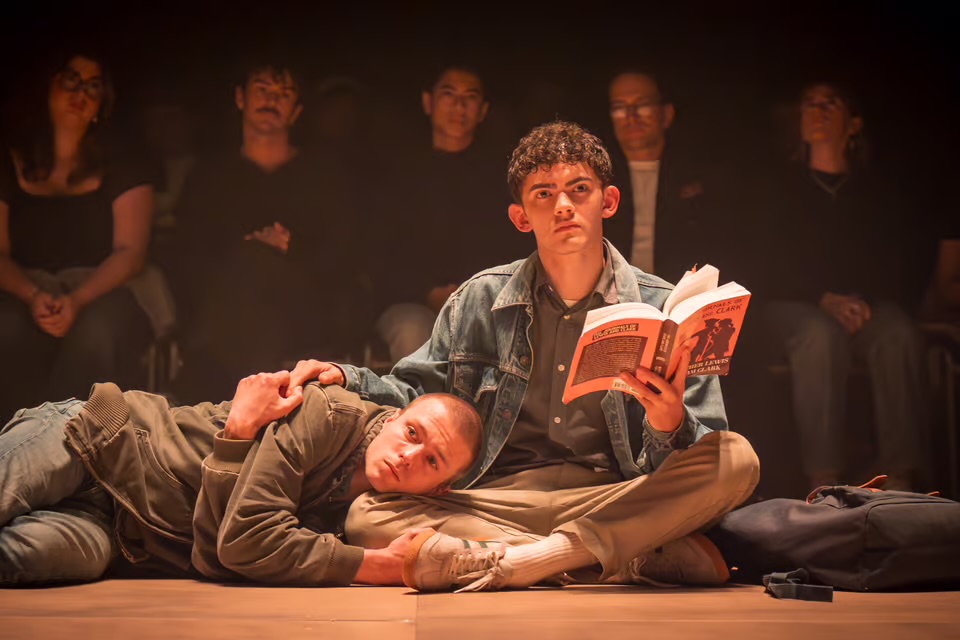
Two young Americans in a rut meet at an out-of-town Costco store. They form a relationship while lamenting the lack of opportunity and adventure in modern life. The critics were impressed by Heartstopper’s Joe Locke as Jake who has a degenerative disease, but reserved their highest praise for Ruaridh Mollica’s brooding Chris. The reviewers had reservations about US playwright Samuel D Hunter’s 2015 drama. They liked the poetry but found it fell short of its ambitious subject matter.

[Links to full reviews are included but a number are behind paywalls and therefore may not be accessible]

4 stars ★★★★

The Telegraph’s Dominic Cavendish was taken by the play: ‘This isn’t a conventional gay romance, more a soulful meditation on the need for connection with someone worth trusting and a return to a spirit of possibility’. And the acting. Locke, he said, ‘is funny and touching as Jake…battling prejudice and Huntington’s disease. Locke draws us in with his fawn-like stare and scrawny vulnerability…Ruaridh Mollica is excellent too as Jake’s tougher co-worker, Chris’.

The Mail’s Patrick Marmion liked the acting, the play and the production: ‘it’s a slow burn, pivoting on emotional nuance and the pains of intimacy.’

3 stars ★★★

The Stage’s Sam Marlowe summed up: ‘It’s all very meticulously done, and the affection that gradually emerges between Chris and Jake is touching, but it just doesn’t seem quite enough. A languid, low-key chamber piece, in the end it leaves you unsatisfied.’

Dominic Maxwell of The Times felt the play didn’t quite come off: ‘There’s some gorgeous writing, but not enough plotting to stop the conceits from feeling like conceits. It starts to feel theatrical rather than engagingly lifelike.’ But he liked the acting: ‘Locke brings an unsentimental, compellingly awkward spirit of yearning…Ruaridh Mollica is equally excellent as the outwardly sturdier Chris, a working-class wannabe writer’. He concluded: ‘Clarkston is lovely, it really is. But it’s slight.’

Kate Wyver in The Guardian decided: ‘Despite the show’s overly expository dialogue, Clarkston gradually gives way to an intimate story about trying to make the best of the hand you’ve been dealt.’ ‘Mollica effortlessly breathes life into this hard-shelled character who doesn’t know how to talk to a man romantically’ ‘The script is often heavy-handed, with a backstory handed to us on a plate and little left unsaid.’ ‘Strangely, some of the audience sit on stage with the actors, their presence adding little but trip hazards.’

For Theo Bosanquet at LondonTheatre: ‘The cast deliver lively and empathetic performances, though it has the feel of a chamber piece that has been stretched beyond its natural size in the Trafalgar’.

Tom Wicker for Time Out noted: ‘Hunter’s writing is perceptive about the doubts that lurk beneath people’s hopes, but its aim at a grander poetry about life can fall short.’

Debbie Gilpin at BroadwayWorld expressed a similar sentiment: ‘The play is mostly of a serious bent, with some gentle humour thrown in along the way…It tiptoes around the edge of the profound, but never quite gets there.’ In common with quite a few reviewers, she commented on the cost of tickets: ‘A large chunk are priced at £100 (including fees) or more, which always feels scandalous for an interval-less play like this – regardless of the show’s quality.’

Alun Hood at WhatsOnStage declared: ‘The writing is subtle but blistering: a morose yet eloquent meditation on lives not well lived, with precious little hope, but an abundance of challenges. It’s blunt and bleak, and almost nothing happens, but the acting and the oblique humour ensure that it is engaging for the most part.’

2 stars ★★

Martin Robinson for The Standard lamented: ‘Maybe a better production would jerk the tears, but static direction by Jack Serio turns most scenes into a bit of a slog…and the most poignant moments become mawkish’. Most of the play, he said, ‘is pure American cheese, as natural as those bright orange balls stacked in their thousands on the Costco shelves.’

Critics’ average rating 3.1★

Value rating 31

You can see Clarkston at the Trafalgar theatre until 22 November 2025. Click here to buy  tickets direct

If you’ve seen Clarkston at the Trafalgar theatre, please leave your rating and review below

Theatre review: The Lady From The Sea with Alicia Vikander & Andrew Lincoln

Watery family drama floats my boat

Bridge Theatre

⭑⭑⭑⭑

Andrew Lincoln & Alicia Vikander in The Lady From The Sea. Photo: Johan Persson

Simon Stone brought us Yerma with Billie Piper, one of the finest productions I have ever seen, and Phaedra with Janet McTeer which was pretty good too. He likes to take a classic, tear it apart, get down to its basics, and rebuild it for the modern world. So did he pull it off with Henrik Ibsen, father of theatrical realism, and stars Alicia Vikander and Andrew Lincoln? The answer is, yes, with style. It is an entertaining, amusing, gripping, unique piece of theatre.

The evening starts (and continues) with much would-be witty repartee of the kind that you find in fiction rather than real life, except this production often presents it as  crass or cringeworthy, and characters talk over one another, and mock one another. Ibsen was an early proselytiser of theatrical realism which meant believable conversations featuring middle class families that middle class theatre audiences could identify with, as opposed to the previous focus on royalty and gods. This play, with a script developed by the actors in conjunction with writer director Simon Stone, pays full homage to Ibsen with its realistic dialogue.

The subject matter is serious but this version is also very funny. One of exchanges that made me laugh, given the title of the play, was when someone said to Ellida: ‘You must be the lady of the house’ and she responded: ‘Did he just call me a lady?’

The play is set in the modern day in the Lake District, which makes a change from the Cotswolds, and is sprinkled with contemporary references, to OnlyFans and Just Stop Oil and the like, but the themes of love, loss and the effect of the past on the present are eternal and universal.

Edward and his second wife Ellida seem happy. Although his daughters from his first marriage are rebellious and rude, the couple are able to shrug it off. Then a former lover appears and Ellie must make a choice between an unfinished relationship and her current love.

Death hangs over the narrative: there are suicides, one by Edward’s first wife; Edward and Ellida have lost a child through miscarriage; a visiting young sculptor has a terminal illness. While the presence of death in their lives messes up some of the characters’ lives, it also acts as a reminder that life is short and unpredictable, and needs to be lived, not postponed.  Dramatic choices and revelations continue to the end.

The acting is uniformly excellent but none better than the two leads- Andrew Lincoln is totally convincing as a man lacking confidence, despite being a leading neurologist. This is revealed to be the result of a cold father. Events test Edward’s  liberal attitudes to breaking point. He, like the script, is funny, angry and anguished.

Alicia Vikander is a more subdued presence playing a quietly confident mature woman, with a slightly flat, stuttering delivery that made all the more powerful her passion, when it came out. At that point, she seemed to revert to the nervous, vulnerable youngster from twenty years earlier, who made decisions that would shape her life.

The young people- two teenage daughters planning the first stages of adulthood, and the dying sculptor- remind us of the turbulence of life as a young person. I loved Isobel Akuwudike and Gracie Oddie-James as the stroppy but ultimately caring daughters, and Joe Alwyn is wonderfully neurotic as the sculptor. John Macmillan is spot-on as the blunt, faithful family friend Lyle. Brendan Cowell is suitably charismatic as Finn, the lover from the past.

The Lady From The Sea at The Bridge. Photo: Johan Persson

Lizzie Clachan’s magnificent set isn’t in keeping with ideas of realism. It is pure theatre. The show is set in the round, bringing the audience close to the actors in this intimate family drama. There are minimal props- a table and chairs in one corner and a sun lounger opposite. (Avoid seats near the right corner as you enter the auditorium and the opposite corner on the far side, as these bits of furniture will sometimes obscure your view.)

During the interval, the entire set, both the floor and the small number of props are changed from completely white to totally black. Straightaway, you feel there will trouble ahead! The beginnings of scenes increasingly overlap with the ends of the previous ones, as the tension increases- as if we can’t wait to see what happens next.

Much of the baggage Ellida carries is weighed down by events at sea, so , in an eye-popping moment in the second act, water appears, first as heavy rain, then as shallow water when part of the stage drops. Two lovers make out in it with echoes of From Here To Eternity, before it becomes a swimming pool. It may not be an immersive production from the audience’s point of view but some of the actors are fully immersed in the pool. It could only happen in theatre. But, far from being gloomy, the water- like the play itself- is ultimately cleansing.

This is an intense piece of theatre I wouldn’t have wanted to miss.

The Lady From The Sea can be seen at The Bridge until 8 November 2025. Buy tickets direct from the theatre

Paul purchased his ticket.

Click here to watch a video of this review on the YouTube channel Theatre Reviews With Paul Seven

Theatre reviews roundup: Entertaining Mr Sloane

Evergreen or dated- the verdict on Joe Orton’s classic

The Young Vic
Tamsin Outhwaite & Jordan Stephens in Entertaining Mr Sloane. Photo: Ellie Kurttz

For her first production as artistic director of the Young Vic, Nadia Fall has chosen a neglected modern classic. Joe Orton’s 60-year-old Entertaining Mr Sloane is a black comedy that the critics indicate has lost little of its shock value, although some found it dated.  The mysterious, sinister young man, who arrives at a house and proceeds to ingratiate himself with the occupants is played by Jordan Stephens (from the hiphop duo Rizzle Kicks) in his first major stage role. A mature woman played by Tamsin Outhwaite and her brother  (Daniel Cerqueira) are both attracted to him, but he is viewed with suspicion by their father (Jordan Stephens).

[Links to full reviews are included but a number are behind paywalls and therefore may not be accessible]

4 stars ⭑⭑⭑⭑

David Jay for The Guardian said: ‘Jordan Stephens … gives the mysterious stranger a bold, open smile, and Tamzin Outhwaite’s Kath blinks like a moth to flame.’ He declared: ‘Six decades on, Orton’s play shows its age: drum-tight, then increasingly chasing its tail. But Fall’s opening show as artistic director of the Young Vic grins with the worst of human behaviour – and that never grows old.’

The Telegraph‘s Dominic Cavendish was struck by the way ‘Nadia Fall’s faithful production at the Young Vic, with Tamzin Outhwaite as the kinky landlady Kath, and Jordan Stephens … as her adoptive orphan “boy”, taps into something timeless: as the action proceeds, we observe the way people driven by extreme emotional, sexual and financial need will stoop to anything.’ ‘Recommended’, he concluded.

Clive Davis of The Times complimented members of the cast, particularly Tamsin Outhwaite: ‘It’s a stunning performance. Orton’s ornate language can be every bit as sinister as Pinter’s, yet the shafts of manic humour constantly catch you off-balance. Tottering around the stage, Outhwaite is a human gargoyle who cradles a cloth like a baby and offers the newcomer a “motherly kiss” before turning into an unlikely seductress’.

Matt Wolf at LondonTheatre felt the production did the play justice: ‘Six decades on, the four-hander hasn’t lost its power to sting, at least as staged in the round on a fascinating set by Peter McKintosh that relegates the memorabilia of the characters’ lives (a crib, chairs etc.) to an aerial collage suspended above the action.’ He commented: ‘The cast across the board mines the dark humour of the piece, while hinting at a “depraved” (the script’s word) landscape beyond’.

3 stars ⭑⭑⭑

Theo Bosanquet for WhatsOnStage had this to say about the cast: ‘The cast combines well, including Stephens, who gives an accomplished stage acting debut. Although he could dial up the menacing aspects of the character – he never quite convinces as a man capable of killing – he has an enjoyably understated comic delivery and successfully hints at the boyish vulnerability underneath Sloane’s leather-clad exterior. Outhwaite meanwhile embodies the louche lustiness of Kath, whose air of cornered desperation is reminiscent of Mike Leigh’s Bev, and nicely contrasts with the besuited, chain-smoking Cerqueira and Steptoe-ish Fairbank. All told, it’s an enjoyable, if concurrently rather cautious, kick off for the Fall regime.’

2 stars ⭑⭑

The Stage‘s Sam Marlowe was disappointed: ‘Unfortunately, Fall’s staging is – pun fully intended – all to cock. Her production is stylistically muddled and unevenly acted, with the result that neither its shocks nor its savage comedy really register.’ The cast didn’t live up to her expectations: ‘Jordan Stephens … appears hopelessly out of his depth. An amoral chancer who deploys his sex appeal like a lethal weapon, Sloane needs a potent menace to go with his dubious charms. Instead…Stephens just looks slightly gormless.’

Katie Kirkpatrick at BroadwayWorld didn’t see the point: ‘Fall’s revival leaves it bizarrely lodged in the past: there’s nothing about this production that makes it clear why this play is worth watching in 2025, with potential themes of bisexuality and xenophobia left at the wayside. It feels as though this production could have been made any time in the past sixty years, in terms of both the play’s themes and the way it is staged.’ She conceded: ‘For all its flaws, Entertaining Mr Sloane is, well, entertaining. The tried-and-tested jokes get plenty of chuckles, it’s visually impressive, and the story’s pacing means it keeps the audience on board throughout. For those with a love of classic plays or farce, there’s plenty to enjoy.’

Andrjez Lukowski’s Time Out review appeared without stars but would likely be a 2 star review: ‘Fall’s take feels both wilfully dated – very much a ’60s period piece – and pointedly unfunny, trading the menacing comedy associated with Orton (‘dark farce’ is the usual term) for drab naturalism.’

Critics’ average rating 3.1⭑

Entertaining Mr Sloane can be seen at the Young Vic Theatre until 8 November 2025. Buy tickets direct from the theatre

If you’ve seen Entertaining Mr Sloane at the Young Vic, please leave your rating and review below

×