Stephen Fry in The Importance of Being Earnest. Photo: Marc Brenner
I gave a lukewarm review to this production of The Importance of Being Earnest when it premiered at the National Theatre. Part of the reason was, I love this play and, even though I still enjoyed the witty dialogue and the ingenious story of identity and hidden truth, I felt the queer interpretation was laid on a bit thick. I accepted that the two main characters’ double lives could be taken as a metaphor for gay men’s secrecy in past times, but, to my mind, Max Webster‘s decision to foreground the subtext undermined the power of Wilde’s actual text. I now think my prejudice blinded me to the quality of what was in front if me
So I wanted to give it a second chance, and go in more prepared for this approach. And I wanted to compare Olly Alexander‘s Algernon and Stephen Fry’s Lady Bracknell with Ncuti Gatwa and Sharon D Clarke.
It’s not only the twostars, there’s a complete new cast. Each actor captured the distinctive cadence of Oscar Wilde’s prose, delivering lines with clarity. Putting my gratitude for that aside, I fully expected Alexander and Fry to lack the power of Gatwa‘s dazzle and Clarke’s swagger. And in a way I was right, neither has the charisma of the National’s original casting. However, their more restrained interpretations of Algie and Lady Bracknell create a more balanced production.
They make the parts their own, as judges on talent shows are apt to say. Olly Alexander delivers an exemplary performance, imbuing Algie with endearing boyish charm, while Stephen Fry relied on a quiet, clipped delivery (and to be fair his height) to exert his authority. This is not the pantomime dame I feared but rather a totally believable version of the snobbish, domineering representative of the aristocracy. Where the previous larger-then-life characterisations almost suffocated Wilde’s delicate plot construction, toning them down seems to allow it to breathe a little more.
The rest of the West End cast are as good if not better than their National Theatre counterparts. Outstanding are the two young women, Gwendolen and Cecily, played by Kitty Hawthorne and Jessica Whitehurst respectively, and the object of Jack and Algie’s affections. I still found their overt expressions of sexual frustration somewhat incongruous with the period context, but I went with it, and actually the tongue waggling and the attention they pay to their fiery loins is pretty funny. Come to think of it, their obsession with their husband being called Ernest is just as silly.
Another highlight is Hayley Carmichael playing the manservants Lane and Merriman. It’s hard not to laugh at Merriman’s every entrance, when this diminutive figure dressed in oversized wig and tailcoat moves with mechanical stiffness and an air of complete bewilderment.
Shobna Gulati and Hugh Dennis extract plenty of humour from the relationship between Miss Prism and Canon Chasuble. Their suppressed passions form a delightful counterpoint to the younger lovers’ unbridled emotions. Nathan Stewart-Jarrett is a fine, likeable Jack Worthing.
Olly Alexander and Hayley Carmichael in The Importance of Being Earnest. Photo: Marc Brenner
Far from going further in laying on thick this gay interpretation, the transferred production seems to have reined it in ever so slightly. I admit I was expecting, and therefore was less concerned about the opening where Algie is in a cocktail dress at a cross dressing party, or the men and women being sexually excited by their own as much as the opposite sex, or by the references to modern pop songs.
It may have avoided becoming the pantomime I feared but the production is still deliciously over the top. Rae Smith’s colourful costumes and lavish sets, complete with masses of blooming bushes and two naked male statues, create an exuberant atmosphere. And the curtain call does provide a panto-style walkdown, with the cast dressed in giant petals.
I would still prefer a version of The Importance of Being Earnest that allows the lines to speak for themselves, but I am very happy to concede that Wilde’s timeless comedy is big enough to take a joke, and this is a particularly good joke.
Shobna Gulati, Ian Kelsey and Christina Bianco delight in Jim Cartwright’s classic comedy
★★★★
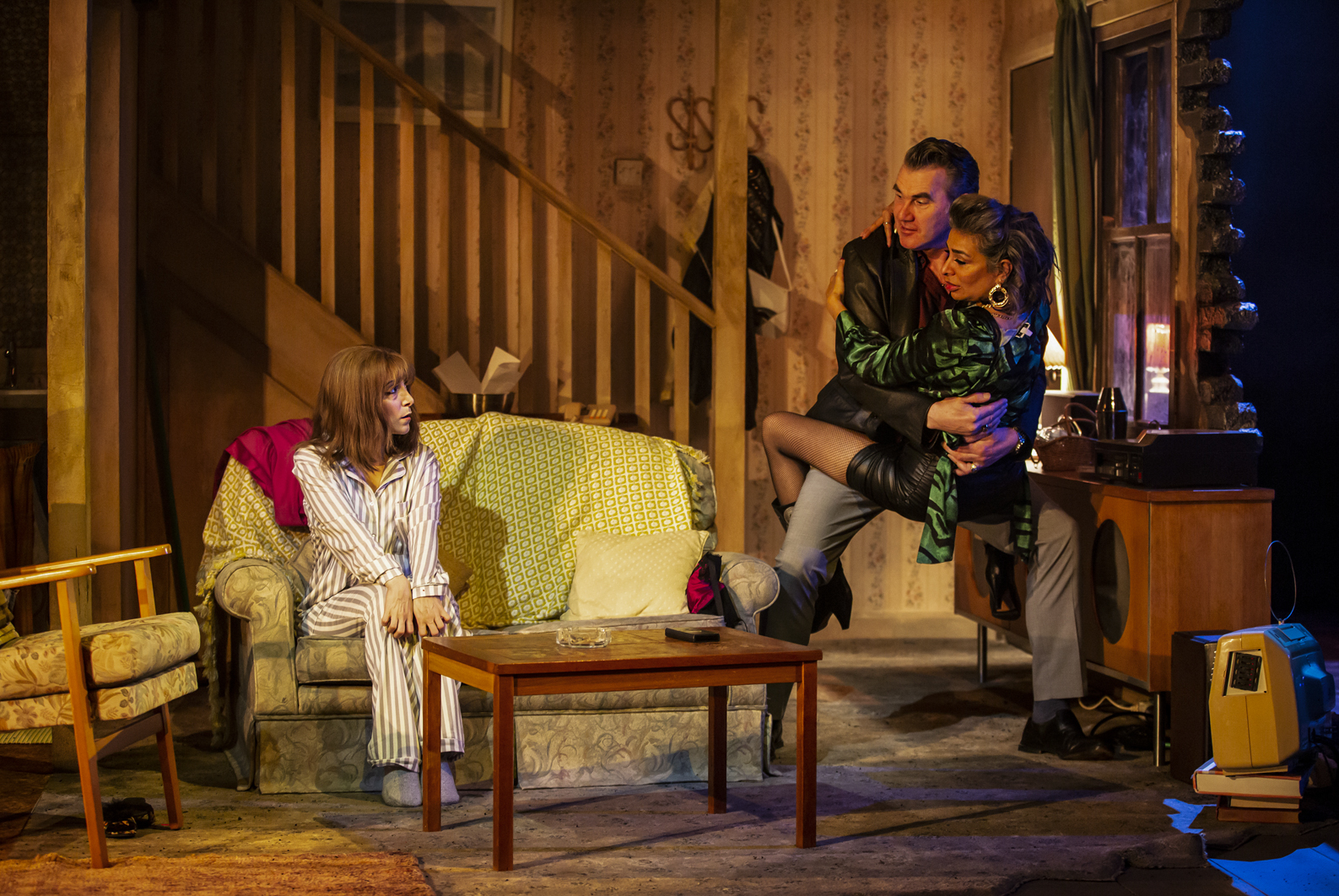
Christina Bianco, Ian Kelsey and Shoibna Gulati in The Rise and Fall of Little Voice. Photo: Pamela Raith Photography
Touring productions are the Cinderella of British theatre. Given the choice, actors will often prefer to work in one place, preferably London. So, when I saw that two former soap actors and a YouTube sensation were heading the cast of the new touring production of The Rise And Fall of Little Voice, I feared the worst. How wrong I was.
Jim Cartwright’s play about an introverted young woman mourning her father and badly treated by her mother, who finds escape in the music of classic female singers, has been revived many times. The challenge for all the actors in this show is that there has also been a film version that is imprinted on most of our brains. Brenda Blethyn as the horrendous mother Mari Hoff, Michael Caine as the smooth talking showbiz manager Ray Say, and of course Jane Horrocks as LV, or Little Voice. So the cast have to work very hard to make you forget those definitive performances. None more so than the person playing LV. In some ways, the challenge is not to mess it up.
With the part of Mari, Jim Cartwright created one of theatre’s great monsters: a selfish woman with no redeeming features whose only concern is her own love life, and who abuses not only her daughter but the English language. Shobna Gulati grabs the part with both hands and extracts every ounce of comedy out of it. She relishes the outrageous puns (“I did it my Ray’) and dishes out malapropisms with a perfect deadpan delivery. When criticising LV for her lack of politeness, ‘She can’t even be swivel’ or, referring to her age, ‘at my time of strife’. Visually, her bosoms are barely contained by her garish outfits, and she totters precariously in tight skirts and high heels. In fact, the dresses and makeup are so over the top that many drag acts would find it hard to compete. Her physical comedy is a joy, especially when she’s playing being drunk. She literally throws herself into the role and gives it, as her character would say, one hundred pesetas. I loved the moment when she pulled Ray onto the sofa, her legs flailing in the air.
Ian Kelsey gives us just the right mix of sleaziness and desperation. I last saw him thirty years ago as Danny Zuko in Grease. He’s still offering roguish allure but, here, as Ray attempts to exploit LV, he adds an underlying nastiness. Mr Kelsey conveys perfectly the ageing charm and sense of failure that make his character comically pathetic.
Christina Bianco creates a good impression
Christina Bianco in The Rise and Fall of Little Voice. Photo: Pamela Raith Photography
I’d never heard of Christina Bianco until now, which is clearly my bad since she has 123,000 followers on YouTube and her impressions of singers have been viewed over 25 million times. So, how well can she sing? We get glimpses as the first act progresses, then there are two nightclub performances, which LV is pushed into making. Not only does she sing beautifully but her impressions of Judy Garland, Marilyn Monroe, Shirley Bassey and many more are spot on. After all these years, very few in the audience will be taken by surprise when, after all the silence and whispers, LV reveals her diva singing voice, but the tingle down the back of the neck that Ms Bianco creates is still powerful enough to merit a round of appreciative applause.
If you want a taste of how good Christina Bianco is at impressions of singers, watch her on YouTube singing Let It Go (there’s a choice but I’d recommend the video from a year ago). As for her Lancashire accent, admittedly she’s an impressionist, but it’s spot on. You would never know she’s from New York.
She is uncannily like Jane Horrocks but it would be unfair to dismiss her performance as an impression because there is little leeway for playing the role differently. Jim Cartwright wrote the part of LV for Jane Horrocks and she played it both in its National Theatre premiere and on film, so that is how the part is meant to be played. The important point is, Christina Bianco is entirely convincing as someone traumatised by grief and parental abuse, who continues to be bullied until she finds her own voice.
Akshay Gulati is believable as the shy would-be boyfriend of LV and William Ilkley makes a cringe-worthy Mr Boo, the club owner and MC.
Fiona Mulvaney is excellent as Mari’s friend Sadie. I can’t help feeling the part of a stooge who says very little other than ‘Okay’ is reminiscent of the kind of one-dimensional character you’d find in an old fashioned sitcom. That’s just one of the ways this play is now showing its age. Also, this mainly pacey play seemed to me to be drawn out at the end.
The set designed by Sara Perks takes the form of a two up-two down house with the front and part of the roof torn off, as if giving us an unauthorised glimpse into what would normally go on behind closed doors. It’s crowded with furniture and other cheap objects, adding to a strong sense of the tastelessness of Mari’s tawdriness, and the claustrophobia of working class life.
Bronagh Lagan is the director responsible for a production that gives laughter, pathos and joy in equal measures.
[Edited 2 April 2022: extended description of Shobna Gulati’s performance.]
Star debut by Max Harwood in a joyous fantasy film musical
★★★★
Everybody’s Talking About Jamie. Photo courtesy of 20th Century Studios
Everybody should be talking about the film of Everybody’s Talking About Jamie but I suspect they won’t because it slipped through the cinemas and is now behind the firewall of Amazon Prime.
First thing to say, this is a movie in its own right, not simply a film of the stage show. It’s the story of a gay teenager verbally bullied at school and rejected by his homophobic father, but who finds liberation in dressing up in glamorous women’s clothing. The central message is a familiar one of allowing people- young people- to be themselves and fulfill their potential.
Like the stage show, it fetures the fabulous songs composed by Dan Gillespie Sells from The Feeling with lyrics from Jamie writer Tim MacRae. They’re energetic, liberating and someones melancholic, although some of the songs from the stage show failed to make the transition to celluloid.
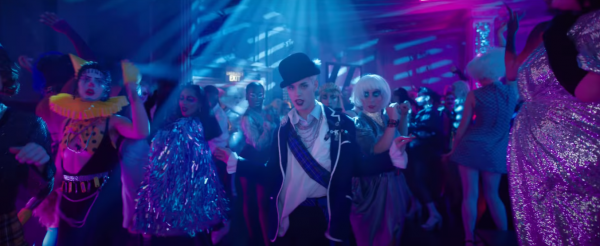
The film is an impressive directorial debut for Jonathan Butterell who tells the story confidently and seamlessly switches from the mundane classroom and other day-to-day situations to the glorious fantasies of the songs in which Jamie imagines the life he should lead.
This is not about someone being ashamed of being gay. Jamie is confident in his sexuality, which is a sign of the progress that’s been made in the 50 years since same-sex relationships became legal. He even stands up to the homophobic class bully. No, his secret desire is to be a drag queen, or more immediately to wear a dress at the forthcoming prom.
It’s not entirely secret. His mother supports him and even buys him ruby encrusted shoes which must surely make us think of The Wizard Of Oz and that old euphemism for gay men, namely friends of Dorothy. His father too is aware but is ashamed of him, which has led to Jamie having a poor self image.
For me the most moving moment was a scene that’s not in the stage show. Jamie has met Hugo Battersby, an older drag queen, played by the great Richard E Grant as someone ‘battered’ by the past but still flamboyantly extrovert. He becomes Jamie’s mentor and shows him a VHS video from the late 80s. This wonderfully convincing, slightly blurry pastiche – complete with a new song- shows the protests against the Thatcher government’s discrimination against gay people, all in the midst of the horrors of the AIDS epidemic.
In a nice touch, the transfixed Jamie and Hugo, at first reflected on the TV screen, become part of the video. It powerfully reminds us- and Jamie- that there were many battles fought by lesbian and gay people and much bravery in being ‘out’. It puts today’s problems in perspective. Talk about standing on the shoulders of giants Short as the scene is, the power of the song This Was Me and the sadness and defiance shown in the video moved me more than anything else in the film.
Max Harwood gives an outstanding performance as Jamie, the self deprecating, likeable youngster who gradually gains the confidence to express himself. Also making an impressive feature film debut is Lauren Patel who plays his studious but vocal Muslim friend Priti.
They are well supported by some great veteran actors. Sharon Horgan, seen recently on Channel 4 in the extraordinarily good This Way Up, is magnificent as the teacher who squashes the ambitions of her working class students. There are two alumni from Coronation Street. Sarah Lancashire plays Jamie’s devoted mother with great warmth and sings the stand-out song – a kind of torch song- He’s My Boy, with depth and passion. The excellent Shobna Gulati plays her comic but forceful friend Ray. Ms Gulati is, I think, the only member of the West End stage show to reprise a role in the film and incidentally she’s playing Ray in the current UK tour.
The story is predictable in both its course and outcome. In many ways you could describe it as a fairy tale and, in saying that, I’m not attempting a crass joke. What I mean is that everything works out just a little too well. The implausibility matters more in this film than it does in the original stage show where you are carried along by your emotional response to the songs and performances. Even so, this is a well-made and uplifting film, right up to the tear-in-the-eye ending.
And if you can’t see it in all its wide screen glory at the cinema, you can catch it streaming on Amazon Prime.
To provide the best experiences, we use technologies like cookies to store and/or access device information. Consenting to these technologies will allow us to process data such as browsing behaviour or unique IDs on this site. Not consenting or withdrawing consent, may adversely affect certain features and functions.
Functional
Always active
The technical storage or access is strictly necessary for the legitimate purpose of enabling the use of a specific service explicitly requested by the subscriber or user, or for the sole purpose of carrying out the transmission of a communication over an electronic communications network.
Preferences
The technical storage or access is necessary for the legitimate purpose of storing preferences that are not requested by the subscriber or user.
Statistics
The technical storage or access that is used exclusively for statistical purposes.The technical storage or access that is used exclusively for anonymous statistical purposes. Without a subpoena, voluntary compliance on the part of your Internet Service Provider, or additional records from a third party, information stored or retrieved for this purpose alone cannot usually be used to identify you.
Marketing
The technical storage or access is required to create user profiles to send advertising, or to track the user on a website or across several websites for similar marketing purposes.