Review: Intimate Apparel

Powerful play about women in a man’s world

⭑⭑⭑⭑⭑
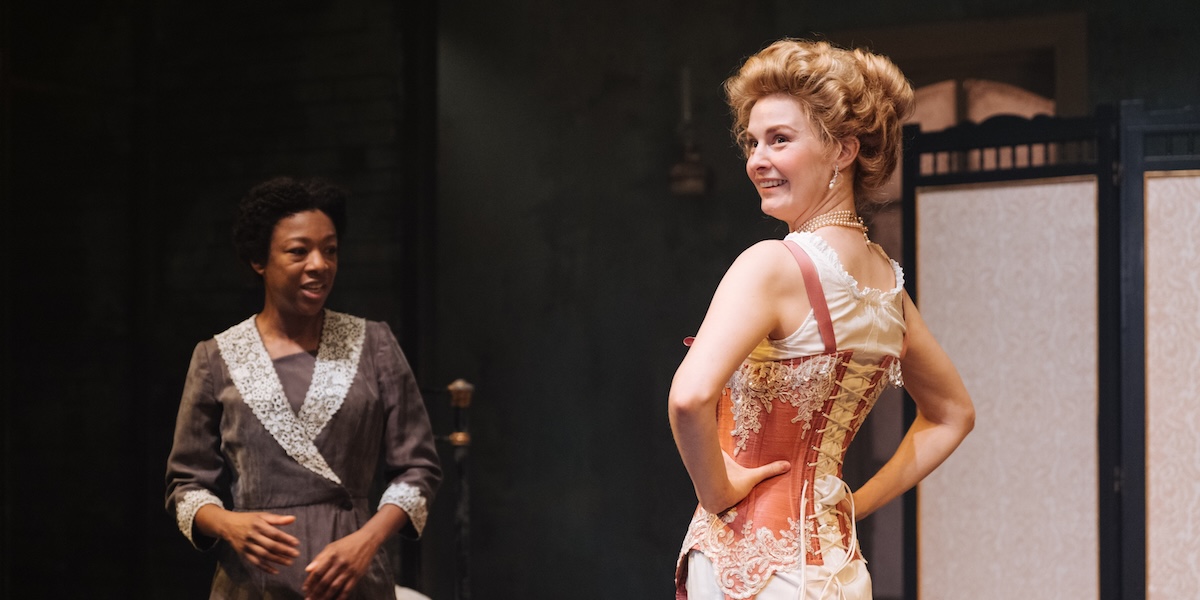
Samira Wiley & Claudia Jolly in Intimate Apparel. Photo: Helen Murray

The intimate apparel in question is a corset which back in 1905 when this play is set, helped women present to the outside world a body shape that conformed with that era’s restrictive standard of female beauty. But corsets aren’t the only deception going on in Lynn Nottage’s twisty play. Intimate Apparel shows us women faking it in a man’s world, while revealing their intimate feelings about their lives to each other when the disguise is off. At times, it is so believable, you forget you’re watching actors. This despite a minimal set and an audience on three sides.

It’s a play centred on women’s place in society at a time when black people were emerging from slavery and only men had the vote. The central character is Esther played by Samira Wiley. She is a black 35 year old unmarried seamstress who makes the intimate apparel of the title. She is shy and self deprecating about her looks. Her lack of confidence has kept her away from a social life, until she is now 35, has never had sex, and is effectively ‘on the shelf’. It is a monumental piece of acting, mixing downtrodden subservience with naive optimism, that totally convinces.

Esther’s clients are her world: they are quasi friends despite the difference in status. A motherly Mrs Dickson played by Nicola Hughes owns a boarding house in which Esther rents a room; Mrs Van Buren (Claudia Jolly) is a brittle white woman with a rich husband who neglects her; Mayme played with panache by Faith Omole achieves her independence through prostitution.

In a lesser play, these characters might be two dimensional ciphers representing different types of women in that society. We are told very little about their backgrounds or personal lives but Lyn Nottage’s special skill is to know her characters so well that every word they speak seems coated with the truth of a fully formed human being. It helps that these talented actors are there to inhabit the carefully created characters and give them a three dimensional reality.

The high quality of the acting extends to the two male characters- Kadiff Kirwan swaggers and whines as George, the kind of man who has never grown up, and Alex Waldmann gives a touching performance as the gentle, humorous Mr Marks, a haberdasher who is genuinely attracted to Esther and a would be a perfect match for her, but is held back by a religious faith that prevents him having physical contact with women outside his family.
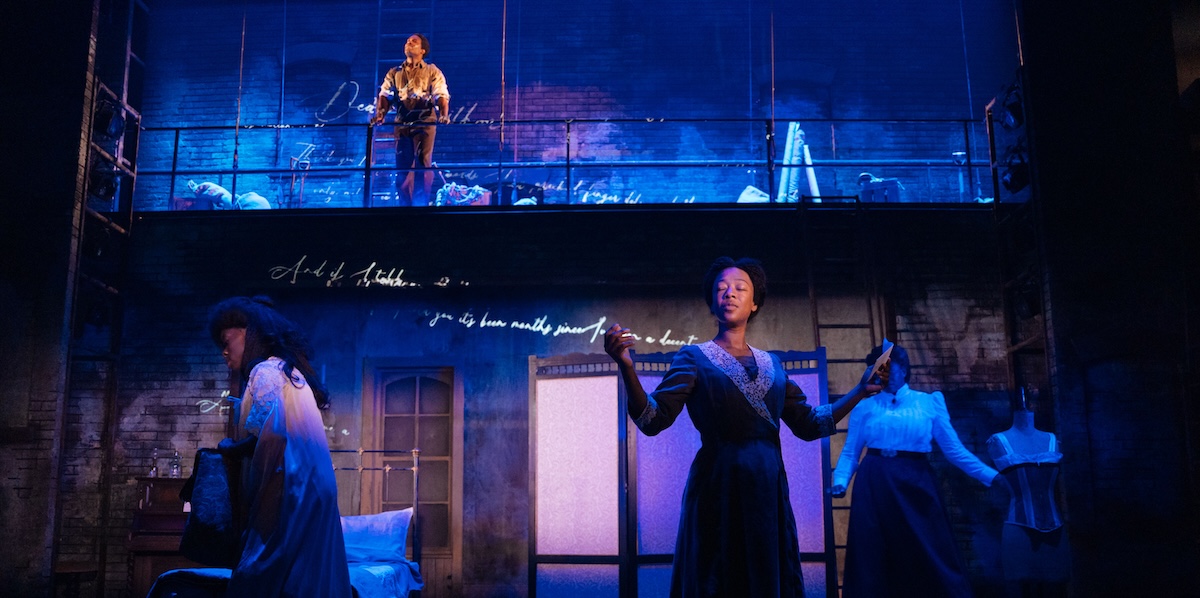
Intimate Apparel at The Donmar. Photo: Helen Murray

When Esther gets a letter out of the blue from a man looking for a pen pal, the other women encourage her to respond. Because she can neither read nor write, they pursue the correspondence on her behalf until a remote love affair takes place and Esther accepts a marriage proposal without ever having met her fiancé.

So, a marriage has been built on something every bit as fake as the bodies created by intimate apparel. Might it still work out or will Esther’s world come crashing down? That’s the subject of the second act.  I’d love to talk about what happens but it would be unfair to spoil the dramatic twists and revelations which actually provoked gasps from the audience- an indication of how involved we were. Credit to director Lynette Linton for the romantic build-up that drew us in and the explosive pinball machine speed with which it blew up in our faces.

Alex Berry’s set used the cramped space of the Donmar well- key props like a bed and sewing machine nimbly moving around while the male characters appeared from high up at the back like Gods. Her costumes were fabulous and I assume accurate representations of the clothes- and underwear- of the period.

Intimate Apparel can be seen at the Donmar theatre until 9 August 2025. Buy tickets direct from the theatre.

Paul paid for his ticket.

Watch this review on the YouTube channel Theatre Reviews With Paul Seven
 

Fairview by Jackie Sibblies Drury at the Young Vic – review

Fairview: Powerful comedy about race

★★★★

WARNING: THIS REVIEW CONTAINS SPOILERS. Invited critics were asked not reveal twists but it’s impossible to review why this play is so powerful without saying how and why. I paid for my ticket so I feel free to discuss the whole play.

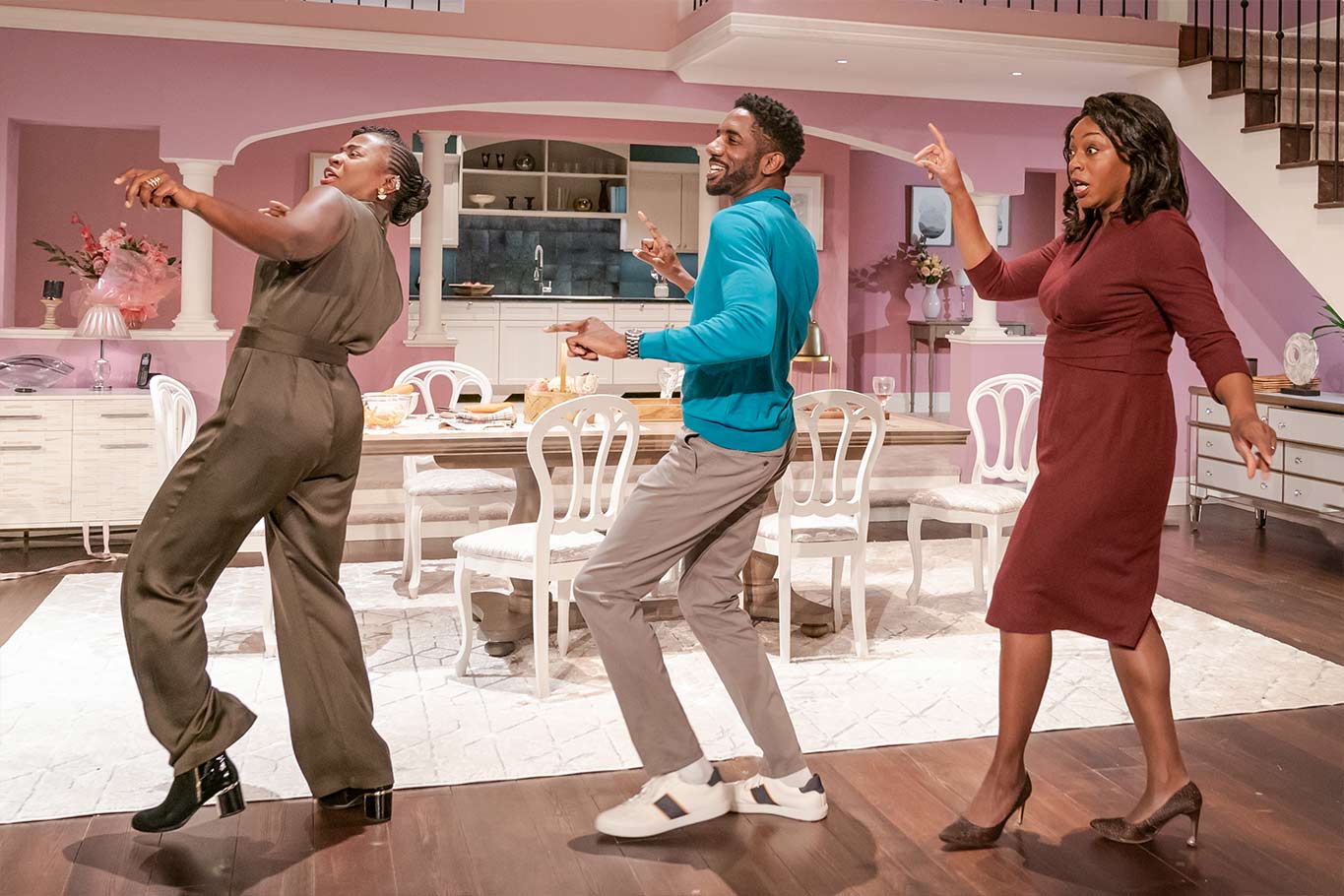
Production shot of Fairview at Young Vic featuring Naana Agyei-Ampadu, Rashan Stone & Nicola Hughes
Naana Agyei-Ampadu, Rashan Stone & Nicola Hughes in Fairview at Young Vic. Photo: Marc Brenner

‘What are you looking at?’ says the wife to the husband right at the beginning of Fairview at the Young Vic. And that really is the question. What are we looking at? The answer seems to be a well-off African-American family preparing for a special occasion. But there’s something not quite right. Is Jackie Sibblies Drury’s play going to be a family drama set around a dinner party with bickering, jealousy and secrets such as we’ve seen many times over the years? Or is this more like a pastiche of a US sitcom? The set, designed by Tom Scutt, is so bright and clean and detailed that it could be made for HD TV.

The characters are black, yes, which in our world of middle class theatre is unusual, so we may anticipate that race is going to figure. Then again, these are middle class people. Shut your eyes and the characters could be any colour: the wife Beverly played by Nicola Hughes with a perfect mix of bossiness, insecurity and affection, the playful husband Dayton played with a cheeky likeability by Rhashan Stone, Naana Agyei-Ampadu squeezing all the comedy she can from the fashion conscious, faddy sister Jasmine, the sensitive rebellious daughter Keisha played by Donna Banya, plus, off stage, the unreliable brother hoping for a partnership in his firm, the daughter’s friend and the mother who won’t come downstairs. All very amusing but fairly predictable archetypes.

There are peculiar moments in this first act that make you suspect there is more going on: the radio malfunctioning briefly, a tendency for the characters to break into dance, the daughter appearing in a spotlight to express her discomfort with the situation.

As if a brick wall has collapsed on you

Then we come to act two and everything changes. It’s as if a brick wall has collapsed on you. From here on in, we are in no doubt this is about race and we are looking at what it means to be black: the white gaze, the stereotypes, the cultural appropriation. Not that Jackie Sibblies Drury presents a simple lecture. Fairview is subtle comedy with many layers, presented with a unique theatricality and directed with flair by Nadia Latif. The twists are jaw dropping and lead you to question what happened in the first act and who these people are. So please don’t read any more if you don’t want to spoil those dizzying surprises.

WARNING: SPOILERS

Act two repeats act one but this time it’s acted out silently while the radio- maybe the radio- provides a commentary from four white people. Who are they? They could be the creators of the characters we are seeing or they could be simply ciphers for the white gaze. Anyway they digress into a discussion about what race they would like to be, each time coming up with stereotypical views of those races, ending with black, where they conclude they wouldn’t want to be the kind of middle class black people we are viewing because they are boring. It’s poor black people who are interesting- the rappers, the loud mamas. The voice who would like to be black remembers her black maid.

This does go on a bit but then there’s a delightful moment when the characters on stage, previously unsynchronised, segue into apparently mouthing what the voices are saying, even though we can remember that this wasn’t the dialogue from the first act. So, in a way, the characters come together in a prelude to the third act.

An uncomfortable evening for those ‘identifying as white’

Because, if that wasn’t enough, we then pick up story of the family and it’s not long before the characters we previously heard talking decide to come on to the stage to spice up this middle class family with black characters who are more ‘interesting’. So the missing brother appears as a rapper, although his sister is still asking how the partnership is going. The mother appears twice, once as the remembered black maid, a history Beverley contradicts. The white people confuse, question and provoke the black people. The black people object to being told what they are. It all ends in an amazing food fight.

Then in a final coup, the daughter invites those in the audience ‘identifying as white’ to come up on stage and see what it feels like to be in the spotlight. To not be ‘normal’, but instead to be focussed upon, expected to perform in a certain way, simply because of the colour of your skin. The actors leave the stage; many of the audience climb on to the stage including me. I’m uncomfortable with defining myself by race but I wasn’t going to pass up the opportunity to see the view from the stage.

It was an interesting experience. The lights are blinding. You can’t see the audience (or what’s left of it). You go from being an anonymous member of that audience to being the focus of attention. I tend to think that theatre is about letting you into other people’s lives or letting us see ourselves in different ways but this really took it from an intellectual exercise to a physical one.

Because Fairview is an American play, it wasn’t as much a punch in the guts for me as it clearly was to audiences when it first performed in the US where there is a history of slavery and segregation. Black people in this country have been and are subject to racial prejudice but they have never been divided from the white population. It would be much harder to write a play which involved stereotyping a black British culture.

A subtle layered comedy

Not that Jackie Sibblies Drury presents a lecture about racist stereotypes and cultural appropriation, except right at the end. If she did, I might be saying that she wasn’t telling us much we didn’t know already. Instead she starts with a middle class family, and thereby acknowledges that education and money are levellers. She subtly shows that even they are aware of what is expected of them which manifests as what you might call watered down stereotypes, a tendency to break into dance for example. She also presents the white people as stereotypes (the camp gay man springs to mind) which suggests that Fairview is not only about race.

I took from the evening a strong plea to take individual people as you find them- with a fair view- rather than imposing preconceptions or prejudices. Anyone could be a victim of prejudice if they are in an underprivileged or weaker group.

That’s what I came away with but this is such a good play that I think people, depending on their backgrounds and prejudices, will have come away with many different reactions. Even if you see it and decide, as some critics did, that Fairview is divisive or outdated, you will come out thinking and talking about it long after the audience have left the stage.

Fairview can be seen at the Young Vic in London until 23 January 2020.

Click here to watch the review of Fairview on YouTube

Minor amendments made on 14 January 2020

×