Theatre review: Nicola Walker in The Unbelievers

Nicola Walker carries the story of a missing son

Jerwood Theatre Downstairs at The Royal Court


Nicola Walker in The Unbelievers. Photo: Brinkhoff/Moegenburg

A boy vanishes without a trace just before his sixteenth birthday. His mother, Miriam, played by Nicola Walker, is devastated. We witness her and her family’s unravelling in the days immediately after his disappearance, one year later, and then seven years later. It’s a harrowing experience for them — but does it make for compelling theatre?

The point of the play is also the problem with it. While the boy’s two siblings and his father gradually attempt to reconcile themselves to his absence, Miriam refuses to accept that her son will not return. The timeline jumps back and forth, as if to show that she never changes, that time has stood still. The family find it increasingly difficult to coexist with her, despite their evident compassion. Their struggle stems partly from her obsessive focus on her missing son and partly from her perpetual anger. Unfortunately, this unchanging emotional state eventually alienates us as well, or alienated me at least.

Nick Payne’s play examines what happens when someone is psychologically unable to move beyond trauma. It’s a fascinating concept in theory, yet as drama, it can feel repetitive — despite the best efforts of the superb director Marianne Elliott, who injects pace and passion into the production.

Nicola Walker delivers an intense and characteristically nuanced performance, complete with her familiar tics and stutters, and emotional authenticity. However, and I hate to say this, after a while her sarcastic giggling at others’ perceived absurdities and repeatedly saying people should go fuck themselves become somewhat wearisome. Convincing as she is, it becomes difficult to remain emotionally invested.

The supporting characters remain sketchily drawn, defined mainly by their reactions to Miriam. Paul Higgins, as the husband, spends much of his time shouting. Alby Baldwin, portraying the elder sibling, grieves in silence. Miriam’s ex-husband, a priest played by Martin Marquez, flounders helplessly. Only the younger daughter (Lucy Thackeray) develops — she finds a partner, becomes pregnant, and tries hardest to reconnect with her mother. “I just want my mum back,” she pleads poignantly.

The Unbelievers at The Royal Court. Photo: Brinkhoff-Moegenburg

Walker is on stage almost continuously, while other actors, when not in a scene, sit silently in a dimly lit upstage area. Ordinarily, performers would exit, allowing the illusion that their lives continue offstage. Here, however, the visible ‘waiting room’ seems to symbolise how, for Miriam, her missing son Oscar remains ever-present, whereas everyone else is out of sight out of mind. Defending her attitude, she says that if any of them had disappeared, she wouldn’t give up on them either, but ironically she has. The spare set, designed by Bunny Christie, effectively mirrors Miriam’s single-minded preoccupation.

We glimpse Miriam’s experience over the course of the seven years: the early dealings with the police, subsequent false sightings and internet trolls, and the desperation of spiritualism and prayer. These should-be heart-wrenching moments but they failed to resonate with me, because I never felt sufficiently connected to the characters.

Because there is no story arc, no character development, and no resolution (we never know how or why Oscar disappeared, or whether he is alive or dead), I found the journey a little monotonous and felt deflated rather than emotionally drained by the end. On the other hand, it was interesting and unexpectedly humorous. And, as always, Nicola Walker delivered good value.

The Unbelievers can be seen at The Royal Court until 29 November 2025. Click here to buy tickets direct from the theatre.

Paul paid for his ticket.
Watch Paul’s review on YouTube

Read a round up of other critics’ reviews here

Anna Maxwell Martin & Chris O’Dowd – Constellations – review

Laughter and tears looking at the role of choice and chance in love

★★★★★

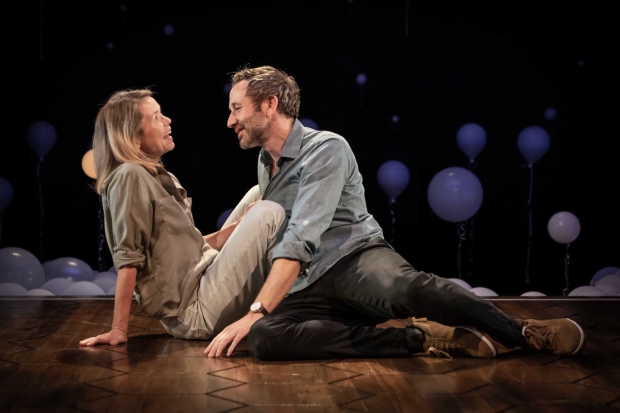
Production photo of Anna Maxwell Martin and Chris O'Dowd in the Donmar Warehouse production of Constellations by Nick Payne directed by Michael Longhurst at the Vaudeville Theatre London
Anna Maxwell Martin & Chris O’Dowd in Constellations. Photo: Marc Brenner

Constellations by Nick Payne at the Vaudeville Theatre is about the ups and downs of a relationship but it’s also about the choices the couple make, depending on the circumstances they are in at any given time or sometimes the mood they are in. So we see the same scenes again with different outcomes, and the potential to be very funny or desperately sad.

Throughout the multiverse of scenarios of false starts and alternative scenarios, and returning to earlier moments, there is a string that connects a linear story of a couple (played in the version I saw by Anna Maxwell Martin and Chris O’Dowd). They meet, form a relationship, split up after an affair, meet again and marry.

In one repeated scene, the man proposes using an analogy of bees. He first delivers his proposal in a stilted fashion, then stumbling, then smoothly.

The format is set from the start when, in a series of very short scenes, the relationship ends before it begins time after time, as each reveals a reason why they can’t get together, followed by a black out, until you are anticipating what the next obstacle will be. The funniest is probably when Chris O’Dowd ‘s previously single character says: ‘My wife’s getting me drink.’

It sounds confusing but it isn’t at all. It’s hard to praise the author enough such an ingenious construction that nevertheless remains watchable and funny.

The play is underpinned by the quantum mechanics-inspired theory that every time we do or don’t do something, a different version of the universe is triggered leading to an infinite number of parallel universes. This is illustrated by the love story between Marianne, a university researcher into quantum theory, and Roland a beekeeper, with indications throughout of how it could have gone differently. But what didn’t happen still informs our understanding of these characters and of what did happen in this particular story of two people who love one another but whose relationship also generates sparks.

And, in being made aware of the many possible outcomes, we inevitably ask how much if any free will is involved in our decisions? In this case, Nick Payne has made the decision to show us what happened when they stayed together, at least until a final choice of paths where, similar to Schrodinger’s cat being alive or dead, there is a one third likelihood of it going one way and two thirds the other. And, since the end is so sad, you also ask yourself whether one of the other paths we didn’t follow would have had a happier outcome.

So the play calls for two excellent actors, who can instantly change mood, and even situation, saying the lines with different intonation or swapping lines, and Anna Maxwell Martin and Chris O’Dowd are both actors of the highest order, with a great rapport, which is very important in linking the multiverse of outcomes we are presented with. They are also great comic actors to boot, which is important because there is much comedy.

In this revival by the Donmar Warehouse, being presented at the Vaudeville Theatre, there are four sets of couples playing the roles. It’s such a good idea to show how different actors of different ages and sexuality enhance the proposition that the characters’ story can be told in many different ways.

I wish I could have seen the others but I’m more than happy that I saw this pairing. Chris O’Dowd is not a regular on stage but he seemed so natural in his role as Roland. As we know, acting ‘natural’ is the hardest thing in the unnatural environment of a stage. He made his character laid back in a type familiar from his screen roles, but he could also be angry and upset as required, and he has a comic timing that any stage actor would be proud of.

Anna Maxwell Martin is a regular performer on stage and, while many of her roles have required her to be serious, she has a terrific comic streak. She can smile or be offhand, trot off an amusing line and hold just the right length of pause for laughter, and use terrific verbal dexterity then move on to a heartbreaking loss of the ability to speak properly. I am in awe of her acting skill.

This is the same production that originated at the Royal Court back in 2012 with the same director Michael Longhurst (Amadeus, Caroline Or Change). He must be credited with some of its success, not least the simplicity of the presentation, just the two actors at the front of the stage, with a background of balloons, representing perhaps a constellation of memories or even universes.

So space is apparently crowded by multiple universes but what about time? Well, that may not exist. The flitting back and forth through time- and (spoiler alert!)  the play having visited the end of their story actually ends with a jump back to the middle. This, it’s pointed out, is how our own stories exist in our minds: not a linear cradle to grave, but little fragments from all over the years. All of our lifetime in our head. That includes false memories. For example, Roland remembers them meeting at a wedding when we know it was a barbecue.

And talking of time, so packed is Constellations with these short meaningful fragments, and the concentration required is so intense, that the play seems much longer than 70 minutes. Which is a tribute to the author and the actors.

The Donmar Warehouse production of Constellations, with performances by Anna Maxwell Martin & Chris O’Dowd alternating with Omari Douglas & Russell Tovey, continues at the Vaudeville Theatre until 21st September

Click here to watch this review on the One MInute Theatre Reviews YouTube channel


×