Theatre review: Natalie Dormer in Anna Karenina at Chichester Festival Theatre

Game Of Thrones star soars in clipped Tolstoy

⭑⭑⭑

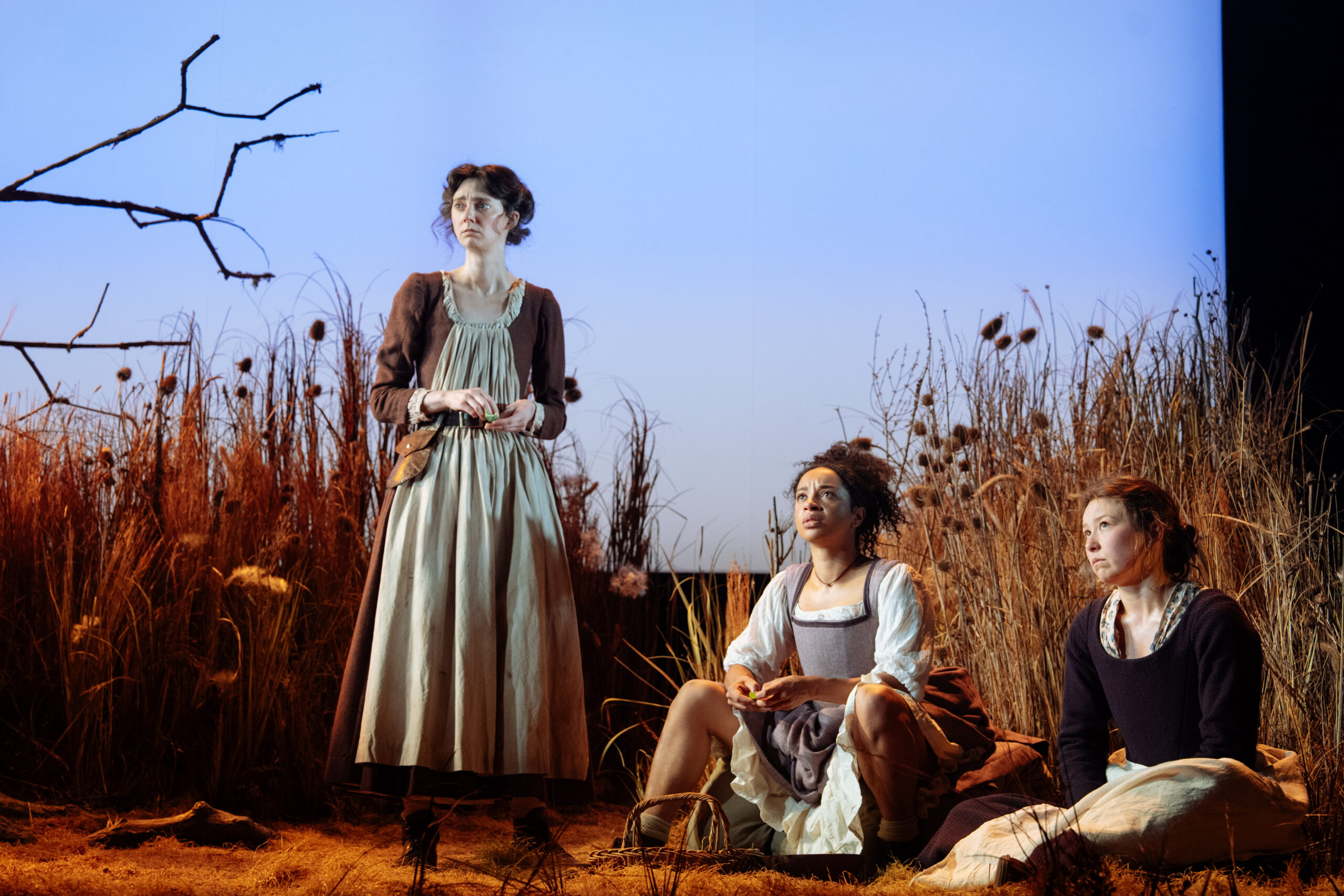
Natalie Dormer in Anna Karenina. Photo: Marc Brenner

For the second time in less than a week, I’ve sat through a play more than three hours long. Stereophonic which I saw a few days ago was, for me, too long. But Anna Karenina was actually too short. It barely gave Tolstoy or Natalie Dormer the chance to show off their brilliance. It was a good try but fell short of doing justice to a great novel.

At three hours, this stage adaptation by Phillip Breen can only hope to present a fraction of Tolstoy’s novel which runs to 38 hours on Audible. Mr Breen has chosen to try to tell the stories of all three of the main women: Anna, Dolly and Kitty. As a result none of them get a full swing at their characters in the time available.
Nevertheless the actors give impressive performances, not least Natalie Dormer as Anna who, within the scope she is given, brings a tornado of emotion to the role, so much so you find yourself longing for her next moment on stage. She has a rich colorata voice like a full bodied red wine, and her piercing eyes and curling mouth give passion to her words.
Naomi Sheldon as Dolly is wonderfully over the top as she harangues her useless philandering husband, bemoans her ageing body and rails against everything with a tirade of very modern expletives. Incidentally I thought the use of contemporary, particularly sexual, terms, while anachronistic, did work well as shorthand for the characters’ feelings.
Kitty was the most one dimensional of the main protagonists but Shalisha James-Davis made the most of this woman constantly on the verge of a nervous breakdown, as she assesses her obsessive suitor-then-husband.
The actors certainly convey the essence of their characters but inevitably much colour is lost. A great deal of narrative is also lost to what much of the time becomes a plot summary.
So, what is the plot? Anna is dissatisfied with ordinary family life and her husband Karenin, a seemingly nice, tolerant chap, and nicely played by Tomiwa Edun. She leaves him for a more passionate life with her lover Vronsky, whose fire cracker character is beautiully conveyed by Seamus Dillane. However, this being the mid 19th century, and she finds herself ostracised from society and separated from her children. Worse still, she begins to doubt Vronsky’s faithfulness. In fact all the men seem to have a roving eye whether they act upon it or not.
Two other unhappy relationships are explored. Levin, played with passion by David Oates, loves Kitty but she resists him. She thinks he will be unfaithful because of his past record of bed hopping. Eventually she is reassured and marries him but her doubts continue right up to a traumatic childbirth.
Dolly is already well into a marriage and has many children. Her husband Stiva gambles and womanises, in a splendidly spineless characterization by Jonnie Broadbent, and she constantly rails at him and at her own lack of attractiveness.
The problem with this filleting approach is that we lose much of the complexity of the characters and their lives. Rather than the flesh, we get the bare bones of the plot. When it comes down to it, plot is only the structure on which good novels or plays build their characters’ development. In this adaptation we are given three women who don’t trust their partners, shout and cry a lot, and end more or less happier than they began. And Tolstoy’s novel is a great deal more than that.
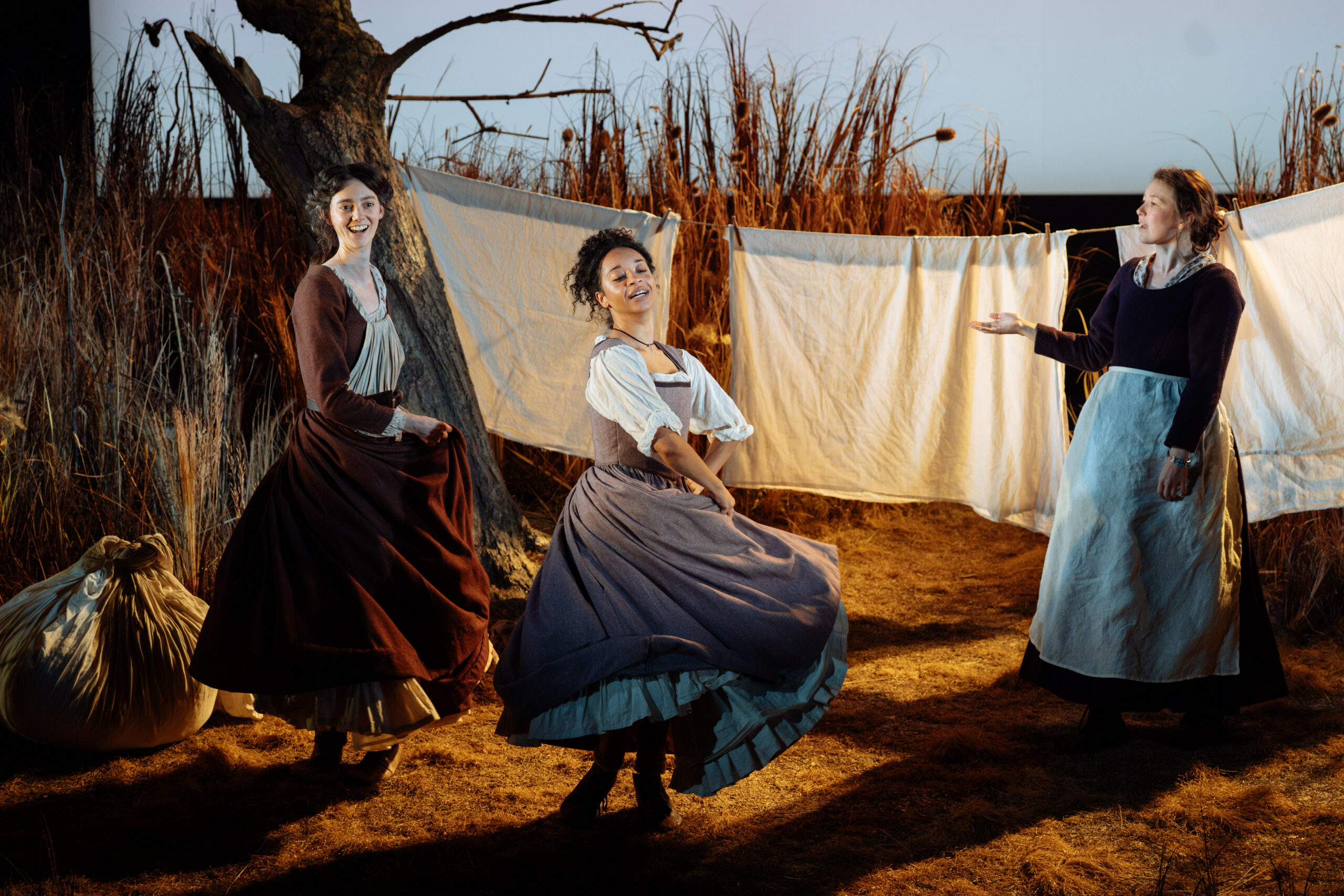
Anna Karenina at Chichester Festival Theatre. Photo: Marc Brenner

The other challenge is how to design it. The open Chichester stage doesn’t allow for solid scenery, except at the very back. So how to present horses and trains, very important components of this story? Since the adaptor Phillip Breen is also the director, we can assume he had a hand in the approach.

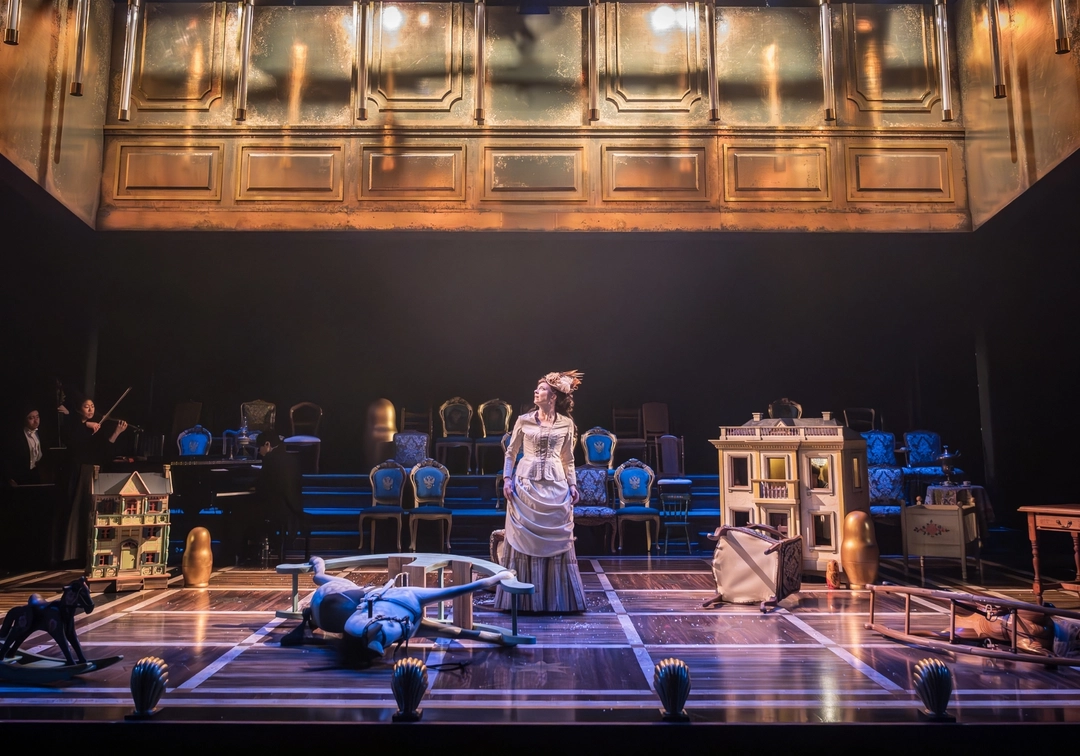
Although Max Jones’ exciting design is busy with many chairs that are moved around, the most noticeable aspect is a nursery theme. Children’s toys are scattered round the stage- dolls houses, horses, a train set. It serves to emphasise, perhaps, that women in this period are still treated like children in terms of their rights. I’m pretty sure the doll’s houses were meant to remind us of Ibsen’s play about another woman trapped in domesticity, a part which Natalie Dormer surely must play. The train set reminds us that the world is changing: modern inventions such as the railways and electricity have arrived. While the former is central to the story, the latter is also given its moment in the spotlight, so to speak, in the form of tubes of light which descend and form, of course, a cage.
The wooden horses come in handy as substitutes for the real thing but frankly the sight of a man shooting an ‘injured’ one was comical- shades of Monty Pyhton and Spamalot. And when Les Dennis in a delightful cameo as the world weary servant Petka drives a carriage drawn by rocking horse, it’s silly rather than amusing. I would rather have used my imagination more, something which we had to do, when it came to the all important train.
I liked many of the effects. The trio of Japanese musicians who played Paddy Cunneen’s edgy music. The way the large cast ( and there are nineteen named actors) sat in chairs at the back of the stage, especially the moment they scraped cutlery together during a dining scene.
There are too many short scenes which become messy but there are some scenes which really hit home, like Anna’s secretive visit to see her son. A rare moment when you really understand profoundly what she has given up.
This adaptation of Tolstoy’s novel is a brave attempt but, like Scott’s trek to the South Pole, it falls short of total success.
Anna Karenina can be seen at Chichester Festival theatre until 28 June 2025. Buy tickets directly here.
Paul was given a review ticket by the theatre.

Woody Harrelson and Andy Serkis in Ulster American – review

Harrelson, Serkis & Harland shine in Ireland satire

★★★★

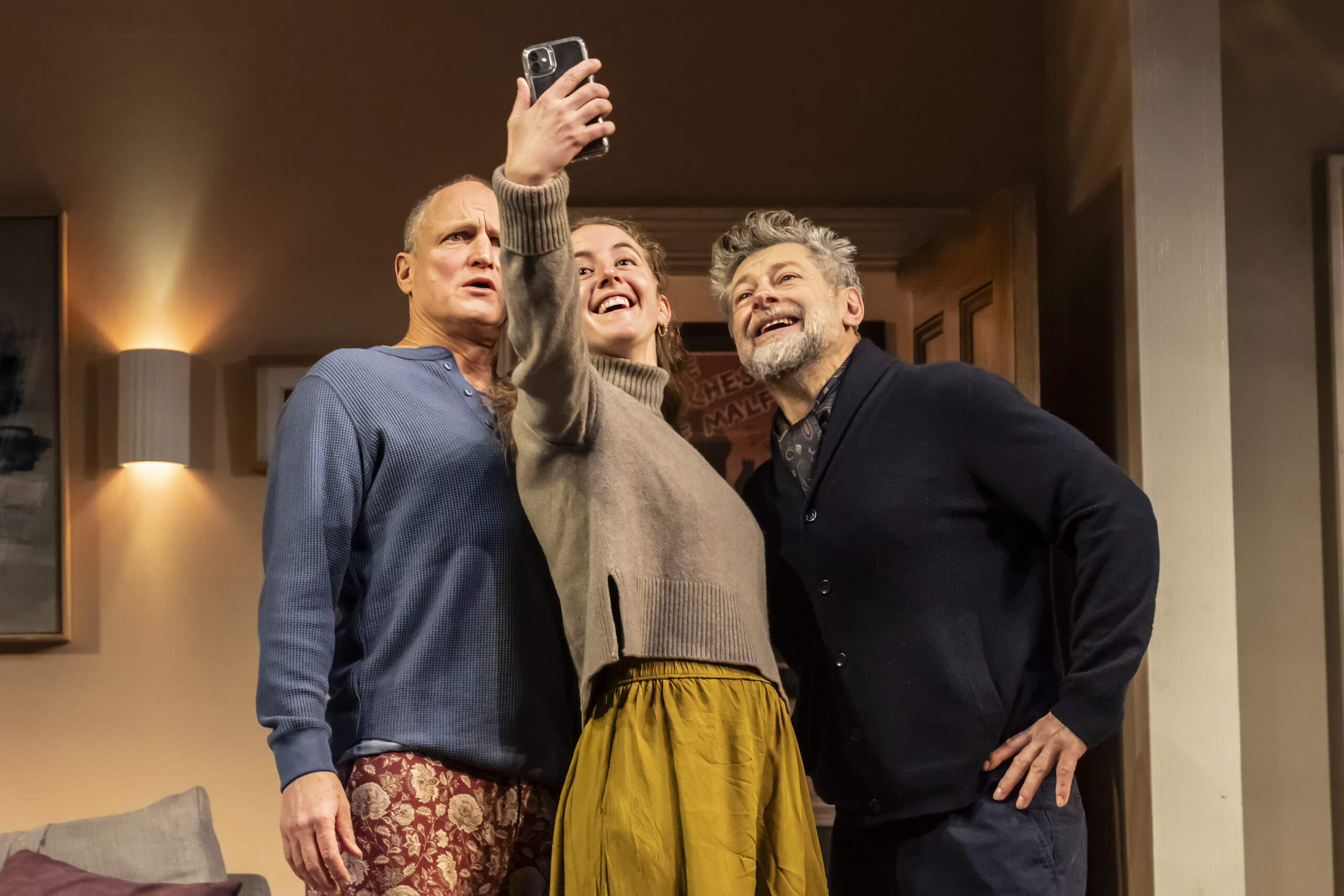
Woody Harrelson, Louisa Harland and Andy Serkis group for a selfie in a scene from Ulster American at the Riverside Studios in London December 2023.
Woody Harrelson, Louisa Harland & Andy Serkis in Ulster American. Photo: Johan Persson/

A big name from Hollywood has come to London to star in a stage play. That’s the basic plot of Ulster American by David Ireland. However, it so happens that two big names from Hollywood really have come to London to star in this particular stage play. And how lucky we are to be able to see the wonderful Woody Harrelson and Andy Serkis on the Riverside Studios stage.

Mr Harrelson is the actor Jay and Mr Serkis plays Leigh, the director of the play. The two men are due to meet with the playwright the night before rehearsals begin. The venue is the director’s living room, a meticulous naturalistic set from Max Jones. They are playing a cat and mouse game, the rodent being Leigh. He thinks the coup of securing an Oscar-winning Hollywood actor will propel him to the artistic directorship of the National Theatre, so he doesn’t want to upset his star. Hence he pussy foots around Jay, panders to his outlandish opinions and eccentric behaviour.
All the while, Jay swaggers and poses and mansplains. Woody Harrelson is superb in this role. He has an easy film star smile and a physical dominance that especially manifests itself when he crouches in what could be a yoga position but makes him appear like an alpha male gorilla. He lopes like a menacing ape while Andy Serkis scuttles like a demented crab.
Jay is a caricature of the kind of actor whom stardom has turned into a spoilt child, and whose every whim and fancy is indulged. He is convinced the Bechdel test was invented by a man; he asks whether white people should ‘reclaim’ the N-word.
The most disturbing moment of this early encounter is when Jay asks Leigh who he would rape if forced to do so at gunpoint. It is shocking but amusing that Jay is so crass that he could even ask the question, but the funniest aspect is Andy Serkis’s reaction. His shocked expressions, squirming postures and desperate grabbing for a drink are a joy to watch.
Even so, is rape a subject for humour? You feel that, while David Ireland is exposing the hypocrisy of these two self-centered men who pretend to have feminist credentials in order to maintain their power, he is also jabbing his finger at us the audience as if to say why are you laughing at this?
He intends a parallel between these white males’ behaviour towards women and the British attitude to the Northern Irish, past and present. So, we the audience’s hypocrisy is being tested.
When Ruth the playwright arrives, tension is already high. And there are few directors as good Jeremy Herrin at signalling antagonistic feelings between characters, as we’ve seen recently in Best Of Enemies and A Mirror.
Played by Louisa Harland in a powerful performance, Ruth is thrilled her play has been chosen by this great actor. Her smile soon fades when she realises the true character of these men.
Straightaway , she reveals her steel when, despite her being introduced by Leigh as being Irish, she insists that, as someone from Northern Ireland, she is British.
Matters are made worse when the Irish American actor who thinks he will be playing a member of the IRA discovers that his character is a psychopathic Ulster Unionist who wants to kill catholics.
She will not change her script to accommodate him. Both men reveal their true colours as they abandon their previous pretension that they want to reveal artistic truth, by ignoring the truth of her play and trying to rewrite it.
Before long, verbal abuse becomes physical, and there is an hilarious chase around the room and through doors that reminds us of Jeremy Herrin’s skill as a director of farce that was seen in his production of Noises Off.
Some of the comedy dialogue is heavy handed, sometimes Woody Harrelson clowns a little too much, and the violent ending doesn’t have the smooth inevitability of a Martin McDonagh play, (which Ulster American resembles) but overall the effect is equivalent to a theatrical stun gun.
The message seems to be: ‘Don’t be surprised if your bad behaviour whether towards women, the Irish or anyone, comes back to poke you in the eye’.

The Ulster American can be seen At Riverside Studios intil 27 January 2024.

Paul received a review ticket from the producer.

The Inquiry – Minerva – review

New political play by Guardian writer lacks drama

★★

John Heffernan, a male actor, stands in front of Deborah Findlay, a female actor, and leans forward to make a point, in the play The Inquiry at Chichestre's Minerva Theatre
Deborah Findlay & John Heffernan in The Inquiry. Photo: Manuel Harlan

I’ve probably been to and enjoyed more plays at Chichester Festival Theatres than anywhere else except the National Theatre. Unfortunately, The Inquiry at The Minerva wasn’t one of them.

The finale of Chichester’s 2023 season is Harry Davies’ theatrical debut and, no question, he is a promising playwright. Indeed there are signs that he has the potential to be another James Graham. I even suspect that, with more work, this play could take off but, at the moment, it’s still on the runway.

Before I report on my inquiry into what went wrong with The Inquiry, let me describe the subject of the play. Public Inquiries were established to answer the need for independent investigations into major incidents, as opposed to the previous practice of governments scrutinising their own wrongdoing. Harry Davies questions just how independent they are.
The subject of this particular Inquiry is a mass poisoning involving a water company. We join it at the stage known as ‘Maxwellisation’, a word I’d never come across before, but which is the term used for the moment when an Inquiry’s draft report is passed to those criticised, for comment and possible correction of facts.
The Justice Minister, who is also Lord Chancellor and an aspiring Prime Minister, has been chastised in the report for his actions whilst Environment Minister. He is dragging his feet in providing his response. To spice things up, someone is leaking confidential information about the report. The minister and his cohort are convinced it must be the Inquiry chair’s team. They plan a counterattack through the media to undermine the inquiry.
You might imagine this is the stuff of gripping drama. It’s not. Apparently, the Inquiry has so far taken four years, and the first act, in which the groundwork is laid for the second act, at some moments felt like it was going to last as long.
The complexities of public inquiries and political intrigues have the potential to be interesting, but only if the characters are meaty. The problem with The Inquiry is that they’re all rather more vegetable than red-blooded.
John Heffernan plays Arthur Gill, the minister under siege. Soft spoken with a ready smile and a flippant approach to serious questions, he is never likely to be accused of being a bully, or arrogant or even ambitious, despite having his eyes on the prime ministerial prize. Mr Heffernan brings colour to the role but he’s working from a pastel palette.
His assistant Helen played by Stephanie Street and his civil servant-cum-just-plain-servant Donna, played by Macy Nyman, are scarcely less pleasant.
Over on the opposing team, Lady Justice Deborah Wingate who chairs the Inquiry is just as quietly spoken, reasonable and smiley. You do get a sense of the steel she would need to employ in her position, but Deborah Findlay’s portrayal emphasises the niceness. No less nice is her right-hand man Jonathan Hayden KC, a charming fixer played by Nicholas Rowe.
Oh, and there’s Arthur Gill’s fixer, his old mentor, Lord Patrick Thorncliffe, who ‘knows’ people and shows at least a hint of ruthlessness behind his smooth exterior. Malcolm Sinclair is appropriately patrician in the role.

Not enough variety in the characters

Mr Davies writes decent, flowing dialogue but his characters all have the same way of speaking, and they’re all ever so polite. It’s as if they all went to the same public school, the same university and belong to the same club. Imagine you bought a Kellogg’s variety pack, and found they were all cornflakes. At one point, Arthur and Deborah even compare memories of their barrister days.
Now, Harry Davies might be making a point that those who run our government and judicial system are all part of an elite club, who know one another and have more in common with each other than they do with the rest of us. But, in a drama, we need characters to have characteristics that will amuse us and annoy us, but, most of all, make us believe their story.
Take David Cameron and Boris Johnson. They have almost identical educational backgrounds but very different characters. The people in The Inquiry seem to have no distinguishing features. When it comes to vanilla, they rival Madagascar.
John Heffernan, Stephanie Street and Malcolm Sinclair who are three actors in the play The Inquiry at The Minerva Theatre in Chichester, are grouped around a table
John Heffernan, Stephanie Street & Malcolm Sinclair in The Inquiry. Photo: Manuel Harlan

I don’t mean The Inquiry should be like The Thick Of It but it would help if the combatants had some distinguishing mannerisms, verbal habits, or, heaven forbid, volatility. For goodness sake, these are politicians and barristers, professions full of actors manqués, people who deliberately adopt a persona for effect. It not only undermines the drama than none of them possess a ready wit, a line in sarcasm, a short fuse, or even a twitch, it takes away credibility.

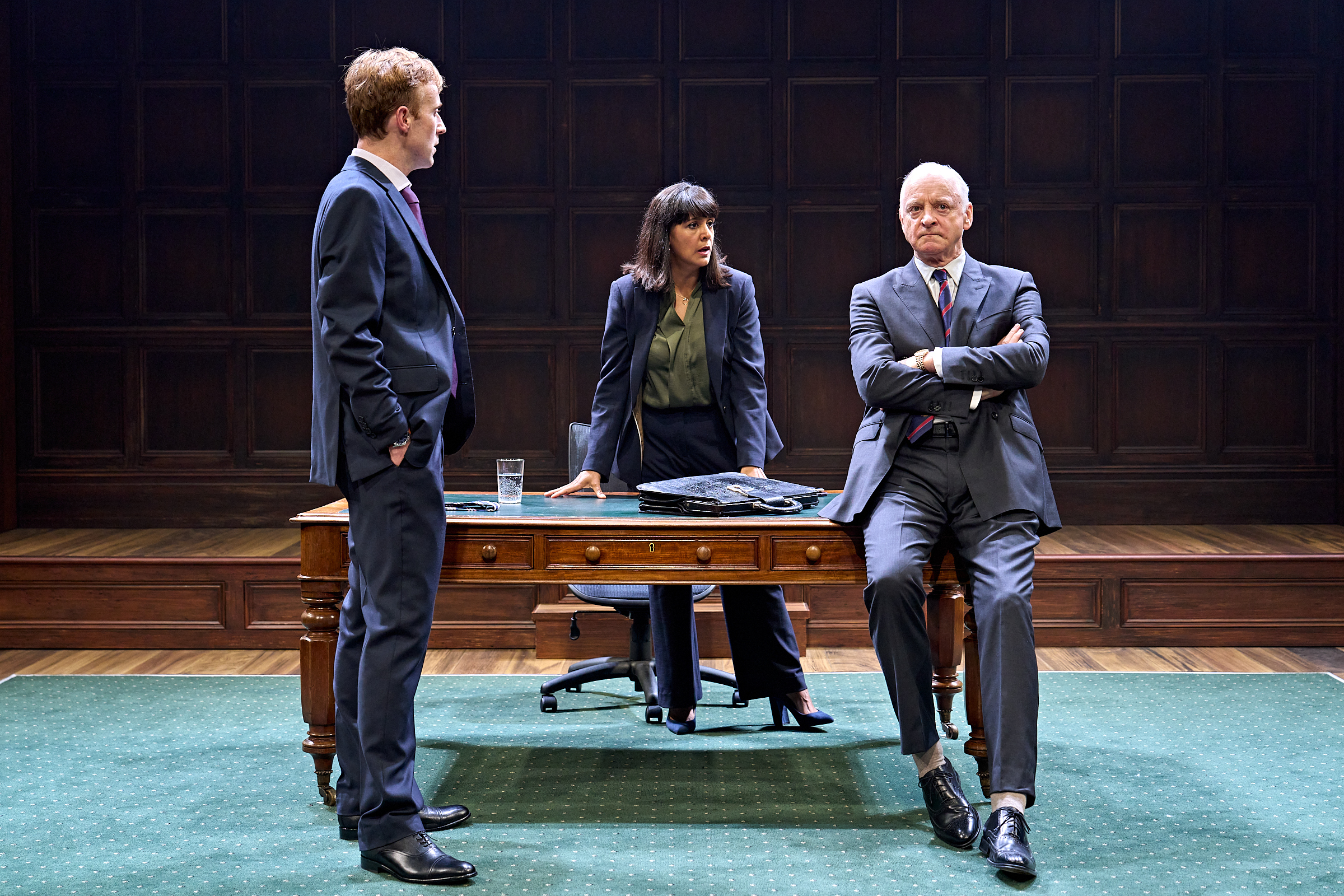
The set designed by Max Jones reflects this: a background of a large rectangle of oak against a larger rectangle of marble, a leather-topped desk on a green carpet on a polished wooden floor. What could be more solid, more neutral- and more boring? This would be highly effective, if only it were in contrast to the characters squabbling on this stage.
Thank goodness for the quality of acting and Joanna Bowman’s direction, which breathed some life into the story.
There are moments within the play when you wake up and take notice. Each act features an ongoing interview between Arthur and a friendly journalist, Elyse. She’s not exactly Jeremy Paxman but she does get beneath his skin, and enables him to reveal more about himself than we might otherwise have learned. It’s a part played with zest by Shazia Nichols.
And I did like the way the play was full of misdirections, admittedly some more clever than others, before it gets to its big question: whether these two powerful people- the minister and the judge- will put their personal feelings or their ambition first.
Everything leads to the one-on-one confrontation, as he tries to force her into resignation and she steadfastly stands her ground. This provides some real drama, as an amiable irresistible force meets a mild-mannered immovable object. It’s a scene of revelations and one major twist. However, that twist is so implausible that when Dame Deborah said, ‘I find that hard to believe’, I found myself nodding: ‘You and me both, my Lady.’

I wondered for a moment whether I’d got the time frame wrong but the play is clearly set in the present day or thereabouts. Both have secrets that could have been scandals in a play from the early 1950s, maybe by Terence Rattigan whose style this drama resembles, but today? I wasn’t convinced. 
Even if The Inquiry doesn’t quite deliver the goods, I hope to see more from Harry Davies.
The Inquiry can be seen at The Minerva until 11 November 2023
Paul was given a review ticket by the theatre

Jonny Lee Miller in A Mirror – Almeida – review

Jonny Lee Miller excels as actor playing censor

★★★★

A male actor stands looking down at a female actor on a chair
Jonny Lee Miller and Tanya Reynolds in A Mirror. Photo: Marc Brenner

It may seem like we’re attending a wedding but it’s clear there’s something else going on. There are posters telling us ‘This Play Is A Lie’. There’s a massive Oath of Allegiance in the foyer. The smaller poster warning against subversion. Even as you sip your delicious coffee from the bar, you realise that you are meant to be in some kind of authoritarian state and this is going to be one of those evenings when you are part of the play. The play in question is A Mirror, a new work by Sam Holcroft that explores state censorship and the state of theatrical writing.

Inside the auditorium, a wedding is taking place. Except it isn’t. That’s just a cover to fool the authorities. We’re really here to watch an unlicensed play, apparently at some danger not only to the actors but to ourselves.
Sam Holcroft was inspired to write this play by a visit to North Korea. Then again, censorship comes in many forms: self censorship under the pressure of social media mobs or powerful people being the most pernicious.
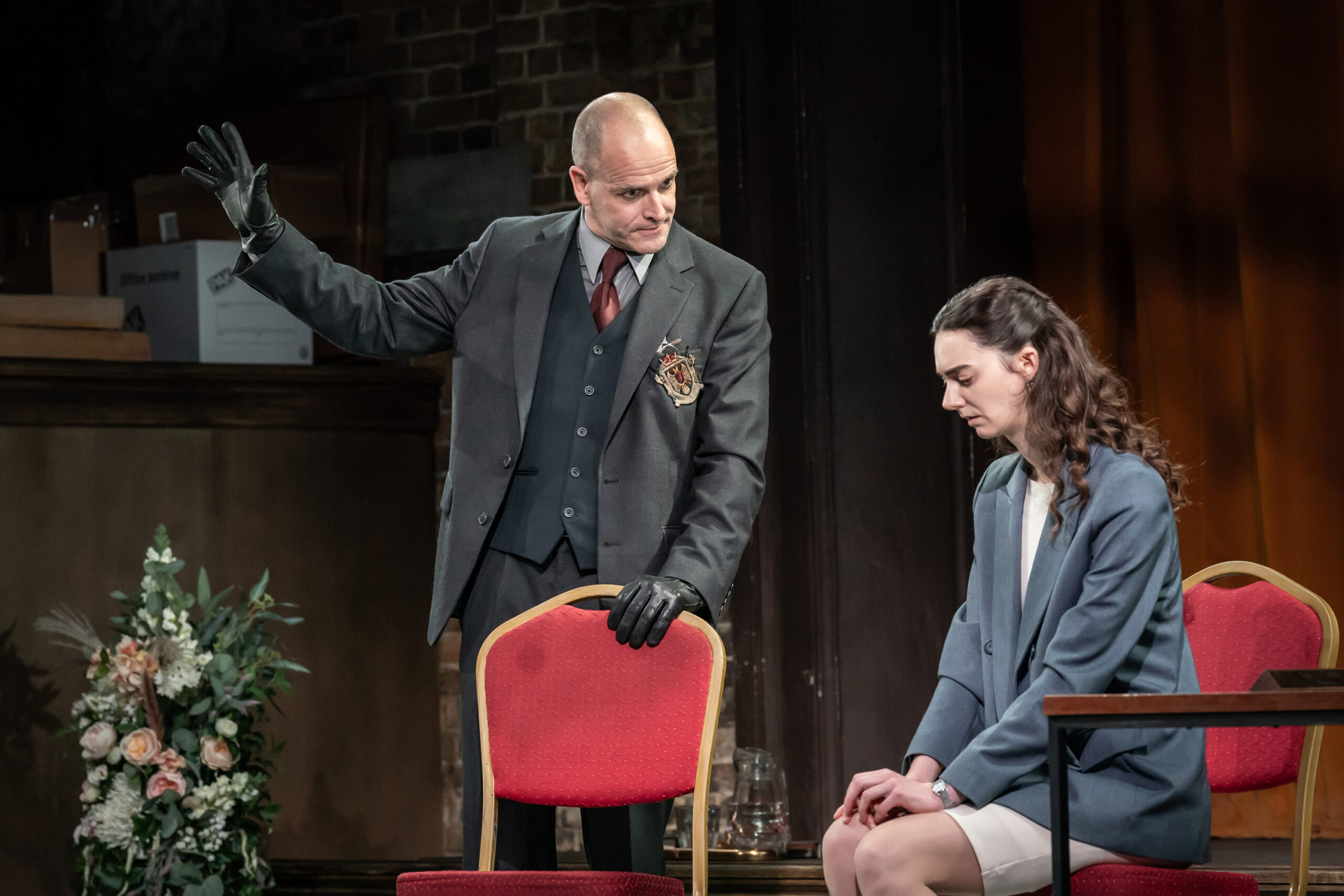
The play- the illegal play- begins with a government censor Mr Čelik interviewing a new young playwright Adem. Those who have come to the show primarily to see Jonny Lee Miller will be very happy. The star of the film Trainspotting, the TV series Elementary, and theatre such as the National’s Frankenstein commands the stage. As Čelik, his leather gloves, his stiff stance, his tight smile, his clipped way of speaking, even his moments of vulnerability and self delusion, give him a sinister air no matter how charming he appears to be.
It’s really quite hard to take your eyes off him, which is a shame because Micheal Ward from TV’s Top Boy who plays Adem is tremendous in his stage debut. His character’s sincerity and naivety are pitched perfectly so that his puzzlement at the criticism leveled at his writing and his eagerness to please, even as he inadvertently produces ever more provocative work, is always believable.
What has attracted Čelik to Adem’s first play is that he can write dialogue that rings true. The problem is, the subject matter is unacceptable- a prostitute and her client, drug dealing, a man masturbating, and much more expose the failings of the country. It turns out that Adem has the ability to remember word for word what people say and that his work is transcripts of conversations he has heard through the walls of his flat, which is why his play is so true to life.
Things get decidedly more complicated- and funnier- when he returns with a new effort which is a transcript of his first meeting with Čelik. Why is this controversial? Because by holding up a mirror to Čelik, the government officer sees his own behaviour as a censor exposed.
The theme of the play- that is, both the play within the play and the overall play- is that art should be a mirror to us, to life and to society. This is an entertaining satire so I’m sure Sam Holcroft doesn’t mean us to take literally that art is better when it offers verbatim dialogue, but the point is, the best art tells a truth, whereas the Ministry of Culture wants it to tell a lie– to offer heroic tales with happy endings that glorify the motherland.
Čelik takes his new assistant Mei under his wing. Alongside an awkward seduction, he attempts to educate her about the power of art. One of the tragedies of this story is that the censor is only too well aware of its power, which is why it needs to be censored. He introduces her to Shakespeare, particularly Romeo And Juliet which has been banned because of its downbeat ending.
One of the joys of this production is the performance of Tanya Reynolds in which Mei blossoms before our eyes. At first, she is a nervous newcomer worried about expressing an opinion but aware that the little, and officially approved, theatre she has seen doesn’t have the ring of truth. All the while she is trying to manage her boss’s amorous intentions. Then she grows in confidence as she gets to know great plays: a perfect illustration of the power of art.

She also gets some of the funniest lines, as when the only thing she likes about one officially approved play is that the trees were realistic.

Two male actors exchange a joke
Micheal Ward and Geoffrey Streatfeild in A Mirror. Photo: Marc Brenner

Some of the most enjoyable moments in A Mirror are when the characters do readings from plays, usually badly, with Mei the most stilted of all. It’s a hilarious parody of theatre, illustrating the important role of actors in interpreting writing. Two versions of a real wartime event are set alongside one another- one a heroic fairytale by an official playwright Bax, Čelik’s star protégé, the other raw and truthful by Adem.

It could be argued that Sam Holcroft presents some of her arguments against censorship too simplistically. After all, much great art has been produced in censorious times: before 1968, Wilde, Coward, Shaw, Rattigan, even Joe Orton, had to submit to the blue pencil of the Lord Chamberlain, and Shakespeare’s plays required the approval of his predecessor, the Master of Revels. Many classic films of the forties were made under the Hays Code.  But Ms Holcroft and director Jeremy Herrin keep the satire moving in a way that doesn’t give you time to question the details too closely.
The state-sponsored playwright Bax is pleased with his fame but cannot come to terms with his compromises. Geoffrey Streatfeild gives his character the right mix of arrogance and self-loathing.

The Power of Theatre

There are various interruptions because police are apparently in the vicinity, during which the cover story of the ‘wedding’ resumes. Characters rush around the auditorium checking doors. These are the occasions when we are reminded that Jonny Lee Miller is an actor playing an actor pretending to be a censor. Again, a first-hand example of the power of theatre.
I won’t go any further in describing the story because it ends with a major twist, albeit one that makes perfect sense when you review what you’ve seen.
Instead, let me describe Max Jones’ set. It begins as a wedding venue. The audience is on three sides, and a raised thrust stage features a cake on a table. This is cleared to be replaced by a desk and chairs. Further back is a half-curtained area indicating a backstage but also suggesting, to me anyway, the kind of curtain that concealed the reality of the puffed-up Wizard of Oz.
Nick Powell’s music played by cellist Miriam Wakeling is a constant addition to the tense atmosphere. And tense is the word I would return to again and again in Jeremy Herrin’s robust production of Sam Holcroft’s exploration of the importance of art and the many ways, crude and subtle, in which it can be censored.                                       
Thank goodness for the Almeida Theatre and its artistic director Rupert Goold for continuing to stage bold new work when so many are playing safe.
Parts of this review have been redacted by the Minister of Culture
A Mirror runs at the Almeida Theatre in London until 23 September 2023.

Paul was given a review ticket by the theatre.

Follow Paul on Threads, Mastodon, X, Instagram and Facebook

×