Terence Rattigan’s play is overpowered by Ben Daniels’ thrilling performance
⭑⭑⭑⭑
Ben Daniels in Man And Boy. Photo: Manuel Harlan
Terence Rattigan is now recognised as one of our great playwrights, spoken of as a successor to Ibsen and Chekov. But this wasn’t always so. After his pre-eminence in the 1940s and 50s, he was swept aside by the new wave of so-called kitchen sink and absurdist drama from the likes of Osborne and Pinter. So when Man And Boy arrived in 1962, it was pretty much dismissed by audiences and critics. It took until 2005 before there was a revival in London, which, although well received, still didn’t bring it into the repertoire of regularly performed Rattigan plays such as The Winslow Boy, The Browning Version, The Deep Blue Sea, and Separate Tables.
Is it then a problem play? Well, the National Theatre is giving us a chance to find out, albeit clothed in a thoroughly modern makeover. The trouble is, Anthony Lau‘s stripped down treatment featuring Ben Daniels leaping on and off tables, tends to overpower the play itself. Then again, it’s such a thrill, maybe that doesn’t matter.
Man And Boy, set in the early 1930s, when financial markets were unstable, centres an amoral, sociopathic millionaire and his relationship with his son. Gregor Antonescu is said to the richest, cleverest financier in the world. Ben Daniels, suited and booted, knocks the role into the acting stratosphere, brilliantly conveying a fast talking charm while occasionally revealing his savage contempt for all around him. He smiles, he bares his teeth, he moves like a raptor.
Ben Daniels in Man And Boy. Photo: Manuel Harlan
‘Liquidity and confidence’ keep him afloat, and it’s a phrase he often repeats. As the play begins, liquidity has deserted him in this world where loans are moved around and called in at dizzying speed, and with that has gone his backers’ confidence in him. Matters are made worse when criminal charges are brought against him. ‘In finance, man makes his own miracles,’ says Gregor, and sets about proving his point. A radio provides an urgent commentary. It’s a searing, damning portrait of the world of the super rich, that resonates today.
Trying to avoid the media while he attempts to make a deal that will save him, he holes up in his estranged son Basil’s pokey apartment in a poor part of New York. It turns out the venue is not random. He has set up a meeting with a major banker Mark Herries, played with a combination of smarm and steel by Malcolm Sinclair. Herries is a closet gay man, whom Gregor hopes to manipulate by passing off his son as a rent boy that he can link up with.
Basil is played with a moving mixture of sadness and surliness by Laurie Kynaston. He is a sensitive musician with a social conscience, hence ‘weak’ in Gregor’s eyes. At first, Basil is hostile to his father- ‘you are nothing’ he says- yet still shows filial loyalty when his father is under threat. So, the second half of the play looks more closely at this damaged relationship, with a broken Gregor who has previously said ‘love is a commodity I can’t afford’ wondering whether he has underestimated the importance of love, and Basil doing everything he can to gain that missing paternal affection.
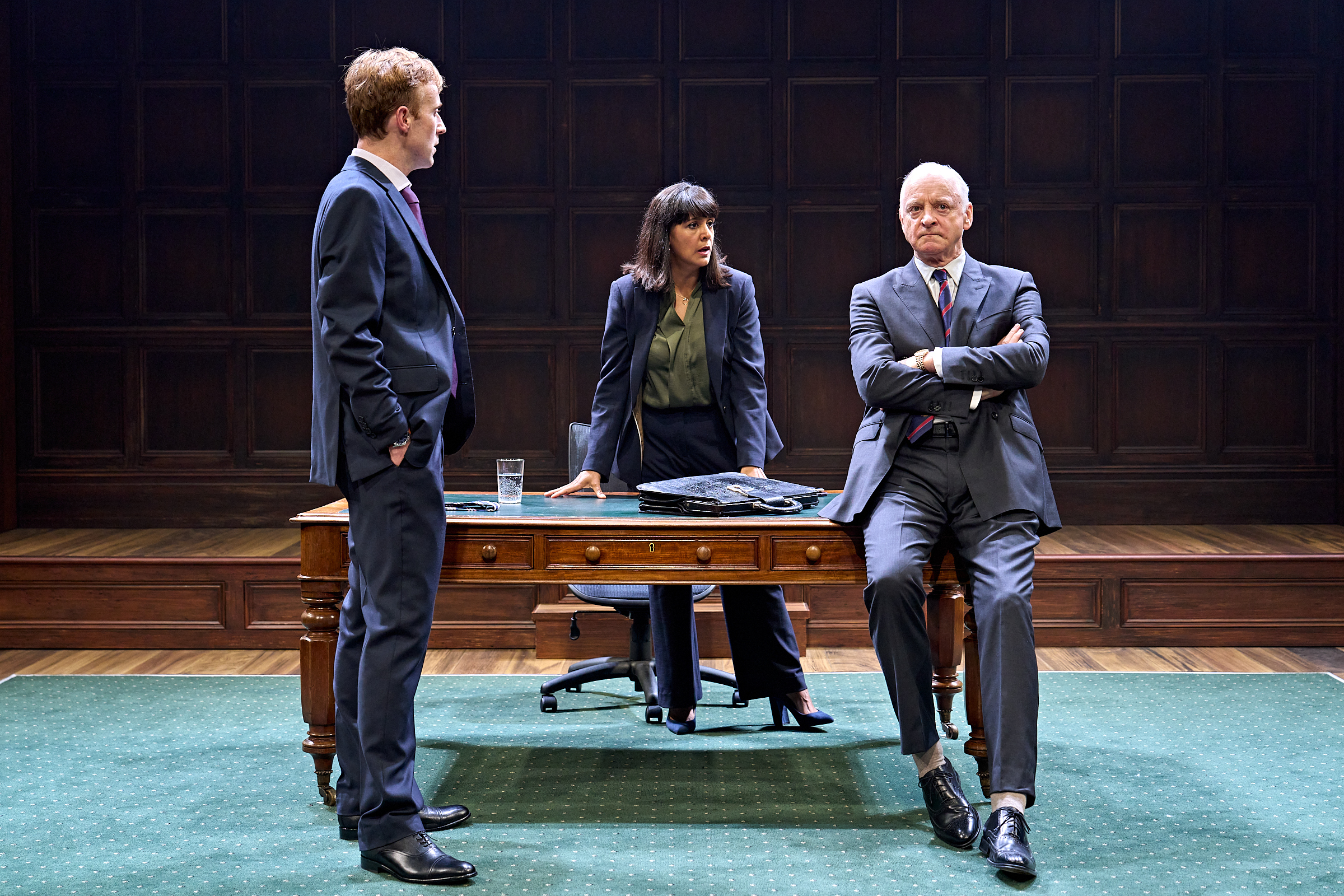
So, what about the tables? On the stage of Georgia Lowe‘s traverse-style set are three long tables that are moved into different configurations for no reason that was apparent to me, unless it was an elaborate pun to do with turning the tables on his enemies. In addition, there are a few simple chairs, a piano, a telephone, a radio, and I think that was it.
On one wall at the back of the theatre is projected the cast list and above the stage entrance the neon words ‘Knock Knock’, although it’s always a doorbell that rings. Why? It could be an attempt at Brechtian alienation, intended to make us step back from emotional involvement, and think about the moral issues. I doubt Rattigan would have approved.
Do the tables help or hinder?
So do the tables help or hinder our understanding of the play? Looked at positively, they create some dramatic moments when Ben Daniels jumps onto them and looks down on all around him. At these times, he is the colossus the world believes him to be, and when he crouches on his haunches and leans over his son, he is like an alpha male silverback gorilla. But, also, they are only cheap kitchen tables, an apt metaphor for the flimsy foundations of Gregor’s power. Credit here to Choreographer and Movement Director Aline David.
Ben Daniels & Laurie Kynaston in Man And Boy. Photo: Manuel Harlan
Then again, when other characters clamber onto a table, the effect feels mannered and a bit distracting. Are they isolating themselves from those close to them, as they are already doing emotionally? Maybe. Or are they just doing it because the tables are there? Any way you interpret it, I will always think of this as the ‘table production’.
I guess we’re used to seeing plays by Rattigan’s contemporaries, writers like Arthur Miller and Tennessee Williams, being given minimalist settings, not to mention those by the father of naturalism, Ibsen. But a naturalistic background has come to seem integral to Rattigan’s work. Very few of us have had the opportunity to see Man And Boy in a conventional production, so it’s hard to judge what is gained or lost in this stripped-bare version.
While the first half dominance of Ben Daniels was thrilling, and his breakdown in the second half shocking, yet his sheer theatrical force, and (yes) the tables, stopped me from getting fully engaged with the evolution of the father-son relationship. This may be intentional, since the play’s centre of gravity is undeniably Gregor.
The other characters we encounter are very much secondary, albeit well played. Phoebe Campbell brings verve to Basil’s girlfriend Carol. Gregor knows all about her, because he has spies, and information is power in his world (that’s how he knows about Mark Harries’ secret life). Leo Wan is David Beeston, an accountant at first confident and aggressive when he tries to prove Gregor’s corruption, but who breaks down in the face of humiliation and frustration. Isabella Laughland gives a delightful performance as Gregor’s semi-detached wife, enjoying the high life but annoyed at the lack of attention from her husband. Nick Fletcher plays Sven, Gregor’s cynical consigliere. It is significant that when Gregor hits rock bottom and craves some human touch, his Wife and his closest friend both make their excuses.
By the way, although I said the set is two-sided, there are gallery and circle seats on the other two sides. I would advise you that those areas offer severely restricted views.
Man And Boy make lack the finesse of Rattigan’s best plays, but Anthony Lau’s bold staging and Ben Daniels mighty performance make the revivial well worthwhile.
Man And Boy can be seen at the National Theatre until 14 March 2026.Buy tickets directly from nationaltheatre.org.uk
Deborah Findlay & John Heffernan in The Inquiry. Photo: Manuel Harlan
I’ve probably been to and enjoyed more plays at Chichester Festival Theatres than anywhere else except the National Theatre. Unfortunately, The Inquiry at The Minerva wasn’t one of them.
The finale of Chichester’s 2023 season is Harry Davies’ theatrical debut and, no question, he is a promising playwright. Indeed there are signs that he has the potential to be another James Graham. I even suspect that, with more work, this play could take off but, at the moment, it’s still on the runway.
Before I report on my inquiry into what went wrong with The Inquiry, let me describe the subject of the play. Public Inquiries were established to answer the need for independent investigations into major incidents, as opposed to the previous practice of governments scrutinising their own wrongdoing. Harry Davies questions just how independent they are.
The subject of this particular Inquiry is a mass poisoning involving a water company. We join it at the stage known as ‘Maxwellisation’, a word I’d never come across before, but which is the term used for the moment when an Inquiry’s draft report is passed to those criticised, for comment and possible correction of facts.
The Justice Minister, who is also Lord Chancellor and an aspiring Prime Minister, has been chastised in the report for his actions whilst Environment Minister. He is dragging his feet in providing his response. To spice things up, someone is leaking confidential information about the report. The minister and his cohort are convinced it must be the Inquiry chair’s team. They plan a counterattack through the media to undermine the inquiry.
You might imagine this is the stuff of gripping drama. It’s not. Apparently, the Inquiry has so far taken four years, and the first act, in which the groundwork is laid for the second act, at some moments felt like it was going to last as long.
The complexities of public inquiries and political intrigues have the potential to be interesting, but only if the characters are meaty. The problem with The Inquiry is that they’re all rather more vegetable than red-blooded.
John Heffernan plays Arthur Gill, the minister under siege. Soft spoken with a ready smile and a flippant approach to serious questions, he is never likely to be accused of being a bully, or arrogant or even ambitious, despite having his eyes on the prime ministerial prize. Mr Heffernan brings colour to the role but he’s working from a pastel palette.
His assistant Helen played by Stephanie Street and his civil servant-cum-just-plain-servant Donna, played by Macy Nyman, are scarcely less pleasant.
Over on the opposing team, Lady Justice Deborah Wingate who chairs the Inquiry is just as quietly spoken, reasonable and smiley. You do get a sense of the steel she would need to employ in her position, but Deborah Findlay’s portrayal emphasises the niceness. No less nice is her right-hand man Jonathan Hayden KC, a charming fixer played by Nicholas Rowe.
Oh, and there’s Arthur Gill’s fixer, his old mentor, Lord Patrick Thorncliffe, who ‘knows’ people and shows at least a hint of ruthlessness behind his smooth exterior. Malcolm Sinclair is appropriately patrician in the role.
Not enough variety in the characters
Mr Davies writes decent, flowing dialogue but his characters all have the same way of speaking, and they’re all ever so polite. It’s as if they all went to the same public school, the same university and belong to the same club. Imagine you bought a Kellogg’s variety pack, and found they were all cornflakes. At one point, Arthur and Deborah even compare memories of their barrister days.
Now, Harry Davies might be making a point that those who run our government and judicial system are all part of an elite club, who know one another and have more in common with each other than they do with the rest of us. But, in a drama, we need characters to have characteristics that will amuse us and annoy us, but, most of all, make us believe their story.
Take David Cameron and Boris Johnson. They have almost identical educational backgrounds but very different characters. The people in The Inquiry seem to have no distinguishing features. When it comes to vanilla, they rival Madagascar.
John Heffernan, Stephanie Street & Malcolm Sinclair in The Inquiry. Photo: Manuel Harlan
I don’t mean The Inquiry should be like The Thick Of It but it would help if the combatants had some distinguishing mannerisms, verbal habits, or, heaven forbid, volatility. For goodness sake, these are politicians and barristers, professions full of actors manqués, people who deliberately adopt a persona for effect. It not only undermines the drama than none of them possess a ready wit, a line in sarcasm, a short fuse, or even a twitch, it takes away credibility.
The set designed by Max Jones reflects this: a background of a large rectangle of oak against a larger rectangle of marble, a leather-topped desk on a green carpet on a polished wooden floor. What could be more solid, more neutral- and more boring? This would be highly effective, if only it were in contrast to the characters squabbling on this stage.
Thank goodness for the quality of acting and Joanna Bowman’s direction, which breathed some life into the story.
There are moments within the play when you wake up and take notice. Each act features an ongoing interview between Arthur and a friendly journalist, Elyse. She’s not exactly Jeremy Paxman but she does get beneath his skin, and enables him to reveal more about himself than we might otherwise have learned. It’s a part played with zest by Shazia Nichols.
And I did like the way the play was full of misdirections, admittedly some more clever than others, before it gets to its big question: whether these two powerful people- the minister and the judge- will put their personal feelings or their ambition first.
Everything leads to the one-on-one confrontation, as he tries to force her into resignation and she steadfastly stands her ground. This provides some real drama, as an amiable irresistible force meets a mild-mannered immovable object. It’s a scene of revelations and one major twist. However, that twist is so implausible that when Dame Deborah said, ‘I find that hard to believe’, I found myself nodding: ‘You and me both, my Lady.’
I wondered for a moment whether I’d got the time frame wrong but the play is clearly set in the present day or thereabouts. Both have secrets that could have been scandals in a play from the early 1950s, maybe by Terence Rattigan whose style this drama resembles, but today? I wasn’t convinced.
Even if The Inquiry doesn’t quite deliver the goods, I hope to see more from Harry Davies.
The Inquiry can be seen at The Minerva until 11 November 2023
To provide the best experiences, we use technologies like cookies to store and/or access device information. Consenting to these technologies will allow us to process data such as browsing behaviour or unique IDs on this site. Not consenting or withdrawing consent, may adversely affect certain features and functions.
Functional
Always active
The technical storage or access is strictly necessary for the legitimate purpose of enabling the use of a specific service explicitly requested by the subscriber or user, or for the sole purpose of carrying out the transmission of a communication over an electronic communications network.
Preferences
The technical storage or access is necessary for the legitimate purpose of storing preferences that are not requested by the subscriber or user.
Statistics
The technical storage or access that is used exclusively for statistical purposes.The technical storage or access that is used exclusively for anonymous statistical purposes. Without a subpoena, voluntary compliance on the part of your Internet Service Provider, or additional records from a third party, information stored or retrieved for this purpose alone cannot usually be used to identify you.
Marketing
The technical storage or access is required to create user profiles to send advertising, or to track the user on a website or across several websites for similar marketing purposes.