Review: Intimate Apparel

Powerful play about women in a man’s world

⭑⭑⭑⭑⭑
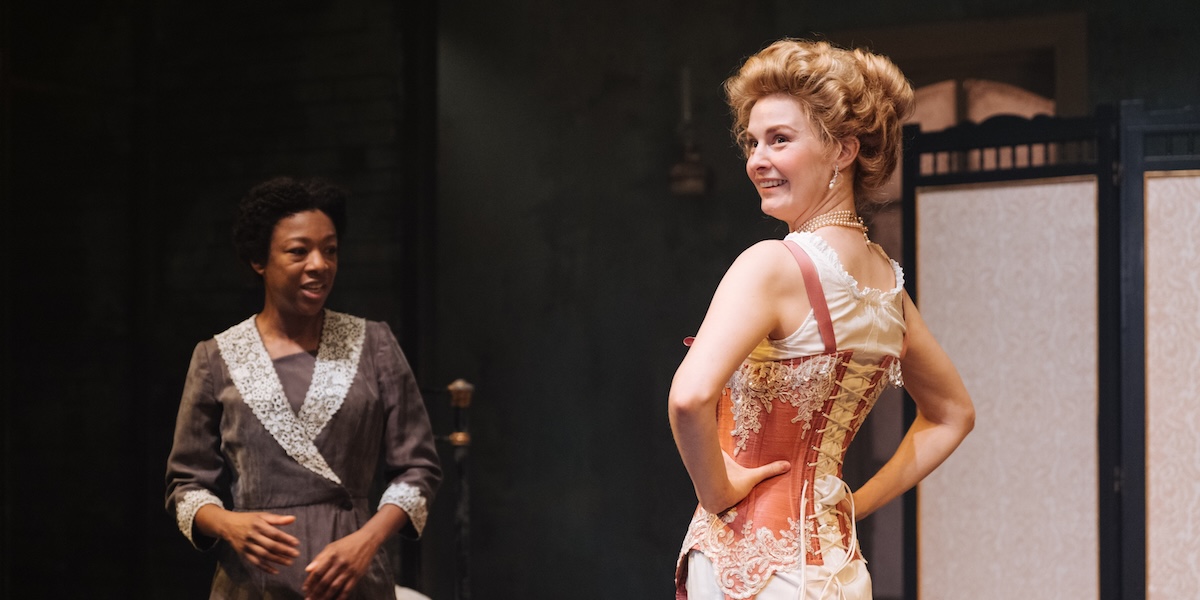
Samira Wiley & Claudia Jolly in Intimate Apparel. Photo: Helen Murray

The intimate apparel in question is a corset which back in 1905 when this play is set, helped women present to the outside world a body shape that conformed with that era’s restrictive standard of female beauty. But corsets aren’t the only deception going on in Lynn Nottage’s twisty play. Intimate Apparel shows us women faking it in a man’s world, while revealing their intimate feelings about their lives to each other when the disguise is off. At times, it is so believable, you forget you’re watching actors. This despite a minimal set and an audience on three sides.

It’s a play centred on women’s place in society at a time when black people were emerging from slavery and only men had the vote. The central character is Esther played by Samira Wiley. She is a black 35 year old unmarried seamstress who makes the intimate apparel of the title. She is shy and self deprecating about her looks. Her lack of confidence has kept her away from a social life, until she is now 35, has never had sex, and is effectively ‘on the shelf’. It is a monumental piece of acting, mixing downtrodden subservience with naive optimism, that totally convinces.

Esther’s clients are her world: they are quasi friends despite the difference in status. A motherly Mrs Dickson played by Nicola Hughes owns a boarding house in which Esther rents a room; Mrs Van Buren (Claudia Jolly) is a brittle white woman with a rich husband who neglects her; Mayme played with panache by Faith Omole achieves her independence through prostitution.

In a lesser play, these characters might be two dimensional ciphers representing different types of women in that society. We are told very little about their backgrounds or personal lives but Lyn Nottage’s special skill is to know her characters so well that every word they speak seems coated with the truth of a fully formed human being. It helps that these talented actors are there to inhabit the carefully created characters and give them a three dimensional reality.

The high quality of the acting extends to the two male characters- Kadiff Kirwan swaggers and whines as George, the kind of man who has never grown up, and Alex Waldmann gives a touching performance as the gentle, humorous Mr Marks, a haberdasher who is genuinely attracted to Esther and a would be a perfect match for her, but is held back by a religious faith that prevents him having physical contact with women outside his family.
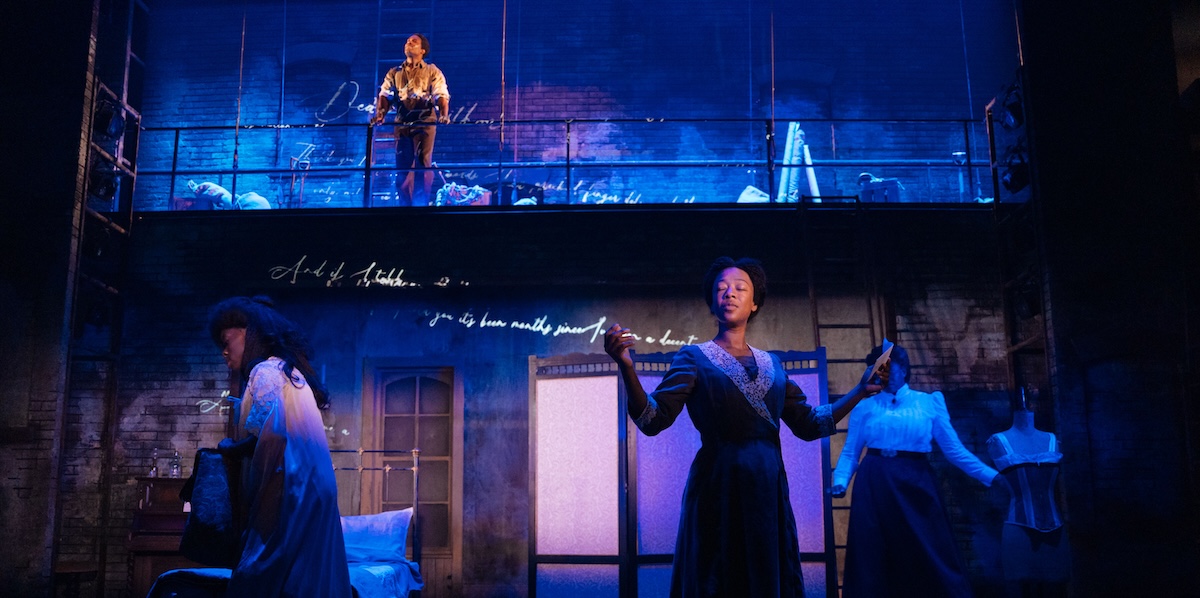
Intimate Apparel at The Donmar. Photo: Helen Murray

When Esther gets a letter out of the blue from a man looking for a pen pal, the other women encourage her to respond. Because she can neither read nor write, they pursue the correspondence on her behalf until a remote love affair takes place and Esther accepts a marriage proposal without ever having met her fiancé.

So, a marriage has been built on something every bit as fake as the bodies created by intimate apparel. Might it still work out or will Esther’s world come crashing down? That’s the subject of the second act.  I’d love to talk about what happens but it would be unfair to spoil the dramatic twists and revelations which actually provoked gasps from the audience- an indication of how involved we were. Credit to director Lynette Linton for the romantic build-up that drew us in and the explosive pinball machine speed with which it blew up in our faces.

Alex Berry’s set used the cramped space of the Donmar well- key props like a bed and sewing machine nimbly moving around while the male characters appeared from high up at the back like Gods. Her costumes were fabulous and I assume accurate representations of the clothes- and underwear- of the period.

Intimate Apparel can be seen at the Donmar theatre until 9 August 2025. Buy tickets direct from the theatre.

Paul paid for his ticket.

Watch this review on the YouTube channel Theatre Reviews With Paul Seven
 

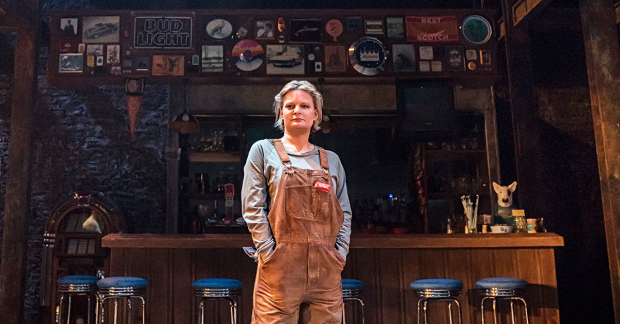
Sweat at The Gielgud – review

Sweat- an important visceral play by Lynn Nottage.

[usr=5]

There is so much I could say about this play but I want to concentrate on the central story which concerns the deindustrialisation that happened in the US in the early 21st century. It’s something we in the UK are only too familiar with.  Our government, like many others, moved the economy away from manufacturing, letting those jobs go to China, Mexico and other developing countries where labour was cheap.

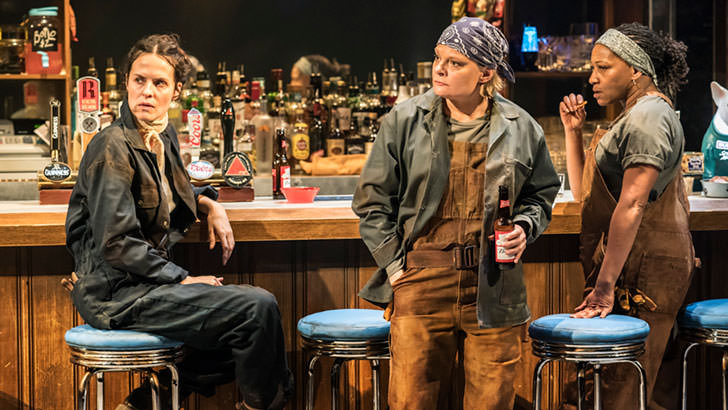
Production shot of Leanne Best, Martha Plimpton and Clare Perkins in the Donmar production of Sweat at the Gielgud Theatre
Leanne Best, Martha Plimpton and Clare Perkins in Sweat. Photo: Johan Persson

In Sweat the action takes place in 2000 in Reading, Pennsylvania and is based on true events surrounding factory closures. Lynn Nottage has created complex believable characters and we see at first hand their sense of ­betrayal,  loss and anger. They feel betrayed because generations had worked at the factory and displayed what they saw as loyalty. They lose their way of life and their sense of worth.

In a succession of scenes, the main characters meet up in a bar that looks as industrial as a factory. In particular we meet two good friends Tracey and Cynthia. At first all is well but we can see the seeds of what will happen. Unlike Tracey and her son Jason (Patrick Gibson) who see working on the line as their lives, Cynthia and her boy Chris (Osy Ikhile) aspire to get away from the grind of the factory floor. Chris plans to go to college, Cynthia would like to move into management.

Both women apply for a supervisor vacancy, Tracey just for the hell of it but Cynthia because she really wants it.  When the more suitable Cynthia gets it, Tracey who’s white puts it about that Cynthia only got the job because she’s black- in other words, because of positive discrimination. Racism, it seems, is just waiting below the surface like sewer beneath a road. When the factory threatens jobs, the division between old friends just gets worse as does prejudice against any ethnic minority.

Martha Plimpton in Sweat. Photo: Johan Persson

Tracey is repulsive. She’s undoubtedly the life and soul of the party but she’s also ignorant and blindly prejudiced. And very aggressive- Mike Tyson would hesitate to pick a fight with her. It’s a layered character brilliantly conveyed by Martha Plimpton. You are appalled by her but you know enough about her to recognise her as a fellow human and to realise her biggest problem is a lack of education, which leads to her inability to see the bigger picture, and her failure to see that her interest lies in unity not division.

Clare Perkins in Sweat. Photo: Johan Persson

When we go forward eight years, we see the long lasting devastating effects of job loss on individuals when a whole community becomes poor. Frankie Bradshaw’s set now represents the isolation of homes rather than the community of the bar. Clare Perkins breaks your heart as Cynthia who dreamed of improving her life and ends up used, abused and struggling to survive.

There is a shocking act of violence involving Jason and Chris that stems from the threatened factory closure. Perhaps Jason was always likely to resort to violence when under pressure but it is easy to see what happens as a metaphor for the blows against the establishment struck by working class people voting for Trump or Brexit.

Lynette Linton‘s direction is tight and the characters express themselves as physically as they do verbally. While the production might not be as visceral as it must have been in the cockpit of its original venue The Donmar, Sweat remains a harrowing, important experience. It brings home the shocking reality of the effect of deindustrialisation on people and communities.  It also gives us an insight into why we are seeing such a rise in racism and populism.

Sweat can be seen at the Gielgud Theatre until 20 July 2019. Click here for information and tickets

Click here to watch watch the review on YouTube

×