One of the finest Othellos of our time
Theatre Royal Haymarket
⭑⭑⭑⭑⭑

The new production of Othello at the Theatre Royal Haymarket is the finest I have seen—and I have seen a few. Director Tom Morris has achieved this triumph by keeping the production straightforward and by casting David Harewood at precisely the right point in his distinguished career to inhabit the title role completely. Added to that are two further superb performances from Toby Jones and Caitlin FitzGerald, plus an additional standout who doesn’t receive above-the-line billing.
If you’re not familiar with the plot, then please stop reading now, because I’m going to assume you know that it’s about a man who is tricked by a cynical liar into believing his wife has cuckolded him and prompting him to murder her.
You can tell from that crude summary, Othello is a at heart a domestic tragedy. Of all the lead characters in Shakespeare’s tragedies, Othello is the least grand. He’s not a King or even a noble, By comparison with Macbeth, Lear or Mark Anthony, he is strikingly ordinary. What makes him stand out is that he’s successful in his career, and an outsider. For audiences, he is very easy to identify with, as he falls victim to someone determined to wreck his life. The play is also Shakespeare’s most plot- as opposed to character- driven tragedy, and presented with such clarity (there’s no subplot) that it is inevitable an audience will be gripped and carried along.
Director Tom Morris understands this and, to his credit, has not imposed any show off interpretation. He trusts Shakespeare’s language to carry the drama, and in the hands of his exceptional cast, it does.
The background is military. Othello is a soldier who has won great victories for Venice. He knows his worth yet still wrestles with a form of impostor syndrome, aware that his race renders him inferior in the eyes of many and that his high standing derives only from his battlefield prowess. His secret marriage to a white woman from patrician Venetian society underscores his fear that the union will be condemned. His insecurity makes him wonder whether it was merely his storytelling that enchanted Desdemona into marrying an ageing black man. It’s a part bursting with contradictions.
Into these polished shoes steps David Harewood, perfect for the part. Wearing a beautiful silky green suit (Shakespeare later refers to jealousy as a ‘green-eyed monster’), he is elegant, poised, and physically imposing. He radiates authority and speaks lyrical lines beautifully and lucidly. But we can also see straightaway why the rigidity of a military man and the lack of confidence of an outsider set him up for his downfall at the hands of Iago.
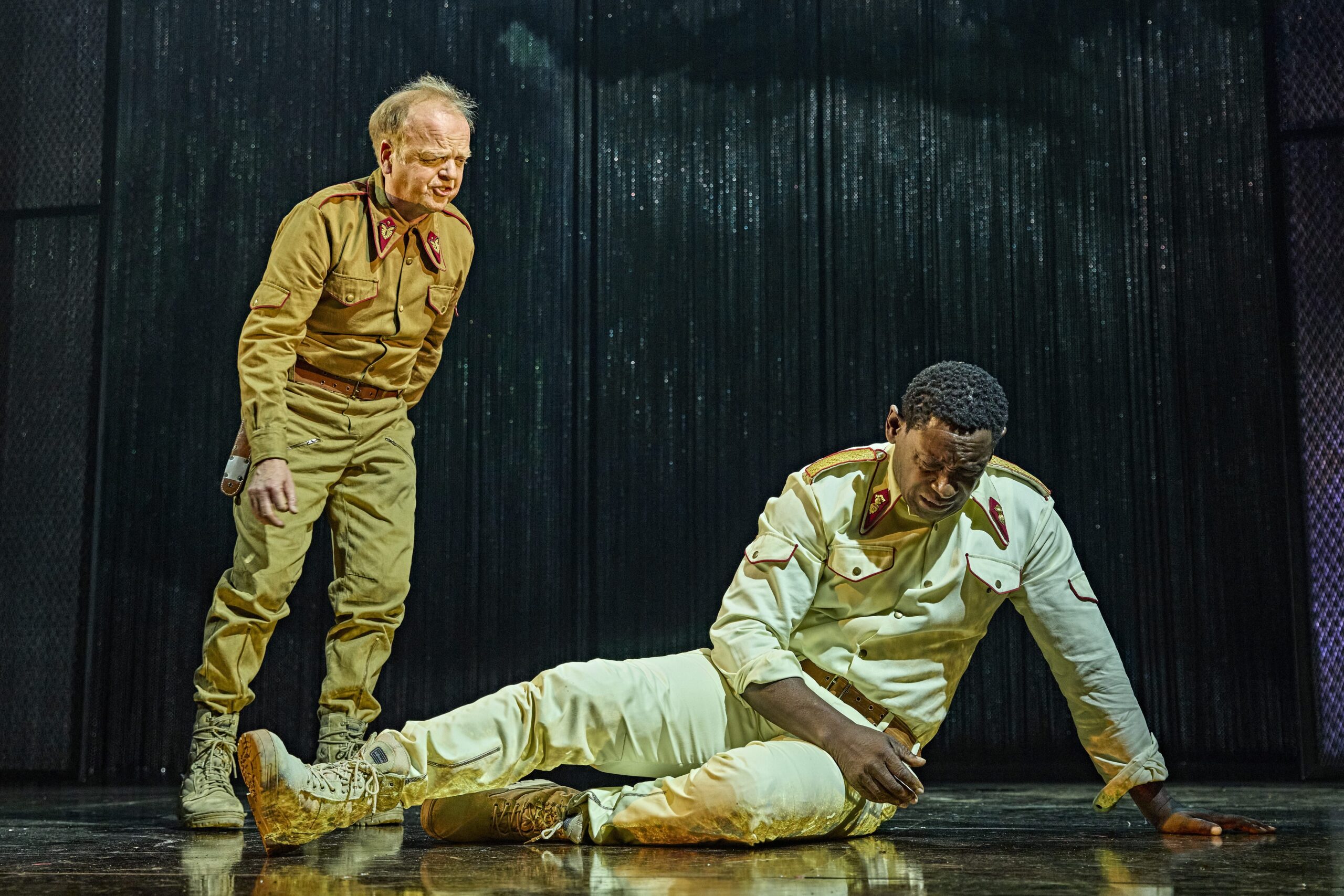
Toby Jones has the task of creating a rounded picture of someone whose history we learn remarkably little about, despite him having more lines than Othello, and indeed more lines than any character in Shakespeare except Hamlet and Richard The Third. He does it brilliantly.
Iago is perceived to be an ‘honest’ soldier. The word occurs over 50 times in the play, as Shakespeare piles on the irony, thus giving the audience something to laugh about in an otherwise serious drama. The important thing is, he is trusted by Othello as a good ‘honest’ soldier.
Toby Jones deploys his familiar genial countenance when addressing others, then swivels toward the audience with a face hardened and eyes glacial.
All the cast are superb
He is aggrieved that he has been passed over for promotion. Othello has appointed Michael Cassio as second-in-command, He seeks vengeance for the slight. Spotting Othello’s vulnerability—Desdemona—he devises a plan to humiliate him. That Othello is so easily convinced his wife is having an affair is, in context, quite plausible: they married in haste and in secret. So, how well does he truly know her? Her enraged father, played with distinction by Peter Guinness, warns him early on, ‘She has deceived her father, and may thee.’ Iago then improvises his way through a thrilling campaign of insinuation, his plot evolving with each new contingency, something Toby Jones conveys with wonderful darting eyes.
Even if you did still have any doubt that Othello would fall for this villain’s machinations, you have only to recall Celebrity Traitors to see how difficult people find it to detect deception, and how trusting they are of appearances. Not that I’m comparing Alan Carr with Iago. More generally, we all know how hard it is to differentiate between truth and falsehood in the mouths of con artists.
Jealousy pervades the play, as does a corrosive sense of inferiority. Both Othello and Iago are driven by these impulses, Jones’s Iago, despite the chip on his shoulder, remains implacably steely, while Harewood’s Othello disintegrates visibly. His once-perfect outfit becomes dishevelled; his tongue which initially roamed nervously around the inside of his mouth, now flicks out of the corner; he spits out words that previously he would have modulated. A tragic flaw has enabled a villain to bring him down, but, once he accepts the supposed evidence of Desdemona’s betrayal, the military tactician resurfaces, coldly orchestrating her destruction.
As for Desdemona: I was initially sceptical about casting an older actor. The text seems to suggest she is young and disingenuous—initially she is seen as having been ‘stolen’ by Othello, and later she is naively oblivious to Othello’s changing temperament. But Caitlin FitzGerald, a mature performer, illuminates the role in unexpected ways. She conveys the giddy rapture of early love while also interacting with Othello on equal footing, asserting herself in their arguments with a modern feminist inflection.
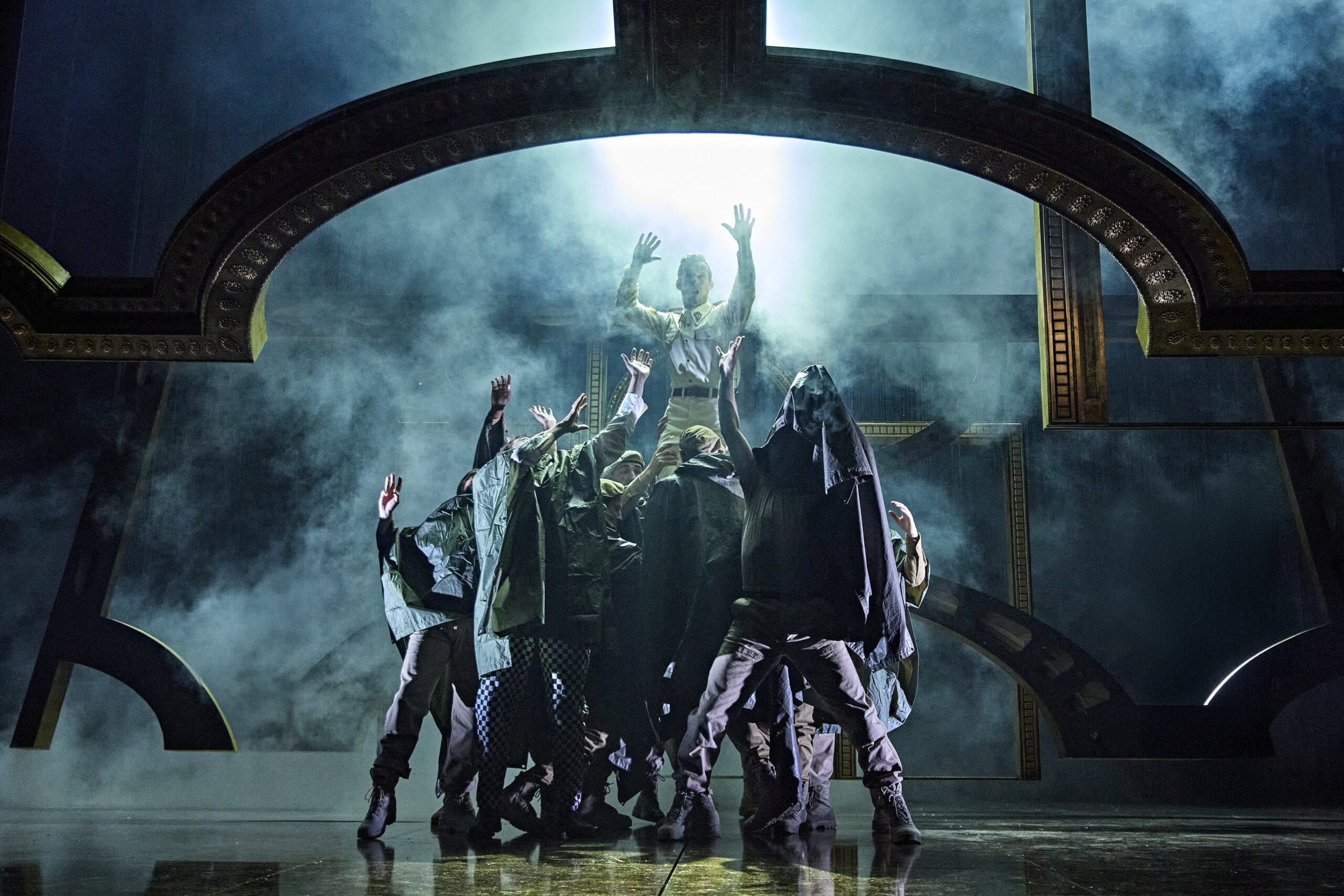
Similarly, Emilia — wife to Iago and maid to Desdemona — receives a powerful push from Vinette Robinson. Though nearly as cynical as her husband, Emilia possesses a moral core he lacks. In this production, she seems to speak for all women as she voices her views on men and on the catastrophe unfolding around her with bruising, heart-breaking passion.
Other parts are deftly realised: Luke Treadaway is a sensitive Cassio, not at all arrogant as he is often portrayed; Tom Byrne as Roderigo is the perfect fool as Iago’s dupe.
Although the dress is modern, Ti Green‘s set is neutral. Gilded geometric structures evoke the opulence of a Venetian palace before reconfiguring into corridors, chambers, and shadowed streets. Nothing distracts from the momentum of the drama. Even PJ Harvey’s atmospheric music—almost continuous—never competes with the action.
In this production, Toby Jones’ portrayal of evil personified remains the driving force, but it is David Harewood’s subtle, flawed Othello who takes centre stage.
Othello can be seen at the Theatre Royal Haymarket until 17 January 2026. Click here to buy tickets direct from the theatre
Paul paid for his ticket
Watch this review on the YouTube channel Theatre Reviews With Paul Seven