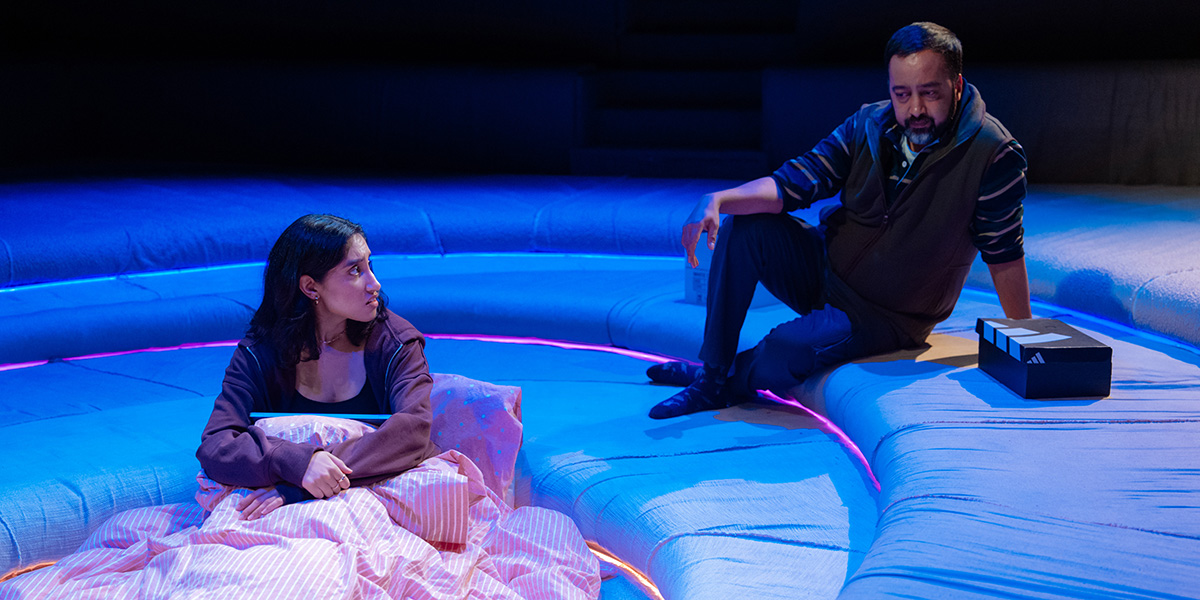
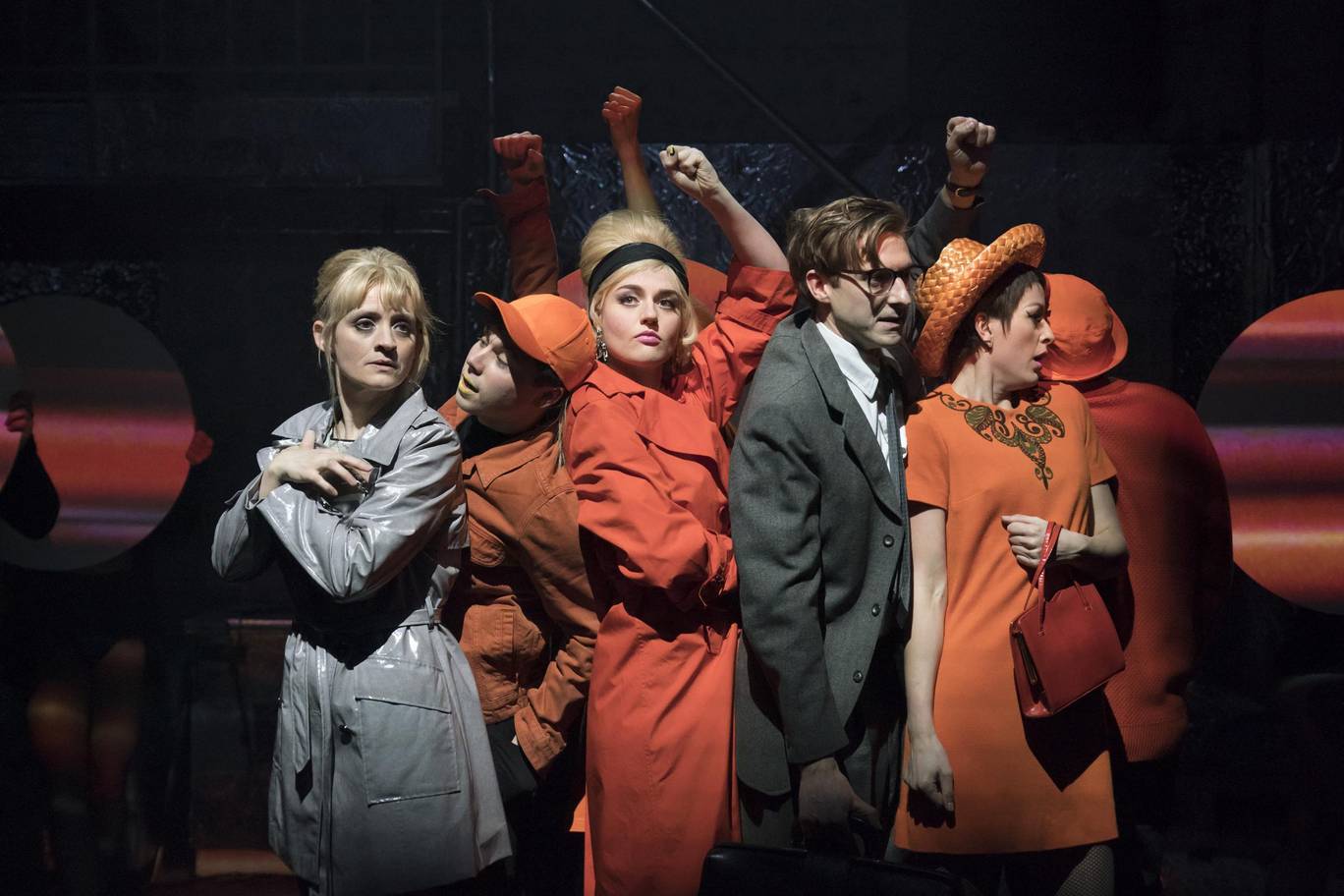
Ambika Mod and Lizzy Connolly in Porn Play. Photo: Helen Murray
Sophia Chetin-Leuner’s new play is about addiction. Unexpectedly the addiction in question is to violent pornography and the addict is a woman.
In case you’re thinking this is a little recherché for the subject of a play, we’re told almost straightaway that more women than men search for violent porn. Even so, she seems to be something of an outlier in the world of porn addicts, the clue being she’s the only woman at a porn addicts anonymous group. It may be about a niche subject, but the play presents a moving portrait of addiction and poses an intriguing question as to why a woman would become addicted to violent pornography.
If you’re easily shocked, this is one to avoid. Ambika Mod’s character Ani spends a significant chunk of the evening playing with herself. She also gives us enough vivid descriptions of what she watches to leave us in no doubt that we are talking about nasty stuff, even if she insists, in that addict’s self deceptive way, that it’s fake.
You might also want to avoid it if John Milton isn’t your thing. She’s an academic specialising in the great poet and we learn a lot about paradise, for which read sexual pleasure, and paradise lost, for which read the pain of grief. It may make you want to pick up a volume of his verse and look at it with new eyes, or not.
Ambika Mod is exceptionally good in this part, communicating desperate need, and the shame, fear and helplessness that go with it, all the while presenting a public façade of normality as she pursues her career as a university lecturer and academic. This actor has such an ability to communicate complex feelings that she is surely heading for the top.
Josie Rourke directs with precision.
Yimei Zhai’s set compliments the action superbly. We the audience are given shoe covers to wear before entering the auditorium. This is because the entire area is covered in soft pale carpet. The circular stage area and its softness may suggest a woman’s gentitalia but also, because of the whorls that take it down through a number of levels, it may signify a downward spiral. In a stroke of genius, the set is designed so the cast can reach between the joins in the fabric to retrieve props, such as a phone, a tablet or larger items like a pillow, much as you might look for a lost coin down the side of your settee, . This is wondrous in itself, but it mainly reinforces the idea that Ani’s addiction is hidden.
Not that it stays hidden for long. She takes out her phone or laptop at every opportunity to masturbate while looking at porn. This could be when someone leaves the room for a moment, or even when they are asleep in the same bed. Those close to her- her boyfriend, her best friend, her father all realise she has a serious problem. Soon her life starts to fall apart. Her exasperated boyfriend leaves her, her job is in jeopardy.
Will Close portrays with sensitivity the boyfriend’s struggle between love and disgust. He also gives us other examples of masculinity in the course of the play: a male porn addict’s macho mansplaining, a young student’s rampant hormones.
The arc of Ani’s addiction is depicted well. She maintains the violence is not really that shocking because it’s ‘fake’, but after trying it for herself she acknowledges that her enjoyment is in watching the women get hurt. She is, after Milton, a ‘brutal woman’. Eventually she reaches a point where she knows she needs to stop. Her addiction seems sad for much of the play. However, when she reaches the end of the road, sitting at one corner of the stage stroking herself robotically while the one person who cares enough to help her is in the opposite corner, it is heartbreaking.
Someone commented on The Fifth Step, another play about addiction, that while the subject is no laughing matter, it can be very funny. Sophia Chetin-Leuner seems to take this view. A couple of scenes spring to mind. Because of her continual rubbing, she has made herself sore and succumbed to an infection. She visits a gynecologist, played by Lizzy Connolly who cloaks her in that brisk matter-of-fact indifference, not even looking at Ani, that many patients will be familiar with.
Ambika Mod & Asif Khan in Porn Play. Photo: Helen Murray
During an event at which she is to receive her award for her book on Milton, Ani is approached by an old man who thinks she’s a waiter simply because she’s a young woman. Women are not expected to win top academic awards any more than they’re expected to be as sexually active as men. The old man is played by Asif Khan, who also gives an exquisitely gentle performance as Ani’s father.
In her mind, people begin to say sexual things to her. A woman seems to say to her: ‘I don’t know how you do it, spend all your time giving head’ which is then corrected as ‘in the head of that vile old man Milton.’ Milton crops up frequently when Ani addresses the audience. She talks about his poems at length, that he identified the way good and evil live in parallel, and pleasure masks pain. This does perhaps explain how her addiction arises from grief. And how Eve, the first woman, is a rebel against the patriarchy but also submissive to it. But it does start to feel like a lecture.
There are other moments when it seems the author has not entirely relevant axes to grind. For example, there’s a scene between Ani and one of her students, another fine creation from Lucy Connolly. To an extent it illustrates the gap between millennials and Gen Z. The ‘woke’ student has been triggered by Ani talking about a rape scene in one of Milton’s poems. Ani representing an older generation (that of the author) is tolerant of different times and wants to study a great poet warts and all. The younger generation has no tolerance and wants to cancel Milton. ‘Why would you want to read him and analyse all these horrible men?’ She asks. It’s a bit of a cliché and doesn’t really add to the story.
Porn Play tries to cram too much in but it is a play well worth seeing for its moving, insightful portrait of the effect of easily available pornography on 21st century sex and relationships.
Derry Girls fill the Olivier stage with their grand performances
★★★★
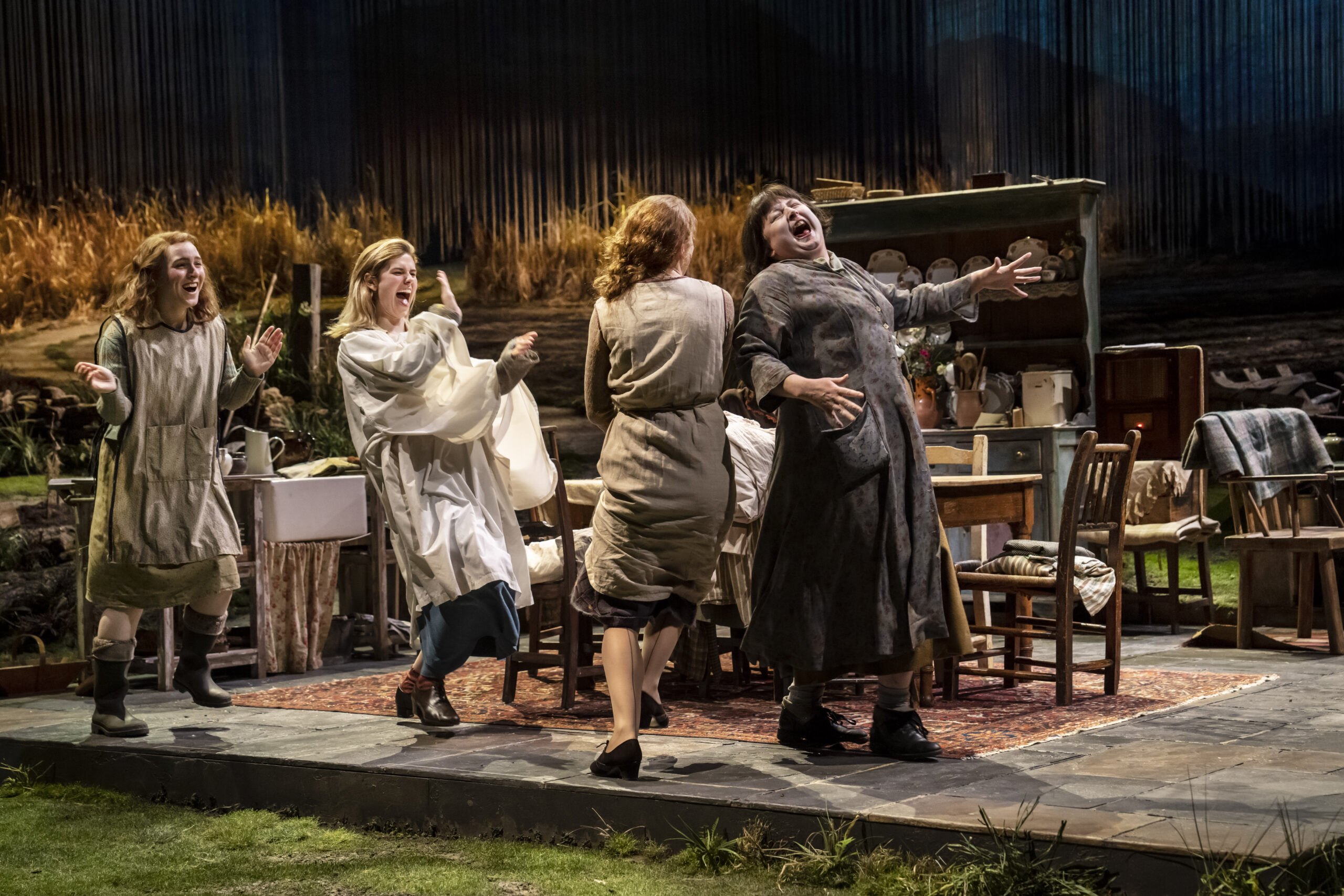
Blaithin Mac Gabhann, Alison Oliver, Louisa Harland and Siobhan McSweeney in Dancing at Lughnasa. Photo: Johan Persson
Brian Friel‘s Dancing at Lughnasa has come to be regarded as a modern masterpiece. The National Theatre first staged it straight after its 1990 Dublin premiere. Now this intimate play is back there on the huge Olivier stage in a new production directed by Josie Rourke.
Siobhan McSweeney and Louisa Harland from Derry Girls play two of five unmarried sisters approaching middle age whose life is suddenly upended in 1936. The story seemed relevant to 1990, but does it still seem like a masterpiece 30 years on?
Dancing at Lughnasa is a multi layered play which is part of the reason it’s so riveting to watch. For a start, it’s a memory play, which in this case means that a narrator tells us at the beginning and at points during the evening that what are witnessing is from his memory, mainly from when he was seven years old. So straightaway, the play raises questions about the reliability of memory but also about the nature of writing itself. Did all that happens really occur in the space of a couple of months, or is it memory (or the writer) rearranging them for the sake of a more dramatic narrative?
This leads us to think about what is true- whether facts are truth or whether fiction tells us a greater truth about life. Ostensibly a play about five unmarried sisters, it is about human relationships universally: what holds them together, what may drive them apart. And those same questions apply to much larger communities.
Running through the play is the eternal battle between body and mind, id and ego. Lughnasa is an annual Irish harvest festival dating back to pre-Christian times, taking place at the beginning of August. It’s a time of all kinds of celebratory activities dedicated to pagan gods: walking up hills, picking wild bilberries, and, yes, dancing. So, while it was appropriated by the Catholic Church, in essence it opposes the asceticism of Christianity, and encourages physical release.
All this aside, its core is a funny and sad description of the lives of a family under pressure. The five sisters, who for one reason or another, are unmarried and live together, without parents, in poverty. They are moving into middle age realising they are too old to find a husband or indeed to dance. They still dream of doing both at the Lughnasa festival.
They rely almost entirely on the income from the oldest, Kate, who is a teacher. Kate is straightlaced and sees it as her job, to be a quasi-mother. Although she tries to hold firm to her Christian principles, the cracks in this façade constantly show. Played by Justine Mitchell, we feel the tension of her trying to hold herself aloof but constantly bewildered and tempted by her wilder sisters. And she shows her joy when she lets herself go.
Maggie is the heart of the home. She cooks and plays, she also has the clearest vision, realising what feelings are being suppressed, and able to defuse tense situations with a joke or a song. Siobhan McSweeney, whom many will recognise from the TV series Derry Girls, is tremendous in this complex role. Just to spend the whole evening watching her eyes, sizing up situations and wondering how best to respond, would be a masterclass in acting.
Agnes and Rose provide the household with some additional income by making gloves. Agnes, played by another Derry Girls alumna Louisa Harland, is quiet; Rose, played with sensitivity by Blaithin Mac Gabhan, has a learning disability. The others recognise her vulnerability and the need to protect her, at which they are not always successful.
The youngest sister Chris is the unmarried mother of Michael who, as an adult, is our narrator. Alison Oliver gives her a brittle naivety, particularly remarkable is the way she comes to life when she sees her child’s father.
The power of dance
We are told by the narrator, played by Tom Vaughan-Lawlor in flat, almost neutral terms, what is going to happen, and, at the end, what happened after the family broke up. This makes watching the play is akin to watching a car crash in slow motion.
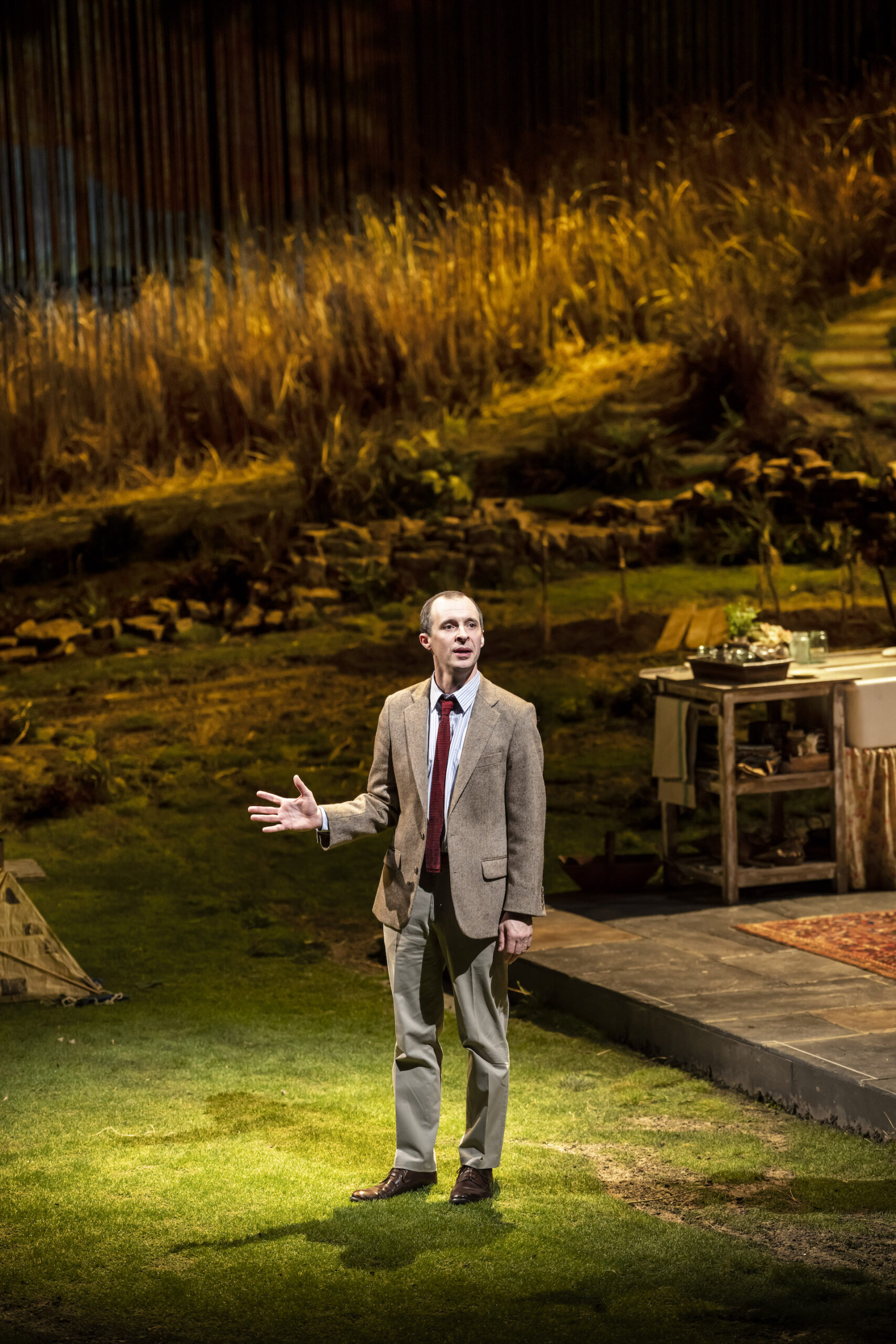
Tom Vaughan-Lawler in Dancing at Lughnasa. Photo: Johan Persson
Director Josie Rourke deserves every award going for the way she has brought this production together. I’ve already indicated that the casting is perfect., but there is also the challenge of presenting an intimate play on the enormous Olivier stage. Her designer Robert Jones achieves this by creating a circle that follows the arc of the edge of the thrust stage. Within that is placed a really quite small platform representing the main living area of the house, thus retaining the play’s intimacy. In front of this room is a yard or play area, a space mainly occupied by the child Michael (whom we never actually see, as everything is seen by him). Behind, a hill rises, (a metaphor perhaps for this family being at the bottom in society, but also a nod to the hill climbing that is part of Lughnasa rituals). At the top is ripe corn ready to harvest and at the back what look like hanging string or chain curtains onto which are projected images of the sky but which also seem to trap the people below.
In Josie Rourke‘s precise direction of the cast around the tight living area, you can literally see how close the sisters are physically as well as emotionally. when they trek away from the house, you feel the separation.
So what are the disruptive events that destroy this family? Firstly, there is the arrival of two men, both in their different ways damaging the reputation of the family. They are caricatures compared with the sisters but this can be interpreted as being Michael’s memory of them. It does have the effect of making them very amusing.
The sisters’ older brother Jack returns from missionary work in Africa, mentally confused at first, but eventually revealing his change from Catholic priest to believer in paganism. It’s an hilarious performance from Ardal O’Hanlan, as he talks almost in a stream of consciousness, oblivious to the effect on others of the shocking things he is saying. One of the funniest moments is when he keeps unconsciously grabbing a sheet his sisters are attempting to fold, symbolising his disruption of their ordered world. His rejection of Catholicism seems to be the reason Kate loses her teaching job, and the family her income.
Michael’s father, a feckless charmer called Gerry, also turns up. Something of a man-child, he appropriately spends most of his visits in the garden, making many promises he cannot keep before disappearing again. Having tried and failed at many jobs, he has decided to join the International Brigade, who are fighting for democracy against the catholic church-supported dictator Franco. Played by Tom Riley, he is a likeable character, and he loves dancing. Dancing seems to be the thing that still unites him and Chris. And dancing is in the title of the play for a reason.
Which brings me to the third disrupter: the new wireless set. It is not news from the outside world that changes their lives, but music, because hearing music inspires them to dance.
As the narrator tells us: ‘Dancing as if language had surrendered to movement- as if this ritual, this wordless ceremony, was now the way to speak, to whisper private and sacred things, to be in touch with some otherness.’
Two of the best scenes in this production are once when Irish music plays on the radio and, slowly but then with increasing pace, the sisters start to dance, even eventually Kate, until they are frenetically jigging round the tiny kitchen, jumping and high kicking with abandon. It’s a glorious moment, thanks to the women of the cast and choreographer Wayne McGregor. Then, later in the play, when Anything Goes is playing on the wireless, two of the characters combine in an erotic dance that reveals their feelings, and changes relationships forever.
Then there is the glove factory that opens- the industrial revolution has finally arrived in their small corner of Ireland- and it puts Aggie and Rose out of work.
So this small community is a microcosm of what happened to Western society as a whole, as seen from the end of the 20th century. The family dynamics at the centre of Dancing at Lughnasa remain fascinating and totally believable, and the dialogue is still a joy. But, nearly a quarter way through the 21st century, we have moved on. Now we are grappling with the changes wrought by digital technology which in very different ways is revolutionising our society and the way we relate to one another. Consequently, the play’s nostalgia isn’t what it used to be, and it no longer packs quite the punch it once did.
Nevertheless, a great production of a still brilliant piece of writing.
Dancing at Lughnasa can be seen at the National Theatre until 27 May 2023
Paul received a complimentary review ticket from the theatre
3 May 2023: I might have added when talking about Siobhan McSweeney’s acting skills that all the sisters use their eyes to great effect.
Anne-Marie Duff adds Wow Factor to excellent production of Sweet Charity
[usr=5]
Sweet Charity with book by Neil Simon, music by Cy Coleman and lyrics by Dorothy Fields.
This would be an excellent production with any musical star but Anne-Marie Duff adds a wow factor. She may not be as good a singer or dancer as those who’ve made a career out of musicals but she can sing and she can dance and she brings to the part all the emotional depth of a great actor. You feel her pain and you feel her ecstasy, and her pick-yourself-up-and-try-again smile is infectious.
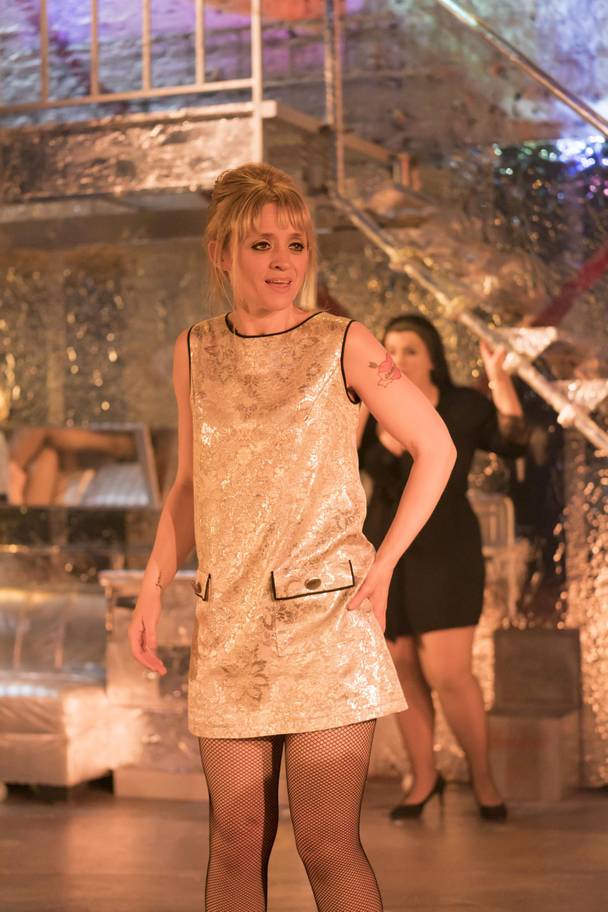
Anne-Marie Duff in Sweet Charity. Photo: Johan Persson
Charity is a taxi dancer in the 1960s. If you don’t know what that is (and I didn’t), it’s someone who works in a club where punters can hire them for a dance, and sometimes more. Charity believes in love. Despite being conned and let down many times, she remains an optimist and keeps looking for love. When things go wrong, she simply changes reality to suit her romantic view of love.
Ironically, despite being no virgin, she remains an innocent, which is the essence of her vulnerability but it’s also her strength. You could simply dismiss her as a naive fool, instead her way of seeing the best in people and not losing hope is inspirational. We want her to find love, even though we fear she won’t.
Anne-Marie Duff is perfect for the part. Her song-and-dance rendering of If My Friends Could See Me Now complete with a routine with a top hat and cane perfectly conveys Charity’s child-like unaffectedness. And her I’m A Brass Band is a joyous expression of what it feels like to be in love.
Anne-MarieDuff (left) and Arthur Darrell in Sweet Charity. Photo: Johan Persson
But it’s not a one woman show.
Arthur Darvill as Charity’s shy insecure boyfriend and Martin Marquez as a charming and charmed (by Charity) film star are both superb. Most of all there are the women who make up the rest of the taxi dancers. Their performance and reprise of Big Spender are astonishing. In the intimate setting of the Donmar where the audience is only four rows deep, these women saying ‘Let me show you a good time?’ is very personal.
Charlotte Jaconelli and the ensemble in Sweet Charity. Photo: Johan Persson
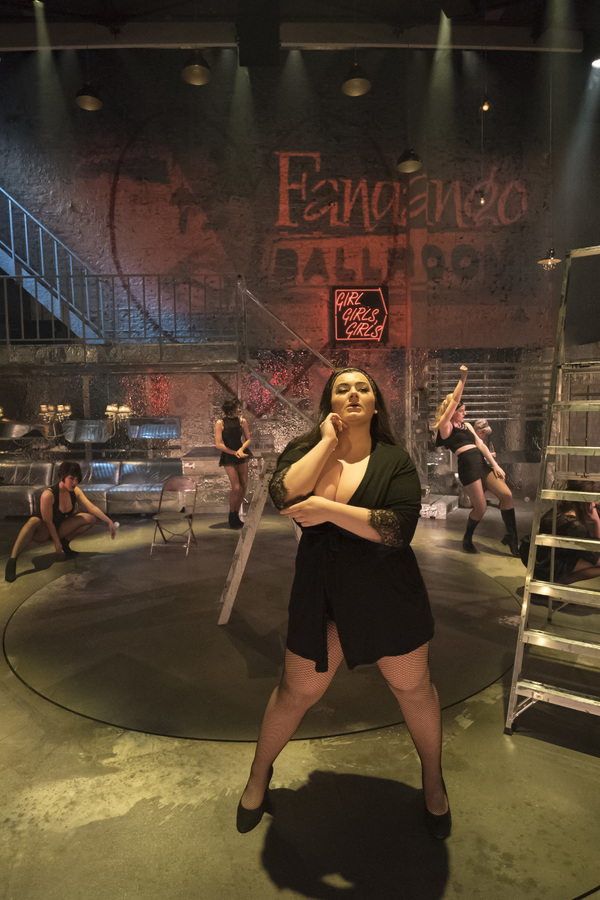
The stunning choreography by Wayne McGregor, paying homage to the original work by Bob Fosse, evokes Cabaret and Chicago. Robert Jones’ set, a simple open stage with silvery props and furniture inspired by Andy Warhol’s 1960s Silver Factory, suggests Charity’s bright optimism in a harsh world.
What a way for director Josie Rourke to bow out as Artistic Director of the Donmar.
Sweet Charity can be seen at the Donmar until 8 June 2019
Review revised on 18 April to add further description of design.
Manage Consent
To provide the best experiences, we use technologies like cookies to store and/or access device information. Consenting to these technologies will allow us to process data such as browsing behaviour or unique IDs on this site. Not consenting or withdrawing consent, may adversely affect certain features and functions.
Functional
Always active
The technical storage or access is strictly necessary for the legitimate purpose of enabling the use of a specific service explicitly requested by the subscriber or user, or for the sole purpose of carrying out the transmission of a communication over an electronic communications network.
Preferences
The technical storage or access is necessary for the legitimate purpose of storing preferences that are not requested by the subscriber or user.
Statistics
The technical storage or access that is used exclusively for statistical purposes.The technical storage or access that is used exclusively for anonymous statistical purposes. Without a subpoena, voluntary compliance on the part of your Internet Service Provider, or additional records from a third party, information stored or retrieved for this purpose alone cannot usually be used to identify you.
Marketing
The technical storage or access is required to create user profiles to send advertising, or to track the user on a website or across several websites for similar marketing purposes.