Top Chekhov adaptation brings out the best in Kristin Scott Thomas & Stephen Mangan
Harold Pinter Theatre
⭑⭑⭑⭑
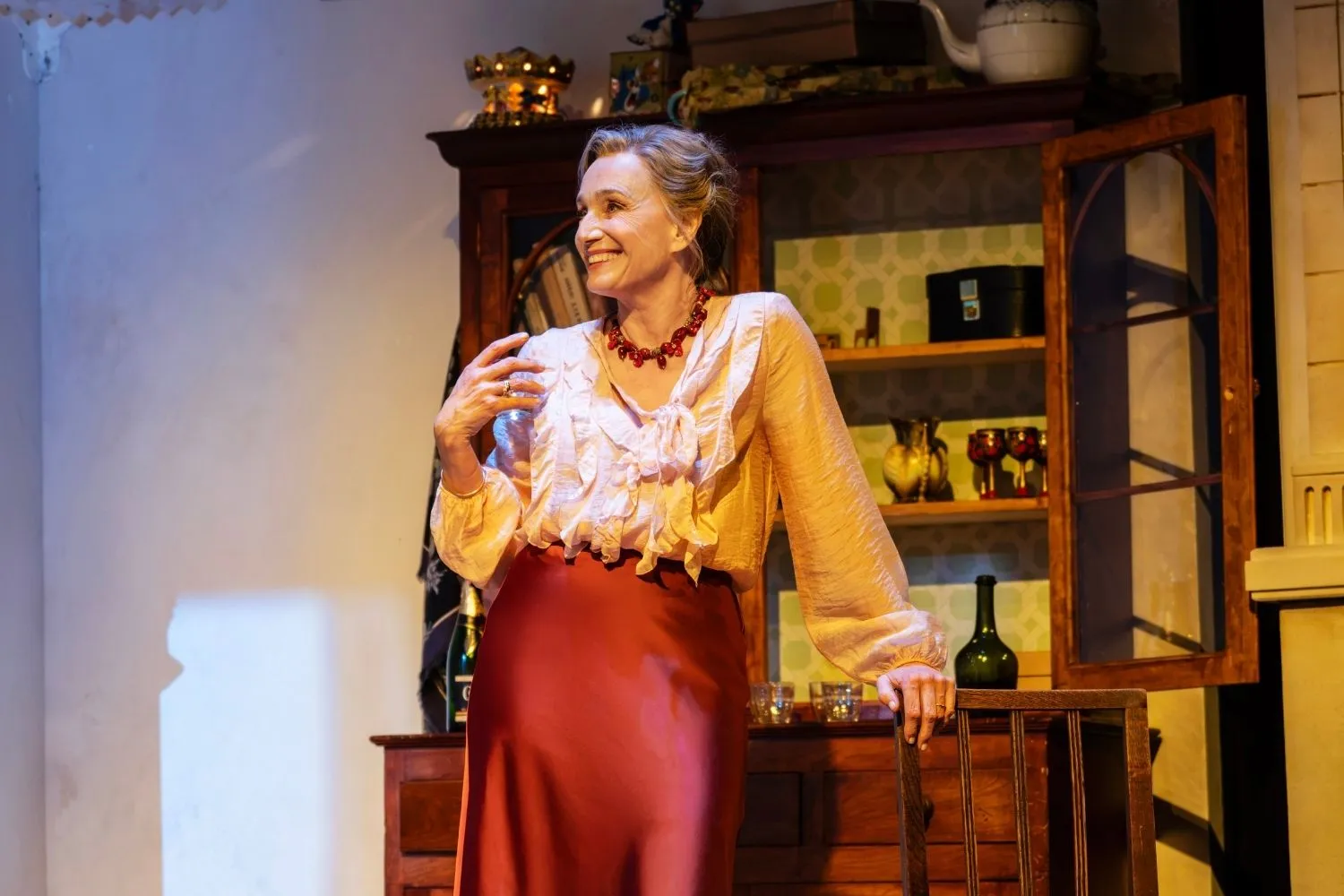
Kristin Scott Thomas in The Cherry Orchard. Photo: Johan Persson
Every production of Chekhov‘s The Cherry Orchard is different: like life, it’s so open to interpretation. Even so, there’s always a sense of doom, and there’s always a comical bubble of illusions shielding those who are looking doom in the face. So what makes this production at the Harold Pinter Theatre special?
This is a particularly star studded production, not only Kristin Scott Thomas and Stephen Mangan starring, but top playwright Conor McPherson providing a re-imagining and IanRickson, a highly successful interpreter of Chekhov, directing. It’s also blessed with a cast of the highest quality.
The language provided by McPherson is blunt and speaks to a modern audience. Chloe Lamford’s decaying, damp looking set and Sussie Juhlin-Wallen’s costumes which mix period and modern elements give the production a sense of time passing. The mixed bunch of characters are either living in the past or seeking to preserve it.
The theme of resistance to change is timeless. The specific change in this case is the old Russian hierarchy crumbling in the face of the rising middle class.
Luba Ranevskaya, played magnificently by Kristin Scott Thomas, is the matriarch of a grand house and estate, the destitute successor to its previously rich and powerful owners.
The focus point of the land is a cherry orchard. It’s a cute touch for the characters to look out on the audience when referring to the orchard. We are, it seems, both the past condemned to perish and the future they will never see.
So many of the characters are lost in their illusions, unable to articulate their thoughts or even finish sentences in the face of the reality before them. Kristin Scott Thomas’ character is like a rudderless ship, fiddling with her hair, offering rictus smiles, distractedly hugging people in a half hearted cure their sadness, looking vacantly as if seeing the past or a different reality, sentences trailing off. Luba continues to behave like the lady of the manor, giving away money she doesn’t have while the debts pile up. Always looking to take flight to Paris to join her unfaithful lover, preferring to keep the memory of its past rather than grapple with modern day challenges of an estate facing bankruptcy.
An impressive cast
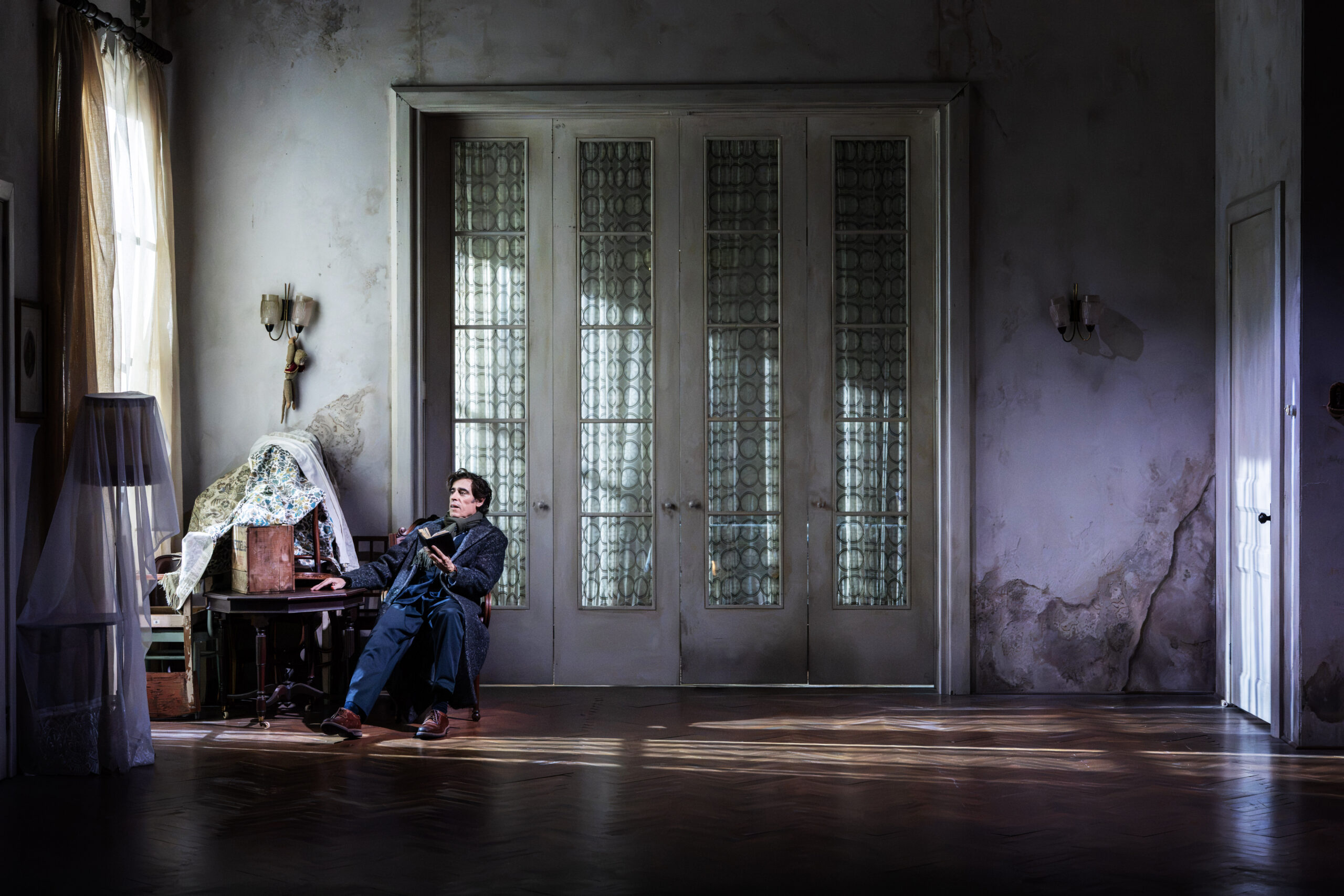
Stephen Mangan in The Cherry Orchard.Photo: Johan Persson
Through the next two and half hours, the people around her interact, sometimes in harmony, sometimes in conflict, fast, slow, sniping, soothing, revealing more and more of their characters, their illusions and their painful vulnerabilities.
Luba’s brother Leo is so inflated in his self importance, but actually a total scrounger, and so unpleasant. He could be a template for a certain ex-royal. Always reassuring himself and those around him that something will turn up. Peter Wight gives him just the right mix of nasty and pathetic. Jeff Rawle brings more pathos to Boris, an impoverished landowner, smiling but always trying to borrow money.
Jack Riddiford is the perpetual student Petyo, even at 30 years old, still talking of graduation. He speaks of revolution but needs the aristocracy to revolt against.
Some female characters look to feckless men for salvation – their love repeatedly unreciprocated. Anastasia Martin is Luba’s unstable daughter. Vinette Robinson gives a powerful performance as the tightlaced adopted daughter Varya, trying to manage the estate finances while wishing she could be a nun. Megan Cusack is the servant Dunyasha taking advantage of the breakdown of the class system to dress up and flirt with attractive men.
Saddest and funniest of all, Karl Johnson is Firs, the old retainer, literally living in the past thanks to dementia but coming up with golden lines like ‘you’re wearing the wrong trousers’. Karl Johnson is an actor I’ve seen many times on stage and he never disappoints.
Only Yermi Lopakhin, played by Stephen Mangan , looks positively to the future. He’s part of a new generation of a self made rich men. Being from peasant stock and well aware of his inferiority, ‘sorry’ is his most used word, a wide-eyed nervous laugh is never far away. He has been in love with Luba since childhood but he can see that the estate must be commercialised to survive, which means the cherry orchard must go. His illusion is that saving the estate will win over Luba. His belief in money as the way to his ideal is as deluded as the head in the sand attitude of those around him. And he is blind to the possibility of happiness with Varya. Stephen Mangan is wonderful in this role, giving a light comic vulnerability to a character that can seem unpleasantly crowing.
This production of The Cherry Orchard is a masterful re-imagining from Conor McPherson that is brought to life by a perfect cast and Ian Rickson’s inspired direction.
The Cherry Orchard can be seen at the Harold Pinter Theatre until 9 January 2026. Buy tickets from the theatre haroldpintertheatre.co.uk
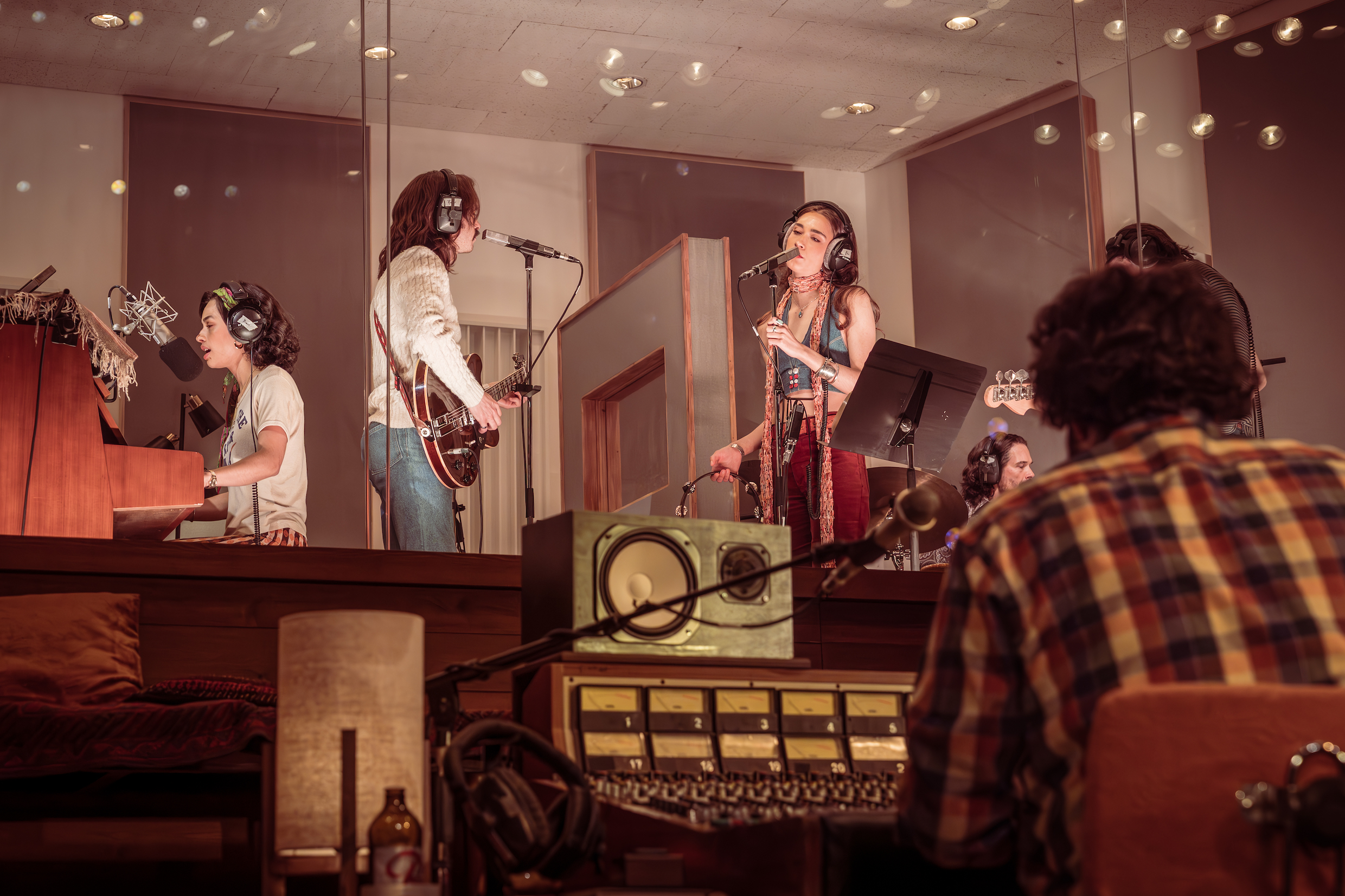
Stereophonic at the Duke of York’s.Photo: Marc Brenner
When I heard Stereophonic was coming to London, I was drawn to it like a moth to a flame. It holds the record for Tony nominations for a play and won the Award for Best Play. So the light was attractive but it turned out that the destructive flame was my lack of interest in rock music, let alone the factory that produces the sausage. Once the three hour play began, I soon remembered why it was not likely to be my sniff of cocaine. So how did I get on with the story of a rock band spending a year in a recording studio?
If the Amazon Prime drama series Daisy Jones & The Six, or Get Back, the eight hour trilogy of films documenting the Beatles’ recording of Let It Be, whetted your appetite for delving into the Babylon of the 1970s that gave birth to some of our greatest popular music, then this show will be for you.
For me, interminable conversations between the various band members about their relationships, and about the recordings, that made up the first half were alleviated only by the songs themselves. Written by Will Butler, formerly of Arcade Fire, they are actually pretty good pastiches of seventies rock. To be fair, there was some witty dialogue by the author of the play David Adjmi.
The unnecessarily long first half sets up a much more interesting second half. As relationships break up, tensions between the band rise, and questions are raised about the nature of creativity, the play, directed by Daniel Aukin, becomes more and more gripping.
Here’s the plot: in the mid 1970s a rock band are recording their second album. The five members are a mix of British and American, and comprise two couples plus the drummer. As they begin their work in the studio, word comes through that a single from their first album and then the album itself are climbing the charts. Suddenly much more money is made available to them by the record company. This turns out to be a case of ‘be careful what you wish for’, because, without the discipline of a time limit, paranoia and perfectionism run unbridled, and the recording extends in length to a year.
The entire play, in four acts, takes place in the studio, so we as an audience feel as trapped as the band in this cramped timeless space, reminiscent of a scenario by Samuel Beckett. Three hours of repetition with the same seven faces start to seem like a year. Designed by David Zinn, the set is constructed in meticulous detail, with the recording booth behind glass at the back of the stage, and the mixer desk and relaxation area at the front.
The most interesting character is the band leader and driving force, Peter, given an edgy performance by Jack Riddiford. It is a stunning portrayal of an artistic genius, who is never satisfied with the quality of the work. His increasingly controlling nature, combined with an absence of social skills, annoys all those present. He combines long silences, lack of consultation, and cutting criticism with a self centred unawareness of his effect on others.
In particular he picks on his longtime girlfriend Diana, played by Lucy Karczewski. Not entirely coincidentally, she has written their hit single and is contributing as many songs as him to the new album. Whether it’s professional jealousy or his desire to dominate her, he deliberately undermines her confidence in both her writing and singing, leading to an increasingly fraught relationship.
Zachary Hart gives life to bass player Reg. His brain is so addled with alcohol he can hardly put one foot in front of the other but can still lay down a great bass line. His behaviour is to the detriment of his relationship with his wife and the band’s keyboard player Holly played by Nia Towle. As he begins to replace his addiction to drink with new addictions to various forms of lifestyle and philosophy, he becomes a proselytiser looking to buttonhole and bore anyone he meets with his New Age beliefs.
Simon the drummer has been away from his family for far too long, and, while he seems like the level headed one, exhaustion leads to moments of ego and insecurity. Chris Stack cleverly adopts a calm, slightly strangulated voice that hides his character’s anxieties. We also see why common sense like his will not get the best out of this creative process.
The two women are not respected by the men, despite the quality of their work, and ironically they are underdeveloped as characters in the play. Their generally down-to-earth behaviour with occasional outbursts only hints at their troubled lives rather than revealing what drives them. This especially applies to Diana whose talent for writing appears to come from nowhere. Her lack of confidence turns out to be the product of her destructive relationship with Peter, but we get little insight into how she would got herself into the situation or how she can get out of it.
Trying to hold things together is recording engineer Grover, a masterful portrait of nerves, obsequiousness and frustration, from Eli Gelb. His hapless assistant Charlie played by Andrew R Butler provides much needed light relief. Like Chris Stack, these two are from the original Broadway cast.
I don’t want to give the impression it’s all argument and mental breakdown, there is also humour in the bickering and banter of David Adjmi’s natural sounding conversations.
Eventually the album is finished but the battle to produce it has left many casualties. At times, I felt like one of them. However the second act goes a long way to redeeming the first. I think how highly you rate this play may depend on your interest in the subject matter because, unlike say Dear England and its exploration of leadership in a football setting, Stereophonic’s study of the creative process doesn’t take you far enough beyond its rock music context.
The greatest play of the 20th century with our greatest actor
★★★★★
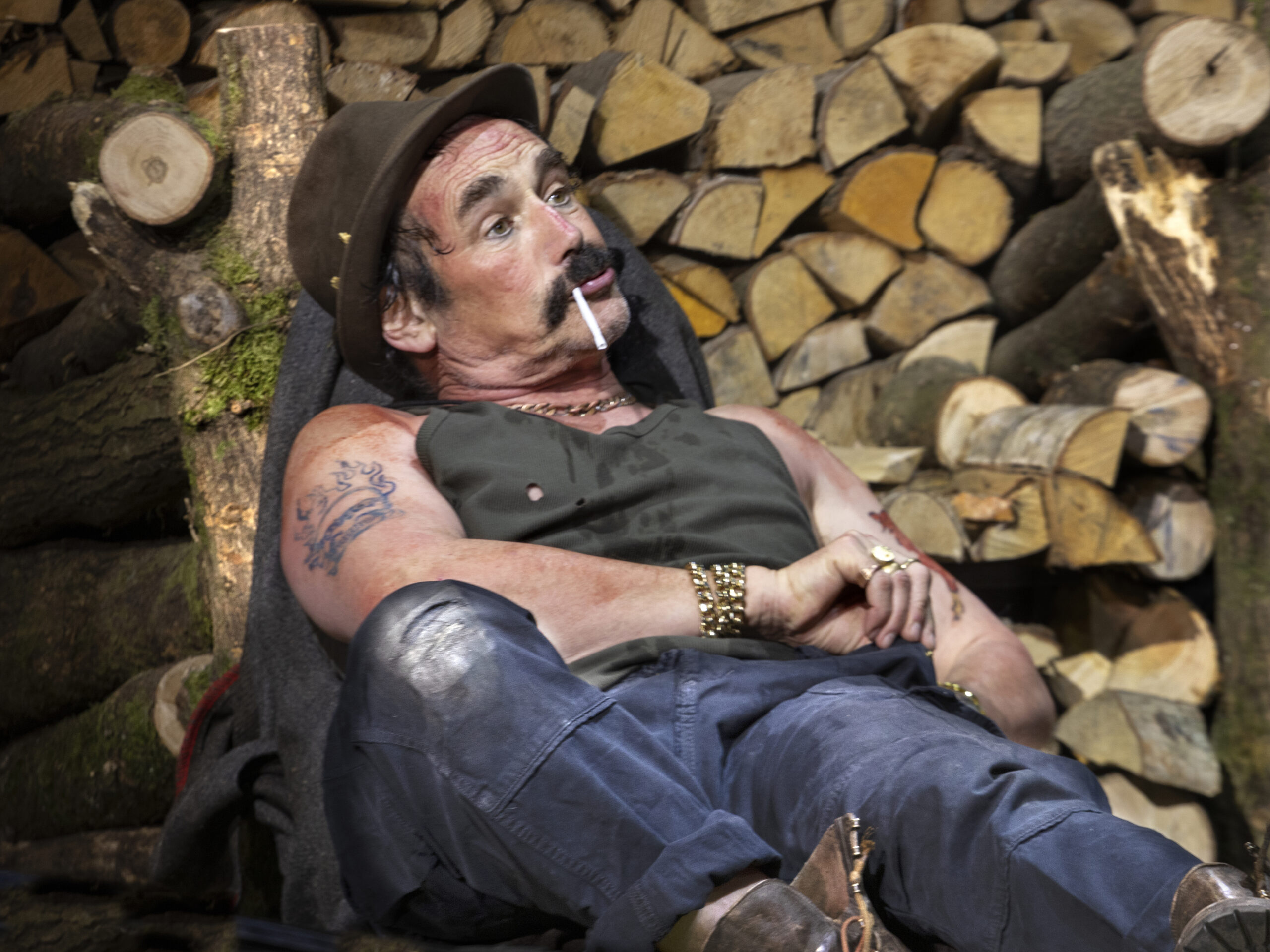
Mark Rylance in Jerusalem. Photo: Simon Annand
I’ve now seen the play that I probably anticipated more than any other in my life. And it exceeded my expectations. Jerusalem is the greatest 21st century play I’ve seen, and Mark Rylance‘s performance is as good as any.
Jez Butterworth’s play is set during St George’s Day, a day when John Byron and his dilapidated mobile home face eviction from his illegal campsite in a Wiltshire wood, the annual local fate stirs memories, his enemies gather, and friendships are tested. In the course of the three-hour play, we’re presented with a picture of an underclass whom society can’t accommodate and wants to pretend doesn’t exist.
It’s a kind of state of the nation play and that nation is seen as controlled and anodyne with its freedom squashed. A mythical past is evoked and the present found wanting. It helps that Mark Rylance’s character is a complex mixture
of light and dark, mischief and malevolence, but Mark Rylance so thoroughly inhabits the role, physically as well as verbally, that you forget he’s acting.
Before the curtain even goes up, we are given hints as to what to expect and what we can expect is going to be complex. The curtain is a huge St George cross faded and of course full of contradictory associations. It may be the England flag but it’s so often associated with a kind of xenophobic little Englander that we’re bound to wonder what’s in store, especially if we consider (and we are reminded later) that St George never even set foot in England.
Although it’s set during St George’s Day, it’s not looking back to Shakespeare, whose birthday is traditionally celebrated on that day, or indeed to the poet Byron who shares his name with the main protagonist. And it’s certainly not about the past colonialists and industrialists who made this nation rich.
A young woman dressed as a fairy, possibly a flower fairy, walks onto the stage in front of the flag and sings Jerusalem. The immortal opening lines hang in the air: ‘And did those feet in ancient time walk upon England’s mountains green.’ They didn’t, of course, but it’s a prelude to a play that has a lot to say about English myths. As she’s finishing, there’s a jolting shock of very loud dance music playing. The curtain goes up on a night time scene in a wood where there’s a rundown mobile home and lots of people having a rave.
The set designed by ULTZ is made up of real English oak trees and it looks like a real mobile home or trailer, as Americans would call it. Despite the mess, you feel you’re in the land of Robin Hood and A Midsummer Night’s Dream, something that should be conserved. Everything is going to happen on this set in the course of this one day in this tight perfectly
constructed play.
Incidentally, it’s the same set design as the original production. ULTZ is just one of the entire creative team that’s been
reassembled, the rest being director Ian Rickson, the lighting designer Mimi Jordan Sherin and the sound designer Ian Dickinson.
So, the scene’s been set for the exploration of a jaded present and a mythical past, gatherings that will reveal the characters, and the girl
that will be the downfall of Rooster Byron.
Then it’s dawn and the site is deserted. The messy state of this clearing in the woods is now clear. Two Council officers played by Niky Wardley and Shane David-Joseph arrive and, at precisely nine o’clock, serve an eviction notice on Rooster because he’s annoying his new neighbours on the recently built estate on the edge of this Wiltshire wood. We also learn later that the Council may be planning to build on this woodland, which may be why it’s taken them 27 years to come up with an eviction order. Their mechanical jobsworth approach is amusing but also inhuman. When they leave, we get our first proper sight of Rooster John Byron.
Straightaway we’re made to sit up in our seats, as he clears his head by doing
handstand in a trough of water and then propels himself out of the trough and onto his feet. It’s the physical act of a gymnast, impressive for an actor in his 60s or indeed any age, and we may realise that, although he’s something of a slob, he’s a fit slob.
He then proceeds to spray the audience with liquid and throw eggshells at them. Well, that’s one way to get attention. Mark Rylance gives a tremendously physical performance as the free-spirited traveller. He walks with the puffed chest of a cockerel. Is that how he got his nickname? But he does have a limp and we find out later that he was injured when pursuing a career(if that’s the right word) as a daredevil motorcycle rider. This previous near fatal job is indicative of one aspect of his character- that he’s brave to the point of foolhardiness.
That’s why we admire him despite ourselves because he’s not only brave but he’s true to himself. He could certainly move but he defiantly refuses. He’ll not conform to society’s norms and expectations. We wouldn’t want him as our neighbour with his drug dealing, loud parties, and entertaining teenagers, but while his backyard is on that theatre stage, we’re on his side.
The other characters we meet only underline his character. The people who gather around him our society’s misfits and rejects. Now, Rooster may be both of these things but he actively chooses his life. He’s a rebel in an age of conformity. Part of his group are people he’s known all his life and it’s a magical element of this show that all the actors of those roles in the original production
are back. It’s as if Mark Rylance has said ‘I’m getting the band back together for one more gig.’
Mackenzie Crook is Ginger, the person closest to Rooster. He’s an unemployed plasterer and would-be DJ. Literal-minded, he lacks imagination but he does have a sense of humour, and he seems to live for his time with Rooster. He’s also shown to be a coward on more than one occasion. Such a contrast to Rooster who has flights of fantasy, sees a much bigger picture,
and doesn’t actually seem to be too bothered about who he’s with.
Mackenzie Crook is a joy to watch as he displays on his face the limits of his brain . He’s a lost soul and he looks it. When he first arrives, he’s full of excitement about the annual Flintock Fair. The fair runs as a motif throughout the play. He loves it because it’s part of tradition, but, like so much else, it’s a faded replica of what it once was. Ginger tells us: ‘When I was a boy, there was this big farmer and you paid 10 pence to take a run up and hoof him in the bollocks. What have they got now?’ he asks. ‘Throw a sponge at the lady vicar’ is the response. We also learn that Johnny’s daredevil rider act used to be the highlight of the show until he had his accident and Health and Safety stepped in to end his career. The fair can often be heard in the background.
Ginger’s annoyed at missing the previous night’s party but Rooster tries to tell
him there was no party and launches into the first
of many tall stories that display his imagination and gift of the gab. He was, he says, visited by the Spice Girls for a night of debauchery and, just to say here, that Mark Rylance is as good a verbal as physical actor. The voice he employs is that of someone stoned: slightly deliberate, slightly hesitant, and slightly very slightly slurred.
Alan David is again The Professor, another misfit and struck it seems by dementia. He has knowledge but can’t apply it. Gerard Horan is Wesley, the
pub landlord who publicly bans Rooster for his outrageous activities but is actually an old acquaintance. He does what he has to do but lets his wife Sue run the pub. He’s been forced by the brewery to dress up as a Morris Man for the annual fair but as the day goes on he becomes wasted and his white outfit stained and dirty. He reminisces with Rooster about their days as young men,
boys actually, getting their first experience of sex. His life now is clearly much less free. Rooster on the other hand never seems to long for the past because it’s inside him, and he feels free. He observes the others with a wry smile and occasional exasperation.
Young people are also attracted to Johnny’s campsite. Lee, played by Jack Riddiford with a ready smile, is fed up with his life in Flintock and intends to
leave for Australia the next day, but typically he has no plan beyond that. Davey, played by Ed Kear with an amusing offhand delivery, has a literally dead-end job- he slaughters cows at an abattoir all day. He’s no ambition to leave Wiltshire. In fact he’s positively hostile to the idea: ‘I leave Wiltshire, my ears pop,’ he says. He and the others are part of an underclass
unnoticed and unheard by the political elites.
Two girls appear. Pea and Tanya, played by Kemi Awoderu and Charlotte O’Leary, are barely sixteen. They mention their fifteen-year-old friend Phaedra Cox, the reigning May Queen, who’s gone missing. At the end of act one, we hear in the distance the PA announcing the opening of the fair.
Act two begins, again we see the fairy whom we now think is probably Phaedra, singing The Werewolf, a song about someone who ‘can’t help’ attacking young maidens.
It’s now afternoon. ‘Outcasts, leeches and undesirables,’ says Johnny about his
companions. They discuss how the beginning of May is a traditional time for misrule. Johnny is in his element. He fantasises about leading a Flintock rebellion that will go down in history, and he tells yet another story.
While the others have vague recollections of a better more interesting England in both recent and ancient times, Johnny the traveller seems to be the only one who recognises the power of the myth, and he goes about creating
some of his own.
In a play about myths, Mark Rylance is a legend
They’re all amusing but this is possibly the funniest. It’s about the time he me a hundred foot giant who’d walked from Land’s End. The giant tells him he built Stonehenge, although Johnny says that could be bullshit. They mainly talk about the weather. Then there’s a hilarious moment when Johnny puts his disposable lighter onto the ground to represent himself and takes on the role of the giant leaning down and stroking him. The giant gives Johnny a drum which was his earring and says he can use it to summon the giants.
Ginger takes him up on this asking why BBC Points West didn’t report a giant
striding across their patch. This leads to a lament about the way Points West has expanded its region so much that it’s no longer local. Davey thinks
they might have missed the story because there’s so much to report. He tells how he was upset by a story about an old lady being kicked to death, ‘before I realise it’s some old biddy from Wales, how could i possibly care less?’ he concludes. And this is what happens throughout Jez Butterworth‘s brilliant
play. He gives little examples and hints about the way things are not how they used to be, and asks whether we want to exchange freedom of speech and action for an obedient, safe society: the anonymous estate versus the individual, supermarket products versus the wild garlic in the wood (surely a metaphor for Rooster), a homogenous nation versus a tribal one, conformity
versus the free spirit, safety versus risk, rootlessness against Rooster’s rare bloodline.
The complexity of the content and of Rooster himself is what makes this play so great. It shows again and again that England’s past is a myth but
do the myths sustain the English or hold us back?
Ginger skeptically asks: ‘where is the drum?’ ‘You’re sitting on it,’ says Johnny, and, sure enough, under a cloth is an ornate drum. So the drum, which will feature at the end is cleverly and humorously introduced.
We’re halfway through the play now and it’s time to meet Johnny’s ex-partner Dawn and his son. The boy is clearly uncertain about this strange man who was supposed to be taking him to the fair but now can’t because of the pressing matter of the eviction. Dawn played by Indra Ove still cares about Johnny but has chosen a more conventional life.
The act ends with the arrival of Troy looking for his stepdaughter Phaedra. He suspects Rooster knows where she is. Troy is another acquaintance from way back and is played by the final member of the original cast, Barry Sloane. With a boxer’s stance, he’s incredibly sinister. His threat to Johnny is chilling. Johnny remains affable but he’s clearly worried in a way that we haven’t seen till now. Nevertheless he boldly- and recklessly- hints that Troy may be physically attracted to his stepdaughter, and it can’t be coincidence that in Greek mythology Phaedra falls in love with her stepson.
After Troy leaves, The Professor tells the tale of St George but, we ask ourselves, does the dragon represent the authorities and perhaps nasty
people like Troy, with Johnny as St George? Or Johnny the dragon, Johnny whom the authorities and Troy want to finish. Myths can work in many ways.
Then Phaedra emerges from the mobile home.
Act three begins, and we’re at the end of the day. Jez Butterworth has lit all the fuses. We know it’s coming to a climactic explosion. Phaedra persuades Johnny to dance with her but at that moment her stepfather Troy and his two brothers arrive. We hear them beat Johnny up inside the caravan and even brand him. They leave. In the distance the fair is winding up. Johnny emerges. He’s covered in the blood that he’s previously referred to metaphorically. He’s badly injured. Like a wounded animal he writhes on the ground. It’s a terrible and upsetting moment when you see all that prejudice against him made manifest.
Eventually, being the determined man he is, he gets up. The physical part of Mark Rylance‘s performance continues to impres to the end, but then so does the verbal part. He has one more meeting with his son, who’s got lost in the wood. His parental advice is: ‘don’t listen to no-one and nothing but what your
own heart bids. Lie, cheat, steal, fight to the death, don’t give up.’ He may be a bad influence, he may be deluded, but he does believe in himself and the link between past, present and future, and that the fight for his freedom is worth it.
He cares, so we care.
Finally Johnny is alone. The script notes that a Spitfire flies overhead
(our ‘finest hour’ when our outnumbered air force took on the might of the Germans and beat them?). He splashes petrol all over his home. He’s going
to set light to it. He evokes the Byron blood. He calls out the names of his forefathers. He curses his enemies. He beats the drum. He summons the legendary giants of a mythical past. Perhaps he himself will become a mythical
giant in the folk memories of future generations of ordinary people with disappointing lives. And, of course, Mark Rylance‘s performance is gigantic,
and already the stuff of theatrical legend.
This revival of Jerusalem was performed at the Apollo Theatre London in 2022
To provide the best experiences, we use technologies like cookies to store and/or access device information. Consenting to these technologies will allow us to process data such as browsing behaviour or unique IDs on this site. Not consenting or withdrawing consent, may adversely affect certain features and functions.
Functional
Always active
The technical storage or access is strictly necessary for the legitimate purpose of enabling the use of a specific service explicitly requested by the subscriber or user, or for the sole purpose of carrying out the transmission of a communication over an electronic communications network.
Preferences
The technical storage or access is necessary for the legitimate purpose of storing preferences that are not requested by the subscriber or user.
Statistics
The technical storage or access that is used exclusively for statistical purposes.The technical storage or access that is used exclusively for anonymous statistical purposes. Without a subpoena, voluntary compliance on the part of your Internet Service Provider, or additional records from a third party, information stored or retrieved for this purpose alone cannot usually be used to identify you.
Marketing
The technical storage or access is required to create user profiles to send advertising, or to track the user on a website or across several websites for similar marketing purposes.