Bryan Cranston, Paapa Essiedu & Marianne Jean-Baptiste are the perfect cast
Wyndham’s Theatre
⭑⭑⭑⭑
When asked to name my favourite theatre production, I invariably cite Ivo van Hove and Jan Versweyveld’s stark staging of A View from the Bridge. Their return to Miller, this time with All My Sons—and with Bryan Cranston, Paapa Essiedu and Marianne Jean-Baptiste leading the cast—was therefore an enticing prospect. The result is a formidable, if not flawless, revival.
All My Sons remains a meticulously engineered dramas: the early hints, the incremental revelations, and the inexorable tightening of tension culminate in a climax of crushing inevitability. Its moral architecture—examining the corrosion that follows when a man, and indeed a society, elevates profit above humanity—remains chillingly contemporary. Miller’s characters, drawn with psychological acuity and emotional precision, still compel.
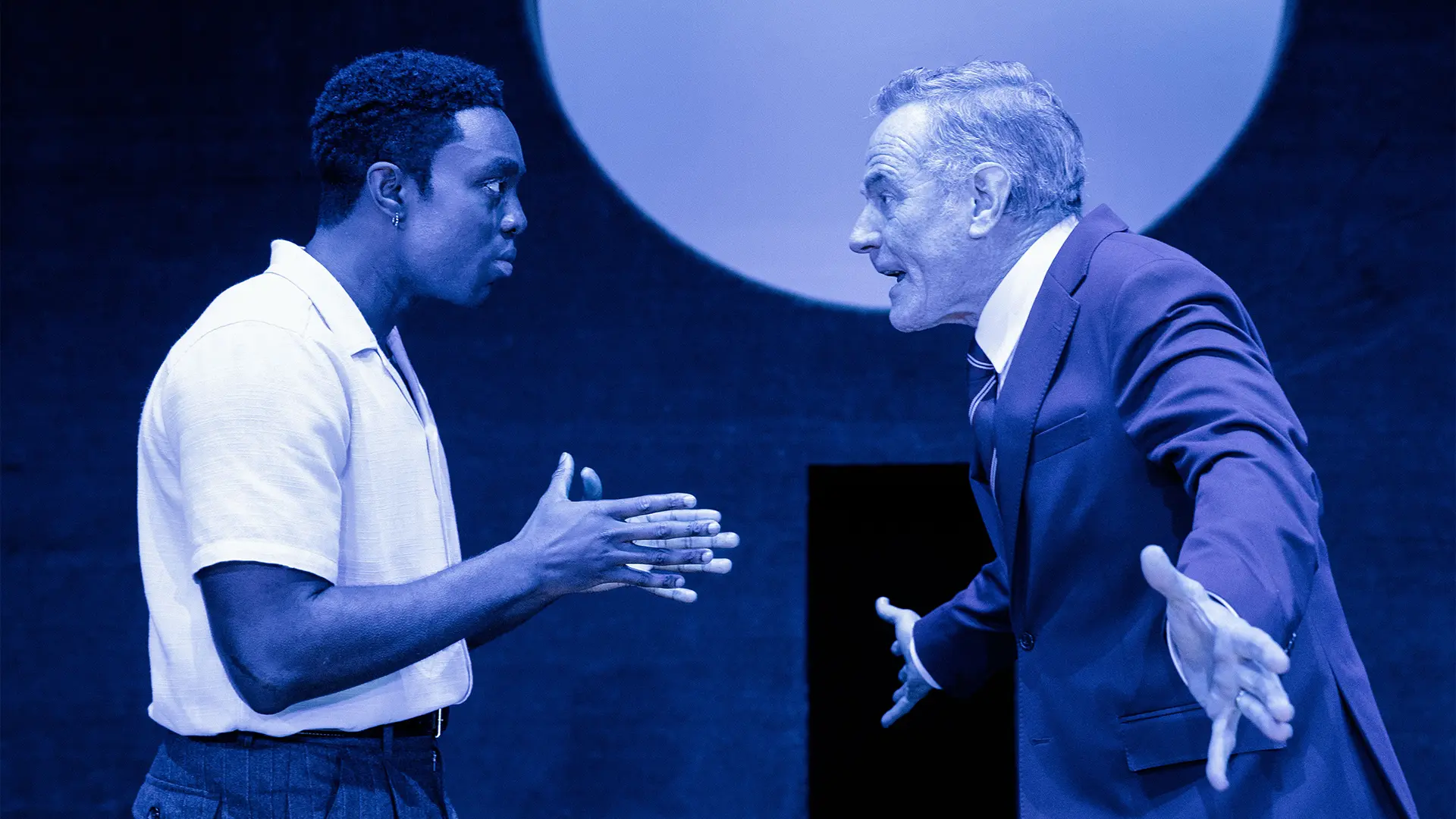
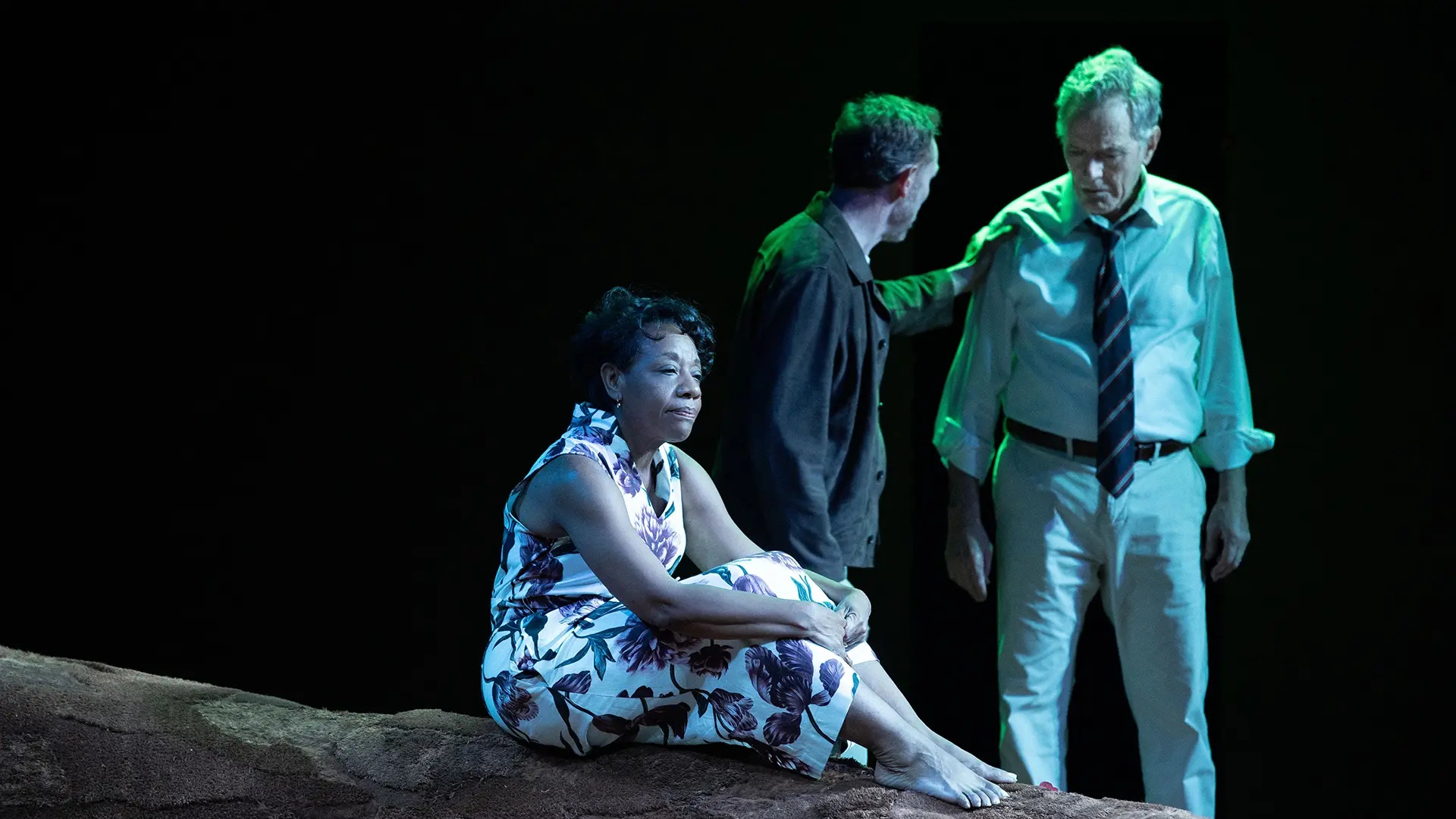
Van Hove and Versweyveld strip the stage of naturalistic detail, replacing Miller’s suburban garden and household façade with a bare stage. Lighting rigs stand in for hedges; the house becomes a blank wall with an aperture and a large circular window that variously evokes a sun, a moon, and, perhaps, an unblinking moral eye. It is a yellow circle when the play begins at dawn, before it unfolds over a single day. This follows an added prologue— we see the violent storm that fells the tree representing the missing eldest son. The fallen trunk remains onstage, the lone scenic element, a constant reminder of where the play is heading.
Versweyveld’s set is ingenious in its austerity, it anchors the play in the heart of mid Western industrial America but it is also universal in time as well as space. His lighting design holds the hand of the play throughout, carrying the emotional arc from the gentlest morning glow to a brutal, unforgiving glare.
Cranston’s Joe Keller is immediately persuasive: genial, grounded, radiating decency. Too good to be true? That’s the pleasure of acting of this calibre: for a time, we truly can’t tell as he walks the tightrope between public charm and private guilt. Paapa Essiedu as his son Chris charts a substantial arc, moving from principled idealism to profound disillusionment. He suggests, with remarkable nuance, the fragility of Chris’s outlook—an annoying idealism propped up by the wealth of the family business and his distance from its harsher realities; his life shaped by his experience of war. Paapa Essiedu matches Bryan Cranston in the depth of emotion he conveys.
Gradually we learn that the family lives beneath a shadow. During the recently ended Second World War, Joe’s factory produced a batch of faulty aircraft parts, leading to the deaths of several pilots. Joe was accused of knowingly shipping them, but ultimately his employee Steve was convicted and imprisoned.
His older son, Larry, was declared missing in action four years ago—but not because his plane contained one of the faulty parts (that would be too neat). His mother, Kate, refuses to accept his death. To do so would shatter the brittle righteous world she clings to. Marianne Jean-Baptiste is superb as Mother, revealing both the warmth that holds the family together and the ferocious denial that threatens to tear it apart. Her breakdown is executed with such controlled intensity that it becomes genuinely difficult to watch.
A catalyst arrives in the form of Ann, Larry’s former fiancée, now intending to marry Chris—and, crucially, she’s Steve’s daughter. Wearing a red dress that contrasts with everyone’s else’s duller browns and blues, she’s a spark tossed into a powder keg. The character can easily feel like a functional supporting role, but in Hayley Squires’ hands she is resolute, textured, and quietly courageous, weathered by hard experience yet capable of deep compassion.
This depth of casting extends throughout: the neighbours and relatives, each seem like real human beings with their own moral dilemmas. Take George, Ann’s brother, who storms through the auditorium in a frenzy of grief and fury to accuse Joe of framing Steve. Tom Glynn-Carney gives him the haunted volatility of someone consumed by pain yet desperate to believe he might be mistaken.
Bold in conception, thrilling in execution, and unquestionably relevant
As Joe offers his catalogue of justifications—military pressure, contractual anxiety, the reassurance that “everyone else was doing it”. These excuses echo across the decades: Boeing overlooking fatal design flaws; suppliers profiting from shoddy PPE during the COVID pandemic; water companies concealing pollution; social-media giants resisting regulation despite the harm to children, vulnerable people and democratic processes; politicians using public office to enrich themselves and their allies. The play has never felt more painfully relevant.
We are left in no doubt that there is no justification for placing profit above human life—even for the most seductive of all reasons: Joe’s claim that he did it for his family. And it is that very family we watch torn apart. “I know you’re no worse than most men,” Chris says, “but I thought you were better. I never saw you as a man. I saw you as my father.”
As the play progresses, Joe’s facade begins to crack, his easygoing selling of his image becomes more desperate, until he is finally confronted with the horror of what he has done. I swear, you can see the life draining from Bryan Cranston, as his face and body sag.
Miller never dilutes his central argument—that business must be governed by conscience and social responsibility—but the greatness of the play is in thw ay it shows us the humanity of the characters and acknowledges the agonising complexity of moral choice. All My Sons may begin in the realm of Ibsenite naturalism, but it concludes as a Greek tragedy of cause and consequence.
Van Hove and Versweyveld deliver a stark, intellectually rigorous interpretation that honours Miller’s ethical inquiry. That said, the production is not without missteps. The fallen tree which is only meant to be four years old is oversized, overly dominant and overstates its symbolism. For someone who adores minimalism, I surprised myself by wishing for a modest table and chairs downstage and a smaller tree upstage. Then there was the incidental music- the persistent, plaintive plinking of piano and string. Though tastefully executed, it ultimately competes with, rather than elevates, the drama. Given the exceptional performances and the potency of Miller’s dialogue, such embellishment feels unnecessary.
These reservations notwithstanding, this is an incisive, superbly performed revival—bold in conception, often thrilling in execution, and unquestionably relevant. Not quite a five-star triumph, but a richly deserved and emphatic four.
All My Sons can be seen at the Wyndham’s Theatre until 7 March 2026. Buy tickets directly at allmysonsplay.com
Click here to watch this review on the YouTube channel Theatre Reviews With Paul Seven
Paul paid for his ticket.
Click here to read a roundup of other critics’ reviews of All My Sons at Wyndham’s Theatre